Intragastric single-incision laparoscopic surgery provides a minimally invasive approach for resecting gastroesophageal junction GISTs. It enhances tumor visualization and preserves function while minimizing complications. This study demonstrated successful tumor removal with rapid recovery. Further research is needed to validate this technique for broader clinical application.
Method Article
Application of Intragastric Single-Incision Laparoscopy Surgery in the Management of Gastroesophageal Junction Gastrointestinal Stromal Tumors
1Department of General Surgery (Department of Gastrointestinal Surgery), The Sixth Affiliated Hospital, Sun Yat-sen University, 2Guangdong Provincial Key Laboratory of Colorectal and Pelvic Floor Diseases, The Sixth Affiliated Hospital, Sun Yat-sen University, 3Biomedical Innovation Center, The Sixth Affiliated Hospital, Sun Yat-sen University
* These authors contributed equally
Opens in a new tab
In This Article
Summary
Loading...
$$\rightleftharpoonup{xx}$$
$$\longleftharp{xx}$$,
$$\longrightharp{xx}$$,
Abstract
Loading...
$$\rightleftharpoonup{xx}$$
$$\longleftharp{xx}$$,
$$\longrightharp{xx}$$,
Gastrointestinal stromal tumors (GISTs) at the gastroesophageal junction (GEJ) pose significant surgical challenges due to their proximity to critical structures. Traditional laparoscopic techniques can lead to excessive tissue removal and complications such as gastroesophageal reflux or pyloric stenosis, while transgastric approaches increase the risks of tumor seeding and intraperitoneal infections. Intragastric single-incision laparoscopic surgery (I-SILS) offers a novel solution by combining intragastric visualization of the tumor and laparoscopic precision with single-port access, allowing for direct tumor visualization and resection while preserving GEJ function. This article presents a 43-year-old male patient with an endophytic GEJ GIST (46.8 mm × 33.9 mm × 30.0 mm in size), successfully treated using I-SILS, as a representative example. The procedure was completed in 42 min with minimal blood loss. The mucosal and submucosal defect was repaired using continuous sutures along the long axis of the stomach to maximize function preservation, and the patient experienced an uneventful recovery with no postoperative complications. The patient was reviewed one year after surgery, and no stenosis or reflux was observed. This approach provides several advantages, including improved tumor visualization, reduced risk of tumor seeding, and preservation of normal gastric and esophageal function. However, this technique is not suitable for all GISTs, particularly those larger than 5 cm. Patient selection and preoperative assessment are crucial. Further research, including large-scale, randomized controlled trials -- is needed to confirm the indications, safety, and effectiveness of I-SILS for GEJ GISTs.
Introduction
Loading...
$$\rightleftharpoonup{xx}$$
$$\longleftharp{xx}$$,
$$\longrightharp{xx}$$,
In recent years, the detection rate of gastrointestinal stromal tumors (GISTs) has significantly increased due to the widespread use of endoscopic examinations and advancements in endoscopic ultrasound technology1. Unlike gastric adenocarcinomas, GISTs exhibit a low rate of lymph node metastasis, and local resection with negative microscopic margins is the recommended approach2. Over the past few years, surgical management of gastric GISTs has evolved toward minimally invasive techniques, with some smaller gastric GISTs now being removed endoscopically, while larger non-metastatic gastric GISTs can be excised laparoscopically3.
Laparoscopic gastric GIST surgeries can be broadly categorized into three types: (1) Exogastric surgeries refer to conventional resection of gastric tumors without opening the gastric lumen. This approach can be combined with endoscopy for better localization of the tumor (laparoscopic and endoscopic cooperative surgeries, LECS)4,5; (2) Transgastric surgeries involve opening the gastric lumen near the lesion, resecting the tumor, and then closing the gastric lumen from the outside6; (3) Intragastric surgeries involve the placement of trocars directly into the gastric lumen, with the tumor excised from within the gastric cavity7.
For submucosal tumors located in specific areas of the stomach, particularly at the gastroesophageal junction (GEJ), large and deeply situated lesions pose significant challenges for both laparoscopic and endoscopic resection8. Conventional exogastric laparoscopic surgery may result in excessive resection of normal tissue, potentially affecting related functions, with postoperative reflux esophagitis occurring in 22%-58.8% of cases, depending on the anastomosis technique used9,10,11. Transgastric laparoscopic procedures carry the risk of tumor seeding within the abdominal cavity, as the gastric lumen is completely opened, and direct manipulation of the tumor may be required12,13. In response to these limitations, S. Ohashi developed a new technique called laparoscopic intragastric surgery (LIGS), which allows for the safe removal of gastric lesions from within the gastric lumen, offering excellent visualization and the ability to perform full-thickness resection and manage perforations14.
With advances in single-port surgeries, an increasing number of laparoscopic procedures can now be performed using a single port15. This study proposes a method that combines single-incision technology with laparoscopic techniques. Intragastric Single-Incision Laparoscopic Surgery (I-SILS) involves the insertion of a single-incision port into the gastric cavity to excise submucosal gastric tumors, thereby reducing the number of incisions required on both the abdominal and stomach walls. The primary aim of this study was to examine the safety and efficacy of this method and to compare it with traditional GIST surgeries in terms of operative outcomes such as gastroesophageal reflux, pyloric stenosis, and bleeding.
This article provides the representative example of a 43-year-old male patient admitted with a complaint of "melena for 7 days." Gastroscopy revealed a mass at the gastroesophageal junction, encircling half the circumference of the cardia, with central ulceration. Computed tomography (CT) and endoscopic ultrasound showed a tumor measuring 46.8 mm × 33.9 mm × 30.0 mm, originating from the muscularis propria of the stomach, with no evidence of lymphadenopathy (see Figure 1). On January 16, 2024, the patient underwent intragastric single-incision laparoscopic resection of the tumor at the GEJ, and postoperative pathology confirmed a diagnosis of moderate-risk GIST. The patient had an uneventful recovery.
Protocol
Loading...
$$\rightleftharpoonup{xx}$$
$$\longleftharp{xx}$$,
$$\longrightharp{xx}$$,
This procedure was a standard surgical intervention approved by the Ethics Committee of the Sixth Affiliated Hospital of Sun Yat-sen University. Written informed consent was obtained from the patient. The research content and methodology adhered to established standards and requirements of medical ethics. Prior to surgery, the patient was informed about the novel nature of I-SILS, including its potential risks, benefits, and alternative treatment options, such as traditional laparoscopic and open surgeries. A detailed consent form was signed, documenting the patient's understanding and agreement. The equipment used in this study is listed in the Table of Materials.
1. Patient preparation
- Patient selection
- Inclusion criteria: Include patients with gastroesophageal junction (GEJ) GISTs confirmed by preoperative abdominal CT showing no enlarged lymph nodes around the stomach and no distant metastases; with a maximum tumor diameter of 5 cm; specifically, submucosal GISTs at the GEJ that are difficult to manage or remove endoscopically.
- Exclusion criteria: Exclude patients if the tumors invaded the full thickness of the gastric wall or were located in the serosal layer.
- Preoperative preparation, surgical positioning, and anesthesia
- Preoperative preparation: Follow the Enhanced Recovery After Surgery (ERAS) protocol16: instruct the patient to fast for 6 hours and abstain from liquids for 2 h prior to surgery.
- Surgical positioning: Place the patient in the supine position with legs apart and the head elevated 15°.
NOTE: The primary surgeon stands on the patient's right side, while the assistant stands between the patient's legs to hold the scope. Positioning the primary surgeon on the right side reduces the distance between the surgeon and the SIL port. By slightly facing toward the patient's head, a straight-line trocar alignment from the surgeon's hand through the SIL port to the lesion is achieved. This setup improves ergonomics, reduces wrist flexion and rotation strain, enhances force transmission during dissection, and minimizes instrument collision (commonly referred to as the "sword fighting" or "scissoring effect"). - Anesthesia: Administer general anesthesia with endotracheal intubation following institutionally approved protocols.
2. Surgical technique
- Make a 4 cm vertical incision 1 cm above the umbilicus to access the abdominal cavity. Insert a single-port device and establish pneumoperitoneum.
- After exploring the abdominal cavity, remove the single-port device. Identify the stomach and exteriorize it using a ring forceps. Make a 3 cm full-thickness incision on the anterior wall of the gastric antrum.
- Attach the walls of the stomach surrounding the gastric incision to the abdominal incision using intermittent full-thickness sutures. Re-insert the single-incision port directly into the lumen of the stomach, securing the inner cuffs to the gastric wall to ensure an optimal seal between the anterior gastric and abdominal walls.
- Establish a pneumogastrum by directly inflating the stomach with carbon dioxide at a pressure of 10-12 mmHg.
- Carefully explore the entire gastric cavity.
NOTE: A 3 cm × 5 cm × 4 cm tumor was identified at the GEJ with surface ulceration (see Figure 2) (the representative example presented in this article). - Protect the surrounding tissues with gauze, and insert a nasogastric tube to identify the esophagus.
- Apply biological glue to the ulcerated tumor surface to reduce the risk of tumor cell dissemination.
NOTE: Biological glue is applied at the surgeon's discretion, typically when the tumor is ulcerated, and there is a high risk of tumor cell dissemination17. - Use an electric hook and an ultrasonic scalpel to incise the mucosa and submucosa approximately 0.5 cm from the tumor margin to expose the tumor boundary. Dissect the tumor using the ultrasonic scalpel, preserving the tumor capsule and the function of the gastroesophageal junction (see Figure 3).
- Place the specimen inside a specimen bag and extract it through the single-port device.
- Clean the surgical site thoroughly by flushing with saline (Figure 4). Close the wound using a 3-0 barbed suture, performing continuous sutures along the long axis of the stomach.
- Fix the final suture with a clip. Cut the barbed suture 3-5 mm from the clip and remove the needle (see Figure 5).
- Examine the gastric cavity to confirm hemostasis, proper suturing, and the absence of stenosis or torsion at the GEJ. Leave the nasogastric tube in place.
- Remove the single-incision device, and close the gastric and abdominal incisions under direct vision, completing the surgery.
3. Postoperative management
- Encourage early mobilization upon awakening from anesthesia.
- Remove the nasogastric tube on postoperative day 1 and initiate a liquid diet.
- Begin oral nutritional supplements (ONS) on postoperative day 2, followed by gradual progression to a semi-liquid diet before discharge.
- Postoperative follow-up: Conduct history-taking, physical examination, and computed tomography (CT) every 3-6 months for the first 3-5 years, then annually.
NOTE: In this case, with the patient's approval, a follow-up gastroscopy and upper gastrointestinal contrast imaging were performed one month postoperatively to assess the healing of the surgical wound inside the stomach and check for stenosis (see Figure 6). Surgical success was indicated by the absence of residual tumor, gastroesophageal junction (GEJ) stenosis, and reflux esophagitis.
Results
Loading...
$$\rightleftharpoonup{xx}$$
$$\longleftharp{xx}$$,
$$\longrightharp{xx}$$,
This article describes a 43-year-old male patient with an endophytic gastroesophageal junction (GEJ) gastrointestinal stromal tumor (GIST) measuring 46.8 mm × 33.9 mm × 30.0 mm, who was successfully treated using I-SILS, serving as a representative case. The surgery was completed in 42 min, with a minimal blood loss of 5 mL. The tumor capsule and gastroesophageal junction were clearly identified and preserved during the procedure, enabling complete tumor resection while maximizing preservation of the gastroesophageal sphincter. The patient was discharged on postoperative day 4. A follow-up gastroscopy one month later showed good closure of the gastroesophageal junction, with the endoscope passing smoothly into the stomach. No signs indicative of reflux esophagitis were observed, and upper gastrointestinal contrast imaging demonstrated unobstructed passage at the gastroesophageal junction, with no evidence of stenosis or reflux (see Figure 6).

Figure 1: Tumor imaging. Computed tomography and endoscopic ultrasound revealed that the tumor originated from the muscularis propria at the gastroesophageal junction. No evidence of lymphadenopathy was observed. Please click here to view a larger version of this figure.
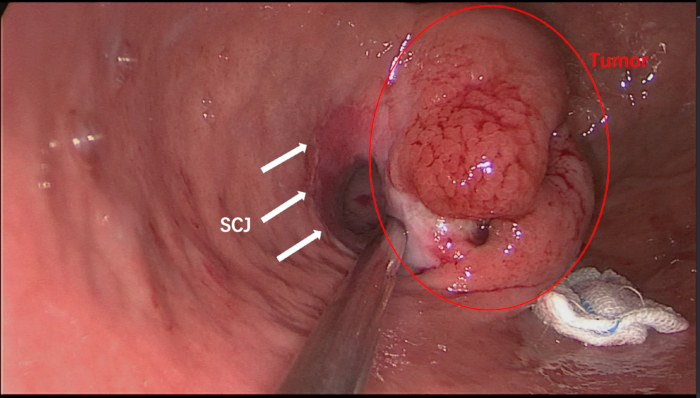
Figure 2: Gastric cavity exploration. The squamocolumnar junction (SCJ) and the tumor at the gastroesophageal junction were visualized within the gastric cavity using intragastric single-incision laparoscopic surgery (I-SILS). The tumor measured approximately 3 cm × 5 cm × 4 cm and exhibited surface ulceration. Please click here to view a larger version of this figure.
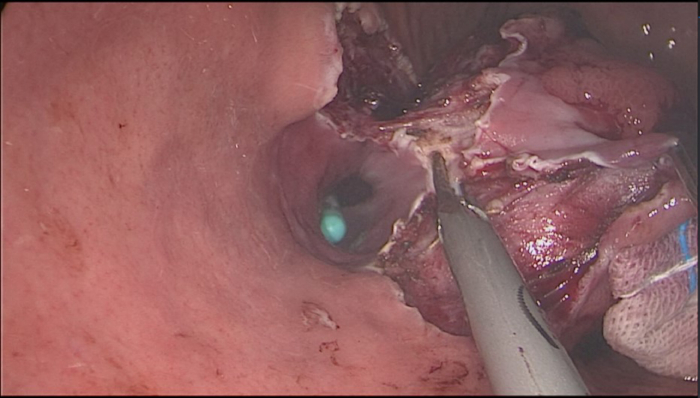
Figure 3: Tumor resection. The tumor was dissected using an ultrasonic scalpel under I-SILS guidance. Please click here to view a larger version of this figure.
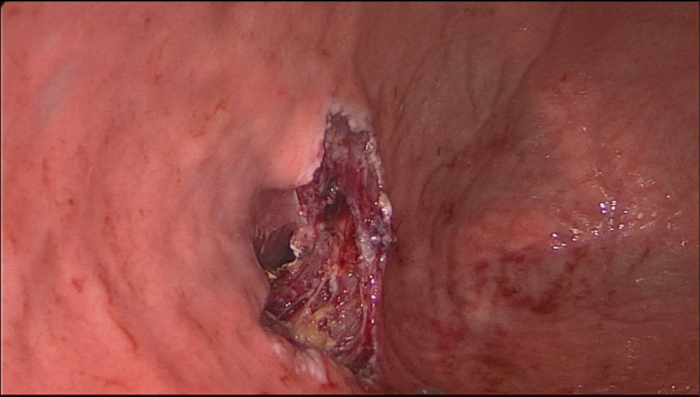
Figure 4: Surgical wound. A mucosal defect resulting from tumor excision was observed, displaying a crescent shape surrounding half of the cardia. Please click here to view a larger version of this figure.

Figure 5: Wound closure. The gastric wound was closed using continuous suturing with 3-0 barbed sutures. Please click here to view a larger version of this figure.

Figure 6: Postoperative assessment of anastomotic healing and esophageal function at 1 month following surgery. (A) Follow-up gastroscopy demonstrating a well-healed anastomosis (white arrows) without evidence of stricture or mucosal irregularity. (B) Endoscopic view of the gastric side of the anastomosis (white arrows), confirming the absence of ulceration, leakage, or reflux-related changes. (C) Upper gastrointestinal contrast radiograph showing the smooth passage of contrast through the esophagogastric junction (red arrow) without narrowing or retrograde flow, indicating no signs of gastroesophageal stenosis or reflux. Please click here to view a larger version of this figure.
Discussion
Loading...
$$\rightleftharpoonup{xx}$$
$$\longleftharp{xx}$$,
$$\longrightharp{xx}$$,
Intragastric single-incision laparoscopic surgery (I-SILS) offers distinct advantages in the treatment of gastroesophageal junction GISTs. First, within the gastric cavity, the magnification effect of the laparoscope allows for precise identification and resection of the tumor under direct vision, maximizing the preservation of normal gastric tissue and the functional integrity of the gastroesophageal junction18. Second, the single-port approach isolates the gastric cavity from the abdominal cavity, effectively preventing tumor seeding within the abdominal cavity19. The specimen is extracted through the single-port device, avoiding the need for additional incisions and the challenges associated with removing large specimens endoscopically20. Additionally, the seamless transition between intragastric and transgastric single-incision laparoscopy facilitates the resolution of challenges within the gastric cavity and allows for abdominal exploration if necessary21. For example, perforation of the stomach during the procedure can be repaired from the outside by rapidly converting to conventional laparoscopic surgery. Postoperative care involves adherence to ERAS protocols, with early mobilization, and patients resuming oral intake on the first postoperative day and typically being discharged within 2-3 days16. Regular follow-up visits are recommended every 3-6 months post-surgery, with CT or endoscopic imaging used to monitor for recurrence. Long-term assessments focus on evaluating reflux, gastric motility, and other functional outcomes.
The choice of incision is crucial in I-SILS. We recommend selecting an upper midline incision above the umbilicus, which avoids excessive traction on the stomach and shortens the distance from the operating port to the gastroesophageal junction, thereby reducing the "sword-dueling" or "scissoring" effect. Before inserting the single-incision port device, the gastric wall incision should be sutured to the abdominal wall skin, isolating the gastric cavity from the abdominal cavity and preventing contamination, particularly from tumor dissemination. This also facilitates the placement and stabilization of the single-port device. However, fixation of the ventral gastrotomy to the abdominal wall can cause contamination of the abdominal incision and tumor seeding; therefore, the abdominal incision should be thoroughly rinsed and disinfected before closure, or an Alexis port can be used in addition to the single-port device for better outcomes22. Further development of a double-cuffed single-incision port could also reduce such contamination. It is important to note that in obese patients, it may be challenging to pull the gastric wall out to create the gastrotomy and subsequently suture it to the abdominal wall skin. In such cases, the protective sleeve can be directly placed into the gastric cavity to establish the single-port channel. During the procedure, gas may escape through the pylorus or gastroesophageal junction. To address this, an insufflation pressure of 10-12 mmHg is advised (slightly lower than the resting tone of the pyloric and gastroesophageal sphincters). Wet gauze can also be positioned at the pylorus or gastroesophageal junction to reduce gas leakage. Regarding the surgeon's positioning, different preferences exist, with some literature suggesting that the primary surgeon operates from between the patient's legs. In single-incision procedures where the surgeon is between the patient's legs, the surgeon's hands are close together, primarily performing forward and rotational movements7. From an ergonomic perspective, rotational movements in front of the chest are more flexible than forward and backward rotations, so in this study, the primary surgeon stood on the patient's right side.
The greatest challenge in intragastric single-incision laparoscopic surgery (I-SILS) is the limited operating space and instrument interference14. This can be mitigated by applying counter-traction between the assisting forceps and the gastric wall to create tension, rotating the forceps in place to change the clamping point, and pulling the needle and suture backward to alleviate the "scissoring" effect and gain more operating space. Additionally, single-handed suturing is often necessary when the assisting forceps are unavailable. Suturing the surgical wound is a key difficulty in I-SILS. Some literature reports the use of a linear cutting stapler for submucosal tumor resection and closure, but using a stapler in the confined space of the gastroesophageal junction is challenging and may result in gastroesophageal stenosis or sphincter injury7,22. Suturing along the long axis of the stomach is crucial to prevent gastroesophageal stenosis, and using barbed sutures can significantly reduce the difficulty of suturing.
However, this technique is not suitable for all GIST surgeries. Preoperative gastroscopy and CT should be performed, and endoscopic ultrasound may be necessary to determine the location and type of GIST. Endophytic GISTs at the cardia, pylorus, and posterior wall, which are difficult to manage endoscopically or with exo/trans-gastric laparoscopic surgery, are ideal candidates for this procedure. Conversely, tumors with exophytic growth, extensive serosal involvement, or those larger than 5 cm are generally excluded from this approach because they are more suited for exogastric laparoscopic resection, which can reduce potential difficulties in tumor extraction, the risk of incomplete resection, or compromised gastric function23. For larger GISTs (>5 cm) at the gastroesophageal junction, neoadjuvant targeted therapy may be considered before surgery to reduce tumor size and create a margin to protect the integrity of the GEJ, thus allowing a less invasive surgical approach such as I-SILS. Therefore, further research is needed to determine the appropriate size of GISTs for intragastric single-incision laparoscopic surgery.
In conclusion, intragastric single-incision laparoscopic resection of GISTs at the gastroesophageal junction is a safe, effective, and minimally invasive technique with potential clinical value. However, large-sample, prospective, randomized controlled trials are needed to further validate the surgical and therapeutic value of this technique, identify patient populations most likely to benefit, explore long-term functional outcomes (e.g., reflux, gastric motility), and compare I-SILS with other innovative techniques like endoscopic submucosal dissection (ESD). Additionally, standardized and systematic training in single-incision laparoscopic techniques is essential for the safe and successful implementation of this procedure.
Disclosures
Loading...
$$\rightleftharpoonup{xx}$$
$$\longleftharp{xx}$$,
$$\longrightharp{xx}$$,
The authors have nothing to disclose.
Acknowledgements
Loading...
$$\rightleftharpoonup{xx}$$
$$\longleftharp{xx}$$,
$$\longrightharp{xx}$$,
This work was supported by the National Natural Science Foundation of China (grant number 82070684), Guangdong Natural Science Fund for Outstanding Youth Scholars (grant number 2020B151502005), and the Bethune Aixikang Distinguished Surgical Fund project (grant number HZB-20190528-5).
Materials
| Name | Company | Catalog Number | Comments |
|---|---|---|---|
| HARMONIC Ace + Shears | ETHICON | HAR36 | |
| Single Port Incision Laparoscopic Flat Type | SURGAID | IA-3A-50x150 | |
| Stratafix Symemetric PDS Plus | ETHICON | SXPP1A400 |
References
Loading...
$$\rightleftharpoonup{xx}$$
$$\longleftharp{xx}$$,
$$\longrightharp{xx}$$,
- Kang, E., et al. Trends in cancer-screening rates in Korea: Findings from the national cancer screening survey, 2004-2023. Cancer Res Treat. 57 (1), 28-38 (2024).
- Von Mehren, M., et al. NCCN guidelines insights: Gastrointestinal stromal tumors, version 2.2022: Featured updates to the NCCN guidelines. J Natl Compr Canc Netw. 20 (11), 1204-1214 (2022).
- Novitsky, Y. W., Kercher, K. W., Sing, R. F., Heniford, B. T. Long-term outcomes of laparoscopic resection of gastric gastrointestinal stromal tumors. Ann Surg. 243 (6), 738-747 (2006).
- Teng, T. Z. J., Ishraq, F., Chay, A. F. T., Tay, K. V. Lap-endo cooperative surgery (LECS) in gastric GIST: Updates and future advances. Surg Endosc. 37 (3), 1672-1682 (2023).
- Hiki, N., et al. Laparoscopic endoscopic cooperative surgery. Dig Endosc. 27 (2), 197-204 (2015).
- Xu, X., et al. Laparoscopic transgastric resection of gastric submucosal tumors located near the esophagogastric junction. J Gastrointest Surg. 17 (9), 1570-1575 (2013).
- Boulanger-Gobeil, C., et al. Laparoscopic intragastric resection: An alternative technique for minimally invasive treatment of gastric submucosal tumors. Ann Surg. 267 (2), e12-e16 (2018).
- Sakamoto, Y., et al. Safe laparoscopic resection of a gastric gastrointestinal stromal tumor close to the esophagogastric junction. Surg Today. 42 (7), 708-711 (2012).
- Privette, A., McCahill, L., Borrazzo, E., Single, R. M., Zubarik, R. L. Laparoscopic approaches to resection of suspected gastric gastrointestinal stromal tumors based on tumor location. Surg Endosc. 22 (2), 487-494 (2008).
- Aizawa, M., et al. Simple modifications of conventional esophagogastrostomy after proximal gastrectomy adequately reduces the postoperative reflux esophagitis: A retrospective analysis of posterolateral fundoplication. Langenbecks Arch Surg. 407 (7), 3153-3160 (2022).
- Nakamura, M., et al. Reconstruction after proximal gastrectomy for early gastric cancer in the upper third of the stomach: An analysis of our 13-year experience. Surgery. 156 (1), 57-63 (2014).
- Lamadé, W., Hochberger, J. Transgastric surgery: Avoiding pitfalls in the development of a new technique. Gastrointest Endosc. 63 (4), 698-700 (2006).
- Kong, S. H., Yang, H. K. Surgical treatment of gastric gastrointestinal stromal tumor. J Gastric Cancer. 13 (1), 3-18 (2013).
- Ohashi, S. Laparoscopic intraluminal (intragastric) surgery for early gastric cancer: A new concept in laparoscopic surgery. Surg Endosc. 9, 169-171 (1995).
- Dreifuss, N. H., Schlottmann, F., Cubisino, A., Bianco, F. M. Novel surgical approach for gastric gastrointestinal stromal tumor (GIST): Robotic single port partial gastrectomy. Surg Oncol. 40, 101704(2022).
- Lee, Y., Yu, J., Doumouras, A. G., Li, J., Hong, D. Enhanced recovery after surgery (ERAS) versus standard recovery for elective gastric cancer surgery: A meta-analysis of randomized controlled trials. Surg Oncol. 32, 75-87 (2020).
- Takagi, T., et al. Intraoperative coating of tumor surface using fibrin glue as a prophylaxis for cancer cell detachment. Gan To Kagaku Ryoho. 28 (11), 1674-1676 (2001).
- Bischof, D. A., et al. Open versus minimally invasive resection of gastric GIST: A multi-institutional analysis of short- and long-term outcomes. Ann Surg Oncol. 21 (9), 2941-2948 (2014).
- Law, J. H., Han, N. X., So, J. B. Y., Kim, G., Shabbir, A. Single-incision transgastric resection for gastric gastrointestinal stromal tumors in anatomically challenging locations. Surg Today. 53 (12), 1401-1408 (2023).
- Omori, T., et al. Comparison of single-incision and conventional multi-port laparoscopic distal gastrectomy with D2 lymph node dissection for gastric cancer: A propensity score-matched analysis. Ann Surg Oncol. 23 (Suppl 5), 817-824 (2016).
- Cazauran, J. -B., et al. Intragastric single-incision laparoscopic surgery for gastric leiomyoma: A stepwise approach. Ann Surg Oncol. 24, 2281-2281 (2017).
- Stiekema, J., Luttikhold, J., Heineman, D., Neerincx, M., Daams, F. Minimally invasive technique for gastric GIST at challenging locations: Single incision surgical gastroscopy. Updates Surg. 75 (4), 953-958 (2023).
- Lian, X., et al. Meta-analysis comparing laparoscopic versus open resection for gastric gastrointestinal stromal tumors larger than 5 cm. BMC Cancer. 17 (1), 760(2017).
Reprints and Permissions
Request permission to reuse the text or figures of this JoVE article
Request Permission