This protocol provides a comprehensive outline of how to perform a 6 min frame running test to estimate aerobic capacity in individuals with cerebral palsy.
Method Article
The 6-Minute Frame Running Test - A Field-based Cardiopulmonary Exercise Test for Individuals with Cerebral Palsy
Linnéa Corell1 , Emma Hjalmarsson1,2 , Eline Bolster3 , Petra van Schie4,5 , Annemieke I. Buizer4,5,6 , Lars Björk1 , Jessica Norrbom7 , Ferdinand Von Walden1
1Department of Women's and Children's Health, Karolinska Institutet, 2Medical Unit Allied Health Professionals, Women's Health and Allied Health Professionals Theme, Karolinska University Hospital, 3Research Centre for Healthy and Sustainable Living, Research group Lifestyle and Health, Utrecht University of Applied Sciences, 4Department of Rehabilitation Medicine, Amsterdam UMC, Vrije Universiteit Amsterdam, 5Amsterdam Movement Sciences, Rehabilitation & Development, 6Emma Children&s Hospital, Amsterdam UMC, 7Department of Physiology and Pharmacology, Karolinska Institutet
Opens in a new tab
In This Article
Summary
Loading...
$$\rightleftharpoonup{xx}$$
$$\longleftharp{xx}$$,
$$\longrightharp{xx}$$,
Abstract
Loading...
$$\rightleftharpoonup{xx}$$
$$\longleftharp{xx}$$,
$$\longrightharp{xx}$$,
Cerebral palsy (CP) is a diverse childhood-onset motor disability that varies significantly in severity and impact. Individuals with more severe forms of CP, particularly those with whole-body involvement, often face substantial barriers to physical activity. These barriers are compounded by the limited availability of exercise options that can accommodate their specific needs. The forms of physical activity that may be available typically involve low levels of aerobic demand, which may not be sufficient to maintain and/or improve cardiovascular health.
However, Frame Running, a parasport performed on a three-wheeled running frame, allows individuals with CP to participate in aerobic exercise at high intensity. The running frame, designed specifically for individuals with motor impairments such as CP, enables the assessment of aerobic capacity in a population otherwise excluded from traditional exercise modalities. The 6-Minute Frame Running Test (6-MFRT) has been validated as an effective measure for estimating maximum aerobic capacity in individuals with CP. It is easy to perform and only requires a running frame, a 200-400 m track, a heart rate monitor, a measuring tape or wheel, and a stopwatch. Thus, the 6-MFRT serves as a practical and reliable measure of aerobic capacity that can be used to assess health-related fitness and evaluate the effect of training interventions.
Introduction
Loading...
$$\rightleftharpoonup{xx}$$
$$\longleftharp{xx}$$,
$$\longrightharp{xx}$$,
Cerebral palsy (CP) is one of the most common childhood-onset disabilities, with a prevalence of 1.6 per 1,000 live births1. It originates from damage to the developing brain before the age of 2, resulting in multifaceted consequences. The spectrum of motor impairments in individuals with CP ranges from minor impairments in motor control to severe physical disabilities and is characterized by limitations in movement, balance, coordination, and posture2. Moreover, individuals with CP have thinner, weaker, and stiffer skeletal muscles compared to typically developed individuals3. Due to factors such as impaired motor control and skeletal muscle function, individuals with CP tend to be less physically active and exhibit increased sedentary behavior4,5,6, which in turn contributes to reduced aerobic capacity. A reduced aerobic capacity predisposes to a higher risk of developing secondary health conditions such as cardiovascular and metabolic diseases7. Therefore, understanding and assessing aerobic capacity in this population is crucial for both healthcare and sports settings, as it provides valuable insights into their cardiovascular health, endurance, and overall physical capabilities.
Maximal oxygen uptake (VO2max), a key measure of aerobic capacity, serves as a predictor across these domains. Assessment of VO2max can guide interventions aimed at enhancing physical fitness, mitigating the risk of secondary health conditions associated with CP, and ultimately improving quality of life. Despite the importance of evaluating aerobic capacity in individuals with CP, there is a notable lack of feasible and adapted aerobic tests, especially for individuals with more severe physical disabilities. Existing gold standard aerobic tests, such as treadmill or cycle ergometer-based protocols, present substantial challenges for individuals with difficulties in running, cycling, maintaining specific postures, and/or executing specific movements. Moreover, these tests are often confined to laboratory settings, requiring specialized equipment like a face mask for measuring oxygen uptake. This not only makes the tests impractical but also less accessible in real-life settings, where the goal is to evaluate and enhance everyday functional abilities.
Consequently, there is a need for validation of alternative methods that can be easily performed in various settings, including but not limited to clinical environments and sports facilities. Frame Running, an adapted sport for individuals with mobility impairments, has emerged as a promising solution to enable moderate to high-intensity physical activity among individuals with CP8,9,10. This sport uses a three-wheeled frame for support during walking and/or running. During the past 10 years, we have focused on developing and validating the 6-Minute Frame Running Test (6-MFRT) as a practical and inclusive method for assessing aerobic capacity in individuals with CP9,10,11. During the test, participants utilize the running frame to support their weight and assist with balance, allowing them to focus on covering as much distance as possible within a 6 min time frame. Our research has shown that the 6-MFRT is a reliable and effective method for estimating VO2max in individuals with CP11. When comparing data obtained during the 6-MFRT with data collected during a traditional treadmill VO2peak test conducted by the same individuals using their running frames, we found no significant differences in VO2peak. Furthermore, the longer distance covered during the 6-MFRT correlated with higher measurements of VO2peak10,11.
By providing open-access methodological standardization of the 6-MFRT, we hope to facilitate its implementation in research, healthcare, and sports. The standardized protocol ensures consistency and reliability when performing the 6-MFRT and enables comparisons not only within the individual but also across different cohorts. The protocol provides detailed instructions on how to conduct and utilize the 6-MFRT in individuals with CP, including preparation, execution, and posttest evaluations to ensure data accuracy and reproducibility.
Protocol
Loading...
$$\rightleftharpoonup{xx}$$
$$\longleftharp{xx}$$,
$$\longrightharp{xx}$$,
The following protocol and setup (Figure 1) were approved by the Swedish Ethical Review Authority. All participants were given oral and written information and provided written informed consent before participating in the described tests. See the attached protocol (Supplemental File 1) and Borg Rating of Perceived Exertion12 (Borg RPE) (Supplemental File 2) that can be used when performing the 6-MFRT.
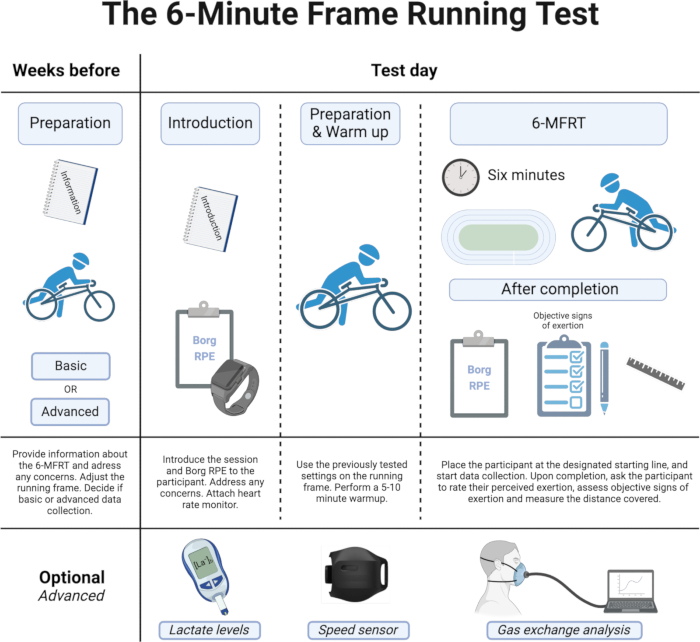
Figure 1: Graphical representation of the 6-Minute Frame Running protocol. Abbreviation: 6-MFRT = 6-Minute Frame Running Test; Borg RPE = Borg Rating of Perceived Exertion. Please click here to view a larger version of this figure.
1. Preparations weeks before test day
- Introduction to the participant
- Provide information about the 6-MFRT to the participant and allow them the opportunity to ask questions.
- If the participant is not accustomed to using a running frame, ask the participant to practice with the running frame at least 2x before the day of testing.
NOTE: This helps minimize improvements solely due to familiarity with the running frame, rather than improvements in aerobic capacity9.
- Adjustments of the running frame with the participant
- Fit the participant onto the running frame, ensuring the saddle, handlebars, and chest plate are adjusted for maximal comfort and support. These settings will be used on the day of testing (see step 2.3.1).
- Recommend the participant to wear cycling shorts or bibs to increase comfort and minimize pain associated with the high pressure on the pelvis during Frame Running.
- Ensure proper positioning and correct adjustments of the running frame to allow the participant to focus on maximal output. For the 6-MFRT, focus on minimizing pain but ensure positioning and bike fitting to propel at maximum speed as well.
- Have the participant decide whether to use ankle-foot orthoses (AFOs).
NOTE: AFOs increase stability and support but could also restrict the range of motion by limiting plantar flexion (i.e., running without AFOs is often faster).
- Measure the intended track using a measuring rolling wheel
- Decision on basic or advanced data collection during the exercise test
NOTE: The determination of the testing type is at the discretion of each test leader and is based on the specific purpose of the test. If the test is part of a research study, we recommend performing the advanced data collection. However, for everyday use or for Frame Running clubs assessing athlete development, the basic data collection may be more practical and feasible.- Before the day of testing, determine which parameters (Table 1) should be included in the data collection depending on the aim of the test.
| Basic | Advanced |
| · Heart Rate | · Heart Rate |
| · Borg RPE | · Borg RPE |
| · Time | · Time |
| · Distance | · Distance |
| · Speed sensor to measure distance and speed | |
| · Capillary blood lactate | |
| · Gas exchange analysis |
Table 1: Parameters for data collection. The table specifies which parameters that could be included if performing basic or advanced data collection during the 6-Minute Frame Running Test. Abbreviation: Borg RPE = Borg Rating of Perceived Exertion.
2. The day of testing
- Introduction to the participant
- Upon the participant´s arrival, provide clear and consistent instructions for the 6-MFRT, including an overview of what to expect during the session.
- Introduce and explain the Borg Rating of Perceived Exertion (RPE) scale, where 6 indicates no effort and 20 indicates maximal exertion (Supplemental File 2).
- Address any questions or concerns the participant may have to ensure they feel safe, comfortable, and well-informed.
- Preparation and warmup
- Collect a baseline capillary blood sample for lactate analysis (optional) before initiating any exercise, moving to the running frame, and/or moving from the wheelchair if used.
- Adjustments of the running frame
- Fit the participant onto the running frame using the previously tested optimal position (see step 2.1).
- Ensure that the participant is securely positioned with a chest strap if needed and that a helmet is worn for safety.
- Allow the participant to perform a 5-10 min warm-up appropriate to their ability (Borg RPE 11-12, Supplemental File 2).
- Determine if the participant needs a follower on the course for steering, safety, or verbal encouragement.
3. Exercise test
NOTE: Document all measurements accurately, including heart rate, distance covered, and perceived exertion, for comprehensive analysis and comparison. Recommended materials and equipment are listed in the Table of Materials.
- Setup of the participant
- Place a heart rate monitor around the participant's chest to enable continuous measurement of heart rate during the exercise test.
- Review the exercise test protocol with the participant to ensure they understand each step and what is expected of them, emphasizing the goal to cover as much distance as possible within 6 min.
Suggested verbal instruction to the participant:
The goal is to cover as much distance as possible within the time limit. Start at a challenging but sustainable pace, and try to increase it over time. Aim to give your maximum effort by the end. If you need to slow down or stop briefly, resume running as soon as you can. We will inform you of the time every minute and encourage you to keep going.
- Performing the 6-MFRT
- Position the participant, with their running frame, at the designated starting line.
- Ask them to rate their perceived exertion level using the Borg RPE scale.
- Begin the data collection; start a timer for 6 min when the participant is instructed to start and count the number of completed laps.
- Encourage the participant to maintain maximal effort throughout the 6 min, providing motivation and support at regular intervals or at each minute, depending on what best suits the participant executing the 6-MFRT.
- Upon completion of 6 min, mark the spot where the participant ends the test as the running frame may still be in motion when the test is concluded.
- Immediately after completion, ask the participant to rate their perceived exertion level using the Borg RPE and assess their performance objectively by noting signs such as being out of breath, sweating, and/or fatigue.
- Simultaneously, collect a postexercise capillary blood sample (optional).
- Measure the distance covered using a measuring rolling wheel, from the designated starting line to the marked spot where the participant ended the test and add to the completed laps.
4. Blood Analysis (optional)
- If blood samples were collected, analyze them for lactate levels to assess the participant's metabolic response to the exercise.
NOTE: Potential methods may include, but are not limited to, gas exchange analysis, heart rate monitoring, blood gas analysis, speed sensor, distance covered during the test, Borg RPE, and/or objective signs of perceived exertion.
Results
Loading...
$$\rightleftharpoonup{xx}$$
$$\longleftharp{xx}$$,
$$\longrightharp{xx}$$,
As representative results, three individuals with CP performed a 6-MFRT on an indoor track with lactate measurements. The participant characteristics are presented in Table 2.
| Participant No. 1 | Participant No. 2 | Participant No. 3 | |
| Sex | Male | Female | Male |
| Age (years) | 26 | 21 | 21 |
| GMFCS level | 3 | 4 | 4 |
| CP motor type | Dyskinetic | Dyskinetic | Dyskinetic |
| SPGALS | 3 | 3 | 1 |
| Weight (kg) | 71.6 | 45.6 | 35.1 |
| Height (cm) | 190 | 155 | 146 |
| BMI (kg/m2) | 19.8 | 19 | 16.5 |
| Frame Running Experience (years) | 12 | 8 | 13 |
Table 2: Participant characteristics. The table shows each participant's characteristics. Abbreviations: BMI = Body Mass Index; CP = Cerebral Palsy; GMFCS = Gross Motor Function Classification System; SGPALS = Saltin Grimby Physical Activity Level Scale.
All participants completed the 6-MFRT, and the results are presented in Table 3. However, for the test to be considered maximal, specific physiological criteria should be met. For this protocol, the following criteria were used where ≥3 of 4 criteria needed to be fulfilled at the end of the test; reaching a certain heart rate depending on age13,14, lactate levels ≥ 6 mmol/L13, Borg RPE ≥ 1713, objective signs of perceived exertion as outlined in the protocol13. For children under 18 years of age, the heart rate criterion is typically set at ≥185 beats per minute (bpm) 13, while for individuals over 18 years, the criterion is set at HR ≥ 85% of age-predicted maximum (220 - age)14. These criteria are not limited to the ones mentioned and can be chosen depending on the participants and/or population performing the test. As shown in Table 3, participant no. 3 did not meet these criteria, illustrating that some individuals with CP have difficulty reaching a maximal level. Therefore, their test results should be interpreted with this consideration in mind.
Figure 2 illustrates representative results of heart rate and speed during the 6-MFRT for all three participants. Note that speed is optional and was mainly used to show how the participants strategically planned their race. Furthermore, during maximal exercise tests, the heart rate responses can vary widely among individuals with CP.

Figure 2: Heart rate and speed during the 6-Minute Frame Running Test. Representative data on heart rate (left y-axis) and speed (right y-axis) measured using a speed sensor during the 6-Minute Frame Running Test in three individuals with cerebral palsy. Each graph represents one individual. Data from participants no. 1 and 2 exemplify advanced data collection, while data from participant no. 3 illustrate basic data collection. This demonstrates that it is not essential to include all measurements; certain measurements can be included or excluded depending on the context and purpose of the evaluation. Abbreviations: bpm = beats per minute; HR = Heart Rate; km/h = kilometer per hour. Please click here to view a larger version of this figure.
| Participant No. 1 | Participant No. 2 | Participant No. 3 | |
| HRpeak, bpm | 184 | 181 | 131* |
| Speedpeak, km/h | 15.9 | 9.7 | - |
| Lactate Levels | |||
| Pre exercise | 0.6 | 2.6 | 1.9 |
| Post exercise | 13.2 | 5,1* | 3,0* |
| Borg RPE | |||
| Pre exercise | 9 | 7 | 9 |
| Post exercise | 17 | 19 | 13* |
| Signs of perceived exertion | Yes | Yes | No* |
| 6-MFRT distance, m | 1193 | 800 | 395 |
Table 3: Representative data from the 6-Minute Frame Running Test. The table shows representative data from the 6-Minute Frame Running Test. *Denotes not fulfilled criteria. Abbreviations: bpm = beats per minute; Borg RPE = Borg Rating of Perceived Exertion; HR = Heart Rate; km/h = kilometer per hour; 6-MFRT = 6-Minute Frame Running Test.
Supplemental File 1: The 6-Minute Frame Running Test protocol. Please click here to download this File.
Supplemental File 2: The Borg RPE scale. Please click here to download this File.
Discussion
Loading...
$$\rightleftharpoonup{xx}$$
$$\longleftharp{xx}$$,
$$\longrightharp{xx}$$,
The exercise test described here can be utilized to study the physiological response to exercise in individuals with impaired posture, balance, and/or motor control. The 6-MFRT is feasible for all individuals with CP, given they can be positioned on a running frame. Individuals with less severe impairments (Gross Motor Function Classification System (GMFCS) I and II) may benefit as the running frame can help to maintain balance when fatigued, thereby supporting them in completing the 6 min effort. For individuals at GMFCS levels III to V, the running frame is essential for performing this level of aerobic effort. The correctly adjusted chest support and saddle positioning enable the participant to focus on running.
We have previously validated this methodology as a feasible exercise test for individuals with CP, comparing it to a gold standard exercise test performed on a treadmill11. While the study focused on the acute response to a single exercise bout, our longitudinal training study demonstrated an increased distance covered during the 6 min test after 12 weeks of Frame Running, using the 6-MFRT as an assessment tool of endurance capacity8. This indicates that the 6-MFRT is an effective test for tracking an individual's progress and/or detecting changes in exercise capacity over time.
Reviewing the exercise test protocol with the participant ensures comprehension of each step and underscores the importance of sustaining maximal effort throughout the entire duration of the test. However, the participant needs to plan their effort strategically to sustain performance during the full 6 min. Encouragement and motivation from the test administrator play a crucial role in ensuring that the participants exert themselves fully, thereby providing a well-estimated measurement of aerobic capacity. Note should be taken to standardize encouragement between test occasions to ensure a similar test situation between individuals and for example before and after a training period. An accurate measurement of the distance covered using a measuring rolling wheel is also essential for assessing performance and ensuring comparable results across repeated tests for each individual.
Despite its advantages, the 6-MFRT has certain limitations. It requires specialized equipment as the running frame and requires familiarity with both the running frame and the test itself, potentially limiting its immediate accessibility. Additionally, even though the 6-MFRT is developed for individuals with motor disabilities, it may still be a challenging test to perform, where factors other than aerobic capacity might be the main limiting factor, that is, vision impairment, cognitive function, or specific neuromuscular limitations inherent to CP (e.g., spasticity, impaired motor control, muscle weakness, or premature muscle fatigue) that may hinder performance before central cardiovascular limits are reached. Furthermore, variability in test performance can be influenced by the participant´s physical condition, including factors such as fatigue or recent illness but also by motivation or cognitive functioning. However, this limitation is the same across all exercise performance tests, including those conducted in individuals without motor impairments. The Borg RPE scale, used to assess exertion levels, relies on subjective evaluation, which can vary among participants and across sessions. We have observed that some individuals with CP may find the Borg RPE challenging to interpret. Therefore, we recommend complementing the Borg RPE with objective signs of perceived exertion, including signs of being out of breath, sweating, and/or looking fatigued.
We have outlined a standardized exercise protocol, but additional steps can be implemented before testing to enhance consistency and reproducibility of results. For example, ensuring continuity by having the same test administrators for the participants across multiple tests can reduce variability. Furthermore, restricting strenuous exercise prior to testing, ensuring the participant is well-rested and avoiding food intake 1-2 h before can minimize variations in performance, lactate levels, and gas exchange outcomes if collected. Maintaining consistent testing conditions, including standardized equipment, controlled room temperature, racetrack, and time of day, is essential, especially if the test will be used for research purposes. To improve reproducibility, a familiarization session with the exercise protocol is also recommended. As a minimum, we recommend including distance covered, heart rate, and Borg RPE and an assessment of objective signs of exertion (e.g., observed breathlessness, sweating, facial flushing) as part of the basic data collection protocol for research purposes. Furthermore, the test should ideally be conducted on an oval track, preferably 200 m or 400 m in length.
In clinical rehabilitation, the 6-MFRT can be used to monitor the effects of a rehabilitation program, helping to tailor interventions and track improvements in aerobic capacity. Regular assessment using this test can also contribute to the early detection of cardiovascular or metabolic issues, enabling timely interventions. In sports and physical activity programs, the 6-MFRT aids in designing and evaluating fitness programs for individuals with CP. In conclusion, we provide a standardized protocol for measuring aerobic capacity in individuals with CP using the 6-MFRT. This method is both feasible and practical, promoting a more active lifestyle and ultimately improving overall health.
Disclosures
Loading...
$$\rightleftharpoonup{xx}$$
$$\longleftharp{xx}$$,
$$\longrightharp{xx}$$,
The authors have no conflicts of interest to declare.
Acknowledgements
Loading...
$$\rightleftharpoonup{xx}$$
$$\longleftharp{xx}$$,
$$\longrightharp{xx}$$,
The study was supported by grants from the Norrbacka-Eugenia Stiftelsen, Stiftelsen Sunnerdahls Handikappfond, The Elsass foundation and Stiftelsen Promobilia to F.v.W. (Swedish team) and Phelpsstichting and Johanna Kinderfonds and Kinderrevalidatie Fonds Adriaanstichting (Dutch team). None of the listed funding bodies played any roles in the design of the study or in the collection, analysis, and interpretation of data and in writing the manuscript.
Materials
| Name | Company | Catalog Number | Comments |
|---|---|---|---|
| Bike computer | Garmin Edge 25 | 010-03709-30 | Used for registration of heart rate and speed. Numerous possible options/alternatives. |
| Chest strap heart rate monitor | Garmin | 010-03709-30 | Used for continous measurment of heart rate. Included in the package option with Garmin Edge 25. Numerous possible options/alternatives. |
| Frame Runner | Optional | Numerous possible options/alternatives; for example https://framerunning.org/about-frame-running/the-frame-runner-technical-drawing/ | |
| Lactate Scout 4 | EKF Diagnostics | 7023-0441-0568 | Optional if lactate levels are included in the measurments. |
| Measuring wheel | Nedo | 703113 | Numerous possible options/alternatives. |
| Speed sensor | Garmin | 010-12843-00 | Used for continuous measurment of speed. Numerous possible options/alternatives. |
| Stop watch | Optional | Numerous possible options/alternatives. |
References
Loading...
$$\rightleftharpoonup{xx}$$
$$\longleftharp{xx}$$,
$$\longrightharp{xx}$$,
- Global prevalence of cerebral palsy: a systematic analysis. Dev Med Child Neurol. 64 (12), 1494-1506 (2022).">McIntyre, S., et al. Global prevalence of cerebral palsy: a systematic analysis. Dev Med Child Neurol. 64 (12), 1494-1506 (2022).
- A report: the definition and classification of cerebral palsy April 2006. Dev Med Child Neurol. 109, 8-14 (2007).">Rosenbaum, P., et al. A report: the definition and classification of cerebral palsy April 2006. Dev Med Child Neurol. 109, 8-14 (2007).
- Forearm flexor muscles in children with cerebral palsy are weak, thin and stiff. Front Comput Neurosci. 11, 30(2017).">von Walden, F., et al. Forearm flexor muscles in children with cerebral palsy are weak, thin and stiff. Front Comput Neurosci. 11, 30(2017).
- Physical and sedentary activity in adolescents with cerebral palsy. Dev Med Child Neurol. 49 (6), 450-457 (2007).">Maher, C. A., Williams, M. T., Olds, T., Lane, A. E. Physical and sedentary activity in adolescents with cerebral palsy. Dev Med Child Neurol. 49 (6), 450-457 (2007).
- Aerobic capacity in children and adolescents with cerebral palsy. Res Dev Disabil. 31 (6), 1352-1357 (2010).">Verschuren, O., Takken, T. Aerobic capacity in children and adolescents with cerebral palsy. Res Dev Disabil. 31 (6), 1352-1357 (2010).
- Maximal aerobic and anaerobic exercise responses in children with cerebral palsy. Med Sci Sports Exerc. 45 (3), 561-568 (2013).">Balemans, A. C. J., et al. Maximal aerobic and anaerobic exercise responses in children with cerebral palsy. Med Sci Sports Exerc. 45 (3), 561-568 (2013).
- Chronic conditions in adults with cerebral palsy. JAMA. 314 (21), 2303-2305 (2015).">Peterson, M. D., Ryan, J. M., Hurvitz, E. A., Mahmoudi, E. Chronic conditions in adults with cerebral palsy. JAMA. 314 (21), 2303-2305 (2015).
- Racerunning training improves stamina and promotes skeletal muscle hypertrophy in young individuals with cerebral palsy. BMC Musculoskelet Disord. 21 (1), 193(2020).">Hjalmarsson, E., et al. Racerunning training improves stamina and promotes skeletal muscle hypertrophy in young individuals with cerebral palsy. BMC Musculoskelet Disord. 21 (1), 193(2020).
- Reliability and construct validity of the 6-minute racerunner test in children and youth with cerebral palsy, GMFCS levels III and IVs. Phys Occup Ther Pediatr. 37 (2), 210-221 (2017).">Bolster, E. A. M., Dallmeijer, A. J., de Wolf, G. S., Versteegt, M., van Schie, P. E. M. Reliability and construct validity of the 6-minute racerunner test in children and youth with cerebral palsy, GMFCS levels III and IVs. Phys Occup Ther Pediatr. 37 (2), 210-221 (2017).
- Physiological response to the 6-minute frame running test in children and adults with cerebral palsy. Pediatr Phys Ther. 34 (4), 529-534 (2022).">Bos, A. M. M. E., et al. Physiological response to the 6-minute frame running test in children and adults with cerebral palsy. Pediatr Phys Ther. 34 (4), 529-534 (2022).
- Validation of the 6-minute frame running test as a cardiopulmonary exercise test for adolescents and young adults with cerebral palsy. Adapt Phys Activ Q. 20, 1-16 (2025).">Hjalmarsson, E., et al. Validation of the 6-minute frame running test as a cardiopulmonary exercise test for adolescents and young adults with cerebral palsy. Adapt Phys Activ Q. 20, 1-16 (2025).
- Perceived exertion as an indicator of somatic stress. Scand J Rehabil Med. 2 (2), 92-98 (1970).">Borg, G. Perceived exertion as an indicator of somatic stress. Scand J Rehabil Med. 2 (2), 92-98 (1970).
- Measurement and interpretation of maximal aerobic power in children. Pediatr Exerc Sci. 31 (2), 144-151 (2019).">Falk, B., Dotan, R. Measurement and interpretation of maximal aerobic power in children. Pediatr Exerc Sci. 31 (2), 144-151 (2019).
- ACSM's guidelines for exercise testing and prescription. , Wolters Kluwer. (2021).">Liguori, G. American College of Sports Medicine. ACSM's guidelines for exercise testing and prescription. , Wolters Kluwer. (2021).
Reprints and Permissions
Request permission to reuse the text or figures of this JoVE article
Request Permission