Here, we describe a new method of rat fixation that facilitates acupuncture and moxibustion on the back of rats.
Method Article
A New Fixation Method for Acupuncture Treatment in Rats
Opens in a new tab
In This Article
Summary
Loading...
$$\rightleftharpoonup{xx}$$
$$\longleftharp{xx}$$,
$$\longrightharp{xx}$$,
Abstract
Loading...
$$\rightleftharpoonup{xx}$$
$$\longleftharp{xx}$$,
$$\longrightharp{xx}$$,
Researchers always encounter the problem that animals are difficult to control in acupuncture-related animal experiments. There are already some methods to prevent animals from escaping treatment sites. However, the effect of these fixation methods is different from the human treatment state. Therefore, we have invented a new fixation method to keep rats prone, quiet, and awake during treatment.
The equipment consists of a porous plastic restraint platform, a square cotton cloth, and several restraint straps for fixing rats. First, thread the restraint straps into the restraint platform. For each strap, pass it through two holes in the same row, leaving two holes between them. After positioning the first strap, insert the other strap into the platform in the same manner, ensuring a four-row gap between the two straps. Second, grab the rat's tail and guide it into the channel formed by two restraint straps. Cover the rat's head with a square cotton cloth. Third, tighten the restraint strap on the neck to fix the head and forelimbs. Then hold the rat's hind limbs and tighten the other strap to fix the waist and hind limbs.
This method does not require anesthesia. The device is simple and easy to operate. To evaluate its efficacy and safety, we administered the procedure to 60 rats. All of them completed the acupuncture treatment without complications. While 14 rats exhibited brief periods of struggle during the procedure, no adverse effects were observed. The results demonstrate that the method is effective and safe for use.
Introduction
Loading...
$$\rightleftharpoonup{xx}$$
$$\longleftharp{xx}$$,
$$\longrightharp{xx}$$,
Both surgical modeling and in vitro intervention require appropriate animal fixation methods. This ensures that animals are in the most maneuverable and relatively comfortable position. We focus on the animal fixation method for acupuncture intervention. Acupuncture is effective in treating many diseases1,2. The study of the acupuncture mechanism has received much attention. At present, acupuncture and moxibustion are hot research topics at home and abroad. The pathological mechanism of acupuncture treatment needs to be further explored, and in addition to clinical experiments, basic research support is also needed3,4. In the basic research on acupuncture and moxibustion, animal fixation is an important technical step.
At present, the commonly used fixation methods include bondage, anesthesia, swinging, high platform, and other fixation methods. The advantages and disadvantages of these methods are outlined below.
The first step in performing the anesthesia fixation method is to anesthetize the rats. When using this method, researchers face the risk that the rats may die. It is also possible to operate directly without restraint after anesthesia5. When using the sock-rabbit platform fixation method, researchers insert the rat's head into a trimmed sock, extend their forelimbs through the holes, and secure their legs to the rabbit platform with rubber bands. This method facilitates acupoint selection on the limbs. Researchers must trim the sock according to the acupuncture site, but the procedure is somewhat complex6. Some researchers have developed a moxibustion fixation device comprising three parts: fixation seat, fixation clip, and moxa-stick holder. This device allows researchers to perform moxibustion on multiple acupoints simultaneously while maintaining a relatively constant temperature. However, the fixed state of this method differs significantly from the clinical treatment of humans7. Wrapping the rats with cloth and suspending them using clamps may significantly reduce the influence of restraint. However, the suspended cloth needs to be cut in advance to expose acupoints, which makes it inconvenient to expose the treatment site8. Some researchers use straps, ropes, and a small jacket with a self-locking Velcro strap to secure rats on a mesh-like cage cover. The device offers low production costs, high practicability, and simple operation. But more than one person is needed to complete the restraint process9. Some researchers construct a body-holding cylinder with wire mesh, secure the rats' legs with holding clamps, and fix their necks using a holding stick. This method provides a firm restraint. Using this method, researchers can better operate on rats because the acupoints on the whole body are exposed. The problem is that the cylinder may be incompatible with the size of the rat. Additionally, this method applies more stress compared to other techniques, so rats may be more susceptible to asphyxiation10. The high-platform fixation method takes advantage of the rats' fear of height. Researchers place rats on the high-platform pedal 50cm above the ground. The rats remain in a natural prone position without the need for additional restraints. This method allows for needling the head and back of rats. This method authentically simulates the treatment environment, so the experimental results have good reference value. Since rats fear heights, their mental state becomes abnormal when placed at such elevations. This makes the method unsuitable for research on mental diseases and could influence the experimental outcomes11. Some researchers use an adjustable restraint platform and straps to fix rats, exposing a large treatment area. However, replicating the clinical scenario remains challenging12.
There is an urgent need to address the issue that fixation methods cannot accurately simulate clinical treatment conditions. We have made every effort to replicate the conditions of human clinical treatment. The method described in this paper falls under the bondage method category. The equipment used in this method includes a restraint platform and restraint straps, along with a cotton cloth to assist in the procedure. The equipment is relatively simple to operate. Compared with other methods, this method better exposes the acupoints on the back of rats and enhances treatment efficiency.
To test the reliability of the device, a total of 60 rats were used for the experiment. All 60 rats were divided into two groups, each containing 30 rats: the electroacupuncture group and the warm acupuncture group. The rats remained calm during the treatment process, and their movement had minimal impact on the procedure. In the electroacupuncture group, 22 rats completed the treatment calmly without struggling. A total of 8 rats struggled during the operation, and 6 dislodged the needles. A total of 24 rats in the warm acupuncture group remained calm during treatment. The other 6 rats exhibited struggling behavior, but none dislodged the moxa balls. These rats that struggled could also calm down after being covered and comforted. Ultimately, all rats completed the treatment successfully.
Access restricted. Please log in or start a trial to view this content.
Protocol
Loading...
$$\rightleftharpoonup{xx}$$
$$\longleftharp{xx}$$,
$$\longrightharp{xx}$$,
This work was supported by the National Natural Science Foundation of China (No. 82205287). The experimental protocols used in this study were reviewed and approved by the Ethics Committee for Animal Experimentation and Use Committee of Beijing University of Chinese Medicine (No BUCM-2024052704-2223) before performing experiments. All demonstrated procedures must be approved by the Institutional Animal Care and Use Committee (IACUC).
Details of the equipment used in the study are listed in the Table of Materials. The protocol can be divided into four sections: experiment preparation, fixing process, treatment operation, and disassembly of the equipment.
1. Experiment preparation (Figure 1)
- Prepare the porous plastic restraint platform. The restraint platform is 500 mm in length, 300 mm in width, and 5 mm in height. The hole on it is 7 mm in length and 3.2 mm in width. The distance between two adjacent holes is 7 mm. This equipment serves as a platform for fixing rats.
- Prepare restraint straps. Each restraint strap measures 300 mm in length and 4.8 mm in width. The restraint straps are serrated and feature a buckle on their tip, which can be locked after insertion.
- Keep a square cotton cloth ready. The square cotton cloth measures 30 cm 30 cm. Use this to block the view of the experimental animals.
- Prepare the electroacupuncture instrument. Employ this device to carry out electroacupuncture procedures.
- Prepare the acupuncture needles (0.25 mm in diameter and 25 mm in length).
- Keep a pair of laboratory-grade latex gloves available. These gloves constitute the fundamental protective measure of the experiment.
- Keep a pair of anti-cutting gloves available, designed to shield researchers from rat bites during the experiment.
- Use moxa to craft moxa balls with a diameter of 5 mm, which are utilized for subsequent moxibustion therapy.
- To avert scalding of the rats, cut some square papers measuring 2 cm 2 cm.
- Keep the sterile gauze ready to be applied to wrap the tail of the rat, ensuring electrical conductivity during the electroacupuncture treatment.
- Preparation before fixation: Before handling the rats, wear laboratory-grade latex gloves and anti-cutting gloves to prevent being bitten by rats.
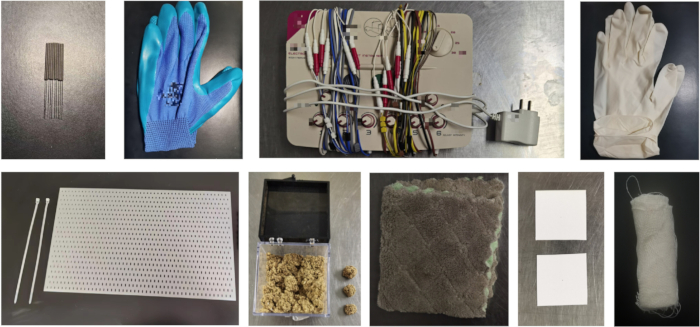
Figure 1: Devices required for the operation. Please click here to view a larger version of this figure.
2. Fixing process
- Thread two restraint straps through the restraint platform. Insert each strap via two holes in the same row, spacing two holes apart, with the straps four rows apart from each other. This spacing matches the rat's body diameter, restricting lateral movement during treatment (Figure 2). Adjust the distance based on the rats' shape and treatment sites as needed.
- Grasp the rat's tail with one hand. The rat will instinctively move forward (Figure 3A).
- Position the rat at the entrance to the channel formed by two restraint straps. The rat will drill into the channel by itself (Figure 3B).
- Cover the rat's head with a square cotton cloth, and use that same hand to hold the rat's neck. Grasp the rat's tail and hind limbs with another hand. This method ensures the rat's posture is maintained (Figure 3C).
- Use the hand holding the head side to gently press the head and neck of the rat. Use the other hand to insert the restraint strap into the buckle and tighten it. Ensure that the restraint strap is located on the tail side of the head and the forelimbs to restrict the movement of its head (Figure 3D, E).
- Hold the tail of the rat with one hand. Ensure that the restraint strap is located in front of the hind limbs of the rat. Then tighten the buckle to restrict the movement of the waist (Figure 3F). The restrained rat is shown in Figure 3G.
- When performing acupuncture on rats, this fixation method ensures stability during the treatment. If the rat still struggles severely, gently cover its head with the cloth. Shielding its entire field of vision and keeping it in a dark environment can calm the rat down.
- Chose DU20, BL17, and BL23 as examples. Selecting this fixation distance better exposes acupoints: DU20 is in the middle of its head, BL17 is between the two restraint straps, and BL23 is at the tail side of the restraint strap, tightening the rat's waist.
- Spin the needle into the acupoints (Figure 4A). The rat completing the acupuncture treatment is shown in Figure 4B, C.
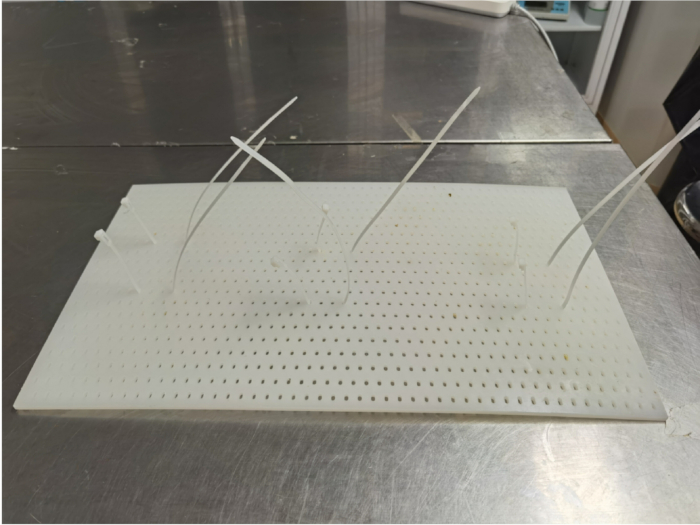
Figure 2: Assembly of restraint platform and restraint strap. The restraint platform with the restraint straps inserted is shown in the figure. Each strap is inserted via two holes in the same row, spacing two holes apart, with the straps four rows apart from each other. Please click here to view a larger version of this figure.
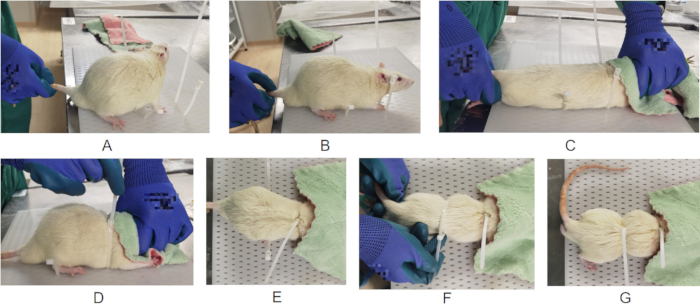
Figure 3: The fixation process of a rat. (A) Hold the tail of the rat. (B) Let the rat flee forward into the channel. (C) Cover the rat's head with a cotton cloth. Press its neck and grab its tail and hind limbs. (D,E) Tighten the strap on its back. (F,G) Tighten the strap on its waist. Please click here to view a larger version of this figure.
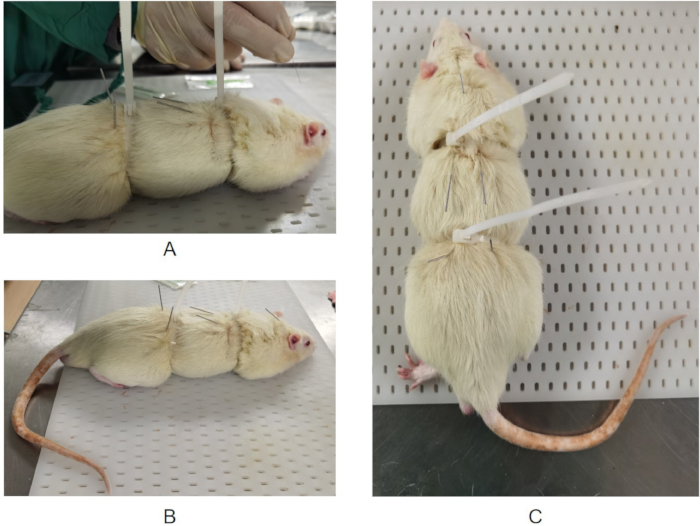
Figure 4: Acupuncture operation on a rat. DU20, BL17, and BL23 were chosen as the acupoints for this acupuncture procedure. (A) Spin the needle into the acupoints. (B,C) The rat completing treatment is shown here. Please click here to view a larger version of this figure.
3. Electroacupuncture treatment
- Connect the electroacupuncture instrument after completing acupuncture. Turn on the electroacupuncture device, press the continuous wave button to select the form of electrical stimulation, and rotate the knob to adjust the current intensity to 1 mA and the frequency to 2 Hz (Figure 5A).
- Taking DU20, BL17, and BL23 as an example, connect three pairs of electrodes as shown in Figure 5. Specifically, connect BL17 and BL23 on the same side as one pair (Figure 5B, C). Connect the tail, wrapped with gauze soaked in saline, to DU20 on the head (Figure 5D, E). The direction of current flow is consistent among all three pairs of electrodes.
- Rotate the time-setting knob to set the treatment duration to 15 min.
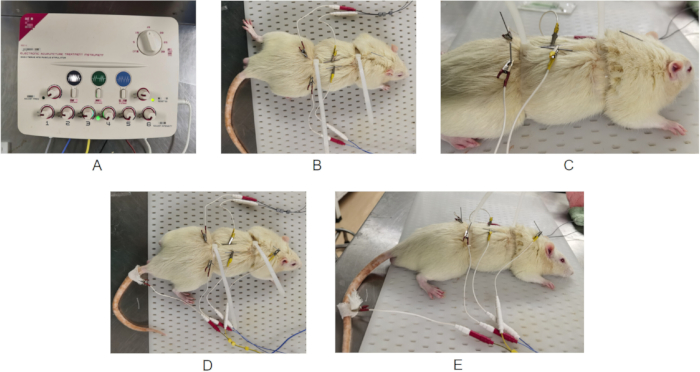
Figure 5: Electroacupuncture operation on a rat. (A) Set the parameter to continuous wave, and adjust the current intensity and the frequency. (B,C) Pair BL17 and BL23 on the same side. (D,E) Wrap the tail with saline-soaked gauze and connect it to DU20. Please click here to view a larger version of this figure.
4. Warm acupuncture treatment
- Prepare these items if warm acupuncture treatment is required: moxa, acupuncture needle (0.25 mm × 25 mm, same as previously used), and several square sheets of paper. Additionally, prepare some moxa balls in advance before the treatment begins (Figure 1).
- Take a square piece of paper and carefully use a needle to puncture the central point of the paper (Figure 6A). Subsequently, insert the needle into the designated acupoint (Figure 6B).
NOTE: For illustrative purposes, this study selected acupoint BL23. - Carefully place the moxa balls onto the needle, and then ignite them (Figure 6C- E).
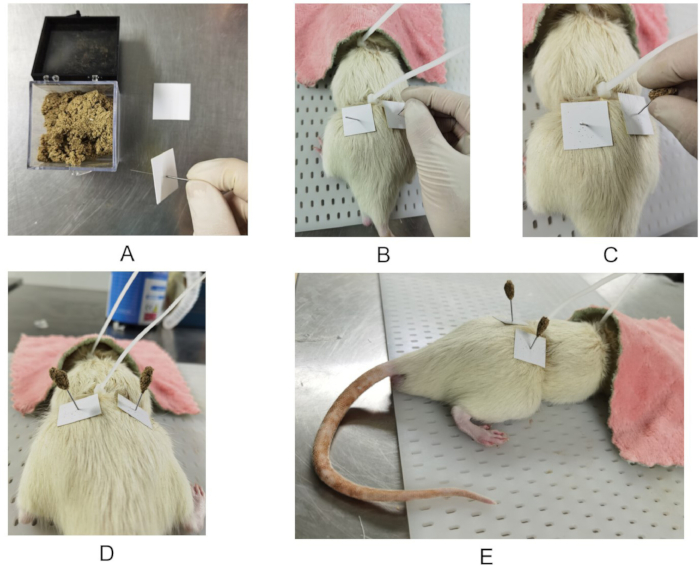
Figure 6: Warm acupuncture operation on a rat. (A) Take a square paper and pierce its center with a needle. (B) Insert needles into acupoints. (C) Put the moxa balls onto the needles. (D,E) The rat completing treatment is shown here. Please click here to view a larger version of this figure.
5. Disassembly of the equipment
- Disassembly of the electroacupuncture equipment
- Upon completion of the electroacupuncture treatment, switch off the electroacupuncture instrument. Then, carefully release the electrode clip from the acupuncture needles. Finally, gently withdraw the acupuncture needles from the treatment area.
- Disassembly of the warm acupuncture equipment
- Following the warm acupuncture treatment, carefully remove the ash of the moxa balls and dispose of it by placing it into water. Then gently withdraw the needles and remove any attached papers.
- Disassembly of the fixation equipment
- Cover the rat's head with a square cotton cloth while simultaneously relaxing the restraint straps. Loosen the restraint strap, tightening the rat's waist at first. Next, firmly grasp the rat's hind limbs and hip area with one hand.
- Release the strap tightening around the rat's neck with the other hand, then gently pull the rat out of the restraint strap by holding its tail.
Access restricted. Please log in or start a trial to view this content.
Results
Loading...
$$\rightleftharpoonup{xx}$$
$$\longleftharp{xx}$$,
$$\longrightharp{xx}$$,
To evaluate the effectiveness of the fixation method, we conducted a trial on a total of 60 rats, which were divided into two groups: 30 rats in the electroacupuncture group and 30 rats in the warm acupuncture group. The treatment operations included electroacupuncture and warm acupuncture, respectively.
After inserting needles into acupoints, the acupuncturist performed lifting, thrusting, and rotating manipulations on each needle to achieve deqi. During the procedure, struggling was observed...
Access restricted. Please log in or start a trial to view this content.
Discussion
Loading...
$$\rightleftharpoonup{xx}$$
$$\longleftharp{xx}$$,
$$\longrightharp{xx}$$,
Rats tend to inhabit dark environments. They feel secure when sheltered and respond calmly to stimuli, exhibiting lower stress levels. The method described here leverages these rat characteristics. The advantages of this fixation method can be summarized as follows: (i) This method can minimize the stress response and pain experienced by experimental animals. It aligns with the 3R principles of animal ethics, namely Reduction, Refinement, and Replacement13. (ii) The shelter reduces rat stress and...
Access restricted. Please log in or start a trial to view this content.
Disclosures
Loading...
$$\rightleftharpoonup{xx}$$
$$\longleftharp{xx}$$,
$$\longrightharp{xx}$$,
All authors have declared no potential conflicts of interest.
Acknowledgements
Loading...
$$\rightleftharpoonup{xx}$$
$$\longleftharp{xx}$$,
$$\longrightharp{xx}$$,
This work was supported by the National Natural Science Foundation of China (No. 82205287).
Access restricted. Please log in or start a trial to view this content.
Materials
| Name | Company | Catalog Number | Comments |
|---|---|---|---|
| Acupuncture needles | Beijing ZhongYan TaiHe Medical Instrument Co., Ltd. | 20222200133 | The specifications of the acupuncture needles are 0.25 mm in diameter and 25 mm in length. |
| Anti-cutting gloves | Lvdazhou Labor Protection Products Factory In Lanshan District, Linyi City | H0315103941 | Designed to shield researchers from rat bites during the experiment. |
| Electroacupuncture instrument | Suzhou Medical Appliance Factory Ltd. | 20172200675 | This device is employed to carry out electroacupuncture procedures. |
| Laboratory-grade latex gloves | Zhonghong Pulin Medical Products Co., Ltd. | 268237719221 | These gloves constitute the fundamental protective measure of the experiment. |
| Moxa | Beijing Tongrentang Xing'an Health Technology Co., Ltd. | 152200000000613 | Moxa serves as the material for crafting moxa balls with diameter are 5 mm, which are utilized for subsequent moxibustion therapy. |
| Porous plastic restraint platform | Chuzhou Huaxin VinyIIndustry Co., Ltd. | 341124000005877 | The restraint platform is 500 mm in length, 300 mm in width and 5 mm in height. The hole on it are 7 mm in length and 3.2 mm in width. The distance between two adjacent holes is 7 mm. This equipment serves as a platform for fixing rats. |
| Restraint straps | Zhejiang Litai Plastic Co., Ltd. | 331003000001553 | Each restraint strap measures 300 mm in length and 4.8 mm in width. The restraint strap are serrated and feature a buckle on their tip, which can be locked after insertion. |
| Square cotton cloth | MUJI (SHANGHAI) Company Limited | WYLP20241105_1 | The square cotton cloth measures 30 cm ´ 30 cm. It is used to block the view of the experimental animals. |
| Square papers | DELI Group Co., Ltd. | 7752-1114 | To avert scalding of the rats, reseachers cut some square papers which specification measuring 2 cm ´ 2 cm. |
| Sterile gauze | Jiangxi Zhonggan Medical Devices Co., Ltd. | 20172140084 | The sterile gauze is applied to wrap the tail of the rat, ensuring electrical conductivity during the electroacupuncture treatment. |
References
Loading...
$$\rightleftharpoonup{xx}$$
$$\longleftharp{xx}$$,
$$\longrightharp{xx}$$,
- Dai, R., et al. Acupuncture improves neuroendocrine defects in a preclinical rat model of reproductive aging. Life Sci. 357, 123102(2024).
- Zhou, X., et al. Key targets of signal transduction neural mechanisms in acupuncture treatment of cardiovascular diseases: hypothalamus and autonomic nervous system. Heliyon. 10 (19), e38197(2024).
- Polat, A., Kozanhan, B., Yildiz, M., Gunenc, O., Tutar, M. S. Transcutaneous electrical acupuncture point stimulation and quality of recovery following cesarean delivery: a randomized controlled trial. Int J Obstet Anesth. 60, 104266(2024).
- Zhang, Z., et al. Effect of wrist-ankle acupuncture point stimulation on preventing postoperative nausea and vomiting in female patients undergoing orthopedic surgery. J Perianesth Nurs. 40 (3), 634-639 (2024).
- Liu, S., et al. Identification of cortical arteries and veins in awake mice using two-photon microscopy. J Anat. 246 (5), 798-811 (2024).
- Kim, G. H., et al. Acupuncture manipulation enhances anti-nociceptive effect on formalin-induced pain in rats. Neurol Res. 32 (Suppl 1), 92-95 (2010).
- Zhang, X., et al. Design and application of a fixation device for experimental rat. Zhongguo Zhen Jiu. 44 (11), 1351-1354 (2024).
- Liu, Q., et al. Improved suspension fixation using rat jacket in rat acupuncture experiments. J Vis Exp. (198), e65652(2023).
- He, C., Zhang, C. X., Zhou, S. Q., Fan, Y. S. Using old meshy cage cover to make a rat fixating device for acupuncture study. Zhen Ci Yan Jiu. 46 (4), 348-350 (2021).
- Li, Y. Y., Lin, N. R., Huang, Y. L., Xue, X. W., Liu, Q. A newly-made rat holder for convenient acupuncture needle insertion. Zhen Ci Yan Jiu. 41 (5), 466-468 (2016).
- Zhou, D. D., et al. Acupuncture in a rat model of asthma. J Vis Exp. (162), e61762(2020).
- Wang, F. M., Xiong, J., Zeng, F., He, Z. X. A fixation frame for acupuncture and moxibustion of Shu-Mu acupoint combination in rats. Zhen Ci Yan Jiu. 47 (10), 938-940 (2022).
- Rinwa, P., Eriksson, M., Cotgreave, I., Bäckberg, M. 3R-refinement principles: elevating rodent well-being and research quality. Lab Anim Res. 40 (1), 11(2024).
Access restricted. Please log in or start a trial to view this content.
Reprints and Permissions
Request permission to reuse the text or figures of this JoVE article
Request Permission