Here, we present the design, testing, and application of a Viscous Damper with Overload Protector (VD-OP) for seismic isolation in structures. It includes mechanical modeling, prototype testing, and integration with high-damping rubber bearings to enhance seismic performance while limiting force transmission and maintaining structural integrity.
A subscription to JoVE is required to view this content. Sign in or start your free trial.
Research Article
Multi-Stage Vibration Control Mechanism and Experimental Effectiveness of Viscous Damper with Overload Protector
In This Article
Summary
Abstract
This research presents an innovative hybrid seismic isolation system that integrates a viscous damper with overload protection (VD-OP) to improve seismic performance and overcome the limitations of traditional isolation methods. The VD-OP incorporates a displacement-dependent nonlinear damping mechanism and a force-limiting feature, effectively controlling excessive damping forces during high-velocity movements caused by varying seismic intensities. A mechanical model, calibrated using experimental data, is developed to replicate the nonlinear damping and overload protection characteristics of the VD-OP. Numerical simulations are validated through experimental testing, providing a solid foundation for optimizing parameters and evaluating performance. The findings show that the force-limiting function plays a critical role in reducing excessive forces on the isolation layer, improving isolation efficiency, and controlling acceleration responses in the superstructure. Parametric studies and case analyses across different seismic scenarios confirm the system's strong energy dissipation capabilities and adaptability, ensuring effective isolation during frequent earthquakes, controlled deformation under design-level events, and structural protection during severe earthquakes. The performance-based design approach proposed here offers practical guidance for the implementation of the VD-OP system, presenting a reliable solution to enhance the seismic resilience of engineering structures.
Introduction
Seismic isolation technology is recognized as an effective strategy for mitigating structural vibration during earthquakes, enhancing the safety and resilience of engineering structures1,2,3. By introducing a flexible isolation layer between the superstructure and its foundation, seismic isolation reduces the transmission of seismic forces, effectively decoupling the building structures from ground motion4,5,6. This mechanism leads to a significant reduction in structural acceleration and inter-story drift, ensuring the protection of both the structure and its occupants. Various isolation devices, including laminated rubber bearings7,8, lead-core rubber bearings9,10,11, friction pendulum bearings12,13,14,15, and rolling bearings16,17, are commonly used in the seismic design of high-rise buildings18, bridges19, and other essential infrastructures20,21.
Despite its widespread application, conventional seismic isolation systems face challenges under extreme seismic conditions. Specifically, insufficient redundancy in the isolation layer and excessive deformation during major earthquakes can compromise isolation efficiency and pose safety risks. To address these limitations, hybrid isolation systems that combine dampers, tuned mass dampers22, and inerter-based dampers23,24,25 have been proposed. These systems combine the energy dissipation capacity of dampers with the vibration control capabilities of tuned mass dampers, enhancing the seismic resilience of the primary structures26,27,28. However, many of these advanced systems remain confined to theoretical analyses and laboratory studies. Their complex configurations and high implementation costs hinder their widespread application in practical engineering projects. Moreover, hybrid isolation systems based on classical viscous dampers29,30,31 suffer from an inherent drawback: excessive damping force under high-velocity deformation. This problem diminishes the isolation effectiveness during multi-level earthquakes, enhances the acceleration response of the superstructure, and raises the risk of failure within the isolation layer. Excessive damping not only undermines the intended benefits of seismic isolation but also introduces new vulnerabilities, particularly under rare but intense seismic excitations. As observed in the 2022 Ms 6.8 Luding earthquake32,33, a building equipped with a viscous damper isolation system experienced an unexpected challenge. The relative velocity across the damper exceeded its design limits, resulting in a damping force far beyond the intended specifications. This outcome highlights the urgent need for advancements in robust and reliable damping technologies capable of withstanding unpredictable seismic forces. The quest for enhanced seismic protection continues, as researchers and engineers strive to develop innovative solutions to safeguard structures and lives in future earthquakes.
To overcome these challenges, this study proposes a novel hybrid isolation system featuring a viscous damper with overload protection (VD-OP). The VD-OP incorporates an innovative force-limiting mechanism that caps the damping force under high velocities, ensuring the isolation system maintains its efficiency across varying seismic intensities. A mechanical model, calibrated with experimental data, is created to simulate the nonlinear damping behavior and overload protection features of the VD-OP. A series of numerical simulations is validated through experimental tests, providing a robust framework for parameter optimization and performance evaluation. The parametric analysis is performed against the nonlinear parameters of the VD-OP, given that a performance-oriented design approach is proposed. Following the suggested parameter sets and design flowchart, the comparative design cases are investigated to illustrate the effectiveness of the VD-OP-based isolation system against multi-level seismic excitations.
Access restricted. Please log in or start a trial to view this content.
Protocol
Mechanical simulation method for the viscous damper with overload protector (VD-OP)
Device construction, working principle, and significance of the VD-OP
All components of the VD-OP are illustrated in Figure 1, including an outer tube, a piston rod, and damping oil. The outer tube is made from high-strength materials and used to enclose the internal components, ensuring a sealed environment to prevent oil leakage. The piston rod, usually composed of high-strength steel, reciprocates within the tube, connected to a piston that forces the damping oil through restrictive orifices, which can generate resistance proportional to the velocity of the rod's movement, thereby dissipating energy from applied forces. When excessive loading occurs, the friction surface mechanism is triggered. If the applied force surpasses the design threshold, the friction surface activates, generating additional resistive forces that restrict the piston rod's displacement speed.
The proposed construction and mechanical principle of VD-OP (Figure 1) is able to guarantee that the damper functions within safe limits under both normal and overload conditions, offering notable advantages. Capping the force at Fmax, it prevents overloading, which is crucial in safeguarding the damper from failure during strong seismic activities. This feature not only enhances the damper's durability but also improves the control of the structural response during earthquakes, thereby boosting the safety and stability of the structure. In conclusion, the VD-OP provides an effective solution for energy dissipation in structural applications, especially in seismic conditions, by integrating a mechanism that prevents overloading. This leads to improved reliability and safety, positioning it as a superior option over traditional viscous dampers.
The VD-OP (Viscous Damper with Overload Protection) exhibits a distinctive force-velocity relationship that differs from traditional viscous dampers (VD). This saturation prevents the damper from experiencing forces beyond its design capacity, thereby safeguarding it from potential failure during extreme conditions. In contrast, traditional VD systems lack this saturation feature, continuing to exhibit a linear force-velocity relationship without any cap on the force. This can be harmful in situations where the applied forces surpass the damper's design limits, potentially causing structural damage. The curve in Figure 1 shows a typical loop, with the force leveling off at Fmax for higher velocities. This behavior ensures that the damper remains within its operational limits, preventing the absorption of excessive forces and thereby improving the overall safety and reliability of the structural system.
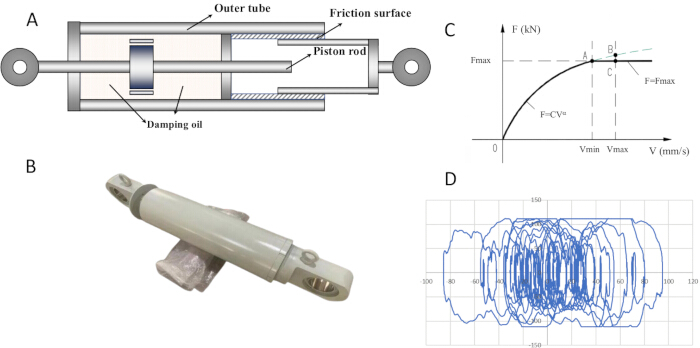
Figure 1: Illustration for the construction of the proposed viscous damper with overload protector (VD-OP). (A) Diagram of VD-OP; (B) Physical appearance of VD-OP; (C) Output force vs relative velocity between the two terminals; (D) Typical hysteretic curve of VD-OP. Please click here to view a larger version of this figure.
Constitutive relationship of the VD-OP
Figure 1 illustrates the mechanical model and hysteretic curve of VD-OP. Initially, the relationship follows a linear dependence, expressed as F = CV, where F is the damping force provided by the VD-OP, C is the damping coefficient, and V is the relative velocity between the two ends of VD-OP, for velocities below a certain threshold. However, once the velocity exceeds this threshold, the force saturates at a maximum value, Fmax, providing a critical overload protection mechanism. The primary distinction between the VD-OP and conventional viscous dampers is the integration of an additional overload protector within the device. The core design feature of the VD-OP is its unloading force, denoted as Fmax, which is governed by the frictional force generated at the integrated friction surface. Once the friction material is specified, the coefficient of friction can be readily determined. According to Coulomb's law, the frictional force Fmax is expressed as Fmax = μPpre, where µ is the friction coefficient and Ppre, is the applied pre-pressure. Thus, by adjusting Ppre, Fmax can be precisely calibrated to satisfy specific design requirements, thereby enhancing the functionality and adaptability of the device.
Parameter analysis for the VD-OP
According to the constitutive relationship of VD-OP (Figure 1), the energy dissipation properties were analyzed. Set the damping coefficient and velocity exponent of VD-OP are C = 500 kN•s0.6/mm0.6 and α = 0.6, and change the different maximum unloading forces Fmax and displacements δ. The hysteresis curves of the VD-OP are depicted under varying parameters (Figure 2). Set the maximum unloading forces and displacements are Fmax = 200kN and δ = 1.2mm, and change the damping coefficients C and velocity exponents α. The hysteresis curves of the VD-OP are depicted under varying parameters (Figure 3).
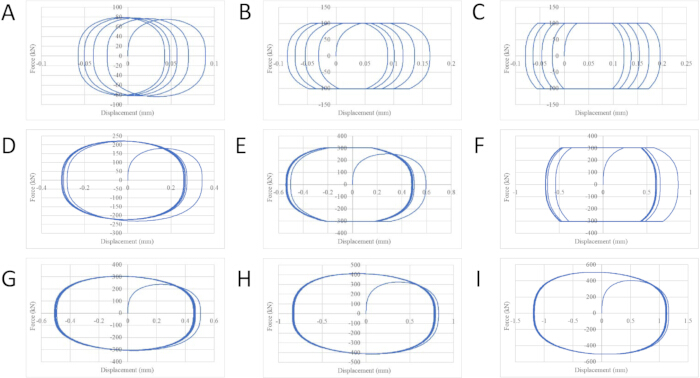
Figure 2: Hysteresis curves of VD-OP with different Fmax under various displacement δ: (A) δ = 0.8mm, Fmax = 100kN; (B) δ = 1.2mm, Fmax = 100kN ; (C) δ = 1.6mm, Fmax = 100kN ; (D) δ = 0.8mm, Fmax = 300kN ; (E) δ = 1.2mm, Fmax = 300kN ; (F) δ = 1.6mm, Fmax = 300kN ; (G) δ = 0.8mm, Fmax = 500kN ; (H) δ = 1.2mm, Fmax = 500kN ; (I) δ = 1.6mm, Fmax = 500kN . Please click here to view a larger version of this figure.
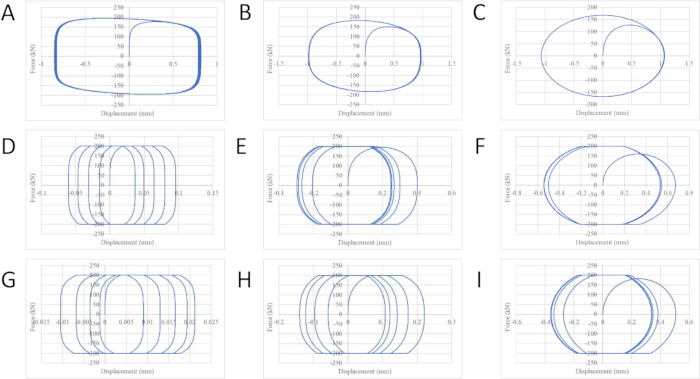
Figure 3: Hysteresis curves of VD-OP with different C and α: (A) C = 200kN•s0.3/mm0.3, α = 0.3; (B) C = 200kN•s0.6/mm0.6, α = 0.6 ; (C) C = 200kN•s1/mm1, α = 1 ; (D) C = 500kN•s0.3/mm0.3, α = 0.3 ; (E) C = 500kN•s0.6/mm0.6, α = 0.6 ; (F) C = 500kN•s1/mm1, α = 1 ; (G) C = 800kN•s0.3/mm0.3, α = 0.3 ; (H) C = 800kN•s0.6/mm0.6, α = 0.6 ; (I) C = 800kN•s1/mm1, α = 1 . Please click here to view a larger version of this figure.
Experimental testing procedures of the VD-OP
Testing the prototype and device
According to the device construction of VD-OP mentioned before, a prototype of the VD-OP device is created to study its mechanical performance. A uniaxial actuator (Figure 4) is used to test the mechanical behavior of VD-OP. The hydraulic system of the testing device comprises a 100-kW servo-hydraulic pump with a PID-controlled flow rate, an actuator with a stroke of ±800 mm, a static test capacity of 3000 kN, and a dynamic test capacity of ±2000 kN. Sensors include a 3000-kN load cell for force measurement and an LVDT with a range of ±1000 mm for displacement measurement. The parameters (Table 1) and the loading protocol (Table 2) of VD-OP are given.
Experimental testing and numerical simulation procedure
The experiment shown in Figure 4 can provide valuable insights into the performance characteristics of VD-OP. Prior to testing, dynamic calibration is performed using a deadweight, followed by zero-point adjustment after a 30-min warm-up period. Install the VD-OP damper between the upper and lower platens, with alignment ensured using a laser alignment tool to achieve coaxially. Mechanical slack is eliminated by applying three pre-cycles with an amplitude of ±5% of the maximum stroke and a frequency of 0.01 Hz. Data acquisition and post-processing involve automatic synchronization of force, displacement, and temperature signals by the experimental control system. Sensor drift is compensated using pre-calibrated coefficients. Additionally, to further validate the accuracy of the test results and finite element analysis, OpenSees was employed to replicate the VD-OP testing conditions. The device parameters and loading scenarios in the finite element model were maintained consistent with those in the physical tests.
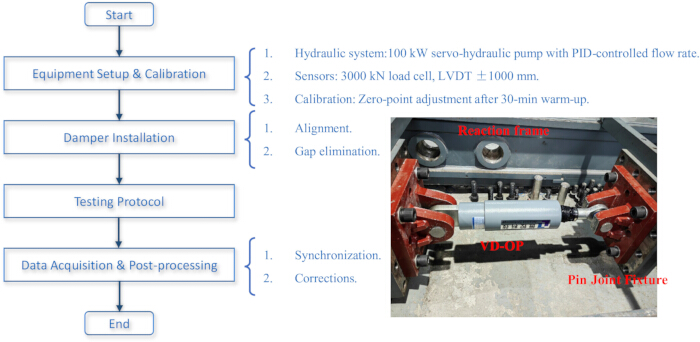
Figure 4: Flowchart of the experimental setup. The experimental procedure begins with dynamic deadweight calibration and zero-point adjustment after a 30-min warm-up, followed by laser-aligned VD-OP damper installation between platens with ±5% pre-cycling (0.01 Hz) to eliminate slack. Force, displacement, and temperature data are synchronously acquired with drift compensation, while OpenSees simulations replicate test parameters to validate experimental and FEA consistency. Please click here to view a larger version of this figure.
Development of the VD-OP isolation system
Configuration of the VD-OP isolation system
Based on the VD-OP mentioned before, the mechanical configuration of the VD-OP isolation system (Figure 5), including high-damping rubber bearings (HDRB) and VD-OP, is described. HDRBs are effective in absorbing energy and reducing seismic forces under normal conditions, but during rare earthquakes, they may undergo large deformations and exhibit stiffness hardening, which could undermine the isolation performance. Regarding the traditional viscous damper, it might also fail under such extreme conditions due to excessive forces. Therefore, a VD-OP isolation method is proposed for structural seismic control. In the proposed isolation system, VD-OP addresses these issues by incorporating an overload protection mechanism that prevents the damper from exceeding its force capacity, thus avoiding failure during rare earthquakes. Additionally, by constraining the force output of the damper, the VD-OP helps counteract the stiffness hardening of the HDRB, maintaining better isolation performance even under large deformations. In summary, the VD-OP isolation system is developed to enhance the safety and performance of building structures by ensuring that both energy dissipation and force limitations are effectively managed, addressing the potential shortcomings of HDRBs during extreme events. The effectiveness of the VD-OP within the isolation system is likely supported by the experimental investigation executed in this study.
Mechanical principle of the VD-OP isolation system
The governing motion equation of a linear damped SDOF structure under seismic excitation is established. The structural mass m, linear spring k, and viscous damping coefficient
The governing motion equation of a linear damped SDOF structure under seismic excitation is established. The structural mass m, linear spring k, and viscous damping coefficient c is considered to represent the equivalent airport control tower. The motion equation can be expressed as:
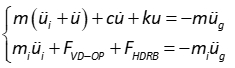
where mi is the mass of the isolation layer, ui and u are the displacement of the isolation layer and primary structure, respectively, FVD-OP and FHDRB are the output forces of VD-OP and HDRB,  is the seismic acceleration. The output forces FVD-OP can be calculated as follows:
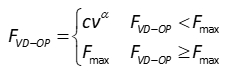
The output force FHDRB can be obtained by means of the DHI mechanical model, which follows the equation:
FHDRB = τDHI • AHDRB (3)
where τDHI and AHDRB are the shear stress by using the DHI model and the effective area of HDRB.
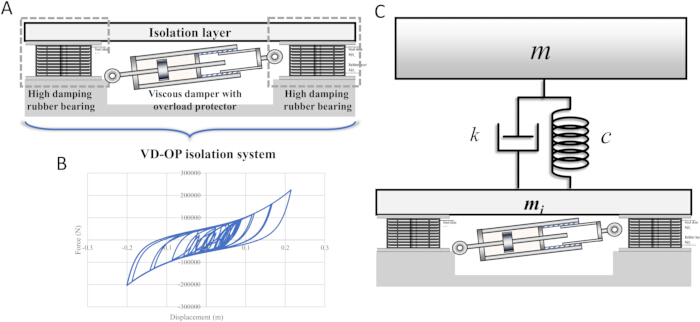
Figure 5: Illustration of the proposed VD-OP-based isolation system for building structures. (A) Diagram of the VD-OP isolation system, (B) typical hysteresis curve of HDRB, (C) mechanical model of single degree-of-freedom system with VD-OP-based isolation system. Please click here to view a larger version of this figure.
Parameter analysis for the VD-OP isolation system
A parametric analysis was conducted on a 2-degree-of-freedom structural model to investigate the overload property of VD-OP against various isolating deformations. The upper structure has a mass of 154666.67 kg, a period of 0.66 s, and an inherent damping ratio of 0.05, while the isolation layer has a mass of 38666.67 kg. The isolation system incorporates HDRB34,35,36 as isolation bearings and VD-OP. The simulations were performed using OpenSees37. The HDRB was modeled using the KikuchiAikenHDR material, with a bearing diameter of 400 mm and a total rubber thickness of 74 mm. The seismic waves with PGA=0.4 g are employed to simulate a rare earthquake. The response of the isolation layer under these rare conditions is depicted (Figure 5).
To improve the system's performance, VD-OP was incorporated, with the key design parameter being the maximum overload protection force, Fmax. The dimensionless parameter, threshold force ratio ρ = Fmax/FBR was varied from 0 to 1.0, with the damping index of VD-OP fixed at 0.6. The structural responses, including displacement, acceleration, deformation of the isolation layer, and base shear force, for different rho values are shown (Table 3 and Figure 6). The hysteretic curves for HDRB and VD-OP under different values of the parameter ρ are presented (Figure 7). The hysteresis curves in Figure 8 illustrate the performance of the VD-OP damper with ρ = 0.5 under different levels of earthquake intensity.
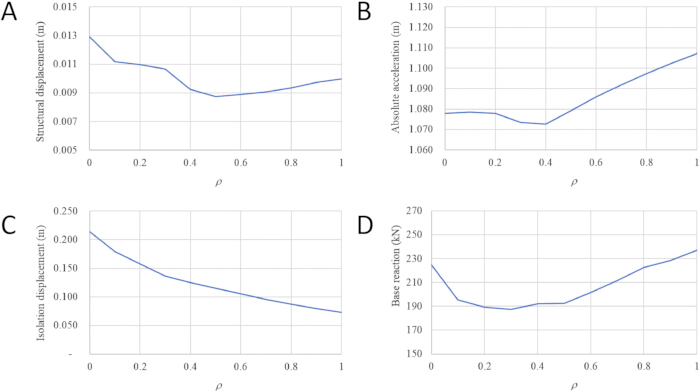
Figure 6: Seismic responses of the system with different ρ. As the threshold force ratio ρ increases, the structural displacement initially decreases, reaching a minimum, before slightly increasing. Please click here to view a larger version of this figure.
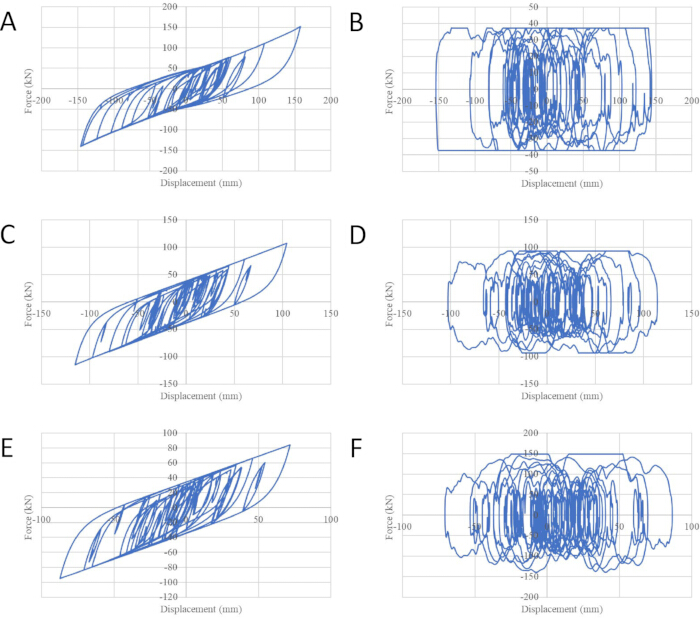
Figure 7: Hysteretic curves of HDRB and VD-OP with different ρ: (A) HDRB, ρ = 0.2; (B) VD-OP, ρ = 0.2; (C) HDRB, ρ = 0.5; (D) VD-OP, ρ = 0.5; (E) HDRB, ρ = 0.8; (F) VD-OP, ρ = 0.8. Please click here to view a larger version of this figure.
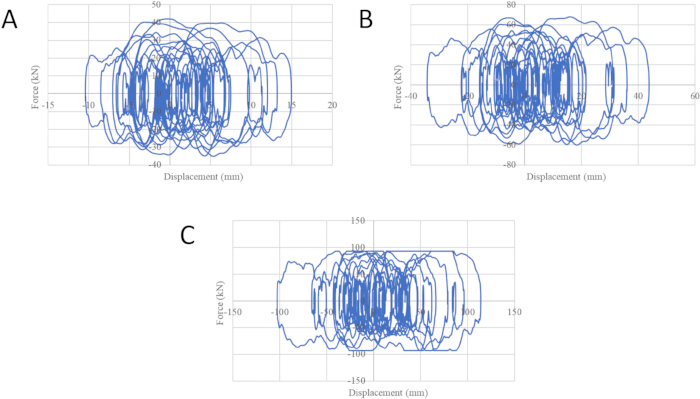
Figure 8: Hysteretic curves of VD-OP with ρ = 0.5 under frequent, fortification, and rare earthquakes. (A) Frequent earthquake; (B) Design-level events; (C) Severe earthquake. Please click here to view a larger version of this figure.
Numerical example setup of VD-OP-incorporated isolated structures
Simulation of the original structure
A three-story concrete frame structure is used to execute seismic isolation analysis to assess the effectiveness and applicability of the VD-OP isolation system. The structural analysis process was accomplished using ETABS software38, and the structural model and plan layout are depicted (Figure 9). The structure measures approximately 32 m by 15.6 m and has a total mass of about 1856 tons. The concrete used in the floors, beams, and columns has a compressive strength of 30 MPa. The structural vibration modes involve translational movements in the X and Y directions, with corresponding periods of 0.66 s and 0.61 s, and a torsional mode around the Z-axis with a period of 0.54 s. Given that the ratio of the periods of the first and third modes exceeds 0.9, this indicates weak torsional performance for seismic response investigation.
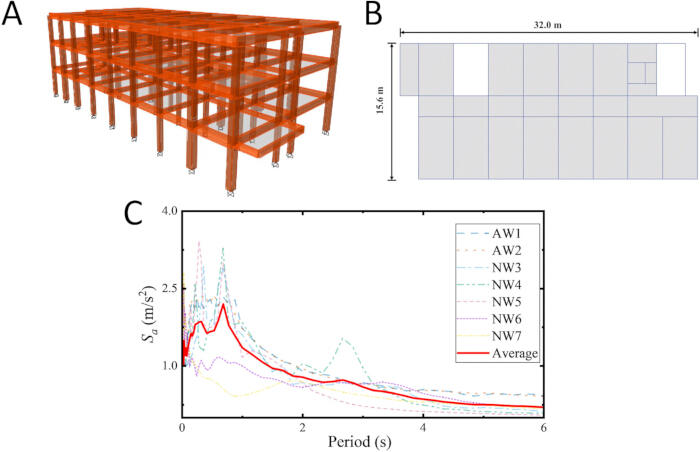
Figure 9: Seismic isolation analysis scheme of the three-story concrete frame structure to assess the effectiveness and applicability of the VD-OP isolation system. (A) Perspective view of the finite element model of the original structure; (B) Structural plan of the typical story; (C) Normalized acceleration spectra of the five input ground motions. Please click here to view a larger version of this figure.
Design of the VD-OP isolation system
The VD-OP isolation system is implemented to enhance the structural seismic resilience by restricting the transferred acceleration responses within the isolation layer. The performance-based design of the VD-OP involves a comprehensive process comprising four key steps: (1) assessing the performance of the original structure, (2) establishing the target for performance improvement, (3) designing the VD-OP-based isolated structure, and (4) validating its seismic performance. The shear force ratio γSF and structural acceleration ratio γACC , which represent the target level of performance improvements, can be established using predetermined typical values or specific engineering requirements. This γSF can be calculated as the ratio of the peak shear force responses of the primary structure to those of the VD-OP-based isolated structure, whereas γACC can be calculated as the ratio of the peak acceleration responses of the primary structure to those of the VD-OP-based isolated structure. The parameter design of the VD-OP involves selecting representative parameter sets to achieve the desired stiffness and damping characteristics, including the damping coefficient, damping exponent, and the threshold force of the overload protector Fmax . The mentioned parameters can be determined according to the parametric findings from the mechanical property investigations and the design principle that minimizes the acceleration responses of the VD-OP-based isolated structure under rare earthquakes. According to the design procedure illustrated above, the parameter design flowchart is summarized (Figure 10).
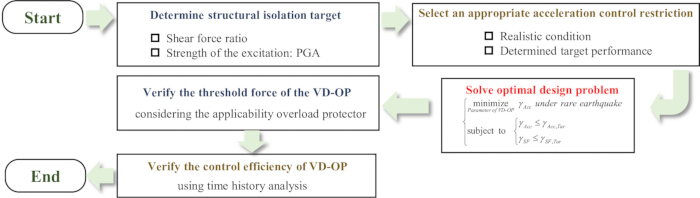
Figure 10: Design flowchart of the proposed hybrid VD-OP-based isolation system. VD-OP design involves: (1) assessing the original structure, (2) defining target improvement ratios (shear force α and acceleration β), (3) optimizing damping parameters (coefficient, exponent, threshold force) for minimal seismic response, and (4) validating performance. Please click here to view a larger version of this figure.
By setting the target isolating efficiency, as evaluated by the target base shear force γSF,Tar and structural acceleration ratio γACC,Tar as 0.35 under the frequent earthquake, a seismic isolation layer incorporating the HDRB and the novel VD-OP was added at the base of the primary structure. The specific parameters for the HDRB and VD-OP are detailed and illustrated (Table 4 and Table 5).
Dynamic analysis of the structure with the VD-OP isolation system
The structure is designed to endure a seismic fortification intensity of seven degrees (0.15g) and is located on a Category IV site, which is classified as a soft soil site39. The site's response spectrum has a characteristic period of Tg = 0.75 s. 4.16 Given these site conditions, seven seismic time history records were chosen for analysis, including two artificial ground motion time histories and five natural ground motion time histories sourced from the K-KET database in Japan40. Detailed information about these seismic records is presented (Table 6), and their acceleration response spectra are given as well (Figure 9).
To evaluate the performance of the HDRB under various earthquake scenarios, the ground motion time histories were scaled to achieve Peak Ground Accelerations (PGA) of 35 gal, 100 gal, and 220 gal39. These PGA values, corresponding to frequent earthquakes, fortification earthquakes, and rare earthquakes, respectively, were selected to ensure a thorough assessment of the seismic resilience of the isolated structure. The dynamic responses of original structures, structures with an HDRB-based VD-OP isolation system, and LRB-isolated structures were thoroughly analyzed under frequent, fortification, and rare earthquake conditions, focusing on inter-story displacement, acceleration, and shear force. The detailed comparative responses are illustrated (Figure 11). The hysteresis curves of VD-OP under the NW3 ground motion input for frequent, fortification, and rare earthquakes are depicted (Figure 12).
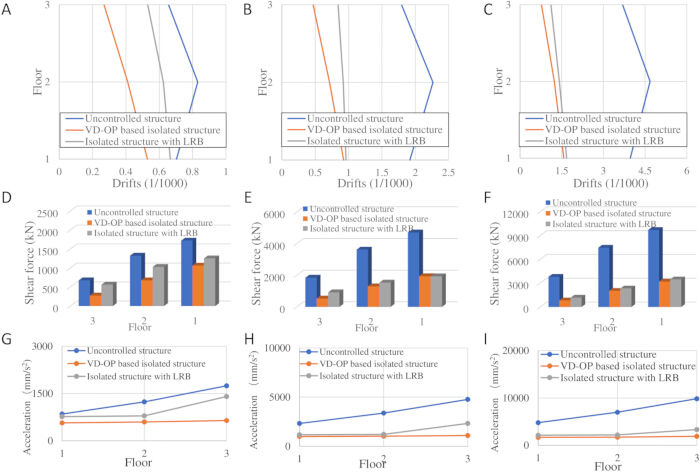
Figure 11: Story drifts under different levels of earthquakes. (A) Story drifts under frequent earthquakes; (B) Story drifts under design-level events; (C) Story drifts under severe earthquakes. (D) Story shears under frequent earthquake; (E) Story shears under design-level events; (F) Story shears under severe earthquake; (G) Story absolute accelerations under frequent earthquake; (H) Story absolute accelerations under design-level events; (I) Story absolute accelerations under severe earthquake. Please click here to view a larger version of this figure.
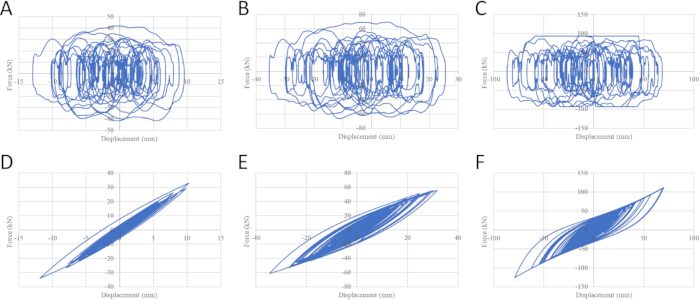
Figure 12: Hysteresis curves in the isolation layer under different levels of earthquakes, NW3. (A) VD-OP under frequent earthquake; (B) VD-OP under design-level events; (C) VD-OP under severe earthquake; (D) HDRB under frequent earthquake; (E) HDRB under design-level events; (F) HDRB under severe earthquake. Please click here to view a larger version of this figure.
Access restricted. Please log in or start a trial to view this content.
Results
Parametric Analysis Outcomes of the VD-OP Device
Force-Velocity Relationship and Hysteretic Behavior (Figure 2):
As shown in Figure 2, the hysteresis curves demonstrate how the damper's energy dissipation behavior changes with different Fmax values and displacement amplitudes. For smaller F
Access restricted. Please log in or start a trial to view this content.
Discussion
This study demonstrates the effectiveness of the VD-OP (Figure 1, Figure 2, and Figure 3) in enhancing seismic resilience through controlled energy dissipation and force limitation. Experimental results (Figure 4, Figure 13, and Figure 14) confirm that the VD-OP mitigates excessive damping forces under high-velocity movements, reducing structur...
Access restricted. Please log in or start a trial to view this content.
Disclosures
The authors declare that there is no conflict of interest regarding the publication of this paper.
Acknowledgements
This research is supported by the Basic Research Project of the State Key Laboratory of the Ministry of Science and Technology (grant number SLDRCE19-A-10). All support is gratefully acknowledged.
Access restricted. Please log in or start a trial to view this content.
Materials
| Name | Company | Catalog Number | Comments |
|---|---|---|---|
| Dynamic test software | Shanghai Hualong | HDTS-v3.0 | Compliant with GB/T 20688.1-2007 |
| ETABS-Building analysis and design | Computer and Structures, Inc | 19.0.2 | For performance modeling and structural analysis |
| Load cell | Ningbo Saishi | C3M-3000 | For experiments with 3000 kN capacity |
| LVDT | Shanghai Hualong | HLVDT1000 | For experiments with ±1000 mm range and 0.01 mm resolution |
| Magnetostrictive sensor | MTS (USA) | MTS-R-Series | For experiments with ±800 mm travel |
| MATLAB | MathWorks | 2024 | For the calculation of the experiments |
| Servo-hydraulic actuator | Shanghai Hualong | YJW-20000 | For experiments with ±800 mm stroke, ±2000 kN dynamic capacity |
References
- Chen, X., Yang, H. T. Y., Shan, J. Z., Hansma, P. K. Bio-inspired passive optimized base-isolation system for seismic mitigation of building structures. J Eng Mech. 142 (1), 1-12 (2015).
- De Domenico, D., Ricciardi, G. An enhanced base isolation system equipped with optimal tuned mass damper inerter (tmdi). Earthq Eng Struct Dyn. 47 (5), 1169-1192 (2018).
- Xu, W., Du, D., Wang, S., Liu, W., Li, W. Shaking table tests on the multi-dimensional seismic response of long-span grid structure with base-isolation. Eng Struct. 201, 109802(2019).
- Zelleke, D. H., Matsagar, V. A. Multi-hazard stochastic response assessment of base-isolated buildings. Struct Infrastruct Eng. 20 (3), 301-325 (2022).
- Chen, P., Wang, B., Karavasilis, T. L., Dai, K. S. A compatible uniaxial Bouc-Wen model for accurate estimation of residual deformation of seismically isolated structures. Eng Struct. 297, 117021(2023).
- Han, Q., Jing, M., Lu, Y. Shaking table tests on the seismic response of truss structure with air spring-fps three-dimensional isolation bearing. Earthq Eng Struct Dyn. 52 (15), 4964-4986 (2023).
- Zhang, R., Wu, M., Lu, W., Li, X., Lu, X. Seismic retrofitting of a historic building by using an isolation system with a weak restoring force. Soil Dyn Earthq Eng. 148, 106836(2021).
- Wu, D., Tesfamariam, S., Xiong, Y. FRP-laminated rubber isolator: Theoretical study and shake table test on isolated building. J Earthq Eng. 27 (5), 1302-1323 (2022).
- Robinson, W. H. Lead rubber hysteretic bearings suitable for protecting structures during earthquakes. Earthq Eng Struct Dyn. 10 (4), 593-604 (1982).
- Cao, S., Ozbulut, O. E., Wu, S., Sun, Z., Deng, J. Multi-level SMA/lead rubber bearing isolation system for seismic protection of bridges. Smart Mater Struct. 29, 055045(2020).
- Yavas, M. S., Gao, Z., Mekaoui, N., Saito, T. A machine learning-based hybrid seismic analysis of a lead rubber bearing isolated building specimen. Soil Dyn Earthq Eng. 174, 108217(2023).
- Mokha, A., Constantinou, M. C., Reinhorn, A. M., Zayas, V. A. Experimental study of friction-pendulum isolation system. J Struct Eng. 117 (4), 1201-1217 (1991).
- Chen, X., Xiong, J. F. Seismic resilient design with base isolation device using friction pendulum bearing and viscous damper. Soil Dyn Earthq Eng. 153, 107073(2022).
- Shang, J., Tan, P., Han, J., Zhang, Y., Li, Y. Performance of seismically isolated buildings with variable friction pendulum bearings under near-fault ground motions. J Build Eng. 45, 103584(2022).
- Hu, X., Zhao, Z., Yang, K., Wang, L., Chen, Q. Novel triple friction pendulum-tuned liquid damper for the wind-induced vibration control of airport control towers. Thin wall Struct. 182 (part B), 110337(2023).
- Tsai, M. H., Wu, S. Y., Chang, K. C., Lee, G. C. Shaking table tests of a scaled bridge model with rolling-type seismic isolation bearings. Eng Struct. 29 (5), 694-702 (2007).
- Lu, Y., et al. Study on the vibration isolation performance of sliding-rolling friction composite vibration isolation bearing. Build. 14 (7), 2053(2024).
- Li, Z., Chen, X., Huang, G., Kareem, A., Zhou, X. Alongwind and crosswind response of friction-pendulum base-isolated high-rise buildings. Eng Struct. 293, 116564(2023).
- Zhong, J., Zhu, Y., Han, Q. Impact of vertical ground motion on the statistical analysis of seismic demand for frictional isolated bridge in near-fault regions. Eng Struct. 278, 115512(2023).
- Zhao, Z., Wang, Y., Hu, X., Weng, D. Seismic performance upgrading of containment structures using a negative-stiffness amplification system. Eng Struct. 262, 114394(2022).
- Jiang, Y., Zhao, Z., Zhang, R., De Domenico, D., Pan, C. Optimal design based on analytical solution for storage tank with inerter isolation system. Soil Dyn Earthq Eng. 129, 105924(2020).
- Engle, T., Mahmoud, H., Chulahwat, A. Hybrid tuned mass damper and isolation floor slab system optimized for vibration control. J Earthq Eng. 19 (8), 1197-1221 (2015).
- De Domenico, D., Ricciardi, G. Optimal design and seismic performance of tuned mass damper inerter (tmdi) for structures with nonlinear base isolation systems. Earthq Eng Struct Dyn. 47 (12), 2539-2560 (2018).
- Qian, F., Luo, Y. F., Sun, H. X., Tai, W. C., Zuo, L. Optimal tuned inerter dampers for performance enhancement of vibration isolation. Eng Struct. 198, 109464(2019).
- Sheng, P., Zhang, Z. H., Jing, S. X., Zhao, F. Isolation performance of the quasi-zero stiffness isolation system enhanced by mixed tuned inerter damper. Int J Struct Stability Dyn. , (2024).
- Tai, Y. J., He, X. H., Huang, Z. W., Wang, W. X., Hua, X. G. Nonlinear dynamic characteristics of crank train inerters for vibration isolation. Nonlinear Dyn. 112 (1), 197-214 (2024).
- Tan, Y., Chen, T., Li, Z. Performance of optimum accelerated oscillator damper-based isolation system for buildings. Eng Struct. 235, 112044(2021).
- Wang, H., Shen, W. A., Zhu, H. P., Luo, H. Stochastic optimization of a nonlinear base isolation system with LRB and EIMD for building structures. Struct Control Health Monit. 2023, 8392421(2023).
- Zhang, R. H., Soong, T. T. Seismic design of viscoelastic dampers for structural applications. J Struct Eng. 118 (5), 1375-1392 (1992).
- Silvestri, S., Trombetti, T. Physical and numerical approaches for the optimal insertion of seismic viscous dampers in shear-type structures. J Earthq Eng. 11 (5), 787-828 (2007).
- Dong, B., Sause, R., Ricles, J. M. Modeling of nonlinear viscous damper response for analysis and design of earthquake-resistant building structures. Bull Earthq Eng. 20 (3), 1841-1864 (2022).
- Chen, M., et al. Identifying potential debris flow hazards after the 2022 Mw 6.8 Luding earthquake in southwestern China. Bull Eng Geol Environ. 83, 241(2024).
- Yao, C., et al. Damages of highway tunnels during 2022 Luding earthquake (Mw=6.6). Soil Dyn Earthq Eng. 177, 108357(2024).
- Dai, K., et al. Seismic analysis of a base-isolated reinforced concrete frame using high damping rubber bearings considering hardening characteristics and bidirectional. Struct. 46, 698-712 (2022).
- Chen, B., Dai, J., Song, T., Guan, Q. Research and development of high-performance high-damping rubber materials for high-damping rubber isolation bearings: A review. Polymers. 14 (12), 2427(2022).
- Wang, S. J., Lin, W. C., Chiang, Y. S., Hwang, J. S. Coupled bilateral hysteretic behavior of high-damping rubber bearings under non-proportional plane loading. J Earthq Eng. 26 (9), 4421-4448 (2022).
- Mckenna, F., Fenves, G. L., Scott, M. H. Open system for earthquake engineering simulation. , http://opensees.berkeley.edu (2003).
- Etabs, building analysis and design, 2021. , Available from: Https://www.Csiamerica.Com/products/etabs (2021).
- MOHURD. Code for Seismic Design of Buildings (GB/T 50011-2010). , Architecture and Building Press. (2016).
- Okada, Y., et al. Recent progress of seismic observation networks in Japan - Hi-net, F-net, K-net and KiK-net. Earth Planets Space. 56, xv-xxviii (2004).
Access restricted. Please log in or start a trial to view this content.