This paper describes the analysis of serum, breast milk and liver samples for 13C-enrichment of retinol and retinyl esters for tracer applications. High-performance liquid chromatography is used to purify and quantify retinol concentrations, and gas chromatography-combustion-isotope ratio mass spectrometry (GC-C-IRMS) is used to analyze the purified extracts.
Method Article
Analysis of 13C Enrichment of Vitamin A in Biological Samples by Gas Chromatography-Combustion-Isotope Ratio Mass Spectrometry
Opens in a new tab
In This Article
Summary
Loading...
$$\rightleftharpoonup{xx}$$
$$\longleftharp{xx}$$,
$$\longrightharp{xx}$$,
Abstract
Loading...
$$\rightleftharpoonup{xx}$$
$$\longleftharp{xx}$$,
$$\longrightharp{xx}$$,
Vitamin A is critical for health, but assessment of vitamin A status is challenging. Vitamin A circulating in blood is homeostatically controlled and often does not reflect vitamin A deficiency or excess. Use of 13C-vitamin A allows tracing and quantifying the total body vitamin A stores and additional information on pharmacokinetics and metabolism. This protocol describes the extraction, purification, and determination of 13C-isotopic enrichment of vitamin A in serum, breast milk, and tissue samples using gas chromatography-combustion-isotope ratio mass spectrometry (GC-C-IRMS). Analysis using GC-C-IRMS provides sensitive and precise enrichment values, particularly for samples with 13C enrichments near natural abundance levels. This enables flexibility in study designs to use smaller tracer doses and longer-term pharmacokinetic sampling. Briefly, to 0.4 to 1 mL serum, ethanol is added to precipitate proteins, C-23 β-apo-carotenol is added as an internal standard, and hexane is used to extract retinoids. The extract is subsequently resuspended in methanol and purified using HPLC. The retinol fraction is then resuspended in hexane and injected into the GC-C-IRMS system. Atom % (At%) is directly calculated in reference to carbon dioxide, which is calibrated against a sucrose standard using an elemental analyzer. Other tissue types that have been analyzed by GC-C-IRMS include breast milk and liver after saponification. Solid phase extraction techniques can be used to assist in the purification of these or other complex matrices. Furthermore, an elemental analyzer can be attached to the IRMS to analyze food samples for total 13C content.
Introduction
Loading...
$$\rightleftharpoonup{xx}$$
$$\longleftharp{xx}$$,
$$\longrightharp{xx}$$,
Vitamin A (VA) is an essential micronutrient required for vision, immune function, cellular differentiation, and metabolic regulation. Optimizing VA status remains a global health challenge, as deficiency or excess can impair health outcomes. Accurate assessment of VA status is critical for clinical or population studies guiding appropriate interventions. However, serum retinol concentration alone is a poor biomarker and diagnostic tool because it is homeostatically regulated across a wide range of total body stores (TBSs) and is affected by inflammation and other nutrient deficiencies1,2.
Isotopically labelled tracers have dramatically transformed VA research by enabling quantitative assessment of TBSs using the retinol isotope dilution (RID) test3,4,5. For RID, a VA tracer enriched in either 13C or 2H is administered, equilibrates with body stores, and the serum (or plasma) retinol tracer-to-tracee ratio (TTR) is measured using MS. An isotope dilution equation is applied with specific assumptions related to VA metabolism to calculate TBSs5,6.
Numerous chromatography and MS combinations can be used to determine the serum retinol TTR (e.g., GC-MS, LC-MS, LC-MS/MS). Analytical precision is critical for accurate RID estimates because TBSs are inversely proportional to TTR. LC-MS/MS is well-suited for high-throughput applications when using heavily labeled tracers and relatively high tracer doses. Typical LC-MS/MS methods report retinol relative standard deviations (RSDs) of 3-6% for intra-assay and <8% for inter-assay7, but there are limited data on the accuracy and precision of TTRs. In contrast, gas chromatography-combustion-isotope ratio mass spectrometry (GCCIRMS) offers exceptional precision for 13C-retinol enrichment, with typical 13C/12C isotope abundance RSDs of ~0.02-0.058,9. This allows precise determination of tracer concentrations in samples where enrichments are low. Using IRMS for RID applications allows for adequate analytical signal using less tracer mass and fewer labeled atoms in the tracer, both saving costs associated with the tracer doses.
This manuscript outlines an analysis for 13C-retinol from blood, breast milk, and tissues using GC-C-IRMS. Depending on the biological sample being tested, analysis of 13C-labeled retinol using GC-C-IRMS begins with one of several potential extraction methods to isolate the non-polar compounds that include the labeled retinol. For serum samples, this involves a liquid-liquid extraction by adding ethanol and hexane and collecting the hexane fraction. If testing breast milk, the samples are first saponified with potassium hydroxide, followed by a similar liquid-liquid extraction to serum. These breast milk samples are also purified using solid phase extraction cartridges to reduce the quantity of other lipids remaining. If extracting from a tissue (e.g., liver), the sample is ground with anhydrous sodium sulfate to remove water, extracted with methylene chloride, and filtered into a volumetric or round-bottom flask for rotary evaporation. An aliquot is dried, resuspended in ethanol, saponified, and extracted using the same method as breast milk. These non-polar solutions from each sample are dried under nitrogen and reconstituted in methanol for purification and quantification on high-performance liquid chromatography (HPLC).
The sensitivity of IRMS allows the determination of enrichment in samples with low sample enrichment, such as pharmacokinetic samples for long-term mathematical modeling applications or extrahepatic tissue samples for precise tracing of VA metabolism. Single-dose, paired RID testing has been proposed to evaluate VA status before and after intervention to determine efficacy in theoretical subjects10, which could be a promising approach if validated in humans. IRMS is able to detect VA tracers near natural enrichment values, which would allow long follow-up windows and flexibility in sampling protocols.
Breast milk has been shown to be a less invasive alternative sampling approach for VA status assessment1. Breast milk retinol can be used as a sampling source for the RID test, and has shown strong correlation with serum-derived RID values in women in Zambia with low VA stores11. For tissues and breast milk samples, solid phase extraction techniques can assist in the purification of these samples in complex matrices. IRMS has also been used to discriminate food sources of VA and determine relative dietary contributions using changes in the natural 13C abundance of serum retinol9,12,13. An elemental analyzer can also be used with IRMS to analyze food samples for total 13C content and compare it with VA enrichment.
When using 13C labels, it is critical to understand the baseline 13C retinol enrichment, due to naturally occurring 13C (~1.1% of total carbon), which can vary with the sources of VA consumed by both individuals and populations. Therefore, for the best accuracy at the individual level, a baseline blood sample is recommended. For population evaluations, a population-based estimate can be generated using a randomly selected subgroup or separate individuals from the same population group14.
Protocol
Loading...
$$\rightleftharpoonup{xx}$$
$$\longleftharp{xx}$$,
$$\longrightharp{xx}$$,
1. Extraction of retinol from biological samples
NOTE: All sample handling and extraction procedures are carried out under yellow or UV-filtered light to minimize degradation.
- Extraction from serum
- Pipette 1 mL of serum (or as much as available) into a 13 x 100 mm (or similar size) glass test tube. Record the serum volume used.
NOTE: Use of a positive displacement pipette is recommended. - Add 1.5x the volume of 200 proof ethanol.
- Add 25 µL of the internal standard, such as C-23 β-apo-carotenol (synthesized from all-trans retinal, abs = 0.9)9. Cap the sample and mix by vortex for 15 s.
- Add 1 mL of hexane, mix by vortex for 15 s, and centrifuge for 2 min (~1,300 × g) at room temperature.
- Using a Pasteur pipette, carefully pipette the top hexane layer into a new glass test tube (12 x 75 mm or 13 x 100 mm).
- Repeat steps 1.1.4 and 1.1.5 2x, pooling the three hexane extracts in the second tube. Place the pooled hexane extract under a gentle stream of nitrogen until dry.
- Add 100 µL of methanol to the dried sample and immediately cap it. Swirl the solution up and down the sides of the tube and then mix the sample by vortex for 15 s.
- Place the samples in a -80 °C freezer for at least 5 min.
NOTE: Samples can remain stored at this step at -80 °C until the next day.
- Pipette 1 mL of serum (or as much as available) into a 13 x 100 mm (or similar size) glass test tube. Record the serum volume used.
- Extraction of breast milk samples
- Thaw milk samples completely and gently invert several times to ensure samples are uniform. Into a 10 mL glass screw top centrifuge tube, measure a 0.5-1.5 mL (standard 1.0 mL) aliquot of milk, and record the volume used.
- Add 1.5x the volume of 200 proof ethanol (containing 0.1% butylated hydroxy toluene (w:v)), mix with a vortex for 15 s.
- Add 25 µL of the internal standard, such as C-23 β-apo-carotenol (synthesized from all-trans retinal, abs = 0.9)15. Cap the sample and mix by vortex.
- Add 0.8x the milk sample volume of 50:50 potassium hydroxide in water (prepared as w:v, e.g., 50 g of KOH dissolved in 50 mL of water), mix by vortex for 15 s.
NOTE: KOH:water should be made up in plastic containers (e.g., HDPE). - Saponify the samples for 1 h in a 45 °C water bath, and mix briefly with a vortex every 15 min.
- Add cold deionized or reverse-osmosis water at the same volume as the starting milk volume.
- Add 1 mL of hexane, mix by vortex for 15 s, and centrifuge for 2 min (~1,300 × g) at room temperature.
- Using a Pasteur pipette, carefully pipette the top hexane layer to a new glass test tube (12 x 75 mm or 13 x 100 mm).
- Repeat steps 1.2.7 and 1.2.8 twice more, pooling hexane in the second tube.
- Take each sample through solid phase extraction (SPE); begin by connecting needed SPE cartridges (PE 500 mg/3 mL of -NH2) to the vacuum manifold.
- Condition each cartridge by running 3 x 2 mL of hexane through each cartridge, never allowing the solvent level to drop below the top of the packing material. Collect hexane into a 16 x 75 mm glass tube and dispose of it appropriately.
- Load the samples into cartridges and pull through with the vacuum until the solvent is just above the level of the packing material. Rinse each cartridge with 3 x 2 mL of hexane in the same manner as step 1.2.11. Dispose of the waste solvent and replace the glass collection tubes with new ones of the same size, labeled with the sample ID.
- Wash retinol through with 3 x 2 mL of methylene chloride, collecting this fraction.
- Dry down the eluate under nitrogen and reconstitute in 100 µL of methanol (MS grade). Mix the sample by vortex and swirl the solvent over all sides of the tube. Centrifuge for 20-30 s.
- Place the samples in a -80 °C freezer for at least 5 min.
NOTE: Samples can remain stored at this step at -80 °C until the next day.
- Extraction of liver samples
- In a glass funnel with 8 cm diameter, fold and place a 15 cm Whatman #1 filter paper in a cone shape. Place a 50 mL volumetric flask under the funnel.
- Thaw tissue and weigh 0.5 g, or as much sample as is available. Record tissue weight used.
- Transfer samples to a mortar and pestle and grind with approximately 5 g of sodium sulfate.
- Add 250 µL of an internal standard such as C-2315.
NOTE: Esterified forms of vitamin A (i.e., retinyl acetate, retinyl butyrate) should not be used because the sample will eventually be saponified, making the standard indistinguishable from endogenous retinol. - In a fume hood, pour 10-15 mL of methylene chloride into the mortar with the ground liver sample and gently mix using the pestle.
- Pour methylene chloride through the filter paper into the volumetric flask.
- Repeat steps 1.3.5 and 1.3.6 twice more, ensuring that the total solvent in the volumetric flask stays below the line.
- Use a Pasteur pipette to rinse the remaining contents of the mortar into the funnel with methylene chloride. Continue to add methylene chloride to the funnel with the Pasteur pipette until the solvent in the volumetric flask reaches the line. Cap the volumetric flask, and while securing the cap in place, invert the flask several times.
- Pour approximately 10 mL of the methylene chloride extract into a 25 mL Erlenmeyer flask. Transfer 5 mL of the solution to a 10 mL glass centrifuge tube with screw top cap. Dry the sample under a gentle stream of nitrogen gas.
- Reconstitute the sample in 2 mL of ethanol + 0.1% butylated hydroxy toluene and vortex to mix the sample.
- Add 0.8 mL of 50:50 (w:v) potassium hydroxide in water, and mix by vortex for 15 s.
- Saponify the samples for 1 h in a 45 °C water bath, and mix briefly with a vortex every 15 min.
- Add 0.1 mL of cold deionized or reverse-osmosis water.
- Add 1 mL of hexane, mix by vortex for 15 s, and centrifuge for 2 min (~1,300 × g).
- Using a Pasteur pipette, carefully pipette the top hexane layer to a new glass test tube (12 x 75 mm or 13 x 100 mm).
- Repeat steps 1.3.14 and 1.3.15 twice more, pooling hexane in the second tube.
- Dry down the pooled hexane under nitrogen and reconstitute in 100 µL of methanol (MS grade). Mix the sample by vortex, and swirl the solvent over all sides of the tube. Centrifuge for 20-30 s and place the samples in a -80 °C freezer for at least 5 min.
NOTE: Samples can remain stored at this step at -80 °C until the next day.
2. Sample purification and quantification using high-performance liquid chromatography
- Prepare HPLC system 1 with a C18 (5 µm, 4.6 x 250 mm) column and UV-Vis detector set to 325 nm.
- Prepare mobile phase of 92:8 acetonitrile:water by measuring the volumes of acetonitrile and water separately and then pouring the water into the acetonitrile. Vacuum filter the mixed solution to remove dissolved gas.
- Turn on the HPLC system 1, perform a solvent purge on the HPLC if needed, then set the flow rate to 1 mL/min for at least 15 min to fully equilibrate the system.
- Inject standards onto the HPLC system.
- For quantifying retinol concentrations, inject 25 µL of C-23 internal standard solution and record the result 3x to compare with samples.
- Inject a retinol standard to determine the exact retention time for the system used to guide fraction collection and retinol quantification.
- Prepare HPLC system 2 (the components are the same as system 1). If using one HPLC system for both steps, replace the column used for the primary purification with a second identical column to minimize potential carryover of compounds from the samples.
- For system 2, vacuum filter methanol, purge the HPLC mobile phase, and then run 0.7 mL/min through for 20 min to equilibrate.
- Remove samples one at a time from the -80 °C freezer, and centrifuge at 1,300 × g for 30 s at room temperature.
- Inject the full sample onto the HPLC, avoiding any pelleted material. Start recording if quantifying retinol.
- Collect the retinol peak into a small glass tube (12 x 75 mm or 13 x 100 mm) as the solvent passes through the detector. Collect the middle portion of the peak to maximize purity, typically absorbance values greater than 0.1 absorbance units (Figure 1), which can be adjusted depending on sample retinol concentration. Wait for the C-23 peak to elute and stop recording.
- Dry sample under a gentle stream of nitrogen.
- Add 100 µL of methanol (MS grade) to the dried sample and cap immediately. Swirl the solution up and down the sides of the tube, then mix the sample by vortex for 15 s. Place the samples in a -80 °C freezer for at least 5 min.
NOTE: Samples can remain stored at this step at -80 °C until the next day. - Remove samples one at a time from the -80 °C freezer. Centrifuge at 1,300 × g for 30 s.
- Inject the full sample onto the HPLC system 2, avoiding any pelleted material.
- As the retinol peak elutes, collect the solvent as it passes through the detector into a small glass vial (<1 mL) with a conical bottom, and gently slide the sample vial into a 12 x 75 mm test tube.
- Turn on the vacuum concentrator and let the condenser cool for 20 min.
- Place the samples in a balanced formation in the carousel, set the heat setting to none and the vacuum to 05.1, close the lid, and press run.
NOTE: The samples typically take 10-20 min to dry. It is important for the gas chromatograph that all methanol has been removed from the samples. - Once dry, transfer the HPLC vial to a 4 mL amber vial with screw cap lid, and reconstitute the sample with 4-7 µL of hexane.
NOTE: This is typically 7 µL, but it is reduced when the sample is determined to be a low concentration during purification. Liver samples may be much more concentrated, so reconstitute in a larger volume. Aim for between 75 ng/µL and 400 ng/µL. - Inject 1-5 µL onto the GC-C-IRMS to achieve an adequate signal, based on the concentration of the sample required to inject approximately 75 ng of retinol.
3. Sample analysis with GC-C-IRMS
- Prepare the GC with a column (100% dimethylpolysiloxane, nonpolar, 15 m, 0.25 mm ID, 0.25 µm film), and the helium flow rate of 1.2 mL/min.
- Perform system checks to ensure there are no leaks, and the IRMS source is properly focused on masses 44, 45, and 46.
Inject 2 µL of a 75 ng/µL 13C-enriched retinol standard each day as the first injection to determine the retention time and verify system performance. - In-the acquisition software, load the instrument method, type the name for the sample, and press run sample. The GC-C-IRMS system will perform a pre-injection system setup routine. Once the green Ready to Inject light on the front of the GC lights up, inject the predetermined volume of sample into the Programmable Temperature Vaporizing PTV injector, remove the syringe, and press the Start button.
- Operate the PTV injector in PTV Splitless mode, with the guard column seated at the top of the injector insert for a simulated on-column injection. Set the injector program to begin with an initial temperature of 50 °C, hold for 1.05 min, increase to 200 °C at a rate of 14.5 °C/s, hold at 200 °C for 1 min, transition to 300 °C at 14.5 °C/s, then hold to purge the injector for 4 min with a helium split flow of 50 mL/min prior to returning to 50 °C for the next injection.
- Program the GC oven temperature to an initial temperature of 50 °C, hold for 1 min, ramp 30 °C/min to 150 °C, then 15 °C/min to 265 °C, then up to 295 °C at 40 °C/min, then hold for 2.50 min prior to cooling to 50 °C for the next injection.
- Ensure that each chromatogram begins with three pulses of CO2 (99.999% purity), calibrated against sucrose (IAEA-CH-6). Access results in the acquisition software.
- After each injection, inspect each chromatogram to verify that the retinol peak is present, and that the integration is appropriate. Use the software to automatically integrate the retinol peaks as much as possible to minimize potential bias from manual integrations. Utilize standard start and end slope detection settings of 20 mV/s.
NOTE: A peak amplitude of 200 mV or lower is too small to provide an accurate 13C ratio measurement. - Export chromatogram data to a spreadsheet program. Include the following essential data categories: Sample name, peak retention time, peak amplitude at mass 45, and AT%.
NOTE: The data that are exported can be specified using a defined export method. The δ value is beneficial for ease of interpretation but not required for calculations.
4. Calculation of vitamin A total body stores and liver concentrations
- Retinol isotope dilution equations.
NOTE: The preferred isotope balance equation and corresponding notation used by some investigators are based on recommendations from the International Union of Pure and Applied Chemistry16. We note that some research groups use notation that attempts to maintain historical use of factors used in RID equations. We also note that factors and supporting literature can differ in whether they apply more directly to calculations for TBSs or liver VA concentrations, depending on study design, experimental model, and analytical outcomes.- Determine serum retinol TTR using the isotopic abundance of 13C of CO2 following combustion according to the following equation:
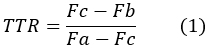
Where F is the isotopic abundance (also known as isotope-amount fraction, abbreviated 'x') of the tracer dose (Fa), serum retinol at baseline (Fb), and serum retinol after dosing and mixing with the body pool (Fc). Mixing periods used are typically around 14-21 days for humans but can be shorter or longer depending on the specific study design. - Use RID equations to calculate VA TBS according to the following base equation.

Where
NOTE: Factors used for absorption and storage include i) dose storage at the time of equilibration (Dose Absorption) typically estimated between 75% and 90% for healthy individuals. Estimate can be reduced if inflammation is present. Ii) Dose retention; Constant: e-kt;k = ln(2)/half-life of retinol; 32 to136 days for children; 140 days for adults); t = days since dosing (usually 14-21 days); serum/liver tracer partitioning: TTRserum / TTRliver; 0.65-0.9 with VA intake during mixing period; 0.9-.1 if using low tracer dose, controlled VA intake, and fasting sampling.

- Calculate liver VA concentrations with additional assumptions for liver weight and the fraction of VA TBS in liver.
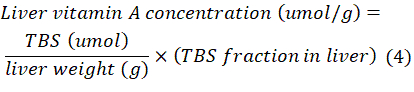
Where

Liver to body weight ratio is commonly estimated as an age-specific constant: infants: 4-4.2%; children: 3%; adults: 2.4%; TBS fraction in liver varies with vitamin A status. Previously used estimates are marginal or low VA status: 0.5; adequate VA status: 0.8-0.9.
- Determine serum retinol TTR using the isotopic abundance of 13C of CO2 following combustion according to the following equation:
Results
Loading...
$$\rightleftharpoonup{xx}$$
$$\longleftharp{xx}$$,
$$\longrightharp{xx}$$,
An example serum sample chromatogram monitored at 325 nm is provided for protocol section 2 (Figure 1). Depending on the specific system and column used, the typical retention time for retinol is 4-6 min and 6-8 min for the internal standard. The green shaded area shows the target collection range for the retinol fraction to minimize impurities. Extraction efficiency of retinol from serum is typically ≥ 85%, while saponified breast milk and tissue samples tend to have lower efficiencies, averaging ~70-80%. Minor amounts of retinol cis-isomers may be observed eluting shortly before or after the main all-trans peak during HPLC purification. No appreciable cis-isomer was observed in the sample presented in Figure 1 but may be seen in Supplemental Figure 1 of reference17. Often, an additional isomer will be separated during the second HPLC purification (not shown) or during the GC separation (Figure 2).
Example GC-C-IRMS chromatograms for a standard, serum sample, and blank are shown for protocol section 3 (Figure 2)9. Each sample includes reference CO2 peaks with 13C enrichment calibrated to an IAEA sucrose standard (IAEA-CH-6).
The experimental IRMS precision (CV%) for isotopic abundance of 13C/total C for: 1) reference CO2 was 0.012 for stability and 0.031 for linearity (n = 10 each); 2) retinol standard was 0.036 for inter-day stability and 0.022 for intra-day linearity (n = 4 each); and 3) experimental was 0.073 ± 0.061 across baseline and eight dietary treatment groups in gerbils (n = 46 across 9 groups)9.
Below is an example of how the resulting serum GC-C-IRMS data are used to calculate TBS and liver VA concentrations determined 14 days after dose administration using the RID equation for Method 4:
Study participant characteristics:
| Age: | 4 years |
| Body weight: | 16.0 kg |
| Fa (2 carbons labeled plus natural abundance): | 0.11 |
| Fb: | 0.010757 |
| Fc: | 0.011057 |
| Applied tracer dose: | 1.0 µmol |
| Time since dosing: | 14 days |
| VA half-life: | 32 days |
| Absorption: | 0.8 |
| Ratio of TTR in serum/liver (diet not controlled): | 0.9 |
| TBS fraction in liver: | 0.8 |
Calculation:
TTR = (Fc-Fb)/(Fa-Fc)
TTR = (0.0110568 - 0.010757) / (0.11 - 0.0110568) = 0.0030300213
1/TTR = 1 / 0.0030300213 = 330.03
Dose retention = e-kt with half-life of 32 days and sampling time of 14 days
k= ln(2)/36 = 0.693147181 / 36 = 0.021660849
t = 14
e-kt = e-0.02166 x 14= 0.738413073
TBS = 1 × 330.03 x 0.8 x 0.738413073 × 0.9 = 175 µmol
For calculation of liver VA concentrations:
Liver weight (g) = 1,000 × body weight (kg) × 3% (estimate for children)
Liver weight = 1,000 x 16.0 x 0.03 = 480 g
Liver VA concentration = (175 / 480) x 0.8 = 0.29 µmol/g
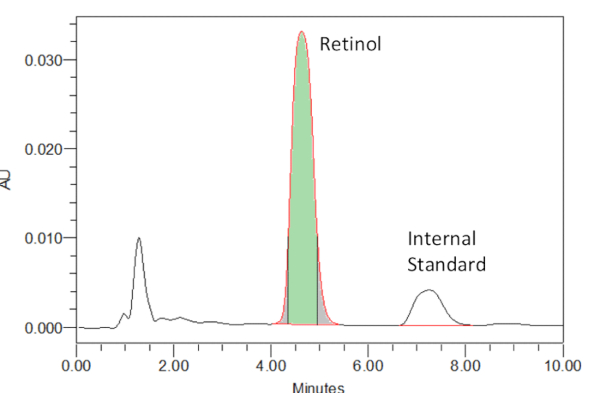
Figure 1: HPLC chromatogram of human serum sample. HPLC system 1 with isocratic mobile phase 90:10 MeOH:H2O and detection at 325 nm. The retinol peak is collected for absorbance values over ~0.1 (green shaded area). The internal standard C-23 β-apo carotenol is used to quantify serum retinol concentration (if desired) during this step. Please click here to view a larger version of this figure.
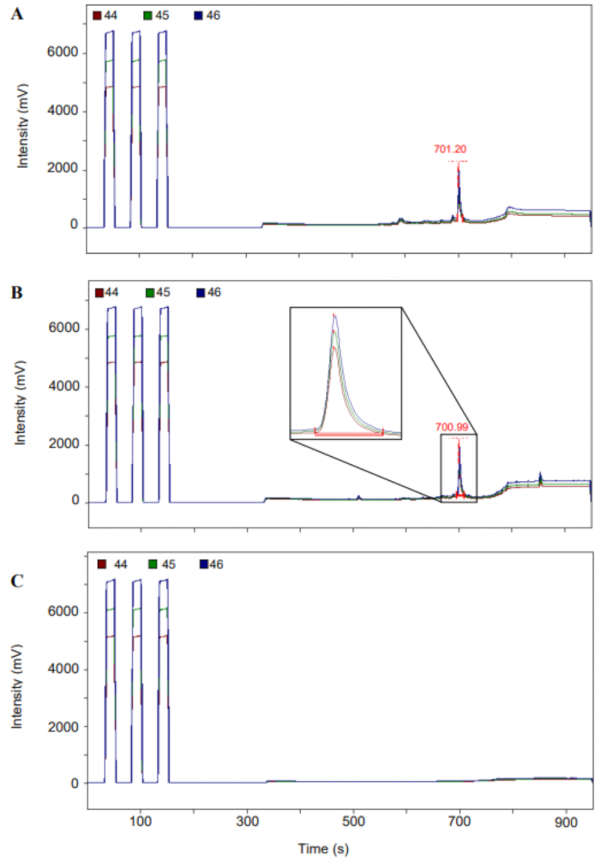
Figure 2: GC-C-IRMS chromatograms demonstrating retinol 13 C/12 C determination. GC-C-IRMS chromatogram of (A) retinol standard, (B) retinol purified from serum, and (C) blank injection adapted from Gannon et al.9. Three traces are for mass 44 (corresponding to 12C16O2), 45 (corresponding to 13C16O2 or 12C16O17O), and 46 (corresponding primarily to 12C16O18O, which is used to correct mass 45 for 17O contribution). Three broad peaks before 200 s are CO2 reference peaks calibrated to a Sucrose 13C Reference Material. Please click here to view a larger version of this figure.
Discussion
Loading...
$$\rightleftharpoonup{xx}$$
$$\longleftharp{xx}$$,
$$\longrightharp{xx}$$,
The methods described for measuring 13C enrichment of retinol using GC-C-IRMS can provide valuable data for evaluating dietary interventions,18 modeling of vitamin A kinetics,19,20,21 clinical research, or population studies incorporating RID for improved estimates of VA status22.
In this test, retinol purified from a biological sample is carried through the GC column by research grade helium (>99.99999% purity) with a temperature gradient, separating it from remaining impurities in the sample. The retinol is combusted to form CO2 and water, and the water is removed. The CO2 is carried to the IRMS, where masses 44, 45, and 46 are measured, and the δ and AT% are determined relative to a CO2 gas reference, which is additionally calibrated against sucrose standard (IAEA-CH-6).
In the preparation of the retinol for injection, the extracted retinol must be of utmost purity to achieve reproducible isotopic ratios and to maximize the longevity of the analytical platform between thorough cleanings. Solvents used for extraction should be of the highest purity grade available, which is usually MS grade. All glassware, such as extraction tubes, Pasteur pipettes, and HPLC injection vials should be new because they are difficult to clean adequately for MS analysis. It is important to use glass tubes and pipettes rather than plastic to minimize plasticizers in the extracts that build up on the GC and combustion columns.
Modifications to this sample analysis workflow could be made depending on the specific study design and sampling source. For example, one HPLC system could likely be optimized for retinol purification. In our experience, this would require water in the mobile phase, and either require a mobile phase gradient, or increased sample drying time prior to injection on the GC-C-IRMS. We found that using two HPLC systems with short isocratic methods balance analytical requirements while obtaining clear signals on the GC-C-IRMS (Figure 2). Use of LC-MS/MS could provide a more streamlined analytical workflow for RID samples7. However, the sensitivity of GC-C-IRMS has distinct advantages of being able to use lower dose and isotope labeling amounts, quantifying tracers at longer time points, and analyzing samples with low sample enrichment.
Limitations of this method include requiring multiple instruments, skilled technical handling, and sample throughput constraints due to longer sample preparation times. The person-time required to prepare each sample could be improved by implementing an HPLC with automated fraction collection capabilities since the HPLC purification steps utilize isocratic methods, resulting in consistent analyte retention times. The method could be optimized to use only one HPLC purification. We use two systems in parallel to increase throughput and facilitate sample drying prior to reconstitution in hexane and injection on the GC-C-IRMS.
While GC-C-IRMS is extremely sensitive for determining isotope ratios, it requires more total sample retinol mass for adequate retinol signal. The sample requirements depend on both the sample amount and the sample VA concentration. Typically, 75 ng of retinol is targeted for a strong peak, allowing for variations in GC transfer and combustion efficiency. In practice, under optimal operation conditions, we have obtained adequate signal with samples resulting in GC-C-IRMS injections as low as 25 ng. This corresponds to a serum sample with lower-volume (~0.4 mL), low retinol concentration (~0.5 µmol/L), and minor losses in the extraction and purification procedures. In the analytical development of the RID method, a major improvement was to switch to a PTV injector. The low starting temperature prevents the hexane carrying the sample from expanding too rapidly, allowing for simulated on-column injections of samples. Injecting directly into the column maximizes the signal of the retinol with the drawback of somewhat worse peak shape and more constant maintenance.
Breast milk has been proposed as a substitute for serum samples in the RID test. This has been validated in Zambian lactating women who largely had low stores of VA11. It is yet to be validated in women who have a higher intake of preformed VA, such as one would find in high-income countries or in populations who consume multiple sources of VA, including dietary intake, food fortification, and supplementation.
Breast milk VA assessment has several advantages over other biochemical indicators of VA status. Collection of breast milk is often easier than blood because phlebotomists are not needed, and breast milk collection is usually considered less invasive for subjects23. Use of casual breast milk samples is convenient and only requires 5 mL of milk. Furthermore, samples do not need to be processed immediately, which shortens sample handling time, particularly in field settings. However, standardization of sample collection for full breast milk samples is critical because concentrations of fat and retinol are higher in hind-milk than foremilk, and milk fat and retinol concentrations tend to vary with the time of the day and the interval since the last feed1,24. For casual samples, retinol concentration is best expressed per g of milk fat. Milk fat needs to be determined ideally just after collection using the creamatocrit method25. Samples should be shielded from light. Aliquots (typically 1 to 5 mL) for HPLC analysis need to be prepared at the time of collection because milk is not homogenous after freezing and thawing.
There are two primary circumstances in which measuring the 13C-enrichment of the VA in the liver may be possible and of interest. The most common situation is when utilizing 13C-labeled retinol in animal studies when the liver is collected. The calculated TBSs of VA will be compared to the concentration of VA in the liver as determined by HPLC/UPLC, but the 13C-enrichment of the liver stores are also useful for determining how the tracer is distributed in circulation relative to long-term stores. Additionally, in some unique circumstances, it is possible to obtain liver biopsy samples from humans who have given consent and also taken a labeled dose of vitamin A26,27. These samples are also useful for validation and testing of 13C-retinol mixing. Liver sample processing begins with grinding a measured sample with anhydrous sodium sulfate to trap water and break down the tissue. This is then extracted with 50 mL methylene chloride through filter paper. A fraction is dried under nitrogen and reconstituted in ethanol with 0.1% butylated hydroxy toluene added as a preservative. The sample is saponified and extracted with the same procedure used for breast milk.
Disclosures
Loading...
$$\rightleftharpoonup{xx}$$
$$\longleftharp{xx}$$,
$$\longrightharp{xx}$$,
The authors have no conflicts of interest to declare.
Acknowledgements
Loading...
$$\rightleftharpoonup{xx}$$
$$\longleftharp{xx}$$,
$$\longrightharp{xx}$$,
This work was funded by NIH-R01 DC019357 and the IAEA Coordinated Research Project E43035.
Materials
| Name | Company | Catalog Number | Comments |
|---|---|---|---|
| 13C Reference Material traceable to the VPDB-LSVEC scale (Sucrose) | International Atomic Energy Agency | IAEA-CH-6 | National Institute of Standards and Technology name: RM 8542 |
| Acetonitrile (HPLC grade) | Fischer Scientific | UN1648 | |
| Ethanol (pure 200 proof, anhydrous, ≥99.5%) | Sigma | 459836 | |
| Glass pasteur pipettes | Any | ||
| Glass test tubes | Any | ||
| Helium (research grace, (>99.9995% purity) | Any | ||
| Hexanes | Sigma | 178918 | |
| Methanol (MS grade) | VWR | MSPP-A-456 | |
| Mortar and pestel, ceramic | Any | ||
| Positive displacement pipette 3-25 µL | Gilson | FD10002 | |
| Positive displacement pipette 10-100 µL | Gilson | FD10004 | |
| Positive displacement pipette 50-250 µL | Gilson | FD10005 | |
| Positive displacement pipette 100-1000 µL | Gilson | FD10006 | |
| Potassium hydroxide | Fisher Scientific | UN1813 | |
| Qualitative filter paper #1 150 mm | Whatman | 1001-150 | |
| Separatory funnels | Any | ||
| Sodium sulfate, anhydrous | Fischer Scientific | S415-212 | |
| Volumetric flasks (50 mL) | Any |
References
Loading...
$$\rightleftharpoonup{xx}$$
$$\longleftharp{xx}$$,
$$\longrightharp{xx}$$,
- Biomarkers of nutrition for development (BOND)-vitamin A review. J Nutr. 146 (9), 1816S-1848S (2016).">Tanumihardjo, S. A., et al. Biomarkers of nutrition for development (BOND)-vitamin A review. J Nutr. 146 (9), 1816S-1848S (2016).
- Selected laboratory-based biomarkers for assessing vitamin A deficiency in at-risk individuals. Cochrane Database Syst Rev. 5 (5), CD013742(2025).">Gannon, B. M., et al. Selected laboratory-based biomarkers for assessing vitamin A deficiency in at-risk individuals. Cochrane Database Syst Rev. 5 (5), CD013742(2025).
- Stable isotope dilution techniques for assessing vitamin A status and bioefficacy of provitamin A carotenoids in humans. Public Health Nutr. 8 (6), 596-607 (2005).">Furr, H. C., et al. Stable isotope dilution techniques for assessing vitamin A status and bioefficacy of provitamin A carotenoids in humans. Public Health Nutr. 8 (6), 596-607 (2005).
- Current capabilities and limitations of stable isotope techniques and applied mathematical equations in determining whole-body vitamin A status. Food Nutr Bull. 37 (2 Suppl), S87-S103 (2016).">Lietz, G., et al. Current capabilities and limitations of stable isotope techniques and applied mathematical equations in determining whole-body vitamin A status. Food Nutr Bull. 37 (2 Suppl), S87-S103 (2016).
- Comparisons among equations used for retinol isotope dilution in the assessment of total body stores and total liver reserves. J Nutr. 145 (5), 847-854 (2015).">Gannon, B. M., Tanumihardjo, S. A. Comparisons among equations used for retinol isotope dilution in the assessment of total body stores and total liver reserves. J Nutr. 145 (5), 847-854 (2015).
- Method for the assessment of vitamin A liver stores. Acta Vitaminol Enzymol. 31 (1-5), 99-112 (1977).">Bausch, J., Rietz, P. Method for the assessment of vitamin A liver stores. Acta Vitaminol Enzymol. 31 (1-5), 99-112 (1977).
- An LC/MS/MS method for stable isotope dilution studies of β-carotene bioavailability, bioconversion, and vitamin A status in humans. J Lipid Res. 55 (2), 319-328 (2014).">Oxley, A., et al. An LC/MS/MS method for stable isotope dilution studies of β-carotene bioavailability, bioconversion, and vitamin A status in humans. J Lipid Res. 55 (2), 319-328 (2014).
- Existing and emerging technologies for measuring stable isotope labelled retinol in biological samples: isotope dilution analysis of body retinol stores. Int J Vitam Nutr Res. 84 (Suppl 1), 30-39 (2014).">Preston, T. Existing and emerging technologies for measuring stable isotope labelled retinol in biological samples: isotope dilution analysis of body retinol stores. Int J Vitam Nutr Res. 84 (Suppl 1), 30-39 (2014).
- 13C natural abundance of serum retinol is a novel biomarker for evaluating provitamin A carotenoid-biofortified maize consumption in male Mongolian gerbils. J Nutr. 146 (7), 1290-1297 (2016).">Gannon, B. M., et al. 13C natural abundance of serum retinol is a novel biomarker for evaluating provitamin A carotenoid-biofortified maize consumption in male Mongolian gerbils. J Nutr. 146 (7), 1290-1297 (2016).
- Use of the paired retinol isotope dilution test, but with a single isotope dose, to assess the impact of a vitamin A intervention on vitamin A stores in theoretical children with low stores. J Nutr. 154 (10), 3151-3156 (2024).">Green, M. H., Green, J. B. Use of the paired retinol isotope dilution test, but with a single isotope dose, to assess the impact of a vitamin A intervention on vitamin A stores in theoretical children with low stores. J Nutr. 154 (10), 3151-3156 (2024).
- Breast milk-derived retinol is a potential surrogate for serum in the 13C-retinol isotope dilution test in Zambian lactating women with vitamin A deficient and adequate status. J Nutr. 151 (1), 255-263 (2021).">Kaliwile, C., et al. Breast milk-derived retinol is a potential surrogate for serum in the 13C-retinol isotope dilution test in Zambian lactating women with vitamin A deficient and adequate status. J Nutr. 151 (1), 255-263 (2021).
- 13C natural abundance in serum retinol acts as a biomarker for increases in dietary provitamin A. Exp Biol Med (Maywood). 234 (2), 140-147 (2009).">Howe, J. A., Valentine, A. R., Hull, A. K., Tanumihardjo, S. A. 13C natural abundance in serum retinol acts as a biomarker for increases in dietary provitamin A. Exp Biol Med (Maywood). 234 (2), 140-147 (2009).
- Provitamin A-biofortified maize consumption increases serum xanthophylls and 13C-natural abundance of retinol in Zambian children. Exp Biol Med (Maywood). 242 (15), 1508-1514 (2017).">Sheftel, J., Gannon, B. M., Davis, C. R., Tanumihardjo, S. A. Provitamin A-biofortified maize consumption increases serum xanthophylls and 13C-natural abundance of retinol in Zambian children. Exp Biol Med (Maywood). 242 (15), 1508-1514 (2017).
- Comparison of total body vitamin A stores using individual versus population 13C-natural abundance of serum retinol in preschool children and women residing in six diverse African countries. J Nutr. 153 (4), 949-957 (2023).">Gannon, B. M., et al. Comparison of total body vitamin A stores using individual versus population 13C-natural abundance of serum retinol in preschool children and women residing in six diverse African countries. J Nutr. 153 (4), 949-957 (2023).
- Twice the amount of α-carotene isolated from carrots is as effective as β-carotene in maintaining the vitamin A status of Mongolian gerbils. J Nutr. 135 (11), 2622-2626 (2005).">Tanumihardjo, S. A., Howe, J. A. Twice the amount of α-carotene isolated from carrots is as effective as β-carotene in maintaining the vitamin A status of Mongolian gerbils. J Nutr. 135 (11), 2622-2626 (2005).
- Guidelines and recommended terms for expression of stable-isotope-ratio and gas-ratio measurement results. Rapid Commun Mass Spectrom. 25 (17), 2538-2560 (2011).">Coplen, T. B. Guidelines and recommended terms for expression of stable-isotope-ratio and gas-ratio measurement results. Rapid Commun Mass Spectrom. 25 (17), 2538-2560 (2011).
- Synthesis of 13C2-retinyl acetate and dose preparation for retinol isotope dilution tests. J Vis Exp. (222), e68535(2025).">Tanumihardjo, S. A., et al. Synthesis of 13C2-retinyl acetate and dose preparation for retinol isotope dilution tests. J Vis Exp. (222), e68535(2025).
- Biofortified orange maize is as efficacious as a vitamin A supplement in Zambian children even in the presence of high liver reserves of vitamin A: a community-based, randomized placebo-controlled trial. Am J Clin Nutr. 100 (6), 1541-1550 (2014).">Gannon, B., et al. Biofortified orange maize is as efficacious as a vitamin A supplement in Zambian children even in the presence of high liver reserves of vitamin A: a community-based, randomized placebo-controlled trial. Am J Clin Nutr. 100 (6), 1541-1550 (2014).
- Duration of retinol isotope dilution studies with compartmental modeling affects model complexity, kinetic parameters, and calculated vitamin A stores in US women. J Nutr. 148 (8), 1387-1396 (2018).">Gannon, B. M., Valentine, A. R., Davis, C. R., Howe, J. A., Tanumihardjo, S. A. Duration of retinol isotope dilution studies with compartmental modeling affects model complexity, kinetic parameters, and calculated vitamin A stores in US women. J Nutr. 148 (8), 1387-1396 (2018).
- The "super-child" approach is applied to estimate retinol kinetics and vitamin A total body stores in Mexican preschoolers. J Nutr. 150 (6), 1644-1651 (2020).">Lopez-Teros, V., et al. The "super-child" approach is applied to estimate retinol kinetics and vitamin A total body stores in Mexican preschoolers. J Nutr. 150 (6), 1644-1651 (2020).
- Use of population-based compartmental modeling and retinol isotope dilution to study vitamin A kinetics and total body stores among Ghanaian women of reproductive age. Curr Dev Nutr. 8 (11), 104484(2024).">Green, M. H., et al. Use of population-based compartmental modeling and retinol isotope dilution to study vitamin A kinetics and total body stores among Ghanaian women of reproductive age. Curr Dev Nutr. 8 (11), 104484(2024).
- Filipino children with high usual vitamin A intakes and exposure to multiple sources of vitamin A have elevated total body stores of vitamin A but do not show clear evidence of vitamin A toxicity. Curr Dev Nutr. 6 (8), nzac115(2022).">Engle-Stone, R., et al. Filipino children with high usual vitamin A intakes and exposure to multiple sources of vitamin A have elevated total body stores of vitamin A but do not show clear evidence of vitamin A toxicity. Curr Dev Nutr. 6 (8), nzac115(2022).
- Breast-milk vitamin A as an indicator of the vitamin A status of women and infants. Bull World Health Organ. 73 (5), 703-711 (1995).">Stoltzfus, R. J., Underwood, B. A. Breast-milk vitamin A as an indicator of the vitamin A status of women and infants. Bull World Health Organ. 73 (5), 703-711 (1995).
- Validation of single daytime samples of human milk to estimate the 24-hour concentration of lipids in urban Guatemalan mothers. Am J Clin Nutr. 65 (2), 439-444 (1997).">Ruel, M. T., Dewey, K. G., Martinez, C., Flores, R., Brown, K. H. Validation of single daytime samples of human milk to estimate the 24-hour concentration of lipids in urban Guatemalan mothers. Am J Clin Nutr. 65 (2), 439-444 (1997).
- Creamatocrit: simple clinical technique for estimating fat concentration and energy value of human milk. Br Med J. 1 (6119), 1018-1020 (1978).">Lucas, A., Gibbs, J. A., Lyster, R. L., Baum, J. D. Creamatocrit: simple clinical technique for estimating fat concentration and energy value of human milk. Br Med J. 1 (6119), 1018-1020 (1978).
- Vitamin A concentrations in liver determined by isotope dilution assay with tetradeuterated vitamin A and by biopsy in generally healthy adult humans. Am J Clin Nutr. 49 (4), 713-716 (1989).">Furr, H. C., Clifford, A. J., Bergen, H. R. 3rd, Jones, A. D., Anderson, D. P., Olson, J. A. Vitamin A concentrations in liver determined by isotope dilution assay with tetradeuterated vitamin A and by biopsy in generally healthy adult humans. Am J Clin Nutr. 49 (4), 713-716 (1989).
- Assessment of vitamin A status by the deuterated-retinol-dilution technique and comparison with hepatic vitamin A concentration in Bangladeshi surgical patients. Am J Clin Nutr. 66 (1), 67-74 (1997).">Haskell, M. J., et al. Assessment of vitamin A status by the deuterated-retinol-dilution technique and comparison with hepatic vitamin A concentration in Bangladeshi surgical patients. Am J Clin Nutr. 66 (1), 67-74 (1997).
Reprints and Permissions
Request permission to reuse the text or figures of this JoVE article
Request Permission