This protocol details a surgical method for inducing cerebral venous outflow occlusion in mice by bilateral ligation of the internal and external jugular veins.
Method Article
Murine Model of Cerebral Venous Outflow Occlusion Through Bilateral Ligation of Jugular Veins
In This Article
Summary
Abstract
Lymphatic vessels play a key role in maintaining fluid homeostasis and immune surveillance within tissues. At the brain's border, the dural meninges contain lymphatic vessels closely neighboring venous sinuses. In humans, idiopathic intracranial hypertension (IIH) is associated with stenosis of dural venous sinuses, suggesting that venous outflow disturbances may affect brain fluid regulation and meningeal lymphatic drainage. To explore this relationship in a controlled setting, we developed a mouse model of cerebral venous outflow occlusion via bilateral ligation of both internal and external jugular veins (JVL). This surgical protocol is reproducible, not invasive, and achieves a high success rate (98.4%) with expected postoperative signs such as facial and brain swelling as well as extracranial vascular remodeling. Two-dimensional time-of-flight (2D-TOF) MR venography followed by three-dimensional (3D) reconstruction confirmed upstream venous congestion. This model enables the longitudinal study of the consequences of impaired cerebral venous outflow on cerebrovascular architecture, lymphatic remodeling, and brain fluid clearance. By manipulating the vessels at the neck, JVL allows investigation of these processes without damaging intracranial structures. Despite anatomical differences between species, JVL provides a robust and accessible approach to dissect the interplay between venous outflow, lymphatic drainage, and fluid homeostasis in the brain.
Introduction
The dura mater is the outermost layer of the meninges that protects the brain and the spinal cord. The dura mater provides structural support and functions as an immune platform characterized by specialized vascular networks and diverse immune populations1,2. The dural venous sinuses collect blood from all cerebral veins and direct it into the jugular veins3,4,5. Dural venous sinuses are closely neighboring MLVs, with conserved patterns between mice and humans6,7,8,9,10. The MLVs contribute to the drainage of brain fluids and ensure antigens, macromolecules, and immune cells trafficking from the meninges to the cervical lymph nodes2,7,9,11,12.
Narrowing (stenosis) of dural venous sinuses results in impaired cerebral venous outflow and is associated with neurological conditions such as idiopathic intracranial hypertension (IIH) -a disease that predominantly affects young overweight women and is characterized by elevated intracranial pressure with no clear underlying cause13,14. IIH patients can be treated by endovascular stenting, which restores both physiological cerebral venous outflow and normal intracranial pressure15.
To better understand the role of venous outflow in brain fluid homeostasis and the involvement of MLVs in this process, we developed a mouse model of cerebral venous outflow occlusion by bilateral ligation of the external and internal jugular veins. No murine model of dural venous sinuses stenosis has been described so far, and models that lead to intracranial cerebral venous outflow occlusion damaged the dural structures of interest16,17,18. Furthermore, JVL models used to study intracranial pressure regulation, brain fluid drainage, and dural vascular remodeling primarily focused on ligation of the external jugular veins alone, which resulted in mild phenotypes without significant outcomes19,20. Previous studies demonstrated the feasibility of ligated both the external and internal jugular veins; however, the protocols described involve complete transection of the vessels following ligation-a step that increases local invasiveness and may confound the interpretation of physiological outcomes, particularly those related to the lymphatic circuitry, given the close anatomical relationships between the internal jugular veins and cervical lymphatics at the neck21,22.
The present paper describes a refined surgical protocol for JVL to induce cerebral venous outflow occlusion in young adult female C57Bl6/J mice aged 6-8 weeks. Our approach is original in that it combines internal and external jugular vein ligation with systematic analysis at multiple time points after surgery, allowing us to precisely define the consequences of venous hypertension on vascular remodeling and brain fluid clearance.
Protocol
All in vivo procedures complied with guidelines and institutional policies of INSERM and the Animal Care and Use Committee of the Paris Brain Institute (APAFIS#34974-2022012017455126).
1. Transfer and pre-treatment of animals
- Transfer female C57Bl6/J mice aged 6-8 weeks and weighing approximately 20 g to the experimental room.
- Administer for each mouse the following subcutaneous injections using insulin needles (30-31 G):
Buprenorphine 0.1 mg/kg (12.5 µg/mL; 200 µL).
Carprofen 20 mg/kg (50 mg/mL, diluted 1:20 in sterile 0.9 % NaCl; 200 µL).
Sodium Chloride 0.9 % (200 µL) for pre-anesthesia hydration.
- Administer for each mouse the following subcutaneous injections using insulin needles (30-31 G):
- Anesthesia induction and maintenance
- Place the mouse in the isoflurane anesthesia chamber and initiate anesthesia with 3-4% isoflurane at an airflow rate of 400-500 mL/min.
- Maintain anesthesia at 1.5% with an airflow rate of 140-250 mL/min, adjusting according to the respiratory rate of the mouse.
- Remove the fur from the mouse's neck at the surgical site, preferably using a depilatory cream.
- Switch on the isoflurane into the anesthetic nose mask (settings 1.2.2).
- Apply ophthalmic gel on the eyes to prevent dryness.
- Put the mouse in supine position, its back on sterile drapes over a heating pad.
- Make sure the mouse head is totally under the anesthetic nose mask.
- Extend the paws at approximately 90° from the body axis to facilitate proper exposure of the neck vessels.
- Tape the hind paws in alignment with the body axis to ensure proper positioning and stability during the procedure.
- Use surgical tapes to stabilize the paws.
- Ensure that the head remains in extension; if necessary, insert a pair of forceps gently into the mouth to help maintain this position.
- Verify anesthesia depth by pinching the tail or paw.
- Monitor body temperature using a rectal probe and regulate the heating pad to maintain 37 °C throughout the procedure.
- Disinfect the surgical site.
- Apply povidone-iodine scrub to the site using a sterile cloth.
- Rinse with NaCl-soaked cotton swabs (three passes).
- Dry the area and apply povidone-iodine solution.
2. Operative phase
NOTE: The entire procedure is performed under a binocular magnifier and an illuminating lamp. All necessary equipment and surgical instruments for the procedure are listed alongside the reagents used in the Table of Materials and displayed in Figure 1.
- Jugular vein exposure
- Make a longitudinal skin incision, about 1.5 cm, using small surgical scissors along the midline of the ventro-cervical region, 5 mm above the sternal manubrium.
- Using two fine forceps, gently separate the submandibular glands along the midline to access the underlying vessels, then proceed with blunt dissection to release the superficial and pre-tracheal layers of the cervical fascia.
- To improve visibility of the surgical field, carefully displace the surrounding tissues using small blunt retractors.
NOTE: Start by dissecting and ligating the external jugular veins, followed by the internal jugular veins, as outlined in the plan below. Ligating the external jugular veins first increases flow through the IJVs, causing them to dilate, which facilitates their dissection. - External jugular vein dissection
- Identify the external jugular veins located just above the thoracic cage, laterally, where they lie superficially.
- Carefully dissect each vein starting from its caudal portion just above the thoracic cage and extending approximately 1 cm cranially.
NOTE: To do this, gently lift the vein using a blunt-tipped forceps by grasping the surrounding fat, and dissect around it using an ultra-fine, pointed forceps.
- Internal jugular vein dissection
- Dissect using fine forceps the fascia that connects the muscles over the trachea with the sternomastoid and omohyoid muscles.
- Use retractors to gently retract the sternocleidomastoid muscle laterally and the pretracheal muscles medially.
NOTE: The internal jugular vein will then be visible within a fascial sheath that also contains the internal carotid artery, the vagus nerve, and the cervical lymphatic vessels. The internal jugular vein lies anterior to the other structures within the fascial sheath. - Carefully dissect the fascia by gently pinching and elevating it to separate the internal jugular vein from the surrounding structures, while minimizing tissue manipulation.
NOTE: Avoid grasping the vein directly, as it is extremely fragile-instead, lift it by the surrounding fascia. Preferably, use an ultrafine-tipped forceps for dissection and a semi-blunt forceps to hold the vein in place.
- Jugular vein ligation
NOTE: The following steps apply to all four vessels, starting with the external jugular veins. Ensure proper hydration of the organs throughout the procedure by applying drops of NaCl to the surgical site, particularly before suturing the skin incision.- Once the vessel is dissected, gently slide the ultrafine forceps beneath the vessel to carefully isolate it and remove any remaining connective tissue.
- Hold the 6.0 braided suture (without needle) with the tips of the forceps and carefully pass it behind the jugular vein, while gently lifting the vein using a semi-blunt forceps.
- Perform a surgeon's knot by crossing the ends of the suture material over each other, then tighten to secure the vessel.
- Make additional throws, two to three, to ensure the knot is firm.
NOTE: If there is uncertainty regarding the completeness of the initial ligation, place a second ligature on the same vessel as a precautionary measure. This secondary suture should be positioned a few millimeters above or below the first knot, along the same axis. Note that the distance between the two knots is not strictly standardized, as it does not significantly affect the outcome. Perform this step only when necessary to ensure complete vessel occlusion, as illustrated in Figure 2.
- Tissue closure
- Place the dissected tissues back in their original position.
- Using forceps, gently grasp the edges of the skin incision to expose them clearly.
- Ensure that both edges of the incision are clean, free of debris, and aligned as closely as possible.
- Hold the suture thread with the needle (non-absorbable 5.0 polypropylene) with the needle holder at the swaged part of the needle.
- Insert the needle at one end of the incision, approximately 3-5 mm from the edge. Use a 90° angle to the tissue surface for smooth insertion.
- Move the needle through the tissue, ensuring it passes evenly through both sides of the incision.
- Tie the first knot and tighten it gently without strangling the tissue.
- Make two additional throws and ensure the knot is firm.
- After tightening, trim the suture ends to leave about 1-2 mm of the suture beyond the knot.
- Repeat the procedure to completely close the skin incision by placing six individual sutures, evenly spaced at approximately 0.25 cm intervals.
NOTE: To establish appropriate controls in the experimental design, sham-operated mice may be included. These animals undergo the identical surgical procedure for vein exposure but without ligation (i.e., omitting step 2.2).
3. Postoperative care
- After the surgery, place the animal in a heated recovery chamber.
- Monitor the animal's respiration through visual observation for 2 min every 5 min until full recovery of consciousness.
- Ensure the animal has sufficient warmth.
- Check for signs of pain such as: arched back, lethargy, absence of movement when the cage is opened.
- Administer subcutaneously buprenorphine (0.1 mg/kg; 12.5 µg/mL; 200 µL) every 8-12 h for 2 days after surgery.
NOTE: If Buprenorphine is insufficient, Carprofen subcutaneous injection (5 mg/kg, diluted 1:80, 200 µL) may be added every 12 h starting from day one after surgery. - Only once awake and fully recovered, return the animal to its housing cage along with its littermates.
NOTE: At this stage, and for a duration of 48 h, standard food and water in gel form are placed directly in the cage rather than on the cage racks, allowing mice to eat and drink comfortably without needing to stretch their necks. - Monitor animal welfare daily during the first 48 h after surgery, then every 2 days until day 7, and once a week thereafter.
NOTE: Monitoring includes appearance, natural and provoked behavior, body weight, and the surgical site, allowing for the detection of pain, stress, or clinical deterioration. Based on these observations, appropriate measures should be taken, including analgesia, supportive care, or euthanasia if necessary.
Results
Immediately after vein ligation, the segment of the vessel upstream of the ligation site becomes visibly enlarged, while the downstream segment collapses, appearing flat and pale due to interrupted blood outflow (Figure 2). The redirection of the blood flow following the first ligation causes the three other jugular veins to slightly expand in a pulsatile manner.
The surgical procedure requires approximately 20 min when performed by a trained operator, with a postoperative survival rate of 98.4% (128/130 mice). However, during initial implementation, the success rate may be lower-approximately 93.8% (122/130)-mainly because of vagus nerve compression (5/130) or vascular hemorrhage (3/130).
Among the mice that underwent successful JVL surgeries and were monitored long-term, 77.5% (86/111) developed diffuse swelling of the face and head, evident as early as one day post-surgery (Figure 3). The edema gradually subsided, with partial resolution observed in 15.3% of mice (17/111) by day seven and complete resolution in all animals by day fourteen (0/111).
Comparison of two-dimensional time-of-flight (2D-TOF) MR venography performed before and two days after JVL surgery, followed by 3D post-processing, demonstrates venous enlargement of the extracranial facial veins upstream of the ligation sites, indicating successful surgery (Figure 4). The complete methodology, along with detailed results and quantitative analyses, is available in El Kamouh et al.23.
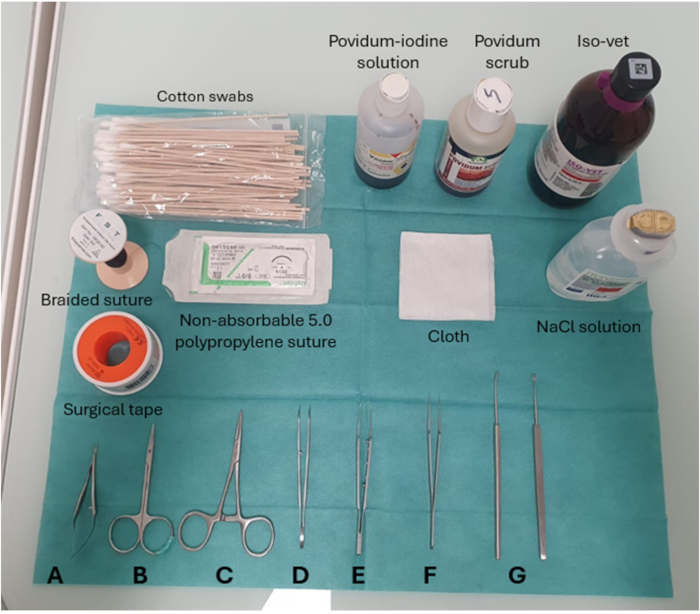
Figure 1: Instruments and reagents used for the surgery. (A) Noyes Scissors (straight), (B) Iris scissors (straight), (C) Mosquito Forceps (straight), (D) Curved tweezers, (E) Fine curved tweezers, (F) Fine straight tweezers, (G) Retractors. Please click here to view a larger version of this figure.
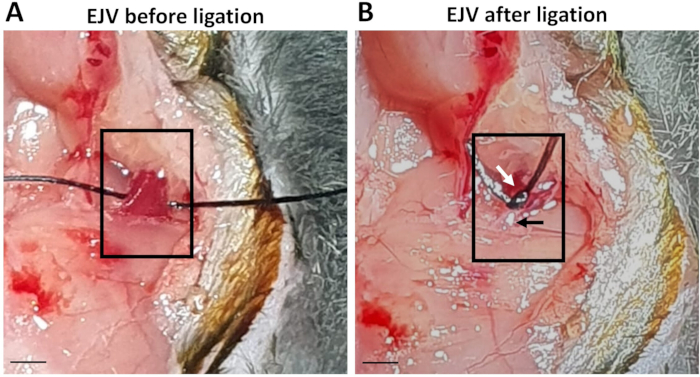
Figure 2: Direct surgical outcome: Morphological changes in the jugular vein. (A,B) Representative images of an external jugular vein (EJV) before (A) and after (B) ligation, with the vessel outlined in a black box. Following ligation, the segment of the vessel upstream of the ligation site is engorged (white arrow), while the downstream segment appears colorless and collapsed (black arrow) due to interrupted blood outflow. Scale bar = 2 mm. Please click here to view a larger version of this figure.
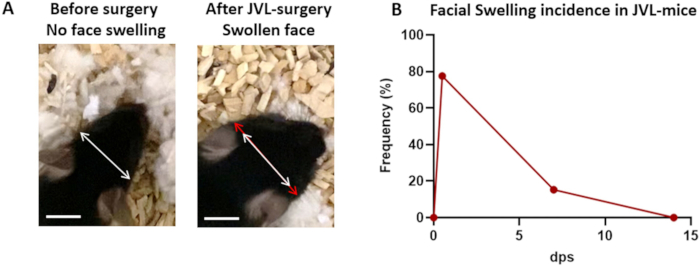
Figure 3: Time course of facial swelling after JVL surgery. (A) Representative images illustrating the postoperative facial swelling in JVL mice, highlighted by the red arrow (left panel), showing swelling that exceeds the normal facial width indicated by the white arrows.(B) The incidence of diffuse facial swelling was longitudinally assessed at multiple time points following JVL surgery. Swelling frequency peaked at 77.5% as early as 2 h post-surgery, followed by a pronounced decline to 15.3% by day 7 (dps 7) and complete resolution by day 14 (dps 14). Data represent longitudinal observations of 111 mice subjected to successful JVL surgery. Scale bar = 1 cm. Please click here to view a larger version of this figure.
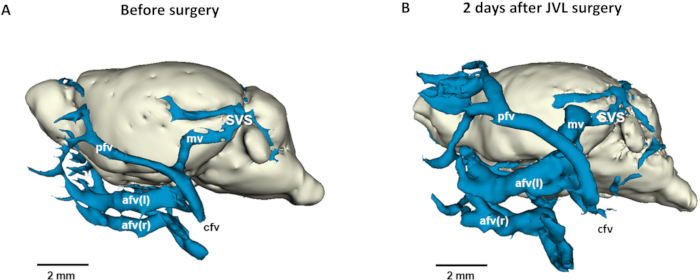
Figure 4: Mice MRI reveals enlargement of extracranial facial veins after ligation. (A,B) Lateral view of the brain and cranial/extracranial veins before (A) and 2 days after JVL surgery (B). 3D-reconstruction was generated with 3D-Slicer (https://www.slicer.org) and performed by 3D post-processing of multi-gradient echo (MGE) and time-of-flight (TOF) sequence images acquired with an 11.7 T scanner. Note the enlargement after surgery of extracranial veins, including the posterior facial vein (pfv), anterior facial vein (afv), and maxillary vein (mv) joining the common facial vein (cfv). Meningeal venous sinuses: sigmoid (SVS). Scale bar = 2 mm. Please click here to view a larger version of this figure.
Discussion
This methodological paper describes the surgical procedure for inducing cerebral venous outflow occlusion in mice through bilateral ligation of the internal and external jugular veins. Female mice were selected to reflect the gender and age profile of patients typically affected by IIH. This model effectively induces key clinical features of IIH, such as intracranial hypertension and brain fluid retention, highlighting cerebral venous outflow impairment as a central pathophysiological feature of the disease and supporting the relevance of this model23. However, due to compensatory vascular remodeling, these features are only transient. Mice with JVL are thus not mimicking IIH pathophysiology and do not reproduce the long-term consequences of chronic venous disorders. However, they provide an interesting model to investigate the remodeling processes induced in the blood and lymphatic vasculature to restore normal blood flow and CSF drainage after alteration of cerebral venous outflow. The dynamic changes in vascular phenotype observed over several weeks after surgery make JVL mice a suitable model for studying the mechanisms of brain vascular remodeling and its impact on fluid clearance and immune surveillance23. The present stepwise protocol ensures a high level of consistency between experiments, especially when performed by skilled practitioners, making it an effective approach for studying the pathophysiology of venous outflow disturbances. Additionally, this model provides longitudinal study opportunities, enabling researchers to assess the progression and resolution of venous congestion.
The main advantage and novelty of the JVL surgical procedure lies in its ability to induce cerebral venous outflow occlusion while preserving the integrity of dural vascular structures. Unlike intracranial approaches16,17,18, this technique avoids direct damage to the dura mater and associated meningeal vessels, enabling reliable analysis of downstream vascular and fluid clearance changes. Compared to other cervical techniques involving coagulation or double ligation followed by vessel transection21,22, this method is less invasive and minimizes tissue manipulation. By avoiding cauterization or excessive manipulations of the vessel, it reduces the risk of damaging adjacent cervical lymphatic vessels -- structures that are increasingly recognized for their role in brain fluid drainage and immune surveillance.
However, the surgery remains technically demanding and requires close postoperative monitoring, especially during the first 48 h. One of the main challenges is the need for high surgical precision. The procedure involves careful dissection and ligation of both internal and external jugular veins while avoiding injury to adjacent critical structures. Proper positioning of the animal is essential: the mouse must be stably secured, with forelimbs extended at right angles to the body and the head maintained in extension to optimize cervical exposure. The internal jugular vein is particularly delicate to isolate due to its proximity to the carotid artery, vagus nerve, and cervical lymphatic vessels. Meticulous dissection is required to avoid life-threatening injury. Compression or damage to the vagus nerve can result in sudden death due to severe autonomic disturbances, and significant bleeding -- especially from vessel perforation -- can lead to rapid deterioration and death if not promptly controlled. Anesthesia must be carefully monitored throughout the procedure, with the isoflurane level adjusted to the respiratory rate, and body temperature maintained via a heating pad. Adequate hydration is also critical, especially in the event of intraoperative bleeding. The use of ketamine is not recommended, as its anesthetic profile is unstable and its duration of action is poorly suited to the length and demands of the procedure.
Additionally, several limitations should be acknowledged. This model has only been validated in young female C57BL/6J mice, and outcomes may vary depending on sex, age, or genetic background. Moreover, venous occlusion in this model is extracranial, whereas IIH in humans involves intracranial dural sinus stenosis. The facial swelling observed in this model, resulting from extracranial venous hypertension, does not occur in IIH patients and may limit the translational relevance of certain peripheral features. Anatomical differences between species further constrain direct extrapolation to human physiology. For instance, in mice, the external jugular veins contribute more substantially to cerebral venous drainage than the internal jugular veins do in humans23. Moreover, vertebral veins play a more significant role in mice than in humans24,25. Lastly, cerebral venous drainage in humans is largely gravity-dependent in the upright position, which influences venous return. In mice, the smaller brain size and horizontal posture reduce the role of gravity, which less affects the efficiency and mechanism of venous blood return from the brain26.
Nevertheless, this model offers a robust and unique platform for investigating how impaired cerebral venous outflow drives remodeling of cerebro-meningeal blood vessels and meningeal lymphatics, as well as changes in brain fluid dynamics over time. Despite its limitations in mimicking the chronic and anatomical aspects of human venous disorders, the JVL model is easy to implement and highly reproducible, making it a valuable tool for studying key mechanisms involved in cerebral blood flow regulation and brain fluid clearance.
Disclosures
The authors have nothing to disclose.
Acknowledgements
This work was supported by Venolymphatic (BBT.1300), NEIMO (FRN, Fond de Recherche Neurosciences), BrainWash (ANR-17-CE14-0005), Lymbrain (ANR-20-CE16-0027-01). The authors are funded by the following sources: M.-R. El Kamouh, ANR-Lymbrain; M. Spajer, BBT.1300 Venolymphatic and INCA (Institut National du Cancer); Anne-Laure Joly Marolany: NEIMO (FRN) and ANR-11-INBS-0006; R. Singabahu: BBT.1300 Venolymphatic, INCA (Institut National du Cancer); S. Lenck: Institut National de la Santé et de la Recherche Médicale and Assistance Publique des Hôpitaux de Paris CIHU-2021.
Materials
| Name | Company | Catalog Number | Comments |
|---|---|---|---|
| 1 mL syringe Omnifix 100 Solo | B.Braun | Ref 91611708V | Used for hydration/dilution |
| Balance KERN 400-45N | KERN & SOHN | 400-45N | Used for tracking animal weight |
| Binocular stereotaxic microscope (Leica S6E) | Leica BIOSYSTEMS | Leica S6E | |
| Braided thread | FST | 18020-60 | Used for vein ligation |
| Buprenorphine (Buprecare), 0.3 mg/mL | Centravet | BUP002 | Used for analgesia |
| Cartridge for Inventor 2010 Scavenger (anesthesia) | PHYMEP | 8438025 | Used for anesthesia |
| Cloth Medicomp | Hartmann | 411029 | Used for maintaining aseptic conditions |
| Cotton swabs | Centravet | COT010 | Used for maintaining aseptic conditions |
| Curved tweezers (Narrow Pattern Curved serrated) | PHYMEP | No. 11003-20 | |
| Euthasol, 400 mg/mL | Centravet | EUT003 | Used for euthanasia |
| Fine curved tweezers (McPherson Forceps) | PHYMEP | No. 11063-07 | |
| Fine Iris scissors straight | PHYMEP | No. 22002-10 or No. 14094-11 | |
| Fine straight tweezers (Dumont Inox Medbio Forceps) | PHYMEP | No. 11254-20 | |
| Heating chamber VET-TECH | PHYMEP | HE011 | Used for maintaining body temperature at 37 °C |
| Homeothermal monitoring system Thermostar RWD | PHYMEP | 69027 | Used for monitoring body temperature |
| Insulin syringe 0.5 mL U-100 (0.33 mm (29 G) x 12.7 mm | BD Microfine TM+ | Ref 324892 | Used for analgesia |
| Isoflurane (Iso-vet), 1000 mg/g | Centravet | ISO005 | Used for anesthesia |
| Mosquito forceps straight | PHYMEP | No. 13010-12 | |
| Non-absorbabale 5.0 polypropene suture (Dafilon 5.0) | Centravet | DAF003 | Used for skin suturing |
| Noyes scissors straight | PHYMEP | No. 15012-12 | |
| Ophtalmic gel (Ocrygel) | Centravet | OCR002 | Used for protecting eyes from irritation and dryness |
| Povidum Iodine Solution (Vetedine), 75 mg/mL | Centravet | VET001 | Used for maintaining aseptic conditions |
| Povidum scrub 4% (soap) | Centravet | POV008 | Used for maintaining aseptic conditions |
| Retractors (Guthrie) | PHYMEP | No. 17021-13 | |
| Rimadyl (Carprofen), 50 mg/mL | Centravet | RIM012 | Used for analgesia |
| Shaver MOSER Germany | Bioseb | BIO-1556 | Used for fur shaving |
| Small anesthesia box induction | PHYMEP | pas de référence | |
| Sodium chloride solution 0.9% B.BRAUN | Centravet | CHL050 | Used for hydration/dilution |
| Stereotaxic frame KOPF | PHYMEP | 963076A | Used to position the animal |
| Surgery lamp (réf: KL 1500 LED) | LEICA BIOSYSTEMS | KL 1500 LED | |
| Surgical Tape | Centravet | COL427 | Used for securing upper and lower limbs |
| TERUMO AGANI Needles 26 G x (0.45 x 13 mm) Regular bevel 11° | Terumo | AN*2613R1 | Used for analgesia |
| Xylazine (Paxman), 20 mg/mL | Centravet | 221631 | Used for analgesia |
References
- Rua, R., McGavern, D. B. Advances in meningeal immunity. Trends Mol Med. 24 (6), 542-559 (2018).
- Rustenhoven, J., et al. Functional characterization of the dural sinuses as a neuroimmune interface. Cell. 184 (4), 1000-1016.e27 (2021).
- Kılıç, T., Akakın, A. Anatomy of cerebral veins and sinuses. Front Neurol Neurosci. 23, 4-15 (2007).
- Balik, V., et al. Variability in wall thickness and related structures of major dural sinuses in posterior cranial fossa: A microscopic anatomical study and clinical implications. Oper Neurosurg. 17 (1), 88-96 (2019).
- Walsh, D. R., Lynch, J. J., O' Connor, D. T., Newport, D. T., Mulvihill, J. J. E. Mechanical and structural characterisation of the dural venous sinuses. Sci Rep. 10 (1), 21763(2020).
- Louveau, A., et al. Structural and functional features of central nervous system lymphatic vessels. Nature. 523 (7560), 337-341 (2015).
- Antila, S., et al. Development and plasticity of meningeal lymphatic vessels. J Exp Med. 214 (12), 3645-3667 (2017).
- Absinta, M., et al. Human and nonhuman primate meninges harbor lymphatic vessels that can be visualized noninvasively by MRI. eLife. 6, e29738(2017).
- Ahn, J. H., et al. Meningeal lymphatic vessels at the skull base drain cerebrospinal fluid. Nature. 572 (7767), 62-66 (2019).
- Jacob, L., et al. Conserved meningeal lymphatic drainage circuits in mice and humans. J Exp Med. 219 (8), e20220035(2022).
- Louveau, A., et al. CNS lymphatic drainage and neuroinflammation are regulated by meningeal lymphatic vasculature. Nat Neurosci. 21 (10), 1380-1391 (2018).
- Da Mesquita, S., et al. Functional aspects of meningeal lymphatics in ageing and Alzheimer's disease. Nature. 560 (7717), 185-191 (2018).
- Grech, O., et al. Cognitive performance in idiopathic intracranial hypertension and relevance of intracranial pressure. Brain Commun. 3 (3), fcab202(2021).
- Markey, K. A., Mollan, S. P., Jensen, R. H., Sinclair, A. J. Understanding idiopathic intracranial hypertension: mechanisms, management, and future directions. Lancet Neurol. 15 (1), 78-91 (2016).
- Nicholson, P., et al. Venous sinus stenting for idiopathic intracranial hypertension: a systematic review and meta-analysis. J NeuroInterventional Surg. 11 (4), 380-385 (2019).
- Bourrienne, M. -C., et al. A novel mouse model for cerebral venous sinus thrombosis. Transl Stroke Res. 12 (6), 1055-1066 (2021).
- Taniguchi, R., et al. A mouse model of stenosis distal to an arteriovenous fistula recapitulates human central venous stenosis. JVS Vasc Sci. 1, 109-122 (2020).
- Ding, R., et al. Activating cGAS-STING axis contributes to neuroinflammation in CVST mouse model and induces inflammasome activation and microglia pyroptosis. J. Neuroinflammation. 19 (1), 137(2022).
- Atkinson, W., et al. Ligation of the jugular veins does not result in brain inflammation or demyelination in mice. PLoS One. 7 (3), e33671(2012).
- Bolte, A. C., et al. Meningeal lymphatic dysfunction exacerbates traumatic brain injury pathogenesis. Nat Commun. 11 (1), 4524(2020).
- Auletta, L., et al. Original Research: Feasibility and safety of two surgical techniques for the development of an animal model of jugular vein occlusion. Exp Biol Med. 242 (1), 22-28 (2017).
- Nyul-Toth, A., et al. Cerebral venous congestion exacerbates cerebral microhemorrhages in mice. GeroScience. 44 (2), 805-816 (2022).
- El Kamouh, M. -R., et al. Cerebral venous blood flow regulates brain fluid clearance via dural lymphatics. bioRxiv. , (2024).
- Mancini, M., et al. Head and neck veins of the mouse. A magnetic resonance, micro computed tomography and high frequency color Doppler ultrasound study. PloS One. 10 (6), e0129912(2015).
- Farrar, M. J., Rubin, J. D., Diago, D. M., Schaffer, C. B. Characterization of blood flow in the mouse dorsal spinal venous system before and after dorsal spinal vein occlusion. J Cereb Blood Flow Metab. 35 (4), 667-675 (2015).
- Fitzpatrick, Z., et al. Venous-plexus-associated lymphoid hubs support meningeal humoral immunity. Nature. 628 (8008), 612-619 (2024).
- Johnson, J. N., et al. The human craniospinal venous system and its influence on postural intracranial pressure: a review. J Neurosurg. 141 (6), 1484-1493 (2024).
Reprints and Permissions
This article has been published
Video Coming Soon