Clicker training serves as a positive reinforcement technique for laboratory gerbils. This method aims to reduce stress and improve handling efficiency through positive reinforcement, thereby contributing to the well-being of experimental animals.
Method Article
Enhancing Gerbil Welfare Through Positive Reinforcement Training in Research Environments
In This Article
Summary
Abstract
Improving laboratory animal welfare by minimizing stress and promoting species-appropriate handling is a central goal of contemporary biomedical research worldwide. Clicker training, a widely recognized form of positive reinforcement training, uses a click sound as a conditioned reinforcer to bridge the desired behavior and the reward, enabling animals to learn more quickly and with reduced stress. Our research group has previously demonstrated that clicker training functions as a form of cognitive enrichment in mice and rats. In the present study, we successfully adapted this training approach for Mongolian gerbils (Meriones unguiculatus), tailoring the protocol to the species-specific behavioral characteristics of gerbils. A cohort of 43 inbred gerbils (27 females and 16 males) underwent a standardized 10-day clicker training protocol, during which they learned to voluntarily approach and interact with the experimenter's hand in exchange for a food reward. Following the training period, animals were subjected to behavioral assessments, including an Open Field Test and a standardized human interaction test, to evaluate the effects of training on exploratory behavior and human-animal interaction. Our findings demonstrate that the implementation of clicker training in gerbils is fast, efficient, and well-tolerated. Trained animals, particularly females, showed increased voluntary interaction with the experimenter's hand and reduced anxiety-like behaviors. These results suggest that species-adapted clicker training protocols can facilitate the development of trust between experimenter and animal, ultimately decreasing stress and improving both animal welfare and the reliability of experimental outcomes.
Introduction
Refining animal use in biomedical research to reduce stress and improve welfare is a widely recognized international objective1,2,3. In 2022, the European Commission reported that of the 838,539 animals used in the European Union (Alures), 3,440 were gerbils4. In Germany, approximately 1.46 million vertebrates and cephalopods were used in animal experiments in 2023 under Section 7 (2) of the Animal Welfare Act (TierSchG)5. Combined with animals killed for scientific purposes, the total number of laboratory animals used in Germany in 2023 reached approximately 2.1 million6. These numbers highlight the relevance of using gerbils in biomedical research, emphasizing the need for continuous improvements in protocols for animal welfare.
The behavioral needs of laboratory animals and the importance of management strategies that support species-specific welfare have been widely recognized as essential to ethical and scientific practice7. Human-animal interactions in husbandry are often limited to the essential task of transferring animals from dirty to clean cages, without fostering a bond between the handler and the animal. This lack of social interaction can lead to stress, which negatively affects animal behavior and physiology, ultimately influencing experimental outcomes8. Improper handling is a well-known source of variability in research data9. For instance, lifting mice by the tail increases anxiety and stress, while tunnel or open-hand methods promote a voluntary approach and reduce anxiety-like behavior10,11. Handling is even used as a standardized acute stressor in small mammal studies due to its consistent effects on physiological markers like glucocorticoid levels12. These findings highlight the substantial impact of brief human interactions and the need for refined low-stress handling techniques13.
Training-based refinement has gained increasing recognition as an effective method for enhancing both animal well-being and research quality10,14. One of the most effective training methods used in animal research is clicker training, which is often paired with food rewards15,16. Over the past decades, 34 studies on clicker training have been published, reflecting the growing scientific interest in this training approach17. Studies show that dogs (47%) and horses (30%) are the most commonly trained laboratory animals, followed by cats, cattle, fish, goats, and monkeys (each 3%)17. Trained animals can voluntarily participate in procedures, reducing stress and minimizing the need for physical restraint18.
Positive reinforcement protocols have also been applied to small mammals. Recent studies report successful training in rabbits for husbandry procedures, and gerbils for behavioral research19,20. In some previous works, we showed that clicker-trained mice exhibited increased contact with experimenters and fewer behavioral indicators associated with stress, such as urination, defecation, vocalization, and floating behavior21,22,23. This is consistent with findings from the veterinary field, where training of small mammals -- such as rabbits, rodents, and ferrets -- has been shown to reduce fear responses and facilitate handling through positive reinforcement techniques24. Notably, we also observed a sex-specific difference in training performance: female mice showed greater motivation and higher response frequency than males across training sessions. This suggests that female mice may engage more readily with voluntary training tasks under standardized conditions21.
While promising, existing training approaches for gerbils are typically tied to specific behavioral paradigms and not designed for general use in daily husbandry routines25. A broadly applicable, standardized protocol for Mongolian gerbils (Meriones unguiculatus) -- independent of a particular experimental setup -- has not yet been established. To address this gap, the present study aimed to develop and validate a simple clicker training protocol tailored to the species-specific characteristics of gerbils. The protocol focuses on stress reduction through gentle handling and voluntary engagement with the experimenter. We hypothesize that this approach will improve animal welfare, establish more consistent behavioral baselines, and increase the reliability of experimental outcomes. Due to its simplicity and flexibility, it could be readily implemented across a wide range of laboratory settings.
To assess the effectiveness and applicability of the proposed training protocol, we formulated the following specific, testable predictions:
Trained gerbils would reliably perform the target behavior -- voluntarily sitting on the experimenter's hand -- within a 10-day training period.
Trained animals would display increased voluntary interaction with the experimenter in a standardized test, compared to untrained controls.
Trained animals would exhibit behavioral indicators consistent with reduced anxiety-like behavior, specifically by spending more time in the center zone of an open field test.
Female gerbils might show stronger behavioral responses to training than males, potentially reflecting sex differences in adaptation to human interaction.
These predictions guided the design of the behavioral assessments and informed the evaluation criteria for the protocol.
Protocol
The handling of the gerbils and the experimental procedures were conducted in accordance with European, national, and institutional guidelines for animal care. Approved by the local authorities' license G 21-1-100. The protocol includes 10 days of training (Monday to Friday), with breaks on the weekends (Saturday and Sunday). The protocol can be easily adapted to meet specific needs. All required materials are listed in the Table of Materials.
1. Animal preparation
- Obtain the required number of animals from the institutional breeding facility. Maintain animals under a 12 h light/dark cycle in an open housing system.
- Wean offspring at 5 weeks of age. Ear-tag the animals after weaning and house in same-sex groups of 2-3 individuals per cage.
- Rear and house all gerbils in Type 4 cages (590 x 380 x 200 mm; 1.815 m2). Equip each cage with at least three tunnels and chew wood for enrichment. Provide food and water ad libitum (see Table of Materials).
- Randomly assign animals to trained (females: n=27; males: n=16) and untrained (females: n=16; males: n=5) groups to minimize selection bias and ensure comparable baseline conditions across treatments. Habituate animals to both the food reward and the experimenter's hand within the breeding cage environment, as outlined in step 2.2. of the protocol. At the start of training, the animals (females and males) were approximately 8 weeks old.
2. Animal habituation
NOTE: If gerbils were not transported, the habituation time can be reduced. The graphical overview of the protocol is depicted in Figure 1. In in-house bred animals, the habituation period for juveniles can be drastically shortened if the parent animals are well habituated and hand-based habituation is continued at least once per week from the time the pups become mobile. This preparatory phase is designed to reduce neophobia and establish a positive food-handling association, ensuring a smooth transition into clicker-based training.
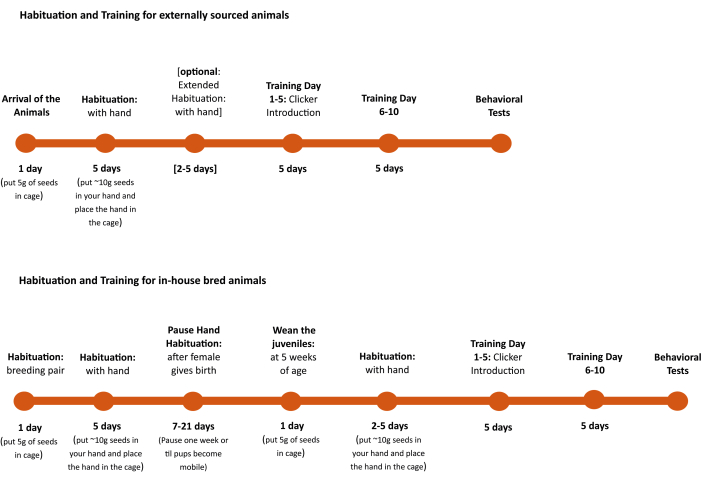
Figure 1: Habituation and training protocol overview for externally sourced and in-house bred animals: This figure outlines the timeline and key procedural steps of the habituation and training protocol used for externally sourced gerbils and in-house bred gerbils. The protocol includes initial handling, food habituation, clicker introduction, and clicker training, adjusted based on the origin and pre-exposure of the animals. Please click here to view a larger version of this figure.
- Week 1: Habituation for externally sourced animals
- Upon arrival, house gerbils in same-sex groups of 2-3 animals per cage. Add nesting and bedding material from the transport box, along with a small amount of familiar food pellets to support acclimatization.
- Provide each cage with at least 3-4 tunnels (e.g., cardboard tubes or plastic shelters) and fill the bedding to a depth of approximately 8-10 cm to allow for species-typical digging behavior.
- Avoid lifting gerbils by the tail, as this can cause stress and risk tail injury26. Instead, use cupped handling to gently transfer the animals when necessary (see Figure 2A).
- Initiate food-based habituation immediately by scattering ~5 g of pumpkin or sunflower seeds into the bedding (see Table of Materials). This encourages digging and familiarizes the animals with the reward.
- On the following day, introduce one hand containing ~10 reward seeds into the cage for 2-3 min. If the animals do not take the seeds directly, place ~5 g of seeds into the bedding.
- Repeat this procedure once daily until the animals take food from the hand. This usually takes about a week. If successful earlier, proceed to clicker training (see step 3).
- During habituation, assess food preferences by offering different seed types in the hand and counting remaining seeds after 2-3 min.
NOTE: Provide food in small portions solely as a reward to reinforce desired behavior. Ensure that the food reward complies with nutritional guidelines for laboratory animals. While this protocol uses pumpkin and sunflower seeds, other suitable rewards may be used if they meet facility hygiene requirements. Commercially available treats designed for laboratory animals are also acceptable.
- Week 1: Habituation for in-house bred animals
- Begin habituation to the food reward directly in the breeding cage by placing ~5 g of pumpkin or sunflower seeds into the bedding, as described in step 2.1.3. This step should be initiated with the breeding pair before parturition to establish familiarity with the reward.
- Once the breeding animals reliably consume seeds from the bedding, offer the reward from the experimenter's hand following the procedure outlined in step 2.1.4. Allow animals to explore and take the reward voluntarily for 2-3 min daily.
- After the female gives birth, suspend hand-based habituation for a minimum of 1 week. During this time, continue to provide food rewards directly into the cage bedding 1-5 times per week to maintain exposure.
- Resume hand-based habituation once the pups become mobile (approximately day 18-21 postpartum). Allow the animals to explore the hand with reward for 2-3 min per session. This supports early familiarization of the offspring with the training context.
- At 5 weeks of age, wean the juveniles and group-house them in same-sex groups of 2-3 animals per cage. Continue the habituation by placing the food reward into the new cage bedding on the day of transfer.
- On the day following the weaning, reintroduce hand-based food delivery as described above (steps 2.1.4 and 2.1.5).
- Repeat this procedure once daily until the animals take food from the hand.
- Once juveniles take the reward consistently from the hand, proceed with the training protocol (see step 3). This usually takes about 1 week. If successful earlier, proceed to clicker training (see step 3).

Figure 2: Handling and habituation of a gerbil using positive reinforcement. (A) Cupped handling of a gerbil: A gerbil is gently scooped with both hands in a cupped manner to minimize stress. (B) Start of training: The experimenter's hand is placed on the cage floor with food rewards in the palm. The gerbil takes a reward, and a click is used to mark the behavior. (C) The gerbil voluntarily sits on the experimenter's hand, indicating successful training. The food reward is visibly placed on the palm. Please click here to view a larger version of this figure.
3. Clicker training
NOTE: Begin training only if the gerbil accepts food from the experimenter's hand. If not, extend the food habituation phase beyond the duration as described in step 2.1. or 2.2.
- Training overview
- Conduct one training session per gerbil per day, each lasting 4 min. Conduct the training directly in the animal's home cage to reduce stress and maintain a familiar environment. It is not necessary to remove all enrichment items but ensure that at least one tube or tunnel remains in the cage, and that there is sufficient space for the experimenter's hand on the cage floor.
NOTE: Ideally, training should be conducted in a dedicated quiet room. If this is not feasible, a sound-shielded cabinet within the animal facility may be used, provided it effectively reduces exposure to environmental noise and disturbances. - To prevent auditory cues from becoming confounding variables, strictly avoid verbal communication or vocal sounds during the training sessions. Limit any vocal interaction with the animals to periods outside the training context.
- Use repetition of the target behavior (e.g., voluntarily sitting on the experimenter's hand) as a practical indicator of successful habituation and learning during training. Consider training successful when this behavior is observed at least 5x per session over three consecutive days (see step 3.4.4).
- Conduct one training session per gerbil per day, each lasting 4 min. Conduct the training directly in the animal's home cage to reduce stress and maintain a familiar environment. It is not necessary to remove all enrichment items but ensure that at least one tube or tunnel remains in the cage, and that there is sufficient space for the experimenter's hand on the cage floor.
- Training preparation
- Prepare all required materials: cut sunflower seeds in half or pumpkin seeds into thirds as rewards. Provide a foot clicker, a timer app that uses color cues (no sound), or any other silent timer (digital or analog), and a clean secondary cage (see Table of Materials).
- Move the home cage to a quiet, distraction-free area where the training will take place to minimize environmental stressors. Avoid sudden or loud noises such as talking, door slamming, or equipment sounds during the session, as gerbils are highly sensitive to auditory stimuli.
- Remove all enrichment items except one tunnel. Ensure the remaining tunnel does not obstruct access to the training area. Make sure there is enough space to accommodate a hand.
- Transfer any companion animal to the clean secondary cage, including a small amount of home cage bedding and enrichment to reduce stress during separation.
- Place the foot clicker (a mechanical device that produces a clicking sound when pressed with the foot; see Table of Materials) beneath the table or training surface. This allows the trainer to mark the desired behavior without using their hands, ensuring consistent timing while keeping both hands available for interacting with the animal.
- Training day 1-5: Clicker introduction
- Start the timer: tap Start in the app or press the button on the silent timer.
- Stand or sit in front of the cage. Place five pieces of the selected seed in the palm and lay the hand flat on the substrate in one corner of the cage.
- Click the moment the gerbil takes a seed from the hand (Figure 2B). If multiple seeds are taken in sequence, click after each one. Use the click sound to associate the food reward with the behavior of feeding from the hand.
- End the training when the animal performs the desired behavior 5x or when the timer reaches zero (after 4 min).
- Starting from day 3, depending on the gerbil's behavior, begin offering the seeds one at a time. Hold the hand just above the cage floor to encourage the animal to stretch or make brief contact with its forepaws (Figure 2C). This helps shape the behavior gradually and prepares the animal for the next training phase (see step 3.4).
- Training day 6-10
NOTE: Optional training tip: If a gerbil is reluctant to climb onto the hand, break the task into smaller, confidence-building steps. First, reinforce the behavior of touching the hand before expecting the animal to climb. Use this shaping strategy to reduce stress and support animals that require more time to habituate to handling.- Offer only one seed at a time. Hold the hand slightly elevated above the substrate to encourage the gerbil to fully climb onto the hand to access the reward. This step builds on the previous shaping process and represents the transition to the final target behavior.
- Once the gerbil consistently climbs onto the hand, click to reinforce the behavior. Begin offering the seed using your second hand (see Figure 3). Maintain the training hand above the cage floor so that the gerbil must climb fully onto it. Use one hand to either hold the seed between your thumb and forefinger (Figure 3A) or use one hand to present the reward above the palm of the other hand, which the animal is encouraged to climb onto (Figure 3B).
- Assess training success as the gerbil voluntarily sitting on the experimenter's hand 5x per session and accepting the reward either from the palm or from the second hand.
- Conclude the training after a maximum duration of 3 weeks (5 days per week) or when the training goal is consistently demonstrated over a period of 3 consecutive days.
NOTE: Although the protocol defines a structured training phase of up to 3 weeks, reinforcement sessions may be continued beyond this period if needed, particularly when a delay is expected between the end of training and the start of the experimental procedures. Continued positive reinforcement can help maintain the learned behavior and ensure reliability across time. We recommend continuing reinforcement once per week after successful completion of the training phase. However, to ensure consistency and comparability between animals, a clear training endpoint-defined by the stable and repeated performance of the target behavior-should be documented before transitioning to experimental tasks.
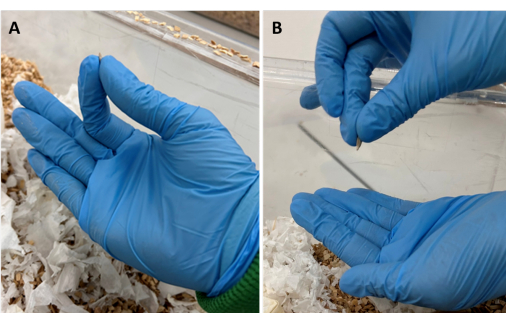
Figure 3: Examples of hand positioning during reward delivery. (A) The reward is held between the thumb and index fingers of the same hand, while the animal sits on the palm. (B) The reward is held with the second and index fingers, while the animal sits on the palm of the other hand. Please click here to view a larger version of this figure.
4. Conducting behavioral tests after training (day 10+)
- Test of interaction
NOTE: Dependent variables: The primary dependent variable is the duration of voluntary interaction between the animal and the experimenter's hand during the second minute of the test. Interaction is defined as direct physical contact, such as sniffing, climbing, or touching the hand with the forepaws10. Behavioral scoring is based on video recordings and can be performed manually or using behavioral analysis software.- Position a camera mounted on a tripod above the table where the interaction test will be conducted.
- If animals are housed in groups, transfer animals to a clean secondary cage containing a handful of bedding from the home cage.
- Remove all tunnels or shelters from the home cage and place them in the clean cage. Leave only the bedding in the test cage (=home cage). Place the home cage, now containing only bedding, under the camera.
- Use cupped handling to gently return the test animal to the home cage.
- Start recording. Remain still in front of the cage for 1 min. After 1 min, place one gloved hand inside the cage near the front edge for an additional 1 min.
- Change gloves between animals of different sexes.
- Open field test
NOTE: Dependent variables: Measured variables include total distance traveled, time spent in the center zone versus periphery, number of center entries, and rearing events. These indicators reflect general locomotor activity and anxiety-like behavior. Increased center time is typically interpreted as reduced anxiety. Behavior is recorded by video and analyzed using automated tracking software (see Table of Materials).- Position a camera above the open field arena (100 cm x 100 cm x 40 cm).
- Start video recording, then gently place the animal in the center of the arena using cupped handling. Record behavior for 7 min.
- After the test, return the animal to its home cage. Clean the open field box and walls with 70% ethanol after each animal. Wait until the ethanol has completely evaporated before placing the next animal into the arena.
5. Statistical analysis
- While full blinding of the experimenter was not feasible during the training sessions due to the nature of direct interaction with the animals, perform behavioral data analysis in a blinded manner to reduce observer bias.
- For both the interaction and open field tests, record all sessions on video. Collect dependent variables either manually by trained observers (interaction test) or automatically using behavioral analysis software (see Table of Materials) for open field recordings (time spent in the center zone).
- Prior to statistical analysis, test all data for normal distribution using the Shapiro-Wilk test. Identify outliers and exclude using the Robust Regression and Outlier Removal (ROUT) method with a false discovery rate (Q) set to 10%. To analyze the effects of training and sex on behavioral outcomes, conduct a two-way repeated measures ANOVA for the interaction test, and a mixed two-way ANOVA to evaluate the time spent in the center of the open field test.
- Categorize the test of interaction and the cumulative time spent in the center zone of the open field as the main dependent variables. Conduct post hoc comparisons using Tukey's Honest Significant Difference (HSD) test. A p-value of < 0.05 was considered statistically significant. All statistical analyses were performed using statistical software (see Table of Materials).
Results
All trained gerbils learned the assigned task within 10 days, demonstrating the feasibility of clicker training in this species. Figure 4 presents the training success of female (n=27) and male (n=16) gerbils from Day 1 to Day 10. The repeated-measures ANOVA analyzing performance on Training Day 1 versus Day 10 in male and female gerbils revealed no significant interaction effect between time and sex (F(1, 41) = 0.003; p = 0.955), indicating that the improvement over time was similar for both sexes. A highly significant effect of time was observed (F(1, 41) = 38.83, p < 0.0001), showing that gerbils from both sexes fully complied with the training protocol by Day 10.
The fact that trained gerbils complied with their assigned task within 10 days validates the effectiveness of clicker training methodology in this species. This success rate aligns with fundamental principles of operant conditioning, where the clicker functions as a secondary reinforcer that bridges the gap between the desired behavior and the primary reward (sunflower/pumpkin seeds). The clicker serves as a bridge between the behavior and the reward, allowing the trainer to mark the exact moment the desired behavior occurs with precise timing. This helps create a clear and immediate association between the action and its positive consequence.
Behavioral testing was conducted following the completion of the training protocol, specifically after training day 10. Two-way mixed ANOVA analysis showed that trained gerbils increased voluntary interaction with the experimenter's hand (Figure 5A). A significant effect of training was detected (F (1, 60) = 22.89; p < 0.0001), with trained animals engaging more frequently with the experimenter. Post hoc analysis revealed the specific differences of training in females (p < 0.0001, n = 27) and males (p = 0.049, n = 16). Sex effect was not observed (F(1, 60) = 0.621, p = 0.434), suggesting that male and female gerbils performed similarly overall. The analysis revealed no significant interaction between sex and training (F(1, 60) = 0.078, p = 0.781).
The increased voluntary interaction by the gerbils indicates that clicker training effectively reduced innate fear responses through positive reinforcement. This may help minimize stress during handling and experimental procedures, improving both animal welfare and data quality.
An assessment of anxiety-like behavior post-training was carried out using the Open Field Test. Figure 5B illustrates the cumulative duration spent in the center zone. No interaction between sex and training was observed in the cumulative duration in the center zone of the Open Field Test (F(1, 60) = 0.101, p = 0.751). Additionally, no significant main effect of sex was found (F(1, 60) = 0.001, p = 0.969. A highly significant main effect of training was observed (F(1, 60) = 17.26, p < 0.0001; HSD Tukey test: p = 0.003 and p = 0.052 in females and males, respectively), indicating that trained gerbils spent significantly more time in the center compared to untrained ones. These results reflect behavioral responses measured after the animals had completed the 10-day training period.
The OFT exploits the natural approach-avoidance conflict that rodents experience when exploring novel environments27. Gerbils may balance their innate drive to explore with their natural tendency to avoid potentially dangerous open spaces. Therefore, the fact that trained gerbils spent more time in the anxiety-provoking center zone indicates that the clicker training enhanced their overall behavioral willingness of exploration, which may indicate improvements in general welfare.
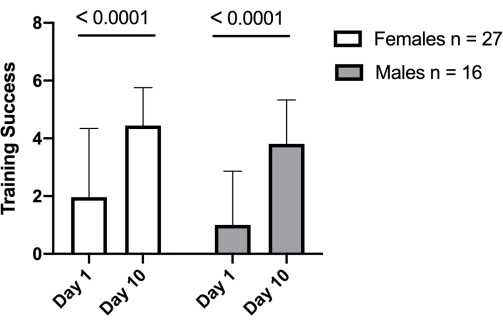
Figure 4: Clicker training validation. Training success on day 1 versus day 10 for male and female subjects: Training success was assessed in female (white bars, n = 27) and male (gray bars, n = 16) gerbils on day 1 and day 10 of the training protocol. A two-way repeated measures ANOVA revealed a significant main effect of training day (p < 0.0001). Multiple comparisons using Tukey's HSD test showed a significant increase in training success from day 1 to day 10 in both females (p < 0.0001, n = 27) and males (p < 0.0001, n = 16). Data are presented as mean ± SD. Please click here to view a larger version of this figure.
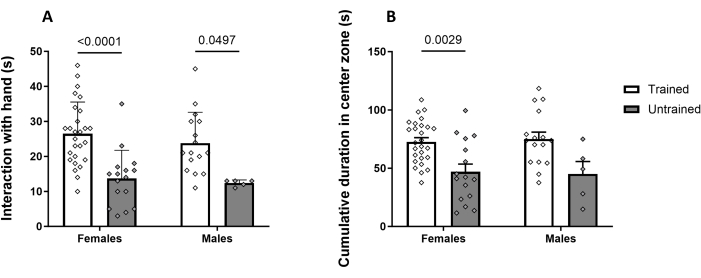
Figure 5: Behavioral assessment. (A) Test of interaction: The duration of interaction with the experimenter's hand (in s) was measured in trained (gray bars) and untrained (white bars) female and male Gerbils after the animals had completed the 10-day training period. The two-way mixed ANOVA revealed a significant main effect of training (p < 0.05) and a significant interaction effect (p < 0.05). Post hoc analysis using Tukey's HSD test showed that trained mice interacted significantly longer with the experimenter's hand compared to untrained mice (females: p < 0.0001, males: p = 0.0497). Data are presented as mean ± SD. Females trained: n= 27; females untrained: n =16; males trained: n = 16; males untrained: n = 5. (B) Open Field Test: The test was conducted after completion of the training protocol, specifically after training day 10. The cumulative duration spent in the center zone (s) was measured in trained (gray bars) and untrained (white bars) female and male gerbils. A two-way mixed ANOVA was performed to analyze the effects of training on center zone exploration. Multiple comparisons using Tukey's HSD test revealed that trained females spent significantly more time in the center zone compared to untrained females (p = 0.003). Data are presented as mean ± SD. Females trained: n= 27; females untrained: n =16; males trained: n = 16; males untrained: n = 5. Please click here to view a larger version of this figure.
Discussion
The findings show the effectiveness of the proposed protocol for habituating gerbils to human interaction in experimental environments. The ability of all trained animals to complete the desired task within 10 days highlights the efficiency of this method.
One critical step in the protocol is the gradual habituation to the experimenter's hand, ensuring that the gerbils associate human interaction with a positive stimulus. The use of species-specific rewards further optimizes the training process. Modifications, such as adjusting the duration of training sessions or changing the reward type, could further tailor the protocol to individual differences among gerbils and optimize it for the specific requirements of the experiment.
We focus on the notable species-specific differences in behavior and learning dynamics between mice and Mongolian gerbils. Such differences should be considered when designing training protocols. For instance, mice tend to be more neophobic and stress-sensitive, often requiring more time to habituate to novel environments and human interaction28. In contrast, gerbils exhibit higher exploratory drive and social curiosity, which can facilitate faster engagement with training tasks29. In the present study, gerbils readily approached the experimenter's hand and learned to associate the clicker with a reward in fewer sessions than typically reported for mice21,22. However, gerbils also showed greater individual variability, particularly in males, which may reflect sex-specific stress or motivational factors that are less pronounced in mouse models. These distinctions highlight the importance of species-adapted training strategies and suggest that gerbils may benefit from shorter, reward-focused sessions with greater emphasis on voluntary interaction, whereas mice may require more gradual desensitization and consistent repetition. Understanding these behavioral and cognitive differences is crucial for refining training protocols and maximizing their effectiveness across species.
Mongolian gerbils can benefit substantially from non-specific or generalized clicker training, which focuses on positive human-animal interaction and basic behavioral conditioning rather than preparation for a particular experimental setup. Such generalized training enhances handling tolerance, reduces basal stress levels, and promotes a more predictable behavioral baseline factors that are valuable across a wide range of experimental contexts30. Non-specific training promotes behavioral flexibility and consistent voluntary interaction with the experimenter, making animals more adaptable to different environments, setups, or testing paradigms16,31,32. This is particularly beneficial in long-term studies or multi-phase experiments, where animals are exposed to a variety of procedures. In the present study, even though the training was not directly tied to a single test protocol, gerbils showed improved interaction with the experimenter and reduced stress-related behavior, supporting the idea that general habituation through positive reinforcement can improve overall experimental resilience and animal welfare.
In addition to increased interaction with the experimenter, trained female animals spent significantly more time in the center zone of the open field test. This behavioral pattern is commonly interpreted as a reduction in anxiety-like behavior in rodents, particularly in response to novel or mildly aversive environments33. These findings suggest that clicker training may contribute to decreased behavioral indicators of anxiety, thereby enhancing the animals' capacity to cope with experimental procedures. This supports the broader conclusion that positive-reinforcement-based habituation protocols can improve stress resilience and behavioral stability in laboratory gerbils. Beyond stress reduction, clicker training has broader implications for experimental outcomes34. Trained gerbils demonstrated greater tolerance of handling, which minimizes stress-induced physiological variations that could confound research results. Similar findings have been reported in other species, including laboratory rabbits and mice, where clicker-trained animals exhibited increased experimenter interaction and fewer anxiety- and depression-related behaviors, such as reduced urination, defecation, vocalization, and floating behavior19,21.
These outcomes highlight the potential of clicker training to improve both animal welfare and the consistency of behavioral data by reducing variability in stress-related responses. It is important to clarify that the aim of this protocol is not to condition animals to associate inherently aversive procedures-such as blood draws-with positive stimuli like the clicker. Rather, the goal is to reduce baseline stress, habituate animals to human interaction, and promote voluntary participation in neutral or mildly challenging tasks. While some studies have explored the use of positive reinforcement to prepare animals for more invasive procedures35, this requires a carefully structured desensitization process and is beyond the scope of the current protocol. Misapplication of clicker cues in contexts associated with discomfort could indeed result in unintended negative associations. However, when applied correctly, positive reinforcement techniques can help animals cope with potentially aversive procedures by enhancing predictability and allowing a degree of control36. Further studies are needed to determine whether gerbils can be reliably trained for such contexts, as has been successfully demonstrated in other species such as dogs and nonhuman primates37,38.
Despite its success, the method has limitations. Some gerbils required longer habituation periods, indicating individual variability in learning speed. Additionally, the relatively low number of untrained male gerbils limits the statistical power of the analysis, making it difficult to draw robust conclusions. Increasing the sample size in this group would likely improve the reliability and interpretability of the results. Further studies should explore potential sex differences in stress responses and learning mechanisms.
The broader implications of this study extend beyond stress reduction. Implementing structured training protocols as part of standard husbandry may reduce variability caused by stress-induced physiological responses and improve the reliability of experimental outcomes39,40. This is especially relevant in disciplines such as neuroscience or metabolic research, where stress is a critical confounding factor. Careful reporting and standardization of training procedures are essential to avoid unintended enrichment effects.
Moving forward, future research should explore alternative reinforcement schedules, automation of training procedures, and long-term effects across species. With increasing scientific support, clicker training represents a valuable refinement strategy that can enhance both data quality and animal welfare. Standardizing training and handling protocols across laboratories could help improve reproducibility and support broader adoption of humane and effective practices in biomedical research.
Disclosures
The authors declare no competing financial interests.
Acknowledgements
This work was supported by the Translational Animal Research Center of the University Medical Center of the Johannes Gutenberg-University Mainz.
Materials
| Name | Company | Catalog Number | Comments |
|---|---|---|---|
| Cages | Zoonlab GmbH | 3010006 | 590 x 380 x 200 mm; 1.815 m2 |
| Camera | Sony | HDR-CX240E | digital HD Video Camera Recorder |
| Food pellets | Ssniff | V1644-000 | Art. Nr. I-Clicker-Blau |
| Foot Clicker | https://www.hundeschulen.com | ||
| GraphPad Prism | GraphPad Software, Inc | https://www.graphpad.com/features | Version 10 for windows |
| Open field Box | Noldus | MXO1S-M001 | opal 100 x 100 x 40 cm |
| Pumpkin seeds | REWE | 8820911 | REWE Bio |
| Pylon viewer | Basler | https://www.baslerweb.com/de-de/software/pylon/ | |
| Sunflowerseeds | Seeberger | 4744292 | |
| Tripod | Manfrotto | GT- mkbfra4gtxp bh | Befree GT |
| Tunnels | Plexx | 14179 | 152 x 76 x 3 mm |
References
- Animal Use Alternatives (3Rs). , National Agricultural Library. Accessed May 21, 2025 https://www.nal.usda.gov/animal-health-and-welfare/animal-use-alternatives (2025).
- The 3Rs. , NC3Rsy. Accessed May 21, 2025 https://nc3rs.org.uk/who-we-are/3rs (2025).
- Locke, P., Romanchik, R., Kincaid, B., Golden, E. The 3RS and non-human animals in biomedical research: the next 65 years. , https://www.ufaw.org.uk/ (2025).
- Number of animals used in experiments in 2022. , European Commission. https://webgate.ec.europa.eu/envdataportal/content/alures/section1_number-of-animals.html (2022).
- Tierschutzgesetz TierSchG, 2022. , Bundesministerium der Justiz. https://www.gesetze-im-internet.de/tierschg/BJNR012770972.html (2022).
- Verwendung von Versuchstieren im Berichtsjahr 2023. , Bundesinstitut für Risikobewertung (BfR). https://www.bf3r.de/de/verwendung_von_versuchstieren_im_berichtsjahr_2023-318066.html (2022).
- Mulholland, M. M., Neal Webb, S. J., Schapiro, S. J. Behavioral Needs and Management of Laboratory Animals. Handbook Lab Animal Sci. 4, 14(2021).
- Gärtner, K., et al. Stress response of rats to handling and experimental procedures. Lab Anim. 14 (3), 267-274 (1980).
- Marcotte, M., et al. Handling Techniques to Reduce Stress in Mice. J Vis Exp. (175), e62593(2021).
- Hurst, J. L., West, R. S. Taming anxiety in laboratory mice. Nat Meth. 7, 825-826 (2010).
- Gouveia, K., Hurst, J. L. Reducing Mouse Anxiety during Handling: Effect of Experience with Handling Tunnels. PLoS One. 8 (6), e66401(2013).
- Ryabinin, A. E., Wang, Y. M., Finn, D. A. Different levels of Fos immunoreactivity after repeated handling and injection stress in two inbred strains of mice. Pharmacol Biochem Behav. 63 (1), 143-151 (1999).
- Balcombe, J. P., Barnard, N. D., Sandusky, C. Laboratory routines cause animal stress. Contemp Top Lab Anim Sci. 43 (6), 42-51 (2004).
- Rinwa, P., Eriksson, M., Cotgreave, I., Bäckberg, M. 3R-Refinement principles: elevating rodent well-being and research quality. Lab Anim Res. 40 (1), 1-11 (2024).
- Skinner, B. F. Operant behavior. Ame Psychol. 18 (8), 503-515 (1963).
- Leidinger, C. S., Kaiser, N., Baumgart, N., Baumgart, J. Using Clicker Training and Social Observation to Teach Rats to Voluntarily Change Cages. J Vis Exp. (140), e58511(2018).
- Pfaller-Sadovsky, N., Hurtado-Parrado, C., Cardillo, D., Medina, L. G., Friedman, S. G. What's in a Click? The Efficacy of Conditioned Reinforcement in Applied Animal Training: A Systematic Review and Meta-Analysis. Animals. 10, 1757(2020).
- Prescott, M. J., Buchanan-Smith, H. M. Training laboratory-housed non-human primates, part 1: a UK survey. Animal Welfare. 16, 21-36 (2007).
- Hohlbaum, K., Kahnau, P., Wilzopolski, J., Fischer-Tenhagen, C. Training Laboratory Rabbits to Refine Routine Husbandry Procedures. J Vis Exp. (204), e66008(2024).
- Jüchter, C., Beutelmann, R., Klump, G. M. Speech sound discrimination by Mongolian gerbils. Hear Res. 418, 108472(2022).
- Leidinger, C., Herrmann, F., Thöne-Reineke, C., Baumgart, N., Baumgart, J. Introducing clicker training as a cognitive enrichment for laboratory mice. J Vis Exp. , e55415(2017).
- Dickmann, J., et al. Clicker training mice for improved compliance in the catwalk test. Animals. 12 (24), 3545(2022).
- Leidinger, C. Refinement Strategies in Breeding and Keeping of Laboratory Mice. , https://refubium.fu-berlin.de/handle/fub188/2088 (2018).
- Brown, S. A. Small mammal training in the veterinary practice. Vet Clin North Am Exotic Animal Pract. 15 (3), 469-485 (2012).
- Mankin, E. A., et al. The hippocampal code for space in Mongolian gerbils. Hippocampus. 29 (9), 787(2019).
- Busch, M., et al. Tiergerechte Haltung von Mongolischen Wüstenrennmäusen (Meriones unguiculatus). , gv-solas.de. (2021).
- Bridges, N. J., Starkey, N. J. Sex differences in Mongolian gerbils in four tests of anxiety. Physiol Behav. 83, 119-127 (2004).
- Walker, M. D., Mason, G. Female C57BL/6 mice show consistent individual differences in spontaneous interaction with environmental enrichment that are predicted by neophobia. Behav Brain Res. 224 (1), 207-212 (2011).
- Anselme, P. Animal Behavior and Cognition Exploratory Search: Information Matters More than Primary Reward. Animal Behav Cogni. 10 (4), 366-383 (2023).
- Tejedor-Real, P., Sahagún, M., Biguet, N. F., Mallet, J. Neonatal Handling Prevents the Effects of Phencyclidine in an Animal Model of Negative Symptoms of Schizophrenia. Biol Psychiatry. 61 (7), 865-872 (2007).
- Chen, K., et al. Exercise training improves motor skill learning via selective activation of mTOR. Sci Adv. 5 (7), eaaw1888(2019).
- Codita, A., et al. Effects of spatial and cognitive enrichment on activity pattern and learning performance in three strains of mice in the IntelliMaze. Behav Genet. 42 (3), 449-460 (2012).
- Wang, S., et al. The different baseline characteristics of cognitive behavior test between Mongolian gerbils and rats. Behav Brain Res. 352, 28-34 (2018).
- Baumans, V., Van Loo, P. L. P. How to improve housing conditions of laboratory animals: The possibilities of environmental refinement. Vet J. 195 (1), 24-32 (2012).
- Fiderer, D., Thoene-Reineke, C., Wiegard, M. Clicker Training in Minipigs to Reduce Stress during Blood Collection-An Example of Applied Refinement. Animals. 14 (19), 2819(2024).
- Layton, R., et al. A Positive-Reinforcement Training Regimen for Refined Sample Collection in Laboratory Pigs. Animals. 15 (4), 471(2025).
- Schapiro, S. J., Bloomsmith, M. A., Laule, G. E. Positive reinforcement training as a technique to alter nonhuman primate behavior: Quantitative assessments of effectiveness. J Appl Animal Welfare Sci. 6 (3), 175-187 (2003).
- Meunier, L. V. D. Selection, Acclimation, Training, and Preparation of Dogs for the Research Setting. ILAR J. 47 (4), 326-347 (2006).
- Golbidi, S., Frisbee, J. C., Laher, I. X. Chronic stress impacts the cardiovascular system: Animal models and clinical outcomes. Am J Physiol Heart Circ Physiol. 308 (12), H1476-H1498 (2015).
- Liu, X., Zheng, X., Liu, Y., Du, X., Chen, Z. Effects of adaptation to handling on the circadian rhythmicity of blood solutes in Mongolian gerbils. Animal Model Exp Med. 2 (2), 127-131 (2019).
Reprints and Permissions
Request permission to reuse the text or figures of this JoVE article
Request Permission