This article outlines a method for studying plant-mediated remediation using 14C-labelled organic contaminants. It describes hydroponic plant preparation, radiolabel uptake, and phosphor-imaging to track contaminant absorption, translocation, and metabolism. The technique offers a valuable tool for evaluating phytoremediation potential across various plant species and environmental pollutants.
A subscription to JoVE is required to view this content. Sign in or start your free trial.
Method Article
Monitoring the Uptake and Localization of Organic Compounds in Plant Tissues Using a Hydroponic 14C-radiolabelling Assay and Phosphor Imaging
* These authors contributed equally
In This Article
Summary
Abstract
Phytoremediation, the use of plants to mitigate environmental contaminants, offers a sustainable and cost-effective approach to cleaning contaminated sites. Developing methods that aid in elucidating the mechanisms behind plant uptake and metabolism of pollutants is crucial for improving phytoremediation practices. This article describes a method to assess the uptake and transformation of organic contaminants by plants using radiolabeled compounds. 14C-labelled organic compounds, such as model 14C-naphthenic acids, are used to trace their absorption, translocation, localization, and metabolism in plant tissues. We have previously used this method with multiple plant species, including Elymus trachycaulus and Salix interior. These observations are corroborated here with the model plant, Arabidopsis thaliana, grown hydroponically in modified Hoagland solutions. Radiolabel uptake was monitored via liquid scintillation counting and phosphor-imaging, which allows for visualization and quantification of radiolabeled compounds within plant tissues. This method details the preparation of plant materials, the use of radiolabeled compounds, and the process of analyzing the distribution and fate of contaminants within plants. The method also includes strategies for assessing compound exudation and allows for the evaluation of both plant uptake and translocation of environmental contaminants. This approach provides insight into plant-mediated remediation processes and can be applied to the study of a wide range of environmental contaminants and plant species.
Introduction
Bioremediation is a remediation technology mediated by biological entities, such as plants and microorganisms. Phytoremediation, which uses plants or plant products to remove contaminants from the environment, can complement or serve as an alternative to microbial-based remediation, overcoming some of the limitations of using microorganisms alone1,2,3,4. Phytoremediation is cost-effective due to the solar-driven processes of plants, where contaminants are absorbed through their roots or shoots and transported between cells and tissues where they can be metabolized, sequestered, or volatilized5. The most effective plants for phytoremediation are typically resilient, stress-tolerant species with high transpiration rates, rapid biomass production, and deep root systems, such as those found in the Populus and Salix genera6. As sessile organisms, plants have evolved diverse metabolic pathways to handle toxic compounds in their environment1. This endows them with a wide range of genes and biochemical processes that enhance their ability to manage contaminants.
The phytodegradation framework, first proposed by Sandermann et al. (1977)7, outlines a three-phase process for plant-mediated contaminant detoxification: transformation, conjugation, and compartmentalization. In each phase, contaminants undergo enzymatic modifications that increase their hydrophilicity, reduce their toxicity, and make them more amenable to sequestration or further mineralization4. However, because plants primarily rely on atmospheric carbon dioxide for carbon fixation, their capacity to fully mineralize organic contaminants is potentially limited. Contaminants may instead be sequestered in vacuoles or cell walls (phytosequestration) or volatilized into the atmosphere (phytovolatilization)1.
A key challenge in phytoremediation research is detecting whether plants can uptake and transform organic contaminants from their environment1. Traditional detection methods often fail to accurately trace the pathways of contaminant uptake and translocation, making it difficult to assess a plant's ability to remediate specific pollutants1,5. Radiolabeled carbon-14 (14C) organic compounds offer a powerful solution to this issue. By exposing plants to 14C-labeled contaminants, researchers can track the incorporation of radiolabeled carbon into plant tissues, providing precise insight into the uptake, translocation, and transformation of the contaminant. This technique enables the identification of plant species capable of remediating specific organic pollutants and offers a reliable way to assess the physiological pathways involved. Ultimately, the use of 14C-labeled compounds advances our understanding of phytoremediation potential, supporting the development of more effective, targeted strategies for environmental remediation.
This article describes a method using 14C-radiolabeled organic contaminants to monitor the uptake, translocation, and fate of these contaminants from a hydroponic solution by plants. A recent publication has described a similar method for tracking the fate of 14C-labelled herbicides upon foliar application8. However, the method described here outlines how to assess the removal and translocation of radiolabelled contaminants from hydroponic solution, with comments on how to adapt this method to the use of soil.
Access restricted. Please log in or start a trial to view this content.
Protocol
NOTE: Before proceeding with this protocol, it is important to consult the relevant institutional and national radioisotope safety guidelines and regulations. In brief, handle all radioactive material, or anything that may have come into contact with radioisotopes, while wearing double gloves, a lab coat, and safety goggles. The procedure was performed in a dedicated space in the lab with tape to mark off sections that contain radioisotopes. Also, after all procedures, clean the glassware and instruments immediately, then swab and test them for the presence of contaminating radioisotopes via scintillation counts. All materials and liquids used in these assays were also disposed of in dedicated radioactive waste containers and disposed of properly following the University of Calgary and Canadian Nuclear Safety Commission's guidelines.
1. Preparation of Hoagland solution
- Prepare a 0.5x (half-strength) Hoagland solution from a commercial mixture or make the media from scratch, consisting of 0.5 mM NH4H2PO4, 3 mM KNO3, 2 mM Ca(NO3)2, 1 mM MgSO4, 23 µM H3BO3, 5 µM MnCl2•4H2O, 400 nM ZnSO4•7H2O, 200 nM CuSO4•5H2O, 70 nM H2MnO4•1H2O, 45 µM FeSO4•7H2O.
- Add MES or another appropriate buffer to achieve a final concentration of 10 mM.
- Adjust the pH to the desired value (here, the pH was 5.0).
2. Preparation of Radiolabeling solution
- Transfer the required volume of 0.5x Hoagland solution (50 mL per replicate) to a clean flask.
- Add 0.1-0.26 kBq/mL of the radiolabeled compound to the Hoagland solution.
NOTE: In this study, 14C-AdCA (adamantane-1-carboxylic acid) dissolved in methanol was used. - Thoroughly mix by swirling the flask for 2-3 min.
- Aliquot 50 mL of the radiolabeling solution into 125 mL Erlenmeyer flasks for each replicate.
3. Arabidopsis ( Arabidopsis thaliana (L.) Heynh.) plant preparation
NOTE: Protocol for hydroponically growing Arabidopsis thaliana is detailed in Conn et al. (2013)9.
- For each plant, remove a cap from a standard 1.7 mL microfuge tube with scissors and pierce a 3 mm diameter hole in the center of the cap using a leather hole punch.
- Temporarily seal the tops of the caps with tape and fill the caps with molten 0.5x Hoagland media containing 0.8% agar, then place into the lid of a modified tip box (the germination tank) (Figure 1A).
- Surface sterilize Arabidopsis seeds by consecutive washes in 70% ethanol for 10 min, then 5 min, and dry in the flow hood on sterile filter paper.
- Sow seeds into the agar medium through the hole punched into the top of the microcentrifuge cap.
- Stratify the seeds in the tip rack at 4 °C for 2-4 days.
- Move the germination tank to a growth chamber under long-day conditions (16 h light, 8 h dark at ~150 µmol/m2s of light and 22 °C).
- Fill tip racks with 0.5x Hoagland solution.
NOTE: Ensure the solution touches the agar to prevent drying. - Grow plants for 2-3 weeks, topping up the solution as needed (every 3-4 days) so that the agar remains in contact with the hydroponic solution.
- Transplant the caps and seedlings into a 10 mm diameter opening cut through the center of a 50 mL Falcon tube lid with a drill and drill saw bit (Figure 1B).
- Drill 12 holes into 10 L plastic tote lid with a 30 mm diameter drill saw bit (the maturation tank).
- Place the Falcon tube lids over the openings in the tote top so that the roots pass into the tote below.
- Attach air stones to the bottom of the maturation tank and fill with Hoagland solution until the roots are mostly submerged.
- Return the plants to the growth chamber and grow for another 6-8 weeks (16 h light, 8 h dark at ~150 µmol/m2s of light and 22 °C), until rosettes are approximately 10 cm in diameter.
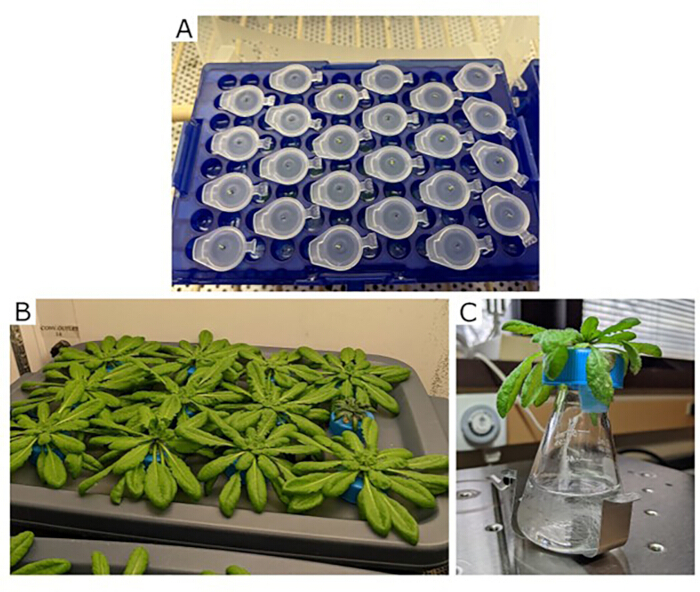
Figure 1: Arabidopsis germination and maturation hydroponic tanks and the 14C-AdCA treatment vessel. (A) The germination tank used to germinate Arabidopsis seeds for hydroponic growth. (B) Arabidopsis plants in the maturation tank ready for experimentation. (C) An Arabidopsis plant with roots submerged in the 14C-AdCA solution during experimentation. The 50 mL flasks (the 14C treatment vessel) are normally covered with aluminum foil (not shown) during exposure to prevent algal growth. Please click here to view a larger version of this figure.
4. Baltic Rush (Juncus balticus Willd. ) plant preparation
- Stratify seeds between two damp pieces of filter paper in a petri dish at 4 °C for 1-2 weeks.
- Remove the top filter paper and place the dish in a growth chamber under long-day conditions (16 h light, 8 h dark at ~150 µmol/m2s of light and 22 °C) for 1 week.
- Transplant seedlings into modified tip racks as described for Arabidopsis (step 3.1-3.4).
- Grow plants for 2-3 weeks (16 h light, 8 h dark at ~150 µmol/m2s of light and 22 °C), or until roots reach 3-4 cm in length.
- Transplant plants into a modified 10 L tote with air stones, fill with Hoagland solution until the roots are mostly submerged, and grow for an additional 6-8 weeks (16 h light, 8 h dark at ~150 µmol/m2s of light and 22 °C).
5. Sandbar willow ( Salix interior Rowlee) plantlet preparation
NOTE: Protocol for growing Sandbar willow plantlets is described in Alberts et al. (2021)10.
- Cut 10 cm stem cuttings (5 mm in diameter) and submerge them overnight at room temperature in diH2O to hydrate and stimulate rooting.
- Transfer the hydrated cuttings to aerated hydroponics tanks with 10 L of 0.5x Hoagland solution and grow for 1 month (16 h light, 8 h dark at ~150 µmol/m2s of light and 22 °C) to establish root and shoot growth.
NOTE: Refresh the Hoagland solution every 2 weeks to prevent nutrient deficiency during plantlet development.
6. Radioisotope labeling
- After making the radiolabeling solution, collect an aliquot of 100 µL from the solution for liquid scintillation counting to determine the initial isotope concentration.
- Gently blot the plant roots dry and transfer the Falcon tube cap assembly to 125 mL Erlenmeyer flasks (the 14C treatment vessel) containing 0.5x Hoagland solution with the 14C-labeled organic compounds from step 2.4.
- Mark the solution level on the flask to ensure it can be topped up to the starting volume during the experiment, accounting for evapotranspiration.
- Wrap flasks in aluminum foil and shake at 40-60 rpm under grow lights for the duration of the assay or until labeled plants are transferred to 0.5x Hoagland solution without radiolabel for a chase period.
- Top up the volume in the flask every 1-2 h to the line made in step 6.3 with Hoagland's solution without the radiolabel before collecting 100 µL aliquots. Make sure to measure the volume of Hoagland's added to each flask to compare the evapotranspiration rate from each solution. After the first 6-8 h, the sampling times can increase to every 12-24 h.
NOTE: This step can last for days if needed, but make sure to monitor radioactivity in the aliquots daily as the experiment progresses. - Optional: For monitoring exudation during the chase period, transfer the plant and Falcon tube cap assembly to a flask with 50 mL of fresh Hoagland solution (containing no 14C-labeled compound) and remove an aliquot of 100 µL every 2 h for the first 6-8 h, then at 24 h intervals from the start of the experiment.
NOTE: To distinguish between passive diffuse and active exudation of the compound out of the plant roots, an active transport inhibitor such as cyclosporin A can be added at a concentration of 20 µM. - Measure the radioactive counts of each aliquot collected between steps 6.1-6.6 using a liquid scintillation counter.
7. Phosphor-imaging of plants
- Rinse the roots for 15 min in 0.5x Hoagland solution without the radiolabel to remove loosely bound radioisotope.
- Collect 100 µL of the rinse solution for liquid scintillation counts.
- Weigh the plants or the non-woody plant material to determine fresh mass.
- Dry the plant material with a gel dryer onto a piece of labeled filter paper at 50 °C under vacuum for 2 h, then leave to dry overnight at room temperature.
NOTE: Once dried, the plants can be stored for extended periods (4-6 months) and imaging can occur on a later date with minimal drop in radioactive signal. - Clear the phosphor screen by exposing it to high light on a phosphor eraser for 15 min.
- Dispense 2-10 µL of radiolabel solution with known radioactivity onto a piece of filter paper and allow this to dry at room temperature overnight.
NOTE: Here, the standards with the radioactivities: 67, 33, 17, 8, 4, and 2 Bq are used, but this can be changed to accommodate the signal intensities from the plant samples. - Place the phosphor screen on top of the dried plant samples and the radioactive standards in the dark or in a closed opaque container and expose them for at least 24 h.
NOTE: If the image is under- or over-exposed, adjust the exposure time accordingly. - Image the screens with a laser scanning phosphor imaging system at 50 µm resolution.
- Analyze the phosphor image signal intensities and distributions using the ImageJ software11.
- ImageJ Steps: Open the image by selecting File > Analyze > Set Measurements... Select Area and Mean Gray Value > OK. Choose Shape Selection Tool that best fits the tissue. Click and Drag on the image to highlight the area of interest. Press Ctrl + M. Copy the Area and Mean Gray Value into a spreadsheet.
- Convert the mean gray values to Bq using the radioactive standards in a standard curve.
- Calculate the total activity in plant tissue (integrated densities) with the following equation:
Integrated Density (Bq) = (Mean Bq of tissue (Bq/cm2) - Background (Bq/cm2)) * Area (cm2)- Optional: Convert the gray-scale image to a color intensity scale using the ImageJ software11.
Access restricted. Please log in or start a trial to view this content.
Results
The 14C-label uptake procedure is applicable to a variety of plant species beyond Arabidopsis, including Salix interior, Elymus trachycaulus (Link) Gould ex Shinners, and wetland species such as Juncus balticus10,12. However, for representative purposes, we present results from Arabidopsis ecotype Columbia-7 (Col-7). Previously, we demonstrated that environmental contaminants, such as naphthen...
Access restricted. Please log in or start a trial to view this content.
Discussion
Phytoremediation has gained attention in recent decades as a passive, economical, and environmentally friendly method for cleaning industrial waste and contaminated sites1. Identifying plant species with enhanced contaminant uptake and understanding the molecular processes governing organic molecule absorption could improve phytoremediation strategies. Unlike other indirect methods, the radiolabel uptake and phosphor imaging technique described here can be used widely to track the uptake and trans...
Access restricted. Please log in or start a trial to view this content.
Disclosures
The authors declare there are no conflicts of interest.
Acknowledgements
This work was supported by Genome Canada through a Large Scale Applied Research Project (LSARP) grant (#18207) in partnership with Genome Alberta and Genome Quebec. Co-funding was provided by the Government of Alberta through Alberta Innovates and the Ministry of Jobs, Economy and Trade.
Access restricted. Please log in or start a trial to view this content.
Materials
| Name | Company | Catalog Number | Comments |
|---|---|---|---|
| Hoagland Modified Basal Salt Mixture | Phyto Technology Laboratories | H353 | Contains Ferrous Sulfate |
| Agar | BioShop | AGR001 | |
| MES (2-(N-morpholino) ethane sulfonic acid) | BioShop | MES555 | |
| pH Meter | Mettler Toledo | FiveEasy | |
| Methanol | BioShop | MET302 | |
| 12C-Adamantane carboxylic acid | Sigma Aldrich | 106399 | |
| 14C-Adamantane carboxylic acid | ViTrax | Custom synthesis | |
| 125 mL Erlenmeyer flasks | VWR | 30623-174 | |
| 50 mL Falcon tubes | VWR | CA21008-940 | |
| Microcentifuge tubes | VWR | 87003-294 | |
| Plant Growth Chambers | Conviron | ||
| Tip Boxes | DiaMed | DIATEC530-8376 | |
| Rubbermaid Roughneck 3 Gal Tote | Amazon | B0B3345MYH | |
| Filter paper | VWR | CA28320-020 | |
| Petri dish | VWR | 11019-566 | |
| Shaker with flask holders | Forma Scientific | Model 4516 | |
| Scintillation cocktail | Research Products International | 111195 | |
| Scintillation vials | VWR | 10014-296 | |
| Scintillation counter | Beckman Coulter | LS 6000IC | vials used will depend on your scintillation counter |
| Gel dryer | Bio-Rad | Model 583 | |
| Laser scanning phosphor imager | Bio-Rad | Molecular Imager FX |
References
- Kafle, A., et al. Phytoremediation: mechanisms, plant selection and enhancement by natural and synthetic agents. Environ Adv. 8, 100203(2022).
- Reis, P. C. J., et al. Microbial degradation of naphthenic acids using constructed wetland treatment systems: metabolic and genomic insights for improved bioremediation of process-affected water. FEMS Microbiol Ecol. 99 (12), fiad153(2023).
- Saleem, M. H., Zhu, H., Liu, L. Synergistic and sustainable impact of reducing nitrogen fertilizer on growth, yield, and quality of ramie (Boehmeria nivea L.). Plant Prod Sci. 25 (3), 289-297 (2022).
- Kamal, A., et al. Ball-milled synthesis of maize biochar-ZnO nanocomposite (MB-ZnO) and estimation of its photocatalytic ability against different organic and inorganic pollutants. J Saudi Chem Soc. 26 (3), 101445(2022).
- Abhilash, P. C., Jamil, S., Singh, N. Transgenic plants for enhanced biodegradation and phytoremediation of organic xenobiotics. Biotechnol Adv. 27 (4), 474-488 (2009).
- Isebrands, J. G., Richardson, J. Poplars and willows: trees for society and the environment. , CAB International and FAO. Boston, USA. (2014).
- Sandermann, H., Diesperger, H., Scheel, D. Metabolism of xenobiotics by plant cell cultures. Plant tissue culture and its biotechnological application. , (1977).
- Mendes, K. F., Martins, B. A. B., Reis, F. C., Dias, A. C. R., Tornisielo, V. L. Methodologies to study the behavior of herbicides on plants and the soil using radioisotopes. Planta Daninha. 35, e017154232(2017).
- Conn, S. J., et al. Protocol: optimising hydroponic growth systems for nutritional and physiological analysis of Arabidopsis thaliana and other plants. Plant Methods. 9 (1), 4(2013).
- Alberts, M. E., et al. Detection of naphthenic acid uptake into root and shoot tissues indicates a direct role for plants in the remediation of oil sands process-affected water. Sci Total Environ. 795, 148857(2021).
- Schindelin, J., et al. Fiji: an open-source platform for biological-image analysis. Nat Methods. 9 (7), 676-682 (2012).
- Alberts, M. E., et al. The effect of rhizosphere pH on removal of naphthenic acid fraction compounds from oil sands process-affected water in a willow hydroponic system. Sci Total Environ. 948, 174720(2024).
- Leishman, C., et al. The effect of oil sands process-affected water and naphthenic acids on the germination and development of Arabidopsis. Chemosphere. 93 (2), 380-387 (2013).
- Widdup, E. E., et al. Identification of detoxification pathways in plants that are regulated in response to treatment with organic compounds isolated from oil sands process-affected water. Chemosphere. 139, 47-53 (2015).
- Alberts, M. E., Chua, G., Muench, D. G. Exposure to naphthenic acids and the acid extractable organic fraction from oil sands process-affected water alters the subcellular structure and dynamics of plant cells. Sci Total Environ. 651, 2830-2844 (2019).
- Martinière, A., et al. Uncovering pH at both sides of the root plasma membrane interface using noninvasive imaging. Proc Natl Acad Sci U S A. 115 (25), 6488-6493 (2018).
Access restricted. Please log in or start a trial to view this content.
Reprints and Permissions
This article has been published
Video Coming Soon