This study examines cardiopulmonary function, physical activity, and lower extremity muscle activation in individuals with knee osteoarthritis (OA) with increased risk of cardiovascular disease (CVD). We found a negative relationship between lower maximum voluntary ventilation and greater biceps femoris activation in the knee OA with CVD risk group.
Research Article
Reduced Pulmonary Function Association with Abnormal Muscle Activation with Knee Osteoarthritis and Increased Cardiovascular Disease Risk
Benke Liu1,2,3 , Yang Xu1,2 , Jiaqi Zheng1,2 , LU Liu1,2 , Yongkang Chen1,2 , Yatai Chai1,2 , Rujie Yao4 , Xuerong Xie1,2 , Ziling Lin1,2 , Shengxing FU1,5 , Ye Ma1,5,6 , Xiangbin Wang1,2,4 , Meijin Hou1,5
1Key Laboratory of Orthopedics and Traumatology of Traditional Chinese Medicine and Rehabilitation, Ministry of Education, Fujian University of Traditional Chinese Medicine, 2College of Rehabilitation Medicine, Fujian University of Traditional Chinese Medicine, 3Yangzhi Affiliated Rehabilitation Hospital of Tongji University, 4The Third People's Hospital of Fujian Province, 5National-Local Joint Engineering Research Center of Rehabilitation Medicine Technology, 6Faculty of Sports Sciences, Research Academy of Grand Health, Ningbo University
Opens in a new tab
In This Article
Summary
Loading...
$$\rightleftharpoonup{xx}$$
$$\longleftharp{xx}$$,
$$\longrightharp{xx}$$,
Abstract
Loading...
$$\rightleftharpoonup{xx}$$
$$\longleftharp{xx}$$,
$$\longrightharp{xx}$$,
This study aimed to explore the cardiopulmonary function, physical activity, and activation of major lower-limb muscles in individuals with knee osteoarthritis (OA) with increased cardiovascular disease (CVD) risk. A total of 21 individuals with knee OA and increased CVD risk and 29 individuals with isolated knee OA completed the long-form International Physical Activity Questionnaire (IPAQ) in an interview format. Pulmonary function was assessed by measuring Forced Vital Capacity (FVC) and Maximum Voluntary Ventilation (MVV). Cardiorespiratory fitness was evaluated using a treadmill-based cardiopulmonary exercise test (CPET) with a modified Bruce protocol. Furthermore, surface electromyography (sEMG) data were collected from the major lower-limb muscles of the symptomatic limb during stair-climbing tasks performed at a self-selected, habitual speed. Compared with the knee OA group, the knee OA with CVD risk group demonstrated significant reductions in vigorous physical activity, maximal voluntary ventilation (MVV), and a lesser decrease in peak oxygen uptake. Additionally, the knee OA with increased CVD group showed greater muscle activation of the biceps femoris (BF) during stair ascent and descent. Furthermore, there was a negative relationship observed between lower MVV and greater BF activation in the knee OA with the CVD risk group. These findings suggest two main conclusions. First, sEMG serves as a valuable non-invasive tool for identifying clinical hallmarks in knee OA patients at risk of CVD by detecting aberrant muscle activation during stair climbing. Second, among these at-risk individuals, superior cardiovascular function is linked to a more balanced knee muscle coordination pattern, as reflected by the inverse relationship between MVV and biceps femoris activation.
Introduction
Loading...
$$\rightleftharpoonup{xx}$$
$$\longleftharp{xx}$$,
$$\longrightharp{xx}$$,
Knee osteoarthritis (OA) is a leading cause of mobility disability, affecting 15% of middle-aged and elderly individuals1. There is increasing evidence linking knee OA with an elevated risk of cardiovascular disease (CVD)2,3,4. Individuals with knee OA often have multiple risk factors for CVD, including nonsteroidal anti-inflammatory drugs and chronic inflammation5. Furthermore, the physical inactivity resulting from knee OA is an indirect cause of increased CVD risk5.
Reduced physical activity due to knee joint disorder can increase the prevalence of metabolic syndrome, including obesity, dyslipidemia, insulin resistance, and hypertension6,7,8,9, and then increases the risk of CVD10,11. Additionally, physical activity limitations can lead to decreased cardiopulmonary function (encompassing both pulmonary function and cardiorespiratory fitness), which is strongly associated with an increased risk of CVD12,13. Therefore, individuals with knee OA who exhibit increased CVD risk may also demonstrate a reduction in cardiopulmonary function.
Abnormal lower limb muscle activation patterns may partially explain the reduction in physical activity14. Previous research has shown that abnormal neuromuscular activation patterns, such as greater activation of the lateral gastrocnemius and medial hamstring, are associated with more severe knee pain15,16. Conversely, reductions in knee medial muscle contraction have been correlated with decreases in knee pain during gait in individuals with knee OA17. Further, severe knee pain can reduce physical activity, particularly in moderate to vigorous physical activity18,19, and then negatively impacting cardiopulmonary function and contributing to an increased risk of CVD.
Stair climbing, a typical daily activity, is the task affected in individuals with knee OA often, and it may be a better indicator of physical activity limitation compared to other activities20,21. Individuals with knee OA would change muscle activity to minimize knee pain and maintain knee stabilization in stair climbing22,23. In addition, the stair-climbing test is a valid surrogate for directly assessing cardiopulmonary function24. Therefore, examining the lower extremity muscle activation pattern during stair walking and its relationship with cardiopulmonary function may provide unique insights into the pathomechanism of increased CVD risk in knee OA patients.
Thus, we hypothesized that compared to individuals with isolated knee OA, knee OA patients with an increased risk of CVD demonstrate decreased physical activity, decreased cardiopulmonary function, and altered lower extremity muscle activation patterns. Furthermore, the hypothesis posits a correlation between the decline in patients' cardiopulmonary function and abnormal activation patterns in their lower limb muscles.
To the best of our knowledge, this is the first study to investigate the activation of major lower-limb muscles during stair climbing in individuals with knee OA and increased CVD risk, as well as the relationship between cardiopulmonary function and muscle activation during stair climbing. The findings of this study may provide evidence for designing more precise rehabilitation plans for this patient population.
Protocol
Loading...
$$\rightleftharpoonup{xx}$$
$$\longleftharp{xx}$$,
$$\longrightharp{xx}$$,
According to the Declaration of Helsinki, the study protocol was approved by the Ethics Institutional Review Board of the Third People's Hospital of Fujian Province (# 2020KS-5-1) and registered on the Chinese Clinical Trial Registry website on November 18, 2020 (identifier number ChiCTR2000041115). All participants provided written informed consent forms to participate in the study.
Participants
Here, 29 participants with knee OA and 21 participants with knee OA and increased CVD risk were recruited from Third People's Hospital of Fujian Province and neighboring communities. Inclusion criteria for the knee OA group were a clinical diagnosis according to the 2019 Diagnosis and Treatment of Osteoarthritis25, unilateral or bilateral Kellgren/Lawrence (K/L) grade ≥2, age 50-65 years, and low or no CVD risk as defined by Prediction for Atherosclerosis Cardiovascular Disease Risk in China (China-PAR)26. The knee OA with increased CVD risk group had the same age and knee OA symptoms as the knee OA group, but had medium or high CVD risk according to China-PAR. Participants in both groups were excluded if they had severe back pain, other lower extremity joint pain, rheumatoid arthritis, fractures, neurological system pathology, a medical history of CVD, and/or pulmonary disease.
Data collection
This study assessed the physical activity, pulmonary function, cardiopulmonary fitness, and muscle activity of subjects by administering the long-form International Physical Activity Questionnaire (IPAQ)27, pulmonary function test, cardiopulmonary exercise test, and surface electromyography (sEMG; Figure 1).
Physical activity assessment
The daily activity levels of participants were assessed using the Chinese version of the Long Form International Physical Activity Questionnaire (IPAQ; examining the validity and reliability of the Chinese version of the International Physical Activity Questionnaire, long form (IPAQ-LC)27, administered in an interview format. This study collected and analyzed data on physical activity during leisure time, domestic and gardening (yard), work-related, and transport-related activities in the past month using the IPAQ. The scores were reported in metabolic equivalent (MET)-min/week, which were calculated by multiplying the number of min per week of activities performed by their respective MET values. Finally, the scores were categorized into walking, moderate, vigorous, and total physical activity. Cases were excluded from the analysis if responses regarding time or frequency were reported as don't know, refused to answer, or were missing.
Pulmonary function test
Prior to the test, we conducted an instrument calibration. The calibration included environmental preparation, volume calibration, and flow/volume sensor calibration. Participants were instructed to abstain from food for 2 h before the experiment.
A nose clip was applied to ensure exclusive oral airflow. The subject then sealed their lips around the mouthpiece to prevent leakage. Strong verbal encouragement was provided throughout the maneuver to maximize effort. Subjects were coached by experienced respiratory therapists using American Thoracic Society guidelines on the Pulmonary Function Test System (230 V, 50/60 Hz, 508 VA, IP20). Spirometry included measurements of forced vital capacity (FVC), forced expiratory volume in 1 s (FEV1), forced expiratory volume in 1 s/forced vital capacity (FEV1/FVC), and maximal voluntary ventilation (MVV). Each subject generated at least three technically acceptable maneuvers. A sharp start of exhalation is required for FVC and FEV1 measurement, and exhalation must last at least 6 s, with less than a 5% variation between repeat maneuvers. During the MVV test, the subject is instructed to perform the deepest and fastest possible breathing maneuvers for 12 s. Best test results were chosen by the technician as those having the highest FVC, FEV1, MVV values, and the best flow volume curves.
Cardiopulmonary exercise test
After performing the pulmonary function test for at least 5 min, a 12-lead electrocardiograph (ECG), an automated cuff, a breathing mask, and an oxygen photometer were attached to monitor heart rate, electrocardiograph, blood pressure, gas exchange, and oxygen saturation.
Participants underwent an incremental maximal CPET utilizing the treadmill and the modified Bruce protocol (see Table 1). Baseline cardiopulmonary values were assessed during a 3 min rest period while seated in the chair; thereafter, a 3 min warm-up was performed on a treadmill at a velocity of 2.7 km/h with zero incline. After the warm-up, exercise intensity was increased every 3 min according to the Modified Bruce protocol, with sequential stages as follows: 2.7 km/h at 0% grade, 2.7 km/h at 5% grade, 2.7 km/h at 10% grade, 4.0 km/h at 12% grade, 5.4 km/h at 14% grade, and 6.7 km/h at 16% grade, aimed at reaching a maximal effort. Holding on to the treadmill handrails was discouraged; however, some patients required the handrails to maintain their balance.
The entire test was monitored by professional cardiologists. During the rest phase, blood pressure (BP) was measured once, and continuously monitored with 12-lead ECG, heart rate (HR), and oxyhemoglobin saturation. During the exercise phase, ECG, HR, and oxyhemoglobin saturation were continuously monitored, and ambulatory BP, symptoms, and fatigue level were monitored every 3 min. Exercise was stopped when participants reached maximum HR, or oxygen uptake did not rise while exercise load increased, or the perceived score (ratings of perceived exertion (RPE) of the Borg (6-20)28) was greater than 17. During recovery, ECG, HR, and oxyhemoglobin saturation were continuously monitored, and BP was measured every 2 min. The test was stopped prematurely for symptoms like significant breathlessness, chest constriction, or dizziness, progressive ventricular ectopy > 3 beats, new atrial fibrillation, sustained decrease in systolic blood pressure > 20 mmHg from the previous stage, or depression of more than 5 mm ST segment.
Testing personnel were proficient in emergency procedures, with essential equipment (including a defibrillator, oxygen, and breathing masks) and medications (e.g., epinephrine, atropine, lidocaine, nitroglycerin, and glucose) available on-site. In any critical event, the test was terminated immediately. Management involved maintaining patent airways, administering oxygen, and establishing intravenous access. Subsequent resuscitation and pharmacological interventions adhered to Advanced Cardiac Life Support (ACLS) protocols, concurrent with activation of the emergency response team for patient transfer.
Breath-by-breath measurements were taken of oxygen uptake (VO2), carbon dioxide output (VCO2), minute ventilation (VE), partial pressure of end-tidal oxygen (PETO2), and carbon dioxide (PETCO2). Heart rate (HR) was recorded at 1 s intervals. The highest value within the last 60 s of exercise was defined as VO2peak, VCO2peak, VEpeak, HRpeak, and the peak of oxygen pulse (VO2 / HRpeak), PETO2peak, PETCO2peak. The anaerobic threshold (AT) was defined by the modified V-slope approach29. The heart rate reserve (HRR) was defined as 220 - a - HRMax during the exercise phase, in which stands a for age and HRMax stands for the maximum heart rate.
sEMG signals of the lower limbs during stair climbing
Prior to electrode placement, participants wore uniformly procured Anta sports shoes and performed five stair-negotiation trials. These trials were executed at a self-selected daily walking speed and without the use of a handrail. Each step was fixed at a width of 100 cm, a height of 20 cm, and a depth of 30 cm. The speeds of stair ascent and descent were recorded by infrared timing systems positioned at both the first and the top steps. The mean ±10% of speeds across the five stair negotiation trials was defined as the normal speed. Official trials with speeds that deviated from the normal speed were excluded from subsequent analysis.
The skin over the target muscles is then prepared by shaving, light abrasion with fine-grit sandpaper, and cleansing with 70% alcohol to reduce impedance and ensure optimal contact. After skin preparation, surface EMG electrodes were placed on the target muscle bellies. The study used a wireless sEMG system to measure muscle activities during the stance phase at a sampling frequency of 2000 Hz. Adhesive pre-gelled Ag/AgCl electrodes (10 mm fixed inter-electrode distance) were placed bilaterally on the tibialis anterior (TA), medial head of gastrocnemius muscle (MG), biceps femoris (BF), rectus femoris (RF), vastus medialis (VM), vastus lateralis (VL), gluteus maximus (GMAX), and gluteus medius (GMED) muscles (see Table 2). Participants then performed maximum voluntary isometric contraction (MVIC) for each investigated muscle, which was used in amplitude normalization tests (see Table 3). Participants were instructed to perform the test action with maximal effort for 4-5 s. Strong verbal encouragement was provided throughout each trial. This procedure was repeated 3x with a 2 min rest interval between trials to prevent fatigue. After the MVIC test, the participants were asked to perform five successful trials of stair ascent and descent at normal speed. The sEMG data during the stance phase were selected in the third and fourth steps of the custom eight-step laboratory staircase.
The stance phase sEMG signals of stair tasks and MVIC were processed in the Visual3D software. The raw data were first band-pass filtered (20-450 Hz), full-wave rectified, smoothed with a 50 ms root mean square (RMS) window, and finally low-pass filtered at 6 Hz to create a linear envelope. The stance phase was identified from the vertical ground reaction force (>10 N threshold). The linear envelope for each stance phase was time-normalized to 101 points and amplitude-normalized to the corresponding maximum value of MVIC. Finally, the RMS of each normalized sEMG data during the stance phase was calculated to reflect the magnitude of muscle activity. The analysis focused on the more symptomatic knee in subjects of the two groups. If the symptoms of both knees were similar, data for the technology-dominant limb were selected.
Statistical analysis
All statistical analyses were conducted using SPSS Statistics 25.0. All variables were presented as mean ±standard deviation. The Shapiro-Wilk test was used to test the normality of all quantitative variables. The normally distributed variables difference of two independent samples in demographics, cardiopulmonary function parameters, and RMS were assessed using independent-samples t-tests; the skewed distribution variables difference was assessed using the Kruskal-Wallis test. The IPAQ scores and K/L grade differences were assessed using the Kruskal-Wallis test. Chi-square test was used to compare the difference in gender. Correlations between different and powerful parameters of cardiopulmonary function (peak of oxygen uptake (VO2peak), maximal voluntary ventilation (MVV), and RMS (biceps femoris (BF)) in knee OA with CVD risk group were detected using Spearman correlations.
Results
Loading...
$$\rightleftharpoonup{xx}$$
$$\longleftharp{xx}$$,
$$\longrightharp{xx}$$,
Characteristics of participants
Of the total 50 participants included in this study, 29 were in the knee OA group and 21 were in the knee OA with increased CVD risk group. There were no significant differences between the two groups in age, height, mass, BMI, gender distribution, waist circumference, hip circumference, waist-hip ratio, or K/L grade. Additionally, the knee OA group and the knee OA with increased CVD risk group did not differ significantly in the Knee Osteoarthritis Outcome Score (KOOS) scores30 (see Table 4).
Physical activity assessment
Compared with the knee OA group, the knee OA with CVD risk group showed lower levels of vigorous-intensity activities (p = 0.044; see Table 5). This lower level of vigorous activity supports the hypothesis that there is a reduction in daily physical activity among patients who have knee OA and are at risk for CVD.
Pulmonary function test
Compared with the knee OA group, the knee OA and CVD risk group displayed lower maximal voluntary ventilation (MVV; p = 0.004; see Table 6). This lower MVV supports the hypothesis that patients with knee OA and elevated CVD risk have impaired pulmonary function.
Cardiopulmonary exercise test
However, there was no significant difference observed between the two groups in cardiopulmonary fitness (see Table 6). Inconsistent with the current hypothesis, increasing cardiovascular risk was not associated with a significant reduction in cardiorespiratory fitness among patients with knee osteoarthritis.
sEMG signals of the lower limbs during stair climbing
In terms of the muscle activation parameters, compared with the knee OA group, the knee OA with CVD risk group showed greater BF activation during both stair ascent (p = 0.013) and descent (p= 0.001; see Table 7). The increased activation of the BF provides support for the hypothesis of altered lower extremity muscle activation patterns during stair climbing in knee osteoarthritis patients with elevated cardiovascular risk. Moreover, BF RMS during stair ascent was found to be significantly correlated with MVV in knee OA with CVD risk group (r = −0.452, p = 0.040; see Table 8). This correlation supports the hypothesis that abnormal extremity muscle activation patterns are associated with declined pulmonary function in patients with knee osteoarthritis and CVD risk.
Compared with the knee group, the knee OA with the CVD risk group has significantly lower levels of vigorous activities, lower MVV, and greater activation of the BF during stair climbing. In addition, there is a negative correlation between the lower MVV and greater BF activation in the knee OA with the CVD risk group.
Data availability:
The raw and processed datasets generated during this study contain sensitive patient information and are not publicly available in a full, unprocessed format to protect patient privacy. De-identified, processed data are available upon reasonable requests from the corresponding author. All requests require approval from the Ethics Committee of the Third People's Hospital of Fujian Province. The raw data are archived on the secure servers of Third People's Hospital of Fujian Province and will be maintained for a minimum of 10 years after publication.
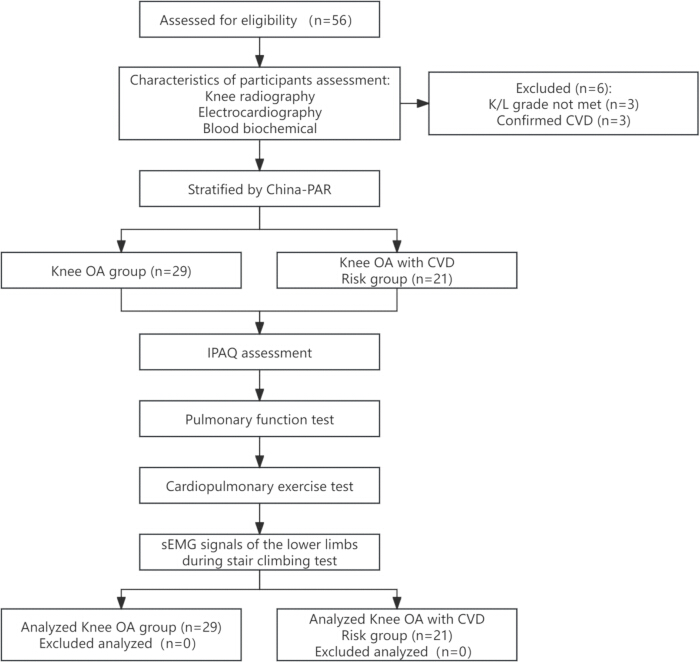
Figure 1: Flow diagram of the total experiment. Abbreviations: K/L = Kellgren / Lawrence, CVD = cardiovascular disease, China-PAR = Prediction for Atherosclerosis Cardiovascular Disease Risk in China, OA = osteoarthritis, IPAQ = International Physical Activity Questionnaire, sEMG = surface electromyography Please click here to view a larger version of this figure.
Table 1: Modified Bruce protocol of treadmill test-specific program. Please click here to download this Table.
Table 2: sEMG placement. Abbreviations: GMAX = gluteus maximus, GMED = gluteus medius muscles, BF = biceps femoris, VM = vastus medialis, VL = vastus lateralis, RF = rectus femoris, TA = tibialis anterior, MG = medial head of gastrocnemius muscle, ASIS = anterior superior spine, PSIS = posterior superior spine. Please click here to download this Table.
Table 3: Muscle MVIC test. Abbreviations: MVIC = maximum voluntary isometric contraction, GMAX = gluteus maximus, GMED = gluteus medius muscles, BF = biceps femoris, VM = vastus medialis, VL = vastus lateralis, RF = rectus femoris, TA = tibialis anterior, MG = medial head of gastrocnemius muscle. Please click here to download this Table.
Table 4: Characteristics of two groups. #: skewed distributed data, *: normally distributed data, &: categorical data. Abbreviations: BMI = body mass index, K/L grade = Kellgren/Lawrence grade, KOOS = Knee Osteoarthritis Outcome Score. Please click here to download this Table.
Table 5: Physical activity was assessed by IPAQ in two groups. #: skewed distributed data. Please click here to download this Table.
Table 6: Cardiopulmonary function of the two groups. #: skewed distributed data, *: normally distributed data. Abbreviations: VC = vital capacity, FVC = forced vital capacity, FEV1 = forced expiratory volume in 1 s, FEV1/FVC = forced expiratory volume in one second/forced vital capacity, MVV: maximal voluntary ventilation, VO2peak = peak of oxygen uptake, RER = respiratory exchange rate, VCO2peak = peak of carbon dioxide output, VEpeak = peak of minute ventilation, HRpeak = peak of heart rate, HRR = heart rate reserve, VO2/HRpeak = peak of oxygen pulse, PETO2peak = peak of partial pressure of end-tidal oxygen, PETCO2peak = peak of pressure of end-tidal carbon dioxide, AT = anaerobic threshold. Please click here to download this Table.
Table 7: Lower limb muscle activation during stair climbing of the two groups. #: skewed distributed data, *: normally distributed data. Abbreviations: GMAX = gluteus maximus, GMED = gluteus medius, RF = rectus femoris, VL = vastus lateralis, VM = vastus medialis, BF = biceps femoris, TA = tibialis anterior, MG = medial head of gastrocnemius muscle. Please click here to download this Table.
Table 8: Pearson correlation coefficients between BF RMS and cardiopulmonary function. Abbreviations: BF = biceps femoris, VO2peak = peak of oxygen uptake, MVV = maximal voluntary ventilation. Please click here to download this Table.
Discussion
Loading...
$$\rightleftharpoonup{xx}$$
$$\longleftharp{xx}$$,
$$\longrightharp{xx}$$,
This is the first study investigating cardiopulmonary function, muscle activation, and their relationship in individuals with knee OA and increased CVD risk. Consistent with the hypothesis, we observed that individuals with knee OA and increased CVD risk have significantly lower maximal voluntary ventilation (MVV), greater activation of the biceps femoris (BF) during stairs climbing, and lower levels of vigorous activities. In addition, this study found a negative relationship between MVV and BF activation during stair ascent.
With increased CVD risk, individuals with knee OA are limited in physical activity, particularly in vigorous activity. Lack of physical activity is the 4th risk factor for global mortality and has a significant influence on the prevalence of diseases, including OA and CVD5. The relationship between vigorous activity, knee OA, and CVD risk is variable and dynamic: a previous study demonstrated that although vigorous activity provides stronger benefits to OA than light activity31, prolonged period of vigorous activity can have detrimental effects on medial knee cartilage defects and exacerbate pain, which may influence individuals with knee OA to avoid vigorous physical activity32,33. For individuals with increased CVD risk, participation in any physical activity is associated with a lower risk of CVD, but vigorous activity carries the greatest benefit for cardiovascular risk34. However, individuals with increased CVD risk commonly worry that vigorous activity is intolerable and potentially leads to cardiovascular events35. Therefore, we suggest that knee OA individuals with increased CVD risk may avoid vigorous physical activity due to symptoms of knee OA combined with fear of cardiovascular events.
Additionally, this study found that individuals with knee OA and increased CVD risk exhibited lower MVV compared to those with isolated knee OA. Lower MVV indicates decreased respiratory muscle endurance in individuals with knee OA and increased CVD risk36. Decline in MVV can be influenced by comorbidities such as diabetes mellitus and hypertension, which can lead to microvascular complications that ultimately affect respiratory muscle endurance36,37,38. In this study, most participants in the knee OA and increased CVD risk group had diabetes mellitus and hypertension, which may have contributed to the lower MVV observed. A lower MVV can limit an individual's capacity to maintain greater and prolonged ventilation to meet the demands of gas exchange during exercise, ultimately leading to a reduction in moderate to vigorous physical activity36,39,40. Thus, individuals with knee OA and increased CVD risk avoided vigorous physical activity, which may also be associated with decreased pulmonary function.
However, this finding is inconsistent with our hypothesis, as individuals with knee OA and increased CVD risk did not exhibit a significant decrease in cardiopulmonary fitness. Traditionally, VO2peak is a powerful indicator of cardiopulmonary fitness, with a lower VO2peak being associated with a greater tendency to develop future CVD risk41. In this study, individuals with knee OA and increased CVD risk only showed a slight reduction in VO2peak. We speculate that this may be due to the fact that total daily physical activity volume was not reduced in these individuals. A previous study has found that compared with moderate intensity activity, vigorous activity has a superior effect on VO2peak, but training volume is also an important factor42. In this study, although individuals with knee OA and increased CVD risk showed an avoidance of vigorous activity, the amount of vigorous activity is limited in individuals with isolated knee OA. Furthermore, there was no significant difference in total activity volume between the two groups. These findings may help explain the results obtained.
Stair negotiation difficulty and pain, frequently the earliest signs of knee osteoarthritis (OA), may stem from abnormal lower limb muscle activation patterns, which alter knee joint loading43. In this study, individuals with knee OA and increased CVD risk demonstrated greater activation of the biceps femoris (BF) muscle during stair ascent and descent compared to those with isolated knee OA. The BF is anatomically connected to both the hip and knee joints, and its activation plays a role in knee flexion as well as hip extension43. As documented previously, quadriceps weakness is common in knee OA, and increased activation of the BF compensates for this dysfunction by shifting the load to the unaffected hip joint43,44. In addition, the increased activation of BF helps stabilize the knee joint by increasing the production of compressive force and reducing the anterior translation of the tibia43,45. However, changes in BF activation may disrupt the normal distribution of knee load, potentially exacerbating the progression of knee OA43.
Consistent with the hypothesis, in the present study, individuals with knee OA and increased CVD risk showed a moderate negative correlation between higher BF activation and lower MVV. Similar to this study, a previous study found MVV was associated with peripheral muscle in individuals with sickle cell disease46. The decrease in respiratory muscle strength and fitness is related to decreased handgrip strength46. In the present study, the strategy of compensating for quadriceps weakness by higher activation of BF may lead to motor apraxia of the quadriceps and worsen OA in individuals with knee OA and CVD risk. Serious quadriceps dysfunction negatively affects moderate-vigorous physical activity47, which can be associated with respiratory muscle dysfunction and eventually lead to a decrease in MVV48,49.
To further validate our hypothesis, several alternative approaches could be employed. For instance, imaging studies (fMRI or X-ray) could directly visualize the associated muscle and joint structural changes in the knee, providing anatomical corroboration for this study's behavioral/physiological findings. Furthermore, longitudinal cohort follow-up would be invaluable to determine the long-term trajectory and clinical outcomes of the phenomenon we observed, establishing causality beyond the associations identified in the current cross-sectional design.
The negative correlation between higher BF activation and lower MVV also suggests the value of sEMG as a non-invasive method for identifying aberrant muscle activity patterns during stair ambulation, which may help characterize clinical hallmarks in individuals with knee osteoarthritis (OA) and increased cardiovascular disease (CVD) risk.
Limitations
Several limitations should be considered when interpreting the findings of this study. Firstly, the CVD risk score calculated using the China-PAR is influenced by several factors, including diabetes, hyperlipidemia, hypertension, and waist circumference. However, the study is a case-control study with a small sample size, which may introduce statistical bias. Future research should expand the sample size and stratify participants by risk level (low, medium, high). Subsequent studies should include intervention trials, multi-center cohorts, or mechanistic investigations to verify the observed associations. Additionally, the majority of individuals in the knee OA and increased CVD risk group had only CVD risk, rather than a definite cardiovascular disease diagnosis, which may limit the generalizability of the findings. Further studies are needed to investigate the biomechanics and cardiopulmonary function of individuals with knee OA and CVD.
Conclusions
This study revealed that individuals with knee OA and CVD risk experienced a relatively smaller decline in cardiopulmonary fitness compared to those with isolated knee OA. However, they also demonstrated a tendency to avoid vigorous physical activity, along with decreased pulmonary function and increased activation of the biceps femoris muscle. Furthermore, a negative correlation was observed between reduced MVV and elevated BF activation.
These findings suggest two key implications: first, sEMG serves as a valuable non-invasive tool for characterizing clinical hallmarks in at-risk knee OA patients by detecting aberrant muscle activation patterns during stair ambulation. Second, tailored exercise interventions for this population should initially focus on restoring muscle balance around the knee, followed by progressively incorporating vigorous activities to enhance cardiopulmonary fitness and pulmonary function.
Disclosures
Loading...
$$\rightleftharpoonup{xx}$$
$$\longleftharp{xx}$$,
$$\longrightharp{xx}$$,
The authors declare that they have no conflict of interest.
Acknowledgements
Loading...
$$\rightleftharpoonup{xx}$$
$$\longleftharp{xx}$$,
$$\longrightharp{xx}$$,
The authors are grateful to all the participants. The authors also acknowledge the Physical Examination Center and Imaging Department of The Third People's Hospital of Fujian Province, for screening of participants. This study is funded by Fujian Provincial Department of Science and Technology (Project Grant Number 2020Y0053), National Key Clinical Specialty Discipline Construction Project of China (Z155080000004), Shanghai Research Center of Rehabilitation Medicine (Top Priority Research Center of Shanghai) (2023ZZ02027), Natural Science Foundation of Fujian Province (Grant 2025-P-005, 2025E3005), Key Laboratory Open Subject (Project Grant Number ZD2020-4-1), and the National Natural Science Foundation of China (Project Grant Number 82074515).
Materials
| Name | Company | Catalog Number | Comments |
|---|---|---|---|
| dynamic electrocardioscanner | GE Healthcare | 2019001977 | real-time monitoring, reusable |
| Pulmonary function testing system | Carefusion Germany 234 GmbH | V-919016 | real-time monitoring, reusable |
| treadmill | treadmill hlp/cosmos | 180409 | crawler belt, Speed and slope can be adjusted |
| Wireless Biofeedback System | Delsys | SP-W02C-1096 | Wireless,emg biofeedback,reusable |
References
Loading...
$$\rightleftharpoonup{xx}$$
$$\longleftharp{xx}$$,
$$\longrightharp{xx}$$,
- Prevalence of knee pain and knee OA in southern Sweden and the proportion that seeks medical care. Rheumatology (Oxford). 54 (5), 827-835 (2015).">Turkiewicz, A., et al. Prevalence of knee pain and knee OA in southern Sweden and the proportion that seeks medical care. Rheumatology (Oxford). 54 (5), 827-835 (2015).
- Painful knee but not hand osteoarthritis is an independent predictor of mortality over 23 years follow-up of a population-based cohort of middle-aged women. Ann Rheum Dis. 75 (10), 1749-1756 (2016).">Kluzek, S., et al. Painful knee but not hand osteoarthritis is an independent predictor of mortality over 23 years follow-up of a population-based cohort of middle-aged women. Ann Rheum Dis. 75 (10), 1749-1756 (2016).
- Osteoarthritis and cardiovascular disease: A Mendelian randomization study. Front Cardiovasc Med. 9, 1025063(2022).">Wang, Z., et al. Osteoarthritis and cardiovascular disease: A Mendelian randomization study. Front Cardiovasc Med. 9, 1025063(2022).
- Cardiovascular Risk Profile and Osteoarthritis-Considering Sex and Multisite Joint Involvement: A Canadian Longitudinal Study on Aging Population-Based Study. Arthritis Care Res (Hoboken). 75 (4), 893-901 (2023).">Perruccio, A. V., et al. Cardiovascular Risk Profile and Osteoarthritis-Considering Sex and Multisite Joint Involvement: A Canadian Longitudinal Study on Aging Population-Based Study. Arthritis Care Res (Hoboken). 75 (4), 893-901 (2023).
- Cardiovascular disease and osteoarthritis: common pathways and patient outcomes. Eur J Clin Invest. 45 (4), 405-414 (2015).">Fernandes, G. S., Valdes, A. M. Cardiovascular disease and osteoarthritis: common pathways and patient outcomes. Eur J Clin Invest. 45 (4), 405-414 (2015).
- The possible influence of osteoarthritis of the knee on the accumulation of coronary risk factors in postmenopausal obese women. Obes Res Clin Pract. 2 (1), I-II (2008).">Michishita, R., Shono, N., Kasahara, T., Katoku, M., Tsuruta, T. The possible influence of osteoarthritis of the knee on the accumulation of coronary risk factors in postmenopausal obese women. Obes Res Clin Pract. 2 (1), I-II (2008).
- Association of Hypertension with Knee Pain Severity Among People with Knee Osteoarthritis. Pain Manag Nurs. 23 (2), 135-141 (2022).">Shi, X., Schlenk, E. A. Association of Hypertension with Knee Pain Severity Among People with Knee Osteoarthritis. Pain Manag Nurs. 23 (2), 135-141 (2022).
- High prevalence of cardiovascular co-morbidities in patients with symptomatic knee or hand osteoarthritis. Scand J Rheumatol. 45 (1), 41-44 (2016).">Calvet, J., et al. High prevalence of cardiovascular co-morbidities in patients with symptomatic knee or hand osteoarthritis. Scand J Rheumatol. 45 (1), 41-44 (2016).
- Gait Speed as a Predictor for Diabetes Incidence in People with or at Risk of Knee Osteoarthritis: A Longitudinal Analysis from the Osteoarthritis Initiative. Int J Environ Res Public Health. 18 (9), 4414(2021).">Alenazi, A. M., et al. Gait Speed as a Predictor for Diabetes Incidence in People with or at Risk of Knee Osteoarthritis: A Longitudinal Analysis from the Osteoarthritis Initiative. Int J Environ Res Public Health. 18 (9), 4414(2021).
- Physician awareness of knee and hip pain in the context of coronary heart disease treatment. Sci World J. 2014, 494801(2014).">Glehr, M., et al. Physician awareness of knee and hip pain in the context of coronary heart disease treatment. Sci World J. 2014, 494801(2014).
- Contributions of symptomatic osteoarthritis and physical function to incident cardiovascular disease. BMC Musculoskelet Disord. 19 (1), 393(2018).">Corsi, M., et al. Contributions of symptomatic osteoarthritis and physical function to incident cardiovascular disease. BMC Musculoskelet Disord. 19 (1), 393(2018).
- Updating Framingham CVD risk score using waist circumference and estimated cardiopulmonary function: a cohort study based on a southern Xinjiang population. Bmc Public Health. 22 (1), 1715(2022).">Sun, X. Y., et al. Updating Framingham CVD risk score using waist circumference and estimated cardiopulmonary function: a cohort study based on a southern Xinjiang population. Bmc Public Health. 22 (1), 1715(2022).
- Trends in cardiorespiratory fitness among apparently healthy adults from the Ball State Adult Fitness Longitudinal Lifestyle STudy (BALL ST) cohort from 1970-2019. PLoS One. 15 (12), e0242995(2020).">Harber, M. P., et al. Trends in cardiorespiratory fitness among apparently healthy adults from the Ball State Adult Fitness Longitudinal Lifestyle STudy (BALL ST) cohort from 1970-2019. PLoS One. 15 (12), e0242995(2020).
- Physical activity and age-related biomechanical risk factors for knee osteoarthritis. Gait Posture. 70, 24-29 (2019).">Hafer, J. F., Kent, J. A., Boyer, K. A. Physical activity and age-related biomechanical risk factors for knee osteoarthritis. Gait Posture. 70, 24-29 (2019).
- A Review of the Relationships Between Knee Pain and Movement Neuromechanics. J Sport Rehabil. 31 (6), 684-693 (2022).">Seeley, M. K., et al. A Review of the Relationships Between Knee Pain and Movement Neuromechanics. J Sport Rehabil. 31 (6), 684-693 (2022).
- The association between knee joint biomechanics and neuromuscular control and moderate knee osteoarthritis radiographic and pain severity. Osteoarth Carti. 19 (2), 186-193 (2011).">Astephen, W. J., Deluzio, K. J., Dunbar, M. J., Caldwell, G. E., Hubley-Kozey, C. L. The association between knee joint biomechanics and neuromuscular control and moderate knee osteoarthritis radiographic and pain severity. Osteoarth Carti. 19 (2), 186-193 (2011).
- Reductions in co-contraction following neuromuscular re-education in people with knee osteoarthritis. BMC Musculoskelet Disord. 17 (1), 372(2016).">Preece, S. J., Jones, R. K., Brown, C. A., Cacciatore, T. W., Jones, A. K. Reductions in co-contraction following neuromuscular re-education in people with knee osteoarthritis. BMC Musculoskelet Disord. 17 (1), 372(2016).
- Relationship of knee pain to time in moderate and light physical activities: Data from Osteoarthritis Initiative. Semin Arthritis Rheum. 47 (5), 683-688 (2018).">Song, J., et al. Relationship of knee pain to time in moderate and light physical activities: Data from Osteoarthritis Initiative. Semin Arthritis Rheum. 47 (5), 683-688 (2018).
- The Association Between Daily Physical Activity and Pain Among Patients with Knee Osteoarthritis: The Moderating Role of Pain Catastrophizing. Pain Med. 20 (5), 916-924 (2019).">Lazaridou, A., et al. The Association Between Daily Physical Activity and Pain Among Patients with Knee Osteoarthritis: The Moderating Role of Pain Catastrophizing. Pain Med. 20 (5), 916-924 (2019).
- Toward a clinical definition of early osteoarthritis: onset of patient-reported knee pain begins on stairs. Data from the osteoarthritis initiative. Arthritis Care Res (Hoboken). 67 (1), 40-47 (2015).">Hensor, E. M., Dube, B., Kingsbury, S. R., Tennant, A., Conaghan, P. G. Toward a clinical definition of early osteoarthritis: onset of patient-reported knee pain begins on stairs. Data from the osteoarthritis initiative. Arthritis Care Res (Hoboken). 67 (1), 40-47 (2015).
- Knee pain during activities of daily living and its relationship with physical activity in patients with early and severe knee osteoarthritis. Clin Rheumatol. 35 (9), 2307-2316 (2016).">Fukutani, N., et al. Knee pain during activities of daily living and its relationship with physical activity in patients with early and severe knee osteoarthritis. Clin Rheumatol. 35 (9), 2307-2316 (2016).
- Neuromotor control during stair ambulation in individuals with patellofemoral osteoarthritis compared to asymptomatic controls. Gait Posture. 71, 92-97 (2019).">Wyndow, N., et al. Neuromotor control during stair ambulation in individuals with patellofemoral osteoarthritis compared to asymptomatic controls. Gait Posture. 71, 92-97 (2019).
- Muscle Co-Activation Across Activities of Daily Living in Individuals With Knee Osteoarthritis. Arthritis Care Res (Hoboken). 71 (5), 651-660 (2019).">Smith, S. L., Allan, R., Marreiros, S. P., Woodburn, J., Steultjens, M. Muscle Co-Activation Across Activities of Daily Living in Individuals With Knee Osteoarthritis. Arthritis Care Res (Hoboken). 71 (5), 651-660 (2019).
- A stair-climb test of cardiorespiratory fitness for Singapore. Singapore Med J. 41 (12), 588-594 (2000).">Teh, K. C., Aziz, A. R. A stair-climb test of cardiorespiratory fitness for Singapore. Singapore Med J. 41 (12), 588-594 (2000).
- Ann Transl Med. 8 (19), 1213(2020).">Zhang, Z., et al. Guidelines for the diagnosis and treatment of osteoarthritis in China (2019 edition). Ann Transl Med. 8 (19), 1213(2020).
- Predicting the 10-Year Risks of Atherosclerotic Cardiovascular Disease in Chinese Population: The China-PAR Project (Prediction for ASCVD Risk in China). Circulation. 134 (19), 1430-1440 (2016).">Yang, X., et al. Predicting the 10-Year Risks of Atherosclerotic Cardiovascular Disease in Chinese Population: The China-PAR Project (Prediction for ASCVD Risk in China). Circulation. 134 (19), 1430-1440 (2016).
- Guidelines for Data Processing and Analysis of the International Physical Activity Questionnaire (IPAQ). Short and Long Forms. , (2005).">Sjostrom, M., et al. Guidelines for Data Processing and Analysis of the International Physical Activity Questionnaire (IPAQ). Short and Long Forms. , (2005).
- The development of rating of perceived exertion-based tests of physical working capacity. J Strength Cond Res. 22 (1), 293-302 (2008).">Mielke, M., et al. The development of rating of perceived exertion-based tests of physical working capacity. J Strength Cond Res. 22 (1), 293-302 (2008).
- Reproducibility of incremental maximal cycle ergometer tests in healthy recreationally active subjects. Clin Physiol Funct Imaging. 37 (2), 173-182 (2017).">Dideriksen, K., Mikkelsen, U. R. Reproducibility of incremental maximal cycle ergometer tests in healthy recreationally active subjects. Clin Physiol Funct Imaging. 37 (2), 173-182 (2017).
- Knee Injury and Osteoarthritis Outcome Score (KOOS): systematic review and meta-analysis of measurement properties. Osteoarth Cartil. 24 (8), 1317-1329 (2016).">Collins, N. J., et al. Knee Injury and Osteoarthritis Outcome Score (KOOS): systematic review and meta-analysis of measurement properties. Osteoarth Cartil. 24 (8), 1317-1329 (2016).
- Potential Functional Benefit From Light Intensity Physical Activity in Knee Osteoarthritis. Am J Prev Med. 53 (5), 689-696 (2017).">White, D. K., Lee, J., Song, J., Chang, R. W., Dunlop, D. Potential Functional Benefit From Light Intensity Physical Activity in Knee Osteoarthritis. Am J Prev Med. 53 (5), 689-696 (2017).
- Pain Med. 21 (10), 2481-2495 (2020).">Burrows, N. J., Barry, B. K., Sturnieks, D. L., Booth, J., Jones, M. D. The Relationship Between Daily Physical Activity and Pain in Individuals with Knee Osteoarthritis. Pain Med. 21 (10), 2481-2495 (2020).
- Effect of long-term vigorous physical activity on healthy adult knee cartilage. Med Sci Sports Exerc. 44 (6), 985-992 (2012).">Teichtahl, A. J., et al. Effect of long-term vigorous physical activity on healthy adult knee cartilage. Med Sci Sports Exerc. 44 (6), 985-992 (2012).
- Physical activity and risk of cardiovascular disease events: inflammatory and metabolic mechanisms. Med Sci Sports Exerc. 41 (6), 1206-1211 (2009).">Hamer, M., Stamatakis, E. Physical activity and risk of cardiovascular disease events: inflammatory and metabolic mechanisms. Med Sci Sports Exerc. 41 (6), 1206-1211 (2009).
- Be brave, BE-FIT! A pilot investigation of an ACT-informed exposure intervention to reduce exercise fear-avoidance in older adults. Cogn Behav Ther. 51 (4), 273-294 (2022).">Farris, S. G., Kibbey, M. M. Be brave, BE-FIT! A pilot investigation of an ACT-informed exposure intervention to reduce exercise fear-avoidance in older adults. Cogn Behav Ther. 51 (4), 273-294 (2022).
- Inspiratory muscle performance and pulmonary function changes in insulin-dependent diabetes mellitus. Am Rev Respir Dis. 143 (1), 97-100 (1991).">Wanke, T., et al. Inspiratory muscle performance and pulmonary function changes in insulin-dependent diabetes mellitus. Am Rev Respir Dis. 143 (1), 97-100 (1991).
- Reduced respiratory muscle strength and endurance in type 2 diabetes mellitus. Diabetes Metab Res Rev. 28 (4), 370-375 (2012).">Fuso, L., et al. Reduced respiratory muscle strength and endurance in type 2 diabetes mellitus. Diabetes Metab Res Rev. 28 (4), 370-375 (2012).
- Cardiovascular disease risk in people with spinal cord injury: is there a possible association between reduced lung function and increased risk of diabetes and hypertension. Spinal Cord. 55 (1), 87-93 (2017).">Koseoglu, B. F., Safer, V. B., Oken, O., Akselim, S. Cardiovascular disease risk in people with spinal cord injury: is there a possible association between reduced lung function and increased risk of diabetes and hypertension. Spinal Cord. 55 (1), 87-93 (2017).
- Can Previous Levels of Physical Activity Affect Risk Factors for Cardiorespiratory Diseases and Functional Capacity after COVID-19 Hospitalization? A Prospective Cohort Study. Biomed Res Int. 2022, 7854303(2022).">Viana, A. A., et al. Can Previous Levels of Physical Activity Affect Risk Factors for Cardiorespiratory Diseases and Functional Capacity after COVID-19 Hospitalization? A Prospective Cohort Study. Biomed Res Int. 2022, 7854303(2022).
- IPF patients are limited by mechanical and not pulmonary-vascular factors - results of a derivation-validation cohort study. Bmc Pulm Med. 19 (1), 244(2019).">Fox, B. D., et al. IPF patients are limited by mechanical and not pulmonary-vascular factors - results of a derivation-validation cohort study. Bmc Pulm Med. 19 (1), 244(2019).
- Cardiorespiratory fitness as a predictor of short-term and lifetime estimated cardiovascular disease risk. Scand J Med Sci Sports. 29 (9), 1402-1413 (2019).">Swainson, M. G., Ingle, L., Carroll, S. Cardiorespiratory fitness as a predictor of short-term and lifetime estimated cardiovascular disease risk. Scand J Med Sci Sports. 29 (9), 1402-1413 (2019).
- Prevention of cardiovascular diseases through sport and physical activity: A question of intensity. Herz. 40 (3), 361-368 (2015).">Wernhart, S., Dinic, M., Pressler, A., Halle, M. Prevention of cardiovascular diseases through sport and physical activity: A question of intensity. Herz. 40 (3), 361-368 (2015).
- Altered hamstring-quadriceps muscle balance in patients with knee osteoarthritis. Clin Biomech (Bristol, Avon). 20 (1), 97-104 (2005).">Hortobagyi, T., et al. Altered hamstring-quadriceps muscle balance in patients with knee osteoarthritis. Clin Biomech (Bristol, Avon). 20 (1), 97-104 (2005).
- Knee extensor muscle weakness is a risk factor for the development of knee osteoarthritis: an updated systematic review and meta-analysis including 46,819 men and women. Br J Sports Med. 56 (6), 349-355 (2022).">Oiestad, B. E., Juhl, C. B., Culvenor, A. G., Berg, B., Thorlund, J. B. Knee extensor muscle weakness is a risk factor for the development of knee osteoarthritis: an updated systematic review and meta-analysis including 46,819 men and women. Br J Sports Med. 56 (6), 349-355 (2022).
- Effect of hamstrings muscle action on stability of the ACL-deficient knee in isokinetic extension exercise. Clin Biomech (Bristol, Avon). 17 (9-10), 705-712 (2002).">Yanagawa, T., Shelburne, K., Serpas, F., Pandy, M. Effect of hamstrings muscle action on stability of the ACL-deficient knee in isokinetic extension exercise. Clin Biomech (Bristol, Avon). 17 (9-10), 705-712 (2002).
- Lung function and six-minute walk test performance in individuals with sickle cell disease. Braz J Phys Ther. 18 (1), 79-87 (2014).">Ohara, D. G., Ruas, G., Walsh, I. A., Castro, S. S., Jamami, M. Lung function and six-minute walk test performance in individuals with sickle cell disease. Braz J Phys Ther. 18 (1), 79-87 (2014).
- Objective physical activity level is associated with rectus femoris muscle echo-intensity in patients with chronic obstructive pulmonary disease. Clin Respir J. 16 (8), 572-580 (2022).">Okura, K., et al. Objective physical activity level is associated with rectus femoris muscle echo-intensity in patients with chronic obstructive pulmonary disease. Clin Respir J. 16 (8), 572-580 (2022).
- Respiratory muscle strength in patients with pulmonary hypertension: The relationship with exercise capacity, physical activity level, and quality of life. Clin Respir J. 12 (2), 699-705 (2018).">Aslan, G. K., Akinci, B., Yeldan, I., Okumus, G. Respiratory muscle strength in patients with pulmonary hypertension: The relationship with exercise capacity, physical activity level, and quality of life. Clin Respir J. 12 (2), 699-705 (2018).
- Influence of neck circumference on respiratory endurance and muscle strength in the morbidly obese. Obes Surg. 21 (8), 1250-1256 (2011).">Goncalves, M. J., Do, L. S., Godoy, E. P., Fregonezi, G. A., Bruno, S. S. Influence of neck circumference on respiratory endurance and muscle strength in the morbidly obese. Obes Surg. 21 (8), 1250-1256 (2011).
Reprints and Permissions
Request permission to reuse the text or figures of this JoVE article
Request Permission