Adoptive T-cell therapy using CAR-T cells shows promise in treating blood cancers, though durable responses are inconsistent. Polyfunctional T cells correlate with remission durability, but standard assays obscure key subpopulations. We present a single-cell workflow using an optofluidics platform to identify and isolate highly functional CAR-T cells for further studies.
Method Article
Evaluating Multimodal Functionality of Chimeric Antigen Receptor T Cells at Single-Cell Resolution through Optofluidics Analysis
Opens in a new tab
In This Article
Summary
Loading...
$$\rightleftharpoonup{xx}$$
$$\longleftharp{xx}$$,
$$\longrightharp{xx}$$,
Abstract
Loading...
$$\rightleftharpoonup{xx}$$
$$\longleftharp{xx}$$,
$$\longrightharp{xx}$$,
Adoptive T-cell therapy is a novel treatment paradigm in which autologous T cells are genetically modified to express a tumor-targeting chimeric antigen receptor (CAR) prior to ex vivo expansion and re-infusion into the patient. Despite remarkable demonstrations of anti-tumor potency in patients with advanced hematological malignancies, long-lasting responses fail to manifest in a substantial fraction of cases. Although several idiosyncratic factors may contribute to the variability in clinical outcomes, there is mounting evidence that the percentage of polyfunctional T cells in the pre-infusion CAR-T cell product strongly correlates with the durability of cancer remission. Unfortunately, standard evaluations of CAR-T cell products currently rely on bulk population measurements or terminal assays, limiting the ability to isolate and study sub-populations with heightened functional properties. Here, we demonstrate a workflow that leverages an optofluidics platform to evaluate both the cytokine secretion profile and activation via CD137 expression of individual CAR-T cells, which can be optionally combined with cytotoxic activity assessment. Cells exhibiting the greatest degree of multimodal functionality can be isolated for further analyses to inform the design of next-generation CAR-T cell therapies.
Introduction
Loading...
$$\rightleftharpoonup{xx}$$
$$\longleftharp{xx}$$,
$$\longrightharp{xx}$$,
Chimeric antigen receptor (CAR)-expressing T cells have demonstrated remarkable anti-tumor potency in patients with advanced hematological malignancies1,2. However, substantial fractions of treated patients eventually relapse, highlighting the need to develop CAR-T cell products with greater functional persistence3,4,5,6. Although many idiosyncratic factors may contribute to the variability in clinical outcomes, there is mounting evidence that the percentage of polyfunctional T cells in the pre-infusion CAR-T cell product strongly correlates with the durability of cancer remission. Thus, strategies to enrich for or engineer CAR-T cells with greater polyfunctionality could yield therapeutic products with enhanced potential to mediate long-lasting clinical responses6,7,8. Unfortunately, current methods to characterize CAR-T cell functions largely rely on bulk population measurements or terminal assays. These limit the ability to isolate and study specific sub-populations with heightened multi-functional properties. For example, cytokine secretion is typically assessed either from bulk supernatants or via intracellular staining. The latter requires cell fixation in exchange for information at the single-cell level9. Similarly, cytotoxic potential is most commonly evaluated for bulk CAR-T cell populations by quantifying the loss of target-cell viability following T-cell/target-cell co-culture10. The ability to evaluate the cytokine secretion, activation, and cytolytic activity of viable CAR-T cells at single-cell resolution could spur the development of therapeutic products with more durable anti-tumor efficacy.
Here, we present a method to simultaneously profile individual CAR-T cells for multimodal functionality via an optofluidics single-cell platform (Figure 1). The system utilizes opto-electrical positioning (OEP) to move cytokine capture beads and individual cells into spatially segregated pens, enabling functional assessments of single CAR-T cells (Figure 2A). In this protocol, we demonstrate a workflow to generate CAR-T cells via non-viral gene transfer and evaluate the cytokine secretion and activation via CD137 of individual CAR-T cells during co-culture with antigen-expressing and antigen-negative target cells (Figure 3 and Figure 4)11. The potential to differentiate cytokine and activation profiles between modified cell products is exemplified by comparing standard CAR-T cells to c-Jun overexpressing ones6. Cytotoxic activity against single target cells can also be assessed using caspase- or fluorescence-based readouts on the optofluidics platform (Figure 2B). However, time-lapse analysis is required to determine interaction kinetics, which can vary significantly for each CAR construct and experiment. Similarly, repetitive killing assays that mimic chronic stimulation require an alternative workflow. Therefore, in this article, we describe the basic procedure for performing cytotoxicity assessment but do not discuss its detailed applications.
Based on the chosen assessment and target characteristics, live CAR-T cells exhibiting the greatest degree of multimodal functionality can be unloaded from the instrument and transferred to individual wells in 96-well plate(s) for further study (Figure 2C).
Protocol
Loading...
$$\rightleftharpoonup{xx}$$
$$\longleftharp{xx}$$,
$$\longrightharp{xx}$$,
NOTE: The buffer and media preparation are provided in Table 1.
1. CD8 T-cell isolation from leukocyte reduction system cone(s)
NOTE: Perform all steps with sterile, aseptic technique in a tissue culture biosafety cabinet. All media for dilutions, washes, and resuspensions should be maintained at 4 °C throughout the procedure.
- Add 15 mL of cell separation media (density 1.077 g/mL) to each of two 50 mL conical tubes (separation tube).
- Hold a leukocyte reduction system (LRS) cone (conical side down) over an uncapped 50 mL conical tube. Using sterilized scissors, cut the plastic tubing extending below the LRS cone. Rest the LRS cone on top of the open 50 mL conical tube and cut the plastic tube above. Collect approximately 8-10 mL blood in the 50 mL conical tube.
- Fill the 50 mL conical tube to 50 mL with PBS + EDTA (prepared as indicated in the list of media and buffers) and pipette to mix the diluted blood. Split the diluted blood equally between the two separation tubes.
- Centrifuge the separation tubes with diluted blood at 750 x g for 15 min at room temperature (RT), with 9 as acceleration and 2 as deceleration.
- Using a 10 mL serological pipette, carefully collect and transfer the buffy coat from each separation tube into a fresh 50 mL conical tube.
- Fill each 50 mL conical tube to 40 mL with PBS + EDTA and resuspend to obtain single-cell suspensions. Centrifuge the single-cell suspensions at 300 x g for 10 min at 4 °C. Aspirate the supernatant.
- Resuspend and combine the cell pellets in 40 mL of PBS + EDTA. Centrifuge the single-cell suspension at 300 x g for 10 min at 4 °C. Aspirate the supernatant.
- Resuspend the cell pellet in PBS + EDTA and determine the viable cell density of the peripheral blood mononuclear cell (PBMC) suspension via Trypan Blue staining.
NOTE: Trypan Blue is a live-cell impermeable dye that stains DNA. Thus, both live PBMCs and non-nucleated cells (i.e., red blood cells) will remain unstained. It is important to exclude small cells (e.g., red blood cells) when determining the viable PBMC density. - Transfer the desired number of PBMCs to a fresh 50 mL conical tube for magnetic enrichment of CD8+ T cells. Estimate 10-fold the number of desired CD8+ T cells as the starting quantity of PBMCs required for magnetic enrichment. Keep reagents cold during the procedure.
- Centrifuge the PBMC cell suspension at 300 x g for 10 min at 4 °C. Aspirate the supernatant. Resuspend the cell pellet in 40 µL of MACS Buffer (prepared as indicated in the list of media and buffers) per 1 x 10⁷ cells.
- Add 10 µL of CD8+ T cell Biotin-Ab Cocktail per 1 x 10⁷ cells. Mix by pipetting and incubate for 5 min at 4 °C.
- Add 30 µL of MACS Buffer per 1 x 10⁷ cells. Add 20 µL of CD8+ T cell Microbeads per 1 x 10⁷ cells. Mix by pipetting and incubate for 10 min at 4 °C.
- Place pre-chilled LS column(s) on a magnet. Place a 15 mL conical tube underneath to collect liquid flow-through. Equilibrate each LS column with 3 mL of MACS Buffer.
- Using the same 15 mL conical tube as the collection tube, apply the cell suspension to the equilibrated LS column. Wash the column 3x with 1 mL of MACS Buffer. Allow each 1 mL wash to fully pass through the LS column before applying the next wash.
- Carefully resuspend the collected cells and determine the viable cell density of the enriched CD8+ T cell suspension via Trypan Blue staining.
2. Bead-based activation of CD8+ T cells
- Calculate the number of human CD3/CD28 beads needed for a 1:1 ratio of T cells:beads. The activation bead stock contains 1 x 10⁶ beads per 25 µL.
- Gently vortex the activation beads for at least 30 s before transferring the calculated volume of bead suspension to a 15 mL conical tube. Add an equal volume of medium to wash the beads and vortex for at least 5 s.
- Place the 15 mL conical tube into the respective magnet for 1 min to collect the beads on the sides of the tube. Aspirate and discard the supernatant.
- Calculate the volume of medium needed for a final T cell concentration of 1 x 10⁶ T cells/mL. Remove the 15 mL conical tube from the magnet and resuspend in the calculated volume of culture medium. Add recombinant human IL-2 to a final concentration of 50 U/mL.
- Transfer the fully supplemented medium to the tube containing the T cells and resuspend. Seed the cell suspension into an appropriate cell culture format (e.g., 1 mL in 48-well plates, 2 mL in 24-well plates) and incubate for 40 h.
3. CAR-T cell generation by non-viral gene transfer via nucleofection
NOTE: Pre-warming of media (37 °C), reagents (RT), and the centrifuge (RT) is critical to provide a high gene-transfer efficiency.
- Prepare and label a 48-well plate with 1 mL of cell culture medium for each nucleofection condition. Incubate the plate for at least 30 min to provide a warm and CO2-adjusted medium with a physiological pH.
- Switch on the Nucleofector and select the positions to be nucleofected within the 16‑well strip. Select the appropriate program (e.g., FI-115 to favor high efficiency or EO-115 for higher viability).
- Take the cell culture plate with T cells out of the incubator and use a microscope to check the visual appearance of the cells, to get a first impression of whether the activation was successful. Successfully activated T cells should show even clustering and an enlarged cell shape. A medium color differing from fresh medium into a slightly orange tone indicates that activation resulted in a more active metabolic state and is considered a good sign. At this point, a flow-cytometric analysis of early activation markers CD25 and CD69 can validate activation.
- Resuspend, harvest, and count activated T cells. Calculate the number of T cells needed by considering 1.2 to 2 x 10⁶ T cells per condition. Transfer the calculated volume to a fresh 15 mL conical tube and centrifuge at 200 x g for 10 min at RT.
- Aspirate and discard supernatant and wash T cells with 10 mL of warm PBS. Centrifuge at 200 x g for 10 min at RT. Use the centrifugation time to thaw the CAR-encoding plasmids, typically comprising a concentration of 1 µg/µL DNA. Assemble transposase-encoding (SB100x) plasmid (1.0 µg) or minicircle (0.5 µg) together with CAR-encoding plasmid (1.0 µg) or minicircle (0.6 µg) in an individual DNAse-free 1.5‑mL microcentrifugation tube per nucleofection condition.
- Prepare a sufficient amount of P3 Nucleofector Solution with added Supplement (per condition: 16.4 µL of Nucleofector Solution + 3.6 µL of Supplement).
- Take the 15 mL conical tube containing the T cells out of the centrifuge, aspirate supernatant, and centrifuge for 1 min at 200 x g to collect residual fluid at the bottom. Take a 200 µL pipette to carefully remove as much buffer as possible without touching the cell pellet.
- Immediately continue with resuspension of the T cell pellet in 20 µL of P3 buffer (as indicated in the list of materials) per condition. Transfer 20 µL of cell suspension in P3 buffer to the 1.5 mL microcentrifugation tube containing the respective constructs, mix gently without introducing air, and transfer the cell suspension to the 16-well nucleofection strip. Gently tap to remove any air from the bottom of the well.
- Place the 16-well strip in the 4-D Nucleofector System and start the nucleofection procedure. After successful nucleofection, a green cross should be visible on the screen for every chosen well.
- Immediately add 100 µL of pre-warmed medium from the prepared 48-well plate before incubating the 16-well strip for 10 min in the incubator.
- Carefully resuspend 2x to 3x, transfer the cell suspension into the prepared 48-well plate, and put it back into the incubator.
- After 4-5 h, carefully remove 500 µL from each well and carefully add 500 µL of fresh and pre-warmed culture medium supplemented with 50 U/mL recombinant human IL-2.
- Perform regular media changes every other day to expand the cells, maintaining a cell density between 0.5 and 2 x 10⁶ T cells/mL.
- On day 6, remove the CD3/CD28 activation beads. Harvest T cells by gently resuspending 10x and transferring the cell suspension to a 15 mL conical tube. Place the 15 mL conical tube in the respective magnet for 1 min.
- Aspirate the cell suspension, transfer to a fresh culture plate, and feed cells with fresh cell culture medium supplemented with IL-2 to a final concentration of 50 U/mL. Beads should remain visible in the sidewalls of the 15-mL conical tube remaining in the magnet.
- Analyze gene-transfer efficiency on day 7 via flow-cytometric analysis of respective CAR or surrogate marker expression before proceeding to magnetic sorting of transgene-positive CAR T cells on day 8 (Gating Strategy in Supplementary Figure 1).
4. Magnetic enrichment of transgene-positive T cells
NOTE: Perform all steps with sterile, aseptic technique in a tissue culture biosafety cabinet. All media for dilutions, washes, and resuspensions should be maintained at 4 °C throughout the procedure.
- Harvest T cells by gently resuspending and transferring to 15 mL conical tubes. Count T cells, take the number of cells to be magnetically enriched and centrifuge for 10 min at 300 x g.
- Aspirate and discard supernatant and wash by resuspending in 10 mL of MACS buffer. Centrifuge for 10 min at 300 x g. Aspirate and discard supernatant.
- Calculate the amount of biotinylated antibody directed against the surrogate marker (e.g., tEGFR) needed. Typically, the antibody should be titrated to 1 µL per 1 x 10⁶ cells.
- Resuspend T cells at a density of 1 x 10⁷ cells per mL and add the calculated amount of biotinylated antibody. Incubate for 20 min at 4 °C.
- Wash by adding 10 mL of MACS buffer and centrifuge 10 min at 300 x g. Aspirate and discard supernatant.
- Resuspend T cells at 1 x 10⁷ cells per 80 µL of MACS buffer. Add anti-biotin microbeads at a volume of 20 µL per 1 x 10⁷ cells. Mix well and incubate for 15 min at 4 °C.
- Wash by adding 10 mL of MACS buffer and centrifuge 10 min at 300 x g. Aspirate and discard supernatant. Resuspend cells in 500 µL of MACS buffer.
- Place pre-chilled LS column(s) on a magnet. Place a 15 mL conical tube underneath to collect liquid flow-through.
- Equilibrate each LS column with 3 mL of MACS Buffer. Using the same 15 mL conical tube as the collection tube, apply the cell suspension to the equilibrated LS column.
- Wash the column 3x with 1 mL of MACS Buffer. Allow each 1 mL wash to fully pass through the LS column before applying the next wash.
- To collect transgene-positive cells, take the LS column from the magnet and put it into a fresh 15 mL conical tube. Add 5 mL of MACS buffer and gently push the liquid out of the column.
- Count the isolated cells and centrifuge for 10 min at 300 x g. Resuspend the transgene-positive cells in an appropriate volume of medium supplemented with IL-2 and incubate until performing functional and/or phenotypical assessments. Perform purity check prior to starting the workflows by staining for the CAR or surrogate transduction marker (Supplementary Figure 2).
5. System preparation
- Turn on the instrument and open the Cell Analysis Suite (CAS) software. Ensure that the waste collection container is empty. Verify that there is water in the humidifier column.
- Navigate to the workflows panel. Open the Full Clean workflow (pre-loaded during system installation).
NOTE: It is recommended to run the Full Clean workflow within 72 h of starting an experiment on the instrument. - Perform all the checks and proceed by clicking Start. When prompted, exchange the conical tubes and reagent bottles in each of the reagent bay slots for fresh containers with BLI cleaning solution. Click the Run icon to proceed.
- When prompted, exchange the conical tubes and reagent bottles in each of the reagent bay slots for fresh containers with sterile water. Click the Run icon to proceed.
- Open the Pre-flight Check workflow (pre-loaded during system installation). Perform all the checks and proceed by clicking Start.
- Prepare a 50 mL conical tube with 2 mL of Wetting Solution. Prepare a separate 50 mL conical tube with 39.6 mL of 1x DPBS and 400 µL of Wetting Additive.
- When prompted, replace the Flush chip with an optofluidics chip. Click the Run icon to proceed. Carefully clean the surface of the optofluidics chip and the nest ferrules with 70% ethanol prior to closing the nests.
- When prompted, exchange the conical tubes and reagent bottles in each of the reagent bay slots for fresh containers with the appropriate solutions.
6. Assay workflow creation
- Navigate to the workflows panel. Select Create new workflow (+), select Opto T cell Profiling, then select MCA and Cytotoxicity Assay from the dropdown menu.
- Double-click Multiplex Cytokine Bead Load to expand the bead load list. If assaying fewer than 3 cytokine targets, click the X to delete cytokine bead(s) from the bead load list.
- Update each field with the appropriate bead type, cytokine target, and import location.
NOTE: The CAS software will automatically load each cytokine capture bead in order of decreasing Cy5 brightness, regardless of how the bead loading entries are arranged. - Double-click Prioritized APC Load w/ Control to expand the target-cell load list. If assaying more than 1 control target-cell and 1 sample target-cell line, add additional cell loading steps.
- Update each field with the desired target-cell line name, desired field of views (FOVs) to pen, and APC selection criteria (by specifying the target pen selection (TPS) template file).
- Select T Cell Load Configuration and select Multiple Cell Lines. Double-click Prioritized T Cell Load to expand the T-cell load list.
- Update each field with the desired T-cell line name, desired FOVs to pen, and T-cell selection criteria (by specifying the TPS template file).
- Double-click Cytotoxicity Assay to expand the cytotoxicity assay settings. Update the workflow-specific Imaging Settings fields with the desired Assay Duration (h).
- Double-click Phenotype and Cytokine Assays to expand the staining protocol for the cytokine secretion assay.
- Update the On Chip Staining fields with the appropriate import location for the primary and secondary stains.
- Double-click T Cell Unload to expand the unload list. Update the # of Exports per Chip (incl. blanks) field to the desired number of exports. Save and open the newly created workflow.
7. Cytokine capture bead load
- Sonicate and/or vortex each bead vial to completely resuspend the capture beads. Determine the bead concentration via a cell counter.
- Adjust the bead densities to 4.5 x 10⁶ beads/mL (Type A beads) or 4 x 10⁶ beads/mL (Type B beads) in 30 µL of Bead Dilution Buffer.
- Store the bead suspensions at 4 °C until prompted to load into the sample loading bay. Perform all the checks and proceed by clicking Start.
- When prompted, mix the cytokine bead suspension with a 20 µL pipette and load the bead suspension into the appropriate import location. Click the Run icon to proceed.
- When prompted, visually inspect several FOVs to verify that the capture beads have been loaded with an even distribution across the fluidic channels at an appropriate density. If the loading distribution and/or density were sub-optimal, select Flush and Import to re-attempt bead loading. If the loading distribution and density were adequate, select Proceed to begin penning beads.
- Repeat step 7.3 for each cytokine capture bead.
8. Target-cell load
- Determine the live cell density of each target-cell line via Trypan Blue staining.
NOTE: This workflow assumes that the target cells are sourced from active cultures. If cryopreserved cells are to be used instead, ensure that the cells have been cultured for at least one passage post-thaw and are at least 90% viable. - Harvest 1 x 10⁶ target cells into a 1.7 mL microfuge tube. Centrifuge at 300 x g for 5 min at RT. Aspirate the supernatant.
- Resuspend each target-cell pellet in 100 µL of Annexin V Staining Solution. Incubate for 30 min at RT, protected from light.
- Add 400 µL of 1x Annexin V Binding Buffer and resuspend by pipetting. Centrifuge at 300 x g for 5 min at RT. Aspirate the supernatant.
- Resuspend each target-cell pellet in 250 µL of Loading Media + CaCl2. Store the target-cell suspensions at 4 °C until prompted to load into the sample loading bay.
- When prompted, resuspend the target cells with a 200 µL pipette and load the target-cell suspension into the appropriate import location. Click the Run icon to proceed.
- When prompted, visually inspect several FOVs to verify that the target cells have been loaded with an even distribution across the fluidic channels at an appropriate density. If the loading distribution and/or density were sub-optimal, select Flush and Import to re-attempt target-cell loading. If the loading distribution and density were adequate, select Proceed to begin TPS gating.
- When prompted, navigate to Manual Operations, then click on TPS, and load the requested TPS template.
- Specify the optical filter(s) and FOVs to be imaged for defining TPS gates, then click Capture Only to initiate image acquisition.
- Open the Gating Configuration Editor, click the checkbox for Annexin, and select the appropriate channel for Annexin V staining for the X Parameter. From the dropdown menu, select Log (Delta Median Brightness). Select OEP for the Y Parameter. From the dropdown menu, select Nearest Neighbor.
- Drag the corners of the resulting gate to exclude Annexin Vhi and Nearest Neighborlow cells, then save the TPS template without changing the file name.
- Navigate back to Workflows and click Continue to proceed with penning. Repeat steps 8.7-8.11 for each target-cell line.
9. T-cell load
- Determine the live cell density of each T-cell line via Trypan Blue staining.
NOTE: This workflow assumes that the T cells are sourced from active cultures. If cryopreserved cells are to be used instead, ensure that the cells have been cultured overnight post-thaw and are at least 90% viable. - Harvest 1 x 10⁶ T cells into a 1.7 mL microfuge tube. Centrifuge at 300 x g for 5 min at RT. Aspirate the supernatant.
- Resuspend each target-cell pellet in 100 µL of Annexin V Staining Solution. Incubate for 30 min at RT, protected from light.
- Add 400 µL of 1x Annexin V Binding Buffer and resuspend by pipetting. Centrifuge at 300 x g for 5 min at RT. Aspirate the supernatant.
- Resuspend each T-cell pellet in 250 µL of Loading Media + CaCl2. Store the T-cell suspensions at 4 °C until prompted to load into the sample loading bay.
- When prompted, resuspend the target cells with a 200 µL pipette and load the T-cell suspension into the appropriate import location. Click the Run icon to proceed.
- When prompted, visually inspect several FOVs to verify that the T cells have been loaded with an even distribution across the fluidic channels at an appropriate density. If the loading distribution and/or density were sub-optimal, select Flush and Import to re-attempt T-cell loading. If the loading distribution and density were adequate, select Proceed to begin TPS gating.
- When prompted, navigate to Manual Operations, then click on TPS, and load the requested TPS template.
- Specify the optical filter(s) and FOVs to be imaged for defining TPS gates, then click Capture Only to initiate image acquisition.
- Open the Gating Configuration Editor, click the checkbox for Annexin, and select the appropriate channel for Annexin V staining for the X Parameter. From the dropdown menu, select Log (Delta Median Brightness). Select OEP for the Y Parameter. From the dropdown menu, select Nearest Neighbor.
- Drag the corners of the resulting gate to exclude Annexin Vhi and Nearest Neighborlow cells, then save the TPS template without changing the file name.
- Navigate back to Workflows and click Continue to proceed with penning. Repeat steps 9.7-9.11 for each T-cell line.
10. Cytotoxicity assay
- Prepare Perfusion media in a 50 mL conical tube by adding 100 µL of pre-thawed NucView 530 Caspase-3 reagent to 20 mL of T-cell Media (stock concentration 1 mM, final concentration 5 µM).
- When prompted, exchange the appropriate conical tube in the reagent bay slots with the prepared conical tube containing Perfusion Media. Click the Run icon to proceed.
NOTE: 20 mL of Perfusion Media is sufficient to perfuse a single optofluidics chip for 24 h. Prepare additional Perfusion media if the cytotoxicity assay is to run longer than 24 h. - If desired, terminate any remaining cytotoxicity assay imaging steps at any point after 14 h have passed by clicking Skip remainder of TPS imaging and proceed with workflow.
11. Phenotype and cytokine assay
- Prepare the primary staining solution in a 1.7 mL microfuge tube by mixing 76 µL of multiplex Human CD8/NK Panel Detection Antibodies and 4 µL of anti-CD137_BV421.
- Mix by pipetting and store at 4 °C until prompted to load. When prompted, mix the primary staining solution with a 20 µL pipette and load into the appropriate import location. Click the Run icon to proceed.
- Prepare the secondary staining solution in a separate 1.7-mL microfuge tube by mixing 72 µL of 1x DPBS with 8 µL of the multiplex kit SA-PE.
NOTE: The secondary staining solution should be prepared beforehand, such that it is ready to load as soon as the primary staining is complete. - Mix by pipetting and store at 4 °C until prompted to load. When prompted, mix the secondary staining solution with a 20 µL pipette and load into the appropriate import location. Click the Run icon to proceed.
12. Assay analysis
- Navigate to the Desktop and open the Assay Analyzer software. Select Assay Analyzer, select Workflows, then select the workflow type to be analyzed.
- Use any desired criteria to define pens of interest for unload. Generate the unload list according to the desired criteria, then return to the CAS software and select Continue selected workflow.
- Verify that checkbox for the Create export list with Assay Analyzer for: [optofluidics Chip ID] is checked.
13. Unload
- Prepare a 96-well round-bottom plate with 50 µL of T-cell media per well. Click Continue to proceed with the cell unload.
- When prompted, open the chip loading bay, open the nest lid, and remove the optofluidics chip. Place the chip in a sterile Petri dish, with the top edge of the optofluidics chip elevated >1° to prevent cells from rolling out of the pens. Store in a sterile tissue-culture incubator during the subsequent flush step.
- Place a sterile Flush chip into the empty nest, close the nest lid, then close the chip bay. Click Done and then Continue.
- When prompted, open the chip loading bay, open the nest lid, and remove the Flush chip. Replace the optofluidics chip into the empty nest, close the nest lid, then close the chip bay. Click the run icon to proceed.
- When prompted, select Open to display the Load/Unload Well Plate menu. Click Unload to remove the previous plate. Update the well plate ID and well plate type, select Load, then select Done.
- Click Continue to proceed with the cell unload. Once all the desired pens have been unloaded, navigate to Manual Operations and open the chip bay to retrieve the plate containing the cells of interest.
Results
Loading...
$$\rightleftharpoonup{xx}$$
$$\longleftharp{xx}$$,
$$\longrightharp{xx}$$,
Using the described protocol, we challenged individual mock-nucleofected, CAR, and c-Jun–overexpressing CAR T cells with either antigen-negative or antigen-positive Figure 3 K562 tumor cells, or left them unstimulated (T-cell only). Target cells were assessed for their homogeneous expression of the antigen as prerequisite for reproducible results (Supplementary Figure 3). Owing to their isolation in single nanopens, we were able to characterize the cytokine expression profiles of these cells as single-, double-, or triple-producers, depending on the condition tested (Figure 3). These results were verified using ELISA as an established method for cytokine detection (Supplementary Figure 4).
As expected, the majority of mock-nucleofected T cells remained negative for all three cytokines measured (TNF-α, IFN-γ, and IL-2). Among standard CAR T cells, double-, triple-, and single-positive IFN-γ cytokine producers, as well as small fractions of TNF-α– and IL-2–secreting cells, were detected upon antigen challenge, while exposure to antigen-negative tumor cells did not induce multicellular cytokine secretion. Interestingly, overexpression of c-Jun enhanced the proportion of double- and triple-cytokine producers, as well as single-cytokine–secreting cells, upon target encounter, thereby reducing the overall fraction of cytokine-negative cells compared with standard CAR T cells. These results are consistent with previous reports describing the phenotypic modulation of CAR T cells by enforced expression of this transcription factor6. Notably, we observed a larger proportion of IFN-γ–positive cells in the T-cell–only group than in the antigen-negative tumor cell group, which might be due to the smaller number of cells analyzed in that condition.
To further investigate T-cell activation, we assessed the expression of CD137 in individual mock-nucleofected, CAR, and c-Jun–overexpressing CAR T cells treated as described above (Figure 4 and Supplementary Table 1). Challenge of CAR T cells with antigen-expressing K562 target cells resulted in increased CD137 expression compared with mock-nucleofected cells. Moreover, we observed a trend toward a slightly higher fraction of CD137-positive cells among c-Jun–overexpressing CAR T cells compared with the standard CAR product.
In conclusion, the described protocol enabled assessment of cytokine secretion and activation of CAR T cells at the single-cell level, allowing the identification of single- and multicellular cytokine producers and recapitulating phenotypic trends previously described at the bulk level6.
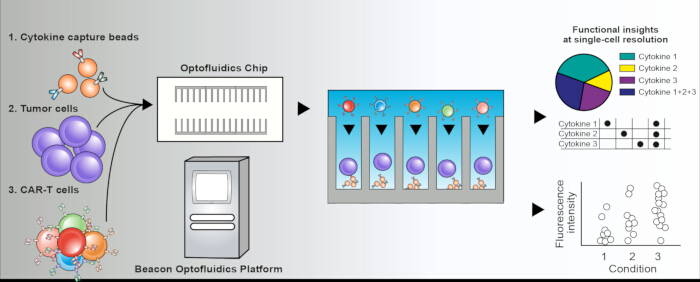
Figure 1: Schematic workflow for multimodal profiling via an optofluidics platform. Please click here to view a larger version of this figure.
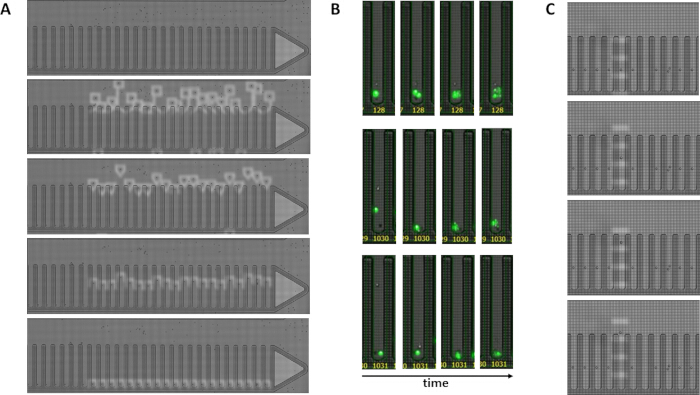
Figure 2: Representative images of different optofluidics platform features. (A) Import the sequence of single particles into individual pens via OEP. The pens in the left part of the images have been loaded in the previous sequence. (B) Killing events in three individual pens over time, showing GFP-expressing antigen-expressing tumor cells. (C) Export of an individual cell from one pen via OEP. Please click here to view a larger version of this figure.
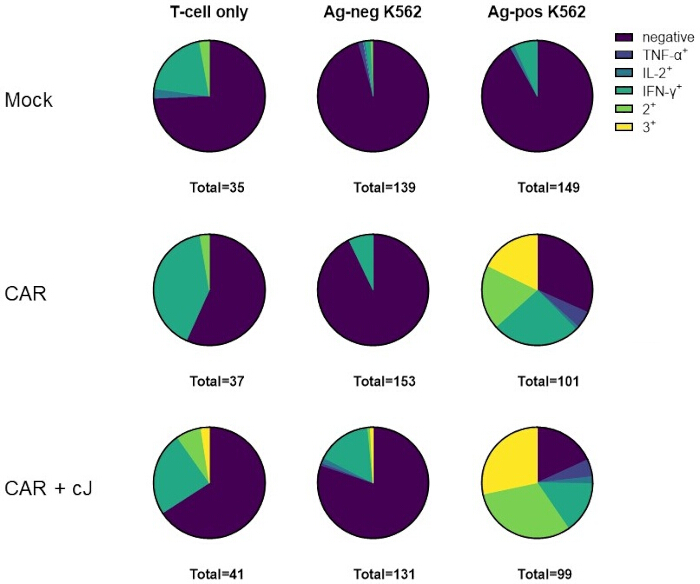
Figure 3: Representative analysis of cytokine secretion profiles at the single-cell level. Individual mock-nucleofected T cells or CAR-T cells were cultured in the presence or absence of either antigen-negative or antigen-positive K562 tumor cells within nanopens containing cytokine capture beads for TNF-α, IL-2, and IFN-γ. Pie charts depict the proportions of analyzed individually penned CAR-T cells with the indicated cytokine secretion profile after 24 h of co-culture (endpoint analysis). Please click here to view a larger version of this figure.
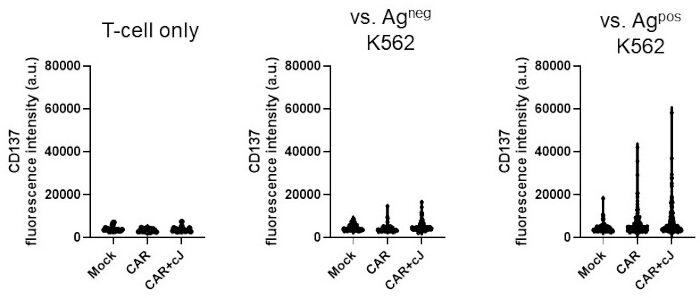
Figure 4: Representative analysis of CD137 expression at the single-cell level. Individual mock-nucleofected T cells or CAR-T cells were stained for CD137 surface expression on the optofluidics chip, 24 h after culture in the presence or absence of either antigen-negative or antigen-positive K562 tumor cells. Violin plots depict the fluorescence intensity of CD137 expression on mock-nucleofected T cells and CAR-T cells after 24 h of culture. Please click here to view a larger version of this figure.
| T cell medium components (Sterile filtered using 0.22µM Vacuum Filter Units) | Volume (final concentration) |
| RPMI-1640 (1x GlutaMAX, 25mM HEPES) | 500 mL |
| Penicillin/Streptomycin (10.000 U/mL) | 5 mL (90 U/mL) |
| β-Mercaptoethanol (50mM) | 0.5 mL (45µM) |
| Human Serum (heat-inactivated) | 50 mL (9%) |
| GlutaMAX Supplement (100x) | 5mL (0.9x) |
| Tumor cell medium components | Volume (final concentration) |
| RPMI-1640 (1x GlutaMAX, 25mM HEPES) | 500 mL |
| Penicillin/Streptomycin (10.000 U/mL) | 5 mL (90 U/mL) |
| Fetal Calf Serum (heat-inactivated) | 50 mL (9%) |
| MACS buffer components | Volume (final concentration) |
| DPBS (Mg2+-free, Ca2+-free) | 500 mL |
| Fetal Calf Serum (heat-inactivated) | 2.5 mL (0.5 %) |
| EDTA (0.5 M) | 2 mL (2 mM) |
| PBS/EDTA buffer components | Volume (final concentration) |
| DPBS | 500 mL |
| EDTA (0.5 M) | 2 mL (2 mM) |
| Loading Media components | Volume (final concentration) |
| T cell medium | 18 mL |
| Loading Reagent | 2 mL |
| Loading Media+CaCl2 components | Volume (final concentration) |
| Loading Media | 499 µL |
| CaCl2 | 1.25 µL |
| Perfusion media+Caspase substrate | Volume (final concentration) |
| T cell medium | 20 mL |
| NucView 530 Caspase-3 Substrate (1 mM in DMSO) | 100 µL |
| Bead Dilution buffer components | Volume (final concentration) |
| DPBS | 800 µL |
| BSA (2% w/v) | 100 µL (0.2% w/v) |
| Tween-20 (10% w/v) | 10 µL (0.1% w/v) |
Table 1: Media and buffer preparation.
Supplementary Figure 1. Exemplary gating-strategy to assess gene-transfer efficiency before magnetic enrichment. Exemplary contour and histogram plots are depicting the gating strategy to identify CAR-expressing (tEGFR-positive) CAR T cells after gene transfer was performed.Please click here to download this file.
Supplementary Figure 2. Purity control post sorting. Exemplary contour plots are depicting fraction of CAR-expressing (tEGFR-positive) CAR T cells after magnetic sorting was performed.Please click here to download this file.
Supplementary Figure 3. Antigen expression on target tumor cells. Representative histogram plots depict WT K562 tumor cells or engineered to express ROR1 stained with isotype or ROR1-targeting antibody via flow cytometry.Please click here to download this file.
Supplementary Figure 4. Cytokine detection using standard ELISA. IL-2 and IFN-γ concentrations in supernatant after 24h of co-culture with K562ROR1 tumor cells at E:T of 4:1 as measured via ELISA for CAR vs CAR+cJ T cells. Statistical significance as determined by unpaired t-test with *P≤ 0.05, **P≤ 0.01, ***P≤ 0.001, ****P≤ 0.0001.Please click here to download this file.
Supplementary Table 1: Cells analyzed. The table indicates the number of individual cells analyzed per condition.Please click here to download this file.
Discussion
Loading...
$$\rightleftharpoonup{xx}$$
$$\longleftharp{xx}$$,
$$\longrightharp{xx}$$,
The demonstrated workflow enables evaluation of the cytokine secretion and activation profile of individual CAR-T cells during co-culture with antigen-positive and antigen-negative target cells that can optionally be combined with cytolytic activity assessment. While the ability to capture multimodal functional data at single-cell resolution presents a way to analyze CAR T-cell performance with unprecedented precision, the quantifiability of the measurements is highly dependent on the accuracy of the OEP technology in loading the same number of cytokine capture beads, target cells, and CAR-T cells in each pen. Thus, it is critical to ensure that the loading density and TPS criteria of each reagent or cell sample are optimized to enable single-bead and/or single-cell loading in each pen. While adapting the concentration of the bead or cell suspension in the fluidics channels can enable adequate pen loading, the Flush and Import options of the platform serve as an additional strategy to re-attempting the loading process.
One advantageous feature of the optofluidics chip design is the segregation of the pen layout into 22 distinct FOVs. By loading T cells engineered with different CAR constructs into different FOVs within the optofluidics chip, we were also able to assess whether an alternative construct enforcing c-Jun overexpression could enhance the generation of CAR-T cells with multimodal functionality, relative to a standard CAR construct (Figure 3 and Figure 4). In this way, an optofluidics platform provides means to rapidly identify candidate CAR constructs that may have the potential to boost the durability of CAR-T cell–induced cancer remission. Of note, the analysis of interaction between target and effector cells at the single-cell level demands crucial control of key parameters, e.g., the heterogeneity of target antigen expression on tumor cells and purity of the CAR-T cell population (Supplementary Figure 2 and Supplementary Figure 3).
Although we focused on evaluating IL-2, TNF-α, and IFN-γ secretion, the broad range of soluble analytes that can be detected with commercially available multiplex cytokine capture panels allows for considerable customization of the workflow. Recent developments highlight that the field is also progressing in the direction of high-dimensional flow cytometry, opening new possibilities for synergies with functional profiling of different immune cell types12,13. For example, future applications may involve screening campaigns to identify polyfunctional CAR-expressing regulatory T cells (Tregs). These secrete multiple anti-inflammatory cytokines such as TGF-β and IL-1014. Thus, the adaptability of an optofluidics system could pave the way for critical insights as cellular immunotherapies expand to new frontiers in the treatment of non-malignant diseases.
Disclosures
Loading...
$$\rightleftharpoonup{xx}$$
$$\longleftharp{xx}$$,
$$\longrightharp{xx}$$,
ML and MH are listed as inventors on patent application WO2021/058811A1. MH is listed as an inventor on patent applications and granted patents related to CAR-T technologies that have been filed by the Fred Hutchinson Cancer Research Center, Seattle, WA, and by the University of Würzburg, Würzburg, Germany. MH is a co-founder and equity owner of TCURX GmbH, Würzburg, Germany. MH received honoraria from Celgene/BMS, Janssen, Kite/Gilead. FF is inventor of a patent application related to CAR-T technologies filed by the University of Würzburg, Würzburg, Germany.
Acknowledgements
Loading...
$$\rightleftharpoonup{xx}$$
$$\longleftharp{xx}$$,
$$\longrightharp{xx}$$,
Supported by the IMI2 Joint Undertaking (EU Horizon 2020, EFPIA, EHA; Grant 945393, T2EVOLVE to MH/ML), the Wilhelm-Sander-Stiftung (2022.134.1 to ML), ERA-NET TRANSCAN-3 (SmartCAR-T to MH/ML), the Paula & Rodger Riney Foundation (to MH/ML), IZKF Würzburg (S-511, C-543 to ML), the Deutsche Forschungsgemeinschaft (DFG, German Research Foundation; Major Instrumentation INST 93/1147-1 FUGG; SFB-TRR221 A03 to MH/ML and A06 to ML; CRC1525 Seed Grant to ML; SFB-TRR 338/3 2026 –452881907 subprojects A02 to MH and C04 to ML), and the Bavarian Cancer Research Center (BZKF; TANGO to MH/ML). We also thank Bruker Cellular Analysis for collaboration and technical support with the optofluidics platform.
Materials
| Name | Company | Catalog Number | Comments |
|---|---|---|---|
| 4-D Nucleofector | Lonza | ||
| Anti-Biotin MicroBeads | Miltenyi Biotec | 130-090-485 | |
| CD3/CD28 Dynabeads | Thermo Fisher | 11131D | |
| CD8+ T cell isolation kit | Miltenyi Biotec | 130-096-495 | |
| CELLSTAR 15-ml conical tubes (PP) | Greiner Bio-One | 188271-N | |
| CELLSTAR 50-ml conical tubes (PP) | Greiner Bio-One | 227261 | |
| Corning 75cm² U-Shaped Canted Neck Cell Culture Flask with Plug Seal Cap | Corning | 430720U | |
| Costar 24-well Clear TC-treated Multiple Well Plates, Individually Wrapped, Sterile | Corning | 3526 | |
| Costar 48-well Clear TC-treated Multiple Well Plates, Individually Wrapped, Sterile | Corning | 3548 | |
| DPBS, no calcium, no magnesium | Thermo Fisher | 14190169 | |
| DynaMag-15 Magnet | Thermo Fisher | 12301D | |
| EGFR (Erbitux, Cetuximab) | Eli Lilly | NDC 66733-948-23 | for in-house conjugation (biotin) |
| EGFR Antibody (C225 (Cetuximab)) [Alexa Fluor 647] | Novus Biologicals | NBP2-75903AF647 | |
| Fetal Bovine Serum, Value | Thermo Fisher | A5256801 | |
| GlutaMAX Supplement (100x) | Thermo Fisher | 35050038 | |
| Human IL-2 IS, premium grade | Miltenyi Biotec | 130-097-748 | |
| Human Serum | Deutsches Rotes Kreuz (DRK)/ German Red Cross (GRC) | N/A | |
| MACS Cell separation column, LS | Miltenyi Biotec | 130-042-401 | |
| MACS MultiStand | Miltenyi Biotec | 130-042-303 | |
| P3 Primary Cell 4D-Nucleofector X Kit | Lonza | V4XP-3032 | |
| Pancoll human, Density: 1.077 g/ml | PanBiotech | P04-60500 | |
| PE Annexin V Apoptosis Detection Kit I | BD Biosciences | 559763 | |
| Penicillin-Streptomycin (10.000 U/ml) | Thermo Fisher | 15140122 | |
| Pierce Cell Surface Biotinylation and Isolation Kit | Thermo Fisher | A44390 | |
| QuadroMACS Starting Kit (LS) | Miltenyi Biotec | 130-091-051 | |
| RPMI 1640 Medium, Glutamax Supplement, HEPES | Thermo Fisher | 72400054 | |
| Serological pipettes 2, 5, 10, 25 and 50 ml | Greiner Bio-One | 710180, 606180, 607180, 760180, 768180 | |
| Trypan Blue Stain (0,4%) | Thermo Fisher | 15250-061 | |
| UltraPure 0,5 M EDTA, pH 8,0 | Thermo Fisher | 15575020 | |
| β-Mercaptoethanol (50mM) | Thermo Fisher | 31350010 | |
| Beacon reagents | |||
| 96-well plate round-bottom | Corning | 3799 | |
| Beacon Plastic Flush chip | 500-00030 | ||
| BLI Cleaning Solution, Sodium Hypocloite, 0.825% | Bruker | 520-08000 | |
| Bovine Serum Albumin (BSA) | Sigma-Aldrich | A4161 | |
| Brilliant Violet 421 anti-human CD137 (4-1BB) Antibody | Biolegend | 309820 | |
| Calcium Chloride (CaCl2) | Sigma-Aldrich | C5670 | |
| LEGENDplex Human IFN-γ Capture Beads B3, 13X | Biolegend | 740545 | |
| LEGENDplex Human IL-2 Capture Bead A5, 13X | Biolegend | 740934 | |
| LEGENDplex Human Th Panel Detection Antibodies V02 | Biolegend | 741041 | |
| LEGENDplex Human TNF-α Capture Bead B7, 13X | Biolegend | 740711 | |
| LEGENDplex SA-PE | Biolegend | 740452 | |
| NucView 530 Caspase-3 Substrate, 1 mM in DMSO | Hölzel | B-10406 | |
| OptoSelect Chip 3500 | Bruker | 500-12001 | |
| Sodium Azide | Sigma-Aldrich | S2002 | |
| TWEEN 20 | Sigma-Aldrich | P1379 | |
| Vegan Export Buffer | Bruker | 520-00040 | |
| VWR Media Bottles, Square, PETG, 125ml | VWR | 216-2265 | |
| VWR Media Bottles, Square, PETG, 500ml | VWR | 216-2267 | |
| Wetting Additive | Bruker | 520-08016 | |
| Wetting Solution | Bruker | 520-00009 |
References
Loading...
$$\rightleftharpoonup{xx}$$
$$\longleftharp{xx}$$,
$$\longrightharp{xx}$$,
- Decade-long leukaemia remissions with persistence of CD4+ CAR T cells. Nature. 602 (7897), 503-509 (2022).">Melenhorst, J. J., et al. Decade-long leukaemia remissions with persistence of CD4+ CAR T cells. Nature. 602 (7897), 503-509 (2022).
- CD19 CAR-T cells of defined CD4+:CD8+ composition in adult B cell ALL patients. J Clin Investigat. 126 (6), 2123-2138 (2016).">Turtle, C. J., et al. CD19 CAR-T cells of defined CD4+:CD8+ composition in adult B cell ALL patients. J Clin Investigat. 126 (6), 2123-2138 (2016).
- Idecabtagene Vicleucel in Relapsed and Refractory Multiple Myeloma. New Engl J Med. 384 (8), 705-716 (2021).">Munshi, N. C., et al. Idecabtagene Vicleucel in Relapsed and Refractory Multiple Myeloma. New Engl J Med. 384 (8), 705-716 (2021).
- Ciltacabtagene autoleucel, a B-cell maturation antigen (BCMA)-directed chimeric antigen receptor T-cell (CAR-T) therapy, in relapsed/refractory multiple myeloma (R/R MM): Updated results from CARTITUDE-1. J Clin Oncol. 39 (15_suppl), 8005(2021).">Usmani, S. Z., et al. Ciltacabtagene autoleucel, a B-cell maturation antigen (BCMA)-directed chimeric antigen receptor T-cell (CAR-T) therapy, in relapsed/refractory multiple myeloma (R/R MM): Updated results from CARTITUDE-1. J Clin Oncol. 39 (15_suppl), 8005(2021).
- FOXO1 enhances CAR T cell stemness, metabolic fitness and efficacy. Nature. 629 (8010), 201-210 (2024).">Chan, J. D., et al. FOXO1 enhances CAR T cell stemness, metabolic fitness and efficacy. Nature. 629 (8010), 201-210 (2024).
- c-Jun overexpression in CAR T cells induces exhaustion resistance. Nature. 576 (7786), 293-300 (2019).">Lynn, R. C., et al. c-Jun overexpression in CAR T cells induces exhaustion resistance. Nature. 576 (7786), 293-300 (2019).
- Determinants of response and resistance to CD19 chimeric antigen receptor (CAR) T cell therapy of chronic lymphocytic leukemia. Nat Med. 24 (5), 563-571 (2018).">Fraietta, J. A., et al. Determinants of response and resistance to CD19 chimeric antigen receptor (CAR) T cell therapy of chronic lymphocytic leukemia. Nat Med. 24 (5), 563-571 (2018).
- Disruption of TET2 promotes the therapeutic efficacy of CD19-targeted T cells. Nature. 558 (7709), 307-312 (2018).">Fraietta, J. A., et al. Disruption of TET2 promotes the therapeutic efficacy of CD19-targeted T cells. Nature. 558 (7709), 307-312 (2018).
- Metabolization of microbial postbiotic pentanoate drives anti-cancer CAR T cells. bioRxiv. , (2025).">Staudt, S., et al. Metabolization of microbial postbiotic pentanoate drives anti-cancer CAR T cells. bioRxiv. , (2025).
- T cell killing requires the IFNγR pathway in solid but not liquid tumours. Nature. 604 (7906), 563-570 (2022).">Larson, R. C., et al. T cell killing requires the IFNγR pathway in solid but not liquid tumours. Nature. 604 (7906), 563-570 (2022).
- CD137 (4-1BB) costimulation of CD8+ T cells is more potent when provided in cis than in trans with respect to CD3-TCR stimulation. Nat Comm. 12 (1), 7296(2021).">Otano, I., et al. CD137 (4-1BB) costimulation of CD8+ T cells is more potent when provided in cis than in trans with respect to CD3-TCR stimulation. Nat Comm. 12 (1), 7296(2021).
- Postinfusion PD-1+ CD8+ CAR T cells identify patients responsive to CD19 CAR T-cell therapy in non-Hodgkin lymphoma. Blood Adv. 8 (12), 3140-3153 (2024).">Denlinger, N., et al. Postinfusion PD-1+ CD8+ CAR T cells identify patients responsive to CD19 CAR T-cell therapy in non-Hodgkin lymphoma. Blood Adv. 8 (12), 3140-3153 (2024).
- High-dimensional temporal mapping of CAR T cells reveals phenotypic and functional remodeling during manufacturing. Mol Ther J Am Soc Gene Ther. 33 (5), 2291-2309 (2025).">Cadinanos-Garai, A., et al. High-dimensional temporal mapping of CAR T cells reveals phenotypic and functional remodeling during manufacturing. Mol Ther J Am Soc Gene Ther. 33 (5), 2291-2309 (2025).
- Regulatory T cells expressing CD19-targeted chimeric antigen receptor restore homeostasis in Systemic Lupus Erythematosus. Nat Comm. 15 (1), 2542(2024).">Doglio, M., et al. Regulatory T cells expressing CD19-targeted chimeric antigen receptor restore homeostasis in Systemic Lupus Erythematosus. Nat Comm. 15 (1), 2542(2024).
Reprints and Permissions
Request permission to reuse the text or figures of this JoVE article
Request Permission