This study proposes a generative AI-based framework that integrates GANs, VAEs, and attention-based deep convolutional networks to detect COVID-19 from cough audio signals, improving robustness, data balance, and cross-dataset generalization for scalable, non-invasive screening.
Research Article
A Generative AI-Based Framework for COVID-19 Screening from Cough Audio Signals
Opens in a new tab
In This Article
Summary
Loading...
$$\rightleftharpoonup{xx}$$
$$\longleftharp{xx}$$,
$$\longrightharp{xx}$$,
Abstract
Loading...
$$\rightleftharpoonup{xx}$$
$$\longleftharp{xx}$$,
$$\longrightharp{xx}$$,
Cough audio analysis provides a practical pathway for developing automated tools to support COVID-19 disease screening. Despite growing interest, many existing approaches remain sensitive to noise, class imbalance, and dataset variability, limiting their reproducibility. This work presents a structured generative artificial intelligence-driven methodology for COVID-19 detection using cough sound recordings. Experiments are conducted using two publicly accessible datasets, COUGHVID and Virufy, both of which comprise labeled cough samples. The proposed protocol consists of sequential preprocessing stages, including cough segmentation, denoising, and signal normalization. Acoustic characteristics are then captured through Mel-Frequency Cepstral Coefficients, chroma descriptors, and spectral contrast features. To improve representation learning and mitigate data imbalance, a hybrid generative framework integrating Variational Autoencoders and Generative Adversarial Networks is employed to synthesize feature-level samples. Classification is subsequently performed using Deep Convolutional Neural Networks and Attention-based DCNN models. Performance evaluation indicates that incorporating generative augmentation consistently improves over non-generative baselines, achieving a peak classification accuracy of 97.2% and an AUROC of 0.953 across the evaluated datasets. These results demonstrate the effectiveness of generative modeling for enhancing cough-based COVID-19 detection and establish a reproducible analytical pipeline for future research in acoustic health monitoring.
Introduction
Loading...
$$\rightleftharpoonup{xx}$$
$$\longleftharp{xx}$$,
$$\longrightharp{xx}$$,
Respiratory acoustics have increasingly been explored as a non-invasive source of information for health assessment, particularly in the context of infectious and pulmonary diseases. Advances in signal processing and artificial intelligence (AI) have enabled automated analysis of cough and breathing sounds, supporting their use as digital biomarkers. Recent studies demonstrate that respiratory sounds captured using microphones embedded in smartphones, wearable devices, or clinical sensors can be effectively analyzed using deep learning models to detect COVID-19 infection1,5. These developments highlight the potential of audio-based screening as a rapid, contactless, and scalable complement to conventional diagnostic procedures. Coronavirus Disease 2019 (COVID-19), caused by the SARS-CoV-2 virus, primarily affects the respiratory system and induces measurable changes in airflow dynamics, lung function, and vocal tract behavior. Although reverse transcription–polymerase chain reaction (RT-PCR) testing remains the reference standard for diagnosis, its logistical constraints and delayed turnaround time limit its suitability for large-scale or continuous screening, motivating the exploration of alternative approaches based on respiratory sound analysis.
A growing body of literature has investigated AI-driven COVID-19 detection using cough, breathing, and speech signals. As summarized in Table 1, prior studies have explored diverse datasets, acoustic feature representations (e.g., MFCC, STFT, spectrogram-based features), and learning paradigms ranging from classical machine learning models to deep convolutional, recurrent, attention-based, and transformer architectures8,9,10,11,12,13,14,15,16,17,18,19,20,21,22,23,24,25,26,27˒43,44,45. Several works have demonstrated promising screening performance using crowdsourced and clinically collected respiratory audio. In contrast, others have emphasized the importance of transfer learning, data augmentation, and explainable AI for improving robustness and trustworthiness. Rather than repeating a detailed study-by-study discussion, Table 1 provides a consolidated comparative overview of these representative approaches, enabling direct comparison of datasets, methodologies, and reported outcomes.
Despite these advances, several limitations hinder the robustness and real-world applicability of existing approaches. Respiratory audio datasets are frequently collected under heterogeneous recording conditions, leading to substantial variability across devices, acoustic environments, and subject populations2,3,4. Many publicly available datasets rely on self-reported COVID-19 status, introducing uncertainty in label reliability7. In addition, pronounced class imbalance and limited availability of clinically validated samples restrict the generalization capability of discriminative models trained solely on observed data4,5. Consequently, model performance reported under controlled experimental settings does not consistently translate to reliable deployment across diverse real-world scenarios.
Taken together, these limitations highlight a critical research gap: the absence of a unified framework that simultaneously addresses data scarcity, class imbalance, and robust generalization across heterogeneous datasets. Although generative models such as Generative Adversarial Networks (GANs) and Variational Autoencoders (VAEs) have been explored to learn latent representations and synthesize realistic biomedical signals6,7, existing studies typically employ these models independently and evaluate them within a single dataset. Moreover, their integration with attention-enhanced convolutional architectures and evaluation under cross-dataset conditions remains insufficiently investigated.
To address this gap, the present study proposes a generative AI-assisted framework for COVID-19 detection from cough sounds that integrates acoustic feature extraction with a hybrid GAN–VAE model and attention-based deep convolutional neural networks (DCNNs). The generative component mitigates class imbalance and limited sample availability through structured latent representation learning and synthetic data generation, while the discriminative models enhance classification robustness across heterogeneous datasets. Unlike prior works that rely predominantly on within-dataset validation, the proposed framework is evaluated using cross-dataset testing on an independent dataset, enabling a more rigorous assessment of generalization performance. The framework is intended as a screening-oriented approach rather than a standalone diagnostic tool, and its design explicitly accounts for recording variability and label uncertainty to support reproducible and reliable deployment.
In this context, the novel contributions of the present study are threefold. First, a unified GAN–VAE hybrid generative framework is integrated with attention-based DCNN classifiers to jointly address class imbalance, limited data availability, and robust feature representation learning in cough-based COVID-19 screening. Second, the proposed approach is systematically evaluated using cross-dataset validation, providing a more realistic assessment of model generalization compared with conventional within-dataset testing. Third, the study presents a detailed analysis of the impact of generative augmentation under heterogeneous recording conditions, thereby positioning the framework as a reproducible proof-of-concept for scalable, practical COVID-19 screening.
| Author(s) & Year | Dataset(s) | Techniques / Features Used | Model / Classifier | Accuracy / Metrics | Limitations / Notes |
| Imran et al., 20208 | Crowdsourced cough dataset (AI4COVID-19) | MFCC, transfer learning, domain-aware features | Risk-averse multi-classifier (DL + ML ensemble) | Accuracy: 92.6% | Dependent on cough quality; limited clinical validation |
| Brown et al., 20209 | Crowdsourced respiratory sounds (>7,000 users) | Handcrafted audio features, VGGish embeddings | Shallow ML models | AUC > 80% | Label noise in crowdsourced data |
| Laguarta et al., 202010 | MIT Open Voice dataset (5,320 subjects) | MFCC, acoustic biomarkers | CNN (ResNet50, transfer learning) | Sensitivity: 98.5%, Specificity: 94.2% | Requires large pretraining dataset |
| Quartieri et al., 202011 | Speech interviews (5 subjects, pre/post COVID) | Respiratory intensity, F0, CPP, formants | Statistical effect-size analysis | achieve an AUC of above 80% across all tasks | Very small sample size |
| Hassan et al., 202012 | Respiratory sounds | Temporal speech features | RNN | Cough:97%, breath:98.2%, voice:88.2% | Lack of detailed dataset statistics |
| Khamparia et al., 201913 | ESC-10, ESC-50 | Spectrogram image-based features | CNN, TDSN | CNN: 77% (ESC-10), 49% (ESC-50); TDSN: 56% (ESC-10) | Environmental sounds only; lower performance on complex datasets |
| Aykanat et al., 201714 | 17,930 lung sounds from 1,630 subjects (electronic stethoscope) | MFCC features, spectrogram images | SVM, CNN | CNN/SVM: 86% (healthy vs pathological), 76%/75% (rale–rhonchus–normal), 80%/80% (single type), 62%/62% (all types) | Requires specialized hardware; not disease-specific |
| Ponomarchuk et al., 202215 | Coswara, Virufy | MFCC, mel-spectrogram, wavelet features | CNN, RNN, ensemble models | AUC: 0.93 (internal), 0.79 (external) | Generalization across datasets remains challenging |
| Feng et al., 202116 | Coswara, Virufy | STFT, MFCC | SVM (RBF), CNN | Accuracy 81.25% (AUC of 0.79) | Dataset-dependent performance |
| Islam et al., 202217 | Clinical cough recordings | Spectral and time-frequency features | Deep neural networks | Accuracy: 89.2% | Limited dataset |
| Manshouri, 202218 | Virufy | Spectral analysis features | Classical ML classifiers | Accuracy:95.86% | Small-scale experimental study |
| Huang et al., 202019 | Lung sounds from 10 COVID-19 patients | Time–frequency respiratory sound analysis | Clinical expert analysis | Qualitative validation | Small dataset; no ML model |
| W. D. Puja et al., 202420 | Coswara, Virufy (cough sound datasets) | STFT, Mel spectrogram, MFCC, RMS energy, spectral bandwidth, spectral centroid, spectral roll-off, ZCR; CNN-based deep feature extraction | 1D CNN (feature extractor) + Random Forest | Accuracy: 93% | Performance depends on cough quality; designed for screening rather than clinical diagnosis; crowdsourced data variability |
| Chadaga et al., 202321 | Crowdsourced cough audio recordings | Mel-spectrogram and time–frequency acoustic features | Convolutional Neural Network (CNN) | Accuracy: 84%, Precision: 85%, Recall: 84%, F1-score: 84% | Performance is limited by data imbalance, self-reported labels, sensitivity to recording conditions |
| Chadaga et al., 202322 | Mild-moderate COVID-19 & other respiratory illness clinical markers | Feature selection (Pearson, PSO); Key markers: Eosinophil, Albumin, T. Bilirubin, ALP, ALT, AST, HbA1c, TWBC | Stacked ensemble; 1D CNN, LSTM, DNN, Residual MLP | Accuracy: 89% | Severe cases excluded; alternative to RT-PCR; explainable AI applied |
| Dar et al. 202423 | COVID-19 Dataset | SJHBO optimization (Jaya+HBO+SO), many spectral features | Deep Q Network (DQN) | Accuracy: 95.11%, Sensitivity: 95.06%, Specificity: 94.69% | High complexity; tuning is improved via a hybrid optimizer |
| Jing Quian et al 202024 | Speech recordings from COVID-19 patients | Acoustic feature sets; analysis of illness severity, sleep quality, fatigue, anxiety | Support Vector Machines (SVM) | 0.69 (illness severity) | Limited to audio features; moderate accuracy; dataset size not specified; only four health aspects considered |
| Sharma, J., et al. 202025 | UrbanSound8K, ESC-10, ESC-50 | Multi-feature channels: MFCC, GFCC, CQT, Chromagram; Mix-up data augmentation | Deep CNN with spatially separable convolutions and attention modules | UrbanSound8K: 97.52%, ESC-10: 94.75%, ESC-50: 87.45% | Not tested on non-benchmark or real-world datasets; computational complexity due to deeper CNN and attention modules |
| Lella KK, et al. 202126 | Respiratory sounds; COVID-19, asthma, healthy) | Data augmentation; deep features using Data De-noising Auto Encoder (DDAE) instead of MFCC | 1D Convolutional Neural Network (1D CNN) | ~90% | Limited dataset details; ~4% improvement over MFCC; generalizability not tested |
| Orlandic et al., 202127 | COUGHVID (25k+ coughs) | MFCCs, PSD, spectral & time features | XGBoost | AUC 96.5%, Precision 95.5% | Self-reported COVID; expert labels on subset |
| Zhang et al., 202343 | Published case reports of HLH following COVID-19 vaccination (literature databases) | Systematic review; clinical feature aggregation; molecular docking analysis | Not applicable (clinical review) | Descriptive statistics; clinical outcomes | Rare event analysis; small sample size; reliance on reported cases may introduce reporting bias |
| Xu et al., 202344 | Reported cases of vaccine-associated VKH disease from literature | Retrospective case review; clinical and imaging feature analysis | Not applicable (clinical observational study) | Treatment response and clinical recovery outcomes | Limited number of cases; lack of control group; causal relationship cannot be firmly established |
| Hu et al., 202545 | Firm-level parent–subsidiary data of SRDI medical device companies in China (Qixinbao database) | Social network analysis; spatial network metrics; geographical detector analysis | Not applicable (network & policy analysis) | Network density, centrality, diffusion indices | Cross-sectional design; equal weighting of firms; no direct performance or clinical outcome metrics |
Table 1: Summary of existing COVID-19 audio-based detection studies. Comparative overview of prior cough/audio screening approaches, including datasets, methods, and reported performance. Please click here to download this Table.
Access restricted. Please log in or start a trial to view this content.
Protocol
Loading...
$$\rightleftharpoonup{xx}$$
$$\longleftharp{xx}$$,
$$\longrightharp{xx}$$,
Proposed Methodology
This study proposes a generative AI–based framework for detecting COVID-19 from cough signals. The framework integrates generative models with discriminative classifiers, with training and evaluation data kept strictly separate. Figure 1 illustrates the detailed architecture of the proposed GAN–VAE–ADCNN framework, showing the flow from audio preprocessing and feature extraction through latent representation learning via a Variational Autoencoder (VAE), synthetic feature generation using a Generative Adversarial Network (GAN), and final classification using Deep Convolutional Neural Networks (DCNN) and Attention-based DCNN (ADCNN). The figure shows that generative components are used only during training, while classification is performed using discriminative models.
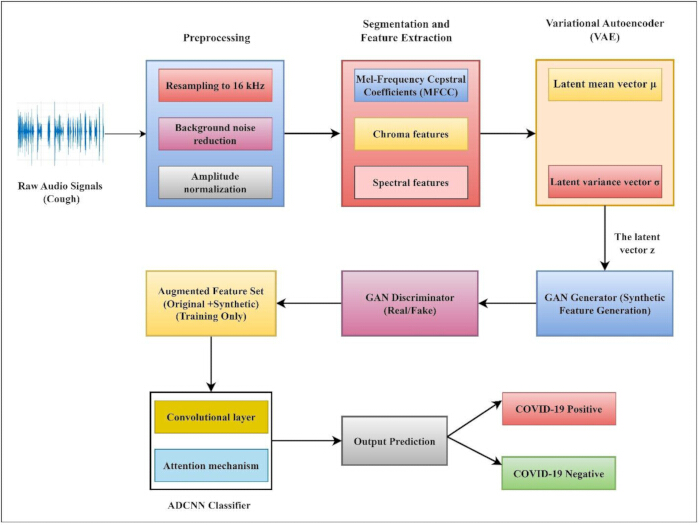
Figure 1: GAN–VAE–ADCNN architecture overview. Schematic of the proposed hybrid pipeline, where cough-derived acoustic features are encoded using a VAE, augmented through GAN-based synthetic sample generation, and classified using DCNN and attention-based DCNN (ADCNN) models. Please click here to view a larger version of this figure.
Model Architecture and Implementation
The generative and discriminative models used in this framework were implemented with fixed and reproducible architectures. The GAN consists of a generator with three fully connected layers (128, 256, and 512 units) using ReLU activation, and a discriminator with three fully connected layers (512, 256, and 128 units) using LeakyReLU activation followed by a sigmoid output.
The VAE encoder comprises two fully connected layers with 256 and 128 units, followed by latent mean and variance estimation with a latent dimensionality of 64. The decoder mirrors this structure and is trained using a combination of reconstruction loss and Kullback–Leibler divergence to learn a structured and probabilistic latent space.
The DCNN classifier includes four convolutional blocks with 3x3 kernels and 32, 64, 128, and 256 filters, respectively. Each block is followed by batch normalization, a ReLU activation, and 2x2 max pooling. The ADCNN extends the DCNN by incorporating a channel-wise attention mechanism after the final convolutional block. All models were optimized using the Adam optimizer with a learning rate of 0.0001 and a batch size of 32. As shown in Figure 1, the VAE and GAN operate only during training, while DCNN and ADCNN are used for classification. The complete training and evaluation procedure is summarized in Algorithm 1.
Algorithm 1: GAN–VAE-Based COVID-19 Detection Framework
Input: Pre-processed cough audio recordings
Output: Binary classification label (COVID-19 positive/negative)
The training and evaluation procedures followed a fixed, reproducible pipeline. All cough audio recordings were resampled to 16 kHz, subjected to noise reduction, and amplitude normalized. The recordings were segmented into fixed-length segments, from which MFCC, chroma, and spectral features were extracted. A total of 40 Mel-Frequency Cepstral Coefficients (MFCCs) were extracted from each audio segment. In addition, 12 chroma features were computed. The resulting representation forms a 52-dimensional feature vector for each cough segment. Subject-level splitting was performed to divide the data into training, validation, and test sets. The VAE was trained to learn probabilistic latent representations, and the resulting latent vectors were used to train the GAN for synthetic feature generation. The training dataset was augmented using GAN–VAE–generated samples, while synthetic data were excluded from validation and testing. DCNN and ADCNN classifiers were trained on the augmented training data, and final evaluation was conducted on the held-out test set using standard performance metrics.
Training Setup, Data Splitting, and Leakage Prevention
All experiments were conducted with a fixed, reproducible training configuration. Data splitting was performed at the subject level before audio segmentation to prevent data leakage. The dataset was divided into training, validation, and test sets at an 80:10:10 ratio, ensuring that all segments from the same recording were assigned to a single subset. The training set was used for model learning and generative data augmentation, the validation set for hyperparameter tuning and early stopping, and the test set was held out for final performance evaluation. Synthetic samples generated by the GAN–VAE framework were used exclusively during training and were strictly excluded from validation and testing to ensure fair evaluation.
Models were trained for a maximum of 100 epochs, with early stopping based on validation loss and a patience of 10 epochs. Optimization was performed using the Adam optimizer with a learning rate of 0.0001 and a batch size of 32. Binary cross-entropy loss was applied for classification, while reconstruction and adversarial losses were used for training the VAE and GAN components, respectively. This unified training and evaluation protocol ensures reproducibility, prevents data leakage, and maintains strict separation between training and evaluation stages.
Dataset Description
Two publicly available cough audio datasets—COUGHVID and Virufy—were used to balance large-scale acoustic diversity with clinically referenced labels, with clearly separated roles in training and evaluation.
COUGHVID is a crowdsourced collection of cough recordings with partial expert annotation and self-reported metadata. To ensure data quality, 428 recordings were selected after applying predefined quality-control criteria, including minimum signal duration, adequate signal-to-noise ratio, removal of corrupted or ambiguous samples, and the presence of identifiable cough events with symptom metadata. After preprocessing and segmentation, these recordings yielded 1,719 cough segments, standardized to WAV format at a 16 kHz sampling rate. COUGHVID was used for training both the generative models and discriminative classifiers.
Virufy consists of physician-supervised cough recordings labeled as RT-PCR positive or negative for COVID-19. All 16 available recordings were included, resulting in 234 cough segments after segmentation, also standardized to 16 kHz. Virufy was used exclusively for external cross-dataset evaluation to assess generalization performance and was not used for training, fine-tuning, or generative augmentation.
The proposed framework should therefore be interpreted as a proof-of-concept screening approach evaluated under controlled experimental conditions rather than as a clinically validated diagnostic system.
Data Preprocessing and Segmentation
All recordings were resampled to 16 kHz, converted to mono, and subjected to silence removal, spectral noise reduction, and amplitude normalization. Segmentation was performed after subject-level splitting to prevent data leakage. Each recording was divided into overlapping 2–4 s segments, and low-energy or silent segments were discarded.
External Validation Protocol
External validation was conducted through cross-dataset evaluation. Models trained on COUGHVID were evaluated on Virufy for external validation. This protocol assesses generalization across datasets collected under different conditions rather than prospective clinical validation. Figure 2 provides a protocol-level overview of this workflow, illustrating dataset usage, preprocessing, feature extraction, classifier training, and evaluation scenarios. While Figure 1 focuses on the internal model architecture, Figure 2 emphasizes experimental design and data flow across training and testing stages.
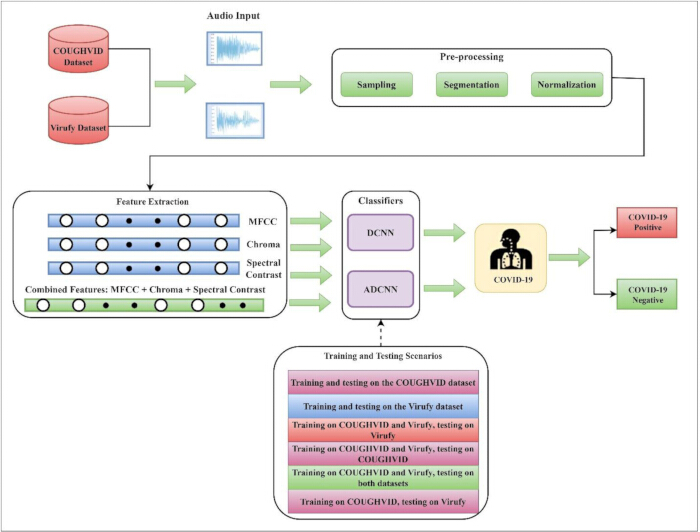
Figure 2: Workflow of the proposed COVID-19 cough screening framework. Illustration of the complete processing pipeline, including preprocessing, feature extraction (MFCC, chroma, spectral features), GAN–VAE-based representation learning and augmentation (training only), and final classification under subject-level splitting and cross-dataset evaluation. Please click here to view a larger version of this figure.
Access restricted. Please log in or start a trial to view this content.
Results
Loading...
$$\rightleftharpoonup{xx}$$
$$\longleftharp{xx}$$,
$$\longrightharp{xx}$$,
Dataset Composition and Class Distribution Analysis
Following preprocessing and segmentation, the COUGHVID and Virufy datasets showed substantial differences in both dataset scale and segment density. COUGHVID contributed 428 out of 444 recordings (96.4%) and 1,719 out of 1,953 extracted cough segments (88.0%), confirming its role as the primary dataset for model training and generative augmentation (Figure 3). In contrast, Virufy contributed only...
Access restricted. Please log in or start a trial to view this content.
Discussion
Loading...
$$\rightleftharpoonup{xx}$$
$$\longleftharp{xx}$$,
$$\longrightharp{xx}$$,
The results demonstrate that the proposed generative AI–based framework can detect COVID-19 from cough signals across heterogeneous datasets. As shown in Table 4 and Table 6, the GAN–VAE hybrid model achieved the best performance, with 97.2% accuracy and an AUROC of 0.953, along with high precision, recall, F1-score, and specificity, indicating balanced classification performance.
Performance improved consistently when generative models were combin...
Access restricted. Please log in or start a trial to view this content.
Disclosures
Loading...
$$\rightleftharpoonup{xx}$$
$$\longleftharp{xx}$$,
$$\longrightharp{xx}$$,
No potential conflict of interest was reported by the author(s).
Acknowledgements
Loading...
$$\rightleftharpoonup{xx}$$
$$\longleftharp{xx}$$,
$$\longrightharp{xx}$$,
We express our sincere gratitude to the faculty and research mentors at the School of Computer Science and Engineering for their valuable guidance, continuous support, and constructive feedback during the preparation of this paper.
Access restricted. Please log in or start a trial to view this content.
Materials
| Name | Company | Catalog Number | Comments |
|---|---|---|---|
| COUGHVID Dataset | École Polytechnique Fédérale de Lausanne (EPFL) | Public release (2021) | Crowdsourced cough audio dataset with self-reported metadata and partial physician annotation; used primarily for training and data augmentation. |
| CUDA Toolkit | NVIDIA | 11.3 | GPU acceleration framework used to speed up model training and inference. |
| LibROSA | Open Source | 0.9 | Audio analysis library used for resampling, segmentation, MFCC extraction, and spectral feature computation. |
| Linux Operating System | Canonical | Ubuntu 20.04 LTS | Operating system used for all experiments and model training. |
| Matplotlib | Open Source | 3.5 | Visualization library used for plotting dataset distributions and evaluation results. |
| NumPy | Open Source | 1.21 | Numerical computing library used for array manipulation and signal processing operations. |
| NVIDIA GPU | NVIDIA | Tesla / RTX class | Graphics processing unit used for training deep and generative models. |
| Python Programming Language | Python Software Foundation | 3.8 | Core programming environment used for data preprocessing, feature extraction, model development, and evaluation. |
| PyTorch | Meta (Facebook AI Research) | 1.12 | Deep learning framework used to implement GAN, VAE, DCNN, and attention-based DCNN models. |
| Scikit-learn | Open Source | 1 | Machine learning library used for data splitting, class weighting, and performance metric computation. |
| SciPy | Open Source | 1.7 | Scientific computing library used for audio preprocessing and signal transformations. |
| Virufy Dataset | Virufy | Public release (2021) | Clinically collected cough recordings with RT-PCR–verified COVID-19 labels; used exclusively for external validation and cross-dataset evaluation. |
References
Loading...
$$\rightleftharpoonup{xx}$$
$$\longleftharp{xx}$$,
$$\longrightharp{xx}$$,
- Aytekin, I., et al. COVID-19 detection from respiratory sounds with hierarchical spectrogram transformers. IEEE J. Biomed. Health Inform. 28 (3), 1273-1284 (2024).
- Walter, J. R., Lee, J. Y., Yu, L., et al. Use of artificial intelligence to develop predictive algorithms of cough and PCR-confirmed COVID-19 infections based on inputs from clinical-grade wearable sensors. Sci. Rep. 14, 8072(2024).
- Altae, A. A., Ehsani Rad, A., Mohebbi, K. Advanced COVID-19 detection using cough signals with space reconstruction and 3D deep convolutional neural networks. Sci. Rep. , (2025).
- Rao, S., Narayanaswamy, V., Esposito, M., Thiagarajan, J. J., Spanias, A. COVID-19 detection using cough sound analysis and deep learning algorithms. Intell. Decis. Technol. 15 (4), 655-665 (2021).
- Alkhodari, M., Khandoker, A. H. Detection of COVID-19 in smartphone-based breathing recordings: a pre-screening deep learning tool. PLoS One. 17 (1), e0262448(2022).
- Zhang, Y., et al. Research on a lung sound classification model based on a dual-channel CNN-LSTM algorithm. Biomed. Signal Process. Control. 94, 106257(2024).
- Askari Nasab, K., Mirzaei, J., Zali, A., Gholizadeh, S., Akhlaghdoust, M. Coronavirus diagnosis using cough sounds: artificial intelligence approaches. Front. Artif. Intell. 6, 1100112(2023).
- Imran, A., et al. AI4COVID-19: AI-enabled preliminary diagnosis for COVID-19 from cough samples via an app. Inform. Med. Unlocked. 20, 100378(2020).
- Brown, C., et al. Exploring automatic diagnosis of COVID-19 from crowdsourced respiratory sound data. Proc. KDD Health Day. , (2020).
- Laguarta, J., Hueto, F., Subirana, B. COVID-19 artificial intelligence diagnosis using only cough recordings. IEEE Open J. Eng. Med. Biol. 1, 275-281 (2020).
- Quartieri, T. F., Talker, T., Palmer, J. S. A framework for biomarkers of COVID-19 based on coordination of speech-production subsystems. IEEE Open J. Eng. Med. Biol. 1, 203-206 (2020).
- Hassan, A., Shahin, I., Alsabek, M. B. COVID-19 detection system using recurrent neural networks. Proc. CCCI. , 1-5 (2020).
- Khamparia, A., Gupta, D., Nguyen, N. G., et al. Sound classification using a convolutional neural network and a tensor deep stacking network. IEEE Access. 7, 7717-7727 (2019).
- Aykanat, M., Kilic, O., Kurt, B., et al. Classification of lung sounds using convolutional neural networks. J. Image Video Process. 65, (2017).
- Ponomarchuk, A., Burenko, I., Malkin, E., et al. Project Achoo: a practical model and application for COVID-19 detection from recordings of breath, voice, and cough. IEEE J. Sel. Top. Signal Process. 16 (2), 175-187 (2022).
- Feng, K., He, F., Steinmann, J., Demirkiran, I. Deep-learning based approach to identify COVID-19. Proc. SoutheastCon. , 1-4 (2021).
- Islam, R., Abdel-Raheem, E., Tarique, M. A study of using cough sounds and deep neural networks for the early detection of COVID-19. Biomed. Eng. Adv. 3, 100025(2022).
- Manshouri, N. M. Identifying COVID-19 by using spectral analysis of cough recordings: a distinctive classification study. Cogn. Neurodyn. 16 (1), 239-253 (2022).
- Huang, Y., et al. The respiratory sound features of COVID-19 patients fill gaps between clinical data and screening methods. medRxiv. , (2020).
- Puja, W. D., Sultana, S., Aowlad Hossain, A. B. M. COVID-19 detection from cough sound signal using random forest learning of deep spectral features. Proc. IEEE SPICSCON. , 1-4 (2024).
- Chadaga, K., Prabhu, S., Bhat, V., et al. COVID-19 diagnosis using clinical markers and multiple explainable artificial intelligence approaches: a case study from Ecuador. SLAS Technol. 28 (6), 393-410 (2023).
- Chadaga, K., Prabhu, S., Bhat, V., Sampathila, N., Umakanth, S., Chadaga, R. Artificial intelligence for diagnosis of mild-moderate COVID-19 using haematological markers. Ann. Med. 55 (1), 2233541(2023).
- Dar, J. A., Srivastava, K. K., Lone, S. A. Optimization-based deep learning for COVID-19 detection using respiratory sound signals. Cogn. Comput. 16 (4), 1927-1946 (2024).
- Qian, J., et al. An early study on intelligent analysis of speech under COVID-19: severity, sleep quality, fatigue, and anxiety. Proc. Interspeech. , (2020).
- Sharma, J., et al. Environment sound classification using multiple feature channels and an attention-based deep convolutional neural network. arXiv. , (2020).
- Lella, K. K., Pja, A. Automatic COVID-19 disease diagnosis using a 1D convolutional neural network and augmentation with human respiratory sound based on parameters: cough, breath, and voice. AIMS Public Health. 8 (2), 240-264 (2021).
- Orlandic, L., Teijeiro, T., Atienza, D. The COUGHVID crowdsourcing dataset, a corpus for the study of large-scale cough analysis algorithms. Sci. Data. 8, 156(2021).
- Lin, Y., et al. SympCoughNet: symptom-assisted audio-based COVID-19 detection. Front. Digit. Health. 7, 1551298(2025).
- Tena, A., Claria, F., Solsona, F. Automated detection of COVID-19 cough. Biomed. Signal Process. Control. 71, 103175(2022).
- Sharma, G., Umapathy, K., Krishnan, S. Audio texture analysis of COVID-19 cough, breath, and speech sounds. Biomed. Signal Process. Control. 76, 103703(2022).
- Hadjaidji, E., Korba, M. C. A., Khelil, K. COVID-19 detection from cough sounds using XGBoost and LSTM networks. Trait. Signal. 41 (2), 939-947 (2024).
- Despotovic, V., Ismael, M., Cornil, M., et al. Detection of COVID-19 from voice, cough, and breathing patterns: dataset and preliminary results. Comput. Biol. Med. 138, 104944(2021).
- Wang, W., Shang, Q., Lu, H. Automatic COVID-19 detection from cough sounds using multi-headed convolutional neural networks. Appl. Sci. 13, 6976(2023).
- Truong, T., Lenga, M., Serrurier, A., Mohammadi, S. Fused audio instance and representation for respiratory disease detection. arXiv. , (2023).
- Shati, A., Hassan, G. M., Datta, A. COVID-19 detection system: a comparative analysis of system performance based on acoustic features of cough audio signals. Proc. IEEE TrustCom. , 2706-2713 (2023).
- Pinkas, G., Karny, Y., Malachi, A., et al. SARS-CoV-2 detection from voice. IEEE Open J. Eng. Med. Biol. 1, 268-274 (2020).
- Hussain, S., et al. Cough2COVID-19 detection using an enhanced multi-layer ensemble deep learning framework and CoughFeatureRanker. Sci. Rep. 14, 25207(2024).
- Silva, L., Valadao, C., Lampier, L., et al. COVID-19 respiratory sound analysis and classification using audio textures. Front. Signal Process. 2, 986293(2022).
- Hamdi, S., Oussalah, M., Moussaoui, A., Saidi, M. Attention-based hybrid CNN-LSTM and spectral data augmentation for COVID-19 diagnosis from cough sound. J. Intell. Inf. Syst. 59 (2), 367-389 (2022).
- Banerjee, A., Nilhani, A. A residual network-based deep learning model for the detection of COVID-19 using cough sounds. Artificial Intelligence Strategies for Analyzing COVID-19 Pneumonia Lung Imaging. , IOP Publishing. (2022).
- Chowdhury, N. K., Kabir, M. A., Rahman, M. M., Islam, S. M. S. Machine learning for detecting COVID-19 from cough sounds: an ensemble-based MCDM method. Comput. Biol. Med. 145, 105405(2022).
- Chang, J., et al. UFRC: a unified framework for reliable COVID-19 detection on crowdsourced cough audio. arXiv. , (2022).
- Zhang, H. Q., et al. Analysis of reported cases of hemophagocytic lymphohistiocytosis after COVID-19 vaccination. Hum. Vaccin. Immunother. 19 (2), (2023).
- Xu, K., et al. Clinical features, diagnosis, and management of COVID-19 vaccine-associated Vogt-Koyanagi-Harada disease. Hum. Vaccin. Immunother. 19 (2), (2023).
- Hu, F., et al. Spatial networks of China's specialized, refined, distinctive, and innovative medical device firms based on parent-subsidiary contacts: implications for regional health policy. Front. Public Health. 13, 1676189(2025).
Access restricted. Please log in or start a trial to view this content.
Reprints and Permissions
Request permission to reuse the text or figures of this JoVE article
Request Permission