This protocol introduces a smart congestion control method for IoT-enabled WSN using a hybrid aggregation and scheduling technique complemented by a neuro-fuzzy decision layer. The proposed system enhances packet delivery, delay, throughput, and energy efficiency, thus increasing the network lifetime while ensuring QoS in the case of variable IoT workloads.
A subscription to JoVE is required to view this content. Sign in or start your free trial.
Method Article
Intelligent Congestion Control Mechanism for IoT-Enabled Wireless Sensor Networks Using Hybrid Aggregation and Scheduling Technique
In This Article
Summary
Abstract
Congestion in IoT-enabled wireless sensor networks (WSNs) degrades packet delivery, latency, and energy usage, impairing the network, especially under bursty and heterogeneous traffic conditions. This protocol illustrates an intelligent congestion control technique that combines hybrid data aggregation, adaptive scheduling, and a neuro-fuzzy decision engine to efficiently handle network load. The method involves first generating simulation data, creating topologies of different node densities, and setting up traffic patterns using NS-2.35. Packet traces are obtained for each scenario to allow reproducible evaluation. The protocol workflow refers to the combination of two mechanisms: (1) hybrid aggregation, which combines packets in time- and count-based windows while retaining priority labels, and (2) adaptive scheduling, which handles dual priority queues via weighted round robin. A neuro-fuzzy controller always evaluates buffer occupancy, link quality, channel utilization, residual energy, and traffic priority. Taking these inputs, it regulates aggregation depth, queue weights, and transmission decisions by fuzzy inference and neuro-adaptive learning. Performance measurement tasks encompass the calculation of packet delivery ratio, end-to-end latency, throughput, node-level energy consumption, and network lifetime. Statistical analyses are performed across multiple runs to check the reliability of the results. The approach reveals better performance in the simulation compared to the baseline schemes. This protocol offers a reproducible framework for exploring hybrid congestion control methods that enable energy-efficient, scalable, and QoS-aware operation in IoT-enabled WSN environments.
Introduction
The massive growth of the Internet of Things (IoT) has necessitated a deployment of billions of interlinked devices, out of which wireless sensor networks (WSNs) are used to provide real-time monitoring and decision support in most cases1,2. These networks become the core structures of IoT-enabled systems in radically different fields, such as healthcare monitoring3, smart cities4, precision agriculture5, industrial automation6, and environmental sensing7. WSNs are made up of sensor nodes that have limited resources such as bandwidth, energy, and computational power. The limitations exacerbate the problem since IoT traffic is also very dynamic and bursty, thus the mentioned networks are highly susceptible to congestion8.
This protocol is especially relevant to medium- to large-scale IoT deployments (150-750 nodes) that produce mixed periodic and bursty traffic under tight energy constraints. Those kinds of situations can be found very often in healthcare monitoring, smart city sensing, and industrial automation systems, where it is still necessary to ensure reliable delivery and low-latency communication despite the limited resources of nodes9.
Congestion in WSNs may seriously hamper the network performance capacity through a variety of means, which include packet drops, increased queuing delays, decreased throughput, and accelerated energy depletion8,10. In mission-critical IoT scenarios, e.g., telemedicine or disaster relief, congestion-caused delay or packet loss can have fatal consequences11,12. Present congestion control methods have three primary categories: traffic-based schemes (source rate limiting, back-pressure control)13,14, aggregation-based schemes (in-network data combination)15,16, and scheduling-based schemes (priority queueing, channel allocation)9,17. Thus, these techniques attain a certain level of success but also have shortcomings when used alone. For example, traffic-based methods are often guilty of worsening application performance due to the reduction of source rates in a non-selective manner. Aggregation-based methods eliminate redundancy but add delay to the time-critical flows. While scheduling-based strategies can increase the level of fairness, they cannot effectively function without the presence of other high traffic loads6.
Compared with traffic-only, aggregation-only, and scheduling-only schemes, hybrid neuro-fuzzy control provides a more balanced trade-off between packet delivery reliability, latency, and energy consumption. By jointly regulating aggregation depth and scheduling priority based on real-time network state, the proposed approach mitigates congestion more effectively under heavy and heterogeneous IoT workloads18.
Research motivation
IoT-enabled wireless sensor networks generate heterogeneous and often bursty traffic, making them vulnerable to congestion, queue overflow, and excessive retransmissions. Existing traffic-based, aggregation-only, or scheduling-only schemes fail to achieve a balanced trade-off between packet delivery, latency, and energy consumption under dynamic load conditions19,20. Motivated by these limitations, this study introduces a hybrid congestion-control protocol that combines adaptive aggregation, QoS-aware scheduling, and neuro-fuzzy decision making to provide reliable, delay-aware, and energy-efficient performance in dense IoT-WSN environments.
Recent work has highlighted the potential of hybrid mechanisms that combine aggregation and scheduling to balance throughput, latency, and energy efficiency21,22. Adaptive methods using fuzzy logic, reinforcement learning, or neuro-fuzzy inference further enhance responsiveness to dynamic network states23,24,25,26. Most of the present methods, however, depend on static thresholds, escalate the computational overhead that is not suitable for resource-constrained nodes, and are not robust under heterogeneous IoT workloads27,28. Therefore, the demand for intelligent congestion control mechanisms that are lightweight, adaptive, and capable of reacting to traffic changes while being able to extend the network lifetime is still very high.
Various studies have been conducted to bring out reliability, QoS enhancement, and secure data handling features in IoT-enabled WSNs. Energy-aware fault detection and recovery schemes29,30, have been found to increase robustness and end-to-end performance in changing environments31. Lightweight blockchain protocols can be used to further secure data communication in IoT-WSN applications. The implementation of hierarchical rule-based fault detection methods also helps in maintaining QoS in sensor deployment that is resource-constrained. These improvements point to the demand for congestion control solutions that can be integrated with reliability, security, and efficient usage of resources in modern IoT systems.
While congestion control techniques for WSNs have been widely researched, it is mostly the case that existing solutions consider only single-layer mechanisms-one of traffic rate adjustment, aggregation, or scheduling15. The protocol in question, however, features a multi-layer adaptive mechanism in which hybrid aggregation, priority-aware scheduling, and neuro-fuzzy decision-making jointly interact and mutually update each other continuously. In contrast to standard fuzzy-only methods, the NFDE employs ANFIS-guided neuro-adaptive tuning, thus allowing for on-the-fly changes to the membership functions and the rule parameters depending on the actual traffic patterns. The proposed protocol is significantly different from the other models by virtue of this integrated cross-layer coordination coupled with a lightweight computation that is suitable for IoT hardware.
Before this paper, a plethora of research has been done on congestion in WSNs, which is evidenced by numerous surveys that report hundreds of algorithms addressing congestion at the link, buffer overflow, or medium contention levels. Most of the solutions have been designed to tackle these problems at a single protocol layer, while the issue of multi-layer adaptive congestion control has hardly been dealt with9,21. The present research fills the void by combining cross-layer adaptation with a lightweight neuro-fuzzy module for IoT-class hardware.
Given these problems, the research has put forward an intelligent congestion control mechanism that is capable of integrating hybrid aggregation and scheduling techniques with a neuro-fuzzy decision engine for IoT-ready WSNs. The aggregation component mitigates redundant transmissions through the utilization of both time-based and packet-count windows. The scheduling component guarantees fairness and QoS compliance by means of the weighted round robin across the dual queues for critical and non-critical flows. The neuro-fuzzy engine keeps track of the main network state variables, jointly buffering occupancy, channel utilization, residual energy, link quality, and traffic priority. By using fuzzy inference rules that are enhanced with neuro-adaptive learning, the controller changes the aggregation depth, scheduling weights, and transmission rates. Such a closed-loop system enables the protocol to be sufficiently flexible in real-time congestion situations.
We set up the key research questions, which helped us to define the scope and the importance of the study, to be able to present them clearly. The research questions that guided the research are as follows:
RQ1: How can hybrid aggregation and scheduling reduce congestion in IoT-enabled WSNs more effectively than stand-alone methods?
RQ2: What role does a neuro-fuzzy decision engine play in adapting to network states under varying traffic loads?
RQ3: How does the proposed protocol improve packet delivery ratio, latency, throughput, and energy efficiency compared to conventional congestion control schemes?
RQ4: Can the proposed protocol extend network lifetime while maintaining QoS across diverse IoT applications?
The contributions of this study are fourfold. The primary argument is a hybrid aggregation and scheduling framework with neuro-fuzzy adaptation for congestion control in IoT-enabled WSNs. The second point is that it implements a reproducible simulation framework to test the performance under different network sizes and traffic intensities. Thirdly, it shows the quantifiable advances in packet delivery, latency, throughput, energy efficiency, and lifetime relative to the baselines. In the end, it offers data, configuration files, and analysis scripts for openness and reproducibility.
The different methods of congestion control, including fuzzy-only, aggregation-only, scheduling-only, and DRL-based, have their limitations, which the proposed work addresses by employing multi-layer adaptation-hybrid aggregation, dual-queue adaptive scheduling, and a neuro-fuzzy decision engine, all integrated into a single lightweight and hardware-friendly framework. In contrast to DRL-based methods, which are computationally expensive and take a long time to converge, the proposed neuro-fuzzy layer can perform the operations almost in real-time with considerably lower energy and CPU usage; therefore, it is ideal for IoT-class sensor nodes. Various congestion-control methods have been compared in Table 1 along with the proposed method.
Table 1: Comparison of existing congestion-control approaches and the proposed method. This table outlines the most important features, advantages, and limitations of different categories of congestion-control methods in wireless sensor networks, like fuzzy-only, aggregation-only, scheduling-only, and DRL-based approaches. It points out the uniqueness of the proposed method in combining hybrid aggregation, adaptive priority scheduling, and a lightweight neuro-fuzzy decision engine to offer multi-layer adaptation with a low computational cost. The comparison made between them shows that the protocol introduced is able to achieve better PDR, lower latency, balanced throughput, and increased energy efficiency, and still be compatible with resource-constrained IoT-WSN devices. Please click here to download this Table.
Related work
Recent research on congestion control in IoT-enabled Wireless Sensor Networks (WSNs) shows that single-layer techniques -- pure aggregation, traffic throttling, or scheduling -- are insufficient under heterogeneous and bursty traffic loads that cause buffer overflow, collisions, and severe energy waste¹-⁵. Hybrid aggregation-scheduling schemes have therefore gained prominence for simultaneously reducing redundant transmissions and regulating contention as node densities scale6,7,8,10. Cross-layer variants integrate routing, clustering, and MAC-level scheduling to stabilize convergecast flows and mixed QoS workloads11,12,13, while fuzzy or heuristic triggers adjust aggregation depth and service discipline based on local congestion signals14,15,16. Soft-computing techniques further improve responsiveness: fuzzy controllers infer queue states from buffer occupancy, link quality, and retransmissions9,17,21; neuro-fuzzy systems enhance this by learning rule weights for multi-objective optimization across packet delivery ratio (PDR), latency, throughput, and energy use22,23,24. Meanwhile, deep reinforcement learning (DRL/RL) approaches manage rate control, caching, and scheduling25,26,27,28, and generative/optimization-based frameworks reshape clusters and routes under stress while tuning local traffic behaviour²9. Across these diverse approaches, intelligent hybrids consistently outperform static methods by curbing queue spillovers, stabilizing contention windows, lowering delay, and improving throughput and energy efficiency under varying traffic conditions8,9,12,24,25,26,27,28,29,30,32,33,34.
A parallel line of work focuses on enhancing network lifetime and QoS by adapting congestion-control parameters to energy levels, link conditions, and application priorities. Studies demonstrate that aggregating correlated packets reduces the number of transmissions, while adaptive scheduling minimizes contention, idle listening, and collision storms14,17,18,27,30,32,33,34,35,36. Priority-based mechanisms safeguard urgent healthcare or industrial traffic while pacing non-critical telemetry18,32,33,35, and fuzzy/neuro-fuzzy routing, clustering, and rate control further smooth oscillations in high-load scenarios33,18. Additional advances such as AI-driven optimization for routing37, clustering38, and long-term congestion-aware mapping39, along with intelligent fault detection40, blockchain-enabled secure communication31, and energy-aware recovery⁴1, highlight the growing trend toward integrated and context-aware congestion solutions. Despite these advancements, most existing approaches still lack a unified, lightweight, real-time framework capable of jointly coordinating aggregation, scheduling, and intelligent adaptation across diverse IoT workloads. This gap motivates the development of an intelligent hybrid congestion-control system that leverages neuro-fuzzy decision-making for scalable, QoS-aware, and energy-efficient performance in modern IoT-enabled WSN environments.
Access restricted. Please log in or start a trial to view this content.
Protocol
1. Simulation environment setup
- Install Ubuntu 22.04 LTS on a workstation with at least an Intel i5 processor, 8 GB RAM, and 20 GB storage. Configure the GNU C/C++ compiler and Tcl/Tk libraries to compile and run NS-2.35.
- Install Python 3.10 along with NumPy, SciPy, Pandas, and Matplotlib for analysis and plotting. Enable the NS-2 energy and queue monitoring modules to capture enqueue, dequeue, drop, delivery, and energy consumption events.
- Execute each experiment 5x using independent random seeds to ensure reproducibility.
- Structure the simulation directory into subfolders for configurations, scripts, results, and analysis, and maintain Markdown logs to record configurations and outcomes.
NOTE: All TCL configuration files, NFDE implementation scripts, and analysis utilities used in the simulation workflow are provided in Supplementary File 1.
2. Network topology and traffic generation
- Generate wireless sensor network topologies with 150, 300, 450, 600, and 750 nodes distributed uniformly within a 600 x 600 m² deployment area.
- Initialize each node with 25 J of energy, a 75 m transmission range, and a 250-kbps bandwidth to represent IoT-class devices.
- Place the sink node either at the center or at the network boundary to create heterogeneous routing paths.
- Introduce traffic models comprising periodic constant bit rate flows at 1 packet/s and event-driven bursts at 5-10 packets/s lasting 20-30 s.
- Combine background and high-priority traffic to test the protocol's ability to distinguish and prioritize flows. Summarized simulation parameters are provided in Table 2.
- NS-2 simulation configuration parameters
- Routing protocol: Use Ad hoc On-Demand Distance Vector (AODV) routing for all simulations. Set the following key parameters: Hello interval: 1 s, Active route timeout: 3 s, TTL start/max: 2 / 7 hops.
NOTE: AODV is selected due to its lightweight control packet overhead and suitability for dynamic IoT/WSN topologies. - MAC configuration: Use MAC protocol IEEE 802.11 DCF (Distributed Coordination Function). Set the following important parameters: Basic rate: 1 Mbps, Data rate: 250 kbps (WSN-class data rate), RTS/CTS: disabled (follows typical low-power WSN setups), CWmin = 31, CWmax = 1023, Slot time = 20 µs, SIFS = 10 µs, DIFS = 50 µs.
- Queue configuration: Set queue type as PriQueue to support dual-priority scheduling, queue length (IFQ length) to 50 packets. Set queue mapping as high-priority traffic to Queue 1 and normal traffic to Queue 2. Set queue behavior to DropTail used for overflow handling.
- Propagation model: Select TwoRayGround for typical IoT/WSN outdoor environments where path loss increases with distance. Set cross-check model parameters as antenna height: 1.5 m, system loss factor: 1.0, minimum received power threshold: −95 dBm.
- Interface and antenna models: Set wireless interface type as Phy/WirelessPhy. Set the following network interface configuration: Interface queue type: Queue/DropTail/PriQueue, Network interface: CMUPriQueue for prioritised service. Set antenna model as Antenna/OmniAntenna since it reflects typical sensor motes (MicaZ, TelosB, etc.).
- IFQ length and packet size: Set interface queue length (IFQLength) to 50 packets as it ensures congestion occurs at realistic traffic peaks. Set the following packet size parameters: Default CBR packet: 512 bytes, MAC header: ~36 bytes, AODV control packet: ~32 bytes. Set fragmentation threshold to None (fragmentation disabled).
- Channel Settings: Set Channel type to Channel/WirelessChannel, Frequency to 2.4 GHz ISM band (common IoT frequency), bandwidth to 250 kbps, and duplexing to half-duplex. Set the link-layer parameters as Initial energy: 25 J, transmission power: 0.66 W, reception power: 0.395 W, idle power: 0.035 W, and sleep power: 0.003 W. Set noise floor to −100 dBm and carrier sense threshold (CST) to −94 dBm.
- Routing protocol: Use Ad hoc On-Demand Distance Vector (AODV) routing for all simulations. Set the following key parameters: Hello interval: 1 s, Active route timeout: 3 s, TTL start/max: 2 / 7 hops.
Table 2: NS-2.35 simulation parameters used for evaluating the proposed congestion-control protocol. This table collects all the simulation configurations in NS-2.35, such as the size of the deployment area, node densities, energy-related parameters, MAC and routing configurations, queue structure, propagation model, packet size, and control thresholds. The parameters serve to guarantee the complete reproducibility of the experimental environment for the performance comparison of hybrid, aggregation-only, scheduling-only, and baseline congestion-control schemes. Please click here to download this Table.
3. Methodology architecture
- Design the proposed protocol by integrating hybrid aggregation, adaptive scheduling, and a neuro-fuzzy decision engine.
- Implement hybrid aggregation to combine packets within time-based or packet-count windows while preserving priority tags for critical traffic.
- Use adaptive scheduling to manage two queues-one for critical and one for non-critical flows and apply weighted round robin scheduling with dynamically adjustable queue weights.
- Employ the neuro-fuzzy decision engine to monitor buffer occupancy, channel utilization, residual energy, link quality, and traffic priority.
- Map these inputs into fuzzy membership functions, apply inference rules to optimize aggregation depth and scheduling weights, and fine-tune system decisions through neuro-adaptive learning.
- NFDE model structure: Implement the Neuro-Fuzzy Decision Engine (NFDE) as a first-order Sugeno Adaptive Neuro-Fuzzy Inference System (ANFIS) with five input variables and three output control parameters. The system uses a five-layer architecture
Layer 1 - Input fuzzification: Converts crisp sensor values into membership degrees.
Layer 2 - Rule firing strength: Computes firing strengths of rules using product inference.
Layer 3 - Normalization: Normalizes firing strengths.
Layer 4 - Linear output terms: Generates weighted linear outputs.
Layer 5 - Output aggregation: Combines results to produce aggregation depth, scheduling weight, and transmission-rate adjustments.
Each rule has the form:If (B is X1) and (C is X2) and (E is X3) and (LQI is X4) and (P is X5) → f = p1·B + p2·C + p3·E + p4·LQI + p5·P + p0.
The model contains 15-25 rules depending on complexity constraints. - Input and output variables
- Set 5 input variables, namely b uffer occupancy (B)- Ratio of current queue length to IFQ length (0-1), c hannel utilization (C)- MAC busy time fraction (0-1), r esidual energy (E)- Remaining energy fraction (0-1), l ink quality indicator (LQI)- normalized link success probability (0-1), and t raffic priority (P) with 1.0 as critical and 0.0 as non-critical.
- Set 3 output variables, namely, aggregation depth (A*)- Recommended number of packets to aggregate (range 1-6), s cheduling weight (W*)- Weight assigned to high-priority queue (0.3-0.8), r ate adjustment (R*)- Transmission-rate scaling (−20% to +10%).
- All inputs use triangular or trapezoidal membership functions defined in the range 0 - 1. Set the m embership functions as below with numerical ranges.
Buffer occupancy (B) - Low: trapmf(0.0, 0.0, 0.20, 0.40), Medium: trimf(0.30, 0.50, 0.70), High: trapmf(0.60, 0.80, 1.0, 1.0)
Channel utilization (C) - Low: trimf(0.0, 0.15, 0.30), Medium: trimf(0.25, 0.50, 0.75), High: trimf(0.70, 0.85, 1.0)
Residual energy (E) - High: trapmf(0.70, 0.80, 1.0, 1.0), Medium: trimf(0.40, 0.55, 0.70), Low: trapmf(0.0, 0.0, 0.30, 0.50)
Link quality indicator (LQI) - Good: trapmf(0.70, 0.80, 1.0, 1.0), Moderate: trimf(0.40, 0.55, 0.70), Poor: trapmf(0.0, 0.0, 0.30, 0.45)
Traffic priority (P) - Non-critical: trimf(0.0, 0.0, 0.1), Critical: trimf(0.9, 1.0, 1.0)
Output membership functions - Since Sugeno ANFIS uses crisp linear outputs:
A* (aggregation depth) = a1·inputs + a0, clipped to [1,6], W* (priority weight) = w1·inputs + w0, clipped to [0.3,0.8], R* (rate factor) = r1·inputs + r0, clipped to [−0.20, +0.10] - Rule base formulation: A complete rule base typically includes 15-25 rules , depending on computational limits. Set a typical rule subset as
If B = high AND C = high → reduce A*, increase W*, reduce R*
If B = medium AND E = high AND P = critical → moderate A*, increase W*
If LQI = poor → increase A* (to reduce retransmissions)
If E = low → reduce R*, reduce A* (energy conservation)
If C = low AND P = critical → set W* high
If B = high AND LQI = good → reduce A*, increase R*
NOTE: Distinctiveness of the neuro-fuzzy rule system. The fuzzy rule system differs from conventional congestion-control schemes in two ways:
Multi-input coupling: It jointly considers queue occupancy, channel utilization, aggregation depth, and packet priority-metrics rarely combined together in existing fuzzy WSN controllers.
Neuro-adaptive rule tuning: Initial rules are expert-defined but subsequently optimized using ANFIS learning, updating rule strengths and output parameters to match real network conditions. Representative rules used include:
IF queue occupancy is high AND channel utilization is high THEN reduce transmission rate and increase aggregation depth.
IF queue occupancy is medium AND priority is high THEN increase scheduling weight.
IF residual energy is low THEN limit retransmissions and reduce queue pressure.
These dynamic rule adjustments enable more responsive congestion mitigation compared to static fuzzy systems. - Define and tune membership functions and rules. First, set up the fuzzy membership functions based on the empirical ranges of the NS-2 simulated trends that were done as a preliminary study. These trends include buffer occupancy, channel utilization, residual energy, and LQI distributions. Then, adjust these membership functions through the ANFIS training procedure, where gradient descent is used to optimize both the MF boundaries as well as the Sugeno output parameters. Make the initial fuzzy rule base from the expert-derived heuristics. After that, train the neuro-adaptive system until the rule weights and parameters get updated due to representative traffic patterns, thus allowing them to be tuned.
- Evaluate the NFDE's computational footprint to determine whether it is a good fit for IoT-class sensor nodes. Keep track of the inference time, which is usually around 1.2-1.8 ms on a Cortex-M4 microcontroller running at 72 MHz. Make sure that the memory consumption for all membership functions and rule parameters does not exceed 40 KB. Perform all ANFIS training offline and not on sensor nodes. To keep real-time adaptability with a very low computational load, only the lightweight inference part should be used during the deployment.
- Training Procedure: Train NFDE offline using the hybrid ANFIS algorithm
Forward pass (Least Squares Estimation): Determines linear parameters of Sugeno rules.
Backward pass (Gradient Descent): Updates nonlinear MF parameters.- Set training parameters as training dataset size: 15,000 samples generated from simulated traffic states, Epochs: 50, Learning rate (α): 0.01, Error tolerance: 1 x 10 ⁻⁴ , Early stopping: 3 consecutive epochs without improvement, Optimization goal: minimize RMSE between NFDE output and ground-truth control profiles.
- NFDE model structure: Implement the Neuro-Fuzzy Decision Engine (NFDE) as a first-order Sugeno Adaptive Neuro-Fuzzy Inference System (ANFIS) with five input variables and three output control parameters. The system uses a five-layer architecture
- Congestion is revealed by both condition and sub-condition level indicators. Distinguish node-level congestion by inspecting queue occupancy levels, queue growth rate, and packet drop events when the IFQ is nearing its capacity limit. Infer channel-level congestion from sustained increases in MAC busy time, long backoff intervals, and rising collision probability. These signals are constantly supplied to the Neuro-Fuzzy Decision Engine that determines congestion severity and issues autonomous control measures.
- Upon congestion detection, the NFDE broadens aggregation to lessen packet transmissions, reconfigure scheduling weights for traffic criticality, and lowers the transmission rate to normalize the queue. Keep the detection mechanism separate from the application layer, thus congestion handling is maintained even if the traffic is of a different type.
- Update parameters every 1-2 s for near real-time responsiveness. Use Table 3 to reference the membership function parameters, output ranges, and representative fuzzy rules applied in the Neuro-Fuzzy Decision Engine. Consult the listed numerical MF values, Sugeno output boundaries, and example decision rules to accurately reproduce the controller's inference and adaptation behavior.
- Perform the analysis in four major stages:
Setup: Prepare NS-2.35, Python analysis tools, and generate network topologies and traffic patterns.
Parameter Tuning: Configure aggregation depth, scheduling weights, interface queue parameters, and NFDE membership functions and learning settings.
Simulation Execution: Run all scenarios across multiple node densities and traffic loads, collect full NS-2 trace files, and log key events including enqueue, dequeue, drop, delivery, and energy states.
Analysis: Extract PDR, latency, throughput, energy, and lifetime metrics using Python scripts and compute statistical significance across baselines.
NOTE: This workflow provides a clear, reproducible sequence from configuration to analysis and is illustrated in Figure 1.
Table 3: Fuzzy membership functions, output ranges, and representative rules used in the neuro-fuzzy decision engine. The five input variables all have triangular and trapezoidal membership functions, and the table gives the exact numerical parameters for them. The table also indicates the operational ranges for Sugeno-type outputs. Representative fuzzy rules demonstrate how the system interprets network conditions to adjust aggregation depth, queue-scheduling weights, and transmission-rate scaling. Among the reproducibility parameters are MF counts, rule set size, learning rate, and updating interval, which are there to facilitate a direct replication of the NFDE. Please click here to download this Table.
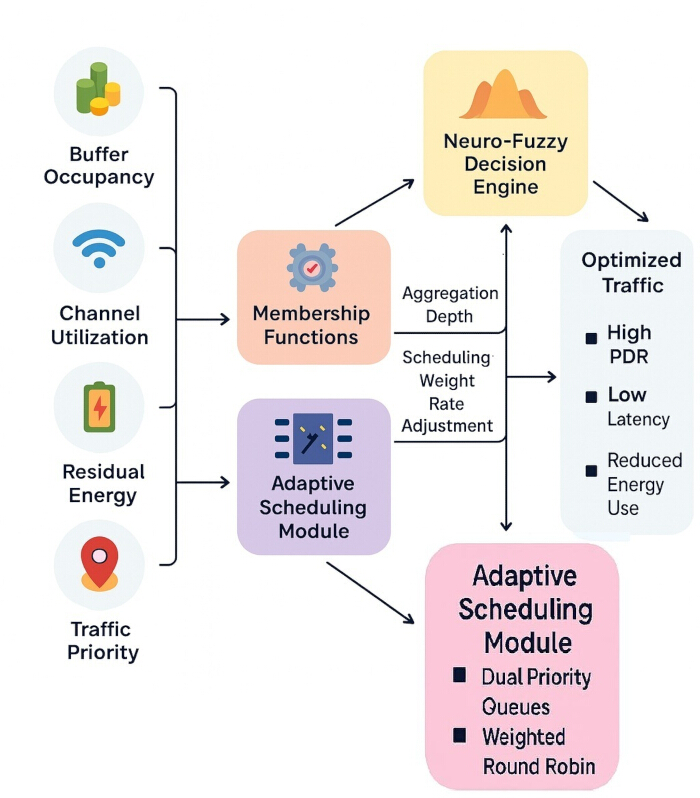
Figure 1: Architecture of the intelligent congestion control protocol for IoT-enabled wireless sensor networks. The hybrid congestion control policy's comprehensive integrated workflow is depicted in this diagram. The network state measurements-buffer occupancy, channel utilization, residual energy, link quality, and traffic priority-are fed into the membership-function layer and the Neuro-Fuzzy Decision Engine, which then generates adaptive control variables such as aggregation depth, scheduling weight, and transmission-rate adjustment. These variables control the Hybrid Aggregation Module and the Adaptive Scheduling Module, thereby enabling the jointly optimized traffic metrics of a higher packet-delivery ratio, lower latency, reduced energy consumption, and prolonged network lifetime. Abbreviations: NF = Neuro-Fuzzy, PDR = Packet Delivery Ratio, WRR = Weighted Round Robin, WSN = Wireless Sensor Network, IoT = Internet of Things, AQM = Active Queue Management (if applicable), RSSI = Received Signal Strength Indicator (if applicable). Please click here to view a larger version of this figure.
4. Dataset details
NOTE: The simulation dataset used in this study was generated internally using the NS-2.35 environment and is not deposited in a public repository due to file size constraints. However, all configuration files, TCL scripts, NFDE code, and Python analysis scripts required to reproduce the dataset are publicly available at the following GitHub repository: https://github.com/Sitaldash123/Hybrid-NF-Congestion-Control-WSN. Researchers can regenerate the full dataset by executing the provided configuration files and scripts. Additional data files can be made available from the authors upon reasonable request.
- Prepare the dataset by generating configuration files, random seed lists, raw NS-2 trace files, processed CSV results, and Python scripts for trace parsing and visualization.
- Dataset Source Clarification:
- Generate the entire dataset using the NS-2.35 simulation platform rather than obtaining it from external or public repositories.
- Configure NS-2.35 to output raw trace files for each simulation run, including enqueue, dequeue, drop, delivery, MAC events, and node-level energy logs.
- Create all topologies, traffic patterns, and parameter settings programmatically as part of the simulation workflow. Ensure that each scenario generates approximately 20 MB of raw trace data and store all experimental outputs within the project directory.
- Process these trace files using Python scripts to extract packet delivery ratio, latency, throughput, energy consumption, and network lifetime metrics.
- No third-party or external datasets are used in this study.
- Cover 75 scenarios across node densities, traffic intensities, and random seeds.
- Expect approximately 20 MB of raw trace data and 1-2 MB of processed results per scenario, yielding a total dataset size of about 2 GB.
5. Simulation execution
- Run each simulation for 900 s. Compare the proposed protocol with three alternatives: an aggregation-only scheme, a scheduling-only scheme, and the PCCP baseline.
- Use identical network topologies and random seeds across all protocols to ensure comparability. Collect trace files from each run and organize them in the results directory by node density, traffic load, and protocol type.
6. Data analysis
- Parse trace files with Python scripts to compute packet delivery ratio, end-to-end latency, throughput, energy consumption per node, and network lifetime (time to first node death and 50% node death).
- Average results across five runs and report them as mean ± 95% confidence interval.
- Apply paired t-tests for normally distributed data and Wilcoxon signed-rank tests otherwise and consider differences significant at p < 0.05.
7. Operational guidance for software use
- NS-2 execution and Tcl script invocation
- Use NS-2.35 to run simulation scenarios using the provided Tcl file (hybrid_protocol.tcl).
Run a single scenario:
ns configs/hybrid_protocol.tcl -nn 300 -seed 3 -traffic bursty -out traces/out_300_seed3.tr
Flags: -nn (nodes), -seed (seed), -traffic (cbr|bursty), -out (trace file).
Batch execution: ./configs/run_experiment.sh
- Use NS-2.35 to run simulation scenarios using the provided Tcl file (hybrid_protocol.tcl).
- Python scripts for trace parsing and metric extraction
- Parse a trace
python analysis/parse_ns2.py traces/out_300_seed3.tr --o results/metrics_300_3.csv - Aggregate metrics
python analysis/compute_metrics.py results --summary results/summary_all.csv - Generate plots
python analysis/plot_metrics.py results/summary_all.csv --output figures/
- Parse a trace
- NFDE training and inference
- Generate training data
python nfde/anfis_train.py --generate 15000 --out nfde/training_data.csv - Train NFDE
python nfde/anfis_train.py --train nfde/training_data.csv --epochs 50 --lr 0.01 --out nfde/nfde_model.pkl - Run NFDE inference
python nfde/infer_nfde.py --B 0.6 --C 0.8 --E 0.5 --LQI 0.75 --P 1.0
- Generate training data
8. Expected outcomes
- Demonstrate superior performance of the proposed protocol over baseline schemes6,7,13,14,17,24. Maintain high packet delivery ratios even under heavy congestion, reduce end-to-end latency through adaptive scheduling, and sustain higher throughput by controlling redundant transmissions.
- Show improved energy efficiency and longer network lifetime through reduced retransmissions and balanced load distribution.
- Highlight the suitability of this protocol for IoT-enabled WSNs in healthcare, industrial IoT, and smart city applications where timely and reliable data delivery is critical.
Access restricted. Please log in or start a trial to view this content.
Results
The PRAM scheme was feasible in a wireless sensor network environment with single-hop communication and limited buffer size. The experiments were carried out with different traffic rates, and the performance of the scheme was compared with the traditional Aloha and a variant of tree-based Aloha (T-Aloha) in terms of throughput, average access delay, and average number of non-empty buffers. The results clearly demonstrated that the proposed scheme achieved superior performance in all the above metrics.
Access restricted. Please log in or start a trial to view this content.
Discussion
The results demonstrate that congestion control has been significantly improved in IoT-enabled wireless sensor networks by the integration of hybrid aggregation, adaptive scheduling, and neuro-fuzzy adaptation. In fact, the new protocol has been seen to achieve better performance than the aggregation-only, scheduling-only, and PCCP baselines in terms of packet delivery, latency, throughput, energy efficiency, and network lifetime across different node densities and traffic conditions. In fact, these gains serve as a conv...
Access restricted. Please log in or start a trial to view this content.
Disclosures
The authors declare that they have no competing financial interests or personal relationships that could have influenced the work reported in this manuscript.
Acknowledgements
The authors gratefully acknowledge the support provided by Vishwakarma University, Pune, for research facilities and administrative assistance throughout the development of this work. The authors also thank the Department of Computer Engineering for providing the computational infrastructure required for simulation and analysis. This research received no specific grant from any funding agency in the public, commercial, or not-for-profit sectors. Large language model tools were used solely for language polishing and formatting. All scientific content, methods, and analyses were developed entirely by the authors. All text generated through AI assistance was reviewed and validated for accuracy.
Access restricted. Please log in or start a trial to view this content.
Materials
| Name | Company | Catalog Number | Comments |
|---|---|---|---|
| Aqua-Sim Module (optional) | NS2 Extension Repository | – | Used if underwater WSN scenarios are tested |
| Desktop/Laptop (Intel i5/AMD Ryzen 5, ≥8 GB RAM, ≥20 GB storage) | Commercially available | – | Used to run all simulations |
| GNU C/C++ Compiler, Tcl/Tk | Ubuntu repository | – | Required for compiling NS-2 |
| MATLAB R2022a (optional) | MathWorks | https://www.mathworks.com | Used for ANFIS/fuzzy modeling if preferred |
| NS-2.35 Network Simulator | ISI/NS2 Project | https://www.isi.edu/nsnam/ns/ | Core simulation environment |
| Processed results (.csv) | Generated in this study | - | Computed metrics: PDR, delay, throughput, energy, lifetime |
| Python 3.10 (NumPy, SciPy, Pandas, Matplotlib) | Python Software Foundation | https://www.python.org | Used for analysis and plotting |
| Python analysis scripts | Generated in this study | - | Scripts to parse traces and generate plots |
| Raw NS-2 trace files (.tr) | Generated in this study | - | Contain packet-level transmission and energy events |
| Simulation configuration files (topology, traffic models, random seeds) | Generated in this study | - | Required for replicating experiments |
| Ubuntu Linux 22.04 LTS | Canonical Ltd. | https://ubuntu.com | Operating system for NS-2 |
References
- Yadav, S. L., Ujjwal, R. L., Kumar, S., Kaiwartya, O., Kumar, M. Traffic and energy-aware optimization for congestion control in next-generation WSNs. J Sensors. 2021 (1), 5575802(2021).
- Li, Z., et al. Congestion control in Internet of Things using auction theory and reinforcement learning. Sci Rep. 14 (1), 77166(2024).
- Alipio, M., Bures, M. A cache-aware congestion control mechanism using deep reinforcement learning for WSNs (DRL-CaCC). Ad Hoc Netw. 166, 103678(2025).
- Sefati, S. S., Arasteh, B., Craciunescu, R., Comsa, C. R. Intelligent congestion control in WSNs based on GANs and optimization. Mathematics. 13 (4), 597(2025).
- Verma, L. P., Kumar, G., Khalaf, O. I., Rawat, S. Adaptive congestion control in IoT networks using one-way delay. Heliyon. 10 (5), e26297(2024).
- Liu, X., Cao, J., Chen, W. Hybrid aggregation-scheduling for bursty WSN traffic. Comput Commun. 160, 498-508 (2020).
- Luo, H., Zhang, Y. Congestion-aware clustering with scheduled aggregation. IEEE Sensors J. 15 (5), 2896-2906 (2020).
- Shrirao, S. M., et al. Navigating congestion in WSN: A comprehensive survey. Int J Comput Netw Appl. 11 (1), 1-18 (2024).
- Wang, X., et al. Machine-learning-based routing and congestion control in IoT: A survey. Inf Fusion. 64, 66-87 (2020).
- Le-Ngoc, K. K., et al. Optimized fuzzy clustering in WSNs using Sugeno FLC. Signal Process. 190, 108312(2022).
- Nithya, S., et al. A fuzzy logic and cross-layered optimization for effective congestion control in wireless sensor networks to improve efficiency and performance. MATEC Web Conf. 392, 01145(2024).
- Kiruthiga, T., Jegadeesan, J. Optimized tree construction and clustering-based data aggregation for heterogeneous WSNs. Int J Distrib Sensor Netw. 21 (2), 1-15 (2025).
- Yadav, S. L. A study on congestion control mechanisms in WSNs. J Adv Res Dyn Control Syst. 13 (2), 145-153 (2021).
- Riaz, U., Aslam, N., Cao, Y., Imran, M., Hussain, S. Fuzzy-tuned AQM for WSN queues. Comput Commun. 151, 235-246 (2020).
- Luo, J., Pesch, D., de Frein, R. Fuzzy rate control for WSN congestion. Ad Hoc Netw. 102, 102115(2020).
- Jain, S., Kumar, N., Obaidat, M. S. ANN-based congestion control in WSNs. Int J Commun Syst. 33 (4), e3555(2020).
- Alsheikh, M. A., Lin, S., Niyato, D., Tan, H. P. Machine learning in WSNs: Algorithms and applications. IEEE Commun Surv Tutor. 22 (3), 1996-2018 (2020).
- Reetha, P. R. S. Fuzzy energy-efficient routing with traffic-delay awareness for IoT. Int J Commun Syst. 38 (5), e6055(2025).
- Paulraj, S. S., et al. Energy-efficient data routing using neuro-fuzzy in IoT-WSNs. Sci Rep. 14, 79590(2024).
- Khan, M. A., Rehman, A., Kim, S. Queue-aware congestion control with adaptive duty cycling. Ad Hoc Netw. 136, 102997(2023).
- Junejo, A. K., et al. Deep learning-assisted congestion prediction for IoT-WSNs. IEEE Access. 8, 187381-187393 (2020).
- Gupta, H., Rao, S. Neuro-fuzzy cross-layer congestion control. Wireless Netw. 26, 3451-3466 (2020).
- Al-Tamimi, A., et al. Adaptive fuzzy congestion control with priority-aware scheduling for WSNs. Sensors. 21 (21), 7124(2021).
- Yaghmaee, M. H., Adjeroh, D. A. QoS-based transport with congestion control. Comput Netw. 178, 107327(2020).
- Alipio, M., Mancuso, V., Bures, M. DRL perspectives on caching and congestion in IoT. ICT Express. 9, 388-399 (2023).
- Sodhro, A. H., Pirbhulal, S., Wang, L. AI for industrial IoT: Energy & congestion control. IEEE Trans Ind Informat. 16 (5), 321-329 (2020).
- Li, C., Meng, X., Zhang, Y. Cross-layer congestion-aware routing with adaptive scheduling. IEEE Access. 10, 120345-120360 (2022).
- Kumar, K. M., Devi, S. Improved ANFIS-based congestion control. Intell Syst Appl Eng. 14, 101-110 (2023).
- Maniraj-Kumar, P., Nagarajan, P., Rahuman, A. K., Gobinath, T. Fuzzy congestion control using Spider Monkey Optimization. IETE J Res. 70 (1), 1-12 (2024).
- Ojha, A., Sharma, R., Patel, D. Evolving landscape of WSNs: AI-driven optimization. SN Appl Sci. 7, 1234(2025).
- A Lightweight Blockchain Scheme for Secure Data Communication in Internet of Things-enabled Wireless Sensor Network. Balraj, L., Prasanth, A., Sowndarya, K. K. D., Kuntavai, T. ProcInt Conf Smart Syst Appl Electr Sci, , 1-6 (2024).
- Zhang, Q., Hou, Y. T., Gokhale, A. Cross-layer design for industrial IoT congestion. IEEE Trans Ind Informat. 16 (2), 139-150 (2020).
- Wang, J., Gao, Y., Liu, W., Sangaiah, A. K., Kim, H. Fuzzy-based congestion-aware routing. Sensors. 19 (3), 671(2020).
- Grover, A., Bansal, R., Sharma, P. Rate-aware congestion control mechanism (RACC). Alexandria Eng J. 61, 6639-6653 (2022).
- Kirubakaran, E., Lakshmi, S. Priority-based hybrid scheduling with adaptive aggregation. Comput Electr Eng. 100, 107834(2022).
- Li, C., Wang, D., Xu, Y. WSN restoration and congestion avoidance via fat-tree variants. Digital Commun Netw. 11, 1-14 (2025).
- Jadhav, S. S. Congestion control and efficiency optimization in WSNs. Wireless Netw. 31, 1-19 (2025).
- Li, J., Huang, X., Chen, W. DRL-aided MAC scheduling for sensor networks. IEEE Access. 11, 115234-115248 (2023).
- Zhang, S., Pan, J. S., Chu, S. -C. Compact meta-heuristics for congestion-aware clustering. Appl Soft Comput. 127, 109370(2022).
- Wang, Y., Fan, Y., Wang, J., Chen, W. Long-term navigation & congestion-aware mapping. Robot. Auton Sys.t. 179, 104724(2024).
- Sahar, G., et al. Data-driven models in WSNs: A survey. Technologies. 9 (4), 76(2021).
- Aruchamy, P., Balraj, L., Sowndarya, K. K. D. An energy-aware link fault detection and recovery scheme for QoS enhancement in Internet of Things-enabled wireless sensor network. Comput Electr Eng. 123, 110092(2025).
- Balraj, L., Prasanth, A. An energy-aware software fault detection system based on hierarchical rule approach for enhancing quality of service in Internet of Things-enabled wireless sensor network. Trans Emerg Telecommun Technol. 35 (4), e4971(2024).
- Contiki: A lightweight and flexible operating system for tiny networked sensors. Dunkels, A., Grönvall, B., Voigt, T. Proc. IEEE Int Conf Local Comput Netw, 2004, 455-462 (2004).
- Levis, P., et al. TinyOS: An operating system for sensor networks. Proc ACM SenSys. 2005, 1-14 (2005).
- Raspberry Pi User Guide. Upton, E., Halfacree, G. , 1st ed, Wiley. (2014).
- ESP32 Series Datasheet. Espressif Syst. 2016, Espressif Systems. 1-55 (2016).
Access restricted. Please log in or start a trial to view this content.
Reprints and Permissions
This article has been published
Video Coming Soon