In a vehicular ad hoc network (VANET), vehicles communicate with each other, and every message must be verified to prevent malicious interference. Traditional authentication methods verify each vehicle individually, creating significant delays. To address this issue, the proposed research introduces an authentication mechanism that combines batch and transfer authentication.
A subscription to JoVE is required to view this content. Sign in or start your free trial.
Research Article
A Secure and Low-Overhead Authentication Protocol for Vehicle Ad Hoc Networks with Batch and Transfer Authentication
In This Article
Summary
Abstract
Vehicular Ad Hoc Networks (VANETs) require secure, efficient, and scalable authentication mechanisms to ensure trust among vehicles and roadside units (RSUs). Traditional one-to-one authentication approaches often lead to high communication and computational overheads, making them unsuitable for large-scale vehicular environments. This leads to a security traffic jam, rendering the process inefficient and unsuitable for real-time safety applications. To address this, study proposes a lightweight authentication protocol that supports both batch and transfer authentication, enabling multiple vehicles to be authenticated simultaneously and allowing authentication validity to be transferred between RSUs without re-executing the full protocol. In batch authentication, a roadside unit verifies a group of vehicles simultaneously instead of one at a time, much like a guard approving an entire busload of pre-verified passengers, which greatly reduces delays at intersections or toll booths. In transfer authentication, when a vehicle moves from one roadside unit’s area to another, the verification data are securely transferred, allowing seamless continuity without restarting the process, similar to a concert wristband that lets attendees move between stages without repeated checks. This scheme leverages the mathematical properties of Chebyshev polynomials to provide strong security with reduced overhead. Performance analysis shows that the proposed method achieves a communication cost of only 42n bytes and a significantly lower computational complexity than existing schemes. This approach enhances scalability, reduces message exchange, and maintains robust resistance against common attacks, making it well-suited for real-time vehicular communications. Overall, this new protocol enhances the practicality of VANETs by reducing data overhead, accelerating authentication, and efficiently managing high traffic volumes, making it a secure and scalable solution for the future of intelligent transportation systems.
Introduction
Vehicular ad-hoc networks (VANETs) enable vehicles to communicate with each other (vehicle-to-vehicle (V2V)) and with vehicles to roadside infrastructure (vehicle-to-infrastructure (V2I)) to improve the safety and efficiency of transportation. In this open wireless environment, any vehicle can broadcast safety messages (e.g., accident warnings or traffic updates); therefore, robust authentication is critical to ensure that the messages originate from legitimate sources. Simultaneously, VANETs impose strict performance requirements, and vehicles exchange messages at high frequencies (often 10 messages per second), leaving only a few milliseconds to verify each message before the next message arrives. Traditional public-key authentication methods, such as elliptic curve digital signature algorithm (ECDSA) digital signatures, as in the WAVE/IEEE 1609.2 standard, incur significant computation and communication overheads. Verifying a single ECDSA signature or managing a public key certificate for every message can overwhelm a resource-constrained onboard unit (OBU) and cause unacceptable delays when multiple messages arrive concurrently. Moreover, vehicles frequently change their point of attachment (moving from one roadside unit (RSU) to another), requiring repeated authentication or handshakes, which can further increase latency.
| Channel | Frequency Range (GHz) | Priority | Primary Functions |
| CCH-178 | 5.885 – 5.895 | High | Authentication control, service advertisements, initial message dissemination from RSUs, batch authentication initiation. |
| SCH-172 | 5.855 – 5.865 | High | Time-critical messages (batch authentication acknowledgments, urgent safety notifications). |
| SCH-174 | 5.865 – 5.875 | Medium to High | Navigation-based validation, traffic-aware batch coordination (urban mobility scenarios). |
| SCH-176 | 5.875 – 5.885 | Low to Medium | Broadcasting revocation lists, group credential updates, periodic re-authentication alerts. |
| SCH-180 | 5.895 – 5.905 | Medium | Secure post-authentication message exchanges (updates/notifications for authenticated batches). |
| SCH-182 | 5.905 – 5.915 | Low | Non-critical services (cloud-assisted verification, internet-based checks, background messages). |
| SCH-184 | 5.915 – 5.925 | Medium to High | High-throughput applications (video streaming, map distribution, OTA updates for authenticated groups). |
Table 1: DSRC channel specifications for secure vehicular networks. It explains the control channel (CCH) and different service channels (SCHs) used in VANETs. All these channels operate within the 5.855–5.925 GHz frequency range, and each has a 10 MHz bandwidth. This setup supports smooth and organized communication, especially for batch authentication and important safety messages. CCH-178 (5.885–5.895 GHz) was the main control channel. It is used to initiate the authentication process and send safety-related messages, high-priority SCHs, such as SCH-172, SCH-174, and SCH-184, are used for time-sensitive tasks, such as emergency alerts and large data transfers, medium and low-priority SCHs, such as SCH-176, SCH-180, and SCH-182, handle less urgent tasks, such as updating revocation lists, reauthenticating vehicles, or managing general services. Abbreviations; DSRC = Dedicated Short-Range Communications; VANET = Vehicular Ad Hoc Network; CCH = Control Channel; SCH = Service Channel; GHz = Gigahertz; MHz = Megahertz.
The dedicated short-range communication (DSRC) spectrum, as shown in Table 1, illustrates its use in vehicular networks. This table outlines channel allocation in the dedicated short-range communications (DSRC) 5.9 GHz band (5.855–5.925 GHz), with each channel having a 10 MHz bandwidth. It highlights the control channel (CCH) and various service channels (SCHs) used in Vehicular Ad Hoc Networks (VANETs) to ensure organized, prioritized communication. Channel 178 serves as the primary CCH for initiating the authentication processes and broadcasting safety-related messages. High-priority SCHs (such as 172, 174, and 184) support time-critical applications like emergency alerts and large data transfers, while medium- and low-priority SCHs (such as 176, 180, and 182) handle less urgent tasks, including revocation list updates, vehicle re-authentication, and general services.
Another challenge is privacy. Vehicles should be authenticated without revealing their permanent identity in every message (to prevent tracking). Solutions such as pseudonymous certificates provide anonymity by using temporary identities; however, they introduce overheads for distributing and revoking large numbers of certificates. A vehicle can use group signature schemes to sign messages for a group. This authenticates the message while keeping the specific vehicles anonymous. However, these group signatures, along with other public-key methods, rely on complex mathematics, such as bilinear pairings and large exponentiations. These operations are not practical for a VANET environment, which is always moving fast and requires low latency. Packet loss worsens this situation. Therefore, a lightweight cryptography method is required. Therefore, a technique that can quickly check multiple messages simultaneously without compromising privacy or security needs to be developed. In this context, researchers have investigated the application of Chebyshev polynomials, which possess two significant characteristics appropriate for cryptography: the semigroup property and chaotic behavior. The main advantage of using Chebyshev polynomial operations is that they consume less computational complexity than elliptic curves. This special property has been used to build new authentication systems that combine ideas from symmetrical and public-key cryptography. For instance, they use one-way functions built from these polynomials to create shared secrets or digital signatures, which provide efficiency and non-repudiation. Studies have already shown that when these Chebyshev protocols are used for authentication, the amount of work that the onboard units of vehicles must perform is much lower. This study provides formal definitions and mathematical details of the Chebyshev polynomial-based operations used in the proposed scheme. Specifically, this study bases security on two assumptions analogous to classical cryptographic hard problems: the Chebyshev polynomial discrete logarithm problem (CPDLP) and the Chebyshev Polynomial Diffie–Hellman Problem (CPDHP). These problems are known to be computationally intractable, which proves that forging a vehicle’s authentication or impersonating a valid node is computationally infeasible. Moreover, it is explicitly stated that, when Chebyshev polynomials are defined over large finite fields with practical bit-lengths (e.g., 160–256 bits), retrieving the polynomial degree or secret parameter from a public polynomial is computationally infeasible with current classical algorithms1.
In recent years, the schemas CDAS (centralized data authentication scheme) and DDAS (distributed data authentication scheme) were proposed2 to handle electricity data in Vehicle-to-Grid (V2G) systems. Both methods showed better speed, security, and efficiency than earlier approaches and effectively protected user privacy. However, this work lacks real-world deployment, ignores dynamic pricing scenarios. A smart and efficient batch authentication scheme for V2G networks that uses bilinear pairings and aggregate signatures to verify multiple electric vehicle (EV) signatures simultaneously was proposed3 for saving time and minimizing the computing power, but this work doesn’t address how blockchain affects long-term storage. A smart batch authentication approach for V2G networks using edge computing to check dense EVs at the same time, was proposed4 using short group signatures and certificateless cryptography to reduce delay and to avoid certificate problems. The batch authentication method for V2G networks using edge computing and short group signatures to check group EVs at once was created5 but, However, it does not fully check the performance in largely crowded EV areas, they did not specify the revocation policy of EV’s.
A framework for privacy-focused data sharing in V2G networks using blockchain was proposed6 a framework for attribute-based encryption (ABE), but in this work they fail to address batch authentication. A privacy-preserving authentication method for V2G networks using blockchain and batch processing was created7 to address elliptic curve cryptography (ECC) based to check group of EVs simultaneously. However, they fail to address scalability challenges for dense was networks. A blockchain-based key management for V2G that also uses batch processing proposed8 a few smart contracts for secure key distribution, renewal, and revocation, thereby ensuring EV privacy; However, it does not check real-time work and is not clear about revoking EVs in a batch. A lightweight batch authentication method for VANETs was proposed9 that uses Chebyshev polynomials to check many vehicles simultaneously with low computation. The mathematical features of Chebyshev polynomials help avoid heavy cryptographic steps, so the system works faster and is more suitable for real-time vehicle communication. It also maintains privacy and provides strong security. However, it does not fully explain how it will manage very large traffic, moving vehicles, revoked users, and the key update process. The VANETs batch authentication scheme by using Chebyshev polynomials was presented10 to verify many vehicle IDs together with less delay. The chaotic parts of Chebyshev polynomials support anonymous IDs, key generation, and privacy. However, this study did not explain much about heavy traffic, high-speed cars, removing bad vehicles in batches, transfer authentication, and full key handling. A light batch authentication system for VANETs was created11, a safe system using Chebyshev polynomials to check large groups of vehicles at once with low cost. It provides privacy and allows for tracing if necessary. However, it does not discuss large-scale networks. It also fails to address the work with VANET rules and full key handling. A Chebyshev chaotic map-based batch authentication scheme for VANETs was proposed12 to authenticate multiple vehicles simultaneously with reduced computational cost. It maintains user privacy by providing anonymous IDs, tracing ability, and skipping heavy cryptographic operations, so it is suitable for live communication. However, it does not explain the revocation of malicious vehicles or compliance with VANET rules. A lightweight batch authentication for VANET networks by using authentication and key agreement (AKA) schemes combined with Chebyshev chaotic maps to check multiple vehicle messages at once was proposed13 for saving time and work. The scheme maintains privacy, message safety, and makes it suitable for real traffic. However, it does not explain how it works for large groups of vehicles, the adoption of fast RSU changes, or removing malicious vehicles in batches. A light batch authentication method for VANETs using Chebyshev chaotic maps was created14 to check many vehicle messages quickly with less delay and less computation. It maintains privacy, safe key exchange, and tracing without heavy crypto, making it suitable for real-time vehicle communication. However, the paper does not explain how the system handles large numbers of vehicles, revokes misbehaving vehicles, or fast-moving cars switching between RSUs. It also lacks integration with standard VANET protocols and does not use edge computing to boost performance.
This study proposes an authentication framework for VANETs that exclusively uses Chebyshev polynomial-based mechanisms for the batch verification of messages and transfer authentication during vehicle handovers. The batch verification scheme allows an RSU or receiving vehicle to verify multiple message signatures together instead of individually, which drastically reduces the per-message delay when the traffic is heavily loaded8. The transfer authentication protocol enables a vehicle to remain continuously authenticated as it moves across different RSU coverage areas without performing a full and expensive handshake at each hop. Instead, a lightweight dynamic session mechanism is used to transfer the authentication state from one session or domain to another. By employing Chebyshev polynomials in both aspects, this scheme ensures that only simple mathematical operations (such as modular multiplication and addition from polynomial evaluation) are required for VANET entities, making it highly suitable for the constrained computational environment of OBUs.
Access restricted. Please log in or start a trial to view this content.
Protocol
Preliminaries
System model: The VANET system consists of three primary entity types: trusted authority (TA), roadside units (RSUs), and vehicles with onboard units (OBUs). The TA is central to initiating the initialization, key management, and occasional revocation. It is fully trusted and typically government- or infrastructure-controlled. Each RSU is a stationary unit deployed along the road. This provides a communication infrastructure; in this model, RSUs are assumed to be connected to the TA via a secure backbone (e.g., fiber or a secure network) so they can send or receive updates from the TA as needed. Vehicles are equipped with OBUs that enable vehicles to vehicle (V2V) and vehicles to infrastructure(V2I) communications. This study assumes that OBUs have a tamper-proof device (TPD) or secure hardware module that can store cryptographic keys and perform cryptographic operations in isolation, protecting long-term secrets from physical compromise.
Communication model: Vehicles broadcast periodic one-hop messages (such as basic safety messages) over a wireless channel (e.g., IEEE 802.11p or C-V2X PC5) that can be received by other vehicles and RSUs in range. These messages must be authenticated by the receivers to ensure their validity. RSUs also send periodic information (traffic signals and warnings) to vehicles through vehicle-to-infrastructure (V2I) communication. In this work, the primary focus is on the authentication of vehicle-to-infrastructure (V2I) messages. It means that the vehicles are authenticated by an RSU through batch authentication when they enter the RSU’s coverage region. V2V authentication can be handled similarly by having vehicles use the same signature scheme; however, batch verification is most beneficial at RSUs, which may need to verify many vehicles’ messages simultaneously.
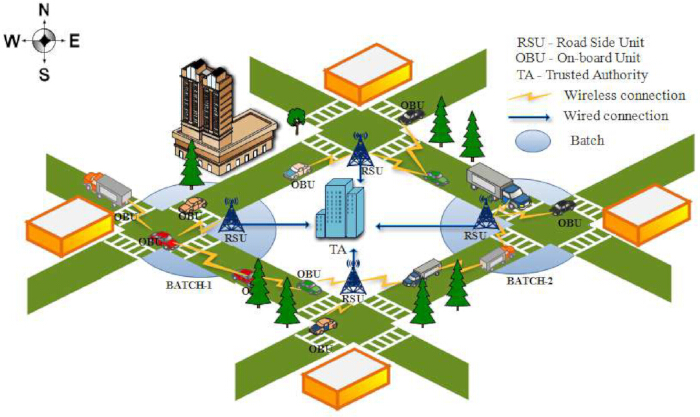
Figure 1: Batch verification in VANET network. This figure depicts the architecture used for batch authentication, illustrating how multiple OBUs in vehicle batches (e.g., BATCH1 and BATCH2) communicate wirelessly with RSUs at intersections or traffic points, which are connected via wired links to a central TA. The protocol enables collective verification of authentication requests in high-density traffic using Chebyshev polynomials. Each vehicle computes an authentication token by evaluating Tk(x) mod P, concatenates it with its identity and timestamp, hashes the value, and transmits it to the RSU. The RSU aggregates the tokens and verifies them collectively.
Abbreviations; VANET = Vehicular Ad Hoc Network; OBU = On-board Unit; RSU = Roadside Unit; TA = Trusted Authority. Please click here to view a larger version of this figure.
Batch authentication in VANETs: In high-density traffic environments, RSUs may receive authentication requests from multiple vehicles within a very short time frame. Performing individual authentication for each request can cause significant computational delays and increase communication overhead. As illustrated in Figure 1, the proposed batch authentication mechanism leverages the mathematical properties of Chebyshev polynomials to achieve efficient multi-vehicle-verification15. Each vehicle computes an authentication token αi by evaluating a Chebyshev polynomial Tvi(Tr(x)) modulo a large prime p, where vi is the vehicle’s private key, r is the RSU’s private key, and x is a public base. The output is concatenated with the vehicle’s digital identity and timestamp, hashed, and transmitted to the RSU. The RSU aggregates all received tokens into a single value and verifies them collectively using the relation Tr.∑vi(x) modulo p. This approach significantly reduces the number of expensive verification operations, thereby improving scalability in environments such as intersections, toll gates, and traffic choke points.
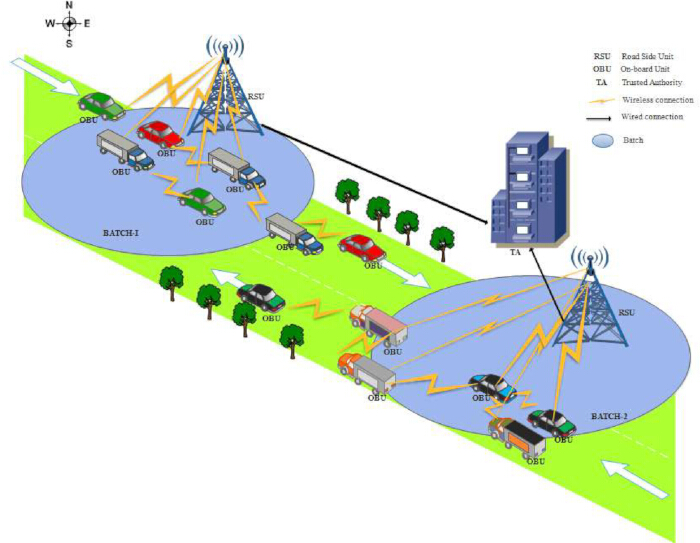
Figure 2: Transfer authentication in VANET networks. This figure shows the proposed lightweight handover authentication protocol that allows a vehicle to move from the current RSU (Roadside unit 1) to the next RSU (Roadside unit 2) without full re-authentication, which can reduce latency. RSU1 generates an authorized card using hash-based concatenation of public keys and a random value, then applies Chebyshev polynomial operations to compute intermediate parameters (ω₁, ω₂), an initial key (IK), an encrypted session key, and a temporary key (TK). These values are sent to the vehicle and forwarded to RSU2. RSU2 verifies the data and recovers the session key using inverse Chebyshev operations, establishing a secure session key (SK) for uninterrupted communication. The protocol supports fast and secure handovers suitable for high-speed vehicular communication environments. Abbreviations; VANET = Vehicular Ad Hoc Network; RSU = Roadside Unit; IK = Initial Key; TK = Temporary Key; SK = Session Key. Please click here to view a larger version of this figure.
Transfer authentication for seamless handover: As vehicles move between RSU coverage zones, re-performing full authentication with every new RSU introduces latency and may disrupt secure sessions. The transfer authentication process, as depicted in Figure 2, enables a secure and lightweight handover. The current RSU generates an authorized card ACi by hashing the concatenation of the vehicle’s and RSU’s public keys along with a random session parameter bi. Using Chebyshev polynomial transformations TAC(x) modulo p, the RSU computes intermediate values ω1,ω2 = ω1  FPKRi, a session-specific key IKi = H(ω1
 FPKvi) and an encrypted session key ω3 = (EIKi(SKi)). Finally, a temporary key TKi is derived from γ = bi.IKi-1 using another Chebyshev transformation Tγ(x). The tuple (TKi,ω2,ω3) is sent to the next RSU, which uses it to verify and resume secure communication with the vehicle without performing full re-authentication. This mechanism ensures minimal disruption and ultralow latency for vehicles moving at high speeds.
Mobility and handover: Vehicles moving from one location to another in the network may encounter multiple RSUs along their route. By combining Chebyshev polynomial-based batch authentication for initial RSU access and transfer authentication for mobility handovers, the system achieves both scalability and continuity16. Batch authentication effectively handles many simultaneous vehicle authentications, whereas transfer authentication reduces re-authentication delays during RSU transitions. Together, these mechanisms form a strong, mathematically secure, and performance-effective framework for VANET authentication.
Chebyshev polynomial preliminaries
Chebyshev polynomials (Tn(x))are the mathematical core concept of the authentication scheme. They follow a recurrence formula and have features that make them suitable for one-way cryptographic functions. The main definitions and properties are as follows.
Definition: The Chebyshev polynomial of degree n (for integer n≥ 0):
Tn(x) = cos(n arccos x),
for x  [-1,1]]. Equivalently, one can define it over the reals or modulo a prime P. The first few Chebyshev polynomials of the first kind Tn(x) up to n=4 (degree varies from 0 to 4) described in Table 2.
| S.No | Degree | Description | Result |
| 1 | T0(x) | T0(x) = cos(0.arccros x) = cos(0) = 1 | T0(x) = 1 |
| 2 | T1(x) | T1(x) = cos(1.arccros x) = cos(arcos x) = 1 | T1(x) = x |
| 3 | T2(x) | T2(x) = cos(2.arccros x) = 2cos2(arcos x)-1 = 2x2-1 (Since cos(2θ) = 2cos2θ-1) | T2(x) = 2x2-1 |
| 4 | T3(x) | T3(x) = cos(3.arccros x) = 4x3-3x (Since cos(3θ) = 4cos3θ-3cosθ) | T3(x) = 4x3-3x |
| 5 | T4(x) | T4(x) = 8x4-8x2+1 (Since cos(4θ) = 8cos4θ-8cos2θ+1) | T4(x) = 8x4-8x2+1 |
Table 2: Evaluation of recurrence relation. This table presents the first few Chebyshev polynomials of the first kind Tn(x) (for degrees 0 to 4), computed using the recurrence relation that forms the mathematical foundation of the proposed authentication scheme. Abbreviations; Tn(x) = Chebyshev polynomial of degree n evaluated at x; n = Polynomial degree; x = Input variable.
In general, they satisfy the recurrence:
Tn+1(x) = 2xTn(x) - Tn-1(x), with T0(x) =1, T1(x) = x .
This recurrence allows efficient iterative computation of Tn(x).
Semi-group property: Similar to multiplicative exponents, Chebyshev polynomials display a composition property specifically:
Tm(Tn(x)) = Tm.n(x) ,
for any positive integers m,n. In words, if one first applies a Chebyshev polynomial of degree n to x, and then applies another Chebyshev polynomial of degree m to the result, it is equivalent to applying a Chebyshev polynomial of degree m * n directly to x. This property is central to using Chebyshev polynomials in Diffie–Hellman like key exchange and authentication protocols, because it resembles the property (ga)b = (gb)a of exponentiation in a cyclic group.
Chaotic behavior: For degrees n>1 , the map x  Tn(x) (when x is in [-1,1]) has been shown to be chaotic mapping under specific conditions. Informally, a small change in x can cause large changes in Tn(x) when n is large, and Tn(x)is distributed in [-1,1] in a way that for large n can appear random. This "pseudo-randomness" is useful in cryptography for producing non-predictable outputs.
Chebyshev polynomial discrete logarithm problem (CPDLP): This is similar to the discrete logarithm problem but uses Chebyshev polynomials. Given a prime modulus P and public values x and y = Tn(x) mod P, it’s very hard to find the integer n. In other words, if one knows x and y, figuring out n is extremely difficult when the numbers are large. This is similar to the classic discrete log problem, where finding a from ga mod P is tough.
Chebyshev polynomial Diffie–Hellman problem (CPDHP): Given x, Ta(x), and Tb(x) (for random secret integers a,b), it is hard to compute Ta.b(x) without knowing either a or b. This mirrors the Diffie–Hellman problem: give ga and gb, an adversary cannot compute gab. In the Chebyshev context, note that Tab(x) = Ta(Tb(x)) = Tb(Ta(x)) by the semi-group property; so if two parties each know one of a,b they can each compute Tab(x) easily, while an eavesdropper knowing only the individual results cannot.
The security of the scheme relies on these assumptions (CPDLP and CPDHP are intractable). For practical implementation, this study operates in a finite field (modulo a large prime P) to guarantee distinct behavior. Typically, a random number x in [2,P-2] is chosen as a system parameter (this plays a role like a generator in a multiplicative group). The TA will choose such an x and publish it as part of the public parameters. Then the Chebyshev polynomials can be computed mod P via the recurrence formula. Although x is not in [-1,1] in this case, one can use the isomorphism between Chebyshev polynomials and hyperbolic cosine for values outside [-1,1], or simply treat the recurrence algebraically mod P. The chaotic property, in a strict sense, applies to real intervals; however, for cryptographic usage, study relies on the unpredictability due to the hardness of the CPDHP in the finite field.
Attack model
In the proposed batch and transfer authentication framework for VANETs using Chebyshev polynomials, researchers consider a realistic threat landscape in which both external and internal adversaries may attempt to disrupt secure communication. External attackers are entities outside the vehicular network that aim to intercept, alter, or inject malicious messages without possessing any legitimate authentication credentials17. Internal attackers, on the other hand, are compromised or malicious vehicles or RSUs that already hold valid credentials but misuse them to impersonate others, forge data, or launch coordinated attacks.
Man-in-the-middle (MIM) attack: The adversary intercepts and relays messages between two legitimate parties while potentially altering their content. The protocol mitigates this by employing mutual authentication and session key agreement based on the hardness of the Chebyshev polynomial problem, ensuring that any intercepted data is computationally infeasible to manipulate without detection18.
Replay attack: An attacker resends previously captured valid messages to gain unauthorized access or cause network confusion. Researchers address this issue by incorporating timestamps and session identifiers into the authentication process, ensuring that messages are valid only within a short time window and cannot be reused later.
Impersonation attack: is also considered, where an attacker attempts to pose as a legitimate vehicle or RSU. By tightly binding the authentication process to unique Chebyshev polynomial keys and verifying digital signatures during batch and transfer authentication, the system ensures that only genuine participants can communicate.
Eavesdropping attacks: where adversaries passively monitor communications to extract sensitive information. The proposed scheme ensures confidentiality through secure session key generation; therefore, even if data packets are intercepted, they remain unintelligible without the secret key.
Collusion attacks: where multiple compromised entities collaborate to break the authentication protocol. The use of aggregated verification in batch authentication and independent verification in transfer authentication prevents compromised nodes from collectively forging valid credentials.
| Symbol | Description |
| Ui | i-th vehicle in the VANET |
| RSU | Roadside Unit |
| TA | Trusted Authority |
| TSi | Timestamp generated by vehicle |
| TARSU | Timestamp generated by RSU |
| TSTA | Timestamp generated by TA |
| ΔT | Maximum allowed clock difference for message validity |
| DIDUi | Pseudonym-based identity of vehicle Ui |
| DIDRSU | Pseudonym-based identity of RSU |
| Tv(x) | Chebyshev polynomial with vehicle's private key "v" |
| Tv(x) | Chebyshev polynomial with Trusted authority private key "b" |
| TPKRi(x) | Chebyshev polynomial with RSU’s public key |
| αi | Identity hash computed by vehicle Ui |
| βi | Identity hash computed by RSU for Ui |
| θi | Polynomial verification token from Ui used for aggregation |
| θ'agg | Expected aggregated polynomial (TA computed) |
| θagg | Aggregated polynomial product from all vehicles Θi |
| mi,ni | Random session key seed values from generated by TA |
| ri,ui | Secret scalar values assigned to RSU and vehicle respectively |
| PUBRSU | Public key of RSU |
| PUBui | Public key of vehicle Ui |
| E1(i),E2(i) | Masking values computed via hash for confidentiality |
| IK(i) | Components of authentication/session key exchange messages |
| SKi | Final session key established between vehicle and RSU |
| H(.) | Collision-resistant hash function |
| ESK(.)/DSK(.) | Symmetric encryption/decryption using session key |
| || | Concatenation operator |
| mod P | Modular operation over a large prime p |
Table 3: Notations. This table lists the key symbols, parameters, and cryptographic notations employed throughout the paper.
Proposed Schema:
This proposed scheme consists of two main components: (i) a batch message verification mechanism using Chebyshev polynomials and (ii) a transfer authentication protocol for vehicle handovers between RSUs. This study first provides an overview of the system setup and then describe each component in detail in the following sections along with that the terminology and the notation were illustrated in Table 3.
Vehicle registration:
Step 1: Each vehicle initiates the authentication process. Let there be n vehicles u1,u2,u3....,un attempting authentication with the same RSU at time t. Each vehicle ui computes:
αi = H(DIDui|| Tvi(Tb(x)) || TSi) (1)
Then, ui sends:
I1(i) = (αi,DIDui,TSi) (2)
to the RSU.
Step 2: RSU aggregates and prepares for batch authentication after receiving all I1(i), RSU performs:
1. Timestamp validation: |TSc - TSi| ≤ ΔT
2. Compute RSU response hash for each vehicle: βi = H(DIDRSU||Tri(Tb(x))||TSRSU)
3. Compute Chebyshev tokens: θi = Tvi(TPKRi(x)) mod P
4. Aggregate all tokens: 
5. Prepare batch message:  and send to TA.
Step 3: TA verifies batch signatures
1. Verify timestamp: TSTA - TSRSU ≤ ΔT
2. Check RSU hash: βi* = H(DIDRSU || Tb(Tri(x)) || TSRSU) = βi
3. Check vehicle hash: αi* = H(DIDui|| Tb(Tvi(x)|| TSi) = αi
4. Aggregate verification: θ'agg = T∑vi(x)mod P
H(θagg) = H(θagg') If all passes, authentication is successful.
Step 4: Session key establishment (in batch) for each ui , TA performs:
1. Compute: E1(i) = H(PUBRSU||ri||TSRSU)
E2(i) = H(PUBui||vi||TSi) .
2. Generate random values mi,niZ*P
3. Compute session key: SKi = H(mi||ni||ri||vi)
4. Construct encrypted components:
I3(i) = H(mi) E1(i)
E1(i)
I4(i) = H(ni)E2(i)
I5(i) = SKiH(mi)
I6(i) = SKiH(ni)
Send bundle: {I3(i),I4(i),I5(i),I6(i),TSTA}ni=1
Step 5: RSU sends session info to each vehicle ui
1. Recover: H(mi) = I3(i)E1(i)
SKi = I5(i)H(mi)
2. Send to ui : {I4(i),I6(i),TSRSU+1}
Step 6: Vehicles complete session key extraction for each ui
1. Compute: H(ni) = I4(i)E2(i)
SKi = I6(i)H(ni)
2. Use the session key to encrypt messages:
ESKi(mi||PUBui||PUBRSU)
Step 7: Transfer authentication for seamless handover
Step 7.1: Authorized card generation by RSU will compute
ACi = H(FPKvi|| FPKRi|| bi)
ω1 = TAC(x) mod P,ω2=ω1FPKRi
IKi = H(ω1||FPKvi)
ω3 = EIKi(SKi)
TKi = Tγ(x) mod P
γ = bi.IKi-1
Send (TKi,ω2,ω3) to the next RSU.
Step 7.2: Validation by the neighboring RSU
TAC(x) = ω2FPKRi-1
IKi '= H(TAC(x)||FPKvi)
TTKi(IKi'(HORi))mod P = Tt(x)mod P
Step 7.3: Session key recovery (New RSU decrypts)
SKi = DIKi'(ω3)
The vehicle ui is now authenticated within the new RSU zone and can continue secure communication, with all notations used in the algorithm detailed in Table 3.
In Figure 3, researchers have explained in detail about the transfer authentication with a swim lane diagram, how the current RSU transfers the authorization to the new RSU by sending its parameters (TKi,ω2,ω3) and after receiving these parameters from the new RSU, it validates the verifies by using
TTKi(IKi'(HORi))mod P = Tt(x)mod P . From this session, the key will be recovered by the new RSU and sent to the Vehicle.
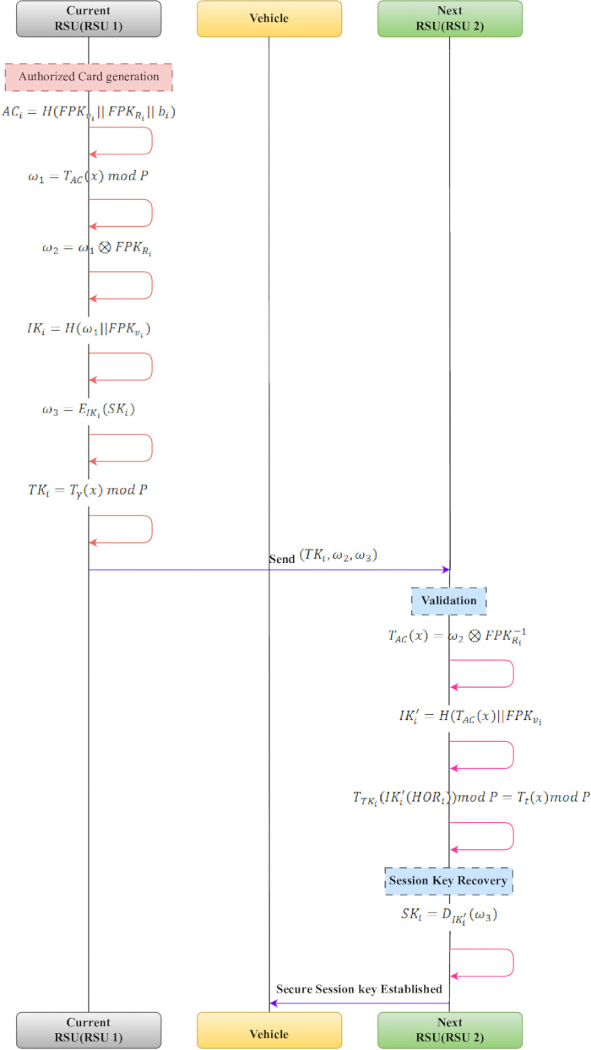
Figure 3: Transfer authentication between two RSUs. This figure illustrates the flowchart of the transfer authentication protocol in a VANET, where a vehicle facilitates secure handover between the current Roadside Unit (RSU 1) and the next Roadside Unit (RSU 2). The process begins with authenticated card generation and cryptographic computations at RSU 1, followed by transmission of parameters to the vehicle, validation, and session key recovery at RSU 2, concluding in the establishment of a secure session key. Abbreviations; VANET = Vehicular Ad Hoc Network; RSU = Roadside Unit. Please click here to view a larger version of this figure.
Access restricted. Please log in or start a trial to view this content.
Results
Security analysis
Informal security analysis
Impersonation attack: An adversary may attempt to impersonate a legitimate vehicle ui or roadside unit (RSU) to gain unauthorized access or disrupt authentication, but such impersonation is computationally infeasible due to the robust security mechanisms in place. Each vehicle and RSU employs Chebyshev polynomial-based signatures, which involve their respective private keys (v<...
Access restricted. Please log in or start a trial to view this content.
Discussion
The proposed batch and transfer authentication scheme significantly enhances VANET performance by overcoming the limitations of traditional one-to-one verification. Through batch authentication, multiple vehicles can be authenticated simultaneously by an RSU, reducing computational and communication load and enabling efficient large-scale operation in dense traffic conditions. This mechanism ensures faster authentication cycles and better bandwidth utilization, making it suitable for real-time vehicular networks that dem...
Access restricted. Please log in or start a trial to view this content.
Disclosures
The authors declare that they do not have any conflicts or financial interests to report regarding the current study. No known competing commercial objectives or private connections may have influenced any of the material presented in this article, the authors declare.
Acknowledgements
We are deeply grateful to my supervisor, Dr. Azees Maria, for their expert guidance, constructive feedback and constant encouragement throughout this work. We thank VIT-AP University for the support and facilities provided. We also thank the anonymous reviewers for their valuable suggestions that improved the quality of the manuscript. This research received no specific grant from funding agencies in the public, commercial, or not-for-profit sectors.
Access restricted. Please log in or start a trial to view this content.
Materials
| Name | Company | Catalog Number | Comments |
|---|---|---|---|
| Component | Specification / Details | ||
| Batch Size (n) | 10 to 100 vehicles | ||
| Comparison Schemes | [20],[21],[22] (analytical from literature) | ||
| Cryptographic Primitives | Chebyshev polynomials (custom recursive implementation), SHA-256 hash | ||
| Hardware Platform | Intel Core i7 processor, 16 GB RAM, Windows 11 (or your specific OS) | ||
| Key Libraries | hashlib (for SHA-256), time (for measurements), built-in math operations | ||
| Measurement Method | Average execution time over 1000 iterations using time module | ||
| Prime Modulus (p) | 256–512 bits (small values like 7919 used for testing; scaled for security analysis) | ||
| Programming Language | Python 3.10 | ||
| Simulation Type | Cryptographic operation timing (no network simulator used) |
References
- Al-Shareeda, M. A., Gaber, T., Alqarni, M. A., Alkinani, M. H., Almazroey, A. A., Almazroi, A. A. Chebyshev polynomial-based emergency conditions with authentication scheme for 5G-assisted vehicular fog computing. IEEE Trans Depend Sec Comput. 22 (5), 4795-4812 (2025).
- Wang, C., Wang, C., Shen, J., Vasilakos, A. V., Wang, B., Wang, W. Efficient batch verification and privacy-preserving data aggregation scheme in V2G Networks. IEEE Trans. Vehicular Tech. 74 (8), 12029-12041 (2025).
- Seifelnasr, M., AlTawy, R., Youssef, A. A conditional privacy-preserving protocol for cross-domain communications in VANET. IEEE Trans. Intell. Transp. Syst. 26 (4), 5251-5263 (2025).
- Wu, Q., Zhang, L., Yang, Y., Choo, K. K. R. Certificateless signature scheme with batch verification for secure and privacy-preserving V2V communications in VANETs. IEEE Trans. Dependable Secure Comput. 22 (2), 1448-1459 (2025).
- Feng, X., Liu, H., Yang, H., Xie, Q., Wang, L. Batch-aggregate: Efficient aggregation for private federated learning VANETs IEEE Trans. Dependable Secure Compute. 21 (5), 4939-4952 (2024).
- Li, L., Hsu, C., Ho Au, M., Cui, J., Harn, L., Zhao, Z. Lattice-based conditional privacy-preserving batch authentication protocol for fog-assisted vehicular ad hoc networks. IEEE Trans. Inf. Forensics Secur. 19, 9629-9642 (2024).
- Imghoure, A., Omary, F., El-Yahyaoui, A. Schnorr-based conditional privacy-preserving authentication scheme with multisignature and batch verification in VANET. Internet of Things. 23, 100850(2023).
- Liu, W., Shi, J., Wang, H., Chen, T., Li, Q., Han, Z., Yuan, J. A location-updating-based self-healing group key management scheme for VANETs. IJIS. 24 (1), (2024).
- Gelenbe, E., Nasereddin, M. Adaptive attack mitigation for IOV flood attacks. IEEE Internet Things J. 12 (5), 4701-4714 (2025).
- Roy, S., Nandi, S., Maheshwari, R., Shetty, S., Das, A. K., Lorenz, P. Blockchain-based efficient access control with handover policy in IoT-enabled intelligent transportation system. IEEE Trans. Veh. Technol. 73 (3), 3009-3024 (2024).
- Long, Y., Peng, C., Tan, W., Chen, Y. Blockchain-based anonymous authentication and key management for Internet of Things with Chebyshev chaotic maps. IEEE Trans. Ind. Inform. 20 (5), 7883-7893 (2024).
- Cui, J., Liu, X., Zhong, H., Zhang, J., Wei, L., Bolodurina, I., He, D. A practical and provably secure authentication and key agreement scheme for UAV-assisted VANETs for emergency rescue. IEEE Trans. Netw. Sci. Eng. 11 (2), 1454-1468 (2024).
- Mohammed, B. A., Al-Shareeda, M. A., Manickam, S., Al-Mekhlafi, Z. G., Alayba, A. M., Sallam, A. A. Anaa-fog: A novel anonymous authentication scheme for 5G-enabled vehicular fog computing. Mathematics. 11 (6), 1446(2023).
- Dong, S., Su, H., Xia, Y., Zhu, F., Hu, X., Wang, B. A comprehensive survey on authentication and attack detection schemes that threaten it in vehicular ad-hoc networks. IEEE Trans. Intell. Transp. Syst. 24 (12), 13573-13602 (2023).
- Vangujar, A. K., Umrani, A., Palmieri, P. Identity-based Cluster Authentication and exchange (ID-cake) message broadcasting and verification in VANETs. Lect. Notes Comput. Sci. , 162-179 (2024).
- Wang, T., Kang, L., Duan, J. A secure access control scheme with batch verification for VANETs. Comput. Commun. 205, 79-86 (2023).
- Wang, W., Han, Z., Zhu, Y., Gadekallu, T. R., Wang, W., Su, C. Enhanced V2R authentication for VANETs using group signatures and dynamic pseudonyms. IEEE Trans. Intell. Transp. Syst. , 1-10 (2025).
- Sun, Z., Xu, J., Li, J., Zhang, T. Privacy protection authentication protocol for consumer Internet of Things in horizontal federated learning environment. IEEE Trans. Consum. Electron. 71 (4), 10551-10560 (2025).
- Zhou, Y., Cao, L., Qiao, Z., Xu, R., Han, Y., Xing, J., Yang, B., Xia, Z., Zhang, M. A novel cloud-assisted authentication key agreement protocol for VANET. IEEE Trans. Veh. Technol. 73 (9), 13526-13541 (2024).
- Naskar, S., Brunetta, C., Zhang, T., Hancke, G., Gidlund, M. Authentication framework with enhanced privacy and batch verifiable message sharing in VANETs. IEEE Trans. Veh. Technol. 99, 1-16 (2025).
- Almazroi, A. A., Aldhahri, E. A., Al-Shareeda, M. A., Manickam, S. ECA-VFog: An efficient certificateless authentication scheme for 5G-assisted vehicular fog computing. PLOS ONE. 18 (6), (2023).
- Zhou, X., Luo, M., Vijayakumar, P., Peng, C., He, D. Efficient certificateless conditional privacy-preserving authentication for VANETs. IEEE Trans. Veh. Technol. 71 (7), 7863-7875 (2022).
- Krishnan, P., Jain, K., Alluhaidan, A. S. D., Prabu, P. Highly secured authentication and fast handover scheme for mobility management in 5G Vehicular Networks. Comput. Electr. Eng. 116, 109152(2024).
Access restricted. Please log in or start a trial to view this content.