This protocol aims to investigate the expression and function of CUB domain-containing protein 1 in nasopharyngeal carcinoma, using clinical tissue analysis and in vitro .assays to assess its role in the regulation of epithelial-mesenchymal transition via the ERK1/2 signaling pathway.
Research Article
Effect of CUB Domain-containing Protein 1 On Proliferation and Epithelial–Mesenchymal Transition In Nasopharyngeal Carcinoma Cells
Opens in a new tab
In This Article
Summary
Loading...
$$\rightleftharpoonup{xx}$$
$$\longleftharp{xx}$$,
$$\longrightharp{xx}$$,
Abstract
Loading...
$$\rightleftharpoonup{xx}$$
$$\longleftharp{xx}$$,
$$\longrightharp{xx}$$,
This protocol describes a methodological approach to investigate the expression and functional role of CUB domain-containing protein 1 in nasopharyngeal carcinoma and its potential involvement in epithelial-mesenchymal transition. Clinical tissue samples from patients with nasopharyngeal carcinoma and rhinitis were collected to analyze CDCP1 expression using real-time quantitative PCR and immunohistochemistry. In vitro experiments were performed using CNE2 and HK1 nasopharyngeal carcinoma cell lines. CDCP1 overexpression and knockdown were achieved by transfection with a CDCP1 plasmid or specific siRNA. Cell proliferation was assessed by MTT assay, apoptosis was evaluated by Caspase-3 activity measurement, and the expression of EMT-related markers and phosphorylation levels of ERK1/2 were detected by western blot and quantitative PCR. To validate pathway involvement, rescue experiments were conducted using the ERK1/2-specific inhibitor U0126. This protocol provides a systematic in vitro and ex vivo. framework for elucidating the molecular mechanisms by which CDCP1 may regulate tumor progression in nasopharyngeal carcinoma.
Introduction
Loading...
$$\rightleftharpoonup{xx}$$
$$\longleftharp{xx}$$,
$$\longrightharp{xx}$$,
Nasopharyngeal carcinoma is the most common primary malignant tumor of the nasopharynx, originating from the nasopharyngeal epithelium, and is a head and neck malignancy with unique geographical distribution characteristics1,2. Approximately 98% of nasopharyngeal carcinoma cases are associated with latent EBV infection. This disease has a high incidence in Asia but is rare in Europe, and its occurrence may be related to dietary habits and other factors3,4,5. According to histological classification, nasopharyngeal carcinoma can be categorized into WHO types I, II, and III6,7,8. Compared with type I, types II and III nasopharyngeal carcinoma are more sensitive to ionizing radiation9; therefore, radiotherapy is widely used in its treatment10,11. However, patients with nasopharyngeal carcinoma still face the risk of tumor cell metastasis, which is one of the leading causes of death12,13. The high recurrence rate highlights the urgent need to clarify the key molecular mechanisms influencing nasopharyngeal carcinoma metastasis and to explore novel biological indicators that can predict metastatic risk.
CUB domain-containing protein 1 (CDCP1) is a membrane protein that plays a driving role in various cancer cells14,15,16. Studies have confirmed that CDCP1 is involved in regulating metastasis in multiple tumors17,18. In lung cancer, CDCP1 expression is upregulated and closely associated with excessive tumor cell proliferation, pathological type, TNM stage, and lymph node metastasis19,20. However, the expression characteristics and function of CDCP1 in nasopharyngeal carcinoma have not yet been reported. Therefore, elucidating the mechanism of CDCP1 in nasopharyngeal carcinoma is of significant clinical importance for revealing its metastatic mechanisms and developing novel intervention targets.
To investigate CDCP1 expression in nasopharyngeal carcinoma and its impact on tumor cell biological behavior, this study employed a strategy combining clinical tissue samples with in vitro cellular experiments. By detecting the expression level of CDCP1 in nasopharyngeal carcinoma tissues and establishing CDCP1. overexpression and silencing models in the nasopharyngeal carcinoma cell line CNE2, cell proliferation was assessed using the MTT assay, apoptosis was evaluated by detecting Caspase-3 activity, and the expression of epithelial-mesenchymal transition (EMT)-related markers as well as the activation status of the ERK1/2 signaling pathway were examined using real-time quantitative PCR and western blot. These methods are widely used in tumor research, offering good reproducibility and ease of operation.
Compared with approaches relying on a single detection method, this study combines multidimensional functional assays with signaling pathway analysis to more systematically evaluate the mechanism of CDCP1 in nasopharyngeal carcinoma. The MTT assay is suitable for high-throughput cell proliferation detection, with simple operation and low cost; Caspase-3 activity detection quantitatively reflects the level of apoptosis; Western blot and qRT-PCR can verify the expression changes of EMT-related factors at the protein and mRNA levels, respectively. Although these methods have certain limitations in terms of mechanistic depth, such as the inability to monitor dynamic changes in signaling pathways in real time, they still provide reliable technical support for preliminary exploration of CDCP1 function.
This study aims to clarify the expression pattern of CDCP1 in nasopharyngeal carcinoma, investigate its mechanism of regulating EMT, tumor cell proliferation, and apoptosis via the ERK1/2 signaling pathway, and thereby provide experimental evidence to elucidate mechanisms of nasopharyngeal carcinoma metastasis and identify potential intervention targets.
Protocol
Loading...
$$\rightleftharpoonup{xx}$$
$$\longleftharp{xx}$$,
$$\longrightharp{xx}$$,
This study was approved by the Ethics Committee of Liyuan Hospital, Tongji Medical College, Huazhong University of Science and Technology [Approval No.: 2026IEC(RYJ016)]. All patients provided informed consent, and the collection and use of clinical samples complied with the relevant ethical guidelines of the Declaration of Helsinki. The main experimental materials and instruments used in this study are listed in the Table of Materials.
Collection of clinical tissue samples and detection of CDCP1 expression
Surgical tissue specimens were collected from seven patients diagnosed with nasopharyngeal carcinoma at our hospital between January 2019 and December 2019. Simultaneously, nasal tissue samples from six patients with rhinitis were collected as controls. All tissue samples were immediately frozen in liquid nitrogen after collection for subsequent RNA extraction.
RNA extraction and real-time quantitative PCR detection
Total RNA was extracted from tissue samples according to the manufacturer’s instructions. For each sample, 50–100 mg of tissue was processed on ice in 1 mL of extraction reagent using a tissue homogenizer. Homogenization was carried out for 30 s and repeated 3x to ensure complete disruption of the tissue. After tissue disruption, each lysate received 200 µL of chloroform. The tubes were shaken vigorously by vortexing for 15 s, kept at room temperature for 3 min, and then spun at 12,000 × g. for 15 min at 4 °C to separate the phases. The clear aqueous layer was removed without disturbing the interphase and transferred into a new tube.
RNA was recovered from this aqueous fraction by adding isopropanol at a 1:1 volume ratio. Following a 10 min incubation at room temperature, the samples were centrifuged at 12,000 × g for 10 min at 4 °C to pellet the RNA. The supernatant was discarded, and the pellet was rinsed once with 1 mL of 75% ethanol. After a second centrifugation step at 7,500 × g. for 5 min at 4 °C, the ethanol wash was removed. The RNA pellet was then air-dried for 5–10 min at room temperature and resuspended in 20 µL of RNase-free water. RNA quantity and purity were determined spectrophotometrically.
For cDNA preparation, 1 µg of total RNA was used for reverse transcription. The reaction was carried out at 37 °C for 15 min and then heated to 85 °C for 5 s. Quantitative real-time PCR (qPCR) was subsequently conducted with TB Green Premix Ex Taq II on a Real-Time PCR System. Each 20 µL reaction contained 2 µL of cDNA template, forward and reverse primers at 0.4 µmol/L each, 10 µL of SYBR Green premix, and nuclease-free water. The amplification protocol began with denaturation at 95 °C for 30 s. This was followed by 40 cycles, with each cycle consisting of 95 °C for 5 s and 60 °C for 30 s for annealing/extension. Primer sequences are listed in Table 1.
Immunohistochemical detection of CDCP1 protein expression
Tissue specimens were first fixed in 4% paraformaldehyde for 24 h, followed by standard dehydration, paraffin embedding, and preparation of 4 µm-thick sections. The paraffin sections were then treated with xylene to remove paraffin and rehydrated sequentially through graded ethanol solutions. For antigen unmasking, the slides were placed in citrate buffer (pH 6.0) and heated in a pressure cooker for 3 min after the solution reached boiling. Endogenous peroxidase activity was quenched by exposing the sections to 3% hydrogen peroxide for 10 min.
After blocking of endogenous enzyme activity, the sections were incubated overnight at 4 °C with the anti-CDCP1 primary antibody diluted at 1:200. On the following day, the slides were treated with a horseradish peroxidase-conjugated secondary antibody for 30 min at room temperature. Signal visualization was carried out using a DAB substrate kit, and the sections were subsequently counterstained with hematoxylin. Finally, the slides were dehydrated, mounted, and examined under an optical microscope.
Cell culture and grouping
CNE2 and HK1 human nasopharyngeal carcinoma cells were maintained in high-glucose DMEM supplemented with 10% fetal bovine serum and 1% penicillin-streptomycin. Cells were cultured at 37 °C in an incubator containing 5% CO₂. When cells reached 70%–80% confluence, they were transfected according to the following groups: Control group (Control): transfected with empty vector or negative control siRNA; CDCP1 overexpression group (CDCP1-OE): transfected with CDCP1 overexpression plasmid; CDCP1 silencing group (si-CDCP1): transfected with CDCP1 siRNA; Rescue experiment group (CDCP1-OE + U0126): treated with the ERK1/2-specific inhibitor U0126 (10 µmol/L) for 48 h on the basis of CDCP1. overexpression.
Transfection was carried out according to the manufacturer’s instructions. Cells were plated 24 h before transfection in 6-well plates at 2 × 10⁵ cells/well, with each well containing 2 mL of antibiotic-free medium. Transfection was initiated when the cultures reached approximately 70% confluence. The culture medium was then removed and replaced with fresh serum-free medium. For each well, either 2 µg of plasmid DNA or 100 pmol of siRNA was prepared separately from 5 µL of transfection reagent, with each component diluted in 250 µL of reduced serum-containing medium. Both mixtures were kept at room temperature for 5 min. The diluted nucleic acid and transfection reagent were then combined and allowed to stand for 20 min at room temperature to generate the transfection complexes. These complexes were added to the cells dropwise, gently distributed across the well, and incubated with the cells for 6 h. Once the incubation period was completed, the transfection mixture was removed, and the cells were supplied with complete medium containing 10% FBS.
Cell proliferation assay
At 48 h post transfection, CNE2 and HK1 cells from each group were collected and seeded in 96-well plates at a density of 3 × 10³ cells/well with 100 µL of medium per well, with five replicate wells per group. After the cells had been cultured for 24, 48, or 72 h, 10 µL of MTT solution at 5 mg/mL was added to each well. The plates were then incubated again at 37 °C with 5% CO₂ for another 4 h. After this incubation, the culture supernatant was carefully discarded, and 100 µL of dimethyl sulfoxide (DMSO) was added to each well to dissolve the formazan crystals. The plates were agitated for 10 min to ensure complete dissolution. Absorbance was then recorded with a microplate reader at 570 nm, using 630 nm as the reference wavelength.
Apoptosis activity assay
At 48 h post transfection, CNE2 cells from each group were collected, and Caspase-3 activity was detected using a Caspase-3 Activity Assay Kit according to the manufacturer's instructions. A total of 100 µL of lysis buffer was added to 1 × 10⁶ cells, lysed on ice for 15 min, and then centrifuged at 12,000 × g. for 10 min at 4 °C. The resulting supernatant was transferred for subsequent analysis. For the Caspase-3 assay, each well received 50 µL of reaction buffer and 5 µL of Caspase-3 substrate (DEVD-pNA). The plate was then maintained at 37 °C for 2 h, and absorbance was measured at 405 nm with a microplate reader.
Western blot analysis
At 48 h after transfection, CNE2 and HK1 cells from each experimental group were harvested for protein extraction. Cells were disrupted in RIPA buffer containing protease inhibitors and kept on ice for 30 min. The resulting lysates were centrifuged at 12,000 × g for 15 min at 4 °C, after which the supernatant fractions were collected. Protein concentration was measured with a BCA protein assay kit.
For western blot analysis, 30 µg of total protein from each sample was mixed with 5x loading buffer and heated at 100 °C for 10 min to denature the proteins. The samples were separated on 10% SDS-PAGE gels at 120 V for 90 min, followed by transfer onto PVDF membranes at a constant current of 300 mA for 90 min. After transfer, the membranes were blocked with 5% non-fat milk for 1 h at room temperature.
The membranes were incubated overnight at 4 °C with primary antibodies against CDCP1 (1:1,000), E-cadherin (1:1,000), Vimentin (1:1,000), p-ERK1/2 (1:2,000), ERK1/2 (1:1,000), and GAPDH (1:5,000).
On the following day, the membranes were rinsed in TBST 3x, with each wash lasting 10 min. They were then exposed to horseradish peroxidase-conjugated secondary antibodies for 1 h at room temperature. After three additional TBST washes, the protein signals were visualized using an ECL chemiluminescence substrate. Band intensity was measured with ImageJ software, and GAPDH was used as the normalization control.
Statistical analysis
All experiments were conducted independently 3x. Results are presented as the mean ± standard deviation (SD). Differences among multiple groups were evaluated by one-way analysis of variance (ANOVA), and Tukey’s method was used for pairwise post hoc comparisons. A P-value of < 0.05 was considered statistically significant.
Results
Loading...
$$\rightleftharpoonup{xx}$$
$$\longleftharp{xx}$$,
$$\longrightharp{xx}$$,
CDCP1. upregulation in nasopharyngeal carcinoma tissues
The expression level of CDCP1 mRNA in seven nasopharyngeal carcinoma tissues and six rhinitis tissues was detected by real-time quantitative PCR. The results showed that CDCP1 mRNA expression in nasopharyngeal carcinoma tissues was significantly higher than that in rhinitis tissues (P < 0.05, Figure 1A). Furthermore, immunohistochemical staining was performed to detect the localization and expression level of CDCP1 protein in the tissues. The results showed that CDCP1 protein was expressed in nasopharyngeal carcinoma tissues, with expression mainly localized at the cell membrane and in the cytoplasm, whereas it was low or absent in rhinitis tissues (Figure 1B). These results indicate that CDCP1. expression is upregulated in nasopharyngeal carcinoma tissues.
Regulation of CDCP1 .expression in nasopharyngeal carcinoma cells
To investigate the function of CDCP1 in nasopharyngeal carcinoma cells, CDCP1 expression was upregulated and downregulated in CNE2 cells by transfection with CDCP1 overexpression plasmid and CDCP1 siRNA, respectively. Real-time quantitative PCR results showed that compared with the control group, CDCP1 mRNA level was significantly increased in the CDCP1 overexpression group (P < 0.05) and significantly decreased in the CDCP1 siRNA group (P < 0.05, Figure 2A). Meanwhile, western blotting was used to detect CDCP1 protein expression levels (Figure 2B). The results showed that CDCP1 protein expression was significantly increased in the CDCP1 overexpression group and significantly decreased in the CDCP1 siRNA group, consistent with the changes in mRNA levels. These results indicate that CDCP1 .overexpression and silencing were successfully achieved in CNE2 cells.
Effect of CDCP1 on the proliferation of nasopharyngeal carcinoma cells
To evaluate the effect of CDCP1 on the proliferation ability of nasopharyngeal carcinoma cells, the MTT assay was used to detect the proliferative activity of CNE2 cells in each group at 24, 48, and 72 h. The results showed that compared with the control group, the proliferation ability of cells in the CDCP1 overexpression group was significantly enhanced (P < 0.05), while that in the CDCP1 .siRNA group was significantly weakened (P < 0.05, Figure 3A). To further validate this result, the above experiment was repeated in another nasopharyngeal carcinoma cell line, HK1, and the results were consistent with those observed in CNE2 cells (Figure 3B). These results suggest that CDCP1 may promote the proliferation of nasopharyngeal carcinoma cells.
Effect of CDCP1 on apoptosis activity of nasopharyngeal carcinoma cells
The effect of CDCP1 on apoptosis of nasopharyngeal carcinoma cells was evaluated by detecting Caspase-3 activity. The results showed that compared with the control group, Caspase-3 activity was significantly decreased in the CDCP1 overexpression group (P < 0.05) and significantly increased in the CDCP1. siRNA group (P < 0.05, Figure 4). These results indicate that CDCP1 can inhibit apoptosis in nasopharyngeal carcinoma cells.
Effect of CDCP1 on EMT-related factors in nasopharyngeal carcinoma cells
Western blot analysis was used to examine whether CDCP1 altered the levels of EMT-associated proteins. Relative to the control group, cells overexpressing CDCP1 showed a significant reduction in E-cadherin expression and a significant increase in Vimentin expression (P < 0.05). In contrast, CDCP1 knockdown by siRNA produced the opposite pattern, with significantly higher E-cadherin expression and significantly lower Vimentin expression (P < 0.05, Figure 5). These results suggest that CDCP1 may promote epithelial-mesenchymal transition in nasopharyngeal carcinoma cells.
Effect of CDCP1 on the ERK1/2 signaling pathway and mechanistic validation
Western blotting was performed to assess changes in ERK1/2 pathway phosphorylation after CDCP1 modulation. Compared with the control group, p-ERK1/2 expression was significantly elevated in the CDCP1 overexpression group (P < 0.05) but was significantly reduced in the CDCP1 siRNA group (P < 0.05). In contrast, total ERK1/2 levels did not differ significantly among the groups (Figure 6A,B).
To verify whether CDCP1 promotes proliferation and EMT in nasopharyngeal carcinoma cells by activating the ERK1/2 signaling pathway, a rescue experiment was performed by adding the ERK1/2-specific inhibitor U0126. The results showed that compared with the CDCP1. overexpression group, U0126 treatment significantly decreased cell proliferation ability (P < 0.05, Figure 6C), significantly restored Caspase-3 activity (P < 0.05, Figure 6D), increased E-cadherin expression, decreased Vimentin expression (P < 0.05, Figure 6E), and significantly inhibited p-ERK1/2 levels (P < 0.05, Figure 6F). These results suggest that CDCP1 may promote proliferation, inhibit apoptosis, and induce EMT in nasopharyngeal carcinoma cells by activating the ERK1/2 signaling pathway.
Data Availability
The raw data supporting the conclusions of this article are provided in Supplemental Table S1.
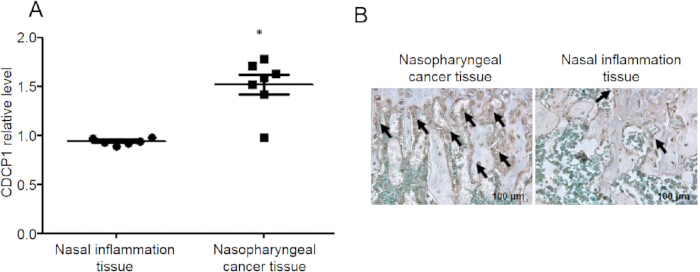
Figure 1. Increased CDCP1 expression in nasopharyngeal carcinoma tissues. (A) Relative expression of CDCP1. mRNA in nasopharyngeal carcinoma tissues (n = 7) and rhinitis tissues (n = 6) detected by real-time quantitative PCR. Data are presented as mean ± standard deviation. *P < 0.05 vs. rhinitis tissues. (B) Representative immunohistochemical staining images of CDCP1 protein expression in nasopharyngeal carcinoma tissues and rhinitis tissues. Scale bar = 100 µm. CDCP1 protein was mainly localized in the cytoplasm and cell membrane of nasopharyngeal carcinoma cells, while its expression was weak or negative in rhinitis tissues. Please click here to view a larger version of this figure.
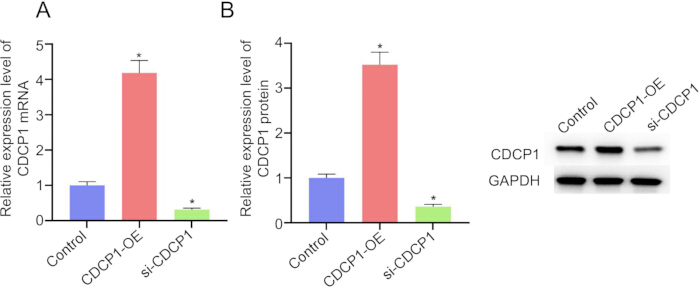
Figure 2. Regulation of CDCP1 expression in CNE2 cells. (A) Relative expression of CDCP1 mRNA detected by real-time quantitative PCR. Values are shown as the mean ± standard deviation based on three independent experiments. *P < 0.05 vs. control group. (B) CDCP1 protein expression levels detected by western blot, with GAPDH. as an internal control. Representative bands from three independent experiments are shown. *P < 0.05 vs. control group. Please click here to view a larger version of this figure.
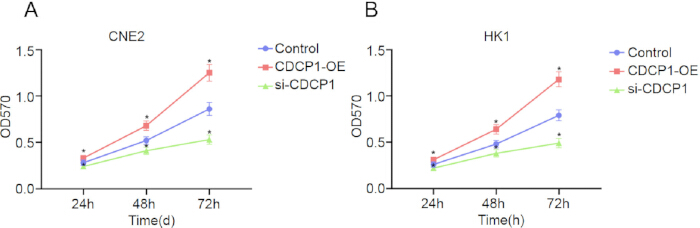
Figure 3. Effect of CDCP1 on proliferation of nasopharyngeal carcinoma cells. CNE2 cells (A) and HK1 cells (B) were transfected as indicated, and cell proliferation was assessed by MTT assay at 24, 48, and 72 h post transfection. Data are presented as mean ± standard deviation from three independent experiments with five replicate wells per group. *P < 0.05 vs. control group at the corresponding time point. Please click here to view a larger version of this figure.
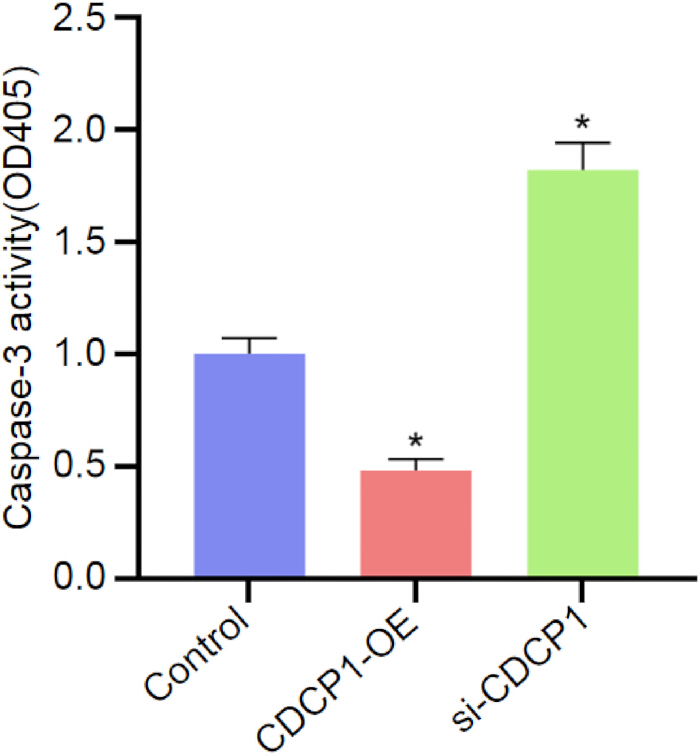
Figure 4. Effect of CDCP1 on apoptosis in nasopharyngeal carcinoma cells. CNE2 cells were transfected as indicated, and Caspase-3 activity was detected by colorimetric assay. Results are expressed as the mean ± standard deviation calculated from three independent experiments. *P < 0.05 vs. control group. Please click here to view a larger version of this figure.
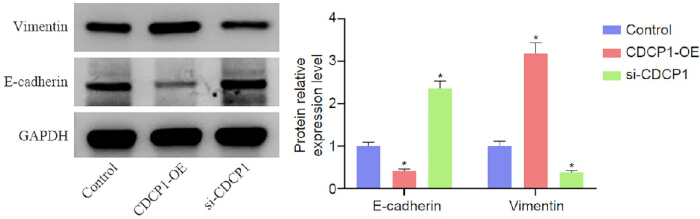
Figure 5. Effect of CDCP1 on expression of EMT-related factors in nasopharyngeal carcinoma cells. CNE2 cells were transfected as indicated, and E-cadherin and Vimentin protein expression was evaluated by western blot analysis, with GAPDH included as the internal control. Representative bands from three independent experiments are displayed. *P < 0.05 vs. control group. Please click here to view a larger version of this figure.
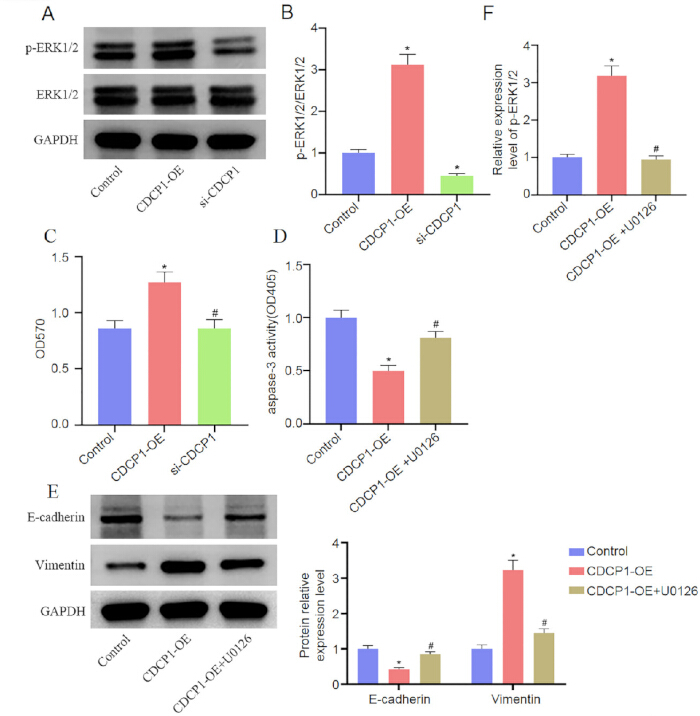
Figure 6. Activation of the ERK1/2 signaling pathway and nasopharyngeal carcinoma progression through ERK1/2. CNE2 cells were transfected as indicated. In the rescue experiment, U0126 (10 µmol/L) was added for 48 h after CDCP1. overexpression. (A) Representative western blot results showing p-ERK1/2 and total ERK1/2 expression. (B) Quantification of p-ERK1/2 expression after normalization to total ERK1/2. Values are shown as the mean ± standard deviation from three independent experiments. *P < 0.05 vs. control group. (C) Cell proliferation measured at 72 h using the MTT assay. *P < 0.05 vs. control group; #P < 0.05 vs. CDCP1-OE group. (D) Caspase-3 activity was measured. *P < 0.05 vs. control group; #P < 0.05 vs. CDCP1-OE group. (E) Protein expression levels of E-cadherin and Vimentin detected by western blot. Representative bands from three independent experiments are shown. (F) Quantitative analysis of p-ERK1/2 levels. *P < 0.05 vs. control group; #P < 0.05 vs. CDCP1-OE group. Please click here to view a larger version of this figure.
| Gene | Forward 5’-3’ | Reverse 5’-3’ |
| GAPDH | AGTATGTTGTCACCGCTGG | TAACCTGTCTATACGGAGGGT |
| CDCP1 | GTACACCCGTCCGAGGAG | GTTAGTCTAGGATCACCGG |
| E-cadherin | CGTCAGGGTCACGAGG | GTCTAGGGTGTTGTCACTAAT |
| Vimentin | AGGATCAGTCACGGGGT | GTTCACGTGTCACGTCA |
Table 1: The primer sequences required for RT-qPCR in this study.
Supplemental Table S1: The original data involved in the results of this study.Please click here to download this file.
Discussion
Loading...
$$\rightleftharpoonup{xx}$$
$$\longleftharp{xx}$$,
$$\longrightharp{xx}$$,
This study systematically investigated, for the first time, the expression characteristics of CDCP1 in nasopharyngeal carcinoma tissues and its effects on tumor cell biological behavior, and preliminarily elucidated the molecular mechanism by which CDCP1 promotes epithelial-mesenchymal transition through activation of the ERK1/2 signaling pathway. The findings suggest that CDCP1 exerts a protumorigenic role in nasopharyngeal carcinoma, providing new experimental evidence for understanding the mechanisms of metastasis in this disease.
This study found that CDCP1. expression was significantly upregulated in nasopharyngeal carcinoma tissues, consistent with previous reports in tumors such as lung cancer and triple-negative breast cancer21,22. Immunohistochemical staining further confirmed that CDCP1 protein was mainly localized at the cell membrane and in the cytoplasm of nasopharyngeal carcinoma cells, a localization consistent with its function as a membrane receptor involved in signal transduction. Notably, the sample size of this study was small (seven nasopharyngeal carcinoma tissues and six rhinitis tissues). Although the expression difference in CDCP1 was preliminarily validated, the correlation between its expression level and clinical prognostic indicators, such as TNM stage, lymph node metastasis, and disease-free survival, could not be analyzed. Future studies should systematically evaluate the relationship between CDCP1 expression and patient prognosis in larger sample cohorts to clarify its potential value as a prognostic marker for nasopharyngeal carcinoma.
In functional studies, by establishing CDCP1 overexpression and knockdown models, this study suggests that CDCP1 may promote proliferation, inhibit apoptosis, and induce EMT in nasopharyngeal carcinoma cells. Specifically, CDCP1 overexpression was associated with significantly enhanced proliferative capacity of CNE2 and HK1 cells and decreased Caspase-3 activity, whereas CDCP1 .silencing was associated with the opposite effects. This result is consistent with the protumorigenic functions of CDCP1 reported in other tumors23,24, but this study is the first to investigate this role in nasopharyngeal carcinoma cells. In relation to EMT regulation, increased CDCP1 expression reduced the level of the epithelial marker E-cadherin while elevating the expression of the mesenchymal marker Vimentin., suggesting that CDCP1 drives EMT in nasopharyngeal carcinoma cells. EMT is a key step by which tumor cells acquire invasive and metastatic capabilities, and these results suggest that CDCP1 may participate in the metastatic process of nasopharyngeal carcinoma by inducing EMT.
Regarding the signaling pathway mechanism, this study found that CDCP1 significantly increased the phosphorylation level of ERK1/2 without affecting total ERK1/2 expression, suggesting that CDCP1 specifically activates the ERK1/2 signaling pathway. To further verify whether CDCP1 functions through this pathway, a rescue experiment was performed using the ERK1/2-specific inhibitor U0126. The results showed that inhibition of the ERK1/2 pathway reversed CDCP1-induced proliferation promotion, apoptosis inhibition, and EMT, confirming that CDCP1's function depends on ERK1/2 signaling. This finding is both related to and distinct from previously reported mechanisms by which CDCP1 regulates tumor cell migration through the Src-PKCδ pathway, suggesting that CDCP1 may exert its functions through diverse downstream signaling pathways in different tumor types25,26.
From a methodological perspective, the optimization of several key steps in this study significantly influenced the reliability of the experimental results. For immunohistochemical detection, the choice of antigen retrieval conditions directly affected the antigen exposure of the membrane protein CDCP1. In preliminary experiments, we compared the retrieval efficiency of citrate buffer (pH 6.0) and EDTA buffer (pH 9.0) and found that the former yielded a lower background signal and clearer membrane localization for CDCP1 antibody staining, a critical optimization step for result interpretation. For cell proliferation detection, although the MTT assay is simple to perform and suitable for high-throughput screening, its detection principle relies on mitochondrial dehydrogenase activity in viable cells, and factors such as cell status and culture duration can affect the results. Therefore, in each experiment, replicate wells were established, and the experiments were repeated 3x to ensure stable results. For future studies requiring more precise assessment of cell proliferation, the EdU incorporation assay or real-time cell analysis systems could be considered to address the limitations of the MTT assay in temporal resolution and dynamic monitoring.
For cell transfection interventions, liposome-based transfection was used to achieve CDCP1 overexpression and silencing. This method is simple to perform and yields relatively high transfection efficiency; however, liposomes exhibit cytotoxicity, and transfection efficiency varies across cell lines. In preliminary experiments, CNE2 cells were found to be sensitive to liposomes; therefore, the transfection duration was controlled to within 6 h before replacing with complete medium to reduce cellular damage. Compared with lentivirus-mediated stable transfection, transient transfection is suitable for preliminary functional validation but does not allow for assessment of long-term intervention effects. Regarding the use of signaling pathway inhibitors, U0126, as a MEK1/2 inhibitor, effectively blocks ERK1/2 phosphorylation; however, it has a short half-life in cell culture. In this study, the drug was replenished during medium changes throughout the 48 h intervention period to ensure sustained inhibitory effects.
The limitations of this study are primarily reflected in the following aspects: First, the clinical sample size was small, making it difficult to analyze the correlation between CDCP1 expression levels and patient prognosis. Subsequent studies should clarify its clinical prognostic value in larger sample cohorts. Second, this study primarily employed in vitro cellular experiments and lacked in vivo validation in animal models of the effects of CDCP1 on tumor growth and metastasis. Although in vitr.o experiments can effectively reveal molecular mechanisms, the regulation of CDCP1 function by factors such as the tumor microenvironment and immune cell infiltration needs to be further confirmed in in vivo models. Third, the EMT assessment relied on two markers: E-cadherin and Vimentin. Although these markers are representative, the EMT process involves coordinated changes in multiple transcription factors and cytoskeletal proteins. Future studies could include the detection of additional markers such as Snail, Twist, and N-cadherin, combined with cellular morphology and migration/invasion assays for further validation.
Regarding the comparison of intervention strategies and future applications, the gene overexpression and silencing strategies employed in this study are suitable for mechanistic research; however, in clinical translation, they may face challenges such as delivery efficiency and safety. Compared with intervention strategies such as antibody neutralization or soluble receptor blockade, genetic-level regulation is more suitable for target function validation. Currently, monoclonal antibodies targeting CDCP1 have shown anti-tumor activity in preclinical studies on some solid tumors, and their potential application in targeted therapy for nasopharyngeal carcinoma could be explored in the future. Additionally, the CDCP1 detection and intervention system established in this study may provide a reference for functional studies of membrane proteins in other head and neck tumors. Combined with patient-derived organoid models, this approach holds promise for advancing individualized therapy targeting CDCP1.
In summary, this study confirms that CDCP1 expression is upregulated in nasopharyngeal carcinoma tissues and promotes cell proliferation, inhibits apoptosis, and induces EMT in nasopharyngeal carcinoma cells by activating the ERK1/2 signaling pathway. The findings clarify the pro-tumorigenic role of CDCP1 in nasopharyngeal carcinoma and its molecular mechanism, providing new experimental evidence for elucidating the mechanisms of nasopharyngeal carcinoma metastasis. Future studies should clarify the clinical prognostic value of CDCP1 in larger sample cohorts and combine in vivo models with novel intervention strategies to promote its clinical translation.
Disclosures
Loading...
$$\rightleftharpoonup{xx}$$
$$\longleftharp{xx}$$,
$$\longrightharp{xx}$$,
The authors declare that there are no conflicts of interest regarding the publication of this paper. No financial or personal relationships have influenced the work reported in this study.
Acknowledgements
Loading...
$$\rightleftharpoonup{xx}$$
$$\longleftharp{xx}$$,
$$\longrightharp{xx}$$,
This work was supported by the Fujian Natural Science Fund project (No.2017J01271).
Materials
| Name | Company | Catalog Number | Comments |
|---|---|---|---|
| BCA Protein Assay Kit | Thermo Fisher, USA | 23225 | For protein concentration determination |
| Caspase-3 Activity Assay Kit | Beyotime, China | C1403 | Colorimetric assay for Caspase-3 activity |
| CDCP1 Overexpression Plasmid | Not specified | Not specified | For CDCP1 overexpression transfection |
| CDCP1 Primary Antibody | Abcam, USA | ab137706 | For IHC and Western blot; dilution 1:200 (IHC) or 1:1000 (WB) |
| CDCP1 siRNA | Not specified | Not specified | For CDCP1 gene silencing |
| CNE2 Cell Line | China Center for Type Culture Collection (CCTCC), China | Not specified | Human nasopharyngeal carcinoma cell line |
| DMEM High Glucose Medium | HyClone, USA | SH30243.01 | Cell culture |
| DMSO | Sigma, USA | D2650 | For dissolving crystals in MTT assay |
| E-cadherin Primary Antibody | Cell Signaling Technology, USA | 3195S | Western blot; dilution 1:1000 |
| ERK1/2 Primary Antibody | Cell Signaling Technology, USA | 4695S | Western blot; dilution 1:1000 |
| GAPDH Primary Antibody | Abcam, USA | ab8245 | Western blot loading control; dilution 1:5000 |
| HK1 Cell Line | China Center for Type Culture Collection (CCTCC), China | Not specified | Human nasopharyngeal carcinoma cell line |
| Lipofectamine 2000 | Invitrogen, USA | 11668019 | Transfection reagent |
| Microplate Reader | BioTek, USA | Not specified | Absorbance detection (MTT, Caspase-3) |
| MTT | Sigma, USA | M2128 | Cell proliferation assay; prepared at 5 mg/mL in PBS |
| Opti-MEM | Gibco, USA | 31985070 | Reduced serum medium for transfection |
| p-ERK1/2 Primary Antibody | Cell Signaling Technology, USA | 4370S | Western blot; dilution 1:2000 |
| PrimeScript RT Master Mix | Takara, Japan | RR036B | Reverse transcription reagent for real-time PCR |
| PVDF Membrane | Millipore, USA | IPVH00010 | Protein transfer; 0.45 μm pore size |
| QuantStudio 5 Real-Time PCR System | Applied Biosystems, USA | A34322 | qPCR detection |
| RIPA Lysis Buffer | Beyotime, China | P0039 | Protein extraction; complete RIPA lysis buffer |
| Secondary Antibody (HRP-conjugated) | Dako, Denmark | Not specified | For IHC and Western blot |
| Sodium Citrate Buffer | Not specified | Not specified | For IHC antigen retrieval, pH 6.0 |
| TB Green Premix Ex Taq II | Takara, Japan | RR820A | qPCR reaction reagent; 200 reactions |
| Tissue Homogenizer | IKA T10, Germany | Not specified | For tissue RNA extraction homogenization |
| TRIzol Reagent | Invitrogen, USA | 15596026 | RNA extraction |
| U0126 | Selleck, USA | S1102 | ERK1/2-specific inhibitor; used at 10 μmol/L |
| Vimentin Primary Antibody | Cell Signaling Technology, USA | 5741S | Western blot; dilution 1:1000 |
Reprints and Permissions
Request permission to reuse the text or figures of this JoVE article
Request Permission