This study protocol was designed to systematically investigate the potential chondroprotective effects of Fructus Xanthii extract in osteoarthritis through integrated multi-omics analyses and in vivo experiments.
Research Article
Fructus xanthii Extract Alleviates Osteoarthritis by Preserving Cartilage Integrity
June 12th, 2026
Xiaohan Dou*1,2 , Xiaohui Li*1,2 , Haohui Wang2 , Mian Li2 , Wenyue Zhang2 , Hao Xu2 , Yanjie Zhang2 , Enshui Zhang3 , Haiyan Ma4 , Yan Zhao2 , Liang Zou4
liangzou84@163.com
sdyinluxu@163.com
1Department of Orthopedic Surgery, The First Affiliated Hospital of Shandong First Medical University & Shandong Provincial Qianfoshan Hospital, 2Biomedical Sciences College & Shandong Medicinal Biotechnology Centre, Shandong First Medical University & Shandong Academy of Medical Sciences, 3Neck-Shoulder and Lumbocrural Pain Hospital of Shandong Academy of Medical Sciences, 4Central Hospital of Shandong Academy of Medical Sciences
Corresponding Authors: Liang Zou <liangzou84@163.com>, Luxu Yin <sdyinluxu@163.com>
* These authors contributed equally
Opens in a new tab
In This Article
Summary
Loading...
$$\rightleftharpoonup{xx}$$
$$\longleftharp{xx}$$,
$$\longrightharp{xx}$$,
Abstract
Loading...
$$\rightleftharpoonup{xx}$$
$$\longleftharp{xx}$$,
$$\longrightharp{xx}$$,
Osteoarthritis (OA) is a progressive degenerative joint disorder for which current pharmacological and surgical interventions mainly relieve symptoms rather than reverse the underlying pathological changes, highlighting the urgent need for novel therapeutic agents. This protocol aimed to investigate the potential chondroprotective effects of Fructus Xanthii extract against OA. First, non-targeted metabolomics profiling was conducted using ultra-high-performance liquid chromatography coupled with high-resolution tandem mass spectrometry (UHPLC-HRMS/MS) to characterize the chemical constituents of the extract. An integrated strategy combining network pharmacology and transcriptomic mining was then applied to identify bioactive components and putative targets of the extract, followed by cross-analysis with OA-related dysregulated genes to obtain core target genes. Gene Ontology (GO) and Kyoto Encyclopedia of Genes and Genomes (KEGG) enrichment analyses were performed to annotate the main biological processes and signaling pathways modulated by the extract. For in vivo validation, zebrafish cartilage injury models and mouse OA models were used to evaluate the chondroprotective effects of the extract. RNA sequencing (RNA-seq) was further adopted to analyze transcriptomic alterations in chondrocytes after treatment, focusing on OA-associated pathways and gene expression profiles; enzyme-linked immunosorbent assay (ELISA) was subsequently performed to verify the expression levels of key proteins/receptors screened by RNA-seq, so as to further confirm the regulatory effects of Fructus Xanthii extract on core OA targets. This integrated multi-omics and experimental protocol provides a systematic approach to explore the potential of Fructus Xanthii extract as a promising botanical candidate for OA intervention.
Introduction
Loading...
$$\rightleftharpoonup{xx}$$
$$\longleftharp{xx}$$,
$$\longrightharp{xx}$$,
Osteoarthritis (OA) is a degenerative joint disorder characterized by the progressive degradation of articular cartilage, subchondral bone sclerosis, synovial inflammation, and osteophyte formation1. According to the Global Burden of Disease (GBD) study, the prevalence of OA has steadily increased across 204 countries and territories from 1990–20202, with this trend expected to accelerate alongside global demographic ageing3. Current estimates indicate that over 250 million individuals worldwide are affected, placing significant strain on individual well-being, healthcare systems, and socioeconomic structures4. Current treatments are predominantly aimed at symptomatic relief, with non-steroidal anti-inflammatory drugs (NSAIDs) and intra-articular viscosupplementation with hyaluronic acid (HA) being the most common interventions. However, these approaches offer limited clinical benefit and are associated with considerable adverse effects5,6. This highlights the critical need for effective disease-modifying osteoarthritis drugs (DMOADs).
Traditional Chinese Medicine (TCM) has long been used in the management of OA, grounded in the concept of "bone bi," a subtype of "bi syndrome"7. In this framework, the pathogenesis of OA is attributed primarily to a deficiency in liver and kidney essence, insufficiency of qi and blood, and subsequent invasion by wind, cold, and dampness8. Accordingly, therapeutic strategies focus on dispelling wind-dampness, dispersing cold, and unblocking the collaterals9. TCM treatments are noted for their multi-target effects, favorable side-effect profiles, and clinically significant efficacy10. Noteworthy formulations such as Buqi Tongluo Capsule (BQTL) and Fuzi Decoction (FZD) have shown clear anti-OA effects in clinical practice, while Du Huo Ji Sheng Tang (DHJST) alleviates OA symptoms by suppressing the NLRP3 inflammasome pathway, supported by centuries of empirical use. Similarly, Shenjinhuoxue Mixture (SHM) attenuates pain and cartilage degeneration through down-regulation of pro-inflammatory mediators such as IL-1β and TNF-α11,12,13. At the monomer level, compounds such as icariin (Cyanoside A, CyA) and erianin, derived from medicinal plants, have been reported to promote chondrocyte proliferation, inhibit inflammatory cytokine release, and maintain joint homeostasis14,15. Collectively, TCM offers a comprehensive therapeutic approach with anti-inflammatory, chondroprotective, and symptom-alleviating properties. However, the complexity of its mechanisms and issues related to standardization necessitate ongoing, rigorous research.
The dried ripe fruits of Fructus Xanthii (Compositae), commonly known as “Cang-Er-Zi”, have been documented to exhibit a wide range of pharmacological activities, including antimicrobial, anti-inflammatory, antioxidant, analgesic, antineoplastic, and immunomodulatory effects16. Phenolic acids isolated from Fructus Xanthii effectively reduce synovial hyperplasia in rheumatoid arthritis (RA)17. Among these, chlorogenic acid (CGA), a representative caffeoylquinic acid derivative, has been found to stimulate osteoblast proliferation and differentiation while inhibiting RANKL-mediated osteoclastogenesis, thus maintaining skeletal homeostasis18. Other phenolic acids identified within the same extract, such as neochlorogenic acid (5-CQA), cryptochlorogenic acid (CCA), and protocatechuic acid, also exhibit antimicrobial, anti-inflammatory, antitumor, and antioxidant properties19,20,21. In addition to phenolic acids, a variety of secondary metabolites present in Cang-Er-Zi contribute to these bioactivities16,20,22,23,24,25. However, the precise role and underlying mechanisms of Fructus Xanthii extract in OA remain largely unexplored.
Non-Targeted Liquid Chromatography-Tandem Mass Spectrometry (LC-MS/MS) Metabolomics is characterized by hypothesis-free, high-throughput, and global coverage capabilities. It enables the simultaneous detection of thousands of metabolite features, providing a panoramic view of metabolic networks, and allows for the systematic discovery of novel biomarkers and aberrant metabolic pathways without prior target prespecification26,27. Combined with high-resolution mass spectrometry technology, this approach is suitable for the comprehensive analysis of various types of biological samples (e.g., serum, synovial fluid, urine, cartilage tissue, etc.) and has demonstrated significant advantages in osteoarthritis (OA) research. On the one hand, it can comprehensively screen for differential metabolites closely associated with the pathological progression of OA (such as various classes of metabolites identified in synovial fluid and synovial tissue) and map them to key pathways, including energy metabolism, cartilage repair, osteogenesis, and lipid metabolism, thereby deepening the understanding of OA pathogenesis. On the other hand, integrating multi-omics data such as transcriptomics and proteomics helps to reveal the role of metabolic reprogramming in cartilage degeneration, inflammatory responses, and joint structure damage, providing critical evidence for identifying early diagnostic biomarkers, evaluating disease progression, and developing targeted metabolic intervention strategies (e.g., regulating bile acid, tryptophan, or fatty acid metabolism), highlighting its translational potential in research on OA precision typing and personalized treatment.
Zebrafish serves as an excellent model organism due to multiple advantages: its genome is highly conserved with that of humans, sharing homology with approximately 70% of human protein-coding genes28,29. It exhibits key characteristics including rapid development, in vitro fertilization, transparent embryos enabling convenient in vivo imaging, high fecundity, and low maintenance costs30,31,32,33. In skeletal research, zebrafish allow for clear visualization of bone formation, mineralization processes, and regeneration capacity, and can be utilized to simulate pathological conditions like osteoporosis and cartilage damage. However, in the study of osteoarthritis (OA), a complex whole-joint disorder characterized by articular cartilage degeneration, synovial inflammation, and subchondral bone alterations, the application of the zebrafish model remains relatively limited.
This article presents a protocol that integrates UHPLC-HRMS/MS-based untargeted metabolomics, network pharmacology, transcriptomic mining, and in vivo experimental validation to explore the potential of Xanthium sibiricum extract as a viable plant candidate for OA intervention. The aim is not only to identify the bioactive components, potential targets, and core regulatory pathways of Xanthium sibiricum extract related to OA through multi-omics integration and computational analysis, but also to verify its chondroprotective effect on OA through in vivo models and further clarify its regulatory mechanism on chondrocyte transcriptome.
Protocol
Loading...
$$\rightleftharpoonup{xx}$$
$$\longleftharp{xx}$$,
$$\longrightharp{xx}$$,
All experiments involving clinical samples and mice were conducted in accordance with the protocol approved by the Ethics Review Committee of Shandong Provincial Medical Biotechnology Research Center. The reagents and the equipment used are listed in the Table of Materials.
1. Isolation and culture of human articular chondrocytes
Human articular cartilage specimens were obtained from patients undergoing arthroscopic surgery or total joint arthroplasty at the First Affiliated Hospital of Shandong First Medical University. Cartilage slices were transported to the laboratory on ice within 30 min of surgical excision. The tissue was washed thoroughly with ice-cold Dulbecco’s phosphate-buffered saline (DPBS; 3–5 washes), then minced finely into approximately 1 mm3 fragments using sterile surgical scissors. Sequential enzymatic digestion was performed, beginning with pre-digestion using 0.25% trypsin-EDTA for 30 min at 37 °C. The digestion process was monitored until the cartilage fragments became thinned, reduced in size, and translucent, after which the cartilage fragments were collected by centrifugation (200 × g, 5 min) at room temperature. This was followed by overnight digestion (8 h, 37 °C) with 0.2% type II collagenase under continuous gentle agitation. The digestion process was monitored until all macroscopically visible cartilage fragments were completely dissolved. The released cells were collected by centrifugation (200 × g, 5 min) at room temperature, resuspended in complete DMEM supplemented with 10% fetal bovine serum, 100 U/mL penicillin, and 100 µg/mL streptomycin, and seeded into 75 cm2 culture flasks. Cells were maintained at 37 °C in a humidified atmosphere containing 5% CO2. Adherent chondrocytes were detached using 0.25% trypsin-EDTA, and the cells were subcultured at a 1:3 ratio when the adherent cells reached 80% confluence of the culture flask surface.
2. Preparation of Fructus Xanthii extract
Dried ripe fruits of Xanthium strumarium L. (Fructus Xanthii) were collected from naturally occurring populations in North China and authenticated by a senior pharmacognosist. The specimen was deposited in the herbarium of Shandong First Medical University. 20 g of finely powdered Fructus Xanthii were placed into an extraction thimble, and exhaustive Soxhlet extraction was performed using 95% ethanol (approximately 250 mL) until seven to eight siphon cycles were completed. The ethanolic extract was filtered, and the filtrate was concentrated to dryness under reduced pressure at 45 °C using a rotary evaporator. The resulting residue was resuspended in 60 mL of double-distilled water and partitioned successively with 60 mL of ethyl acetate in a separatory funnel. The mixture was shaken vigorously and allowed to undergo phase separation at 4 °C for 24 h. The aqueous layer was then collected, lyophilized, and stored at −80 °C until further use.
3. Standardized workflow for non-targeted LC-MS/MS metabolomics
- UHPLC-HRMS/MS-based Non-targeted metabolomics analysis
Non-targeted metabolomic profiling was performed on an ultra-high-performance liquid chromatography-high-resolution tandem mass spectrometry (UHPLC-HRMS/MS) platform. Metabolites were rapidly quenched and extracted using a chilled methanol–water system. Chromatographic separation was achieved on a UHPLC system equipped with a C18/T3 chromatographic column (100 × 2.1 mm, 1.8 µm) maintained at 40 °C. A binary gradient (0–28 min) consisting of 0.1% formic acid in water (A) and 0.1% formic acid in acetonitrile (B) was applied at a flow rate of 0.3 mL/min. Mass spectrometric detection was performed on a hybrid quadrupole-Orbitrap instrument operated in polarity-switching full MS/data-dependent MS2 (Full MS/dd-MS2) mode, with a full scan range of m/z 70–1,050 and a resolution of 120,000 (FWHM at m/z 200). Higher-energy collisional dissociation (HCD) fragmentation was carried out at 20, 40, and 60 eV, with dynamic exclusion set to 10 s. - Raw data were converted to mzXML format using ProteoWizard. Peak picking, retention-time alignment, and de-isotoping were performed on XCMS Online using HRMS-optimized parameters (ppm = 5, bw = 5, snthresh = 6). Features containing more than 50% missing values across samples were excluded, and the remaining peak areas were normalized to the total ion current (TIC). Metabolites were annotated by matching accurate mass, MS2 spectra, and retention time against an in-house reference library using a mass error tolerance of ≤ 5 ppm and a dot-product score threshold of ≥80.
NOTE: Strict standard operating procedures were followed throughout the workflow. Samples were snap-frozen in liquid nitrogen (−80 °C) immediately after collection, transported using a dry-ice chain, and processed using randomized extraction, injection, and batching procedures. Pooled quality control (QC) samples were inserted after every 10 study samples to monitor instrumental drift.
4. Network pharmacology analysis
- Network pharmacology-based screening of active compounds and target prediction
Active ingredients of Fructus Xanthii were retrieved from the TCMID database (https://www.tcmsp-e.com/tcmspsearch.php) and the HERB database (http://herb.ac.cn/). The retrieved compounds were filtered according to the recommended ADME thresholds of oral bioavailability ≥30% and drug-likeness ≥0.18. Predicted human targets of the qualified compounds were obtained from the two databases. The screening results were collected and collated, resulting in the identification of 15 active compounds and 151 unique protein targets associated with Fructus Xanthii. - Integration of transcriptomic data and identification of OA-associated core targets
Differentially expressed genes (DEGs) in cartilage tissues between normal and osteoarthritis (OA) samples were extracted from the GEO database datasets GSE51588 (n = 5 normal, 6 OA) and GSE169077 (n = 10 normal, 40 OA) using the GEO2R web tool (https://www.ncbi.nlm.nih.gov/geo/geo2r). OA-upregulated genes were defined using the criteria of log2 fold-change >0.5 and adjusted p-value <0.05. The intersection between OA-upregulated genes and the 151 Fructus Xanthii-related protein targets was visualized using the R package ggvenn. Protein–protein interaction (PPI) networks of the intersection targets were constructed using the STRING database (https://string-db.org/). The PPI network data were imported into Cytoscape, and the top 10 hub genes were screened for subsequent functional enrichment analysis using the CytoHubba plug-in with the MCC algorithm.
5. Determination of Maximum Tolerated Concentration (MTC) in zebrafish
Transgenic zebrafish larvae (Tg col2a1a:EGFP) at 2 days post-fertilization (2 dpf) were randomly distributed into 6-well plates at a density of 30 larvae per well. Each well was supplemented with 3 mL of exposure medium containing serially diluted Fructus Xanthii extract. Moribund or deceased larvae were removed daily. The larvae were continuously exposed at 28 °C for 72 h, after which the maximum tolerated concentration (MTC) was determined as the highest concentration at which larval mortality did not exceed 10%.
6. Establishment of the zebrafish bone-injury model
Tg col2a1a:EGFP zebrafish larvae at 2 days post-fertilization (2 dpf) were assigned to four groups: control, model, chondroitin sulfate (CS) positive control, and Fructus Xanthii extract treatment. All groups except the control group were exposed to Staphylococcus aureus (OD600 = 0.8, 1 × 10⁸ CFU/mL) for 24 h to induce bone injury. Successful model establishment was confirmed by verifying a reduction of at least 50% in cartilage-specific green fluorescence intensity in the craniofacial region relative to the control group under an epifluorescence microscope.
7. Quantitative assessment of cartilage-specific fluorescence in zebrafish larvae
The larvae were exposed continuously to graded concentrations of Fructus Xanthii extract or 1,000 µg/mL sodium chondroitin sulfate A (positive control) at 28 °C for 72 h. Subsequently, 10 larvae were randomly selected from each 6-well replicate (n = 30 per group). The selected larvae were anesthetized using 0.016% tricaine and positioned laterally on 1% low-melting agarose pads. Fluorescence images were acquired at 2× magnification (excitation 488 nm, emission 525/50 nm) using a stereomicroscope equipped with a fluorescence camera. Cartilage-specific EGFP intensity in the craniofacial region, including the ceratohyal and Meckel’s cartilage, was quantified using image analysis software. Background correction was performed on the integrated density values, and the corrected values were normalized to the control group for statistical analysis of chondroprotective efficacy.
8. Induction of OA in C57BL/6J mice
Male C57BL/6J mice (6–8 weeks old, 20–22 g) were housed under specific pathogen-free (SPF) conditions at 22 °C ± 2 °C with a 12 h light/dark cycle. The mice were allowed to acclimatize for one week and were then randomly assigned into three groups (n = 8 per group) using a random number table: (1) sham-operated control, (2) ACLT-induced OA (ACLT), and (3) ACLT plus Fructus Xanthii extract intervention (ACLT + Fructus Xanthii extract). All surgical procedures were performed under sterile conditions in accordance with a previously validated protocol.
The mice were anesthetized with intraperitoneal sodium pentobarbital (50 mg/kg) (following institutionally approved protocols), and a medial parapatellar incision was made to expose the right knee joint capsule. The anterior cruciate ligament was transected under an operating microscope to induce joint instability, after which the joint capsule and skin were closed in layers using 6-0 absorbable sutures. Sham-operated mice underwent identical arthrotomy procedures without ligament transection. Joint stability was evaluated, and successful model establishment was confirmed by performing the drawer test or by assessing the degree of joint injury in histological sections from the model group mice.
Postoperative analgesia with buprenorphine (0.1 mg/kg, subcutaneous injection) was administered for three consecutive days. The treatment agents were administered once daily by gavage. The ACLT + Fructus Xanthii extract group received 100 µL of 1,000 µg/mL Fructus Xanthii extract diluted in normal saline, whereas the other two groups received 100 µL of normal saline as the vehicle control. At 8 weeks post-surgery, the mice were euthanized by CO2 asphyxiation followed by cervical dislocation, and the knee joints were harvested for histological analyses.
9. Histopathological staining
- Knee joint tissue histological preparation and staining
The operated knee joints were excised en bloc at postoperative week 8 and fixed in 4% paraformaldehyde (PFA) at 4 °C for 48 h. The fixed joints were decalcified in 10% ethylenediaminetetraacetic acid (EDTA; pH 7.4) for 14 days, dehydrated through a graded ethanol series, and embedded in paraffin. Serial sagittal sections (5 µm) were prepared from the embedded joints, and the following histological staining procedures were performed.- Hematoxylin and Eosin (H&E) staining
Hematoxylin and eosin (H&E) staining was performed to assess general tissue architecture, cartilage integrity, and synovial hyperplasia. - Safranin-O/Fast Green staining
Safranin-O/Fast Green staining was performed to detect proteoglycans within the cartilage tissue. The stained sections were examined using a light microscope equipped with a digital camera, and images were captured at 10× and 20× magnifications.
- Hematoxylin and Eosin (H&E) staining
- OARSI-based semi-quantitative scoring of cartilage degeneration
For semi-quantitative assessment of cartilage degeneration, the stained sections were retrospectively re-evaluated and scored according to the Osteoarthritis Research Society International osteoarthritis cartilage histopathology assessment system, which evaluates cartilage damage severity based on grade (0–6; extent of cartilage loss) and stage (0–4; spatial distribution of damage) of articular cartilage degeneration.
A post-hoc blinding strategy was adopted for all evaluations. All sections were de-identified by removing the original group labels and were re-coded using anonymous serial numbers. Two experienced pathologists independently scored the sections without knowledge of group allocation. Cross-validation was performed between the two sets of scoring results. When the score difference was ≥1, the discrepant sections were jointly re-evaluated by the two pathologists to establish a consensus score. The final consensus scores were used for subsequent statistical analysis to ensure the objectivity, robustness, and reproducibility of the histopathological results.
10. RNA-sequencing (RNA-seq)
Primary human articular chondrocytes (passages 2–3) were seeded into 6-well plates at a density of 5 × 10⁵ cells per well. The cells were serum-starved for 24 h and then allocated into two groups (n = 3 per group): (1) Control group: cells were treated with vehicle only (0.1% DMSO); (2) Fructus Xanthii extract group: cells were treated with 1,000 µg/mL Fructus Xanthii extract dissolved in DMSO.
The cells were treated for 24 h, after which total RNA was extracted using TRIzol Reagent according to the manufacturer’s protocol. RNA integrity (RIN ≥7.0) and concentration were assessed using an RNA analyzer. Strand-specific cDNA libraries were prepared using an RNA sequencing library preparation kit and sequenced on a high-throughput next-generation sequencing (NGS) platform in paired-end 150 bp (PE150) mode. Quality control of the raw FASTQ files was performed using FastQC, followed by adapter and quality trimming using Trimmomatic prior to downstream analysis.
11. RNA-seq data processing
Differentially expressed genes downregulated by Fructus Xanthii extract (vs. control group; p < 0.05 and logFC < −0.5) were extracted from the RNA-seq dataset and intersected with the top 10 hub targets. The resulting core targets associated with Fructus Xanthii extract and osteoarthritis were visualized using the ggvenn package.
12. ELISA
Primary human articular chondrocytes at passages 2–3 were seeded in 6-well plates at a density of 5 × 10⁵ cells per well. Cells were incubated in serum-free medium for 24 h to induce quiescence. The cells were subsequently divided into the following three groups (n = 3 per group):
(1) Blank control: cells were treated with vehicle (0.1% DMSO) only; (2) Positive control: cellular inflammation was induced with IL-1β, followed by treatment with vehicle (0.1% DMSO); (3) Fructus Xanthii extract group: cellular inflammation was induced with IL-1β, followed by treatment with 1000 µg/mL Fructus Xanthii extract dissolved in 0.1% DMSO. Cell culture supernatants were collected after 24 h of incubation and stored at −80 °C until use. Levels of MMP1 and PGR in the culture supernatants were determined using commercially available enzyme-linked immunosorbent assay (ELISA) kits specific for human MMP1 and PGR, respectively. The assays were performed according to the manufacturers’ instructions.
13. Statistical analysis
All statistical analyses were performed using statistical analysis and graphing software, and data were presented as mean ± standard deviation (SD). Data normality was assessed using the Shapiro–Wilk test, and homoscedasticity was evaluated using the Levene test. Inter-group comparisons were performed using one-way or two-way analysis of variance (ANOVA), followed by Tukey’s or Šidák post-hoc tests, as appropriate. Pairwise comparisons were conducted using a two-tailed Student’s t-test. Non-parametric data were analyzed using the Mann–Whitney U test. A two-sided P-value < 0.05 was considered statistically significant.
Results
Loading...
$$\rightleftharpoonup{xx}$$
$$\longleftharp{xx}$$,
$$\longrightharp{xx}$$,
Quality assessment and metabolic landscape of non-targeted LC-MS/MS data
QC samples demonstrated excellent reproducibility, as indicated by highly overlapping TIC chromatograms in both positive and negative ion modes, with retention time drift remaining below 0.05 min across the entire analytical batch. Raw data underwent XCMS-based preprocessing, which included peak detection, integration, and retention-time alignment. Putative metabolites were annotated by matching accurate mass (≤5 ppm), isotopic patterns, and high-quality MS/MS spectra against an in-house spectral library. After rigorous filtering and TIC normalization, 2,179 and 1,291 reliable features were retained for positive- and negative-ion modes, respectively, forming the quantitative matrix for subsequent chemometric analyses.
Chemical composition of Fructus Xanthii extract
Phytochemical profiling revealed a structurally diverse metabolome, consisting of phenolic acids, lignans, sesquiterpenoids, flavonoids, and hydroxycinnamic acid derivatives. These compounds work synergistically through multi-component, multi-target, and multi-pathway mechanisms to produce anti-inflammatory, analgesic, anti-allergic, antimicrobial, immunomodulatory, and antitumor effects. A summary of the principal bioactive compounds identified is presented in Table 1.
Network-pharmacology-driven identification of Fructus Xanthii Extract–OA core targets
Volcano plots of the two GEO OA datasets (Figure 1A,B) visualized the differential expression landscape, distinguishing up-regulated (red), down-regulated (blue), and non-significant (grey) genes. A Venn intersection of the datasets identified 34 concordantly dysregulated genes, defining the Fructus Xanthii extract-relevant OA gene pool (Figure 1C). The network pharmacology map (Figure 1D) illustrated Fructus Xanthii extract (purple nodes), its active constituents (blue), constituent targets (orange), and OA-up-regulated targets overlapping with Fructus Xanthii extract (red), with CGA (MOL001955, red font) highlighted as the most connected component. The PPI network constructed from the 34 intersecting genes (Figure 1E) revealed the top 10 hub genes, with color intensity (from red to yellow) reflecting decreasing connectivity, pinpointing key regulatory targets for Fructus Xanthii extract-mediated OA intervention.
Functional enrichment of Fructus Xanthii Extract–OA core targets based on network pharmacology
GO enrichment analysis revealed that the Fructus Xanthii extract & OA core targets are significantly enriched in biological processes closely linked to OA pathogenesis. Key processes driving OA progression include extracellular matrix disassembly and collagen catabolism, central to cartilage degradation, with MMP1 identified as a key effector gene. Additionally, processes regulating vascular smooth muscle cell proliferation were enriched, involving genes such as MMP2 and MMP9, which may exacerbate OA by altering the local joint microenvironment (Figure 2A).
KEGG pathway enrichment analysis, represented by a bar chart, highlights several pathways that contribute to OA progression through the regulation of key gene expression. Pathways directly related to MMP1 include the IL-17 signaling pathway (involving MMP1, MMP9, TNF), relaxin signaling pathway (MMP1, MMP2, MMP9, TGFB1), PPAR signaling pathway (MMP1, PPARG), and lipid and atherosclerosis pathway (MMP1, MMP9, PPARG, TNF). Inflammatory pathways, such as the TNF signaling pathway (MMP9, TNF) and NF-κB signaling pathway (PLAU, TNF), are also significantly enriched. These pathways activate inflammatory cascades and indirectly regulate matrix-degrading enzymes like MMP1, thereby collectively driving OA progression (Figure 2B).
Alleviatory effect of Fructus Xanthii extract on cartilage injury in zebrafish larvae
Dose–response mortality data (Table 2) indicated that, under the experimental conditions, zebrafish tolerated Fructus Xanthii extract at a concentration of 1,000 µg/mL without exhibiting any lethality or overt phenotypic abnormalities. Concentrations above this threshold resulted in dose-dependent mortality. Therefore, 1,000 µg/mL was established as the maximum tolerated concentration (MTC) for subsequent OA intervention studies in this model.
Representative fluorescence images (Figure 3A) and the corresponding quantitative bar chart (Figure 3B) show that, compared to the model control, cartilage-specific EGFP intensity was significantly reduced in zebrafish larvae exposed to Fructus Xanthii extract at concentrations of 250, 500, and 1,000 µg/mL, indicating a dose-dependent restoration of cartilage integrity. The maximal therapeutic effect was observed at 1,000 µg/mL (Table 3), confirming this concentration as the optimal therapeutic dose within the tested range.
Fructus Xanthii extract mitigates joint damage in a murine model of OA
Synovial hyperplasia, inflammatory infiltration, and progressive cartilage degradation are key histopathological features of OA. To assess the in vivo chondroprotective efficacy of Fructus Xanthii extract, sagittal sections of murine knee joints were stained with H&E and Safranin-O/Fast Green. As shown in Figure 4, model mice exhibited severe fibrillation, focal cartilage erosion, disorganized chondrocyte alignment, and significant synovial thickening with extensive inflammatory infiltrates. In contrast, joints from the Fructus Xanthii-treated group displayed notably preserved articular cartilage, restored chondrocyte columnar organization, and a marked reduction in synovial hyperplasia and inflammatory cell infiltration. Semi-quantitative evaluation of cartilage degeneration via the OARSI histopathology assessment system revealed that the sham-operated group had a negligible OARSI score (0.25 ± 0.12), while the ACLT model group showed a significantly elevated OARSI grade and stage composite score (4.83 ± 0.52, p < 0.001 vs. sham group). Administration of Fructus Xanthii extract significantly reduced the OARSI composite score (2.17 ± 0.41, p < 0.001 vs. ACLT model group), indicating a marked attenuation of cartilage degenerative severity. All OARSI scoring results were derived from consensus scores by two independent blinded pathologists, ensuring the objectivity and reliability of the histopathological assessment. These histological findings collectively demonstrate that Fructus Xanthii extract significantly alleviates OA-associated joint damage in vivo. Subsequent studies will further validate the related molecular and inflammatory markers of OA to elaborate on the underlying mechanism.
Key targets of Fructus Xanthii extract on chondrocytes
In the PCA plot, distinct clustering of samples from different groups indicates significant differences in gene expression patterns and supports the robustness of the sequencing data grouping (Figure 5A). The volcano plot effectively illustrates the distribution of differentially expressed genes between the two groups, providing an intuitive overview of the number and magnitude of expression changes (Figure 5B). The heatmap, with color gradients representing gene expression levels, reveals similar expression profiles within groups and clear distinctions between groups (Figure 5C). The KEGG pathway enrichment bubble plot visually highlights key pathways significantly enriched by differential genes, guiding subsequent mechanistic validation (Figure 5D). A Venn intersection of genes down-regulated by Fructus Xanthii extract (p < 0.05, logFC < -0.5) and the Top 10 hub targets identified the core overlapping molecules MMP1 (p = 0.015362) and PGR (p = 0.00095466), confirming these as key OA-related effectors of Fructus Xanthii extract (Figure 5E). Box plots comparing gene expression between groups demonstrated that both MMP1 and PGR were significantly reduced in the Fructus Xanthii extract-treated group compared to the control (Figure 5F), suggesting that Fructus Xanthii extract mitigates cartilage matrix degradation by suppressing MMP1 and modulates estrogen-mediated inflammatory cartilage damage by down-regulating PGR.
Effects of Fructus Xanthii extract on MMP1 and PGR levels in human chondrocytes determined by ELISA
The levels of MMP1 and PGR in the culture supernatants of human chondrocytes were determined by ELISA, as presented in Figure 6. Low levels of MMP1 were detected in all groups; notably, the MMP1 and PGR levels in the Fructus Xanthii extract‑treated group were slightly lower than those in the positive control group. These findings indicate that Fructus Xanthii extract may reduce MMP1 and PGR expression and exert anti‑inflammatory effects to a certain extent (Figure 6A,B).
DATA AVAILABILITY:
The raw sequence data reported in this paper have been deposited in the Genome Sequence Archive and Open Archive for Miscellaneous Data in the National Genomics Data Center (Nucleic Acids Res 2025), China National Center for Bioinformation / Beijing Institute of Genomics, Chinese Academy of Sciences (GSA-Human: HRA017913; OMIX: OMIX016285), which are publicly accessible at https://ngdc.cncb.ac.cn/gsa-human. and https://ngdc.cncb.ac.cn/omix/34,35.
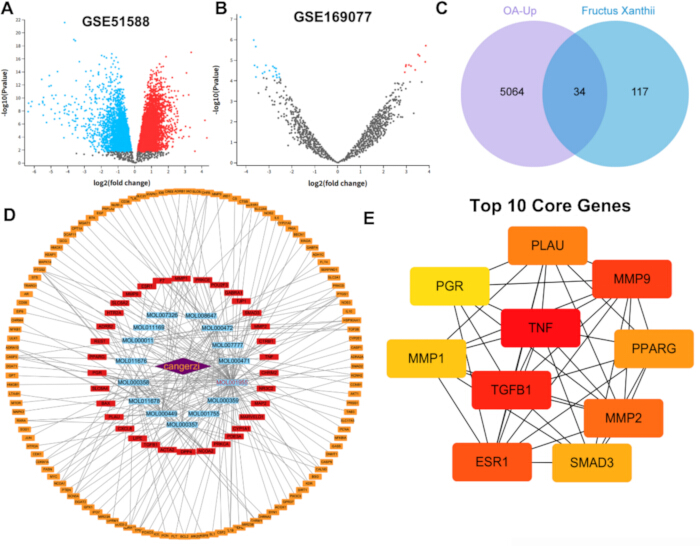
Figure 1: Network pharmacologic identification of core targets of Fructus xanthii extract against osteoarthritis. (A,B) Volcano plots displaying differentially expressed genes in the two GEO OA datasets. (C) Venn diagram of overlapping DEGs (34 genes). (D) Network pharmacology map: Fructus Xanthii (purple), active compounds (blue), compound targets (orange), and OA-up genes overlapping targets (red). (E) PPI network of top 10 hub genes derived from the 34 intersecting genes; color gradient from red to yellow indicates decreasing importance. Please click here to view a larger version of this figure.
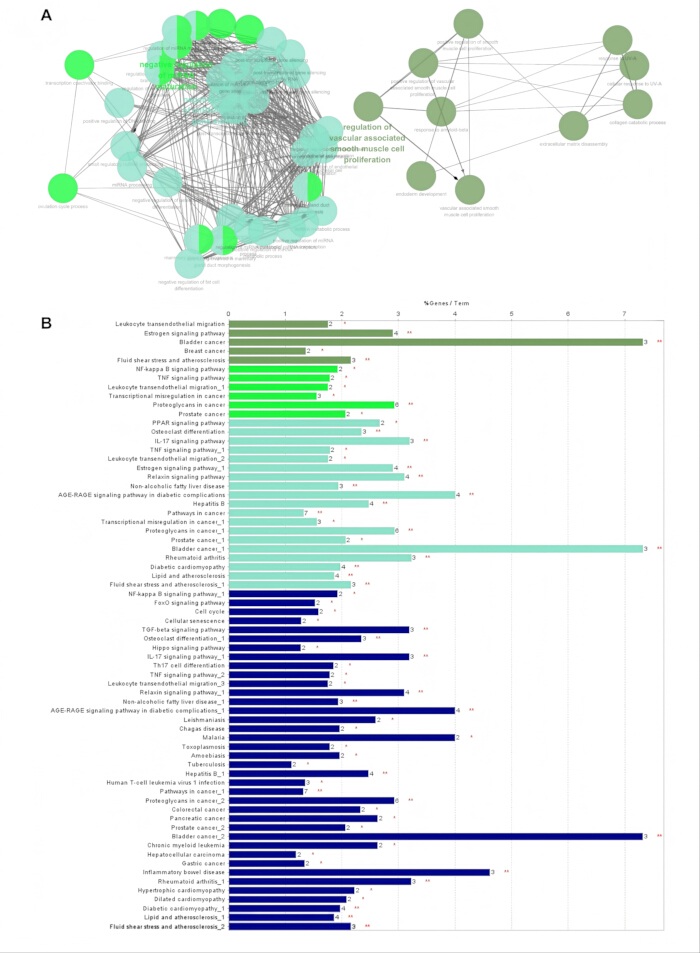
Figure 2: Functional enrichment analysis of core targets for osteoarthritis intervention. (A) GO enrichment network. (B) KEGG pathway bar chart Please click here to view a larger version of this figure.
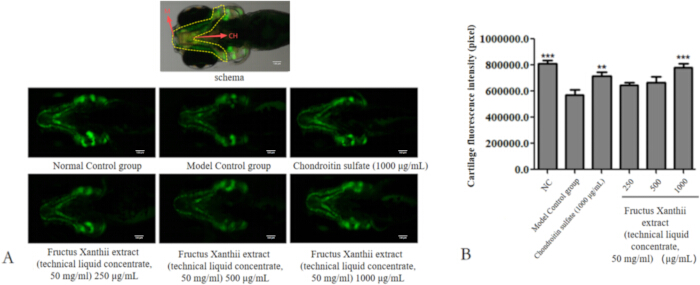
Figure 3: Chondroprotective effects of Fructus Xanthii extract in a zebrafish cartilage injury model. (A) Representative fluorescence images of craniofacial cartilage in zebrafish larvae from each group. CH: ceratohyal cartilage, M: Meckel's cartilage (yellow dashed boxes indicate the anatomical regions of CH and M). Scale bars: 100 µm. (B) Quantitative analysis of the combined EGFP fluorescence intensity of CH and M cartilage. All data are expressed as mean ± SD and compared against the model control group. ***p < 0.001 versus model control (ANOVA followed by Tukey’s post hoc test). Please click here to view a larger version of this figure.
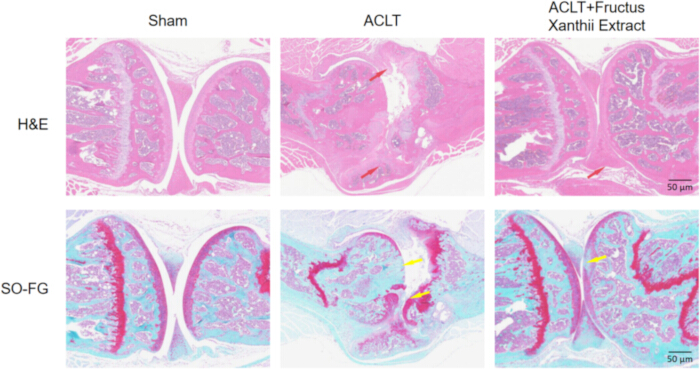
Figure 4: Fructus Xanthii extract attenuates knee-joint damage in the OA mouse model. Representative sagittal sections of the operated knees stained with H&E (upper panels) and Safranin-O/Fast Green (lower panels) are shown (n = 8 per group). Red arrows indicate synovial hyperplasia; yellow arrows denote cartilage degradation. Scale bars: 50 µm. Please click here to view a larger version of this figure.
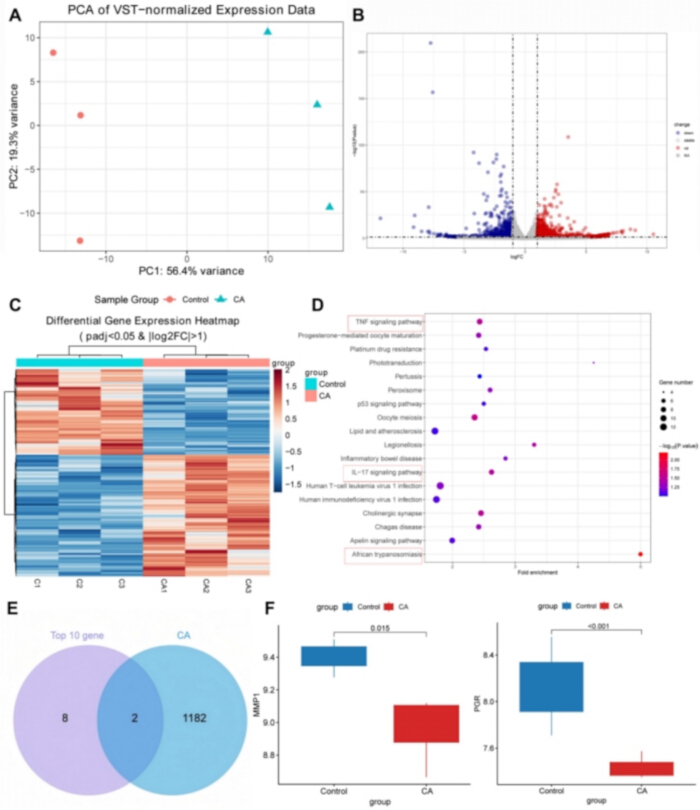
Figure 5: Transcriptomic identification of MMP1 and PGR as key targets in chondroprotection. (A) PCA plot. (B) Volcano plot. (C) Differential gene heatmap. (D) KEGG result bubble plot. (E) Venn diagram of the intersection between the Top 10 core targets and genes downregulated by Fructus Xanthii extract treatment. (F) Differential box plots of MMP1 and PGR. Please click here to view a larger version of this figure.
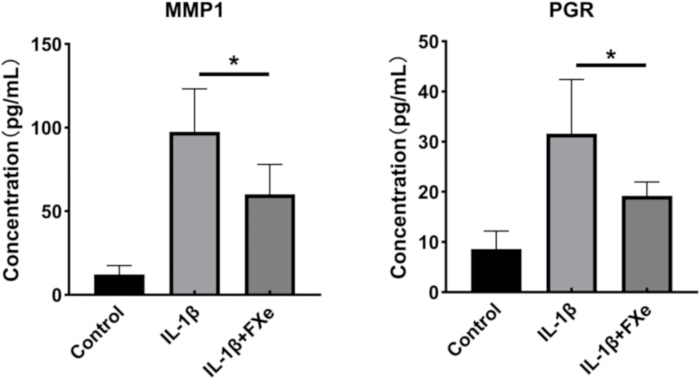
Figure 6: Fructus Xanthii extract inhibits the MMP1/PGR axis. Levels of MMP1 (left) and PGR (right) in the culture supernatant of human chondrocytes treated with Fructus Xanthii extract. Please click here to view a larger version of this figure.
| Group | Bioactive compounds |
| Phenolic acids and their derivatives | Chlorogenic acid, cryptochlorogenic acid, caffeic acid, etc. |
| Flavonoids | Quercetin, kaempferol, etc. |
| Alkaloids | Xanthatin, etc. |
| Atractyloside and its derivatives | Atractyloside and carboxyatractyloside, etc. |
| Volatile oils | Linalool, etc. |
Table 1: Principal active constituents of Fructus Xanthii extract.
| Group | Concentration (μg/mL) | Number of deaths (tail) | Mortality (%) | Phenotype |
| Normal control group | - | 0 | 0 | No obvious abnormality |
| Model control group | - | 0 | 0 | No obvious abnormality |
| Fructus Xanthii extract (technical liquid concentration, 50 mg/mL) | 125 | 0 | 0 | Similar to the model control group |
| 250 | 0 | 0 | Similar to the model control group | |
| 500 | 0 | 0 | Similar to the model control group | |
| 1000 | 0 | 0 | Similar to the model control group | |
| 2000 | 30 | 100 | - |
Table 2: Experimental results of Fructus Xanthii extract improving OA efficacy concentration (n = 30).
| Group | Concentration (μg/mL) | Cartilage fluorescence intensity (pixel, mean ± SE) | Bacterial fluorescence intensity (pixel, mean ± SE) |
| Normal control group | - | 808453 ± 27915*** | - |
| Model control group | - | 569592 ± 39064 | 615226 ± 61627 |
| Chondroitin sulfate | 1000 | 715228 ± 31867** | 592563 ± 64177 |
| Fructus Xanthii extract (technical liquid concentrate, 50 mg/ml) | 250 | 647004 ± 19292 | 621542 ± 61649 |
| 500 | 667652 ± 44877 | 630907 ± 53371 | |
| 1000 | 779844 ± 33111*** | 593817 ± 68539 | |
| Compared to the model control group, p < 0.01, *p < 0.001 | |||
Table 3: Experimental results of evaluating the efficacy of Fructus Xanthii extract on OA (n = 10). Compared to the model control group, p < 0.01, *p < 0.001.
Discussion
Loading...
$$\rightleftharpoonup{xx}$$
$$\longleftharp{xx}$$,
$$\longrightharp{xx}$$,
OA is a prevalent degenerative joint disorder and a leading cause of disability worldwide36. Its pathogenesis is complex and multifactorial, involving biochemical, cellular, and molecular changes across joint tissues. Once considered a simple "wear-and-tear" phenomenon of articular cartilage, OA is now widely recognized as a chronic, whole-joint disease characterized by cartilage degradation, synovial inflammation, osteophyte formation, and subchondral bone remodelling37,38,39. Increasing evidence highlights the central role of inflammation in OA pathophysiology, with inflammatory mediators produced by the synovium, cartilage, and subchondral bone being closely linked to cartilage breakdown40,41. Global epidemiological data estimate that approximately 595 million people were affected by OA in 2020, underscoring its substantial societal burden. Although pharmacological and surgical interventions can alleviate pain and functional impairment to some extent, they do not halt or reverse disease progression42,43,44. As progressive cartilage attrition and loss are the defining pathological features of OA, and considering the heterogeneity of chondrocytes, the sole cellular constituents of hyaline cartilage, strategies focused on mitigating and repairing cartilage damage have become a primary therapeutic target45.
In recent years, TCM has garnered increasing attention in OA research due to its multi-component and multi-target characteristics14,46. Fructus Xanthii (Cang-Er-Zi), a classical TCM, has been documented to possess anti-inflammatory, analgesic, antitumor, antimicrobial, antiviral, anti-allergic, and glucose- and lipid-lowering activities. Its extract has been shown to ameliorate RA by reducing serum inflammatory cytokines, alleviating peri-articular edema, attenuating vascular dilation and congestion, and significantly decreasing inflammatory cell infiltration. Previous studies in adjuvant-induced arthritic (AA) rats demonstrated that stir-baked Fructus Xanthii extract modulates energy metabolism, hormonal balance, amino-acid metabolism, and oxidative stress responses, thereby mitigating RA pathology17. However, the molecular mechanisms underlying the potential therapeutic effects of Fructus Xanthii extract in OA remain to be fully elucidated.
In this study, the active fractions of Fructus Xanthii were isolated, and their principal bioactive constituents were characterized, including phenolic acids and derivatives, flavonoids, alkaloids, atractylosides and their analogs, and volatile oils. An integrated in-silico workflow, combining TCMID/HERB and GEO2R analyses, identified 15 active compounds and 151 putative targets. Subsequent STRING–CytoHubba screening pinpointed the top 10 hub genes, whose GO and KEGG profiles were closely associated with inflammatory and extracellular-matrix-degradation pathways.
To date, a variety of mouse models have been extensively applied in osteoarthritis (OA) research, mainly including surgically induced models, chemically induced models, and non-invasive mechanical loading models47. Compared with other induced models, the anterior cruciate ligament transection (ACLT) model utilized in the present study exhibits multiple methodological advantages in OA research, which align with the core methodological design of this study. Specifically, the ACLT model can more significantly promote chondrocyte hypertrophy and possesses unique pathological characteristics in simulating specific types of joint instability. In studies on knee OA-related pain, this model displays typical synovial fibrosis, hyperalgesia, and increased levels of CGRP/NGF in the dorsal root ganglia at 28 days post-surgery. Its superior pathological manifestations over other models highlight its robustness and reliability, making it widely recognized as the preferred model for investigating pain mechanisms48,49,50. These features also enhance the repeatability and persuasiveness of the research findings derived from this protocol. Beyond the utilization of the ACLT model, this study also introduced a zebrafish cartilage injury model, which constitutes another key methodological innovation of the protocol. Zebrafish have been widely used in the research of cartilage development and injury mechanisms due to their high efficiency in model establishment and convenient detection51,52. Given that S. aureus has been confirmed to induce irreversible cartilage destruction in mammalian models, attempts were made to establish a zebrafish cartilage injury model induced by S. aureus in preliminary studies, which verified the feasibility and practicality of this approach: zebrafish stimulated by S. aureus showed a significant decrease in cartilage fluorescence intensity, indicating obvious cartilage damage. This methodological design not only enriches the experimental system of the protocol but also forms a complementary verification system with the ACLT model. This study combined these two models, which is a critical optimization of the traditional single-mouse-model research paradigm and closely links the key discussion point of "multi-dimensional exploration of cartilage protective effects" to the protocol’s core design of "dual-model combination". Compared with previous studies that used only mouse models, the combined application of the two models enables a more comprehensive, multi-perspective investigation of the cartilage-protective effects of Fructus Xanthii extract, thereby improving the comprehensiveness and scalability of the research protocol.
Notably, the cross-integration of multi-model validation and multi-omics profiling elucidates the consistent molecular mechanism underlying the chondroprotective effects of Fructus Xanthii extract in both in vitro and in vivo systems. The optimal therapeutic concentration of Fructus Xanthii extract (1,000 µg/mL) was screened in the S. aureus-induced zebrafish cartilage injury model, which also provided preliminary evidence for the reparative effects of the extract on cartilage damage. This concentration was subsequently validated in the mouse ACLT OA model, which shares greater structural similarity with the human skeletal system, demonstrating significant protective effects on articular cartilage and alleviating synovial hyperplasia, thus confirming the concentration-dependent efficacy and species-conserved activity of the extract. In addition, untargeted metabolomics analysis via ultra-high-performance liquid chromatography-high-resolution tandem mass spectrometry (UHPLC-HRMS/MS) identified the core bioactive components of Fructus Xanthii extract. Network pharmacology combined with RNA-seq transcriptomic data of human chondrocytes further pinpointed the MMP1/PGR axis as its key regulatory target. Subsequent protein-level validation by enzyme-linked immunosorbent assay (ELISA) closely linked the metabolic characteristics, transcriptional regulation, and functional phenotypes of the extract, forming a closed evidence chain of "component identification - target screening - mechanism verification - in vivo validation". This multidimensional integration not only verifies the reliability of the anti-OA effects of Fructus Xanthii extract but also clarifies the molecular basis for the synergistic effects of its bioactive components and the regulation of OA-associated signaling pathways, thereby providing a systematic research paradigm for the development of botanical drugs for OA intervention.
Notwithstanding the notable translational potential suggested by the present study, critical drug delivery constraints in osteoarthritis remain to be addressed, including anatomical barriers, rapid synovial clearance, short intra-articular residence, and inadequate sustained release, all of which impair therapeutic efficacy; recent advances in intra-articular formulations and nanomedicine have offered promising strategies to overcome these bottlenecks via prolonged retention, enhanced cartilage targeting, and controlled drug release, supporting the need to integrate optimized delivery systems into future development of Fructus Xanthii extract53,54,55. Meanwhile, multiple limitations of this study should be recognized: the active monomeric components underlying its anti-OA effects remain uncharacterized; systemic and intra-articular inflammation was not fully evaluated; the identified signaling pathway changes lack rigorous causal validation; comprehensive pharmacokinetic investigations on bioavailability, tissue distribution, metabolism, and joint-target effective concentrations are still warranted; protein-level validations are insufficient to establish a complete mechanistic evidence chain; and the preclinical animal models require further optimization to better recapitulate human OA pathogenesis. Future research will systematically supplement protein-level assays, compare the efficacy and safety of Fructus Xanthii extract with existing OA therapies, and investigate potential subtype- or gender-related differences in side effects associated with the MMP1/PGR regulatory axis, thereby strengthening mechanistic evidence and facilitating clinical translation.
In conclusion, this study systematically outlines the multi-target mechanism by which Fructus Xanthii extract slows OA progression. Using network pharmacology, transcriptomics, and cross-species validation models, it was shown that the extract simultaneously inhibits MMP1-mediated extracellular matrix degradation and PGR-driven inflammatory cascades, thereby preserving cartilage integrity and reducing synovial pathology. These findings not only expand the traditional anti-arthritic use of Fructus Xanthii within a modern molecular framework of OA biology but also provide a theoretical foundation for its development as a translatable, disease-modifying botanical drug candidate.
Disclosures
Loading...
$$\rightleftharpoonup{xx}$$
$$\longleftharp{xx}$$,
$$\longrightharp{xx}$$,
The authors declare no known competing financial interests or personal relationships that could have influenced the work reported in this paper.
Acknowledgements
Loading...
$$\rightleftharpoonup{xx}$$
$$\longleftharp{xx}$$,
$$\longrightharp{xx}$$,
This research was financially supported by the Shandong Province Nature Fund Surface Project Grant (No. ZR2024MH088), the Shandong Province Traditional Chinese Medicine Technology Project (No. 2020M070), and Cultivation Fund of The First Affiliated Hospital of Shandong First Medical University & Shandong Provincial Qianfoshan Hospital (Grant No. QYPY2022NSFC0601)”.
Materials
| Name | Company | Catalog Number | Comments |
|---|---|---|---|
| 4% PFA | Biosharp, China | BL539A | pH 7.4, sterile |
| C57BL/6 Mice | Vital River Laboratory Animal Technology Co.,Ltd, China | N/A | Male, 8-10 weeks old, 20-25g |
| Chondroitin sulfate | MCE, America | HY-B2162 | Purity ≥98% |
| ClusterProfiler (R Package) | Bioconductor | Free access | Integrated in R v4.2.2 |
| Collagenase, Type II, powder | Gibco, America | 17101015 | ≥125 U/mg |
| Cytoscape | Cytoscape Consortium | Free access (https://cytoscape.org/) | v3.9.1 (with CytoHubba) |
| Cytoscape | Cytoscape Consortium | Free access | Version 3.9.1 |
| DESeq2 (R Package) | Bioconductor | Free access | Integrated in R v4.2.2 |
| DMEM, high glucose | Gibco, America | 11965092 | Sterile medium |
| Ethanol | Sinopharm Chemical Reagent Co.,Ltd, China | 10009218 | Analytical grade, 95% |
| Ethyl acetate | Sinopharm Chemical Reagent Co.,Ltd, China | 10009418 | Analytical grade |
| Fetal bovine serum (FBS) | Cellmax, China | SA102.02 | Heat-inactivated |
| Fluorescence Microscope | Nikon, Japan | Eclipse Ti2-U | Equipped with GFP filter (488nm excitation) & digital camera |
| GEO Database | NCBI | https://www.ncbi.nlm.nih.gov/geo/geo2r | GEO2R analysis tool |
| GraphPad Prism | GraphPad Software, LLC, America | Commercial | Version 9.5.1 |
| Hematoxylin-Eosin(HE) Stain Kit | Solarbio, China | G1120 | Ready-to-use kit |
| HERB Database | Chinese Academy of Sciences | http://herb.ac.cn/ | V2.0 |
| Human MMP-1 ELISA Kit | Yamei Biotechnology, China | HJ088 | For human, 96-well plate |
| Human Progesterone Receptor (PR) ELISA Kit | Shanghai Enzyme-Linked Biotechnology Co., Ltd., China | ml05997 | For human, 96-well plate |
| ImageJ | National Institutes of Health (NIH) | Free access | Version 1.53t |
| Light Microscope | Olympus, Japan | BX53 | 10×/20× objectives & digital camera |
| Lyophilizer | Christ, Germany | Alpha 1-4 LDplus | Freeze-drying system |
| Modified Saffron-O And Fast Green Stain Kit | Solarbio, China | G1371 | For bone/cartilage staining |
| Neutral Balsam | Solarbio, China | G8590 | Mounting medium |
| Penicillin-Streptomycin | Gibco, America | 15070063 | 100×, sterile |
| Phosphate-buffered saline (PBS) | Sparkjade, China | CR0013-500ML | pH 7.2-7.4, sterile |
| R software | R Foundation for Statistical Computing | Free access (https://www.r-project.org/) | v4.4.1 (with ggvenn) |
| Serum-free Cell Freezing Medium | Biosharp, China | BL203B | Sterile |
| Staphylococcus aureus | American Type Culture Collection (ATCC) | ATCC 25923 | Standard strain |
| STRING Database | STRING Consortium | https://string-db.org/ | Protein interaction analysis |
| TCMID Database | Shaanxi Qinling Qiyao Collaborative Innovation Center | https://www.tcmsp-e.com/tcmspsearch.php | V3.0 |
| Tg(col2a1a:EGFP) Zebrafish | Zebrafish International Resource Center (ZIRC) | N/A | Larvae (2 dpf), AB strain |
| TRIzol Reagent | Thermo Fisher, America | 15596018CN | For total RNA extraction |
| Trypsin-EDTA (0.25%), phenol red | Gibco, America | 25200056 | Sterile solution |
| Ultra-high Performance Liquid Chromatography (UHPLC) | Thermo Fisher, America | Q Exactive Focus | Coupled with HRMS/MS |
| XCMS-online | Scripps Research Institute | Free access | Web-based platform |
Reprints and Permissions
Request permission to reuse the text or figures of this JoVE article
Request Permission