This protocol describes an approach to investigate the causal effects of chronic metabolic traits on small-vessel stroke and to assess the mediating role of depression using Mendelian randomization analysis.
Research Article
Investigating The Causal Effects of Chronic Metabolic Traits on Stroke and The Mediating Role of Depression: Evidence From Mendelian Randomization
Xiaolin Sun*1 , Xuting Chen*1 , Jia Liu*1 , Jing Bai1 , Liang Li1 , Zhongli Wa1 , Ming Zeng1 , Jianming Fu1 , Yunhai Yao1 , Fang Shen1 , Meihong Zhu1 , Ming Lu2
Opens in a new tab
In This Article
Summary
Loading...
$$\rightleftharpoonup{xx}$$
$$\longleftharp{xx}$$,
$$\longrightharp{xx}$$,
Abstract
Loading...
$$\rightleftharpoonup{xx}$$
$$\longleftharp{xx}$$,
$$\longrightharp{xx}$$,
Chronic metabolic traits such as body mass index (BMI), obesity, and type 2 diabetes (T2D) are known risk factors for cerebrovascular diseases. Depression, often comorbid with metabolic disorders, may mediate these associations. A two-sample Mendelian randomization (MR) analysis was conducted to examine the causal effects of genetically predicted BMI, obesity, and T2D on small-vessel stroke (SVS) and major depressive disorder (MDD). The relationship between depression and SVS was further assessed, and a two-step MR mediation analysis was applied to explore whether depression mediates the associations between chronic metabolic traits and SVS risk. Higher BMI, obesity, and T2D were significantly associated with increased risk of SVS (BMI: OR = 1.25, p = 1.27 × 10⁻³; Obesity: OR = 1.09, p = 0.032; T2D: OR = 1.17, p = 1.14 × 10⁻⁷). All three traits also elevated risk of MDD (BMI: OR = 1.20, p = 3.31 × 10⁻¹⁰; Obesity: OR = 1.06, p = 0.006; T2D: OR = 1.03, p = 0.035). MDD, in turn, increased the risk of SVS (OR = 1.11, p = 0.035). Mediation analyses indicated that depression showed a potential partial mediating effect on the BMI–SVS association (indirect effect = 0.019, p = 0.046), while mediation via obesity or T2D was non-significant. These results highlight the importance of addressing comorbid depression in individuals with metabolic disorders to reduce cerebrovascular risk.
Introduction
Loading...
$$\rightleftharpoonup{xx}$$
$$\longleftharp{xx}$$,
$$\longrightharp{xx}$$,
Stroke is one of the leading causes of mortality and disability worldwide, with an estimated 12 million new cases annually and more than 100 million people living with its long-term consequences1,2. With the aging global population and the increasing prevalence of lifestyle-related conditions, the burden of stroke is expected to rise further, leading to substantial health and socioeconomic impacts1,2. In addition to well-established risk factors such as hypertension, diabetes, dyslipidemia, smoking, and obesity, emerging evidence has suggested that psychiatric disorders, particularly major depressive disorder (MDD), may also contribute to stroke risk3,4,5. However, the complex interplay between metabolic diseases, depression, and stroke remains poorly understood.
Mendelian randomization (MR) uses genetic variants as instrumental variables (IVs) to reduce confounding and reverse causation, thereby providing a more robust framework for causal inference compared with conventional observational studies6. Unlike observational designs, which are susceptible to residual confounding, measurement error, and reverse causality, MR leverages the random allocation of genetic variants at conception to approximate a natural experiment. In addition, compared with other causal inference approaches such as regression-based mediation models, MR offers greater robustness to unmeasured confounding, particularly when investigating complex, interrelated traits. Large-scale genome-wide association studies (GWAS) have enabled the application of two-sample MR to investigate causal links between complex traits and diseases at the genetic level. Previous MR studies have demonstrated causal effects of metabolic diseases—such as body mass index (BMI), obesity, and type 2 diabetes (T2D)—on stroke7,8,9. Likewise, genetic evidence supports a bidirectional relationship between depression and stroke10. Yet, whether depression mediates the effect of metabolic diseases on stroke has not been systematically assessed.
Several potential biological mechanisms support a mediating role of depression. Chronic metabolic disorders are known to promote systemic inflammation, endothelial dysfunction and dysregulation of the hypothalamic–pituitary–adrenal axis, which may increase vulnerability to depression11. In turn, depression is associated with behavioral risk factors (e.g., smoking, physical inactivity, poor diet), autonomic imbalance, platelet hyperactivity, and increased cortisol secretion, all of which may elevate stroke risk12,13. Observational studies have attempted to address these pathways, but findings remain inconsistent due to confounding, short follow-up, and measurement error14. Consequently, the causal nature of the metabolic disease–depression–stroke pathway remains unclear. Although MR can strengthen causal inference, it cannot fully elucidate detailed biological mechanisms or directly inform clinical interventions, and its validity depends on key assumptions such as the absence of horizontal pleiotropy.
In this study, two hypotheses were investigated using univariable, multivariable, and two-step two-sample MR analyses. First, the causal associations between metabolic traits (BMI, obesity, and T2D) and the risk of small-vessel stroke (SVS) were examined. Second, the potential mediating role of depression in these associations was assessed, and the proportion mediated was quantified. This analytical framework is particularly suitable for disentangling mediation effects among correlated metabolic and psychiatric traits, as it decomposes total effects into direct and indirect components while minimizing confounding. By leveraging large-scale GWAS summary statistics, this study provides novel genetic evidence to clarify the interplay between metabolic disorders, depression, and SVS. These findings may help to identify biological pathways underlying stroke risk and inform integrated prevention strategies targeting both metabolic health and mental health.
Protocol
Loading...
$$\rightleftharpoonup{xx}$$
$$\longleftharp{xx}$$,
$$\longrightharp{xx}$$,
Univariable, multivariable, and two-step two-sample MR mediation analyses were conducted to investigate whether genetically predicted chronic metabolic diseases were causally associated with SVS risk and to assess the proportion of mediation by MDD. The flow chart of MR analyses in this study is shown in Figure 1. Detailed characteristics of all GWAS datasets used in this study are summarized in Supplementary Table 1. GWAS summary statistics were obtained from a publicly available database (IEU OpenGWAS: https://gwas.mrcieu.ac.uk/) using a Mendelian randomization analysis software platform (see Table of Materials) via the extract_instruments() and extract_outcome_data() functions. Exposures included BMI15 (ebi-a-GCST90013974), obesity16 (ieu-a-90), and type 2 diabetes (T2D; ebi-a-GCST006867). The mediator was major depressive disorder (MDD; ieu-a-1188)18, and the outcome was SVS (ebi-a-GCST006909). All GWAS datasets included individuals of predominantly European ancestry to minimize population stratification bias.
GWAS data of chronic metabolic traits
Chronic metabolic diseases were examined as exposures, including BMI, obesity, and type 2 diabetes. GWAS summary statistics for BMI15 (ebi-a-GCST90013974) and obesity16 (ieu-a-90) were obtained from the MRC-IEU and GIANT consortium (European ancestry, up to 407,609 individuals for BMI and 32,858 cases/65,839 controls for obesity). Type 2 diabetes17 data (ebi-a-GCST006867) were derived from the DIAGRAM consortium (European ancestry, 62,892 cases/596,424 controls). These GWAS datasets are publicly available and primarily based on the UK Biobank and other large-scale cohorts.
GWAS data for depression
For the outcome of depression, the latest GWAS summary statistics from the Psychiatric Genomics Consortium (PGC) (ieu-a-1188)18 were used, including 59,851 cases and 113,154 controls of European ancestry. MDD diagnosis in the included cohorts was based on structured clinical interviews or validated self-reports according to DSM-III/IV or ICD-9/10 diagnostic criteria. Individuals with a history of bipolar disorder or schizophrenia were excluded.
GWAS data for SVS
Summary statistics for stroke were obtained from the MRC-IEU consortium (ebi-a-GCST006909)19, which included up to 5,386 cases and 192,662 controls of predominantly European ancestry. SVS was defined based on physician diagnosis and/or clinical records. This dataset has been widely used in MR studies investigating vascular risk factors and is publicly available.
Statistical analysis
All analyses were conducted in R (version 4.1.2) using a Mendelian randomization analysis software platform (see Table of Materials). Two-sample MR was conducted using single-nucleotide polymorphisms (SNPs) as instrumental variables (IVs), which must satisfy three core assumptions: relevance (associated with the exposure), independence (not associated with confounders), and exclusion restriction (affecting the outcome only through the exposure)20,21,22. SNPs were selected based on genome-wide significance (p < 5 × 10⁻⁵), linkage disequilibrium pruning (r2 < 0.001 within a 10,000 kB window), and F-statistics >10 to avoid weak instrument bias20,22. LD clumping was performed using the European reference panel from the 1000 Genomes Project23. Palindromic and ambiguous SNPs were excluded during both data extraction and harmonization procedures. During outcome data extraction via the extract_outcome_data() function, palindromic SNPs were initially retained using standard extraction functions, and allele frequency information was used to infer strand alignment when possible. SNPs with minor allele frequency (MAF) below a predefined threshold (e.g., MAF < 0.3) were retained, as strand orientation could be reliably inferred, whereas those with intermediate allele frequencies were considered ambiguous. During the harmonization step through the harmonise_data() function, palindromic SNPs with ambiguous strand orientation—particularly those with intermediate allele frequencies—were excluded to ensure consistent alignment of effect alleles across exposure, mediator, and outcome datasets. SNP harmonization was conducted via the harmonise_data() function to align effect alleles across datasets. During this process, allele strands were aligned to ensure consistency, and SNPs with incompatible alleles or strand ambiguity were excluded. After filtering, approximately 600–800 SNPs for BMI, 70–90 SNPs for obesity, and 326 SNPs for T2D were retained for downstream analyses (see Table 1 and Table 2).
For univariable MR, the primary method used was inverse-variance weighted(IVW), which estimates the causal effect by combining SNP-specific ratio estimates using inverse-variance weighting under the assumption of no horizontal pleiotropy20. Pleiotropy was assessed using the MR-Egger intercept test implemented via the mr_pleiotropy() function, with P < 0.05 indicating potential horizontal pleiotropy. Heterogeneity was evaluated using Cochran’s Q test, implemented through the mr_heterogeneity() function. If heterogeneity was detected (P < 0.05), a random-effects IVW model was applied; otherwise, a fixed-effects IVW model was used. For multivariable MR analyses, SNPs were combined across exposures and mediators. Effect alleles were harmonized using the harmonise_data() function across exposure, mediator, and outcome datasets, and multivariable IVW analysis was performed as the primary method.
To account for multiple comparisons, false discovery rate (FDR) correction was applied using the Benjamini–Hochberg method via the p.adjust() function in R across the main Mendelian randomization analyses. Specifically, adjustment was performed for the total number of primary causal tests, including the effects of metabolic traits on SVS (n = 3), metabolic traits on depression (n = 3), and depression on SVS (n = 1), resulting in a total of seven tests. Adjusted P-values (FDR q-values) were calculated, and statistical significance was interpreted considering both nominal P-values and FDR-corrected values. Results that remained significant after FDR correction were considered robust, while those with nominal significance only were interpreted cautiously.
Mediation analysis
For mediation analyses, a two-step MR framework was applied to estimate the indirect effects of chronic metabolic traits on SVS through depression. This framework was implemented by performing two sequential MR analyses using GWAS summary statistics. In this framework, E denotes the exposure (BMI, obesity, or T2D), M denotes the mediator (depression), and Y denotes the outcome (SVS). First, the causal effect of each chronic metabolic trait (BMI, obesity, and T2D) on mediator (β (E M)) was estimated. Second, the causal effect of mediator on outcome (β (MY)) was evaluated. The indirect effect (mediation effect) was calculated by multiplying these two estimates:

and the proportion mediated was derived by dividing the indirect effect by the total effect
(Proportion mediated =  ).
).
The standard error (SE) of the indirect effect was estimated using the delta method, assuming independence between the two effect estimates:
SE indirect = 
Results
Loading...
$$\rightleftharpoonup{xx}$$
$$\longleftharp{xx}$$,
$$\longrightharp{xx}$$,
Causal effects of chronic metabolic traits on SVS
In the univariable MR analyses, genetically predicted higher BMI, obesity, and T2D were all positively associated with an increased risk of SVS. The associations were consistent across sensitivity analyses, with no evidence of substantial horizontal pleiotropy from the MR-Egger intercept test. Genetically predicted higher BMI was significantly associated with an increased risk of SVS, showing 25.0% higher odds (OR = 1.250, 95% CI: 1.091–1.431, p = 1.27 × 10⁻³). Similarly, genetically predicted obesity was positively associated with SVS risk. Specifically, each SD increase in genetic liability to obesity corresponded to 9.2% higher odds of SVS (OR = 1.092, 95% CI: 1.007–1.184, p = 3.23 × 10⁻²). For T2D, robust evidence was observed, with genetically predicted liability to T2D being strongly associated with SVS. The effect estimate indicated 16.6% higher odds of SVS (OR = 1.166, 95% CI: 1.102–1.235, p = 1.14 × 10⁻⁷) (Table 1).
Causal effects of chronic metabolic traits on depression
The causal impact of chronic metabolic traits on the risk of MDD were evaluated using IVW method. Genetically predicted higher BMI was strongly and consistently associated with increased risk of depression, each genetically predicted 1-SD increase corresponded to 19.9% higher odds of MDD (OR = 1.199, 95% CI: 1.133–1.269, p = 3.31 × 10⁻¹⁰). Similarly, genetic liability to obesity was significantly associated with a higher risk of depression. Specifically, per SD increase in obesity liability was linked to 5.8% higher odds of MDD (OR = 1.058, 95% CI: 1.016–1.102, p = 6.41 × 10⁻³). For T2D, a modest but statistically significant causal effect was also observed. Genetically predicted liability to T2D was associated with 2.6% higher odds of MDD (OR = 1.026, 95% CI: 1.002–1.050, p = 3.46 × 10⁻²) (Table 2).
Causal effects of depression on SVS
The potential causal role of depression in the development of ischemic stroke, with a particular focus on the small-vessel subtype, was further investigated using IVW Mendelian randomization. Genetically predicted liability to MDD was significantly associated with an elevated risk of SVS. Specifically, a per-unit increase in genetically determined risk of MDD conferred 11.0% higher odds of SVS (OR = 1.110, 95% CI: 1.007–1.224, p = 3.52 × 10⁻², adjusted p = 3.52 × 10⁻²) (Figure 2).
Mediation analyses
To further clarify whether depression mediates the causal pathways from chronic metabolic traits to SVS, two-step Mendelian randomization-based mediation analyses were conducted. For BMI, genetically predicted higher BMI was found to exert a significant indirect effect on SVS risk through MDD. Specifically, the estimated mediation effect was 0.019 (SE = 0.0095), with a Z value of 1.99 (p = 0.046), and a 95% CI ranging from 0.0003 to 0.0375. This indicates that part of the BMI-related increase in SVS risk may be explained by its causal impact on depression, which in turn predisposes to SVS. In contrast, the mediation effect of obesity (binary phenotype) on SVS through depression was weaker and did not reach statistical significance (indirect effect = 0.0059, SE = 0.0034, Z = 1.74, p = 0.081, 95% CI: -0.00075 to 0.01261). Similarly, T2D demonstrated a positive but non-significant mediation effect via depression (indirect effect = 0.0027, SE = 0.0019, Z = 1.37, p = 0.17, 95% CI: -0.0011 to 0.0064). The overall mediation framework and estimated causal pathways are illustrated in Figure 2.
Sensitivity analyses
Results were robust in leave-one-out analyses, with no single SNP driving the observed associations. MR-PRESSO detected no significant outliers, and F-statistics for the genetic instruments exceeded the conventional threshold (>10), indicating that weak instrument bias was unlikely.
Additional analysis accounting for multiple testing
To account for multiple comparisons, false discovery rate (FDR) correction was applied to the primary MR analyses (Table 1-2). After FDR correction, the associations of BMI with SVS and depression, and T2D with SVS, remained statistically significant. In addition, the association between obesity and depression also remained significant. In contrast, several associations with nominal significance, including obesity on SVS, T2D on depression, and depression on SVS, were no longer statistically significant after FDR correction. These results suggest that while the main findings are robust, some secondary associations should be interpreted with caution.
DATA AVAILABILITY:
The datasets used in this study are publicly available GWAS summary statistics obtained from the IEU OpenGWAS database (https://gwas.mrcieu.ac.uk/). The data were used as provided, and no new raw datasets were generated. SNP selection and data extraction were performed as part of the analytical procedures described in the protocol.
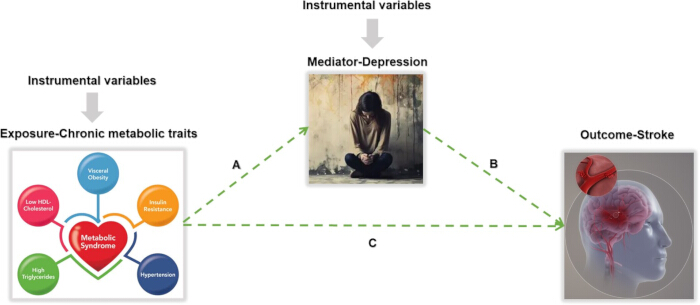
Figure 1: The flow chart of MR analyses in this study. This figure illustrates the overall study framework, which evaluates the causal effects of chronic metabolic traits (exposures) on the risk of small-vessel stroke (SVS) (outcomes) and the mediating role of depression using a two-sample Mendelian randomization approach. (A) The causal effect of chronic metabolic traits on depression. (B) The causal effect of depression on SVS. (C) The total causal effect of chronic metabolic traits on SVS can be decomposed into direct and indirect (mediated) effects. Please click here to view a larger version of this figure.
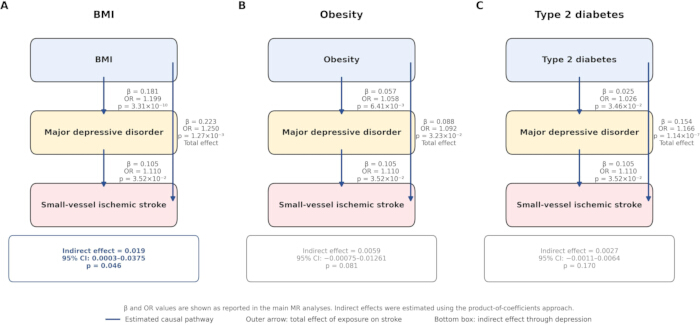
Figure 2: Mendelian randomization mediation analysis of the pathways linking metabolic traits, depression, and small-vessel stroke. (A–C) BMI, obesity, and T2D. Arrows indicate causal effects, with outer arrows representing total effects and vertical arrows indicating indirect effects through depression. Effect sizes (β), ORs, and P-values are displayed. BMI shows a significant mediation effect, whereas obesity and T2D do not. Please click here to view a larger version of this figure.
| Exposures | Outcomes | No. of SNPs | OR (95% CI) | P | FDR P | Heterogeneity test | Pleiotropy test | |
| Cochran's Q | P | PIntercept | ||||||
| BMI (id: ebi-a-GCST90013974) | Small-vessel stroke (id: ebi-a-GCST006909) | 696 | 1.250 (1.091–1.431) | 1.27 × 10⁻³ | 2.96 × 10⁻³ | 775.13 | 0.018 | 0.58 |
| Obesity (id: ieu-a-90) | Small-vessel stroke (id: ebi-a-GCST006909) | 90 | 1.092 (1.007–1.184) | 3.23 × 10⁻² | 3.52 × 10⁻² | 117.1 | 0.025 | 0.1 |
| T2D (id: ebi-a-GCST006867) | Small-vessel stroke (id: ebi-a-GCST006909) | 326 | 1.166 (1.102–1.235) | 1.14 × 10⁻⁷ | 3.99 × 10⁻⁷ | 361.6 | 0.079 | 0.8 |
Table 1: The main MR analysis results of the causal effects of chronic metabolic traits on small-vessel stroke. *The results of IVW with random effect; SNPs, single nucleotide polymorphisms; OR, odd ratio; CI, confidence interval; IVW, inverse variance weighted; FDR, false discovery rate
| Parameter | Pre-operative (Mean ± SD) | Post-operative (Mean ± SD) | P-value |
| Hemoglobin (Hb, g/L) | 133.8 ± 11.0 | 133.8 ± 11.0 | >0.99 |
| Platelet Count (PLT, × 109/L) | 244.5 ± 52.4 | 234.2 ± 45.1 | 0.001 |
| Prothrombin Time (PT, s) | 11.7 ± 1.7 | 11.5 ± 1.5 | 0.237 |
| Activated Partial Thromboplastin Time (APTT, s) | 31.9 ± 3.8 | 32.2 ± 3.6 | 0.348 |
Table 2: The main MR analysis results of the causal effects of chronic metabolic traits on depression. *The results of IVW with random effect; SNPs, single nucleotide polymorphisms; OR, odd ratio; CI, confidence interval; IVW, inverse variance weighted; FDR, false discovery rate
Supplementary Table 1: Basic characteristics of GWAS datasets used in this study. Please click here to download this file.
Discussion
Loading...
$$\rightleftharpoonup{xx}$$
$$\longleftharp{xx}$$,
$$\longrightharp{xx}$$,
In this MR study, the causal associations between major chronic metabolic traits (BMI, obesity, and T2D), depression, and SVS were systematically investigated. The study highlights three key findings. First, genetically predicted higher BMI, obesity, and T2D were causally associated with an increased risk of SVS. Second, these metabolic traits were also associated with an elevated risk of depression, while depression itself showed a causal relationship with SVS. Third, mediation analyses suggested that depression partly mediated the effect of metabolic traits on SVS, with the proportion mediated varying across different exposures. The validity of these findings depends on several critical methodological steps. In particular, selecting strong and independent genetic instruments, rigorously controlling for horizontal pleiotropy, and accurately harmonizing xposure, mediator, and outcome datasets are essential for ensuring reliable causal inference in MR analyses. Failure to meet these conditions may lead to biased estimates and incorrect interpretation of causal relationships.
The present findings are consistent with previous observational studies reporting strong associations between metabolic dysregulation and stroke24,25,26,27. Prior cohort studies have shown that obesity and T2D accelerate cerebrovascular aging through pathways involving insulin resistance, endothelial dysfunction, and systemic inflammation28,29,30. However, most of these studies could not exclude reverse causality or residual confounding. By leveraging genetic instruments, the MR design strengthens the causal inference. The observed associations between metabolic traits and depression are also supported by prior evidence31,32,33. Clinical and epidemiological studies suggest that obesity and T2D contribute to depression through mechanisms involving chronic inflammation, hypothalamic–pituitary–adrenal axis dysregulation, and impaired neuroplasticity32,34. Conversely, depression itself has been identified as a risk factor for SVS, potentially via adverse health behaviors, increased platelet aggregation, and neuroendocrine dysfunction3. The present results confirm these links at the genetic level. Compared with conventional observational and regression-based mediation analyses, the MR framework offers important advantages by reducing confounding and reverse causation, particularly when investigating complex, interrelated traits. Furthermore, MR-based mediation allows decomposition of total effects into direct and indirect components at the genetic level, offering a more robust approach for disentangling causal pathways.
The mediation analysis suggested that depression may partially mediate the association between BMI and SVS. However, this effect was modest and borderline statistically significant. In contrast, no significant mediation effects were observed for obesity or T2D. Therefore, the mediating role of depression appears to be specific to BMI in this analysis and should be interpreted with caution. Notably, the mediation effect for BMI did not remain robust after correction for multiple testing and should therefore be considered suggestive rather than definitive. The partial mediating role of depression suggests that metabolic traits may increase SVS risk not only through classical vascular pathways (e.g., atherosclerosis, hypertension-induced vascular damage, glucose toxicity) but also via psychological pathways. Chronic metabolic disturbances may predispose individuals to depression, which in turn accelerates cerebrovascular pathology through stress-related neuroendocrine activation, systemic inflammation, and behavioral risk factors such as physical inactivity, poor diet, and smoking35,36,37,38. This highlights the complex interplay between somatic and psychological health in cerebrovascular disease. Several practical considerations should be taken into account when interpreting these findings. Weak instrument bias may arise if SNPs are not strongly associated with the exposure, although this was minimized by applying F-statistic thresholds. Horizontal pleiotropy may influence causal estimates, particularly when genetic variants are associated with behavioral or environmental factors. In addition, inconsistent results across MR methods may indicate potential violations of MR assumptions and should be carefully examined. Finally, borderline mediation effects, such as those observed for BMI, require cautious interpretation and independent validation in future studies.
Importantly, the mediation findings were not consistent across all metabolic traits. In this study, depression showed evidence of a modest indirect effect only for BMI, whereas no significant mediation effects were observed for obesity or T2D. This difference may reflect important biological and methodological distinctions among these traits. BMI is a continuous measure that captures variation across the full spectrum of adiposity and may therefore be more sensitive to detecting psychosocial and behavioral pathways linked to depression. In contrast, obesity was analyzed as a binary phenotype, which may not adequately reflect gradations in metabolic burden or psychological vulnerability. For T2D, the relationship with SVS is likely dominated by direct biological mechanisms, including chronic hyperglycemia, endothelial dysfunction, inflammation, and microvascular injury, which may reduce the relative contribution of depression-mediated pathways. The analytical framework applied in this study largely followed standard MR and two-step mediation approaches, with predefined instrument selection criteria and established statistical thresholds for pleiotropy and heterogeneity testing. No major methodological modifications beyond these standard procedures were implemented, ensuring comparability with existing MR studies.
The potential clinical significance of depression as a mediator should also be interpreted carefully. These findings provide genetic evidence supporting a possible indirect pathway between BMI and SVS through depression, but this does not necessarily imply that treatment of depression alone would proportionally reduce SVS risk in clinical settings. Mendelian randomization identifies potential causal pathways at the population-genetic level, whereas intervention effects depend on timing, treatment response, disease severity, and other environmental or behavioral factors6,39,40. Therefore, the results should be viewed as highlighting depression as a potentially relevant component of the metabolic–cerebrovascular pathway, rather than as direct evidence for a specific intervention strategy. Future longitudinal and interventional studies are needed to determine whether integrating mental health management into metabolic risk reduction can meaningfully lower stroke risk.
The absence of significant mediation effects for obesity and T2D may be explained by several factors. First, obesity was modeled as a binary trait, which may not fully capture the continuous variation in adiposity compared with BMI, potentially reducing sensitivity to detect mediation effects. Second, the impact of T2D on stroke is likely dominated by direct biological mechanisms, including chronic hyperglycemia, endothelial dysfunction, and microvascular damage, which may overshadow indirect pathways through depression. Third, although obesity and T2D were associated with increased risk of depression, the effect sizes were relatively modest, which may limit statistical power to detect significant mediation effects. These findings suggest that the metabolic–stroke relationship may operate through heterogeneous pathways depending on the specific metabolic trait. This highlights the importance of distinguishing between different metabolic phenotypes when investigating psychological mediation pathways.
The major strengths of this study include the MR design, which minimizes bias from confounding and reverse causality; the use of large-scale GWAS datasets with high statistical power; and the application of a two-step MR mediation analysis to quantify indirect effects. Several limitations should be acknowledged. First, the current analyses were restricted to populations of predominantly European ancestry, limiting generalizability to other ethnic groups. Second, although MR is less prone to confounding, horizontal pleiotropy cannot be fully excluded. MR requires that the selected genetic instruments affect the outcome only through the exposure of interest rather than through alternative pathways. Although this design reduces confounding compared with conventional observational studies, some genetic variants associated with BMI, obesity, T2D, or depression may also be linked to broader behavioral or environmental factors, such as physical activity, diet, smoking, or socioeconomic status. These factors could introduce horizontal pleiotropy if they independently influence both metabolic traits and SVS risk or depression. While the sensitivity analyses, including MR-Egger intercept tests, MR-PRESSO, heterogeneity analyses, and leave-one-out analyses, did not indicate substantial directional pleiotropy, such approaches cannot completely rule out violations of MR assumptions. Therefore, the observed causal estimates should be interpreted cautiously, particularly for associations with modest effect sizes or borderline statistical significance. In this context, the results are best interpreted as evidence supporting a likely causal contribution of metabolic traits to SVS and depression, rather than as proof that these relationships are entirely independent of behavioral or social pathways. Third, depression is a heterogeneous phenotype, and its genetic architecture may not fully capture clinical subtypes such as treatment-resistant or late-life depression. Stroke is a broad outcome; future studies should explore other subtypes (ischemic vs. hemorrhagic) separately. Finally, given the number of statistical tests performed, the risk of false-positive findings cannot be ruled out. After applying FDR correction, the primary associations—particularly those involving BMI and T2D—remained robust. However, several associations with borderline statistical significance, including the effects of obesity on SVS, T2D on depression, depression on SVS, and the mediation effect of BMI through depression, were attenuated and should therefore be interpreted as suggestive rather than definitive. Further studies are warranted to validate these findings.
From a practical perspective, this analytical framework is highly reproducible and scalable, as it relies on publicly available GWAS summary statistics and standardized analytical pipelines. Moreover, this approach can be readily extended to investigate other exposure–mediator–outcome relationships, making it broadly applicable in genetic epidemiology. These findings suggest that integrated management of metabolic health and mental health may be essential for effective SVS prevention. Screening for depression in patients with obesity or T2D could help identify high-risk individuals, while interventions targeting both metabolic and psychological factors may provide synergistic benefits. In conclusion, this MR study provides robust evidence that BMI, obesity, and T2D increase SVS risk, with depression acting as a partial mediator in these associations. These findings underscore the importance of addressing both metabolic and psychological health in strategies aimed at reducing the burden of stroke.
Disclosures
Loading...
$$\rightleftharpoonup{xx}$$
$$\longleftharp{xx}$$,
$$\longrightharp{xx}$$,
The authors declare that they have no competing interests.
Acknowledgements
Loading...
$$\rightleftharpoonup{xx}$$
$$\longleftharp{xx}$$,
$$\longrightharp{xx}$$,
This work was supported by the Science and Technology Program of Jiaxing (2023AD11020, 2023AD11019, 2022AY30029, 2023AD31033) and the Medical and Health Science and Technology Program of Zhejiang (2024KY1689).
Materials
| Name | Company | Catalog Number | Comments |
|---|---|---|---|
| R software (version 4.1.2) | The R Foundation | https://www.r-project.org/ | Statistical computing environment |
| TwoSampleMR package (version 0.6.22) | IEU OpenGWAS | https://mrcieu.github.io/TwoSampleMR/index.html | Mendelian randomization analysis software platform |
References
Loading...
$$\rightleftharpoonup{xx}$$
$$\longleftharp{xx}$$,
$$\longrightharp{xx}$$,
- GBD 2021 Stroke Risk Factor Collaborators. Global, regional, and national burden of stroke and its risk factors, 1990-2021: A systematic analysis for the global burden of disease study 2021. Lancet Neurol. 23 (10), 973-1003 (2024).
- Wang, C. H., Xin, Z. K. Causal association between 25-hydroxyvitamin d status and cataract development: A two-sample mendelian randomization study. World J Clin Cases. 12 (16), 2789-2795 (2024).
- Cai, H., et al. Major depression and small vessel stroke: A mendelian randomization analysis. J Neurol. 266 (11), 2859-2866 (2019).
- Harshfield, E. L., et al. Association between depressive symptoms and incident cardiovascular diseases. JAMA. 324 (23), 2396-2405 (2020).
- Penninx, B. W., Milaneschi, Y., Lamers, F., Vogelzangs, N. Understanding the somatic consequences of depression: Biological mechanisms and the role of depression symptom profile. BMC Med. 11, 129(2013).
- Davey Smith, G., Hemani, G. Mendelian randomization: Genetic anchors for causal inference in epidemiological studies. Hum Mol Genet. 23 (R1), R89-R98 (2014).
- Georgakis, M. K., et al. Diabetes mellitus, glycemic traits, and cerebrovascular disease: A mendelian randomization study. Neurology. 96 (13), e1732-e1742 (2021).
- Larsson, S. C., Bäck, M., Rees, J. M. B., Mason, A. M., Burgess, S. Body mass index and body composition in relation to 14 cardiovascular conditions in uk biobank: A mendelian randomization study. Eur Heart J. 41 (2), 221-226 (2020).
- Marini, S., et al. Mendelian randomization study of obesity and cerebrovascular disease. Ann Neurol. 87 (4), 516-524 (2020).
- Li, G. H., et al. Evaluation of bi-directional causal association between depression and cardiovascular diseases: A mendelian randomization study. Psychol Med. 52 (9), 1765-1776 (2022).
- Calagua-Bedoya, E. A., Rajasekaran, V., De Witte, L., Perez-Rodriguez, M. M. The role of inflammation in depression and beyond: A primer for clinicians. Curr Psychiatry Rep. 26 (10), 514-529 (2024).
- Hare, D. L., Toukhsati, S. R., Johansson, P., Jaarsma, T. Depression and cardiovascular disease: A clinical review. Eur Heart J. 35 (21), 1365-1372 (2014).
- Krittanawong, C., et al. Association of depression and cardiovascular disease. Am J Med. 136 (9), 881-895 (2023).
- Osborne, M. T., et al. Disentangling the links between psychosocial stress and cardiovascular disease. Circ Cardiovasc Imaging. 13 (8), e010931(2020).
- Mbatchou, J., et al. Computationally efficient whole-genome regression for quantitative and binary traits. Nat Genet. 53 (7), 1097-1103 (2021).
- Berndt, S. I., et al. Genome-wide meta-analysis identifies 11 new loci for anthropometric traits and provides insights into genetic architecture. Nat Genet. 45 (5), 501-512 (2013).
- Xue, A., et al. Genome-wide association analyses identify 143 risk variants and putative regulatory mechanisms for type 2 diabetes. Nat Commun. 9 (1), 2941(2018).
- Wray, N. R., et al. Genome-wide association analyses identify 44 risk variants and refine the genetic architecture of major depression. Nat Genet. 50 (5), 668-681 (2018).
- Malik, R., et al. Multiancestry genome-wide association study of 520,000 subjects identifies 32 loci associated with stroke and stroke subtypes. Nat Genet. 50 (4), 524-537 (2018).
- Burgess, S., Butterworth, A., Thompson, S. G. Mendelian randomization analysis with multiple genetic variants using summarized data. Genet Epidemiol. 37 (7), 658-665 (2013).
- Lawlor, D. A., Harbord, R. M., Sterne, J. A., Timpson, N., Davey Smith, G. Mendelian randomization: Using genes as instruments for making causal inferences in epidemiology. Stat Med. 27 (8), 1133-1163 (2008).
- Pierce, B. L., Ahsan, H., Vanderweele, T. J. Power and instrument strength requirements for mendelian randomization studies using multiple genetic variants. Int J Epidemiol. 40 (3), 740-752 (2011).
- Auton, A., et al. A global reference for human genetic variation. Nature. 526 (7571), 68-74 (2015).
- Bradley, S. A., et al. Role of diabetes in stroke: Recent advances in pathophysiology and clinical management. Diabetes Metab Res Rev. 38 (2), e3495(2022).
- Lau, L. H., Lew, J., Borschmann, K., Thijs, V., Ekinci, E. I. Prevalence of diabetes and its effects on stroke outcomes: A meta-analysis and literature review. J Diabetes Investig. 10 (3), 780-792 (2019).
- Lee, S. H., Jung, J. M., Park, M. H. Obesity paradox and stroke outcomes according to stroke subtype: A propensity score-matched analysis. Int J Obes (Lond). 47 (8), 669-676 (2023).
- Ye, J., et al. Association between the weight-adjusted waist index and stroke: A cross-sectional study. BMC Public Health. 23 (1), 1689(2023).
- Chehaibi, K., Hrira, M. Y., Trabelsi, I., Escolà-Gil, J. C., Slimane, M. N. Gene variant and level of il-1β in ischemic stroke patients with and without type 2 diabetes mellitus. J Mol Neurosci. 57 (3), 404-409 (2015).
- Chen, R., Yan, J., Liu, P., Wang, Z., Wang, C. Plasminogen activator inhibitor links obesity and thrombotic cerebrovascular diseases: The roles of pai-1 and obesity on stroke. Metab Brain Dis. 32 (3), 667-673 (2017).
- Letra, L., Sena, C. Cerebrovascular disease: Consequences of obesity-induced endothelial dysfunction. Adv Neurobiol. 19, 163-189 (2017).
- Campayo, A., Gómez-Biel, C. H., Lobo, A. Diabetes and depression. Curr Psychiatry Rep. 13 (1), 26-30 (2011).
- Milaneschi, Y., Simmons, W. K., Van Rossum, E. F. C., Penninx, B. W. Depression and obesity: Evidence of shared biological mechanisms. Mol Psychiatry. 24 (1), 18-33 (2019).
- Roy, T., Lloyd, C. E. Epidemiology of depression and diabetes: A systematic review. J Affect Disord. 142, S8-S21 (2012).
- Li, P., et al. Pramipexole improves depression-like behavior in diabetes mellitus with depression rats by inhibiting nlrp3 inflammasome-mediated neuroinflammation and preventing impaired neuroplasticity. J Affect Disord. 356, 586-596 (2024).
- Miller, A. H., Raison, C. L. The role of inflammation in depression: From evolutionary imperative to modern treatment target. Nat Rev Immunol. 16 (1), 22-34 (2016).
- Pan, A., Sun, Q., Okereke, O. I., Rexrode, K. M., Hu, F. B. Depression and risk of stroke morbidity and mortality: A meta-analysis and systematic review. JAMA. 306 (11), 1241-1249 (2011).
- Penninx, B. W. Depression and cardiovascular disease: Epidemiological evidence on their linking mechanisms. Neurosci Biobehav Rev. 74 (Pt B), 277-286 (2017).
- Whooley, M. A., Wong, J. M. Depression and cardiovascular disorders. Annu Rev Clin Psychol. 9, 327-354 (2013).
- Burgess, S., Scott, R. A., Timpson, N. J., Davey Smith, G., Thompson, S. G. Using published data in mendelian randomization: A blueprint for efficient identification of causal risk factors. Eur J Epidemiol. 30 (7), 543-552 (2015).
- Holmes, M. V., Ala-Korpela, M., Smith, G. D. Mendelian randomization in cardiometabolic disease: Challenges in evaluating causality. Nat Rev Cardiol. 14 (10), 577-590 (2017).
Reprints and Permissions
Request permission to reuse the text or figures of this JoVE article
Request Permission