This protocol demonstrates how dried recombinant antibody panels streamline Chimeric Antigen Receptor T (CAR T) cell characterization by reducing variability and simplifying workflows. It enables reproducible assessment of critical quality attributes, including absolute quantification of Chimeric Antigen Receptor T cells, and is compatible across different flow cytometry platforms.
Method Article
Standardized Flow Cytometry Assay Using Dried Recombinant Antibody Panels for CAR T Cell Characterization
Opens in a new tab
In This Article
Summary
Loading...
$$\rightleftharpoonup{xx}$$
$$\longleftharp{xx}$$,
$$\longrightharp{xx}$$,
Abstract
Loading...
$$\rightleftharpoonup{xx}$$
$$\longleftharp{xx}$$,
$$\longrightharp{xx}$$,
Flow cytometry is commonly used to assess critical quality attributes of Chimeric Antigen Receptor T (CAR T) cells, including viability, phenotype, and transduction efficiency. Conventional liquid reagent workflows require multiple preparation steps, which can introduce variability and differences in operator-dependent handling. Preformulated dried recombinant antibody panels provide an alternative format that combines recombinant antibody technology with a ready-to-use configuration. Recombinant antibodies offer defined specificity and reduced lot-to-lot variability, while the dried format reduces preparation steps and simplifies reagent handling. Here, we present a step-by-step workflow for CAR T cell analysis using dried recombinant antibody panels. The protocol includes sample staining, data acquisition, and analysis, and is accompanied by a schematic overview of the workflow. Representative staining results are shown to illustrate panel application, and differences in hands-on time compared to a conventional liquid reagent workflow are highlighted. The examples provided demonstrate how these panels can be used to streamline the multiparametric characterization of CAR T cells. Overall, this work provides a practical framework for implementing dried recombinant antibody panels in flow cytometry-based CAR T cell analysis.
Introduction
Loading...
$$\rightleftharpoonup{xx}$$
$$\longleftharp{xx}$$,
$$\longrightharp{xx}$$,
CAR T cell therapies have emerged as a major advancement in cancer treatment, particularly for hematologic malignancies. This approach utilizes the patient’s own immune system by modifying T cells to express chimeric antigen receptors (CARs) that recognize and target cancer cells1. However, the highly complex infrastructure and labor-intensive manufacturing processes required to produce CAR T cells make rigorous, standardized characterization essential for ensuring both product quality and patient safety. A substantial portion of the overall cost of CAR T therapy arises from the extensive laboratory work and quality-control (QC) procedures, many of which involve manual, multi-step workflows. Within this context, key characterization parameters—such as transduction efficiency and identity testing—are crucial for assessing the therapeutic potential of the modified cells2. Traditional liquid staining methods in flow cytometry, commonly used for these assessments, present several challenges. Variability in pipetting, reagent stability issues, and operator bias can lead to inconsistencies and inaccuracies in data, potentially compromising the reliability of the results3.
Flow cytometry is a cornerstone technology for the characterization and quality control of CAR T cells, enabling detailed analysis of multiple cell parameters. However, the conventional use of liquid reagents in this process is fraught with potential pitfalls4,5. Pipetting variability can introduce significant errors, especially when dealing with small volumes and multiple reagents. Moreover, liquid reagents are susceptible to degradation over time, which can compromise their stability and yield inconsistent staining results6. Operator bias, stemming from manual preparation and handling, further exacerbates these issues, potentially leading to variability in results across laboratories and even within runs in the same lab. Critical quality attributes such as cell viability, transduction frequency, CD3+ count, and identity are essential for the safe release of CAR T products. Ensuring the accuracy and consistency of these measurements is vital, as they directly impact the therapeutic efficacy and safety of the CAR T cells1. For instance, accurate assessment of transduction frequency is crucial for determining the proportion of T cells successfully modified to express the CAR, while CD3+ count and percentage provide insights into the overall composition and purity of the T-cell population.
Dried antibody panels offer a promising solution to these challenges by providing consistent reagent delivery and reducing setup time and the risk of error. These panels are comprised of multiple antibodies that were dried from premixed cocktails. After drying, these panels are stable and ready to use, eliminating the need for complex preparation steps and minimizing the potential for human error6,7. Importantly, there is no need to reconstitute these dried panels before use—cell suspensions can be added directly to the dried antibody mix. The incorporation of recombinant antibodies into these dried formats offers several advantages over conventional polyclonal or hybridoma-derived reagents. Their molecularly defined structure ensures high lot-to-lot consistency and reproducibility, reducing variability across experiments and laboratories. An engineered Fc-region based on human IgG1 minimizes cross-reactivity and background staining. As a consequence, Fc-blocking is not required, further reducing the required time to perform the flow cytometric assay. The dried format protects reagents from degradation, maintaining their efficacy over time and across batches. This consistency is crucial for achieving reliable and reproducible results in flow cytometry assays8.
The applicability of dried reagent formats extends across various stages of CAR T cell therapy development and monitoring. In manufacturing quality control, dried reagents facilitate closed-system sampling, ensuring sterility and consistency. This is particularly important in a clinical setting, where maintaining the integrity of the sample is paramount9. For product characterization, dried reagents enable accurate assessment of absolute counts and immune subsets, crucial for determining the therapeutic quality of the CAR T cells. Furthermore, in research settings, dried reagents are invaluable for longitudinal patient monitoring, allowing for consistent tracking of CAR T cell persistence over time, which is critical for understanding the long-term efficacy and safety of the therapy.
The advantages of using dried antibody panels in flow cytometry are manifold, with one of the most important being their ability to reduce pipetting errors by providing a fully preconfigured panel rather than requiring individual reagents to be resuspended and combined manually. Unlike single dried antibodies—which still need to be reconstituted and pipetted and therefore primarily offer extended shelf life—preassembled dried panels eliminate multiple manual preparation steps. This streamlines the workflow, significantly minimizing opportunities for operator-dependent variability. As a result, the overall process becomes less error-prone, less time-consuming, and less reliant on extensive technical training, making it accessible to a broader range of laboratories10. Furthermore, the stable, ready-to-use format of dried recombinant antibody panels ensures consistent, reliable assay performance across operators and locations9.
To fully realize the potential of dried reagent technology in flow cytometry, it is essential to develop a step-by-step protocol for its use. This includes guidelines for dried panel staining, acquisition, and automated analysis, ensuring that all aspects of the process are standardized and optimized for accuracy and efficiency. By providing a clear and comprehensive protocol, laboratories can achieve consistent and reliable results, facilitating the safe and effective release of CAR T cell products2. Here, we provide a protocol that leverages the advantages of dried antibody panels to address limitations of traditional liquid staining methods, thereby enhancing reliability, efficiency, and reproducibility—key features to ensure safe and effective CAR T cell therapies (Figure 1).
Protocol
Loading...
$$\rightleftharpoonup{xx}$$
$$\longleftharp{xx}$$,
$$\longrightharp{xx}$$,
All human samples were collected from healthy anonymous volunteers after written informed consent was obtained. All procedures were approved by the Ethics Committee of the Ärztekammer Nordrhein (#2020272) and carried out in accordance with the required ethical and biosafety regulations.
1. Sample collection and preparation
- Collect Chimeric Antigen Receptor T (CAR T) cell samples aseptically from the processing pouches for manufacturing quality control.
- Process the samples promptly to maintain cell viability. Store the samples at 2–8 °C, protected from light, until staining.
- Determine the cell number of each sample prior to staining.
- Adjust each sample to a concentration of up to 106 nucleated cells per 100 µL using phosphate-buffered saline (PBS)/2 mM EDTA/0.5% BSA buffer, pH 7.2.
- If necessary, centrifuge the samples at 300 × g. for 5 min. Aspirate the supernatant completely.
- Resuspend the cells to the appropriate concentration.
2. Dried panel staining
NOTE: Two preformulated dried antibody panels are used to stain samples: the dried recombinant Immune Cell Composition (ICC) Cocktail, human, and the dried recombinant CAR T Transduction Cocktail, human. CAR staining for the CAR T Transduction panel is critical. Reliable separation of CAR-negative and CAR-positive cells is required for accurate determination of transduction frequency. Washing may reduce cell recovery due to cell loss during centrifugation and aspiration. Therefore, no-wash protocols are generally preferred when accurate cell concentration is required.
- ICC Cocktail (no-wash protocol)
- Add 100 µL of the prepared cell suspension directly to the dried ICC antibody tube. Mix by pipetting up and down and/or briefly vortex to fully dissolve the pellet. Incubate for 10 min in the dark at room temperature (19–25 °C).
- Confirm that the dried antibody pellet is fully dissolved. Proceed directly to acquisition without a wash.
- CAR T transduction cocktail (wash protocol)
- Add 100 µL of the prepared cell suspension to the dried CAR T transduction tube.
- Add the appropriate volume of CAR detection reagent (e.g., 2 µL). Mix by pipetting up and down and/or briefly vortex to fully dissolve the pellet. Incubate for 10 min in the dark at room temperature (19–25 °C). Confirm that the dried antibody pellet is fully dissolved.
- Wash the cells by adding 1 mL of buffer. Centrifuge at 300 × g. for 5 min. Remove the supernatant completely.
- Secondary staining (if required)
- Perform a second wash (see step 2.2.3) for biotin-labeled CAR detection reagents to remove free biotin-conjugated reagent and reduce background staining.
- Resuspend the cells in 98 µL of buffer. Add 2 µL of phycoerythrin (PE)-labeled secondary antibody. Vortex briefly to mix. Incubate for 10 min in the dark at room temperature (19–25 °C).
- Wash the cells to remove unbound secondary antibody (see step 2.2.3).
- Final preparation for acquisition
- Adjust the volume of all stained samples (CAR T Transduction Cocktail and ICC Cocktail) to 300–500 µL with buffer. Protect samples from light and keep at 2–8 °C.
- Perform acquisition within 1 h to maintain fluorophore stability and preserve cell viability.
3. Flow cytometric acquisition and data analysis
- Prepare and prime the flow cytometer, ensuring calibration and instrument settings are optimized.
- Turn on the lasers and rinse the fluidic system. Allow at least 30 min for the optical bench to warm up.
- During warm-up, run a cleaning program with a 1% hypochlorite solution.
- Use calibration beads to adjust laser settings.
- Prepare single-stained controls for compensation using matching antibody sets.
- For beads: add an appropriate volume of positive and negative control beads.
- For cells: add 100 µL of cell suspension.
- For biotin-conjugated reagents: include a tube with 98 µL of buffer plus 2 µL of PE-labeled secondary antibody.
- Verify that compensation reagents match the antibody cocktail (lot numbers).
- Incubate controls for 10–20 s, vortex for 5 s, then incubate 10 min in the dark at 19–25 °C.
- Dilute samples with 600 µL of buffer and mix thoroughly.
- Set up compensation using single-stained controls.
- Adjust FSC and SSC voltages and define thresholds to exclude debris.
- Acquire at least 50,000–100,000 live lymphocytes per sample.
- Perform gating to evaluate viability, CD3 expression, and CAR expression.
- For absolute quantification, determine the fraction of CAR-positive T cells (f₍CAR T₎).
- Define total leukocytes (N₍total₎) as viable CD45+, single cells after debris exclusion.
- Measure total leukocyte counts by direct counting from ICC-stained samples if supported by the instrument or using counting beads or a hematology analyzer.
- Calculate CAR T cell concentration:

NOTE: Example calculation with values from Figure 2 and Figure 3


- Apply this method for CAR T cell quantification across different instruments and workflows.
Results
Loading...
$$\rightleftharpoonup{xx}$$
$$\longleftharp{xx}$$,
$$\longrightharp{xx}$$,
Dried recombinant antibody panels were applied to CAR⁺ T cell samples to demonstrate flow cytometry staining workflows. As illustrated in Figure 1, replacing conventional liquid reagent workflows with preformulated dried antibody panels eliminates several preparation steps—including tube labeling (to indicate the panel's antibody composition; each tube still requires the appropriate sample ID), reagent combining, and manual mixing—thereby simplifying the staining process. Tubes include a label that can be scanned with compatible cytometers or read manually, providing flexible options for sample identification.
Representative examples show that the dried immune cell composition panel enables identification of key leukocyte subsets (Figure 2), while the dried CAR T transduction panel allows visualization of CAR-expressing T cells and assessment of transduction (Figure 3). Fc blocking is not required for these panels, and only a single isotype control is needed for all antibodies in the panel. These examples highlight the application of dried panels for multiparametric analysis of CAR T cells and demonstrate how the workflow can be executed efficiently with reduced hands-on steps. The composition of the dried antibody panels used in this study is provided in Table 1.
Figure 4 illustrates the reduction in preparation time for a representative experiment when using dried panels for both less experienced and experienced users. The dried format streamlines staining procedures, minimizes manual handling, and provides practical guidance for workflow implementation and training. Importantly, the use of dried antibody cocktails yielded immune cell subset frequencies comparable to those obtained with conventional liquid cocktails (Figure 5). Additionally, dried antibody panels are stable at room temperature and can be stored at ambient conditions throughout their one-year shelf life, in contrast to conventional liquid antibodies, which typically require cold storage. This stability supports repeated use, long-term studies, and simplified inventory management.
In conclusion, the examples provided demonstrate how dried recombinant antibody panels can be used to streamline the multiparametric characterization of CAR T cells. Overall, this work provides a practical approach for implementing dried antibody panels in flow cytometry-based CAR T cell analysis, with simplified handling, reduced preparation steps, and adaptable panel configurations.
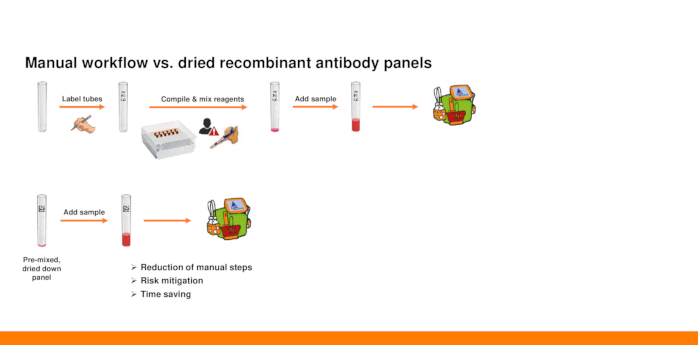
Figure 1: Comparison of manual staining workflow and dried recombinant antibody panels. The traditional manual workflow (top) involves multiple preparation steps, including tube labeling, combining and mixing reagents, and adding samples, which can increase hands-on effort. In contrast, the dried recombinant antibody panel workflow (bottom) uses premixed, dried-down panels that require only the addition of the sample. This streamlined approach reduces manual steps and simplifies the staining process, illustrating workflow efficiency and practical implementation. Please click here to view a larger version of this figure.
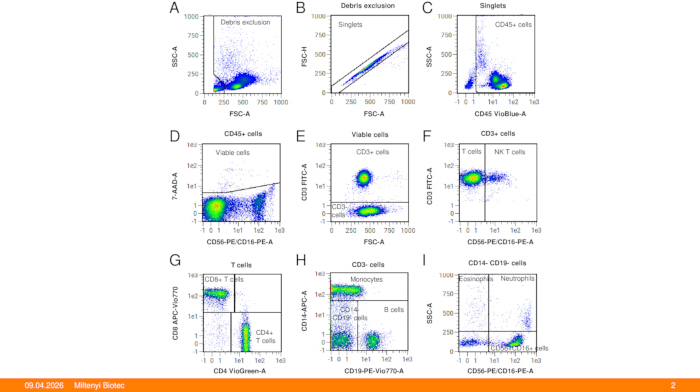
Figure 2: Flow cytometric analysis of a leukapheresis sample stained with the dried recombinant antibody panel “Immune Cell Composition Cocktail”. (A) Debris was excluded by gating on FSC versus SSC to include all cells. (B) Doublets were removed using an FSC-A versus FSC-H gate. (C) Leukocytes were identified by gating on CD45+ cells, allowing exclusion of residual erythrocytes. (D) Dead cells were excluded using 7-AAD staining. (E,F) CD3+ cells were identified and further classified into (E) T cells and (F) NKT cells based on CD56 expression. (G) T cells were subsequently separated into CD4+ and CD8+ subsets. (H) Within the CD3– population, monocytes were defined by CD14 expression and B cells by CD19 expression. (I) The remaining CD14–/CD19– cells were subdivided into SSC high/CD16– eosinophils, SSC high/CD16+ neutrophils, and SSC low/CD56+/CD16+ cells. Please click here to view a larger version of this figure.
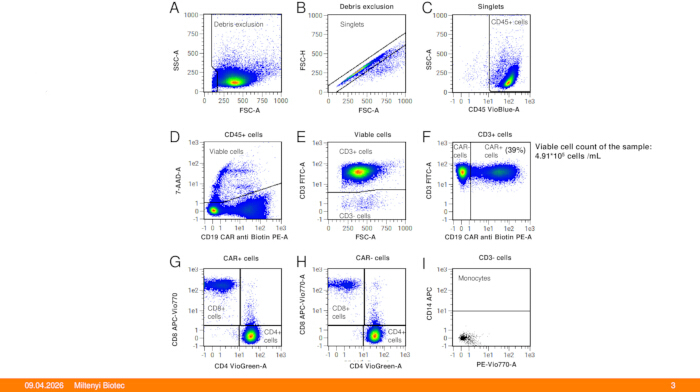
Figure 3: Flow cytometric analysis of CD19 CAR T cells (FMC63) stained with the dried recombinant antibody panel “CAR T Transduction Cocktail”. (A) Debris was excluded by gating on FSC versus SSC to include all cells. (B) Doublets were removed using an FSC-A versus FSC-H gate. (C) Leukocytes were identified by gating on CD45+ cells. (D) Dead cells were excluded based on 7-AAD− staining. (E,F) CD3+ cells were identified and subsequently separated into CAR+ and CAR− populations. (G) CAR+ and (H) CAR− cells were further subdivided into CD4+ and CD8+ T cell subsets. (I) Within the CD3− population, residual monocytes were defined by CD14 expression. Please click here to view a larger version of this figure.
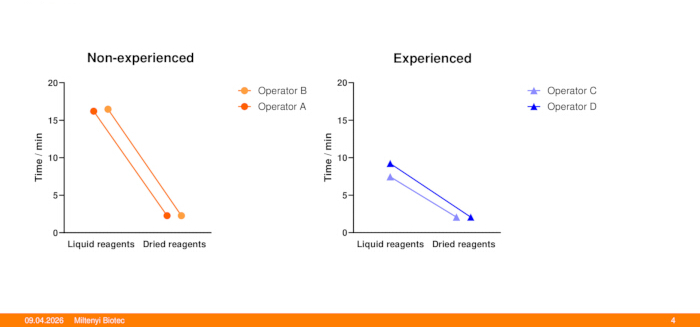
Figure 4: Time savings achieved with dried antibody panels across experience levels. For non-experienced (left) and experienced users (right), the time was assessed to set up a flow cytometric experiment (dried recombinant antibody panel “Immune Cell Composition Cocktail”, technical triplicates) from the start of the experiment until the start of incubation, including reagent handling, pipetting, and documentation. Please click here to view a larger version of this figure.
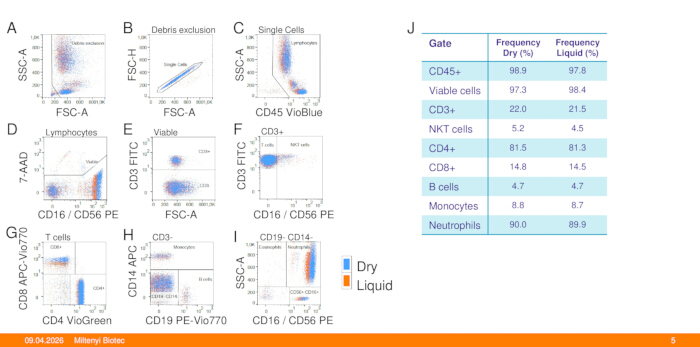
Figure 5: Flow cytometry analysis of lysed whole blood, overlay of a sample stained with the dried recombinant antibody panel “Immune Cell Composition Cocktail” (blue) and a sample stained with the same antibodies in a liquid format (orange). (A) Debris was excluded by gating on FSC versus SSC to include all cells. (B) Doublets were removed using an FSC-A versus FSC-H gate. (C) Leukocytes were identified by gating on CD45+ cells, thereby excluding residual erythrocytes. (D) Dead cells were excluded using 7-AAD staining. (E) CD3+ cells were identified. (F) These cells were then classified into T cells and NKT cells based on CD56 expression. (G) T cells were subsequently separated into CD4+ and CD8+ subsets. (H) Within the CD3– population, monocytes were defined by CD14 expression and B cells by CD19 expression. (I) The remaining CD14–/CD19– cells were subdivided into SSC high/CD16– eosinophils, SSC high/CD16+ neutrophils, and SSC low/CD56+/CD16+ cells. (J) Frequencies obtained with liquid antibodies and dried reagent panels were compared. Please click here to view a larger version of this figure.
| Purpose | V1 VioBlue | V2 VioGreen | B1 FITC | B2 PE | B3 7-AAD PerCP-Vio 700 | B4 PE-Vio770 | R1 APC | R2 APC-Vio770 |
| Determination of cell viability and composition of immune cells | CD45 | CD4 | CD3 | CD56/CD16 | 7-AAD | CD19 | CD14 | CD8 |
| Determination of transduction efficiency of CAR T cells | CD45 | CD4 | CD3 | CAR detection reagent | 7-AAD | / | CD14 | CD8 |
Table 1: Composition of dried recombinant antibody panels used for CAR T cell analysis. This table lists the antibodies included in each dried panel, specifying the target antigen, clone, fluorochrome, and typical amount per tube. Two panels are shown: the “Immune Cell Composition” panel for identification of major leukocyte subsets, and the “CAR T Transduction” panel for detection of CAR expression and T cell subset characterization. The information provides a reference for workflow implementation and optional adaptation with additional liquid-conjugated antibodies.
Discussion
Loading...
$$\rightleftharpoonup{xx}$$
$$\longleftharp{xx}$$,
$$\longrightharp{xx}$$,
Dried recombinant antibody panels provide a streamlined, practical workflow for CAR T cell characterization in the laboratory. The preformulated format reduces preparation steps and simplifies handling, helping to limit operator-dependent variability and support consistent execution of multiparametric flow cytometry procedures8. Representative examples illustrate the use of these panels to identify leukocyte subsets, detect CAR expression, and evaluate T cell subsets. Panels can also be supplemented with additional liquid-conjugated antibodies to include extra markers or immune subsets, enabling flexible adaptation to specific experimental needs or higher-parameter analyses.
Accurate CAR detection is critical for the reliable determination of transduction frequency1. Clear separation of CAR-negative and CAR-positive populations depends on appropriately optimized staining conditions, particularly when CAR expression levels vary. Controls such as fluorescence-minus-one (FMO) samples can support accurate gating. In some cases, washing steps may improve discrimination by removing unbound antibodies; however, these steps can reduce cell recovery due to cell loss during centrifugation and aspiration. Therefore, no-wash workflows may be preferred when accurate cell quantification is required.
While the approach ideally uses a CAR-specific detection reagent that recognizes the extracellular domain of the engineered CAR, alternative reagents, such as antibodies targeting conserved linker regions between the antigen-binding and signaling domains, can also be employed. These alternatives enable the detection of CAR-expressing cells and may be incorporated into workflows where CAR-specific reagents are unavailable, with appropriate optimization.
Integration with automated acquisition and analysis systems, including Express Mode, can further streamline data collection and analysis, reducing hands-on time and enabling consistent execution of workflows across operators.
While this work illustrates the method, formal assay validation for regulated manufacturing or release testing has not been performed. Multi-center validation has not yet been conducted, so reproducibility across laboratories remains to be confirmed5. The approach relies on preformulated panels, which may limit flexibility for highly specialized applications. However, custom-dried panel options can be designed to include specific markers or combinations, enabling tailored workflows and overcoming the limitations of standard panels. Cost considerations are largely balanced by reduced hands-on time and streamlined procedures, which may be particularly advantageous in high-throughput workflows.
Future work could focus on quantitative performance assessments, formal validation for regulated use, and expansion to multi-center studies to evaluate workflow consistency across laboratories. Custom panel design represents a practical avenue for expanding marker coverage, addressing unique experimental questions, or adapting to longitudinal immunomonitoring studies.
In summary, dried recombinant antibody panels provide a flexible and practical platform for CAR T cell flow cytometry. They reduce preparation steps, simplify workflows, and support flexible experimental design, including custom panel configurations.
Disclosures
Loading...
$$\rightleftharpoonup{xx}$$
$$\longleftharp{xx}$$,
$$\longrightharp{xx}$$,
M.L. and M.H. are listed as inventors on patent application WO2021/058811A1. M.H. is listed as an inventor on patent applications and granted patents related to CAR T technologies that have been filed by the Fred Hutchinson Cancer Research Center, Seattle, WA, and by the University of Würzburg, Würzburg, Germany. M.H. is a co-founder and equity owner of T-CURX GmbH, Würzburg, Germany. M.H. received honoraria from Celgene/BMS, Janssen, Kite/Gilead. M.L. is listed as inventor on patent application WO2021/058811A1 related to CAR T-cell engineering. J.J, A.R., and C.E. are employees of Miltenyi Biotec. A.R., A.B., D.M., M.M., and S.W. are employees of Miltenyi Biotec.
Acknowledgements
Loading...
$$\rightleftharpoonup{xx}$$
$$\longleftharp{xx}$$,
$$\longrightharp{xx}$$,
This research was funded by the Innovative Medicines Initiative 2 Joint Undertaking under grant agreement number 945393, T2EVOLVE, this Joint Undertaking receives support from the European Union's Horizon 2020 Research and Innovation Program, the European Federation of Pharmaceutical Industries and Associations (EFPIA) and the European Hematology Association (EHA)(to S.W., M.H., C.Q., M.L.), ERA-NET TRANSCAN-3 (EC co-funded call 2021, SmartCAR-T to M.H and M.L.), Wilhelm-Sander-Stiftung (grant no. 2022.134.1 to M.L.), the Paula & Rodger Riney Foundation (to M.H. and M.L.), IZKF Würzburg (S-511, C-543 to M.L.), the German Research Foundation (Deutsche Forschungsgemeinschaft, DFG, TRR 221 (subproject A03 and A06 to M.H. and M.L.); TRR338 (subprojects A02 M.H. and C04 M.L.) and CRC1525 (seed grant to M.L.)), the Bavarian Cancer Research Center (BZKF; TANGO to M.H. and M.L.), INCA Award by Novartis (to M.L.).
Materials
| Name | Company | Catalog Number | Comments |
|---|---|---|---|
| (Optional) Biotin Antibody, PE, REAfinity | Miltenyi Biotec | 130-110-951 | Only needed if a Biotin-conjugated CAR Detection Reagent is used. |
| (Optional) CAR T Cell Express Mode Package | Miltenyi Biotec | 160-002-376 | Software add-on for MACSQuant Analyzers; enables automated gating and data analysis, though manual analysis is also possible. |
| CAR Detection Reagent of choice detectable in the PE channel, e.g., CD19 CAR Detection Reagent, human, Biotin | Miltenyi Biotec | 130-129- 550 | Alternative options: CD19 CAR FMC63 Idiotype Antibody, PE, REAfinity (130-127-342); CD22 CAR Detection Reagent, human, Biotin (130-126-727); BCMA CAR Detection Reagent, human, PE (130-133-888) |
| Flow cytometer, e.g., MACSQuant Analyzer 16 | Miltenyi Biotec | 130-109-803 | StainExpress tubes are compatible with all standard flow cytometers. |
| StainExpress CAR T Transduction Cocktail, human | Miltenyi Biotec | 130-127-638 | Custom dried antibody panel configurations can be requested through your local Miltenyi Biotec representative or technical support team. |
| StainExpress Immune Cell Composition Cocktail, human | Miltenyi Biotec | 130-127-637 | Custom dried antibody panel configurations can be requested through your local Miltenyi Biotec representative or technical support team. |
References
Loading...
$$\rightleftharpoonup{xx}$$
$$\longleftharp{xx}$$,
$$\longrightharp{xx}$$,
- Chimeric antigen receptor therapy. N Engl J Med. , (2018).">June, C. H., Sadelain, M. Chimeric antigen receptor therapy. N Engl J Med. , (2018).
- CAR-T cell manufacturing: major process parameters and next-generation strategies. J Exp Med. , (2024).">Ayala Ceja, M., et al. CAR-T cell manufacturing: major process parameters and next-generation strategies. J Exp Med. , (2024).
- Seventeen-colour flow cytometry: unravelling the immune system. Nat Rev Immunol. , (2004).">Perfetto, S. P., Chattopadhyay, P. K., Roederer, M. Seventeen-colour flow cytometry: unravelling the immune system. Nat Rev Immunol. , (2004).
- Multicentre harmonisation of a six-colour flow cytometry panel for naïve/memory T cell immunomonitoring. J Immunol Res. , (2020).">Macchia, I., et al. Multicentre harmonisation of a six-colour flow cytometry panel for naïve/memory T cell immunomonitoring. J Immunol Res. , (2020).
- Recommendations for the validation of flow cytometric testing during drug development: II assays. J Immunol Methods. , (2011).">O'Hara, D. M., et al. Recommendations for the validation of flow cytometric testing during drug development: II assays. J Immunol Methods. , (2011).
- Novel lymphocyte screening tube using dried monoclonal antibody reagents. Cytometry B Clin Cytom. , (2015).">Hedley, B. D., Keeney, M., Popma, J., Chin-Yee, I. Novel lymphocyte screening tube using dried monoclonal antibody reagents. Cytometry B Clin Cytom. , (2015).
- Immunophenotyping using dried and lyophilized reagents. Methods Mol Biol. , (2019).">Langweiler, M. Immunophenotyping using dried and lyophilized reagents. Methods Mol Biol. , (2019).
- Standardization of cytokine flow cytometry assays. BMC Immunol. , (2005).">Maecker, H. T., et al. Standardization of cytokine flow cytometry assays. BMC Immunol. , (2005).
- Standardizing immunophenotyping for the Human Immunology Project. Nat Rev Immunol. , (2012).">Maecker, H. T., McCoy, J. P., Nussenblatt, R. Standardizing immunophenotyping for the Human Immunology Project. Nat Rev Immunol. , (2012).
- Stabilization of pre-optimized multicolor antibody cocktails for flow cytometry applications. Cytometry B Clin Cytom. , (2017).">Chan, R. C., Kotner, J. S., Chuang, C. M., Gaur, A. Stabilization of pre-optimized multicolor antibody cocktails for flow cytometry applications. Cytometry B Clin Cytom. , (2017).
Reprints and Permissions
Request permission to reuse the text or figures of this JoVE article
Request Permission