Here, we present a rapid, pure, and cost-effective method for establishing tumor organoids from the A549 cell line, suitable for preliminary tests and educational purposes.
Method Article
Generating Tumor Organoid Cultures from the Lung Adenocarcinoma Cell Line
June 12th, 2026
1State Key Laboratory of Genetics and Development of Complex Phenotypes, School of Life Sciences, Fudan University, 2Shanghai Key Laboratory of Lung Inflammation and Injury, Department of Pulmonary Medicine, Zhongshan Hospital, 3National Demonstration Center for Experimental Biology Education, School of Life Sciences, Fudan University
Corresponding Authors: Xinhua Lin <xlin@fudan.edu.cn>, Bin Guo <binguo@fudan.edu.cn>
* These authors contributed equally
Opens in a new tab
In This Article
Summary
Loading...
$$\rightleftharpoonup{xx}$$
$$\longleftharp{xx}$$,
$$\longrightharp{xx}$$,
Abstract
Loading...
$$\rightleftharpoonup{xx}$$
$$\longleftharp{xx}$$,
$$\longrightharp{xx}$$,
Here, we describe a protocol for generating Cell Line-Derived Tumor Organoids (CDTOs) from the A549 human lung adenocarcinoma cell line. The protocol involves embedding 2D-expanded A549 cells in Matrigel and maintaining them in 3D culture medium for long-term culture. Recommended seeding density of 500 cells/µL was determined to support consistent organoid formation. The resulting CDTOs were characterized by hematoxylin and eosin (H&E) staining and immunofluorescence (IF). The organoids maintained high expression of the lung adenocarcinoma markers Thyroid Transcription Factor 1 (TTF-1), adhesion protein E-Cadherin (ECAD), and cytoskeleton protein Keratin 7 (KRT7). Furthermore, tight junction protein Zona Occludens 1 (ZO-1) expression showed dysregulated polarity of tumor organoids. This protocol offers a technically straightforward, cost-effective, and purely tumorous organoid platform for lung adenocarcinoma research. Its simplicity and reproducibility also make it suitable for undergraduate laboratory teaching, where it can help students acquire fundamental 3D tumor organoid culture techniques within a limited lab schedule.
Introduction
Loading...
$$\rightleftharpoonup{xx}$$
$$\longleftharp{xx}$$,
$$\longrightharp{xx}$$,
Organoids are in vitro. self-organized three-dimensional (3D) structures that originate from stem cells and are capable of recapitulating biological complexities of real organs to a considerable extent1. The cells constituting organoids may derive from induced pluripotent stem cells or tissue-derived cells, the latter including normal stem/progenitor cells, differentiated cells, and tumor cells2. Compared with traditional two-dimensional culture systems and animal models, organoids can more closely mimic the physiological characteristics of the human body while offering greater experimental flexibility. Consequently, organoid technology has been widely applied in drug development3, personalized medicine4, and disease modeling5.
Numerous studies have established organoid models for a broad spectrum of cancers, including colorectal6, prostate7, pancreatic8, gastric9, hepatic10, biliary11, breast12, and neuroendocrine tumors. However, one of the major challenges in tumor organoid research lies in maintaining purity. For instance, a study on non-small cell lung cancer revealed that only 17% of the established organoids were purely tumorous, as tumor samples often contain a mixture of normal and malignant cells that are difficult to fully separate prior to culture13. This impurity issue can cause elimination of tumor cells by outgrowth of non-tumor cells, interfere with readouts of drug susceptibility tests, and lead to inaccurate molecular analyses, such as RT-qPCR or Western blot, where RNAs and proteins from tumor cells are diluted by uncontrollable proportions of contaminating cells.
To address this issue, researchers have explored the design of selective culture media that exploit the reduced dependency of tumor cells on certain growth factors, thereby inhibiting normal cell growth while promoting tumor cell expansion14. In addition, strategies such as cell sorting or monoclonal identification are being developed to construct pure tumor organoids.
This protocol describes the generation of Cell line-Derived Tumor Organoids (CDTOs) using the A549 human lung adenocarcinoma cell line, which has been reported to partially exhibit cancer stem cell-like properties, as well as enhanced clonogenicity, proliferative potential, and tumorigenicity in vitro.15. The resulting CDTOs maintained expression of lineage-specific biomarkers Thyroid Transcription Factor 1 (TTF-1)16, adhesion protein E-Cadherin (ECAD)17, and cytoskeleton protein Keratin 7 (KRT7)16 and exhibited physiological features characteristic of tumor organoids. This model is easy to establish and contains defined cancer cell components, making it suitable for researchers new to the tumor organoid field or those challenged by loss of tumor identity in primary tumor organoid cultures. Potential applications include preliminary drug susceptibility testing18, tumor microenvironment studies19, and educational training in 3D culture techniques.
Protocol
Loading...
$$\rightleftharpoonup{xx}$$
$$\longleftharp{xx}$$,
$$\longrightharp{xx}$$,
The room temperature in the lab is 22–24 °C and is referred to as RT. Using a swing-bucket centrifuge is recommended. The reagents and the equipment used are listed in the Table of Materials.
1. Establishment of primary A549 organoids
- Preparation and A549 cell harvest
- Prepare a 6 cm dish containing A549 cells at 70% confluency. Prewarm TrypLE and PBS to 37 °C. Calculate the cell amount and Matrigel volume according to the experimental design and Table 1.
- Thaw required Matrigel aliquots with redundancy for at least two wells on ice for at least 60 min. Prepare polystyrene and TC-treated plates to allow the domes to stay hemispherical.
- Freshly prepare 2D medium (Dulbecco‘s Modified Eagle’s Medium containing 10% fetal bovine serum) and 3D medium (Human Lung Adenocarcinoma Organoid Medium). 3D medium can be generated from commercial kits or according to the works of Sachs, N. et al. from Hans Clever’s lab20.
NOTE: One 6 cm dish can usually yield about 5,000,000 cells after digestion. Reduce the number of input cells for the experimental design. Plates designed for confocal imaging using a glass bottom are not suitable for Matrigel to form a proper 3D shape.
- Aspirate the spent 2D medium and wash the cells once with 1 mL PBS to remove residual serum. Aspirate PBS, add 1 mL of prewarmed TrypLE, and incubate the plate at 37 °C for 4 min.
- Observe the cells under a microscope. When the cytoplasm retracts and the cells lose intercellular connections, add an equal volume (1 mL) of fresh 2D medium to terminate the enzymatic reaction.
- Gently pipette to detach and resuspend the adherent cells from the culture surface. Transfer the cell suspension into 1.5 mL centrifuge tubes and centrifuge at 300 × g. for 3 min at RT to pellet the cells.
- Discard the supernatant and resuspend the cell pellet in 1 mL 2D medium. Dilute 10 µL cell suspension to 100 µL and count cell numbers with a hemocytometer. Calculate the required volume according to step 1.1.1 and aspirate to a 1.5 mL centrifuge tube with pre-rinsed tips.
- Prepare a 6 cm dish containing A549 cells at 70% confluency. Prewarm TrypLE and PBS to 37 °C. Calculate the cell amount and Matrigel volume according to the experimental design and Table 1.
- Seeding harvested cells into Matrigel
- Prepare ice and precool pipette tips in -20 °C fridge for 1 min and use low-retention tips if possible. Make sure no crystals remain in the Matrigel aliquots and that no bubbles form when the tip enters the solution.
- Centrifuge the tube containing harvested cells at 300 × g. at RT and discard the supernatant. Place the tube on ice. Use precooled pipette tips to slowly aspirate the required volume of Matrigel and add it to the pellet on ice. Resuspend using only the first stop of the pipette slowly on ice. Please do not leave ice for more than 10 s if observation is required.
- Use precooled pipette tips and keep the mixture on ice. Dispense one aliquot of the mixture into the center of each well. Slowly withdraw the pipette while dispensing, using only the first stop to avoid bubble formation.
NOTE: The mixture should form a dome-shaped 3D structure in the center. Resuspend the mixture before proceeding to the next well. If possible, avoid using the edge wells and add PBS to these wells. - Incubate the plate at 37 °C in a 5% CO₂ incubator for 40 min to allow gel polymerization. After the Matrigel has solidified, carefully add 3D medium along the well wall, and continue culturing at 37 °C.
NOTE: Avoid generating bubbles during dispensing. If bubbles are generated, avoid using that portion of the mixture. - During culture, replace the 3D medium every 3 days or whenever a color change (from pink to yellow) is observed. Examine organoid growth under an inverted microscope at each medium change, and document morphology photographically to monitor structural development.
NOTE: Organoids should be dense and convoluted with diameters longer than 30 µm instead of disintegrated or fragmented as indicated by 5000 cells/µL (Figure 1D).
2. Fixation, embedding, and sectioning of organoids
- Prepare organoid cultures at day 6–9. Remove the culture medium from the cell culture plate. Gently detach the organoids by pipetting with 1 mL of cold PBS, and transfer them into a 1.5 mL tube pre-rinsed with 5% BSA to prevent adhesion. Allow the organoids to settle naturally by gravity on ice and carefully remove the supernatant.
- Add 1 mL cold PBS to resuspend the pellet. Allow the organoids to settle naturally by gravity for at least 5 min and carefully remove the supernatant. If some organoids fail to sediment, centrifuge briefly at 200 × g. for 1 min at 4 °C to collect them. This step will be performed multiple times and will be referred to as ‘small wash’.
- Perform the small wash twice to remove residual Matrigel. If residual Matrigel persists, add a final concentration of 10 mM EDTA to cold PBS while washing.
CAUTION: Transfer the samples to the fume hood. Add 4% paraformaldehyde (PFA) sufficient to cover the organoids, and fix on ice for 1 h in a fume hood. Discard the fixative and perform the small wash twice. Proceed with step 4.1 for IF staining. - After the organoids settle at the bottom of the tube, discard the supernatant and preheat the samples in a 70–75 °C metal bath for 5 min to avoid rapid agarose solidification during step 2.7.
- Prepare 3% (w/v) agarose in 1× PBS, and heat the mixture in a microwave water bath until fully dissolved and transparent. Avoid boiling to prevent volume loss or changes in agarose concentration.
- Rapidly resuspend the fixed organoids in 30–50 µL of 3% agarose, ensuring even distribution, and cool on ice for 20–30 min until solidified, avoiding generating bubbles.
- Once the agarose-organoid mixture has solidified, carefully remove the agarose block from the tube using a needle and transfer it into a labeled tissue embedding cassette.
- Sequentially immerse the cassette containing the agarose block in graded ethanol solutions (30%, 50%, 70% [may be stored overnight at 4 °C], 80%, 90%, 95%, 100%, and 100%) for dehydration. Incubate each step on a shaking platform at 20 rpm for 30 min.
- Pre-melt paraffin wax blocks in an oven before use at 65 °C. Transfer the dehydrated agarose-embedded organoids into xylene for clearing. Immerse twice, each for 15–20 min, to remove residual ethanol.
- Transfer the tissue cassettes sequentially into paraffin bath 1 for 45 min, and then into paraffin bath 2 for another 45 min.
- Place the tissue cassettes and metal molds into the molten paraffin chamber of the embedding station. Remove the organoid or tissue sample from the cassette and position it in the center of the metal mold. Place the mold on a cold plate to fix the sample orientation.
- Position the tissue cassette on top of the metal mold, fill with additional molten paraffin, and allow to cool on the cold plate for at least 60 min. Once the paraffin block is fully solidified, remove the metal mold, and store the paraffin-embedded organoid block at 4 °C until sectioning.
- Section the paraffin-embedded organoid blocks using a microtome. Ensure that the thickness of each section is uniform to facilitate subsequent staining and imaging.
- Allow the cut sections to float in a water bath maintained at 40 °C to allow complete expansion of the paraffin ribbons. Ensure that each section spreads out as a single, wrinkle-free layer; discard any folded or overlapping sections.
- Mount the expanded sections onto adhesive microscope slides by immersing the slide at a slight angle beneath the section and lifting it vertically to capture the tissue. Label the slides with a pencil to preserve sample identification during subsequent processing.
3. Hematoxylin and Eosin (H&E) staining
- Bake the slides containing tissue or organoid sections in a 60 °C oven for 1–2 h to ensure proper adhesion and remove residual paraffin.
- Dewax the sections sequentially by immersing them in xylene I for 15 min, xylene II for 15 min, and then rehydrate through a graded ethanol series of 100%, 100%, 95%, 90%, 80% and 70%, each for 5 min. Then, rinse the slides in double-distilled water (ddH₂O) twice, each for 5 min.
- Stain the sections with hematoxylin for 5 min, rinse in running tap water for 1–2 min, and then differentiate in 1% acid alcohol for 2 s. Wash again in tap water for 1–2 min, then bleach the nuclei in 1% ammonia water for 5 s, followed by a final rinse in tap water for 1–2 min.
- Dehydrate the sections through a graded ethanol series of 70%, 80%, 90%, and 95%, each for 3 min, and then counterstain with eosin in an alcohol-based eosin solution for 10 min.
- Rinse the sections twice in absolute ethanol, each for 5 min.
NOTE: For alcohol-based eosin, ensure dehydration up to 95% ethanol prior to staining. For water-soluble eosin, perform staining before dehydration. - Clear the sections by immersing them twice in xylene, each for 5 min, and keep them in xylene until mounting.
- Mount the slides immediately after removal from xylene using neutral resin mounting medium, carefully avoiding air bubbles.
- Air-dry the mounted slides at RT for 30–60 min, then observe under a light microscope.
NOTE: Immediate mounting after xylene clearing prevents oxidation and ensures optical clarity.
4. Whole-mount immunofluorescence staining
- Continue from step 2.4. Add 1 mL blocking and permeabilization solution (5% BSA + 0.3% Triton X-100) to the pellet and incubate at RT for 60 min or at 4 °C as a stopping point for 1–2 days.
- Dilute primary and secondary antibodies following manufacturer’s recommended ratio in the blocking and permeabilization solution. Small wash once and add 200 µL diluted primary antibodies to the pellet. Incubate at 4 °C overnight.
- Perform the small wash 3 times and add 200 µL diluted secondary antibodies to the pellet. Incubate at RT for 60 min.
- Next, perform the small wash 3 times. Add 15 µL mounting medium to resuspend the pellet and drop the medium containing organoids on a glass slide. Slowly apply a coverslip to the medium and seal the coverslip with nail polish. Do not manually compress the cover slip and allow the mounting medium to spread by surface tension.
Results
Loading...
$$\rightleftharpoonup{xx}$$
$$\longleftharp{xx}$$,
$$\longrightharp{xx}$$,
The general process of this protocol includes expanding 2D A549 cells into the exponential stage (Supplementary Figure 1A) and passage into 3D Matrigel to form organoids (Figure 1A). Upon encapsulation in Matrigel, cells proliferated and self-assembled, predominantly forming monoclonal organoids (Figure 1B). Its dense and convoluted morphology was uniform across passage (Supplementary Figure 1C). In comparison, most of these structures were spherical and increased in size with continued culture; a fraction adhered to the plate bottom from the outset, giving rise to 2D clones (Figure 1C). This adherent morphology was more frequently observed in high-serum conditions, such as organoids cultured with DMEM supplemented with 10% FBS (Supplementary Figure 1B). Seeding density gradients from 50–5000 cells/µL were conducted to assess their influence on colony-forming efficiency (CFE) and organoid size (Figure 1D). Figure 1E,F showcased the two statistics at day 7, and group 5000 cells/µL was excluded from the statistical analysis because the cells were too dense, resulting in poor light transmission and making accurate counting difficult. At the lowest density tested, organoids are poorly formed, manifested by a smaller colony size and lower forming efficiency. At 2000 and 5000 cells/µL, organoids began to shrink and fragment (Figure 1D) in the center of the gel during culture, resulting from limited nutrient diffusion. Combining the two statistics, 500 cells/µL showed optimal organoid growth with only a slightly lower CFE. Seeding at 500 cells/µL can also generate a clear visual appearance and enhance the yield of organoids per well within the same plate format.
H&E staining was performed to validate the morphological features of A549 CDTOs. As shown in Figure 2A, the organoids exhibited solid spheroidal structures with varying sizes and architectural heterogeneity. Critically, the majority of organoids lacked a defined central lumen and instead presented as densely packed cell masses with dysregulated polarity, demonstrating a strong morphological correspondence with primary lung adenocarcinoma organoids21. Further immunofluorescence (IF) staining showed positive expression of lung adenocarcinoma markers transcription factor TTF-1, adhesion protein ECAD, and cytoskeleton KRT7 (Figure 2B). Positive ZO-1 and ECAD signals showed a tightly connected structure with dysregulated polarity of the CDTOs, similar to primary lung adenocarcinoma organoid features21. Hypoxia-Inducible Factor 1-Alpha (HIF1α) was also positive in the culture22 (Supplementary Figure 1D).
In conclusion, these results confirmed that this protocol can successfully generate structured A549 organoids that retain key lung adenocarcinoma molecular markers. The positive expression of TTF-1/ECAD/KRT7 serves as an indicator for successful modeling and cellular identity. The seeding density is a critical parameter, with low densities failing to initiate organoid formation and high densities resulting in aberrant growth.
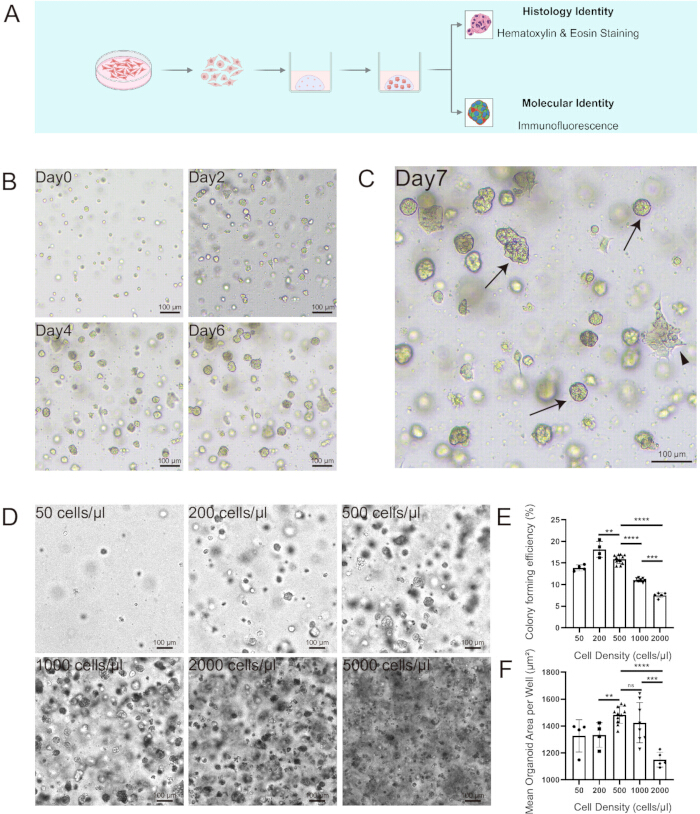
Figure 1: Establishment of A549 CDTOs from 2D-cultured cells. (A) Schematic workflow for generating tumor organoids from 2D-cultured A549 cells. 2D A549 cells were digested into single cells and then embedded into Matrigel domes for 3D culture. (B) Time-series images showing the progression from single cells to mature organoids at the same location. Seeding density: 500 cells/µL. CDTOs in (B), (C), and (D) were maintained in a 6 µL gel in a 48-well plate. Scale bar: 100 µm. (C) Representative image of A549 CDTOs at day 7. Arrowhead: 2D adherent clone. Arrow: 3D organoid. Scale bar: 100 µm. (D) Center image of A549 CDTOs of different seeding densities from the automated imaging device. The images were captured by automation to reduce bias and were used to generate quantification data in (E)and (F). Scale bar: 100 µm. (E,F) Quantification data of colony-forming efficiency (CFE) and mean organoid area per well of (D). 5000 cells/µL were excluded for inaccuracy and difficulty in quantification. Organoids were counted and divided by the total seeding amount to generate CFE. Areas in one well were measured and averaged by counts. Data are presented as mean ± SD, with N = 4–8. Statistical significance was assessed using one-way ANOVA followed by Tukey's post-hoc test for multiple comparisons correction. Significance levels are denoted as: ****, padj < 0.0001; ***, padj < 0.0005; **, padj < 0.001; ns, not significant. Please click here to view a larger version of this figure.
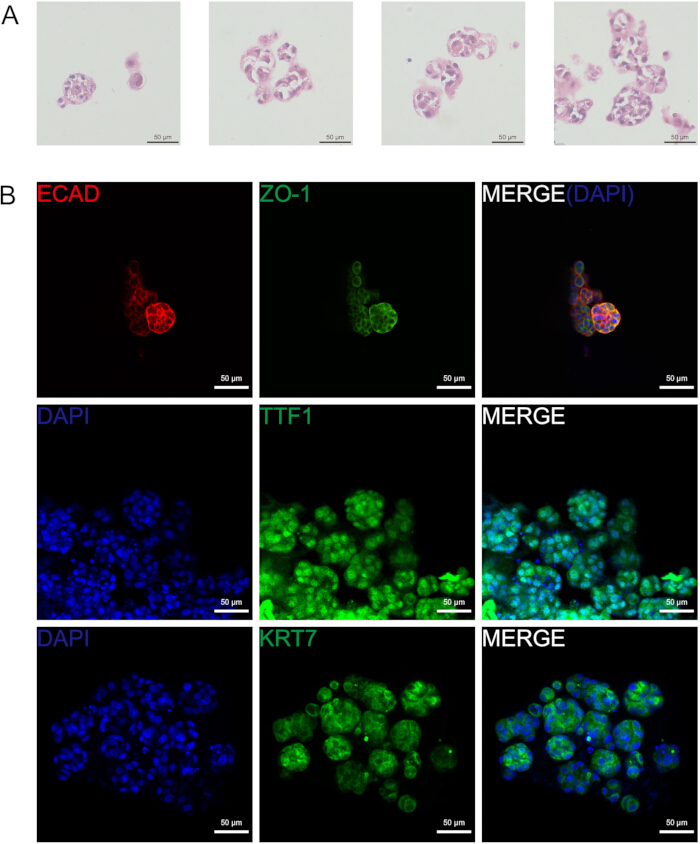
Figure 2: Histological and molecular characterization of A549 organoids. (A) H&E staining reveals the overall architecture and cytomorphology of the organoids, resembling primary lung adenocarcinoma organoid features. Scale bar: 50 µm. (B) Immunofluorescence analysis reveals positive expression of key lung adenocarcinoma markers: TTF1, ECAD, and KRT7. Positive ZO-1 expression showed tight junctions of tumor organoids. Nuclei are labeled with DAPI. Scale bar: 50 µm. Please click here to view a larger version of this figure.
| Plate Type | Matrigel Volume (μL/dome) | Domes per Well | Medium Volume (μL) | Seeding Density |
| 96-well | 2-3 | 1 | 100 | 500 cells/μL |
| 48-well | 6-10 | 1 | 200 | |
| 24-well | 20-30 | 1 | 500 | |
| 12-well | 20-30 | 3-4 | 1500 |
Table 1: Recommended Matrigel droplet configuration for 3D organoid culture. Due to Matrigel viscosity, preparing 10%–20% excess volume is recommended. Generally, the maximum volume within the recommended range should be used.
Supplementary Figure 1: Additional characterization of A549 organoids. (A) Representative image of A549 cells at 70% confluence in 2D culture. Scale bar: 100 µm. (B) Representative images of organoids cultured at 1000 cells/µL in 3D medium and in Dulbecco ‘s Modified Eagle’s Medium containing 10% fetal bovine serum. Arrowhead: 2D adherent clone. Scale bar: 100 µm. (C) Passaged A549 CDTOs showed consistent morphology with Figure 1C. Scale bar: 100 µm. (D) HIF1α-positive expression revealed a potential hypoxic microenvironment. Nuclei are labeled with DAPI. Scale bar: 50 µm. Please click here to download this file.
Discussion
Loading...
$$\rightleftharpoonup{xx}$$
$$\longleftharp{xx}$$,
$$\longrightharp{xx}$$,
This protocol describes a method for generating A549 lung adenocarcinoma Cell line-Derived Tumor Organoids optimized for technical simplicity, reproducibility, and educational use. Three parameters critically determine success: initial cell state, medium formulation, and matrix composition. Additionally, culture duration is not recommended to exceed 14 days. Listed below are key parameters and troubleshooting.
Initial cell state
The cells were maintained at a low passage number (<20 passages) to minimize genetic drift and clonal selection. Cells were harvested during the logarithmic growth phase (70%–80% confluence) to ensure optimal organoid-forming capacity. During cell counting, the harvested cells were confirmed to be in a single-cell suspension, as clumping affected quantification in downstream assays, although it generally did not interfere with colony formation; persistent clumps were filtered through a 40 µm cell strainer.
Matrigel scaffolding
After seeding, the plate was transferred to the incubator immediately to minimize cell sedimentation and early adherence, with adherence of up to 10% of the input cell number considered tolerable. Matrigel droplets were incubated at 37 °C for at least 40 min to ensure complete gelation before the addition of medium. Matrigel was thawed overnight on ice at 4 °C, aliquoted into precooled sterile microcentrifuge tubes to avoid repeated freeze–thaw cycles, and stored at −20 °C for short-term use (within 1 month) or −80 °C for long-term storage. Aliquots were thawed on ice for approximately 1–2 h and were never exposed to temperatures above 0 °C. During handling, Matrigel was kept on ice at all times, and precooled pipette tips and tubes were used to prevent premature gelation; the gel–cell mixture was maintained on ice during seeding and gently resuspended five times to ensure even distribution, with pipette tips changed every 10 wells to prevent gel residue condensation. Adequate medium volume was maintained, and edge wells were filled with PBS to prevent evaporation-induced edge effects, as uneven gel–cell distribution and evaporation adversely affected organoid formation. Bubble formation was minimized by pressing the pipette only to the first stop and dispensing slowly; portions containing fine, dense bubbles were discarded, as bubbles could interfere with imaging and size measurements, even though one or two bubbles typically did not affect cell growth. Occasional cracking or floating of Matrigel droplets was observed despite careful handling, and lot numbers were recorded to identify and avoid problematic batches.
Medium formulation
The culture medium was prepared fresh or used within 14 days when stored at 4 °C, with preparation aligned to the experimental schedule to avoid prolonged storage. The medium was replaced every 3 days, and early yellowing of the medium was interpreted as an indicator of high metabolic activity, requiring immediate replacement and more frequent subsequent changes to maintain optimal growth conditions.
Limitations
This current model lacks patient heterogeneity, tumor microenvironment components, and is subject to genetic drift with extended passage (use cells <20 passages). Organoid-forming capacity requires intrinsic stem-like subpopulations (e.g., CD133⁺/ABCG2⁺ in A549)16, limiting applicability to other cell lines.
Applications
The protocol serves primarily for undergraduate teaching (results within 7–10 days), graduate training in 3D techniques, and as a positive control for method development. Research usages include preliminary drug screening18, extracellular matrix studies19, and other proof-of-concept organoid experiments, though findings usually require validation in more physiologically relevant models. By defining critical parameters and providing troubleshooting guidance, this protocol offers a reproducible, cost-effective platform for educational and preliminary research applications in 3D cancer modeling.
Disclosures
Loading...
$$\rightleftharpoonup{xx}$$
$$\longleftharp{xx}$$,
$$\longrightharp{xx}$$,
The authors have no conflicts of interest to disclose.
Acknowledgements
Loading...
$$\rightleftharpoonup{xx}$$
$$\longleftharp{xx}$$,
$$\longrightharp{xx}$$,
This work was supported by the Fudan Good Practice Program of Teaching and Learning, the National Research Institute for Teaching Materials, and the National Program for Talent Training in Basic Disciplines (No. J1210012), as well as the Program for Cultivating Top-Notch Students in Basic Disciplines from the Ministry of Education (No. 20211021). Figure 1A was created in BioRender (Joe, Z. (2026) https://BioRender.com/0qi2gmd).
Materials
| Name | Company | Catalog Number | Comments |
|---|---|---|---|
| 1.5 mL Micro Centrifuge tube | Biofil | CFT003015 | |
| A549 [A-549]human non-small cell lung cancer cells | ZQXZbio | ZQ0003 | STR: Amelogenin: X,Y; CSF1PO: 10,12; D13S317: 11; D16S539: 11,12; D5S818: 11; D7S820: 8,11; TH01: 8,9.3; TPOX: 8,11; vWA: 14. Mycoplasma was negetive when purchased was tested every 2 weeks. Passage number within 10 passages from the P1 aliquots of the purchased batch was used. |
| Advanced DMEM/F12 | Gibco | 12634010 | |
| Anti-E Cadherin antibody | Abcam | ab231303 | |
| Anti-Fade Mounting Medium | YEASEN | 36307ES08 | |
| Anti-HIF-1 alpha antibody | Abcam | ab51608 | |
| Biological Safety Cabinet | Nuaire LABGARD | NU-540 | |
| Biological Tissue Embedding Machine | KEDEE | KD-BM | |
| BSA | Sigma | A1933 | |
| Cell-Grade BSA | Sigma | A1933-100G | |
| Centrifuge | Eppendorf | Centrifuge 5702 R | Swing bucket; Mild to low speed. |
| Centrifuge tube | Biofil | CFT920150 | |
| Citrate Antigen Retrieval Solution (pH 6.0) | ZSGB-BIO | ZLI-9065 | |
| Cryostage | KEDEE | KD-BL | |
| Cytation 5 Cell Imaging Multimode Reader | Biotek | Cytation 5 | |
| Cytokeratin 7 (KRT7) Rabbit mAb | Abclonal | A4357 | |
| DMEM | Gibco | 11965092 | |
| DMSO | Solarbio | D8371 | |
| Donkey Serum | Solarbio | SL050 | |
| Dulbecco's Modified Eagle Medium | Gibco | 11965118 | |
| Eclipse Ts2 Inverted Microscope | Nikon | Eclipse Ts2 | |
| Eosin Staining Solution (Alcohol-Soluble) | Servicebio | G1001 | |
| FBS | Nobimpex | B118-500 | |
| Forma Steri-Cycle i160 CO2 Incubator | Thermo Scientific | i60 | |
| Hematoxylin Bluing Solution | Servicebio | G1040 | |
| Hematoxylin Differentiation Solution | Servicebio | G1040 | |
| Hematoxylin Staining Solution | Servicebio | G1004 | |
| Hemocytometer | Solarbio | YA0810 | |
| Human Lung Adenocarcinoma Organoid Medium (3D medium) | PMO Bio | HC1001 | |
| Immunohistochemistry (IHC) Pen | ZSGB-BIO | ZLI-9305 | Store in 4°C |
| Laser Confocal Microscope FV3000 | Olympus | FV3000 | Usual parameter range: PMT Voltage: 500 ± 200 V; Laser Transmissivity: 5 ± 3%; Offset: 3 % |
| Manual Rotary Microtome | Leica | RM2235 | |
| Metal Bath | ALLSHENG | MK-3000 | |
| Microwave Oven | Galanz | ||
| Nail Polish | Lete | ||
| Neutral Balsam (Mounting Medium for Microscopy) | Beyotime | C0173 | |
| Organoid-Specific Extracellular Matrix Gel | PMO Bio | BM1001 | |
| PBS | WISENT | 311-010-CL | |
| Peroxidase Blocking Solution | Beyotime | P0100A | |
| Pipettes | Eppendorf | 312300063/312300020/312400083 | |
| Pipettes tips | Axygen | 14-222-692/14-222-723/14-222-869 | Consider using low retention tips if possible. |
| Three-Dimensional Shaker | SCILOGEX | SK-D3309-Pro | Low speed. |
| Tissue Flotation Water Bath | KEDEE | KD-P | |
| Triton X-100 | VWR | 92046-34-9 | |
| Trypan Blue | Gibco | 15250061 | |
| TryPLE | Gibco | 12605028 | |
| TTF1 Recombinant Monoclonal Antibody | HUABIO | HA720067 |
References
Loading...
$$\rightleftharpoonup{xx}$$
$$\longleftharp{xx}$$,
$$\longrightharp{xx}$$,
- Modeling mouse and human development using organoid cultures. Development. , (2015).">Huch, M., Koo, B. K. Modeling mouse and human development using organoid cultures. Development. , (2015).
- Engineering organoids. Nat Rev Mater. , (2021).">Hofer, M., Lutolf, M. P. Engineering organoids. Nat Rev Mater. , (2021).
- Patient-derived lung cancer organoids as in vitro cancer models for therapeutic screening. Nat Commun. , (2019).">Kim, M., et al. Patient-derived lung cancer organoids as in vitro cancer models for therapeutic screening. Nat Commun. , (2019).
- Personalized chordoma organoids for drug discovery studies. Sci Adv. , (2022).">Al Shihabi, A., et al. Personalized chordoma organoids for drug discovery studies. Sci Adv. , (2022).
- Modeling development and disease with organoids. Cell. , (2016).">Clevers, H. Modeling development and disease with organoids. Cell. , (2016).
- Prospective derivation of a living organoid biobank of colorectal cancer patients. Cell. , (2015).">Van de Wetering, M., et al. Prospective derivation of a living organoid biobank of colorectal cancer patients. Cell. , (2015).
- Organoid cultures derived from patients with advanced prostate cancer. Cell. , (2014).">Gao, D., et al. Organoid cultures derived from patients with advanced prostate cancer. Cell. , (2014).
- Organoid models of human and mouse ductal pancreatic cancer. Cell. , (2015).">Boj, S. F., et al. Organoid models of human and mouse ductal pancreatic cancer. Cell. , (2015).
- A comprehensive human gastric cancer organoid biobank captures tumor subtype heterogeneity and enables therapeutic screening. Cell Stem Cell. , (2018).">Yan, H. H. N., et al. A comprehensive human gastric cancer organoid biobank captures tumor subtype heterogeneity and enables therapeutic screening. Cell Stem Cell. , (2018).
- A human multi-lineage hepatic organoid model for liver fibrosis. Nat Commun. , (2021).">Guan, Y., et al. A human multi-lineage hepatic organoid model for liver fibrosis. Nat Commun. , (2021).
- Human branching cholangiocyte organoids recapitulate functional bile duct formation. Cell Stem Cell. , (2022).">Roos, F. J. M., et al. Human branching cholangiocyte organoids recapitulate functional bile duct formation. Cell Stem Cell. , (2022).
- A human breast cancer-derived xenograft and organoid platform for drug discovery and precision oncology. Nat Cancer. , (2022).">Guillen, K. P., et al. A human breast cancer-derived xenograft and organoid platform for drug discovery and precision oncology. Nat Cancer. , (2022).
- Challenges in establishing pure lung cancer organoids limit their utility for personalized medicine. Cell Rep. , (2020).">Dijkstra, K. K., et al. Challenges in establishing pure lung cancer organoids limit their utility for personalized medicine. Cell Rep. , (2020).
- Establishment of novel colorectal cancer organoid model based on tumor microenvironment analysis. Life Med. , (2024).">Xu, Z., et al. Establishment of novel colorectal cancer organoid model based on tumor microenvironment analysis. Life Med. , (2024).
- Identification and isolation of cancer stem cells from A549 cells. Zhongguo Fei Ai Za Zhi. , (2013).">Xia, H., et al. Identification and isolation of cancer stem cells from A549 cells. Zhongguo Fei Ai Za Zhi. , (2013).
- Systematic review of lung cancer with breast metastasis. J Thorac Dis. , (2025).">Nakata, J., Whittall, I., Russo, M. G., Su, S., Friedberg, J. Systematic review of lung cancer with breast metastasis. J Thorac Dis. , (2025).
- E-cadherin a potential biomarker in cancer and a therapeutic target. Biochim Biophys Acta Rev Cancer. , (2025).">Kumari, P., Dash, S., Samanta, D. E-cadherin a potential biomarker in cancer and a therapeutic target. Biochim Biophys Acta Rev Cancer. , (2025).
- Tumor organoids may be more suitable for clinical personalized chemotherapeutic drug screening in lung adenocarcinoma. Front Cell Dev Biol. , (2025).">Yun, W., et al. Tumor organoids may be more suitable for clinical personalized chemotherapeutic drug screening in lung adenocarcinoma. Front Cell Dev Biol. , (2025).
- Morphological characterization of human lung cancer organoids cultured in type I collagen hydrogels a histological approach. Int J Mol Sci. , (2023).">Monleón-Guinot, I., et al. Morphological characterization of human lung cancer organoids cultured in type I collagen hydrogels a histological approach. Int J Mol Sci. , (2023).
- Long-term expanding human airway organoids for disease modeling. EMBO J. , (2019).">Sachs, N., et al. Long-term expanding human airway organoids for disease modeling. EMBO J. , (2019).
- Modeling lung adenocarcinoma metastases using patient-derived organoids. Cell Rep Med. , (2024).">Liu, Y., et al. Modeling lung adenocarcinoma metastases using patient-derived organoids. Cell Rep Med. , (2024).
- HIF-1α promotes kidney organoid vascularization and applications in disease modeling. Stem Cell Res Ther. , (2023).">Peng, K., et al. HIF-1α promotes kidney organoid vascularization and applications in disease modeling. Stem Cell Res Ther. , (2023).
Reprints and Permissions
Request permission to reuse the text or figures of this JoVE article
Request Permission