This protocol describes the establishment of an aggregated Aβ1-42-induced Alzheimer’s disease-like mouse model and the assessment of triptolide effects on hippocampal inhibitory synapse-associated proteins, PI3K/Akt/GSK-3β signaling, and autophagy-related markers.
Research Article
Evaluating Triptolide Effects on Hippocampal Gephyrin, Collybistin, and Autophagy in an Aβ1-42 Mouse Model
Opens in a new tab
In This Article
Summary
Loading...
$$\rightleftharpoonup{xx}$$
$$\longleftharp{xx}$$,
$$\longrightharp{xx}$$,
Abstract
Loading...
$$\rightleftharpoonup{xx}$$
$$\longleftharp{xx}$$,
$$\longrightharp{xx}$$,
Alzheimer’s disease is associated with synaptic dysfunction, but standardized procedures for evaluating how Aβ-induced pathology affects inhibitory synapse-associated proteins and autophagy-related signaling after candidate intervention remain limited. This protocol describes a workflow for establishing an Aβ1-42-induced Alzheimer’s disease-like mouse model and assessing the effects of triptolide on hippocampal Gephyrin, Collybistin, PI3K/Akt/GSK-3β signaling, and autophagy-related markers. Adult C57BL/6J mice receive bilateral intracerebroventricular injection of Aβ1-42 prepared under aggregation-inducing conditions, followed by daily intraperitoneal administration of triptolide with or without the PI3K inhibitor LY294002. Spatial learning and memory are evaluated using Morris water maze testing. Hippocampal neuronal injury and Aβ deposition are assessed by hematoxylin and eosin staining and Aβ immunohistochemistry, and hippocampal lysates are analyzed by Western blotting to quantify Gephyrin, phosphorylated Gephyrin, Collybistin, PI3K/Akt/GSK-3β signaling proteins, LC3-II/I, and p62. Key procedural considerations include standardized Aβ1-42 preparation, accurate stereotaxic injection, consistent behavioral testing conditions, blinded region-of-interest selection, and standardized image and densitometry analysis. Using this workflow, Aβ1-42 administration produced spatial learning and memory deficits, hippocampal neuronal injury, Aβ deposition, reduced Gephyrin and Collybistin expression, altered PI3K/Akt/GSK-3β signaling, and increased LC3-II/I and p62 accumulation. Triptolide partially reversed these behavioral, histological, and molecular changes, whereas LY294002 attenuated its effects. This protocol can be used to evaluate Aβ-induced hippocampal molecular alterations and candidate interventions, while recognizing that this model does not reproduce the chronic, multifactorial progression of human Alzheimer’s disease.
Introduction
Loading...
$$\rightleftharpoonup{xx}$$
$$\longleftharp{xx}$$,
$$\longrightharp{xx}$$,
Alzheimer’s disease (AD) is a progressive neurodegenerative disorder characterized by cognitive decline, memory impairment, and behavioral disturbances, and it represents one of the leading causes of dementia in older adults. Although amyloid-β (Aβ) deposition, tau pathology, synaptic dysfunction, neuroinflammation, and impaired protein homeostasis have been widely implicated in AD pathogenesis, the molecular mechanisms linking Aβ-associated toxicity to inhibitory synaptic protein disruption remain incompletely understood1,2,3,4. Inhibitory synaptic dysfunction may disturb the balance between excitation and inhibition in neuronal circuits, thereby contributing to network instability and cognitive impairment. However, the intracellular signaling events that regulate inhibitory synapse-associated scaffolding proteins under Aβ-induced AD-like pathological conditions require further clarification5.
Gephyrin is a major postsynaptic scaffolding protein that anchors and stabilizes inhibitory neurotransmitter receptors, including glycine receptors and γ-aminobutyric acid type A receptors, at postsynaptic sites6. Collybistin, encoded by ARHGEF9, is a guanine nucleotide exchange factor that interacts with Gephyrin and promotes the clustering and membrane localization of inhibitory synaptic components7. The functional interaction between Gephyrin and Collybistin is therefore essential for the organization, maintenance, and plasticity of inhibitory synapses. Disruption of this protein complex may impair inhibitory neurotransmission and contribute to cognitive deficits. Notably, Gephyrin stability and synaptic clustering can be regulated by phosphorylation-dependent mechanisms. Aβ oligomer-associated signaling has been reported to influence kinases such as glycogen synthase kinase-3β (GSK-3β), which may promote Gephyrin phosphorylation at serine 270 and thereby affect Gephyrin clustering and degradation. These findings suggest that kinase-mediated regulation of Gephyrin may represent an important molecular link between Aβ-associated pathology and inhibitory synaptic dysfunction8,9.
The PI3K/Akt pathway is a key intracellular signaling pathway involved in neuronal survival, synaptic plasticity, protein homeostasis, and autophagy regulation. Akt activity can suppress GSK-3β through inhibitory phosphorylation, thereby modulating downstream substrates involved in neuronal function and synaptic stability. Dysregulation of PI3K/Akt/GSK-3β signaling has been implicated in AD-related neuronal injury and may contribute to both synaptic impairment and abnormal protein degradation10,11. In parallel, autophagy is an essential intracellular degradation pathway that removes damaged organelles and misfolded proteins. Autophagy-lysosomal dysfunction has been closely associated with Aβ accumulation, tau pathology, and neuronal damage in AD12. However, LC3-II/I changes alone cannot distinguish increased autophagosome formation from impaired autophagic degradation; therefore, additional markers such as p62 are needed to better evaluate autophagy-related flux changes. Together, these observations support the need to examine PI3K/Akt activity, GSK-3β-mediated regulation of Gephyrin, and autophagy-related markers within the same experimental framework.
Triptolide, a bioactive diterpene triepoxide isolated from Tripterygium wilfordii, has been reported to exert anti-inflammatory, immunomodulatory, and neuroprotective effects13. Previous studies have suggested that triptolide can improve cognitive performance and preserve inhibitory synapse-associated proteins in AD-like models. Nevertheless, the mechanistic relationship among triptolide treatment, PI3K/Akt pathway activation, GSK-3β-mediated Gephyrin phosphorylation, Collybistin expression, and changes in autophagy-related proteins has not been fully defined. Whether triptolide regulates hippocampal Gephyrin and Collybistin expression through a PI3K/Akt/GSK-3β-associated mechanism in an Aβ1-42-induced AD-like mouse model remains unclear14,15.
Compared with chronic transgenic AD models, such as APP/PS1 or 5xFAD mice, and tauopathy-based models, intracerebroventricular injection of aggregated Aβ1-42 provides a relatively rapid and technically accessible approach for inducing Aβ-associated hippocampal injury and cognitive impairment. This protocol is appropriate when the experimental goal is to evaluate short-term Aβ-induced neurotoxicity, hippocampal molecular changes, and intervention-related effects on defined signaling pathways. However, this model does not reproduce the chronic amyloid production, tau pathology, vascular alterations, neuroimmune complexity, or age-dependent progression of human AD. Therefore, findings obtained using this protocol should be interpreted as Aβ-induced AD-like pathology and ideally validated in chronic transgenic models, tau-related models, or human-derived neuronal systems. Despite previous evidence linking Aβ pathology, PI3K/Akt/GSK-3β signaling, inhibitory synapse-associated proteins, and autophagy-related abnormalities to AD-like pathology, few protocols integrate behavioral testing, hippocampal histological assessment, Aβ immunohistochemistry, analysis of inhibitory synapse-associated proteins, kinase signaling assessment, and detection of autophagy-related markers within a single Aβ1-42-induced intervention model. This methodological gap limits the reproducible evaluation of whether candidate compounds modulate changes in inhibitory synapse-associated proteins through defined intracellular signaling pathways.
The objective of this protocol is to provide a reproducible workflow for evaluating hippocampal Gephyrin and Collybistin expression and their associated regulatory mechanisms in an Aβ1-42-induced AD-like mouse model treated with triptolide, with or without the PI3K inhibitor LY294002. The original contribution of this work is the integration of stereotaxic Aβ1-42 administration, pharmacological modulation of signaling pathways, Morris water maze testing, histological and immunohistochemical assessment, and Western blot analysis of inhibitory synapse-associated proteins, PI3K/Akt/GSK-3β signaling, and autophagy-related markers. The working hypothesis was that Aβ1-42-induced AD-like pathology would be associated with impaired PI3K/Akt signaling, altered GSK-3β-associated Gephyrin phosphorylation, reduced hippocampal Gephyrin and Collybistin expression, and abnormal accumulation of autophagy-related proteins, whereas triptolide treatment would partially reverse these behavioral and molecular abnormalities.
Protocol
Loading...
$$\rightleftharpoonup{xx}$$
$$\longleftharp{xx}$$,
$$\longrightharp{xx}$$,
All animal procedures were approved by the Medical Ethics Committee of Hubei University of Medicine and were performed in accordance with institutional guidelines for animal care and use (No. SYXK2019-0031.). All procedures involving animals, Aβ1-42, triptolide, LY294002, paraformaldehyde, xylene, ethanol, and chemiluminescent reagents should be performed with appropriate personal protective equipment, including a laboratory coat, gloves, and protective eyewear. Animal carcasses, brain tissues, Aβ-contaminated consumables, paraformaldehyde waste, xylene waste, and ECL-contaminated materials should be collected separately and disposed of in accordance with institutional biosafety and chemical waste disposal regulations. Image analysis was performed using ImageJ. For immunohistochemical analysis, images were converted to 8-bit grayscale or subjected to color deconvolution to isolate DAB-positive staining. The same threshold was applied to all images within the same experiment. The positive staining area, total region-of-interest area, and integrated density were measured. For Western blotting, band intensities were measured using the gel analysis tool after background subtraction. Target protein levels were normalized to β-actin, whereas phosphorylated proteins were normalized to their corresponding total protein levels.
The reagents and equipment used in this study are listed in the Table of Materials, including product names, manufacturers, catalog or model numbers, and generic descriptions.
Animals and experimental grouping
Forty-eight adult C57BL/6J mice, including 24 males and 24 females, aged 10-12 weeks and weighing 22-28 g, were purchased from the Animal Experimental Center of Hubei University of Medicine. The mice were housed under specific pathogen-free conditions at 22 ± 2 °C with free access to autoclaved water and standard rodent chow. After 1 week of acclimatization, the mice were randomly assigned to four groups: the control group, the Aβ1-42-induced AD-like model group, the triptolide-treated group, and the LY294002 plus triptolide co-treatment group, with 12 mice per group. Male and female mice were balanced across groups as evenly as possible.
Aβ1-42 peptide was dissolved in sterile normal saline to a final concentration of 10 µg/µL. To prepare Aβ1-42 under aggregation-inducing conditions, the solution was incubated at 37 °C for 7 days in a circulating water bath, gently mixed before use, and kept on ice during injection. This preparation condition was adapted from previously published Aβ42 aggregation procedures. In the present study, the aggregation state of the exact injected Aβ1-42 batch was not independently characterized by Thioflavin T fluorescence, SDS-PAGE/Western blotting, or transmission electron microscopy. Therefore, the term “aggregated Aβ1-42” in this protocol refers to Aβ1-42 prepared under aggregation-inducing incubation conditions.
For model establishment, mice were anesthetized by intraperitoneal injection of 10% pentobarbital sodium at a dose of 0.04 mL/10 g body weight. Adequate anesthesia was confirmed by the absence of pedal withdrawal and corneal reflexes. Each mouse was then fixed on a stereotaxic apparatus, and the scalp was shaved and disinfected with iodophor or 75% ethanol. A midline incision was made to expose the skull, and the bregma was identified under a stereomicroscope. The skull was adjusted so that bregma and lambda were positioned on the same horizontal plane.
Bilateral lateral ventricle injections were performed using the following coordinates relative to bregma: anteroposterior, −0.50 mm; mediolateral, ±1.00 mm; and dorsoventral, −3.00 mm from the skull surface. A total volume of 2 µL aggregated Aβ1-42 solution was slowly (2 µL/min) injected into each lateral ventricle using a micro syringe. The injection was performed at a constant low speed to reduce tissue damage and reflux. After injection, the needle was left in place for approximately 5 min, then slowly withdrawn. Control mice received an equal volume of sterile normal saline at the same coordinates and using the same surgical procedure. After injection, the scalp incision was closed using sutures or wound clips, and the mice were placed in a warmed recovery cage until they regained consciousness. Postoperative recovery, body weight, wound healing, grooming behavior, locomotor activity, and signs of pain or distress were monitored daily.
Drug intervention was initiated 2 weeks after stereotaxic injection, after the model was considered stable. Triptolide was dissolved in normal saline containing 4% propylene glycol and administered intraperitoneally once daily for 30 consecutive days. The triptolide-treated group received triptolide at 0.2 mg/kg daily, whereas the LY294002 plus triptolide co-treatment group received triptolide together with the PI3K inhibitor LY294002 at 0.3 mg/kg once daily for 30 consecutive days. The control group and the Aβ1-42-induced AD-like model group received equal volumes of vehicle solution using the same injection schedule16.
Morris water maze test
Spatial learning and memory were assessed using the Morris water maze 24 h after the final drug administration. The water maze consisted of a circular pool filled with water maintained at 22 °C ± 1 °C. Visual cues were placed around the pool and kept unchanged throughout the experiment. During the place navigation phase, the hidden platform was fixed in the target quadrant. Before testing each day, mice were allowed to acclimate to the testing room for approximately 30 min.
The place navigation test was performed for 6 consecutive days. In each trial, the mouse was gently placed into the water, facing the pool wall from one of the starting quadrants, and allowed to search for the hidden platform for up to 60 s. If the mouse found the platform within 60 s, it was allowed to remain on the platform for 15 s. If the mouse failed to locate the platform within 60 s, it was guided to the platform and allowed to remain there for 20 s to facilitate spatial memory consolidation. Each mouse underwent 4 trials per day, and escape latency, swimming distance, and swimming speed were recorded using an automated video-tracking system.
On day 7, the platform was removed for the probe trial. The mouse was placed into the water from the quadrant opposite the original platform location and allowed to swim freely for 60 s. The number of platform crossings and the percentage of time spent in the target quadrant were recorded. After each trial, the mouse was dried and returned to a warmed cage to prevent hypothermia17,18.
Tissue collection
After behavioral testing, mice were deeply anesthetized by intraperitoneal injection of 10% pentobarbital sodium at a dose of 0.04 mL/10 g body weight. Eight mice from each group were randomly selected for hippocampal protein extraction. Their brains were rapidly removed on ice, and bilateral hippocampal tissues were dissected on an ice-cold surface. The hippocampal samples were placed into pre-labeled cryovials, snap-frozen in liquid nitrogen, and stored at −80 °C until protein extraction.
The remaining four mice from each group were used for histological and immunohistochemical analyses. Under deep anesthesia, the mice were transcardially perfused with phosphate-buffered saline until the liver became pale, followed by 4% paraformaldehyde. The brains were carefully removed and post-fixed in 4% paraformaldehyde at 4 °C for 24 h. After fixation, the brain tissues were submitted to the pathology experimental platform, where paraffin embedding and subsequent sectioning were performed. Paraformaldehyde was handled in a chemical fume hood, and paraformaldehyde-containing waste was collected separately in accordance with institutional chemical waste disposal requirements.
Hematoxylin and eosin staining
Paraffin-embedded brain tissues were cut into 4 µm coronal sections containing the hippocampus. The sections were baked at 60 °C for 1 h, deparaffinized twice in xylene for 10 min each, and rehydrated through graded ethanol solutions (100%, 95%, 85%, and 75%) followed by distilled water (5 min for each step). After rehydration, sections were stained with hematoxylin for 10 min, rinsed in running tap water, briefly differentiated in acid alcohol (2 s), when necessary, and blued in running tap water. The sections were then counterstained with eosin for 5 min, dehydrated through graded ethanol, cleared in xylene twice for 5 min each, and mounted with neutral resin.
Hippocampal morphology was observed under a light microscope. Images were acquired from the same hippocampal subregion across all groups, using the 20× magnification and imaging parameters. Neuronal damage was evaluated based on neuronal density, nuclear pyknosis, and disordered arrangement using image-analysis software by an investigator blinded to group allocation19.
Aβ immunohistochemistry
For Aβ immunohistochemistry, paraffin sections were deparaffinized and rehydrated as described for hematoxylin and eosin staining. Antigen retrieval was performed in EDTA antigen retrieval buffer at pH 8.0 by heating the sections in a microwave oven at high power for 3 min twice. The sections were allowed to cool to room temperature and then washed three times with PBS for 5 min each. Endogenous peroxidase activity was blocked with 3% hydrogen peroxide for 15 min at room temperature, followed by PBS washing three times for 5 min each. Nonspecific binding was blocked with 5% normal goat serum for 30 min at room temperature. The sections were incubated overnight at 4 °C with a primary antibody against Aβ diluted 1:200 in PBS. After incubation, sections were washed three times with PBS for 5 min each, then incubated with an HRP-conjugated secondary antibody for 60 min at room temperature. After washing with PBS, DAB substrate was applied, and color development was monitored under a microscope. The reaction was stopped with distilled water once brown-positive staining became visible. Sections were counterstained with hematoxylin, dehydrated through graded ethanol, cleared in xylene, and mounted with neutral resin. Images were captured from the same hippocampal subregion across all groups using identical microscope settings at 20× magnification. Aβ immunostaining was quantified using image-analysis software. The positive staining threshold was kept consistent across all images, and Aβ deposition was calculated as the positive staining area divided by the total number of cells in each microscopic field.
Hippocampal protein extraction and western blot analysis
Frozen hippocampal tissues were kept on ice and homogenized in ice-cold RIPA lysis buffer containing protease and phosphatase inhibitors. The homogenates were incubated on ice for 30 min and vortexed intermittently to ensure sufficient lysis. Lysates were then centrifuged at 12,000 × g for 15 min at 4 °C, and the supernatants were collected for protein analysis. Protein concentrations were determined using a BCA protein assay kit according to the manufacturer’s instructions. Briefly, BSA standards and protein samples were prepared in duplicate, mixed with BCA working reagent, incubated at 37 °C for 30 min, and measured at 562 nm using a microplate reader. Protein concentrations were calculated according to the standard curve, and all samples were adjusted to the same final concentration before electrophoresis20.
20 µg of total protein from each hippocampal sample were separated by 12% SDS-PAGE and transferred onto PVDF membranes. Electrophoresis was performed at 80 V for stacking and 120 V for separation. Proteins were transferred to PVDF membranes activated in methanol using wet transfer at 100 V for 90 min at 4 °C. After transfer, the membranes were blocked with 5% BSA for 1 h at room temperature. The membranes were then incubated overnight at 4 °C with primary antibodies against Gephyrin (1:1000 dilution), phosphorylated-Gephyrin (1:500 dilution), Collybistin (1:1000 dilution), PI3K (1:1000 dilution), Akt (1:1000 dilution), phosphorylated Akt (1:1000 dilution), GSK-3β (1:1000 dilution), phosphorylated GSK-3β (1:1000 dilution), LC3 (1:1000 dilution), p62 (1:1000 dilution) and β-actin (1:5000 dilution). After washing with TBST, the membranes were incubated with HRP-conjugated secondary antibodies for 1 h at room temperature (1:5000 dilution). Protein bands were visualized using ECL chemiluminescent substrate and captured with a chemiluminescence imaging system. Band intensities were quantified using image-analysis software. Total protein expression levels were normalized to β-actin. High-resolution uncropped Western blot images were included in the supplementary materials.
Statistical Data
Statistical analysis was performed using statistical analysis and graph-generation software. Data were expressed as mean ± SD, as indicated in the figure legends. Behavior testing and image quantification were performed by investigators blinded to group allocation. Escape latency during the Morris water maze training phase was analyzed using two-way repeated-measures ANOVA, with group and training day as factors. Probe trial data, histological quantification, immunohistochemical quantification, and Western blot densitometry were analyzed using a one-way ANOVA test. Statistical significance was defined as p < 0.05. Standard significance notation was used as follows: *p < 0.05, **p < 0.01, and ***p < 0.001. Exact sample sizes were reported in the corresponding figure legends. Male and female mice were evenly distributed across the experimental groups. However, sex-stratified statistical analysis was not performed because the study was not designed or powered to detect sex-specific effects. This limitation is acknowledged in the Discussion section.
Results
Loading...
$$\rightleftharpoonup{xx}$$
$$\longleftharp{xx}$$,
$$\longrightharp{xx}$$,
Impaired learning and memory in Aβ1-42-induced AD-like mice and partial improvement after triptolide treatment
To establish an Aβ1-42-induced AD-like mouse model, aggregated Aβ1-42 was stereotaxically injected into the bilateral lateral ventricles of C57BL/6J mice. After model establishment, mice were treated with vehicles, triptolide, or triptolide combined with the PI3K inhibitor LY294002. Spatial learning and memory were then evaluated using the Morris water maze.
During the 6-day place navigation phase, escape latency decreased gradually across all groups, indicating that the mice acquired the spatial learning task with repeated training (Figure 1A). However, Aβ1-42-induced AD-like mice showed consistently longer escape latencies than control mice, particularly on later training days, suggesting impaired spatial learning. Triptolide treatment shortened the escape latency compared with the Aβ1-42-induced AD-like model group, whereas co-treatment with LY294002 weakened this improvement. These findings indicate that triptolide partially improved Aβ1-42-induced spatial learning impairment, and this effect was attenuated by PI3K inhibition.
Representative swimming tracks further supported these behavioral changes (Figure 1B). Control mice showed a more direct, target-oriented search pattern around the platform location, whereas Aβ1-42-induced AD-like mice displayed a scattered, inefficient swimming trajectory. Triptolide-treated mice showed improved searching behavior, with trajectories more concentrated around the target area. In contrast, mice treated with LY294002 and triptolide showed less efficient searching than those treated with triptolide alone. In the probe trial performed after platform removal, Aβ1-42-induced AD-like mice crossed the original platform location fewer times than control mice, indicating impaired spatial memory retention (Figure 1C). Triptolide treatment increased the number of platform crossings, while LY294002 co-treatment reduced this effect. Similarly, the percentage of time spent in the target quadrant was reduced in Aβ1-42-induced AD-like mice compared with control mice, increased after triptolide treatment, and decreased again after LY294002 co-treatment (Figure 1D).
Together, these behavioral results demonstrate that bilateral intracerebroventricular injection of aggregated Aβ1-42 induced spatial learning and memory deficits in mice. Triptolide partially reversed these behavioral impairments, whereas LY294002 attenuated triptolide's protective effect, suggesting that PI3K/Akt signaling may contribute to the behavioral effects observed in this model.
Aβ1-42 injection induced hippocampal neuronal injury and Aβ deposition, which were attenuated by triptolide
To further verify the establishment of Aβ1-42-induced AD-like pathological changes and evaluate the effect of triptolide on hippocampal injury, hematoxylin and eosin staining and Aβ immunohistochemistry were performed on brain sections from each group.
HE staining showed that neurons in the control group were densely and regularly arranged, with relatively clear cell morphology and nuclear structure (Figure 2A). In contrast, Aβ1-42-induced AD-like mice exhibited obvious hippocampal neuronal damage, characterized by disordered cellular arrangement, reduced neuronal density, and increased nuclear condensation. Triptolide treatment partially improved hippocampal neuronal morphology, with more preserved cellular arrangement and less apparent nuclear pyknosis compared with the Aβ1-42-induced model group. However, cotreatment with LY294002 attenuated the protective effect of triptolide, as reflected by more pronounced neuronal disorganization and injury compared with the triptolide-treated group.
Aβ immunohistochemistry was then performed to assess Aβ deposition in the hippocampus (Figure 2B). Minimal Aβ-positive staining was observed in the control group, whereas the Aβ1-42-induced AD-like model group showed markedly increased brown Aβ-positive signals. Triptolide treatment reduced Aβ-positive staining compared with the model group, indicating that triptolide attenuated Aβ deposition in this model. In contrast, mice treated with LY294002 plus triptolide showed increased Aβ-positive staining compared with mice treated with triptolide alone. Quantitative analysis further confirmed these histological observations. Aβ-positive signal area normalized to the total number of cells in each microscopic field was increased in the Aβ1-42-induced AD-like model group compared with the control group, reduced after triptolide treatment, and partially increased again after LY294002 co-treatment (Figure 2B).
These results indicate that Aβ1-42 injection induced hippocampal neuronal injury and Aβ accumulation, while triptolide partially alleviated these pathological changes. The reversal observed after LY294002 co-treatment suggests that PI3K/Akt signaling may contribute to triptolide's protective effect.
Triptolide restored hippocampal Gephyrin and Collybistin expression and modulated PI3K/Akt/GSK-3β signaling
To determine whether the behavioral and histological changes were accompanied by alterations in inhibitory synapse-associated proteins and their upstream regulatory signaling, hippocampal lysates from each group were analyzed by Western blotting. Compared with the control group, Aβ1-42-induced AD-like mice showed a marked reduction in hippocampal Gephyrin expression, whereas phosphorylated Gephyrin levels were increased (Figure 3A). Triptolide treatment partially restored total Gephyrin expression and reduced phosphorylated Gephyrin levels. In contrast, LY294002 co-treatment weakened the effect of triptolide, as shown by reduced Gephyrin expression and increased phosphorylated Gephyrin compared with the triptolide-treated group. These results suggest that Aβ1-42-induced pathology was associated not only with reduced hippocampal Gephyrin abundance but also with enhanced Gephyrin phosphorylation, while triptolide partially reversed these alterations.
Collybistin showed a similar expression pattern to total Gephyrin. Aβ1-42-induced AD-like mice exhibited decreased hippocampal Collybistin expression compared with control mice, whereas triptolide treatment restored Collybistin expression. LY294002 co-treatment partially reversed this effect (Figure 3B). These findings indicate that triptolide preserved the expression of inhibitory synapse-associated scaffolding proteins in the hippocampus, and this effect was attenuated by PI3K inhibition. The PI3K/Akt/GSK-3β signaling pathway was then examined to further elucidate the molecular changes underlying Gephyrin phosphorylation. In the Aβ1-42-induced AD-like model group, PI3K expression and the p-Akt/Akt ratio were reduced compared with the control group, indicating impaired PI3K/Akt signaling activity (Figure 3B). The p-GSK-3β/GSK-3β ratio was also reduced in the model group. Because phosphorylation of GSK-3β at the inhibitory site reflects suppression of GSK-3β activity, this reduction suggests relatively increased GSK-3β activity in the Aβ1-42-induced AD-like hippocampus. Triptolide treatment increased PI3K expression, restored the p-Akt/Akt ratio, and elevated the p-GSK-3β/GSK-3β ratio. These effects were weakened by LY294002 co-treatment.
Together, these results suggest that Aβ1-42-induced AD-like pathology was associated with reduced hippocampal Gephyrin and Collybistin expression, increased Gephyrin phosphorylation, and impaired PI3K/Akt-mediated inhibitory phosphorylation of GSK-3β. Triptolide partially reversed these molecular changes, whereas LY294002 attenuated triptolide's effects, supporting the involvement of PI3K/Akt/GSK-3β signaling in the regulation of hippocampal Gephyrin and Collybistin in this model.
Triptolide attenuated autophagy-related protein abnormalities in the hippocampus of Aβ1-42-induced AD-like mice
To determine whether Aβ1-42-induced AD-like pathology and triptolide treatment were associated with changes in autophagy-related proteins, LC3 and p62 expression were examined in hippocampal lysates by Western blotting. Compared with the control group, Aβ1-42-induced AD-like mice showed an increased LC3-II/I ratio, indicating increased accumulation of LC3-II associated with autophagosomes. In parallel, p62 expression was also elevated in the model group, suggesting accumulation of autophagy-related substrates in the hippocampus. Triptolide treatment reduced both the LC3-II/I ratio and p62 expression compared with the Aβ1-42-induced AD-like model group. These results indicate that triptolide attenuated the abnormal accumulation of autophagy-related proteins induced by Aβ1-42. In contrast, LY294002 cotreatment increased the LC3-II/I ratio and p62 expression compared with triptolide treatment alone, suggesting that PI3K inhibition attenuated triptolide's effect on autophagy-related protein changes (Figure 4).
Overall, the control group provided the baseline behavioral, histological, and molecular profile, whereas the Aβ1-42-induced AD-like model group confirmed that intracerebroventricular Aβ1-42 administration produced cognitive impairment, hippocampal neuronal injury, Aβ deposition, reduced inhibitory synapse-associated proteins, changes in PI3K/Akt/GSK-3β signaling, and accumulation of autophagy-related proteins. The comparison between the Aβ1-42-induced model group and the triptolide-treated group showed that triptolide partially reversed these abnormalities. The comparison between the triptolide-treated group and the LY294002 plus triptolide co-treatment group further showed that PI3K inhibition attenuated triptolide's effects. These results support the working hypothesis that triptolide modulates changes in hippocampal Gephyrin, Collybistin, and autophagy-related proteins in an Aβ1-42-induced AD-like model through a PI3K/Akt/GSK-3β-associated mechanism.
DATA AVAILABILITY:
All raw data necessary to reproduce the findings of this study are provided as Supplementary File 1 and Supplementary File 2. These include the original western blot and gel images, uncropped blot data, raw numerical values used for statistical analyses, and the graphs generated. (Supplementary File 1 and Supplementary File 2) These files provide the raw data supporting the quantitative results reported in Figure 1–4.
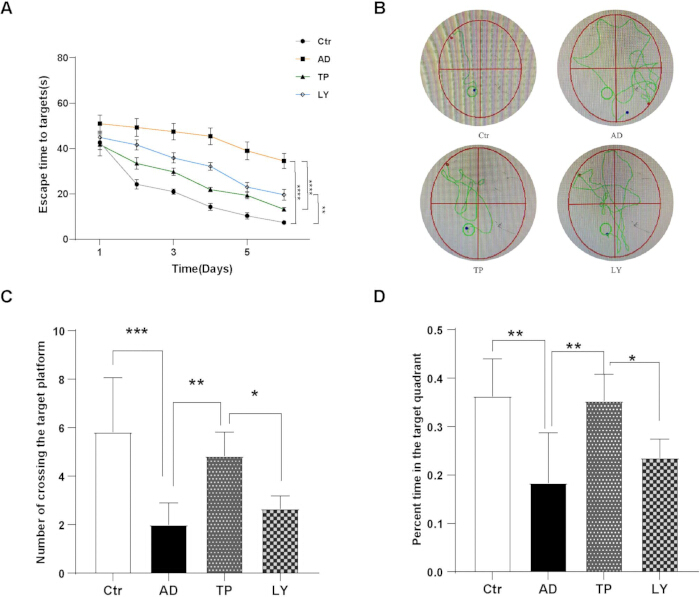
Figure 1: Triptolide partially improved spatial learning and memory deficits in Aβ1-42-induced AD-like mice. (A) Escape latency during the 6-day place navigation phase of the Morris water maze. (B) Representative swimming trajectories during the probe trial. (C) Number of crossings over the original platform location after platform removal. (D) Percentage of time spent in the target quadrant during the probe trial. Data are presented as mean ± SD. Escape latency was analyzed by two-way repeated-measures ANOVA, and probe trial data were analyzed by one-way ANOVA test. Ctr, control group; AD, Aβ1-42-induced AD-like model group; TP, triptolide-treated group; LY, LY294002 plus triptolide co-treatment group. n = 6 per group. Please click here to view a larger version of this figure.
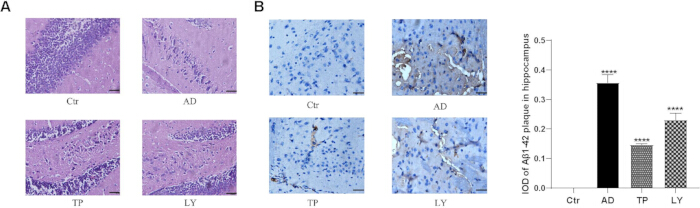
Figure 2: Triptolide attenuated hippocampal neuronal injury and Aβ deposition in Aβ1-42-induced AD-like mice. (A) Representative hematoxylin and eosin staining images of hippocampal sections from each group. Scale bar = 50µm. (B) Representative Aβ immunohistochemical staining images and quantitative analysis of Aβ-positive deposition in the hippocampus. Scale bar = 50µm. Data are presented as mean ± SD. Statistical analysis was performed using a one-way ANOVA test. Ctr, control group; AD, Aβ1-42-induced AD-like model group; TP, triptolide-treated group; LY, LY294002 plus triptolide co-treatment group. n = 3 per group. Please click here to view a larger version of this figure.
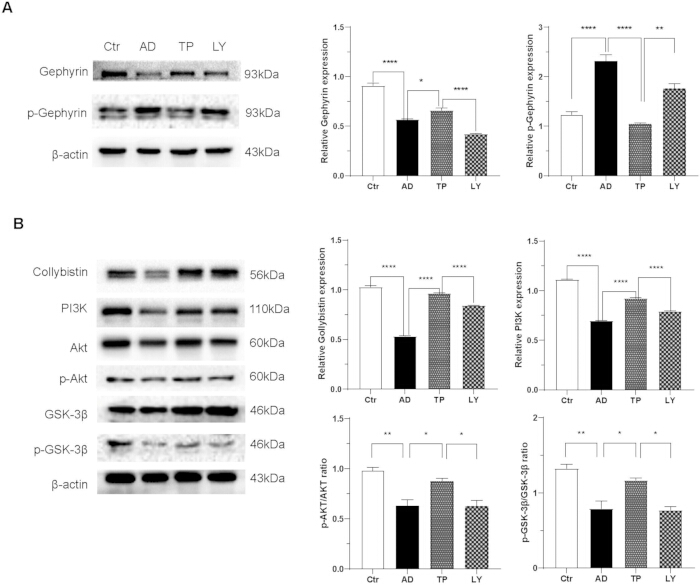
Figure 3: Triptolide restored hippocampal Gephyrin and Collybistin expression and modulated PI3K/Akt/GSK-3β-associated signaling in Aβ1-42-induced AD-like mice. (A) Representative Western blot images and quantitative analysis of total Gephyrin and phosphorylated Gephyrin expression in hippocampal lysates from each group. (B) Representative Western blot images and quantitative analysis of Collybistin, PI3K, Akt, phosphorylated Akt, GSK-3β, and phosphorylated GSK-3β in hippocampal lysates. Collybistin and PI3K were normalized to β-actin. Phosphorylated Akt and phosphorylated GSK-3β were quantified as p-Akt/Akt and p-GSK-3β/GSK-3β ratios, respectively. Data are presented as mean ± SD. Statistical analysis was performed using a one-way ANOVA test. Ctr, control group; AD, Aβ1-42-induced AD-like model group; TP, triptolide-treated group; LY, LY294002 plus triptolide co-treatment group. n = 3 per group. Please click here to view a larger version of this figure.
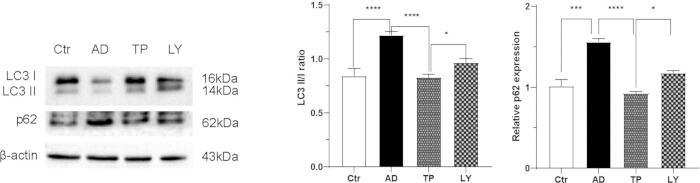
Figure 4: Triptolide attenuated autophagy-related protein abnormalities in the hippocampus of Aβ1-42-induced AD-like mice. Representative Western blot images and quantitative analysis of LC3-I/II and p62 expression in hippocampal lysates from each group. The LC3-II/I ratio was calculated by dividing the LC3-II band intensity by the LC3-I band intensity, and p62 expression was normalized to β-actin. Data are presented as mean ± SD. Statistical analysis was performed using a one-way ANOVA test. Ctr, control group; AD, Aβ1-42-induced AD-like model group; TP, triptolide-treated group; LY, LY294002 plus triptolide co-treatment group. n = 3 per group. Please click here to view a larger version of this figure.
Supplementary File 1: Uncropped Western blot images. The bands used for quantification are indicated, and molecular weight markers are shown where available.Please click here to download this file.
Supplementary File 2: Raw numerical values used for statistical analyses in this article. This file contains the raw numerical datasets used to generate the quantitative graphs in Figure 1–4, including Morris water maze behavioral measurements, Aβ immunohistochemistry quantification, and Western blot densitometry values.Please click here to download this file.
Discussion
Loading...
$$\rightleftharpoonup{xx}$$
$$\longleftharp{xx}$$,
$$\longrightharp{xx}$$,
The central mechanistic proposal of this study is that Aβ1-42-induced pathology suppresses PI3K/Akt signaling, reduces inhibitory phosphorylation of GSK-3β, promotes Gephyrin phosphorylation, decreases hippocampal Gephyrin and Collybistin expression, and contributes to the accumulation of autophagy-related proteins, whereas triptolide partially counteracts these changes through a PI3K/Akt/GSK-3β-associated pathway. This study shows that Aβ1-42-induced AD-like pathology is accompanied by impaired spatial learning and memory, hippocampal neuronal injury, increased Aβ deposition, reduced Gephyrin and Collybistin expression, enhanced Gephyrin phosphorylation, altered PI3K/Akt/GSK-3β signaling, and accumulation of autophagy-related proteins. Triptolide partially reversed these behavioral, histological, and molecular abnormalities, whereas LY294002 attenuated its effects. These findings support a model in which triptolide protects hippocampal inhibitory synapse-associated proteins, at least in part, through PI3K/Akt/GSK-3β-Mediated regulation of Gephyrin phosphorylation and changes in autophagy-related proteins. It should be noted that the Aβ1-42 intracerebroventricular injection model primarily reflects Aβ-induced neurotoxicity and AD-like pathology rather than the full chronic, multifactorial progression of human AD21.
Gephyrin and Collybistin are central components of inhibitory synaptic organization. Gephyrin anchors inhibitory neurotransmitter receptors at postsynaptic sites, while Collybistin promotes Gephyrin clustering and membrane localization. Reduced expression of these proteins may therefore disturb inhibitory synaptic stability and contribute to impaired hippocampal network function8. In this study, Aβ1-42 reduced hippocampal Gephyrin and Collybistin expression, while triptolide restored both proteins. The increase in phosphorylated Gephyrin provides a plausible mechanism for Gephyrin loss, as phosphorylation at Ser270 has been linked to Gephyrin dispersal, reduced clustering, and protein destabilization. The parallel reduction in PI3K expression, Akt phosphorylation, and inhibitory phosphorylation of GSK-3β suggests that Aβ1-42 weakens PI3K/Akt signaling and may increase GSK-3β activity, which is consistent with enhanced Gephyrin phosphorylation. Conversely, triptolide restored Akt phosphorylation, increased inhibitory phosphorylation of GSK-3β, and reduced Gephyrin phosphorylation, whereas LY294002 weakened these effects. These results suggest that triptolide may preserve Gephyrin and Collybistin expression through PI3K/Akt/GSK-3β-associated regulation of Gephyrin phosphorylation. However, because whole hippocampal lysates were used, these findings reflect changes in hippocampal protein abundance and phosphorylation rather than direct evidence of synaptic localization22,23.
Autophagy-related abnormalities may also contribute to the molecular changes observed in this model. Autophagy is important for neuronal proteostasis, but impaired autophagic degradation in AD can lead to the accumulation of autophagosomes and pathological protein substrates24,25. In the present study, Aβ1-42 increased both the LC3-II/I ratio and p62 expression, suggesting accumulation of autophagosome-associated LC3-II and autophagy-related substrates. Triptolide reduced both markers, whereas LY294002 partially reversed this effect, suggesting that triptolide may alleviate autophagy-related protein accumulation via a PI3K/Akt-dependent mechanism. Together with the changes in Gephyrin, Collybistin, and PI3K/Akt/GSK-3β signaling, these findings extend the understanding of triptolide’s neuroprotective effects beyond anti-inflammatory or general neuroprotective actions, suggesting that triptolide may also influence inhibitory synapse-associated scaffolding proteins, kinase signaling, and proteostasis-related pathways in Aβ-associated AD-like pathology26.
Several critical steps determine the success and reproducibility of this protocol. First, the aggregation state of Aβ1-42 should be carefully controlled and verified before injection, because peptide preparation can strongly influence pathological outcomes. Second, accurate stereotaxic injection into the lateral ventricles is essential; reflux, incorrect needle placement, or excessive injection speed may result in variable Aβ exposure and inconsistent behavioral or histological outcomes. Third, Morris water maze testing requires stable visual cues, consistent water temperature, and monitoring of swim speed to exclude motor impairment as a confounding factor. Fourth, histological and immunohistochemical quantification should be performed using predefined hippocampal regions of interest and blinded analysis. Finally, Western blot results depend on equal protein loading, appropriate gel concentration, efficient transfer, and use of uncropped blot images to confirm band specificity.
Several limitations should be considered. First, the Aβ1-42 injection model does not reproduce the chronic progression, tau pathology, vascular changes, or neuroimmune complexity of human AD. Second, although male and female mice were evenly distributed across groups, the study was not powered for sex-stratified analysis27. Third, whole hippocampal lysates cannot determine whether changes in Gephyrin and Collybistin occur specifically at inhibitory synapses. Fourth, the proposed PI3K/Akt/GSK-3β–Gephyrin mechanism remains associative, because GSK-3β activity and Gephyrin Ser270 phosphorylation were not directly manipulated. Finally, LC3-II/I and p62 are static Western blot readouts and cannot fully define dynamic autophagic flux. Future studies should use synaptosomal fractionation, immunofluorescent co-localization with inhibitory postsynaptic markers, GSK-3β gain- or loss-of-function approaches, Gephyrin Ser270 mutant constructs, and lysosomal inhibitor-based flux assays. Validation in chronic transgenic AD models, tau-related models, and human-derived neuronal systems will also be needed to determine whether this pathway is broadly relevant to AD pathology14. A further limitation is that the aggregation state of the exact Aβ1-42 preparation used for stereotaxic injection was not independently validated by Thioflavin T fluorescence, SDS-PAGE/Western blotting, or transmission electron microscopy. Although the peptide was prepared using a prolonged 37 °C incubation procedure commonly used to promote Aβ1-42 aggregation, batch-to-batch variation in aggregation state may affect pathological outcomes. Future studies should validate this workflow in chronic transgenic AD models, tau-related models, and human-derived neuronal systems. Additional experiments should include direct validation of Aβ1-42 aggregation status, stereotaxic injection accuracy assessment using dye or anatomical verification, synaptosomal fractionation, immunofluorescent co-localization with inhibitory postsynaptic markers, GSK-3β gain- or loss-of-function approaches, Gephyrin Ser270 mutant experiments, and lysosomal inhibitor-based autophagic flux assays. Dose-response and safety studies of triptolide are also needed before translational applications can be considered
Disclosures
Loading...
$$\rightleftharpoonup{xx}$$
$$\longleftharp{xx}$$,
$$\longrightharp{xx}$$,
Conflict of Interest: The authors declare no conflict of interest.
Acknowledgements
Loading...
$$\rightleftharpoonup{xx}$$
$$\longleftharp{xx}$$,
$$\longrightharp{xx}$$,
Not applicable.
Materials
| Name | Company | Catalog Number | Comments |
|---|---|---|---|
| Anti-Gephyrin antibody | 12681 | Peoteintech | Primary antibody for Western blot detection of total Gephyrin. |
| Anti-phosphorylated-Gephyrin antibody | 147011 | Synaptic Systems | Primary antibody for Western blot detection of phosphorylated Gephyrin. |
| Anti-Collybistin antibody | ab316963 | abcam | Primary antibody for Western blot detection of Collybistin. |
| Anti-PI3K antibody | 27921 | Peoteintech | Primary antibody for Western blot detection of PI3K. |
| Anti-Akt antibody | 9272 | Cell Signaling Technology | Primary antibody for Western blot detection of total Akt. |
| Anti-phosphorylated Akt antibody | 4060 | Cell Signaling Technology | Primary antibody for Western blot detection of phosphorylated Akt. |
| Anti-GSK-3β antibody | 12456 | Cell Signaling Technology | Primary antibody for Western blot detection of total GSK-3β. |
| Anti-phosphorylated GSK-3β antibody | 5558 | Cell Signaling Technology | Primary antibody for Western blot detection of phosphorylated GSK-3β. |
| Anti-β actin antibody | 66009 | Peoteintech | Loading-control antibody for Western blot normalization. |
| Anti-LC3 antibody | 11972 | Cell Signaling Technology | Primary antibody for Western blot detection of LC3-I and LC3-II. |
| Anti-p62 antibody | 5114 | Cell Signaling Technology | Primary antibody for Western blot detection of p62/SQSTM1. |
| Anti-Aβ1-42 antibody | ab150155 | abcam | Primary antibody for detecting Aβ1-42. |
| HRP-conjugated secondary antibody (anti-mouse IgG) | 7076S | Cell Signaling Technology | Secondary antibody for mouse primary antibodies in Western blotting. |
| HRP-conjugated secondary antibody (anti-rabbit IgG) | 7074S | Cell Signaling Technology | Secondary antibody for rabbit primary antibodies in Western blotting. |
| Anti-Aβ antibody | GT622, | Invitrogen, | Primary antibody for Aβ immunohistochemistry. |
| Aβ1-42 | 9001 | Shanghai Duma Technology Co., Ltd. | Amyloid-β peptide used to prepare the aggregation-inducing injection solution. |
| triptolide | BD9097 | Shanghai Bide Pharmaceutical. | Test compound administered intraperitoneally. |
| LY294002 | ab120243 | abcam | PI3K inhibitor used for the co-treatment group. |
| paraformaldehyde | P0099 | Beyotime | Fixative for transcardial perfusion and tissue post-fixation. |
| xylene | 108298 | Merck | Deparaffinization and tissue-clearing reagent. |
| ethanol | 100983 | Merck | Rehydration and dehydration reagent for paraffin sections. |
| propylene glycol | 294004 | Merck | Vehicle component for drug solution preparation. |
| protease and phosphatase inhibitors | P1045 | Beyotime | Lysis-buffer additive used to preserve proteins and phosphorylation states. |
| RIPA lysis buffer | P0013 | Beyotime | Lysis buffer for total protein extraction from hippocampal tissue. |
| EDTA antigen retrieval buffer | ab93680 | abcam | Heat-mediated antigen retrieval buffer for immunohistochemistry. |
| pentobarbital sodium | P3761 | Sigma | Anesthetic used for surgery and tissue collection. |
| Goat serum | ZLI-9056 | ZSGB-BIO | Blocking reagent for immunohistochemistry. |
| PVDF membranes | ISEQ00010 | Merck Millipore | Membrane used for Western blot transfer. |
| Morris water maze | VX80 | Shanghai Xinruan Information Technology Co., Ltd. | Behavioral apparatus and video-tracking system for spatial learning and memory assessment. |
| chemiluminescence imaging system | Doc™ XR+ 1708195 | Bio-rad | Imaging system for chemiluminescent Western blot signal acquisition. |
| stereotaxic apparatus | / | Stoelting Technology Co., Ltd | Apparatus used for stereotaxic intracerebroventricular injection. |
| BCA protein assay kit | P0006 | Beyotime | Colorimetric assay kit for total protein concentration measurement. |
| microplate reader | Synergy2 | Biotek | Absorbance reader used for BCA assay measurement. |
| ImageJ | version 9.0.1 | National Institutes of Health | Image-analysis software for histology, immunohistochemistry, and Western blot densitometry. |
| GraphPad Prism | version 8.5 | GraphPad Software | Statistical-analysis and graph-generation software. |
Reprints and Permissions
Request permission to reuse the text or figures of this JoVE article
Request Permission