Integrating analytical approaches from established pressure-controlled perfusion methods optimized a simple, low-cost syringe-pump system for assessing outflow facility and ocular compliance in mouse eyes.
Method Article
Measuring Outflow Facility And Ocular Compliance In Ex Vivo Mouse Eyes Using A Syringe-pump System
Cong Li*1 , Yuteng Li*2 , Pengchao Feng*1 , Zhijun Xing*3 , Chen Xin4 , Wei Lu1,5 , Markus H. Kuehn6,7 , Wei Zhu1
1Department of Pharmacology, School of Pharmacy, Qingdao University, 2Qingdao No.9 High School, 3Qingdao Hospital of Traditional Chinese Medicine, Qingdao Hiser Hospital, 4Beijing Institute of Ophthalmology, Beijing Tongren Eye Center, Beijing Tongren Hospital, Capital Medical University, 5Department of Histology and Embryology, School of Basic Medical Sciences, Bengbu Medical University, 6Department of Ophthalmology and Visual Sciences, University of Iowa, 7Center for the Prevention and Treatment of Visual Loss, Iowa City Veterans Affairs Medical Center
Opens in a new tab
In This Article
Summary
Loading...
$$\rightleftharpoonup{xx}$$
$$\longleftharp{xx}$$,
$$\longrightharp{xx}$$,
Abstract
Loading...
$$\rightleftharpoonup{xx}$$
$$\longleftharp{xx}$$,
$$\longrightharp{xx}$$,
Maintaining intraocular pressure (IOP) at a suitable and stable level is essential for ocular health. The biomechanical properties of the trabecular meshwork (TM), Schlemm’s canal (SC), and the entire corneoscleral shell play a crucial role in IOP homeostasis. Outflow facility (C) is a key parameter for evaluating the effectiveness of TM and SC in draining aqueous humor, while ocular compliance (ϕ) reflects the elasticity of the corneoscleral shell and transient outflow through TM and SC. Previously, a simple, cost-effective syringe-pump system was developed to assess C. However, using simple linear regression for in vivo data analysis has limitations in characterizing TM and SC function. In this study, the syringe-pump system was optimized by applying analytical approaches developed for established pressure-controlled ocular perfusion systems. The measured C and ϕ values in ex vivo eyes were compared with previously published perfusion-system values and were consistent with those reported ranges. In summary, this straightforward, low-cost syringe-pump system facilitates the evaluation of the biomechanical properties of TM and SC.
Introduction
Loading...
$$\rightleftharpoonup{xx}$$
$$\longleftharp{xx}$$,
$$\longrightharp{xx}$$,
Maintaining a suitable and stable level of intraocular pressure (IOP) is essential for ocular health1. Sustained elevation in IOP is the primary risk factor for glaucoma2,3. Long-term IOP fluctuations over months or years also contribute to vision loss4,5. Recent studies identified another form of IOP fluctuation, transient fluctuations caused by daily activities, which may also accelerate glaucoma progression6,7. For example, a 46-year-old man with a 20-year history of eyelid rubbing and a 52-year-old man who had rubbed his eyes for 10 years both exhibited accelerated optic disc damage8,9. These findings highlight the importance of timely, appropriate responses to the changes in IOP to minimize the risk of visual loss.
IOP is regulated by the balance between aqueous humor (AH) production and its drainage10. AH exits the eye primarily through the conventional and uveoscleral pathways11. In both normal and glaucomatous eyes, the conventional pathway comprising the trabecular meshwork (TM) and Schlemm’s canal (SC) is the principal source of outflow resistance that influences IOP homeostasis12,13,14. Therefore, the biomechanical properties of TM and SC are essential for the eye to adapt to changes in IOP15,16,17.
Recent technological advances have facilitated more accurate assessment of AH outflow. Invasive approaches, such as gravity-based perfusion and the syringe-pump system, have been developed to calculate outflow facility (C), which indicates how TM and SC regulate steady-state outflow18,19,20,21,22,23,24. Noninvasive methods, such as tonography25 and fluorophotometry26, have been used clinically to determine C in patients with glaucoma. However, most approaches are unable to assess TM and SC function specifically. For example, in the syringe-pump system, steady-state flow rate and pressure data are fitted using simple linear regression, and the slope is interpreted as a pressure-dependent C. However, this calculated C in live mice cannot accurately reflect AH outflow capacity through the conventional pathway because it is affected by AH secretion, uveoscleral outflow, and episcleral venous pressure, as described by the Goldmann equation.
To address this limitation, Millar et al. calculated AH inflow, conventional outflow, and uveoscleral outflow in the same mouse eye by multiple constant-flow measurements based on the assumption of absent AH inflow, no episcleral venous pressure, and unchanged uveoscleral outflow after euthanization22. In 2016, Sherwood et al. reported that uveoscleral outflow is 0 in ex vivo eyes at 0 mmHg, and then addressed the same question by introducing a power-law model using iPerfusion (a pressure-controlled perfusion system hereafter referred to as the perfusion system)27. The methodological advancements have clarified the distinct roles of TM and SC, enhancing understanding of their physiological functions in maintaining steady-state AH outflow.
In addition, the transient response of TM and SC to IOP fluctuations is essential for maintaining IOP homeostasis. To track this motion, Xin et al. developed phase-sensitive optical coherence tomography (OCT), which enables observation on a timescale of seconds28. Three-dimensional serial block-face scanning electron microscopy can examine this motion at an ultrastructural level29. However, image-based methods only estimate the biomechanical properties of TM and SC and do not yield actual values of transient AH drainage. In 2019, after developing iPerfusion, Sherwood et al. calculated ocular compliance (ϕ) as a key indicator of both corneoscleral elasticity and the transient response of TM and SC30. This advancement provides a quantitative parameter for assessing the transient behaviors of TM and SC in response to IOP fluctuations.
Based on these advances in assessing TM and SC function, this study improved the syringe-pump system by incorporating the power-law model for C calculation and integrating new methodologies to calculate ϕ. These measurements were compared with published data obtained using the perfusion system to evaluate whether the optimized syringe-pump system is suitable for assessing outflow facility and ocular compliance in ex vivo mouse eyes.
Protocol
Loading...
$$\rightleftharpoonup{xx}$$
$$\longleftharp{xx}$$,
$$\longrightharp{xx}$$,
All experiments were conducted in accordance with the ARVO Statement for the Use of Animals in Ophthalmic and Vision Research and the laboratory animal care and use guidelines of Qingdao University Medical Center (QDU-AEC-2022069).
1. Animal selection and handling
- Use 5-month-old mice with a 50% C57BL/6 and 50% BALB/c genetic background. Do not consider sex in the experimental design.
- Maintain mice under a 12 h/12 h light–dark cycle at 23 ± 2 °C and humidity of 50 ± 5%.
2. IOP measurement
- Anesthetize mice using 2.5% isoflurane with 80% (vol/vol) oxygen in a sealed chamber for 3.5 min.
CAUTION: Isoflurane is a volatile anesthetic. Perform anesthesia in a well-ventilated area or an appropriate containment system. - Transfer mice to an operating platform. Maintain anesthesia using a mask for an additional 30 s.
- Perform all measurements between 9:00 and 12:00. Record three measurements per eye. Calculate the average value for each data point.
3. System setup (Figure 1)
- Connect a 100 µL syringe to a syringe pump.
- Connect the syringe to a flowthrough pressure sensor.
- Connect the sensor to a data acquisition system.
NOTE: Ensure that the pressure sensor and eye holder are aligned at the same height to avoid pressure artifacts. - Fill the system with 1× phosphate-buffered saline (PBS). Remove all air bubbles.
- Place the eye in a holder with a circular recess (4–6 mm diameter). Ensure the eye is stable during cannulation. Position the pressure sensor and eye holder at the same height.
NOTE: Misalignment may introduce pressure measurement errors. The STL design file for the customized eye holder is provided as Supplemental File 1.
4. Software operation
- Pressure sensor calibration
- Open the data acquisition software. Load the calibration setup file. Select the calibration function.
- Connect the system to a water reservoir at two defined heights.
- Input measured and actual pressures using the conversion:
1 cm H2O = 0.735 mmHg
- Pump setup
- Open the module settings. Load the regulator configuration file.
- Select the pump device. Input the maximum flow rate and the syringe diameter.
- Data recording
- Start recording.
- Stop recording after each pressure step.
- Input the next pressure value.
- Restart recording.
5. Needle preparation
- Pull a glass micropipette according to an established protocol8.
- Grind the tip to an inner diameter of 80–100 µm. Polish the needle tip.
CAUTION: Handle glass needles with care to avoid injury. - Mount the needle on a micromanipulator. Connect the needle to the pressure transducer.
- Fill the needle with PBS.
- Position the needle tip at the same height as the pressure sensor.
- Resistance measurement
- Apply a pressure of 1 mmHg. Record the flow rate.
- Calculate needle resistance:

- Use needles with resistance between 0.01 and 0.5 mmHg/(µL/min).
6. System facility and compliance
- Facility measurement
- Perfuse the system with PBS. Seal the system using a three-way valve.
- Apply pressure steps of 6, 8, 10, 12, 14, and 16 mmHg.
- Record P and Q for 10 min at each step. Calculate average values from the last 5 min.
- Perform linear regression. Interpret the slope as a system facility.
- Validation
- Repeat measurements 3x.
- Confirm that the system facility is less than 0.2 nL/min/mmHg.
- Compliance measurement
- Introduce a 35 cm silicone tube into the system.
- Measure compliance with and without Teflon tubing.
- Calculate volume change using a discrete-volume method14.
- Determine system compliance as 4 nL/mmHg.
- Sensitivity check
- Confirm that the detectable system compliance is greater than 9.9 nL/mmHg.
7. Enucleation
- Euthanize mice using CO2 at a flow rate of 0.7 L/min for 3 min.
CAUTION: CO2 euthanasia must follow institutional guidelines to ensure humane endpoints. - Dissect extraocular muscles and optic nerves using sterile instruments. Enucleate the eyeballs.
- Immediately mount one eye in the holder at 35.5 °C.
- Store the contralateral eye at 4 °C.
- Measure both eyes using the same system.
8. Cannulation
- Needle insertion
- Insert the needle through the central cornea at a 45° angle.
- Advance the needle to a depth of 0.3–0.5 mm into the anterior chamber.
- Validation
- Stabilize the system. Confirm pressure fluctuation ≤ 0.4 mmHg over the final 5 min.
9. Ocular Cr
- Stabilize the eye at 8 mmHg for 30 min.
- Apply pressure steps of 6, 8, 10, 12, 14, and 16 mmHg.
- Apply a final step at 8 mmHg.
- Data collection
- Set maximum flow rate to 4 µL/min.
- Record P and Q for 10 min at each step.
- Analysis
- Plot P–T and Q–T curves. Calculate mean values from the last 5 min.
- Fit data to the power-law model27:
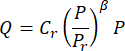
- Define Cr (after subtracting system facility) as ocular outflow facility.
- Set Pr = 8 mmHg.
- Define β as the nonlinear coefficient.
10. Ocular Φr
- Analyze P–T and Q–T curves during pressure increments. Identify the flow increase to Qmax and subsequent deceleration.
- Calculate the volume change between tp and tmax using the discrete-volume method30.
- Fit data to the modified Friedenwald equation30:
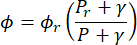
- Set Pr = 13 mmHg. Define Φr (after subtracting system compliance) as ocular compliance Φr,eye and γ as a material parameter.
Results
Loading...
$$\rightleftharpoonup{xx}$$
$$\longleftharp{xx}$$,
$$\longrightharp{xx}$$,
The performance of the optimized syringe-pump system was evaluated by comparing C and ϕ in 5-month-old mice with previously published values from pressure-controlled ocular perfusion studies. The normality of datasets in Figure 2F was assessed using the Shapiro–Wilk test, and statistical comparisons were performed using a two-tailed paired Student’s t-test.
As shown in Figure 2A–C, the IOP, Cr,eye, and Φr,eye were 14.0 mmHg (95% confidence interval: 13.2–14.8 mmHg), 5.2 nL/min/mmHg (95% confidence interval: 4.1–6.4 nL/min/mmHg), and 46.0 nL/mmHg (95% confidence interval: 40.6–51.3 nL/mmHg), respectively. The syringe-pump system produced outflow facility values comparable to those obtained using the perfusion system (Figure 2D)31,32,33,34.
Due to the limited availability of Φr,eye data in 5-month-old mice, data from mice aged 2 to 6 months were included for comparison (Figure 2E). The Φr,eye values obtained using the syringe-pump system fell within the reported range of values calculated using the perfusion system(35,36).
Previous studies using the perfusion system have reported anterior chamber (AC) deepening due to pressure imbalance between the anterior and posterior chambers during cannulation or pressure elevation37. To assess whether this phenomenon occurred in the present system, flow rate (Q) was measured before and after pressure increments. At 8 mmHg, the mean Q after pressure increments was lower than the value measured before the increments (n = 10 eyes; 0.04 vs. 0.06 µL/min; P = 0.0283; Figure 2F). This decrease is likely attributed to a higher pressure in the posterior chamber relative to the anterior chamber, which induces a reduction of the iridocorneal angle rather than AC deepening.
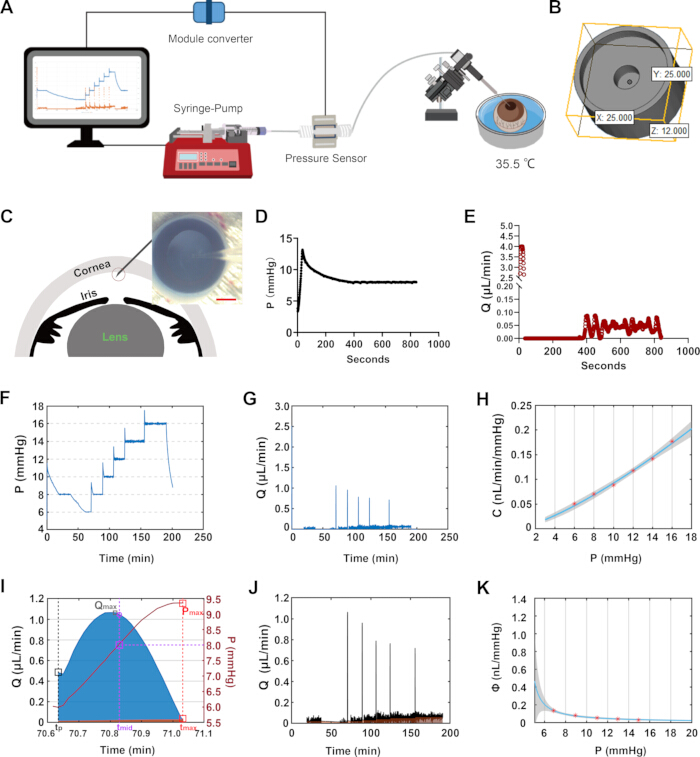
Figure 1: The optimized syringe-pump system. Schematic illustration of the (A) syringe-pump system, (B) three-dimensional eye holder, and (C) cannulation. (D,E) Representative pressure-time (P-T) and flow rate-time (Q-T) curves after cannulation. (F,G) Representative pressure-time (P-T) and flow rate-time (Q-T) curves throughout the entire procedure. (H) A representative Q-P curve with red data points fitted to the power-law model27, and with the shaded region indicating the 95% confidence interval. Each red point represents the average P and Q at each step. (I) Schematic illustration of the P-T curve (red line) and the Q-T curve (blue line) when pressure increases from 6 to 8 mmHg. According to the volume-pressure relationship30, the blue area under the Q-T curve represents the change in input volume, while the orange area represents the volume draining from the eye. The difference between these two areas indicates ocular compliance. tp: the time when the system starts; tmid: the time when Q reaches Qmax; tmax: the time when P reaches Pmax. (J) A representative Q-T curve with the calculated blue and orange areas. (K) A representative compliance-pressure curve with red data points fitted to the modified Friedenwald equation30. The shaded region indicates the 95% confidence interval. Please click here to view a larger version of this figure.
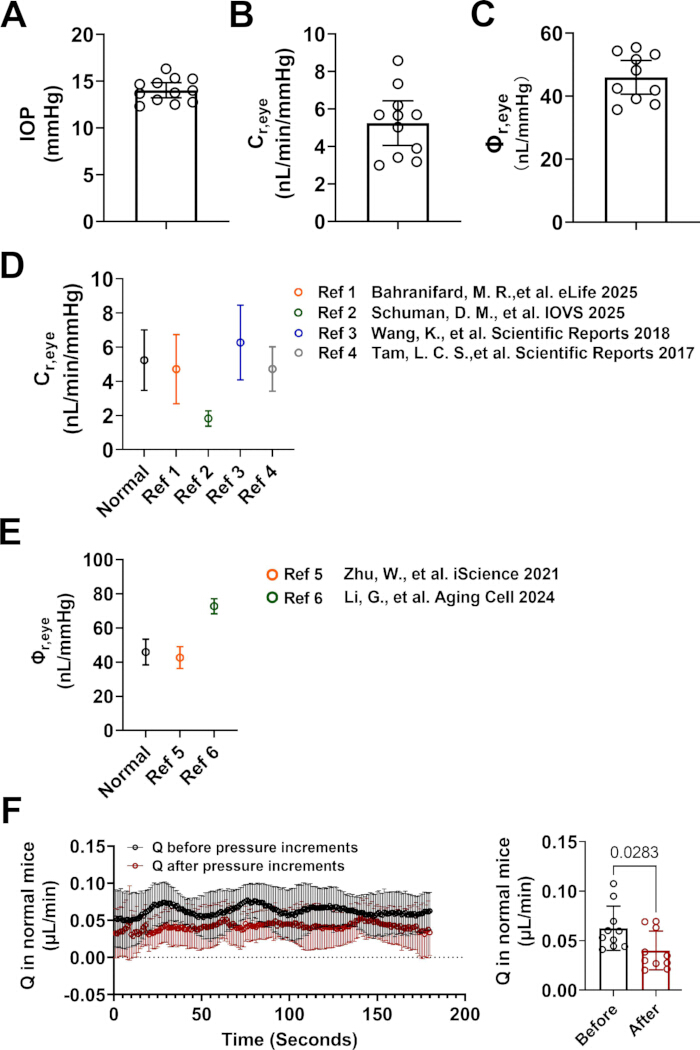
Figure 2: Outflow facility and ocular compliance in normal mice. (A-C) Each data point represents the measurement of one eye. The data were normally distributed (P = 0.13 for IOP; P = 0.14 for Cr, eye; P = 0.18 for Φr,eye). Data are expressed as the mean ± 95% confidence intervals. (D,E) Plots showing Cr, eye, and Φr,eye from the syringe-pump system (black) or from the perfusion system31,32,33,34,35,36. (F) Left panel: averaged Q before (black) and after (red) pressure increments. Right panel: scatter plot showing averaged Q in the 3 min before and after pressure increments. n = 10 eyes. Normality of Q values was assessed using the Shapiro–Wilk test, and P values were determined using a two-tailed paired Student’s t-test. Please click here to view a larger version of this figure.
Supplemental File 1. Design file for the eye holder. STL file of the customized eye holder used to stabilize the mouse eye during cannulation and perfusion with the syringe-pump system.Please click here to download this file.
Discussion
Loading...
$$\rightleftharpoonup{xx}$$
$$\longleftharp{xx}$$,
$$\longrightharp{xx}$$,
This study presents an optimized syringe-pump system for estimating outflow facility and ocular compliance in mouse eyes, yielding values consistent with those reported using pressure-controlled ocular perfusion systems. The present approach improves the accuracy of syringe-based measurements while maintaining a simple and accessible experimental setup. This combination of methodological refinement and accessibility may facilitate broader adoption in laboratories where more advanced systems are not readily available.
The primary advantage of this system is improved data accuracy, which enables the identification of key genes and molecular pathways involved in AH outflow and ocular biomechanics. This improvement can facilitate pharmacological interventions and genetic manipulations for glaucoma, and also support the monitoring of subtle age-related changes, early disease progression, and therapeutic responses over short periods. For example, accurate assessment of C has facilitated the discovery of mechanosensitive targets, such as TRPV4-mediated calcium influx in regulating TM mechanics and influencing AH outflow38, as well as the significant role of pressure-dependent nitric oxide release in tissue contractility and SC relaxation39. Precise calculation of ϕ has demonstrated subtle age-related reductions in ocular compliance, suggesting increased corneoscleral stiffness may enhance susceptibility to glaucomatous damage36.
An additional advantage of the system is its relatively low cost (~$9,000) and operational simplicity, which may improve accessibility for laboratories with limited resources. Unlike more complex systems, the present setup can be implemented using commonly available components, making it suitable for a wider range of experimental environments.
Furthermore, temporary storage at 4 °C did not significantly affect outflow facility (4 °C vs. control: 5.3 nL/min/mmHg vs. 5.2 nL/min/mmHg, P = 0.9) or ocular compliance (4 °C vs. control: 45.2 nL/mmHg vs. 46.4 nL/mmHg, P = 0.8). This stability may be attributed to ocular recovery during the 30 min stabilization period before pressure increments40. Therefore, using a single experimental setup allows measurement of both eyes.
This system also enables analysis of ocular responses during pressure decreases, which are less commonly examined. For example, compliance can be evaluated as pressure decreases from Pmax to a lower setpoint (e.g., 8 mmHg; Figure 1). This condition may partially reflect transient physiological events such as blinking, eye closure, or mechanical perturbations6. Analysis of these responses may provide additional insight into how the eye restores pressure equilibrium following transient fluctuations.
Several factors influencing measurement accuracy should be considered. Improper cannulation, including incorrect insertion angle or depth, may lead to leakage and artificially elevated outflow facility values. Inadequate calibration of the pressure sensor may introduce variability across experimental sessions. In addition, verification of system facility and compliance is essential to identify potential leaks or air bubbles and to establish a reliable baseline for measurements. Standardized operator training is therefore critical to minimize technical variability.
Long-term use of system components may also affect measurement accuracy. For example, prolonged use of tubing materials may alter system compliance, and pressure sensors may exhibit calibration drift over time. Periodic verification of system performance and replacement of components when deviations are detected are recommended to maintain measurement reliability.
Several limitations should be acknowledged. First, the system was not directly validated against the perfusion system under identical experimental conditions. Instead, comparisons were made using previously published data, which may introduce variability due to differences in experimental conditions, mouse strains, or operator techniques. Second, inherent hardware characteristics result in a transient drop in flow rate when the system is paused to adjust pressure settings, as well as an elevated flow rate immediately after restarting. Third, a short delay (~1 s) in pressure readings may affect temporal accuracy. Standardization of measurement timing may help mitigate these effects. Fourth, sex is identified as a key variable in the ARVO Statement, but it was not included in this experimental design because of the limited sample size. Fifth, the measurements of outflow facility and ocular compliance in this study do not accurately represent physiological conditions because the effects of episcleral venous pressure, aqueous humor production, and uveoscleral outflow are absent in ex vivo eyes. Furthermore, its sensitivity for detecting changes in outflow facility below 0.2 nL/min/mmHg or ocular compliance below 9.9 nL/mmHg remains untested. The accuracy of the optimized system has not yet been validated in other species. A comparative analysis using data from different operators is necessary but has not yet been conducted.
Finally, it remains unclear whether anterior chamber deepening occurs in this system. Future studies incorporating additional parameters, such as pupillary diameter or anterior segment imaging, may help clarify this issue. Eyes exhibiting evidence of structural changes should be excluded from analysis.
Taken together, noninvasive approaches cannot specifically estimate conventional outflow capability, and results may also be affected by ocular conditions25,26. To directly assess conventional outflow, invasive methods using ex vivo eyes have been established, such as measuring flow rate under hydrostatic pressure generated by a reservoir at a defined height. This gravity-based technique, first established by Bárány18, has been widely applied across many species and was recently optimized in the perfusion system. Compared with more complex pressure-controlled perfusion systems, the improved syringe-pump system may reduce operational complexity and cost while producing C and ϕ values that are consistent with published ranges.
Future research will focus on resolving the remaining limitations of the syringe-pump system, including conducting a head-to-head validation between different systems, incorporating sex as a variable, evaluating other species, comparing data acquired by multiple operators, and establishing a method to exclude eyes with AC deepening.
In conclusion, the optimized syringe-pump system improves the accuracy of outflow facility measurements while maintaining simplicity and accessibility. Incorporation of ocular compliance measurements provides additional insight into the biomechanical response of the eye to intraocular pressure fluctuations. This system may therefore serve as a practical tool for investigating ocular biomechanics in mouse models and potentially in other species.
Disclosures
Loading...
$$\rightleftharpoonup{xx}$$
$$\longleftharp{xx}$$,
$$\longrightharp{xx}$$,
The authors have no conflicts of interest to declare.
Acknowledgements
Loading...
$$\rightleftharpoonup{xx}$$
$$\longleftharp{xx}$$,
$$\longrightharp{xx}$$,
We thank Prof. Harald Stauss at the University of Iowa for developing the HemoLab software. This study was supported by the National Key Research and Development Program (2022YEF0132500), Qingdao Key Technology and Industrialization Project (23-1-4-xxgg-16-nsh), Taishan Scholar Youth Expert Program (tsqn202103055), Shandong Excellent Youth Science Fund (ZR2022YQ72), Ophthalmology Joint Project of Qingdao University.
Materials
| Name | Company | Catalog Number | Comments |
|---|---|---|---|
| Reagent | 1× PBS Buffer | Thermo Fisher Scientific | 10010023 |
| Isoflurane | Shenzhen Rewoode Life Sciences Co., Ltd., China | R640 | |
| Material | 100 μL High Precision Syringe | Hamilton | 1710 |
| Borosilicate Glass | Sutter, Novato, CA | BF100-50-10 | |
| Disposable sterile syringe | Fenglin Medical Devices Co., Ltd. Jiangxi, China | 10 ml | |
| Pressure Sensor | IcuMedical | PX26-015G | |
| Silicone tube | Runze Fluid Co., Ltd, Nanjing, China | N/A | |
| Transparent PTFE tube | Runze Fluid Co., Ltd, Nanjing, China | N/A | |
| Equipment | Flaming/Brown pipette puller | Sutter, Novato, CA | P-97 |
| Manual Micromanipulator | World Precision Instruments (WPI) | M3301 | |
| Metal bath | Beaver Biology, Suzhou, China | 2016C | |
| MicroForge | Narishige Scientific Instrument Lab., Tokyo, Japan | MF830 | |
| Micropipette Grinder | MPInstrument Co., Ltd., Wuhan, China | KDG-02 | |
| PZMIII Stereo Zoom Binocular Microscope | World Precision Instruments (WPI) | PZMIII | |
| Syringe-Pump | World Precision Instruments (WPI) | AL-1000 |
Reprints and Permissions
Request permission to reuse the text or figures of this JoVE article
Request Permission