Here we present a protocol for generating unmarked gene deletions and constructing genome-wide Tn5 insertion mutant libraries in Pectobacterium brasiliense, a phytopathogen responsible for potato blackleg and soft rot. This approach enables efficient reverse genetic analysis and facilitates the functional characterization of virulence-associated genes in this organism.
Method Article
A Toxin-Based Counter-Selection System for Markerless Gene Deletion and High-Density Tn5 Transposon Mutagenesis in Pectobacterium brasiliense
Bin Xie*1,2 , Minghua Xie*2 , Utpal Handique2 , Yulu Zhang3 , Doron Teper4 , Lei Li5 , Jian Wu2 , Xiaofeng Zhou1
1State Key Laboratory of Biocontrol, School of Agriculture and Biotechnology, Sun Yat-sen University, 2Potato Engineering ' Technology Research Center, Inner Mongolia University, 3Urumqi Experimental School, 4Department of Plant Pathology and Weed Research, Agricultural Research Organization-Volcani Institute, 5Chinese Academy of Agricultural Sciences, Institute of Vegetables and Flowers
Opens in a new tab
In This Article
Summary
Loading...
$$\rightleftharpoonup{xx}$$
$$\longleftharp{xx}$$,
$$\longrightharp{xx}$$,
Abstract
Loading...
$$\rightleftharpoonup{xx}$$
$$\longleftharp{xx}$$,
$$\longrightharp{xx}$$,
Pectobacterium brasiliense is a highly pathogenic bacterium responsible for potato tuber soft rot, blackleg, and aerial stem rot. Elucidation of its pathogenic mechanisms is essential for disease control; however, genetic tools for this organism remain limited. A toxin-based counter-selection system was developed to enable markerless gene deletion and high-density Tn5 transposon mutagenesis. The vmi480 toxin derived from the pLP12 plasmid was used as a counter-selection marker to construct the suicide vector pKV2. Using this system, the recA gene in the P. brasiliense SM strain was successfully deleted. The resulting recA mutant served as the parental strain for the construction of a Tn5 insertion library comprising over 12,000 mutants through conjugation with the RHO3 helper strain carrying pKV2-LLtnp. In this derivative plasmid, the vmi480 toxin was replaced with a hyperactive Tn5 transposase under the control of an outward-facing lac promoter to reduce polar effects. High-throughput tuber inoculation assays enabled the identification of pathogenicity-deficient mutants, including insertions in the type II secretion system, a key virulence determinant that mediates the secretion of plant cell wall-degrading enzymes. This platform supports functional genomics and facilitates the investigation of virulence mechanisms in this economically important pathogen.
Introduction
Loading...
$$\rightleftharpoonup{xx}$$
$$\longleftharp{xx}$$,
$$\longrightharp{xx}$$,
P. brasiliense is one of the most aggressive species within the Pectobacterium genus and is the causal agent of potato soft rot, blackleg, and aerial stem rot1. These diseases lead to an estimated 30% yield loss in potato, a crop ranking as the world’s third most important food source and a key component of China’s agricultural production system2. Despite its economic impact, the molecular mechanisms governing the pathogenicity of P. brasiliense remain insufficiently understood, largely due to the lack of efficient and reproducible genetic manipulation tools for this species3,4,5.
Functional genomic studies in many phytopathogenic bacteria rely on robust allelic exchange and transposon mutagenesis systems; however, comparable genetic tools for P. brasiliense remain limited or inefficient. In particular, effective counter-selection markers compatible with this species are scarce. While the sacB gene is widely utilized as a counter-selection marker for gene deletion in various bacteria, P. brasiliense could exhibit high tolerance up to 50% sucrose during the selection process5. This tolerance likely reflects a lack of sensitivity to toxins, possibly due to the enzymatic conversion of sucrose into sugar polymers. Furthermore, high sucrose concentrations may induce deleterious osmotic shock6. Additionally, efficient large-scale mutagenesis methods, such as Tn5 transposon insertion library construction, have not yet been well established for this organism.
To address these technical limitations, a toxin-based counter-selection system was developed, and a robust Tn5 mutagenesis screening workflow was established for P. brasiliense. Compared to traditional sucrose-based methods, this toxin-based approach offers distinct advantages, including enhanced selection stringency, improved specificity in identifying double-crossover events, and the elimination of confounding osmotic stress. Similar vmi480 toxin-antitoxin-based systems have been successfully implemented to overcome selection barriers in Vibrio species7. The established methodology is highly applicable to the high-throughput functional characterization of unknown genes and provides a versatile platform that can be adapted to other related soft-rot Pectobacteriaceae.
Protocol
Loading...
$$\rightleftharpoonup{xx}$$
$$\longleftharp{xx}$$,
$$\longrightharp{xx}$$,
1. Generation of a markerless recA deletion mutant in P. brasiliense
- Extract genomic DNA from P. brasiliense SM and pKV2 plasmid (pLP12 derived with modification of antibiotic selection marker and multiple cloning site) from the E. coli donor strain using standard DNA preparation procedures.
- Verify the quality and concentration of the extracted genomic DNA and plasmid DNA via agarose gel electrophoresis and NanoDrop spectrophotometry.
- Linearize plasmid pKV2 by double digestion with EcoRI and NheI at 37 °C for 5 h. Verify complete digestion by agarose gel electrophoresis and purify the linearized plasmid.
- Identify approximately 800 bp regions upstream and downstream of the recA gene using genome analysis software and design the corresponding primer pairs LBF/LBR and RBF/RBR (See Table of materials for all primers used in this study).
- Amplify both homologous arms under standard PCR cycling conditions and purify the PCR products. A 50 µL PCR typically yields 2.5 µg of product.
NOTE: The Tm values and GC content of primers may be adjusted by modifying the boundaries of the homologous regions. - Assemble the recombinant suicide plasmid pKV2-recA using a DNA assembly kit by ligating the purified homologous arms with the linearized plasmid backbone.
- Transform the assembly mixture into chemically competent E. coli S17-1 λpir cells by heat shock, recover the cells in LB medium, and plate onto LB agar containing kanamycin (LB + kan).
NOTE: The final concentrations used are 50 mg/mL kanamycin, 0.2% (w/v) glucose, 0.3% (w/v) arabinose, and 0.3 mM 2,6-diaminopimelic acid (DAP). - Validate positive clones by restriction digestion or colony PCR. (See Table of materials for all medium recipes used in this study).
- Extract the confirmed pKV2-recA plasmid and transform it into E. coli WM3064 using heat shock transformation (expected transformation rate > 106 cfu/µg).
- Select transformants on LB agar containing kanamycin and diaminopimelic acid (DAP).
- Perform biparental conjugation by mixing overnight cultures of the donor strain (WM3064 pKV2-recA) and the recipient P. brasiliense SM at a 1:1 (v/v) ratio, typically yielding 104 to 106 transconjugants per milliliter of donor and recipient cells.
- Wash the mixed culture once with sterile water, spot the mixture onto LB agar supplemented with kanamycin and DAP, and incubate at 28 °C for 48–72 h.
NOTE: If no transconjugants are observed, the donor-to-recipient ratio may be increased to 2:1 (v/v) to improve conjugation efficiency. If high background growth is observed, the residual DAP may be removed by washing the mixed culture twice with sterile water. - Recover the conjugation mixture and plate onto LB agar containing kanamycin and glucose (without DAP) for counter-selection.
- Pick 6–8 colonies and replica-plate them onto both LB + kan and LB + kan + arabinose.
- Select colonies that grow on LB + kan but fail to grow on LB + kan + arabinose; these are first-crossover candidates.
- Inoculate confirmed first-crossover strains into LB medium and incubate overnight. Plate the cultures onto LB agar containing L-arabinose to induce the second homologous recombination.
- Pick several colonies and replica-plate them onto LB + arabinose and LB + kan. Select colonies that grow on LB + arabinose but not on LB + kan; these are putative recA deletion mutants.
NOTE: If no colonies are observed following the second-crossover event, the potential essentiality of the target gene for bacterial growth should be evaluated. Alternatively, the upstream and downstream homologous regions may be extended to 1,200 bp to enhance homologous recombination efficiency. - Confirm the recA mutants by colony PCR using primer pair checkF/checkR designed to amplify across the recA promoter and terminator regions to verify the in-frame deletion of the target gene. Sequence the PCR product to confirm precise in-frame deletion of recA.
- Successful deletion is indicated by a reduction in the PCR product size, which should correspond to the wild-type fragment length minus the specific length of the deleted gene segment.
2. Construction of pKV2-LLtnp for Tn5 mutagenesis in P. brasiliense
- Amplify the Tnp transposase cassette from pMCS2-LLtnp8 using primer pair Tnp-F/Tnp-R, and amplify the oriγR6K Tn5 backbone from pKV2 using primer pair ori-F/ori-R. Purify all PCR products using a DNA purification kit.
- Assemble the purified Tnp cassette and oriγR6K Tn5 backbone using a DNA assembly kit. Transform the assembly mixture into chemically competent E. coli S17-1 λpir cells by heat shock, recover in LB medium, and plate onto LB agar supplemented with kanamycin (LB + kan).
- Validate positive clones by colony PCR using primer pairs ori-F/ori-R and Tnp-F/Tnp-R.
- Prepare E. coli RHO3 competent cells by inoculating a single colony into LB medium and incubating overnight. Dilute the culture 1:100 into fresh LB medium and grow to an OD600 of 0.6.
- Chill the culture on ice and wash the cells three times with pre-cooled 0.1 M CaCl₂. Resuspend the final pellet in 500 µL of pre-cooled 20% glycerol and store at −80 °C.
- Transform 10 µL of the validated recombinant plasmid (pKV2-LLtnp) into 100 µL of RHO3 competent cells by heat shock (expected transformation rate > 106 cfu/µg). Incubate on ice for 30 min, heat shock at 42 °C for 45 s, then cool on ice for 2 min.
- Add 500 µL LB medium and incubate at 37 °C for 1 h with agitation. Plate onto LB agar containing kanamycin and DAP (LB + kan + DAP) and incubate at 37 °C overnight.
- Validate positive RHO3 transformants by colony PCR using Tnp-F/Tnp-R.
3. Construction of the Tn5 transposon mutant library in P. brasiliense
- Grow P. brasiliense ΔrecA in LB medium at 28 °C and grow RHO3/pKV2-LLtnp in LB medium supplemented with kanamycin and DAP (LB + kan + DAP) at 37 °C. Allow both strains to reach an OD600 of 1.
- Mix 100 µL of P. brasiliense ΔrecA with 100 µL of RHO3/pKV2-LLtnp, centrifuge the mixture, discard the supernatant, and resuspend the washed pellet in 10 µL of LB medium.
- Spot the resuspended mixture onto an LB agar plate supplemented with DAP and incubate at 28 °C for 8 h to allow conjugation.
- Recover the conjugation mixture by rinsing the plate surface with 1 mL sterile LB medium. Centrifuge briefly, discard the supernatant, and wash the pellet twice with LB medium to remove DAP.
- Resuspend the washed pellet in 300 µL LB medium and plate 10x serial dilutions onto LB agar supplemented with kanamycin and glucose (LB + kan + glucose; without DAP) to select for transconjugants.
- Incubate the plates at 28 °C for 48 h. Pick five colonies and validate each by colony PCR using primer pairs ori-F/ori-R and Tnp-F/Tnp-R to confirm successful introduction of the Tn5 transposon. Sequence all five colonies to verify Tn5 insertion in the genome.
NOTE: Prior to the formal construction of the mutant library, six single colonies were randomly selected from the conjugation plate. Plasmid rescue assays were performed to determine the insertion sites, using two different restriction enzymes separately as two parallel control groups. A total of 36 sequencing reads were obtained. A single Tn5 insertion event was validated only when the six insertion sites for each individual colony were identical. - Estimate the mutant library capacity by repeating the conjugation step and counting colony numbers. Ensure that the total library size exceeds 12,000 colonies to achieve sufficient genomic coverage for downstream screening.
NOTE: If a low mutagenesis frequency is observed, the use of a hyperactive Tn5 transposase variant, such as the E54K/M56A/L372P mutant, should be considered to enhance transposition efficiency. - Transfer individual mutant colonies obtained in step 6 into 96-well plates containing 200 µL LB + kan per well. Incubate the plates overnight at 28 °C with shaking at 200 rpm.
- Add 133 µL of sterile 50% glycerol to each well to achieve a final concentration of approximately 20%. Seal and store the 96-well plates at −80 °C for long-term preservation.
4. High-throughput pathogenicity assays via potato tuber and pot inoculation
- Prepare potato tubers (cv. Favorita) by rinsing with sterile water, immersing briefly in 75% ethanol, and air-drying on a clean bench. Slice the tubers into ~8 mm-thick sections and place the slices in sterile 90-mm Petri dishes. Prepare at least three slices for biological replicates.
- Inoculate 1 µL of each mutant strain onto potato slices using a multi-channel pipette, following the plate layout of the 96-well mutant library. Include P. brasiliense ΔrecA as a positive control and LB + kan as a negative control.
- Incubate the inoculated potato slices at 28 °C for 7–8 h. Record mutants exhibiting visibly reduced maceration or smaller lesion areas compared with the ΔrecA control. Quantify the lesion area by measuring its length and width. Designate these as primary screening candidates.
NOTE: Ensure that OD600 values of mutant cultures and controls are normalized to 0.8 before inoculation. - For secondary screening, inoculate 5 µL of each candidate strain onto fresh potato slices (6 strains per slice, equal spacing). Prepare three biological replicates for each strain. Incubate at 28 °C for 7–8 h and record lesion sizes to confirm attenuation.
- Isolate strains showing consistent virulence reduction by streaking them onto LB + kan plates. Incubate the plates at 28 °C overnight and store validated reduced-virulence mutants at 4 °C for subsequent analysis.
- For whole-plant validation, inoculate potato stems with 150 µL of bacterial suspensions normalized to 1 x 10⁸ CFU/mL. Inject suspensions into the basal stem region using a sterile syringe. Observe disease development after 48 h. Perform biological replicates on three individual plants.
- Score disease severity using the blackleg disease grading scale (“a 6-point ordinal scale: 0, 1, 3, 5, 7, 9”) and calculate the Disease Index as:
- Grade 0: No disease symptoms on the entire plant.
- Grade 1: Stem lesions cover no more than 1/3 of the stem circumference, and/or individual leaves are wilted.
- Grade 3: Stem lesions cover no more than 1/2 of the stem circumference, and/or fewer than half of the leaves show mild wilting, and/or a few lower leaves have lesions.
- Grade 5: Stem lesions cover more than 1/2 of the stem circumference, and/or more than half of the leaves show mild wilting.
- Grade 7: Stem lesions encircle the entire stem circumference, and/or more than 2/3 of the leaves are wilted.
- Grade 9: All leaves of the plant are wilted or dead.

- Prepare long-term storage stocks of confirmed attenuated mutants by mixing cultures with an equal volume of sterile 50% glycerol to a final concentration of 25%, and store at -80 °C.
5. Identification of Tn5 insertion sites by plasmid rescue
- Grow the Tn5 mutant of interest and extract genomic DNA using a bacterial genomic DNA extraction kit. Quantify DNA concentration to ensure sufficient input for downstream digestion.
- Digest 1–2 µg of genomic DNA with EcoRI in a 100 µL reaction containing 10× reaction buffer and 5 µL of enzyme, and incubate the mixture at 37 °C for a minimum of 3 h. Verify digestion completion using an agarose gel.
- Precipitate the digested DNA by adding 1/10 volume of 3 M sodium acetate and 3 volumes of absolute ethanol. Mix thoroughly and incubate at -20 °C for 1 h.
- Centrifuge at 13,500 x g for 5 min and wash the pellet sequentially with 75% ethanol and absolute ethanol. Air-dry the pellet and resuspend in 17 µL of sterile water.
- Self-ligate the digested DNA fragments by adding 2 µL of 10× T4 DNA ligase buffer and 1 µL of T4 DNA ligase. Include a negative control (no ligase) to check background transformation. Incubate the ligation reaction at 4 °C overnight to promote circularization of restriction fragments.
- Transform 10 µL of the ligation mixture into chemically competent E. coli S17-1 λpir using heat shock transformation as described previously. Recover cells in LB for 1 h and plate onto LB agar containing kanamycin (LB + kan) to select for plasmids carrying the Tn5 cassette.
- Pick five random kanamycin-resistant colonies and extract plasmid DNA using a standard plasmid miniprep kit. Validate plasmid structure by digesting 500 ng of each plasmid with HindIII and incubating at 37 °C for 5 h. Analyze digestion patterns by agarose gel electrophoresis.
- If plasmid band sizes match expected fragment patterns, perform Sanger sequencing using the 5' ME primer located within the Tn5 ends.
- Identify the precise Tn5 insertion site by aligning the 50-100 bp flanking sequence downstream of the Tn5 5'-ME region against the P. brasiliense SM genome using BLAST or genome analysis software.
- Confirm that all five independent sequencing reactions for each mutant map to the same genomic coordinate (> 98% sequence identity).
- If any of the five sequencing reactions map to a different genomic coordinate, this indicates the presence of multiple Tn5 insertion sites in that mutant. In such cases, analyze additional colonies to determine all insertion positions. Alternatively, perform Southern blotting or whole-genome sequencing to obtain more definitive insertion-site mapping.
- Designate mutants with a single, consistent insertion site across all sequencing reactions as bona fide Tn5 single-insertion mutants suitable for downstream phenotypic or genetic analyses.
Results
Loading...
$$\rightleftharpoonup{xx}$$
$$\longleftharp{xx}$$,
$$\longrightharp{xx}$$,
To overcome the instability caused by the sucB mutation in P. brasiliense, the vmi480 toxin from plasmid pLP12 was employed as a counter-selection marker, and the modified suicide vector pKV2 (Figure 1A) was constructed by replacing the antibiotic resistance cassette and adjusting the cloning site configuration. To generate a markerless recA deletion mutant, ~800 bp left and right homologous arms of the recA gene were cloned into pKV2, followed by a two-step selection procedure to obtain double-crossover recombinants. PCR verification using primer pair LBF/RBR and Sanger sequencing showed an approximately 600 bp difference between the mutant and the wild type, confirming successful deletion of recA (Figure 1B).
Using the recA mutant strain as a recipient background, a Tn5 transposon mutant library was constructed, yielding over 12,000 individual mutants. High-throughput pathogenicity screening, using both potato tuber (Figure 2A,B) and whole-plant inoculation assays (Figure 2C), identified three mutants with markedly reduced virulence compared to the parental strain. As illustrated in Figure 2C, the disease indices were significantly lower in the mutant groups than in the wild-type control: SM (91%), 12-10-2 (24%), 14-5-6 (24%), and 43-10-7 (22.22%).
Plasmid rescue analysis further mapped the flanking sequence of the Tn5 5’ ME site (Figure 3A) to outC, outE and outF genes within the type II secretion system (T2SS) gene cluster (Figure 3B), which is implicated in the secretion of plant cell wall–degrading enzymes. These results provide experimental validation that the genetic manipulation platform established in this study is highly functional and capable of identifying key functional genes within the P. brasiliense genome.
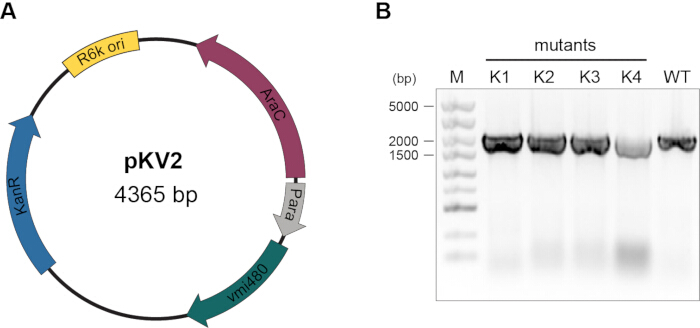
Figure 1: Verification of the markerless recA deletion in P. brasiliense. (A) Map of the pKV2 suicide vector used for markerless gene deletion in this study. (B) PCR verification of the recA deletion mutants following the second homologous recombination event. Please click here to view a larger version of this figure.
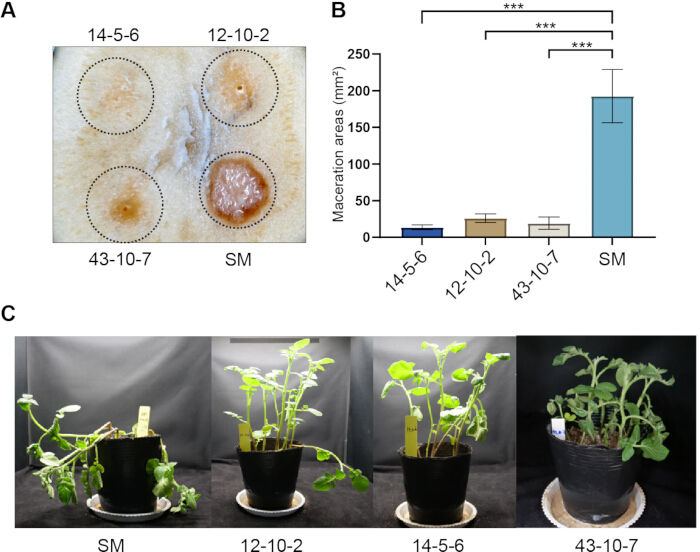
Figure 2: Pathogenicity assays of Tn5 insertion mutants. (A) Representative potato tuber maceration caused by the wild-type SM strain and three mutants (OD600 = 0.8) at 28 °C. Images were taken 8 h post-inoculation. (B) Quantification of maceration areas on potato slices 8 h post-infection. Means ± SE errors are indicated, n ≥ 3. The asterisk indicates a significant difference between SM and mutants in a One-way ANOVA test (P < 0.05). (C) Whole-plant pathogenicity assay showing aerial stem rot symptoms on 14-day-old potato seedlings inoculated with bacterial suspensions (108 CFU/mL). Photographs were taken two days post-inoculation. Please click here to view a larger version of this figure.
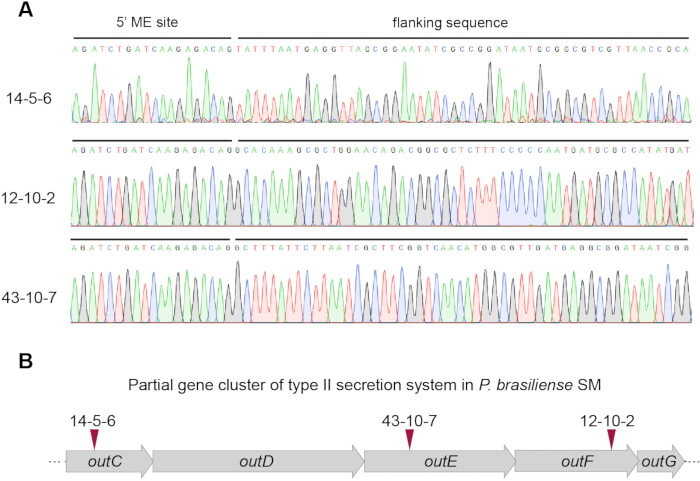
Figure 3: Mapping of Tn5 insertion sites via plasmid rescue. (A) Representative Sanger sequencing chromatograms showing the Tn5 5’ ME region and adjacent genomic sequences. (B) Partial gene cluster of the type II secretion system (T2SS) in P. brasiliense, indicating the genomic locations of Tn5 insertion sites identified in attenuated mutants. Please click here to view a larger version of this figure.
Discussion
Loading...
$$\rightleftharpoonup{xx}$$
$$\longleftharp{xx}$$,
$$\longrightharp{xx}$$,
The genetic manipulation strategy developed in this study provides an option for functional genomics in P. brasiliense, a primary soft-rot pathogen of potato9,10. By integrating a toxin-based counter-selection system into a suicide plasmid backbone, a markerless ΔrecA mutant was generated. This approach offers significant advantages over traditional sacB-based systems; while sacB often yields high background growth due to P. brasiliense's inherent sucrose tolerance and osmotic sensitivity, the toxin-based system provides enhanced selection stringency and higher specificity for double-crossover events. The resulting ΔrecA strain serves as a stabilized background that eliminates unspecific homologous recombination, thereby ensuring the genetic stability of subsequent transposon insertions. Furthermore, the deletion of the recA gene has no observed impact on virulence or fitness cost, a critical prerequisite for meaningful pathogenicity assays.
The success of this protocol depends on several critical steps, most notably optimizing conjugation efficiency. Given that efficiencies vary across donor backgrounds and plasmid sizes, achieving a high-density library requires precise donor-to-recipient ratios and, in some cases, the removal of residual diaminopimelic acid (DAP) to reduce background growth. The established Tn5 mutagenesis system, coupled with high-throughput tuber and whole-plant virulence assays, enabled the rapid identification of pathogenicity-deficient mutants. Notably, the identification of multiple attenuated mutants with insertions within the Type II Secretion System (T2SS) validates the biological relevance of the pipeline, as T2SS is central to the secretion of plant cell wall–degrading enzymes (PCWDEs) essential for soft-rot development11.
Looking forward, this genetic toolkit establishes a versatile platform with broad future applications. The core principles of the toxin-mediated allelic exchange and Tn5 workflow are theoretically adaptable to other recalcitrant soft-rot Pectobacteriaceae and related Enterobacteriaceae7. Furthermore, this methodology provides the necessary foundation for large-scale functional genomics studies, such as Tn-seq or high-throughput regulatory network mapping. Collectively, these tools facilitate deeper mechanistic studies into host adaptation and virulence regulation, providing a methodological roadmap for research on economically significant phytopathogens.
Practical troubleshooting remains vital for the execution of this workflow. Common technical challenges include low transconjugant recovery and difficulties in plasmid rescue. To address these, the protocol emphasizes the use of high-efficiency competent cells (>109cfu/µg) and the evaluation of gene essentiality if second-crossover colonies fail to emerge. Additionally, while plasmid rescue is a practical and accessible method for mapping insertion sites, researchers must consider the potential for multiple transposon insertions. In such instances, targeted gene deletion using the established counter-selection toolkit is required to definitively correlate a specific disruption with the observed phenotype.
Disclosures
Loading...
$$\rightleftharpoonup{xx}$$
$$\longleftharp{xx}$$,
$$\longrightharp{xx}$$,
The authors have no conflicts of interest to declare.
Acknowledgements
Loading...
$$\rightleftharpoonup{xx}$$
$$\longleftharp{xx}$$,
$$\longrightharp{xx}$$,
This work was supported by the National Natural Science Foundation of China (32472504 and 32561143029 to X.Z., and 32201914 to J.W.), the Guangdong Basic and Applied Basic Research Foundation (2024A1515012708 to X.Z.), the Nature Science Foundation of Inner Mongolia (2024QN03044 to U.H.), and the Pearl River Talent Program (2021QN02N151 to X.Z.).
Materials
| Name | Company | Catalog Number | Comments |
|---|---|---|---|
| Bacterial genomic DNA extraction kit | Extract bacterial genomic DNA | Tiangen | DP302-02 |
| Diaminopimelic acid | 0.3 mM in 1 L medium | Macklin | D836611-5g |
| DNA assembly kit | DNA assembly | Vazyme | C116-02 |
| DNA purification kit | DNA purification | Tiangen | DP214-02 |
| Kanamycin | 50 mg/mL | Aladdin | K103025-25g |
| Glucose | 0.2% (w/v) | Aladdin | G116305-250mg |
| Tryptone | 10% in 1 L medium | OXOID | LP0042B |
| Yeast Extract | 5% in 1 L medium | OXOID | LP0021B |
| NaCl | 10% in 1 L medium | Biofroxx | 1249KG001 |
| Agar | 15% in 1 L medium | Biofroxx | 8211GR500 |
| L-arabinose | 0.3% (w/v) | Aladdin | A106196-25g |
| Plasmid Miniprep kit | Extract plasmid | Tiangen | DP103-02 |
| EcoRI | Restriction endonuclease | Yugong Biotech | EG15536 |
| NheI | Restriction endonuclease | Yugong Biotech | EG15552 |
| HindIII | Restriction endonuclease | Yugong Biotech | EG15539 |
| T4 DNA ligase | Linear DNA self-circularization | Yugong Biotech | EG15205 |
| Centrifuge | RWD | M1324R | |
| PCR Thermal Cycler | BIO-GENER | GET3XG | |
| Digital camera | SONY | ILCE-7M4 | |
| Electrophoresis system | LY | DYY-6C | |
| Water bath | JOANLAB | WB100-1F | |
| Gel documentation system | Thermo Fisher Scientific | iBright CL750 | |
| Autoclave | Yamato | SQ510C | |
| Shaking incubator | ZHICHU | ZQZY-AR8 | |
| Constant temperature incubator | ZQ | DHP-9272 | |
| NanoDrop | Thermo Fisher Scientific | Lite Plus | |
| UV-Vis spectrophotometer | HITACHI | U-3900 | |
| Electroporator | BIO-RAD | MicroPulser | |
| Strains and plasmids | |||
| P. brasiliense SM | Potato pathogenic bacteria | Laboratory strain collection | |
| E. coli S17-1 λpir | E. coli competent cells | WEIDI | DL2010S |
| E. coli WM3064 | E. coli competent cells | BIO SCI BIO | C1039 |
| E. coli RHO3 | E. coli competent cells | Laboratory strain collection | |
| pKV2 | The modified suicide plasmid | Constructed in this study | |
| pLP12 | suicide plasmid | Laboratory strain collection | |
| pMCS2-LLtnp | Provide the fragment carrying Tn5 | Laboratory strain collection | |
| pKV2-LLtnp | The modified plasmid carrying the Tn5 fragment. | Constructed in this study | |
| Pimers | |||
| LBF (ctgaaagcttctgcaggagctcgctgacccaacaatccttgattaagatgaggc) | Customized | ||
| LBR (gttcagccaccattctgctcctgtcatgcggcgt) | Customized | ||
| RBF (caggagcagaatggtggctgaacgggttgtgac) | Customized | ||
| RBR (gatcctgcagcggagcggccgcgcagatcgcgggcaaggttagtc) | Customized | ||
| checkF (ctatgcgcttcgcataccgtgc) | Customized | ||
| checkR (gctcttgctcataattgtcctgg) | Customized | ||
| TnpF (ggaatctagaccttgagtcgatatcactctcgtttaatgctg) | Customized | ||
| TnpR (acaaacaaaaccaaattctgtacggcgaag) | Customized | ||
| ori-F (taatcgccttgcagcacatc) | Customized | ||
| ori-R (ggtatgagtcagcaacacct) | Customized | ||
| 5’ME (attcattaatgcagctggcacg) | Customized |
References
Loading...
$$\rightleftharpoonup{xx}$$
$$\longleftharp{xx}$$,
$$\longrightharp{xx}$$,
- Martínez-Prada, M. D. M., Curtin, S. J., Gutiérrez-González, J. J. Potato improvement through genetic engineering. GM Crops Food. 12 (1), 479-496 (2021).
- Wang, N., Reidsma, P., Pronk, A. A., de Wit, A. J. W., van Ittersum, M. K. Can potato add to China’s food self-sufficiency? The scope for increasing potato production in China. Eur J Agron. 101, 20-29 (2018).
- Sun, Y., et al. Comparative genomic and transcriptome analyses of two Pectobacterium brasiliense strains revealed distinct virulence determinants and phenotypic features. Front Microbiol. 15, (2024).
- Liu, Y., Filiatrault, M. J. Complete genome sequence of the necrotrophic plant-pathogenic bacterium Pectobacterium brasiliense 1692. Microbiol Resour Announc. 9 (12), e00037-20(2020).
- Moleleki, L. N., Pretorius, R. G., Tanui, C. K., Mosina, G., Theron, J. A quorum sensing-defective mutant of Pectobacterium carotovorum ssp. brasiliense 1692 is attenuated in virulence and unable to occlude xylem tissue of susceptible potato plant stems. Mol Plant Pathol. 18 (1), 32-44 (2017).
- Polyudova, T., Eroshenko, D., Korobov, V. The effect of sucrose-induced osmotic stress on the sensitivity of Escherichia coli to bacteriocins. Can J Microbiol. 65 (12), 895-903 (2019).
- Luo, P., He, X., Liu, Q., Hu, C. Developing universal genetic tools for rapid and efficient deletion mutation in Vibrio species based on suicide T-vectors carrying a novel counterselectable marker, vmi480. PLoS One. 10 (12), e0144465(2015).
- Lv, W., et al. Essential gene dynamics across distinct growth conditions in Xanthomonas citri. Hortic Res. 12 (9), uhaf160(2025).
- Toth, I. K., Bell, K. S., Holeva, M. C., Birch, P. R. J. Soft rot erwiniae: from genes to genomes. Mol Plant Pathol. 4 (1), 17-30 (2003).
- Mansfield, J., et al. Top 10 plant pathogenic bacteria in molecular plant pathology. Mol Plant Pathol. 13 (6), 614(2012).
- Pineau, C., et al. Structure-function analysis of pectate lyase Pel3 reveals essential facets of protein recognition by the bacterial type II secretion system. J Biol Chem. 296, 100305(2021).
Reprints and Permissions
Request permission to reuse the text or figures of this JoVE article
Request Permission