Mouse periosteal skeletal stem cells (SSCs) were isolated by FACS and cultured in vitro. A controllable experimental system was established to apply cyclic tensile mechanical stimulation to SSCs, resulting in decreased expression of the cellular senescence-associated genes, specifically p16 and p21.
Method Article
An In Vitro System for Applying Tensile Force to Skeletal Stem Cells Using a Cyclic Cell Stress Tension System
June 12th, 2026
Opens in a new tab
In This Article
Summary
Loading...
$$\rightleftharpoonup{xx}$$
$$\longleftharp{xx}$$,
$$\longrightharp{xx}$$,
Abstract
Loading...
$$\rightleftharpoonup{xx}$$
$$\longleftharp{xx}$$,
$$\longrightharp{xx}$$,
Bone is a major mechanosensitive organ that continuously responds to physical cues in the body. Although mechanical stimulation plays important roles in skeletal development, homeostasis, and injury repair, the specific responses of skeletal stem cells (SSCs) to mechanical stress remain incompletely understood. To address this question, we established an in vitro model to isolate mouse periosteal SSCs and apply mechanical stimulation. Mouse periosteal cells were first obtained by enzymatic digestion, and SSCs were subsequently isolated by fluorescence-activated cell sorting (FACS) based on established surface markers. After attachment to culture, SSCs were subjected to tensile mechanical stimulation using a cyclic cell stress-tension system. This system enables the reproducible application of tensile force to cultured cells and provides a platform for analyzing SSC responses to mechanical input. Using this approach, we found that the expression of the cellular senescence-associated genes p16 and p21 was markedly reduced in SSCs following mechanical stimulation. These findings suggest that tensile stimulation may influence senescence-related changes in SSCs under in vitro conditions. Overall, this protocol provides a useful and suitable platform for studying SSC behavior under mechanical stimulation and for investigating how mechanical cues affect SSC function.
Introduction
Loading...
$$\rightleftharpoonup{xx}$$
$$\longleftharp{xx}$$,
$$\longrightharp{xx}$$,
As the largest and most important supporting organ in the human body, the skeletal system not only provides attachment sites and protection for other organs, but also serves as the foundation for motor function. Therefore, the skeletal system is constantly exposed to various mechanical stimuli from both internal and external environments. Mechanical stimulation signals are equally crucial for bone development and functional maintenance. As early as 1893, it was proposed that there is a certain positive correlation between bone density and the mechanical force that bones bear, which is Wolff’s law1. In recent years, some studies have demonstrated the significance of the skeletal system bearing mechanical forces for the normal development of bones2,3,4,5. The response of the skeletal system to mechanical force partly depends on the cellular components in the bone6. Osteocytes account for 85% to 90% of the cellular components in the skeletal system. Due to their wide distribution and unique dendritic cell morphology, osteocytes are currently the most thoroughly studied type of skeletal cell in terms of mechanical response7,8. Besides the widely recognized ability of osteocytes to respond to mechanical force, skeletal precursor cells also play an indispensable role in it. It was found that the response of periosteal precursor cells to mechanical signals regulated their fate transformation, thereby influencing tissue damage repair9.
Skeletal stem cells (SSCs) are a type of tissue-specific stem cells with self-renewal ability, which can differentiate into mature bone cell types required for bone growth, maintenance and repair. In 2015, surface marker genes for mouse SSCs were identified10. Subsequently, multiple studies have also demonstrated that SSCs play a very important role in various aspects such as bone development, homeostasis maintenance, and bone injury repair11,12. Due to the characteristic of the skeletal system responding to mechanical forces, we can consider mechanical force signals as an indispensable factor in regulating the function of skeletal stem cells. To study the behavioral changes of SSCs under mechanical stimulation, we need to establish a suitable experimental system for applying mechanical force in vitro.
The main methods of in vitro mechanical stimulation for cells include fluid shear stress, compressive stress, tensile force, hydrostatic pressure, matrix stiffness and matrix topology6,13. Based on the surface marker genes of mouse SSCs, we obtained mouse periosteal SSCs by flow cytometry sorting, since the SSCs involved in fracture repair mainly originate from the periosteum14. Subsequently, an appropriate tensile force was applied to the periosteal SSCs through a cyclic cell stress tension system. After tensile force stimulation, cell samples can be obtained, and multi-omics analyses can be conducted, including transcriptome sequencing, proteome sequencing, and ATAC-seq. Therefore, establishing this protocol provides a solid foundation for studying SSC responses to mechanical stimulation.
Protocol
Loading...
$$\rightleftharpoonup{xx}$$
$$\longleftharp{xx}$$,
$$\longrightharp{xx}$$,
The mouse experiments in this protocol have all been approved by the Animal Care and Use Committee of Shanghai Institute of Biochemistry and Cell Biology, Chinese Academy of Sciences (SIBCB-S350-2312-41).
1. Isolation of periosteal cells in mice
- Place 4- to 6-week-old mice in a CO₂ euthanasia box and expose them to CO₂ continuously for 3 min until breathing stops.
- Disinfect the surface of the mice's bodies with 75% alcohol. Use ophthalmic scissors to separate the hind limbs. Then use pointed forceps and ophthalmic scissors to remove the skeletal muscles from the hind limbs, ensuring that the joint regions of the femur and tibia remain intact.
- Preserve the isolated bones in chilled PBS, and then coat both ends of the bones with low-melting agarose (5-10% in TAE buffer).
- Digest the femurs and tibias in minimum essential medium alpha (α-MEM) containing 1 mg/mL collagenase, 2 mg/mL dispase II, and 0.1 mg/mL DNase I at 37°C and 0.3 × g for 30 min twice. Collect the digested cells into the culture medium (α-MEM + 10% fetal bovine serum (FBS)).
- Filter the cell suspension through a 40 µm cell strainer and then centrifuge at 500 × g for 5 min to remove the supernatant.
- Resuspend the cell precipitate with red blood cell lysis buffer for 2 min and terminate the reaction with flow cytometry buffer (PBS + 2% FBS).
- Centrifuge the cells at 500 × g for 5 min and discard the supernatant. Resuspend the cells with flow cytometry buffer at 1 × 10⁷ cells/mL for cell sorting.
2. Fluorescence-activated cell sorting
- Stain the cell suspension with the following antibodies as follows: PerCP/Cy5.5-conjugated anti-mouse CD45, PerCP/Cy5.5-conjugated anti-mouse CD31, PerCP/Cy5.5-conjugated anti-mouse Ter119, FITC-conjugated anti-mouse 6C3/Ly-51, Brilliant Violet 605-conjugated anti-mouse CD90.2, PE/Cy7-conjugated anti-mouse CD105, APC-conjugated anti-mouse CD200.
- Dilute the above antibodies at a ratio of 1:500 and incubate them on ice for 30 min, protected from light.
- Wash the cells with flow cytometry buffer, and perform cell sorting with a fluorescence-activated cell sorter to obtain CD45- CD31- Ter119- CD90.2- 6C3- CD105- CD200+ SSCs. Collect the sorted SSCs with the culture medium. Analyze the acquired data with FlowJo v10.8.1 software.
- Expand the sorted SSCs in culture dishes with expansion medium in a 5% CO2 cell incubator. One passage could be performed before mechanical stimulation.
NOTE: Approximately 1 × 10⁵ periosteal SSCs can be obtained from each pair of 6-week-old mice.
3. Mechanical stimulation of SSCs
- Dilute the rat tail type I collagen in sterilized 0.02 M acetic acid to a final concentration of 0.15 mg/mL. This solution can be reused 3 times and should be kept at 4 °C.
- Add 1.5 mL of diluted Rat tail type I collagen to each well of the 6-well flexible-bottomed culture plate. After coating the plates for 1 h at room temperature, aspirate the excess collagen and wash the plates once with PBS for later use.
- NOTE: For immediate use, the plate should be rinsed with PBS to remove any residual acid. Before storage at 4 °C, the plate should be completely dried with the lid removed.
- Digest the cultured mouse periosteal SSCs, centrifuge at 500 × g for 5 min, resuspend the cell precipitate in the culture medium to achieve a cell density of 1 × 10⁵ cells/mL, add 2 mL of cell suspension to each well of the 6-well flexible-bottomed culture plate, and place it in the cell incubator.
- 24 h after seeding the cells, place the flexible-bottomed culture plate in the stretched base plate, and retain another cell flexible-bottomed culture plate as a control group without mechanical force stimulation.
- Set the parameters in the FX-6000 Version 1.0 software as follows: Stretch strength 8%, frequency 0.1 Hz, waveform as a square wave, waveform duty cycle 80%, and stretch duration for 12 h.
NOTE: There are four positions on the stretched base plate for placing a 6-well flexible-bottomed culture plate. If the cells required for the experiment are fewer than 4, the empty positions should be filled with new 6-well flexible-bottomed culture plates. After applying appropriate mechanical stimulation, SSCs can undergo functional tests, such as cell differentiation or proliferation, or samples can be extracted for multi-omics sequencing.
4. Real-time quantitative PCR (RT-qPCR)
- After the mechanical stimulation of the cells was completed, discard the culture medium, wash the cells once with PBS, extract total RNA with TRIzol Reagent, and perform RNA reverse transcription.
NOTE: After RNA extraction is completed, it can be stored at -80 °C. The cDNA obtained from reverse transcription can also be stored at -20 °C for subsequent testing. - Perform the RT-qPCR with a real-time PCR system. The primer sets used were as follows:
Hprt: forward 5’-GTTAAGCAGTACAGCCCCAAA-3’,
Hprt: reverse 5’-AGGGCATATCCAACAACAAACTT-3’,
p16: forward 5’-GGTCACACGACTGGGCGATT-3’,
p16: reverse 5’-GCACCGTAGTTGAGCAGAAGAG-3’,
p21: forward 5’-GCCTGGTTCCTTGCCACTTCTT-3’,
p21: reverse 5’-ATTACGGTTGAGTCCTAACTGCCATC-3’.
5. The effects of short-term treatment of mechanical stress
- Set the parameters in the FX-6000 Version 1.0 software as follows: Stretch strength 8%, frequency 0.1 Hz, waveform as a square wave, waveform duty cycle 80%. The cells are lysed with RIPA lysis buffer I (with phosphatase inhibitor cocktail and protease inhibitor cocktail) at 10 min and 60 min after mechanical tension stimulation.
- Perform the Western blot with Erk and p-Erk antibody.
Results
Loading...
$$\rightleftharpoonup{xx}$$
$$\longleftharp{xx}$$,
$$\longrightharp{xx}$$,
Following the implementation of this protocol, tensile force was successfully applied to periosteal SSCs of mice. Firstly, SSCs were obtained from the periosteum of mice by flow cytometry. The flow cytometry results showed that the proportion of SSCs at the periosteum accounted for nearly 30% of Lin- (CD45-, CD31-, Ter119-) CD90.2- 6C3- (Figure 1), which was much higher than that in the bone marrow. Given the significant role of periosteal SSCs in bone development and fracture repair14,15. It is necessary to fully analyze the changes in periosteal SSCs after responding to mechanical stimulation.
To detect the changes that occurred in periosteal SSCs after mechanical force stimulation, the expression of cellular senescence marker genes was detected, as primary cells are prone to cell senescence during culture passage16. The results showed that after mechanical stimulation, the expression of cellular senescence marker genes p16 and p21 in periosteal cells was found to be significantly downregulated (Figure 2A–B). Short-term treatment can increase the phosphorylation level of Erk in skeletal stem cells; however, longer treatment duration does not further increase the phosphorylation level of Erk (Figure 2C).
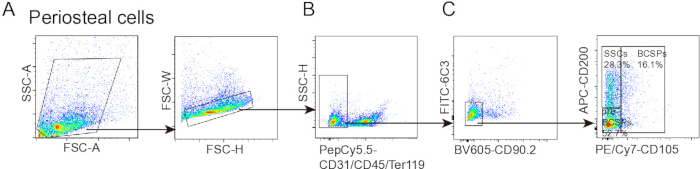
Figure 1: Fluorescence-activated cell sorting of periosteal SSCs. (A) Singlet gating on SSC-A vs FSC-A and FSC-W vs FSC-H. (B) Lin- cell gating within the singlet population using CD31, CD45, and Ter119 antibodies. (C) SSC gating within the Lin⁻ population was performed using 6C3, CD90.2, CD105, and CD200 antibodies. The proportions of SSCs, pre-BCSPs, and BCSPs in the Lin⁻ 6C3⁻ CD90.2⁻ population were 28.3%, 52.7%, and 16.1%, respectively. Abbreviations: BCSP = bone cartilage stromal progenitor. Please click here to view a larger version of this figure.
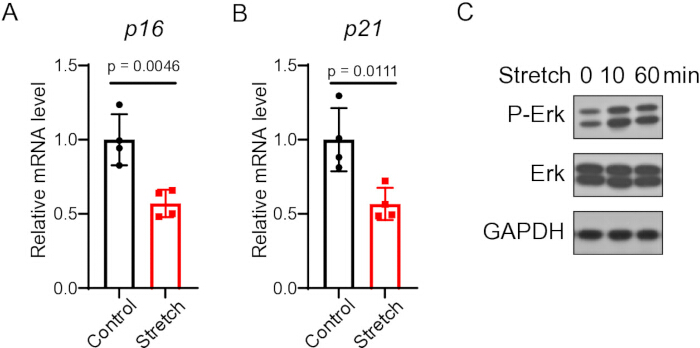
Figure 2: Detection of cell senescence marker gene expression in periosteal SSCs. (A, B) After mechanical force stimulation, the mRNA expression of senescence marker genes p16 (A) and p21 (B) in mouse periosteal SSCs decreased significantly. Data are presented as the means ± SD. n = 4 refers to biological replicates. Unpaired t-test. (C) The protein levels of p-ERK and ERK were detected in cells at 10 min and 60 min after the application of mechanical tension stimulation. Please click here to view a larger version of this figure.
Discussion
Loading...
$$\rightleftharpoonup{xx}$$
$$\longleftharp{xx}$$,
$$\longrightharp{xx}$$,
In recent years, skeletal stem cell marker genes from different parts of bones have been continuously discovered11,12,17. However, research on the direct regulation of SSCs function still needs to be deepened, especially in the aspect of mechanical force stimulation regulation. So far, research on the mechanical regulatory effects of skeletal stem cells/precursor cells has mainly been based on the construction of Piezo1 knockout mouse models9,18, and there is still a lack of direct evidence to reveal what changes have occurred in SSCs under mechanical stimulation. The cyclic stretch system can provide precise, controllable, repeatable, static, or periodic stress changes for cells cultured in vitro, making it a very suitable experimental platform for applying mechanical force to cells. Many studies have utilized the cyclic stretch system to investigate the cellular responses of osteoblasts, osteocytes, chondrocytes, tenocytes, ligament cells, and myoblasts under mechanical stimulation19. Here, mouse periosteal SSCs were collected by flow cytometry sorting, and then mechanical stimulation was applied with the cyclic stretch system, providing a reliable experimental system for further research on the regulation of SSCs' function by mechanical stimulation. The advantage of this protocol is that it can apply specific and controllable mechanical stimulation to SSCs, eliminating the interference of other bone cell types in animal models, such as exercise models and models that directly apply mechanical loading to bones20,21.
The first key point of this protocol is to obtain a cell suspension with sufficient viability for cell sorting. During bone digestion on a shaker, the rotation speed should not exceed 0.5 × g. This parameter can be adjusted based on experimental outcomes. In some cases, the speed may be reduced to 0.1 × g, with a corresponding increase in the digestion time. Second, due to differences in equipment and experimental systems among laboratories, researchers may need to further optimize the parameters used for mechanical stimulation based on our protocol in order to achieve the desired results.
One limitation of this protocol is that it requires a relatively large number of SSCs (2 × 10⁵ cells per well), whereas SSCs are present in bone tissue at low abundance. Although this limitation can be partially addressed by increasing the number of experimental mice, such a strategy may restrict its broader applicability. For future clinical translation of mechanically stimulated SSCs, the development of an appropriate in vitro expansion system that preserves SSC properties in a stable manner will be essential, analogous to approaches used for the in vitro expansion of hematopoietic stem cells22.
In conclusion, a protocol for the direct application of mechanical stimulation to mouse periosteal SSCs is presented, and mechanical stimulation was found to reduce the expression of p16 and p21 in SSCs. It is worth noting that short-term treatment enhances Erk phosphorylation in skeletal stem cells, whereas prolonged stimulation does not further elevate this phosphorylation level. Therefore, observing distinct biological effects requires trying different durations or magnitudes of mechanical stimulation. The implementation of this protocol may promote further investigation into the regulation of SSC function by mechanical force and improve understanding of the mechanistic network through which the skeletal system responds to mechanical signals.
Disclosures
Loading...
$$\rightleftharpoonup{xx}$$
$$\longleftharp{xx}$$,
$$\longrightharp{xx}$$,
The authors declare no competing interests.
Acknowledgements
Loading...
$$\rightleftharpoonup{xx}$$
$$\longleftharp{xx}$$,
$$\longrightharp{xx}$$,
We thank the core facility for flow cytometry and the animal core facility of Shanghai Institute of Biochemistry and Cell Biology, Chinese Academy of Sciences. The work was supported by the National Natural Science Foundation of China (32471190, 82502903) and Hainan Provincial Foreign Experts Program (506068033010).
Materials
| Name | Company | Catalog Number | Comments |
|---|---|---|---|
| α-MEM | Corning | 10-022-CV | periosteal cells Isolation |
| APC anti-mouse CD200 | BioLegend | 123809 | SSCs sorting |
| BioFlex 6-Well Culture Plate | Flexcell | BF-3001A | Cell culture |
| Brilliant Violet 605 anti-mouse CD90.2 | BioLegend | 140317 | SSCs sorting |
| Collagenase | Sigma | C0130 | periosteal cells Isolation |
| Dispase II | Sigma | D4693 | periosteal cells Isolation |
| DNase I | Sigma | DN25 | periosteal cells Isolation |
| Fetal Bovine Serum | Gibco | A5356701 | SSCs sorting |
| FITC anti-mouse 6C3/Ly-51 | BioLegend | 108305 | SSCs sorting |
| Flexcell Tension System | Flexcell | Flexercell FX-6000 | Cell tension |
| Flow Cytometry Sorter | BD | BD FACSAria Fusion | SSCs sorting |
| MesenCult Expansion Kit (Mouse) | Stem cell | 05513 | Cell culture |
| PE/Cy7 anti-mouse CD105 | BioLegend | 120409 | SSCs sorting |
| PerCP/Cy5.5 anti-CD31 | BioLegend | 102522 | SSCs sorting |
| PerCP/Cy5.5 anti-CD45 | BioLegend | 103132 | SSCs sorting |
| PerCP/Cy5.5 anti-mouse TER-119 | BioLegend | 116228 | SSCs sorting |
| PrimeScript RT Reagent Kit | TaKaRa | RR037A | RT-qPCR |
| Rat tail type I collagen | Corning | 354236 | Cell culture |
| real-time PCR system | Thermo Fisher Scientific | QuantStudio 1 Plus | RT-qPCR |
| red blood cell lysis buffer | Beyotime | C3702 | periosteal cells Isolation |
| TRIzol | Sigma | T9424 | RT-qPCR |
| Phosphatase Inhibitor Cocktail II | MCE | HY-K0022 | WesterBlot |
| RIPA Lysis Buffer I | Sangon Biotech | NO. C500005 | WesterBlot |
| Protease Inhibitor Cocktail | MCE | HY-K0010 | WesterBlot |
| p44/42 MAPK (Erk1/2) Antibody | Cell Signaling Technology | 9102 | WesterBlot |
| Phospho-p44/42 MAPK (Erk1/2) (Thr202/Tyr204) (D13.14.4E) Rabbit Monoclonal Antibody | Cell Signaling Technology | 4370 | WesterBlot |
References
Loading...
$$\rightleftharpoonup{xx}$$
$$\longleftharp{xx}$$,
$$\longrightharp{xx}$$,
- Wolff, J. Das Gesetz der Transformation der Knochen. Deutsche Medizinische Wochenschrift. 19, 1222-1224 (1893).
- Li, X., et al. Stimulation of Piezo1 by mechanical signals promotes bone anabolism. eLife. 8, 49631(2019).
- Sun, W., et al. The mechanosensitive Piezo1 channel is required for bone formation. eLife. 8, 47454(2019).
- Wang, L., et al. Mechanical sensing protein PIEZO1 regulates bone homeostasis via osteoblast-osteoclast crosstalk. Nat Commun. 11, 282(2020).
- Zhou, T., et al. Piezo1/2 mediate mechanotransduction essential for bone formation through concerted activation of NFAT-YAP1-ß-catenin. eLife. 9, 52779(2020).
- Wang, L., et al. Mechanical regulation of bone remodeling. Bone Res. 10, 16(2022).
- Qin, L., Liu, W., Cao, H., Xiao, G. Molecular mechanosensors in osteocytes. Bone Res. 8, 23(2020).
- Uda, Y., et al. Osteocyte Mechanobiology. Curr Osteoporos Rep. 15, 318-325 (2017).
- Wang, L., et al. Piezo1 balances the osteogenic-tenogenic plasticity of periosteal progenitor cells through the YAP pathway. Cell Rep. 44, 115630(2025).
- Chan, C. K., et al. Identification and specification of the mouse skeletal stem cell. Cell. 160, 285-298 (2015).
- Feng, H., et al. Skeletal stem cells: origins, definitions, and functions in bone development and disease. Life Med. 1, 276-293 (2022).
- Yuan, G., et al. Skeletal stem cells in bone development, homeostasis, and disease. Protein Cell. 15, 559-574 (2024).
- Wang, Y. K., Chen, C. S. Cell adhesion and mechanical stimulation in the regulation of mesenchymal stem cell differentiation. J Cell Mol Med. 17, 823-832 (2013).
- Jeffery, E. C., et al. Bone marrow and periosteal skeletal stem/progenitor cells make distinct contributions to bone maintenance and repair. Cell Stem Cell. 29, 1547-1561 (2022).
- Liu, Y. L., et al. Fibrous periosteum repairs bone fractures and maintains the healed bone throughout mouse adulthood. Dev Cell. 59, 1192-1209 (2024).
- Hu, H., et al. ZKSCAN3 counteracts cellular senescence by stabilizing heterochromatin. Nucleic Acids Res. 48, 6001-6018 (2020).
- Li, Q., Xu, R., Lei, K., Yuan, Q. Insights into skeletal stem cells. Bone Res. 10, 61(2022).
- Shen, B., et al. A mechanosensitive peri-arteriolar niche for osteogenesis and lymphopoiesis. Nature. 591, 438-444 (2021).
- Yu, H. S., et al. Impact of mechanical stretch on the cell behaviors of bone and surrounding tissues. J Tissue Eng. 7, 2041731415618342(2016).
- Chang, X., Xu, S., Zhang, H. Regulation of bone health through physical exercise: Mechanisms and types. Front Endocrinol (Lausanne). 13, 1029475(2022).
- Ma, Q., et al. Significance of mechanical loading in bone fracture healing, bone regeneration, and vascularization. J Tissue Eng. 14, 20417314231172573(2023).
- Sakurai, M., Ishitsuka, K., Becker, H. J., Yamazaki, S. Ex vivo expansion of human hematopoietic stem cells and clinical applications. Cancer Sci. 115, 698-705 (2024).
Reprints and Permissions
Request permission to reuse the text or figures of this JoVE article
Request Permission