This retrospective cohort study evaluated whether a structured clinical pathway for rehabilitation nursing was associated with improved swallowing recovery, fewer complications, and shorter hospitalization compared with conventional care in stroke patients with dysphagia.
Research Article
Effectiveness of Clinical Pathway-Based Rehabilitation Nursing on Swallowing Function in Stroke Patients With Dysphagia: A Retrospective Cohort Study
Opens in a new tab
In This Article
Summary
Loading...
$$\rightleftharpoonup{xx}$$
$$\longleftharp{xx}$$,
$$\longrightharp{xx}$$,
Abstract
Loading...
$$\rightleftharpoonup{xx}$$
$$\longleftharp{xx}$$,
$$\longrightharp{xx}$$,
Dysphagia after stroke increases the risk of aspiration pneumonia, malnutrition, and prolonged hospitalization. Standardized nursing pathways may improve care delivery, but real-world evidence remains limited. This retrospective cohort study, reported in accordance with the Strengthening the Reporting of Observational Studies in Epidemiology (STROBE) statement, included 210 adult stroke patients with dysphagia treated at Suzhou Hospital, Affiliated Hospital of Medical School, Nanjing University, from January 2020 to May 2025. Patients received either clinical pathway-based rehabilitation nursing (n = 106) or conventional care (n = 104). Primary outcomes were improvement in swallowing function at discharge and aspiration pneumonia. Secondary outcomes included nutritional status, functional recovery, ICU stay, overall complications, and length of hospital stay. Group differences were assessed using chi-square tests, independent-samples t tests, or Mann–Whitney U tests, and multivariable logistic regression was used to identify independent factors associated with swallowing improvement. Compared with conventional care, pathway-based care was associated with a higher rate of swallowing improvement (72.6% vs. 51.9%, P < 0.001), a lower incidence of aspiration pneumonia (7.5% vs. 15.4%, P = 0.015), higher functional recovery at discharge (Barthel Index ≥70: 68.9% vs. 49.0%, P < 0.001), a shorter ICU stay (1.7 ± 1.0 vs. 2.5 ± 1.2 days, P = 0.002), a lower overall complication rate (21.7% vs. 31.7%, P = 0.029), and a shorter hospital stay (35.7 ± 7.8 vs. 47.9 ± 10.1 days, P < 0.001). In multivariable analysis, clinical pathway-based nursing remained independently associated with swallowing recovery (adjusted OR = 2.12, 95% CI, 1.38–3.27; P < 0.001). Clinical pathway-based rehabilitation nursing was associated with improved swallowing outcomes and fewer in-hospital complications in this retrospective cohort, supporting further prospective multicenter evaluation and integration into standardized stroke rehabilitation practice.
Introduction
Loading...
$$\rightleftharpoonup{xx}$$
$$\longleftharp{xx}$$,
$$\longrightharp{xx}$$,
Stroke remains a major cause of death and long-term disability worldwide, and dysphagia is one of its most frequent and clinically important complications1,2,3,4,5,6. Swallowing impairment after stroke is associated with aspiration pneumonia, malnutrition, dehydration, prolonged hospitalization, and reduced functional recovery4,5,6. Early, coordinated management is therefore essential in routine stroke care.
Conventional nursing management of post-stroke dysphagia often includes dietary modification, positioning, basic swallowing exercises, and general aspiration precautions. However, in routine practice, these measures may be delivered inconsistently, with variable timing, intensity, and documentation. Clinical pathways aim to reduce such variability by providing evidence-based, multidisciplinary, and time-linked care plans that standardize assessment, intervention, reassessment, and discharge preparation7,8,9. Although pathway-based approaches have shown promise in stroke care, evidence specifically focused on swallowing rehabilitation nursing remains limited, especially from real-world retrospective cohorts7,8,9.
Clinical pathway-based rehabilitation nursing represents a structured, process-oriented approach designed to standardize dysphagia management through predefined assessment, intervention, and reassessment steps. The overall goal of this approach is to improve the consistency and timeliness of swallowing rehabilitation, thereby reducing preventable complications and enhancing functional recovery. Compared with conventional care, which is often delivered variably across providers and settings, pathway-based models integrate multidisciplinary coordination, explicit decision rules, and continuous monitoring into routine clinical workflows7,8,9. Previous studies have shown that structured care pathways and checklist-based interventions can improve adherence to best practices, reduce complications, and enhance efficiency in hospital settings7,8,9. In the context of post-stroke dysphagia, where early detection and coordinated management are critical for preventing aspiration pneumonia and malnutrition4,5,6, such standardization may offer practical advantages over non-standardized approaches. However, evidence specifically addressing the implementation and effectiveness of pathway-based rehabilitation nursing for swallowing dysfunction remains limited, particularly in real-world inpatient cohorts. This study therefore contributes to the existing literature by evaluating a structured clinical pathway in routine clinical practice and may help clinicians determine whether this approach is appropriate for integration into stroke rehabilitation programs.
A retrospective cohort study was conducted to evaluate whether clinical pathway-based rehabilitation nursing was associated with improved swallowing outcomes compared with conventional care in hospitalized stroke patients with dysphagia. It was hypothesized that pathway-based care would be associated with greater swallowing improvement, a lower incidence of aspiration pneumonia, and a shorter hospital stay4,5,6,7,8,9.
Protocol
Loading...
$$\rightleftharpoonup{xx}$$
$$\longleftharp{xx}$$,
$$\longrightharp{xx}$$,
This retrospective cohort study was conducted in accordance with the Declaration of Helsinki and approved by the Ethics Committee of Suzhou Hospital, Affiliated Hospital of Medical School, Nanjing University (Approval No. IRB2025091). The manuscript was revised in accordance with the Strengthening the Reporting of Observational Studies in Epidemiology (STROBE) statement for cohort studies. The study used routinely collected, anonymized clinical data; the consent process complied with institutional ethics requirements for retrospective research.
1. Study design, setting, and cohort assembly
This single-center retrospective cohort study included consecutive adult patients admitted between January 2020 and May 2025. Eligibility criteria were age ≥18 years, stroke confirmed by CT or MRI, dysphagia identified by a bedside water swallow test and/or videofluoroscopic swallowing study (VFSS), and complete medical and nursing records during the index hospitalization. Exclusion criteria were pre-existing swallowing disorders unrelated to stroke (such as esophageal disease or head and neck tumors), severe cognitive impairment or inability to cooperate with swallowing assessment, concomitant progressive neurological disease (such as Parkinson's disease), and incomplete in-hospital follow-up data. Of 247 screened patients, 37 were excluded, leaving 210 for the final analysis (Figure 1). Patients were assigned to the conventional care or clinical pathway group according to the nursing model documented in the medical record during the index admission.
2. Baseline and follow-up swallowing assessment
Baseline swallowing assessment was completed within 24 h of dysphagia recognition. Bedside screening used a 30 mL water swallow test performed with the patient in a seated or semi-recumbent position. Results were recorded as follows: Grade I, one uninterrupted swallow without coughing; Grade II, more than one swallow without coughing; Grade III, one swallow with coughing, throat clearing, or a wet voice; Grade IV, multiple swallows with coughing, throat clearing, or a wet voice; and Grade V, inability to complete the test safely5,6. When aspiration risk remained uncertain, silent aspiration was suspected, or dietary advancement decisions required imaging confirmation, the rehabilitation team performed VFSS using standard lateral fluoroscopic observation of liquid and semi-solid boluses. Swallowing status was reassessed during hospitalization and again at discharge using the same clinical workflow. Improvement in swallowing function was defined as at least a one-grade reduction in dysphagia severity between admission and discharge and/or documented improvement on VFSS.
3. Conventional nursing care
Conventional nursing care consisted of routine dysphagia management delivered during hospitalization, including basic diet texture modification, general feeding precautions, simple postural guidance, and non-standardized swallowing exercises. The frequency and intensity of these interventions depended on routine ward practice and the patient’s clinical condition, but they were not delivered within a predefined multidisciplinary pathway.
4. Clinical pathway-based rehabilitation nursing
The clinical pathway group received a standardized nursing program jointly implemented by neurologists, rehabilitation physicians, rehabilitation nurses, and dietetic support personnel (Figure 2).
- Initial assessment phase (day 0-1)
Within 24 h of dysphagia identification, nurses documented water swallow test grade, level of consciousness, cough strength, respiratory status, feeding safety, nutritional risk, and aspiration history. Oral intake was deferred or restricted in patients with clear aspiration risk until team review. - Early intervention phase (day 1-3)
Patients received upright positioning during feeding, oral hygiene, individualized diet texture adjustment, feeding pace control, and compensatory swallowing postures. Enteral feeding support was maintained when oral feeding was considered unsafe. - Daily rehabilitation phase
Oropharyngeal muscle strengthening and tongue-lip mobility exercises were delivered for 15-20 min twice daily when tolerated. Breathing-swallow coordination training was delivered for approximately 10-15 min daily. Safe-feeding training and compensatory posture practice were reinforced at each supervised meal. Nurses monitored coughing, wet voice, oxygen desaturation, sputum burden, and intake tolerance after each feeding session. - Reassessment and pathway adjustment
A multidisciplinary review was performed every 48-72 h, or earlier if clinical deterioration occurred. Diet texture was advanced only when the patient tolerated the current diet without obvious choking or desaturation for 24-48 h, and reassessment supported progression. VFSS was repeated when bedside findings were inconsistent with clinical symptoms or when aspiration risk remained unclear. - Discharge preparation
Before discharge, nurses repeated the swallowing assessment, reviewed aspiration precautions, instructed caregivers on feeding posture and home exercises, and documented a home rehabilitation plan.
5. Outcome measures and variable definitions
The primary outcomes were improvement in swallowing function by discharge and the absence of aspiration pneumonia during hospitalization. Aspiration pneumonia was diagnosed based on clinical symptoms, radiographic findings, and, when available, microbiological data. Secondary outcomes included discharge serum albumin (≥35 g/L vs. <35 g/L), discharge functional recovery (Barthel Index ≥70), length of ICU stay, overall in-hospital complication rate, and length of hospital stay. Demographic and clinical covariates included age, sex, stroke type, smoking history, alcohol consumption, hypertension, diabetes mellitus, dyslipidemia, body mass index (BMI), family history of stroke, and dysphagia severity at baseline.
6. Statistical analysis
Data were analyzed using SPSS version 25.0 (IBM Corp., Armonk, NY, USA). Continuous variables were tested for normality using the Kolmogorov–Smirnov test. Normally distributed continuous variables were expressed as mean ± standard deviation and compared using the independent-samples t test; non-normally distributed data were summarized as median (interquartile range) and compared using the Mann–Whitney U test. Categorical variables were expressed as n (%) and compared using the chi-square test or Fisher’s exact test, as appropriate. Multivariable logistic regression was used to identify factors independently associated with swallowing improvement, with adjusted models including prespecified demographic and clinical covariates recorded in the medical record. All tests were two-sided, and P < 0.05 was considered statistically significant.
Results
Loading...
$$\rightleftharpoonup{xx}$$
$$\longleftharp{xx}$$,
$$\longrightharp{xx}$$,
Patient selection
A total of 247 patients with stroke-associated dysphagia were screened between January 2020 and May 2025. Thirty-seven patients were excluded because of pre-existing non-stroke swallowing disorders (n = 13), severe cognitive impairment or inability to cooperate with swallowing assessment (n = 8), concomitant progressive neurological disease (n = 11), or incomplete follow-up data during hospitalization (n = 5). The final cohort comprised 210 patients: 104 received conventional care, and 106 received clinical pathway-based care (Figure 1).
Baseline characteristics
The two groups were broadly comparable at baseline (Table 1). No significant between-group differences were observed for age, sex, stroke type, smoking history, alcohol consumption, hypertension, diabetes mellitus, dyslipidemia, body mass index (BMI), family history of stroke, or baseline dysphagia severity (all P > 0.05).
Clinical outcomes
Patients managed with clinical pathway-based rehabilitation nursing had a significantly higher rate of swallowing improvement than those receiving conventional care (72.6% vs. 51.9%, P < 0.001). The pathway group also had a lower incidence of aspiration pneumonia (7.5% vs. 15.4%, P = 0.015), a higher proportion of patients with a Barthel Index ≥70 at discharge (68.9% vs. 49.0%, P < 0.001), a shorter ICU stay (1.7 ± 1.0 vs. 2.5 ± 1.2 days, P = 0.002), a lower overall complication rate (21.7% vs. 31.7%, P = 0.029), and a shorter hospital stay (35.7 ± 7.8 vs. 47.9 ± 10.1 days, P < 0.001) (Table 2). Nutritional status at discharge, defined as albumin ≥35 g/L, was numerically better in the pathway group but did not reach statistical significance (42.5% vs. 32.7%, P = 0.104).
Multivariable analysis of swallowing recovery
In univariate analysis, nursing intervention type, age, smoking history, hypertension, diabetes mellitus, and dysphagia severity were associated with swallowing improvement. In the multivariable model, clinical pathway-based nursing remained independently associated with swallowing recovery (adjusted OR = 2.12, 95% CI, 1.38–3.27; P < 0.001) (Table 3).
Data availability:
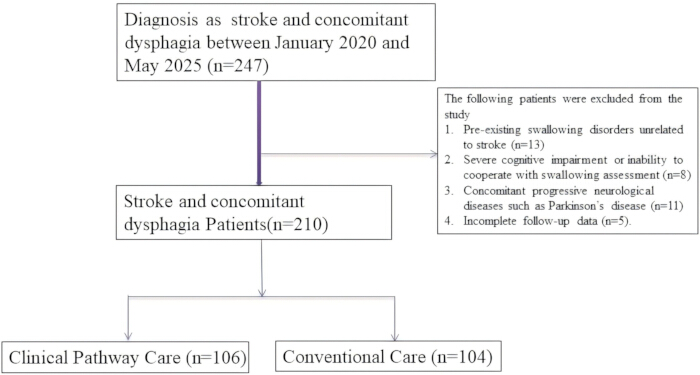
Figure 1: Flowchart of patient screening, exclusions, and group allocation. A total of 247 patients with stroke-associated dysphagia were screened, of whom 37 were excluded based on predefined criteria. The final cohort included 210 patients, allocated to conventional care (n = 104) and clinical pathway-based care (n = 106). Please click here to view a larger version of this figure.
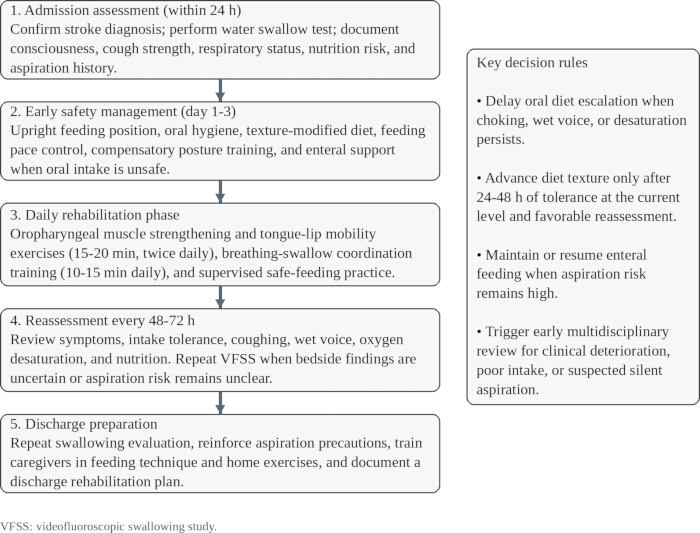
Figure 2: Structured clinical pathway-based rehabilitation nursing protocol for patients with post-stroke dysphagia. The protocol outlines sequential phases including initial assessment, early intervention, daily rehabilitation, reassessment, and discharge preparation, with defined timing, intervention components, and decision rules for diet advancement and aspiration risk management. Please click here to view a larger version of this figure.
| Variable | Category | Conventional care (n = 104) | Clinical pathway-based care (n = 106) | P-value |
| Age (years) | Mean ± SD | 63.5 ± 9.8 | 62.8 ± 10.2 | 0.489 |
| Sex | Male | 57 (54.8%) | 62 (58.5%) | 0.462 |
| Female | 47 (45.2%) | 44 (41.5%) | ||
| Stroke type | Ischemic | 73 (70.2%) | 75 (70.8%) | 0.813 |
| Hemorrhagic | 31 (29.8%) | 31 (29.2%) | ||
| Smoking history | Yes | 27 (26.0%) | 24 (22.6%) | 0.52 |
| Alcohol consumption | Yes | 21 (20.2%) | 20 (18.9%) | 0.78 |
| Hypertension | Yes | 27 (26.0%) | 32 (30.2%) | 0.257 |
| Diabetes mellitus | Yes | 24 (23.1%) | 30 (28.3%) | 0.248 |
| Dyslipidemia | Yes | 31 (29.8%) | 28 (26.4%) | 0.554 |
| BMI (kg/m²) | Mean ± SD | 24.6 ± 3.2 | 24.8 ± 3.4 | 0.651 |
| Family history of stroke | Yes | 13 (12.5%) | 11 (10.4%) | 0.625 |
| Dysphagia severity | Mild | 27 (26.0%) | 31 (29.2%) | 0.312 |
| Moderate | 43 (41.3%) | 41 (38.7%) | ||
| Severe | 34 (32.7%) | 34 (32.1%) | ||
| Abbreviations: BMI, body mass index. | ||||
Table 1: Baseline demographic and clinical characteristics of stroke patients with dysphagia in the conventional care and clinical pathway-based care groups. Data are presented as mean ± standard deviation or n (%), as appropriate. No statistically significant differences were observed between groups for baseline variables (all P > 0.05).
| Outcome | Conventional care (n = 104) | Clinical pathway-based care (n = 106) | P-value |
| Improvement in swallowing function | 54 (51.9%) | 77 (72.6%) | <0.001 |
| Aspiration pneumonia | 16 (15.4%) | 8 (7.5%) | 0.015 |
| Albumin ≥35 g/L at discharge | 34 (32.7%) | 45 (42.5%) | 0.104 |
| Functional recovery (Barthel Index ≥70) | 51 (49.0%) | 73 (68.9%) | <0.001 |
| Length of ICU stay (days) | 2.5 ± 1.2 | 1.7 ± 1.0 | 0.002 |
| Overall in-hospital complication rate | 33 (31.7%) | 23 (21.7%) | 0.029 |
| Length of hospital stay (days) | 47.9 ± 10.1 | 35.7 ± 7.8 | <0.001 |
| Abbreviations: ICU, intensive care unit. | |||
Table 2: Clinical outcomes in the conventional care and clinical pathway-based care groups. Data are presented as mean ± standard deviation or n (%), as appropriate. Clinical pathway-based care was associated with improved swallowing recovery, reduced aspiration pneumonia incidence, improved functional recovery, and shorter ICU and hospital stays compared with conventional care.
| Variable | Category | Univariate OR (95% CI) | P-value | Multivariable OR (95% CI) | P-value |
| Nursing intervention type | Pathway-based care vs. conventional care | 2.18 (1.52-3.14) | <0.001 | 2.12 (1.38-3.27) | <0.001 |
| Age | ≥65 vs. <65 years | 1.65 (1.18-2.30) | 0.004 | 1.55 (1.12-2.14) | 0.008 |
| Sex | Male vs. female | 1.12 (0.79-1.58) | 0.46 | 1.09 (0.75-1.58) | 0.633 |
| Stroke type | Hemorrhagic vs. ischemic | 0.88 (0.61-1.27) | 0.497 | 0.92 (0.61-1.39) | 0.705 |
| Smoking history | Yes vs. no | 1.48 (1.03-2.14) | 0.035 | 1.35 (0.91-1.99) | 0.125 |
| Alcohol consumption | Yes vs. no | 1.21 (0.85-1.73) | 0.313 | 1.15 (0.77-1.73) | 0.502 |
| Hypertension | Yes vs. no | 1.46 (1.03-2.08) | 0.035 | 1.34 (0.94-1.91) | 0.099 |
| Diabetes mellitus | Yes vs. no | 1.57 (1.08-2.29) | 0.02 | 1.39 (0.92-2.11) | 0.121 |
| Dyslipidemia | Yes vs. no | 1.34 (0.90-2.00) | 0.149 | 1.27 (0.84-1.92) | 0.26 |
| BMI | ≥25 vs. <25 kg/m² | 1.29 (0.89-1.87) | 0.173 | 1.22 (0.82-1.82) | 0.319 |
| Family history of stroke | Yes vs. no | 1.36 (0.91-2.03) | 0.124 | 1.24 (0.85-1.82) | 0.267 |
| Dysphagia severity | Severe vs. mild/moderate | 1.98 (1.34-2.91) | <0.001 | 1.67 (1.12-2.48) | 0.012 |
| Abbreviations: OR, odds ratio; CI, confidence interval; BMI, body mass index. Outcome modeled: swallowing function improvement at discharge. | |||||
Table 3: Univariate and multivariable logistic regression analysis of factors associated with swallowing function improvement at discharge. Odds ratios (ORs) with 95% confidence intervals (CIs) are reported. Multivariable analysis adjusted for prespecified demographic and clinical covariates.
Discussion
Loading...
$$\rightleftharpoonup{xx}$$
$$\longleftharp{xx}$$,
$$\longrightharp{xx}$$,
In this retrospective cohort study, clinical pathway-based rehabilitation nursing was associated with improved swallowing recovery and a lower in-hospital complication burden compared with conventional care in stroke patients with dysphagia. Compared with routine care, pathway-based management was associated with higher rates of swallowing improvement, fewer aspiration events, better functional recovery at discharge, and shorter ICU and hospital stays. These findings support the value of standardized rehabilitation nursing workflows in the inpatient management of post-stroke dysphagia.
The observed benefit is clinically plausible. Pathway-based care emphasizes early assessment, consistent aspiration precautions, repeated reassessment, structured swallowing exercises, nutritional surveillance, and caregiver education7,8,9,10,11,12,13,14,15,16,17,18,19,20. When these elements are coordinated within a time-defined multidisciplinary pathway, delays in intervention and variability in feeding management may be reduced, thereby improving recovery efficiency and reducing preventable complications. The findings are consistent with prior reports suggesting that organized dysphagia management and nurse-driven stroke care can improve outcomes in neurologic rehabilitation7,8,9,10,11,12,13,14,15,16,17,18,19.
This study adds real-world evidence by evaluating routine inpatient practice in a relatively large cohort and by reporting both functional and safety-related outcomes. At the same time, the results should be interpreted cautiously. Because the study was retrospective, residual confounding and documentation bias cannot be excluded. The study was also conducted at a single center, which may limit external generalizability. In addition, although the clinical pathway was standardized at the unit level, the exact intensity of some rehabilitation sessions may have varied according to tolerance and staffing. Finally, the study evaluated only in-hospital outcomes; long-term swallowing status, readmission beyond discharge, and post-discharge quality of life were not available.
Future prospective multicenter studies should validate these findings, examine long-term swallowing and nutritional outcomes, and determine whether specific pathway components contribute differentially to recovery. Economic evaluation and implementation studies would also help determine the feasibility of broader adoption across stroke rehabilitation settings.
Conclusion
Clinical pathway-based rehabilitation nursing was associated with improved swallowing recovery, a lower incidence of aspiration pneumonia, fewer in-hospital complications, and shorter hospitalization in this retrospective single-center cohort of stroke patients with dysphagia. These findings support further prospective evaluation of structured nursing pathways as part of standardized stroke rehabilitation care.
Disclosures
Loading...
$$\rightleftharpoonup{xx}$$
$$\longleftharp{xx}$$,
$$\longrightharp{xx}$$,
The authors declare no conflicts of interest.
Acknowledgements
Loading...
$$\rightleftharpoonup{xx}$$
$$\longleftharp{xx}$$,
$$\longrightharp{xx}$$,
Not applicable.
FUNDING:
No external funding was received for this study.
Materials
| Name | Company | Catalog Number | Comments |
|---|---|---|---|
| CT scanner | Standard clinical equipment | — | — |
| MRI scanner | Standard clinical equipment | — | — |
| SPSS software | Version 25.0 | IBM Corp. | Armonk, NY, USA |
| Videofluoroscopic swallowing study (VFSS) system | Standard clinical equipment | — | — |
| Water swallow test | Standard clinical protocol | In-house clinical protocol | — |
Reprints and Permissions
Request permission to reuse the text or figures of this JoVE article
Request Permission