This protocol presents a maximum-entropy spectral-estimation-based method for precise defect localization in long power distribution cables using frequency-domain reflectometry. It details high-frequency cable modeling, reflection coefficient spectrum analysis, spectral extrapolation, and validation via simulations and experiments, achieving superior accuracy compared to conventional FFT approaches.
Method Article
Power Distribution Cable Defect Localization Technology Based on the Maximum Entropy Spectral Method
Opens in a new tab
In This Article
Summary
Loading...
$$\rightleftharpoonup{xx}$$
$$\longleftharp{xx}$$,
$$\longrightharp{xx}$$,
Abstract
Loading...
$$\rightleftharpoonup{xx}$$
$$\longleftharp{xx}$$,
$$\longrightharp{xx}$$,
As cable laying distances in modern urban distribution networks continue to expand, the accuracy of fault location via frequency-domain reflectometry (FDR) diminishes markedly with increasing length. To improve precision for long cables, this study proposes a maximum-entropy spectral-estimation-based method. A high-frequency distributed parameter model for distribution cables is developed to quantitatively assess the impacts of insulation aging and mechanical damage on per-unit-length capacitance and inductance. Drawing on transmission line theory, the relationship between the reflection coefficient spectrum and the defect position is derived, along with a step-frequency optimization criterion to enhance spectral resolution. To mitigate spectral leakage and limited resolution in fast Fourier transform (FFT)-based frequency-domain analysis, the maximum entropy spectral method is employed for high-fidelity spectrum estimation, thereby elevating fault distance localization accuracy. Simulations reveal that, relative to conventional FFT, the proposed method reduces location errors by 2–4.5 times in typical long-cable cases. Experimental results confirm a relative error below 0.25% for the maximum entropy approach, surpassing the conventional method's error under 0.55%, thus validating its efficacy and superiority in engineering practice.
Introduction
Loading...
$$\rightleftharpoonup{xx}$$
$$\longleftharp{xx}$$,
$$\longrightharp{xx}$$,
With the increasing demand for power supply reliability and safety in modern power systems, cables have been widely adopted in urban distribution networks. Among them, cross-linked polyethylene (XLPE) cables are extensively utilized due to the author’s outstanding advantages1,2. Distribution cables are typically installed underground, where the operating environment is harsh. As service time increases, combined with load fluctuations and overloading, cable aging becomes more pronounced. Consequently, localized defects such as water trees, electrical trees, partial discharges, and insulation moisture may gradually occur. If not addressed in time, these defects may evolve into severe failures, eventually leading to power outages in the grid3,4. Therefore, defect identification and fault location of distribution cables have become essential components of power grid operation and maintenance.
The fault location methods for distribution cables can be broadly categorized into two types: online and offline approaches. Online methods are mainly represented by traveling-wave location, partial discharge (PD) monitoring, and the common-mode leakage current method. Traveling-wave location identifies fault positions by analyzing transient traveling waves generated at the fault. However, it faces several challenges, including difficulties in accurately extracting wavefronts, severe superposition of fault features with nonlinear distribution, and inconvenient installation. More importantly, this method is not applicable for locating aging-related defects5. PD-based online monitoring detects defect signals generated inside the cable and enables real-time assessment of operating conditions. Nevertheless, it still encounters technological bottlenecks in recognizing aging defects and performing long-term monitoring. Problems such as signal interference, noise suppression, and complex data analysis often lead to misjudgments in practical applications6,7,8. The common-mode leakage current method determines the position and severity of aging defects by measuring variations in common-mode leakage currents at the cable terminals. This technique offers non-intrusive detection with high sensitivity. However, its anti-interference capability is relatively weak, as high-frequency differential-mode currents, such as those generated during variable-frequency equipment operation, can significantly reduce measurement accuracy. In addition, online monitoring of energized cables must address signal isolation in high-voltage environments, which increases equipment costs and maintenance complexity9,10,11.
In terms of offline methods, several approaches have been proposed, including time domain reflectometry (TDR)12, frequency domain reflectometry (FDR)13, and time-frequency domain reflectometry (TFDR)14 Among them, TDR suffers from low energy in the high-frequency components of the injected pulse signal and is highly susceptible to cable attenuation effects and noise interference, resulting in limited location accuracy and poor capability in detecting incipient defects at early stages of cable faults15. TFDR, by injecting Gaussian chirp pulses, mitigates the deficiency of insufficient high-frequency components in TDR16. However, TFDR requires complex signal modulation circuits and extraction algorithms, and its high-frequency modulated signals attenuate rapidly, making defect detection in long cables challenging17. FDR, on the other hand, injects swept-frequency signals with equal power distribution. It contains the richest high-frequency components, achieves higher location accuracy, and demonstrates greater sensitivity compared with TDR, which has led to its rapid development. Depending on the type of acquired signal, FDR can be further categorized into broadband impedance spectrum (BIS) methods18,19,20 and reflection coefficient spectrum (RCS) methods21,22,23,24.
In 2003, one group first proposed a cable local defect localization method based on the input reflection coefficient spectrum of cables25. However, this approach did not account for the frequency-dependent effects of distributed parameters, which may lead to misjudgments. Later, an inverse fast Fourier transform (IFFT) was applied to extract information from the reflection coefficient spectrum at the cable input, enabling effective localization of local defects such as thermal aging, radiation aging, and extrusion deformation26. It was also observed that the higher the upper frequency of the sweep signal, the higher the spatial resolution of frequency-domain reflectometry (FDR). Nevertheless, when applied to long cables, the upper frequency of the sweep signal decreases significantly, resulting in reduced localization accuracy.
The core of the FDR method lies in performing the FFT on the acquired reflection signals. However, due to the inherent spectral leakage problem of the FFT, researchers have proposed several improvements. A study introduced the use of a distance window combined with a Kaiser window function in the discrete Fourier transform (DFT) to extract the defect components from the real part of the reflection coefficient spectrum, thereby enabling the localization of loosened copper shielding defects in cables27. A Kaiser window-based DFT28 was applied to the real part of the input reflection coefficient spectrum, achieving fault-type identification for open-circuit, short-circuit, high-resistance, and low-resistance conditions. A study proposed applying a Blackman window-based DFT to the imaginary part of the cable input impedance for the detection and localization of moisture in intermediate joints29. An interpolation algorithm using the Hanning self-convolution window in the DFT was introduced to estimate the frequency and phase of periodic components in the real part of the reflection coefficient spectrum30, which enabled polarity determination of cable impedance anomalies. Subsequently, improvements were achieved by incorporating Nuttall windows, fourth-order three-term Nuttall windows, second-order Nuttall self-convolution windows, and three-point interpolated DFT algorithms31. Overall, existing studies have mainly focused on window function design or interpolation algorithm refinement, which have enhanced defect localization accuracy to a certain extent.
From the perspective of the FFT principle, in frequency-domain reflectometry (FDR), the higher the frequency of the injected signal, the better the measurement accuracy. In theory, if the injection frequency approaches infinity, the cable defect can be located with perfect precision. However, the transmission of ultra-high-frequency signals along cables experiences severe attenuation, making them unsuitable for medium- and long-length cables32,33. Therefore, there exists an inherent trade-off between the maximum injection frequency in FDR and the achievable defect location accuracy. To address this issue, this paper proposes a cable defect localization technique based on the maximum entropy spectral method. The method predicts the high-frequency portion of the reflection coefficient spectrum from the measured low-frequency data according to the maximum entropy criterion, and then computes the maximum entropy spectrum(MES) of the reflection coefficient to determine the defect location. Compared with conventional FFT-based FDR methods, which are limited by spectral leakage and resolution constraints, especially in long-distance cable applications, the proposed maximum entropy spectral method provides higher spectral resolution by effectively extrapolating high-frequency information from limited measured data. Unlike window-function-based improvements that mainly suppress sidelobes without fundamentally enhancing resolution, the MES approach improves both peak sharpness and localization accuracy. In addition, compared with interpolation-based or parametric spectral estimation methods, the MES method offers a better balance between resolution and robustness, making it particularly suitable for detecting incipient defects in long distribution cables. This approach improves the localization accuracy, reducing the relative error from 0.55% in conventional methods to 0.25%, while producing smoother localization curves that facilitate the identification of defect peaks.
Protocol
Loading...
$$\rightleftharpoonup{xx}$$
$$\longleftharp{xx}$$,
$$\longrightharp{xx}$$,
NOTE: Perform all measurements on the test cable in an offline state (de-energized). Use a vector network analyzer (VNA) or equivalent frequency-domain reflectometry instrument capable of swept-frequency signal injection and reflection coefficient acquisition. Ensure the cable is open-circuited at the far end unless otherwise specified. Minimize connection reflections by using short, direct coaxial connections and conductive tape for secure contact. Refer to the Table of Materials for recommended equipment and software.
1. Prepare the cable sample and measurement setup
- Select the power distribution cable for testing (e.g., YJLV22-8.7/10 kV-3×70 XLPE cable or equivalent).
- Measure and record the total cable length and known defect positions (if artificially introduced).
- Measure the electromagnetic wave propagation velocity in the cable.
- Connect the cable to the instrument at one end and leave the far end open.
- Acquire the reflection coefficient spectrum over a suitable frequency band.
- Identify the oscillation period corresponding to the full cable length (round-trip).
- Calculate velocity as
 (1)
(1)
- Prepare the cable head connection.
- Strip the cable end to expose the core and shield.
- Use double-sided conductive copper tape to securely attach the instrument leads to the core and shield.
- Minimize branch lead length to reduce head-end reflections.
2. Configure the frequency sweep parameters
- Determine the frequency step (Δf) using the selection criterion.
- Use the cable-end oscillation period
 (2)
(2) - Set
 to ensure at least 200 sampling points per cycle.
 - The frequency step Δf determines the maximum observable distance range:
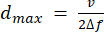 (3)
(3) - To ensure that the full cable length L can be resolved without ambiguity:
 (4)
(4) - In this study, a more stringent condition is adopted to improve resolution:
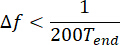 (5)
(5)
- Use the cable-end oscillation period
- Set the frequency band.
- Set the lower limit to 100 kHz (or instrument minimum).
- Set the upper limit to the maximum attainable without excessive attenuation (typically 30–50 MHz for cables <200 m; reduce for longer cables).
- The upper frequency limit fmax directly affects spatial resolution:
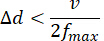 (6)
(6) - A higher fmax leads to finer resolution, but is constrained by cable attenuation.
- Calculate the required number of sampling points
 (7)
(7) - Configure the instrument with the calculated frequency band, step, and points (e.g., 100 kHz–50 MHz, ~5,000 points for high resolution).
3. Acquire the reflection coefficient spectrum
- Calibrate the instrument (open-short-load calibration recommended for VNA).
- Connect the prepared cable head to the instrument port.
- Inject swept-frequency sinusoidal signals and measure the input reflection coefficient Γ(ω) at each discrete frequency point.
- The measured reflection coefficient can be expressed as:
 (8)
(8) - where: Γd: reflection coefficient at the defect,
 : phase constant, d: defect distance.
 - This relationship shows that the phase of the reflection coefficient varies linearly with frequency, forming the basis for distance estimation.
- The measured reflection coefficient can be expressed as:
- Record the complex reflection coefficient spectrum (magnitude and phase, or real and imaginary parts).
- Save the data as frequency vs. real/imaginary reflection coefficient.
4. Process the data using the conventional FFT method (for comparison)
- Extract the imaginary part of the reflection coefficient spectrum.
- Apply a window function (e.g., Blackman window) to reduce sidelobe leakage.
- Perform inverse fast Fourier transform (IFFT) on the windowed imaginary part.
- The inverse Fourier transform is introduced as:
 (9)
(9)
- The inverse Fourier transform is introduced as:
- The defect distance is calculated as:
 (10)
(10)
- where t is the time corresponding to the peak position after the inverse Fourier transform.
- Identify defect peaks (excluding head-end and terminal reflections) in the reflection coefficient spectrum.
5. Apply the maximum entropy spectral method for defect localization
- Load the acquired reflection coefficient spectrum data.
- Detrend and center the imaginary part sequence.
- Select the autoregressive model order
 (11)
(11)
- where N is the number of data points.
- Implement the Burg recursion algorithm.
- Initialize forward and backward prediction errors.
- Recursively compute reflection coefficients and autoregressive parameters while minimizing forward and backward error power.
- Extrapolate the autocorrelation sequence based on the maximum entropy criterion.
- Compute the power spectrum from the extrapolated sequence.
- Identify peaks in the maximum entropy power spectrum.
- Convert peak positions to defect distances using
 (12)
(12) - Compare peak clarity and localization error with the conventional FFT results.
6. Interpret the results
- Distinguish positive peaks (successful defect detection) from spurious peaks or suboptimal traces.
- Calculate relative localization error as
 (13)
(13) - Confirm success by relative error <0.25% and a clear, smooth peak without significant sidelobes.
Results
Loading...
$$\rightleftharpoonup{xx}$$
$$\longleftharp{xx}$$,
$$\longrightharp{xx}$$,
The reflection coefficient spectrum and defect localization results were obtained from both simulations and experiments using the maximum entropy spectral method and compared with conventional FFT-based approaches. A successful defect localization is characterized by a smooth power spectrum with a sharp, prominent peak at the exact defect position, minimal spurious peaks (pseudopeaks caused by sidelobes or leakage), and a low relative error (typically <0.3%). In contrast, suboptimal results from conventional FFT methods often exhibit numerous spurious peaks, broader defect peaks due to limited resolution and spectral leakage, and higher relative errors (up to 0.55%), which can complicate peak identification and reduce accuracy.
In simulations, a distribution cable model was established in PSCAD with structural parameters listed in Table 1. Three cable samples of varying lengths and defect positions were configured (Table 2). For shorter cables (Sample 1), the conventional unwindowed FFT yielded complex spectra with significant leakage, resulting in a relative error of approximately 0.55% (Table 3). Adding a Blackman window reduced sidelobe effects but did not improve resolution, producing multiple minor spurious peaks that interfered with defect identification (Figure 1). The maximum entropy spectral method generated smoother curves with clear single defect peaks and no significant spurious artifacts, reducing the relative error to ≤0.25% across all samples (Figure 2, Figure 3, Figure 4; Table 3). This improvement was particularly evident in longer cables (Samples 2 and 3), where high-frequency attenuation severely limited conventional methods.
Experimental validation was performed on a 171 m 10 kV cable with an externally induced defect at 63 m. The selected experimental cable length and defect location are representative of typical urban distribution cable scenarios, thereby providing a practical basis for validating the effectiveness of the proposed localization method. Both methods showed pronounced peaks at the cable head and terminal due to impedance mismatches and open-end reflection. The conventional FFT with Blackman window exhibited multiple spurious peaks from sidelobes, with a relative error of 0.55% (Figure 5). In contrast, the maximum entropy method produced a cleaner spectrum with minimal spurious peaks and a sharper defect peak, achieving a relative error of 0.25% (Figure 5). These results validate the protocol's success: defect positions are identified as the primary peak (excluding known head and terminal peaks), with success confirmed by low error and smooth, interpretable curves. It should be noted that the current experimental validation is conducted on a limited number of cable samples and defect conditions, primarily focusing on a representative single-defect scenario in a medium-length distribution cable. While these results effectively demonstrate the feasibility and accuracy of the proposed method, they may not fully cover all practical operating conditions. Future work will extend the experimental validation to include multiple defect types (e.g., insulation degradation, joint defects, and mechanical damage), a wider range of cable lengths, and repeated measurements under varying environmental and operational conditions. These efforts will help to further evaluate the robustness, repeatability, and general applicability of the proposed method in practical engineering scenarios.
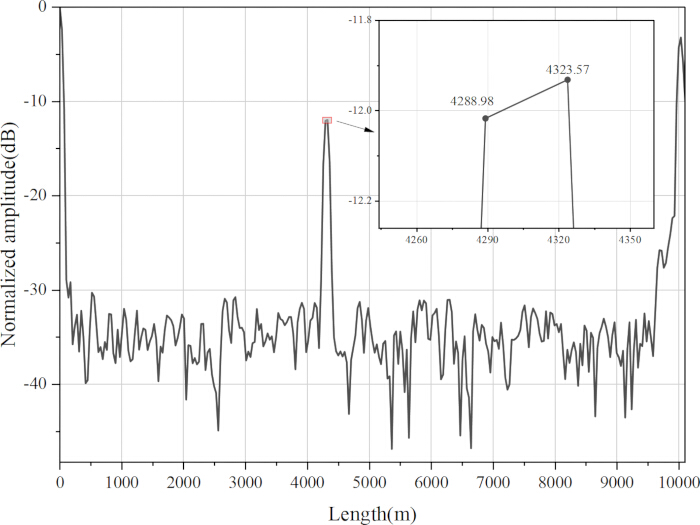
Figure 1: Sample 1 FFT+Blackman window function defect localization figure. Figure 1 shows the FFT+Blackman window result for Sample 1, where spurious sidelobe peaks obscure the true defect location. Please click here to view a larger version of this figure.
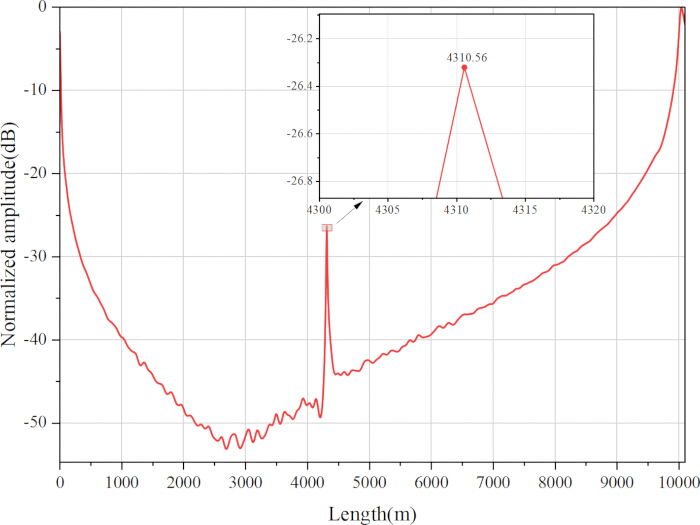
Figure 2: Sample 1 maximum entropy spectral method defect localization figure. Figure 2 shows the maximum entropy spectral method result for Sample 1, producing a smooth curve with a single sharp peak at the defect location and no significant spurious sidelobes. Please click here to view a larger version of this figure.
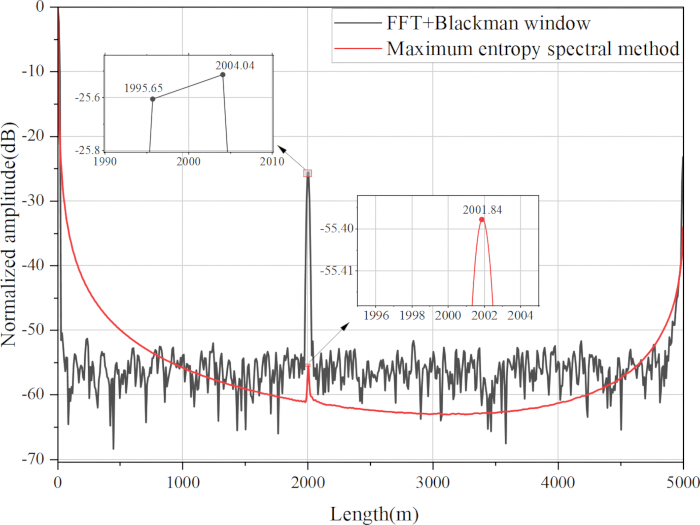
Figure 3: Sample 2 defect localization comparison figure. Figure 3 compares FFT+Blackman window and the maximum entropy method for Sample 2, showing smoother results from the latter. Please click here to view a larger version of this figure.
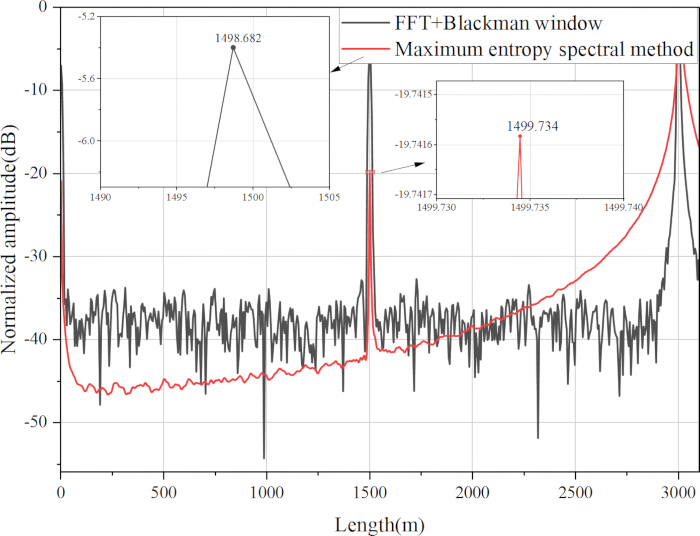
Figure 4: Sample 3 defect localization comparison figure. Figure 4 compares the two methods for Sample 3, where the maximum entropy method provides cleaner and sharper peaks than the FFT+Blackman window. Please click here to view a larger version of this figure.
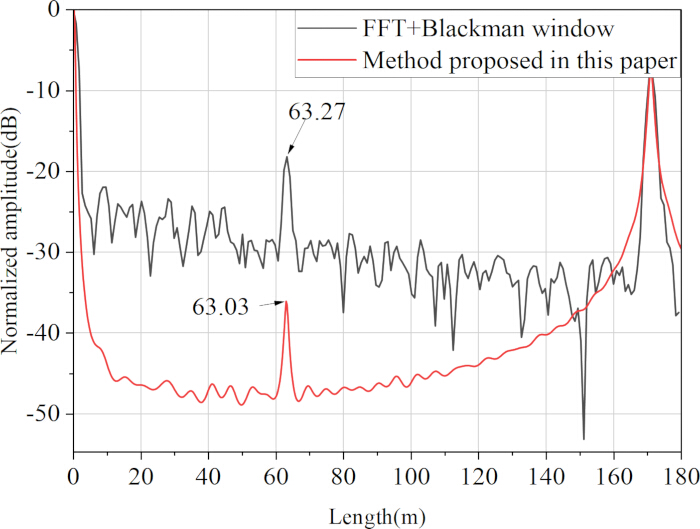
Figure 5: 171 m cable defect localization comparison figure. Figure 5 compares the two methods on a 171 m cable with a defect at 63 m; the proposed method yields a cleaner spectrum and sharper peak than FFT+Blackman window. Please click here to view a larger version of this figure.
| Cable model parameters | Thickness (mm) | Resistivity/Complex permittivity |
| Conductor | 5 | 2.65 × 10⁻⁸ Ω∙m |
| Inner/Outer semiconductive layer | 0.9/0.6 | - |
| XLPE main insulation | 4.2 | 2.3 + j0.001 |
| Copper shield | 0.15 | 1.75 × 10⁻⁸ Ω∙m |
| Embedded layer | 1 | 2.3 + j0.001 |
| Steel strip armor | 1 | 1.45 x 10⁻⁷ Ω∙m |
| Outer sheath | 3 | 3 + j0.001 |
Table 1: Cable simulation structure parameters.
| Sample number | Length (m) | Defect location (m) | Defect complex permittivity | Sampling frequency band (Hz) | Step frequency (Hz) |
| NO.1 | 10000 | 4300~4301 | 2.99+j0.001 | 100k~2.5M | 400 |
| NO.2 | 5000 | 2000~2001 | 2.99+j0.001 | 100k~10M | 880 |
| NO.3 | 3000 | 1500~1501 | 2.99+j0.001 | 100k~15M | 1300 |
Table 2: Simulation cable samples.
| Sample number | Defect location (m) | Traditional method (m) | Relative error (%) | Maximum entropy spectral method (m) | Relative error (%) |
| NO.1 | 4300~4301 | 4323.57 | 0.548 | 4310.56 | 0.246 |
| NO.2 | 2000~2001 | 2004.04 | 0.202 | 2001.84 | 0.092 |
| NO.3 | 1500~1501 | 1498.68 | 0.088 | 1499.73 | 0.018 |
Table 3: Simulation cable sample defect localization error results.
Discussion
Loading...
$$\rightleftharpoonup{xx}$$
$$\longleftharp{xx}$$,
$$\longrightharp{xx}$$,
In this study, the authors present a detailed protocol for localizing defects in power distribution cables using frequency-domain reflectometry (FDR) enhanced by the maximum entropy spectral (MES) method. Previous studies have often relied on conventional fast Fourier transform (FFT)-based analysis, which struggles with spectral leakage, limited resolution in long cables, and spurious peaks that complicate defect identification34. Additionally, researchers without advanced signal processing expertise may face challenges in optimizing frequency sweep parameters, extrapolating high-frequency data, and interpreting complex spectra35,36,37. To address these issues, the author’s protocol integrates a high-frequency distributed parameter cable model, derivation of the reflection coefficient spectrum, optimized step-frequency selection, and MES estimation via the Burg algorithm. By systematically comparing the performance of conventional FFT (with or without windowing) and MES on the same reflection coefficient data, users can achieve superior localization accuracy and clearer peak identification. The performance of the proposed method depends on several key parameters, including the autoregressive model order M and the frequency sampling interval Δf. The model order is selected as M≈N/3, which provides a practical balance between spectral resolution and numerical stability. A smaller value of M may lead to broadened spectral peaks and reduced localization accuracy, while an excessively large value may introduce spurious peaks due to overfitting. The frequency step Δf determines the measurable distance range and resolution, and should satisfy the condition Δf< v/2L to avoid ambiguity. Within a reasonable parameter range, moderate variations in M and Δf do not significantly affect the localization results, indicating that the proposed method exhibits stable performance and is not overly sensitive to parameter tuning.
The protocol outlined here includes several key steps for robust implementation. First, acquire the reflection coefficient spectrum by injecting swept-frequency signals and configuring the instrument with appropriate upper/lower frequency limits and step size based on the cable length and propagation velocity. Next, preprocess the data if needed, then apply the MES method using the Burg recursion to extrapolate high-frequency components and compute the power spectrum. In this study, the autoregressive model order is empirically selected as M≈N/3, where N is the number of sampled frequency points38. This choice represents a balance between spectral resolution and numerical stability. A smaller model order may lead to insufficient spectral resolution and broadened peaks, while an excessively large order may introduce spurious peaks due to overfitting. The selected order has been validated through multiple simulation tests to provide stable and accurate localization results. For model order selection, the authors recommend setting it to approximately N/3 (where N is the number of sampling points) to balance resolution and stability. Visualization of localization curves (e.g., defect peaks versus distance) allows direct comparison with FFT results. With this step-by-step guide—including cable preparation, connection minimization to reduce head-end reflections, data acquisition, and spectral analysis—researchers can reliably reproduce the method and identify defect positions with relative errors as low as 0.25%.
However, users should note potential challenges and troubleshooting tips when applying this protocol. The performance of the proposed method is influenced by several parameters, including frequency sampling density, upper frequency limit, and autoregressive model order39. Among these, the model order has the most significant impact on the sharpness and stability of the spectral peaks. Sensitivity analysis indicates that moderate variations around the selected model order do not significantly affect the localization accuracy, demonstrating the robustness of the method within a reasonable parameter range. The MES method is computationally intensive and memory-demanding, particularly for large datasets with thousands of frequency points; the authors recommend running analyses on high-performance computers rather than standard laptops to avoid prolonged processing times40. Connection artifacts at the cable head (e.g., from SMA connectors or branched leads) can introduce spurious reflections—minimize these by using short, direct connections or conductive tape, as demonstrated in the author’s experiments. If spurious peaks persist in FFT results, switch to MES, which inherently suppresses sidelobes without windowing. Additionally, accurate measurement of propagation velocity is critical for distance calibration; discrepancies can be resolved through preliminary tests on known cable lengths.
Despite its advantages, the method has some limitations. It relies on offline measurements, requiring cable de-energization, which may not suit real-time online monitoring needs. High-frequency signal attenuation in very long cables (>10 km) or severely degraded sections can still limit effective bandwidth, though MES mitigates this better than FFT by extrapolation41,42. The protocol assumes primarily capacitive changes from insulation defects; mechanical or severe conductive faults may require complementary techniques. In practical applications, measurement noise may affect the reflection coefficient spectrum and lead to fluctuations in the estimated power spectrum43,44,45. Compared with conventional FFT-based methods46, the maximum entropy spectral method exhibits improved noise robustness due to its parametric modeling nature, which suppresses sidelobe leakage and reduces the impact of random noise. Nevertheless, excessive noise may still introduce minor spurious peaks, and appropriate preprocessing (e.g., smoothing or averaging) is recommended to further enhance stability.
Compared to alternative approaches, such as traditional FFT with window functions (e.g., Blackman or Nuttall) or interpolation algorithms47, the author’s MES-based method offers significantly higher resolution and accuracy, reducing relative errors by more than half (from ~0.55% to 0.25%) while producing smoother curves free of sidelobe artifacts. Unlike time-domain reflectometry (TDR) or time-frequency domain reflectometry (TFDR), which suffer from pulse energy limitations or complex modulation, this FDR-MES approach excels in sensitivity to incipient insulation defects and applicability to long distribution cables48,49. The proposed method is particularly suitable for medium- to long-length distribution cables, where high-frequency attenuation significantly limits the performance of conventional FFT-based approaches. It is especially effective for detecting insulation-related defects that cause distributed parameter variations. However, its performance depends on the available frequency bandwidth and the accuracy of propagation velocity estimation50. In extremely long cables or severely attenuated conditions, the effective bandwidth may still limit the achievable resolution.
This method holds important implications for power distribution network maintenance, enabling early detection of localized defects like aging, water trees, or mechanical damage in underground XLPE cables. Its enhanced precision supports preventive maintenance, reducing outage risks and costs in urban grids. In the future, the authors plan to extend the protocol to multi-defect scenarios, integrate automated peak detection, and explore hybrid online adaptations for broader engineering deployment.
Disclosures
Loading...
$$\rightleftharpoonup{xx}$$
$$\longleftharp{xx}$$,
$$\longrightharp{xx}$$,
The authors have no conflicts of interest to declare that are relevant to the content of this article.
Acknowledgements
Loading...
$$\rightleftharpoonup{xx}$$
$$\longleftharp{xx}$$,
$$\longrightharp{xx}$$,
This work was supported by the Science and Technology Project of Guangxi Power Grid Co., Ltd. under Project No. 040100KC23110005.
Materials
| Name | Company | Catalog Number | Comments |
|---|---|---|---|
| Conductive copper tape, double-sided | Not specified | N/A | Used for connecting test leads to the cable core and shield to minimize head-end reflection interference https://www.shcenxin.com/metaltape/93.html |
| YJLV22-8.7/10 kV-3×70 medium-voltage cable | Not specified | YJLV22-8.7/10 kV-3×70 | Cross-linked polyethylene (XLPE) aluminum core steel tape armored PVC sheathed power cable; total length 171 m; used as test object with externally induced defect http://www.xmdl518.com/jspn01-Products-6234877/ |
| 10 kV cable defect localization device | Not specified | Not specified | Frequency-domain reflectometry instrument; frequency band 100 kHz–50 MHz; configured with 5,001 sampling points for reflection coefficient spectrum acquisition https://www.163.com/dy/article/K6OHFJOO0552X57P.html |
Reprints and Permissions
Request permission to reuse the text or figures of this JoVE article
Request Permission