This study demonstrates that inflammatory and coagulation dysregulation jointly drive kidney injury, linking IL-6 and Factor VIII to accelerated chronic eGFR decline and identifying disseminated intravascular coagulation as a key determinant of severe sepsis-associated acute kidney injury.
A subscription to JoVE is required to view this content. Sign in or start your free trial.
Research Article
Associations of Inflammatory and Coagulation Biomarkers with Kidney Injury Across Chronic and Acute Clinical Settings
In This Article
Summary
Abstract
Inflammation and coagulation are increasingly recognized as interrelated drivers of kidney injury, yet their combined impact across chronic and acute clinical settings remains incompletely characterized. This study examined the association between inflammatory and coagulation biomarkers and renal outcomes in both a general population cohort and a septic shock ICU cohort. This was a secondary analysis of previously collected data from a community-based cohort and an ICU cohort. In the population cohort, 3,678 participants with repeated kidney function measurements were included, and baseline inflammatory (C-reactive protein [CRP], interleukin-6 [IL-6]) and coagulation biomarkers (fibrinogen, Factor VIII, D-dimer) were assessed. Kidney function decline was evaluated over approximately five years using mixed-effects models. In the ICU cohort, 312 patients were analyzed; disseminated intravascular coagulation (DIC) was defined using International Society on Thrombosis and Haemostasis criteria, and acute kidney injury (AKI) was defined according to KDIGO guidelines. Higher baseline IL-6 and Factor VIII levels were independently associated with faster annual eGFR decline. In the ICU cohort, AKI occurred in 68.6% of patients and DIC in 34.6%. DIC was independently associated with severe AKI and need for renal replacement therapy. Admission procalcitonin demonstrated superior discrimination for AKI compared to CRP. These findings highlight thromboinflammation as a shared mechanistic pathway linking chronic kidney disease progression and sepsis-associated acute kidney injury.
Introduction
Acute and chronic kidney injuries often occur in the context of systemic inflammation and coagulation disturbances. Growing evidence suggests that disordered inflammation and coagulation – along with abnormal neutrophil-endothelial interactions – play a significant role in the pathogenesis of kidney injury1,2. In patients with advanced kidney disease, pro-inflammatory cytokines (e.g., IL-1, IL-6, TNF-α) are frequently elevated, and these inflammatory mediators can trigger coagulation cascades that further damage renal tissues3,4,5. Conversely, activation of coagulation can exacerbate inflammation; such “thromboinflammation” contributes to tissue injury in vulnerable organs like the kidney6.
In sepsis, for example, a massive release of inflammatory mediators causes endothelial dysfunction and widespread coagulopathy, leading to microvascular fibrin thromboses in the circulation7,8. This septic coagulopathy is characterized by aberrant clotting activation, suppressed fibrinolysis, and consumption of coagulation factors, resulting in pathologic fibrin deposition in the microcirculation. The unique microvascular architecture of the kidney (dense glomerular and peritubular capillary networks) makes it especially susceptible to such thromboinflammatory injury9. Indeed, in severe systemic inflammation, interactions between activated blood cells and the renal endothelium can reduce perfusion and oxygen delivery to nephrons, precipitating acute tubular necrosis and glomerular damage.
Clinically, inflammatory and coagulation biomarkers have been linked to subsequent renal dysfunction. For instance, in a large multi-ethnic cohort study, higher baseline levels of interleukin-6 (IL-6, an inflammatory cytokine) and Factor VIII (a pro-coagulant factor) were each independently associated with a faster decline in kidney function over time. Similarly, C-reactive protein (CRP) and fibrinogen (markers of systemic inflammation and coagulation, respectively) tend to rise as renal function worsens10,11. These findings are consistent with experimental evidence indicating IL-6 is central to the coordination of inflammation, and IL-6 levels are inversely correlated with with glomerular filtration rate (GFR).
On the acute side, clinicians have observed that disseminated intravascular coagulation (DIC) in septic patients is associated with multiorgan failure, including severe acute kidney injury (AKI). Nevertheless, data specifically relating sepsis-related coagulopathy to AKI incidence and severity were scarce previously. Recent clinical research is emerging to indicate that microvascular thrombosis and endothelial injury caused by inflammation are major contributors to sepsis-related AKI, whether or not sustained hypotension is present12,13. Although supportive care has advanced, the exact interactions between inflammatory and coagulation pathways and their convergence in causing kidney injury are not fully understood, and effective specific treatments have not yet been developed. However, the combined impact of inflammatory and coagulation pathways on kidney injury across both chronic and acute settings remains insufficiently characterized. This knowledge gap contributes to persistently high mortality in sepsis-induced AKI and progression of chronic kidney disease. Further combined studies are thus required to explain the interplay between inflammatory mediators and coagulation abnormalities in the pathogenesis of renal injury and to determine the potential therapeutic targets.
The objective of this study was to examine the interplay between inflammatory mediators, coagulation abnormalities, and kidney injury in chronic and acute settings. It was hypothesized that elevated inflammatory markers and pro-coagulation factors are associated with worsened renal outcomes, and that coagulopathic complications (such as DIC) are associated with an increased risk of severe AKI. The study was designed to evaluate these associations across both chronic and acute clinical contexts.
Access restricted. Please log in or start a trial to view this content.
Protocol
Ethical considerations
This study represents a secondary analysis of fully de-identified data obtained from previously completed observational cohort studies. No new patient recruitment, interventions, or collection of identifiable private information were undertaken for the purposes of this analysis. Because the data were fully de-identified and originally collected under approved protocols, this analysis did not meet the definition of human subjects research, and no additional institutional review board review or ethical approval was required. All original studies received appropriate ethical approval, and informed consent was obtained from participants at the time of initial enrolment.
Study design
This work represents a secondary, retrospective analysis of fully de-identified data derived from two previously completed observational cohort studies examining inflammatory, coagulation, and renal outcomes in chronic and acute clinical settings. The study was structured in two complementary components (Figure 1): a chronic population-based cohort analysis evaluating long-term kidney function decline and an acute ICU cohort analysis assessing sepsis-associated coagulopathy and acute kidney injury.
To address the study objective, complementary analyses were conducted in two populations: (1) a community-based cohort to examine whether baseline inflammation and coagulation biomarkers predict long-term kidney function decline, and (2) a cohort of critically ill septic patients to evaluate the impact of acute coagulopathy on AKI development. By integrating these two analytical contexts, the study aimed to comprehensively assess the joint influence of inflammatory and coagulation pathways on renal injury.
The analysis was conducted in accordance with the STROBE guidelines for observational research.
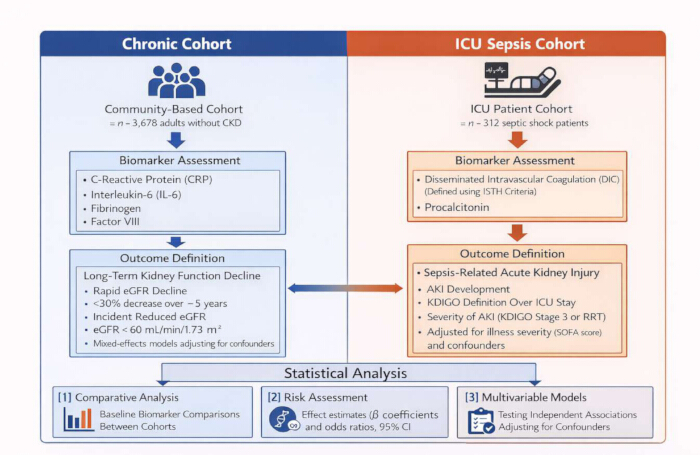
Figure 1: Schematic representation of the study design and analytical workflow. This figure illustrates the overall study design, showing the workflow of two de-identified cohorts and their analysis linking inflammatory and coagulation biomarkers to kidney outcomes. Please click here to view a larger version of this figure.
Chronic Cohort (Population Study)
For the chronic context, data were utilized from a previously conducted prospective, community-based cohort study, analyzed here as a secondary analysis of de-identified data, focusing on adults without baseline kidney failure. The cohort was modeled on the Multi-Ethnic Study of Atherosclerosis (MESA). A total of 3,678 participants (aged 45–84 years; 52% women) were included after exclusion of individuals with baseline estimated glomerular filtration rate (eGFR) < 60 mL·min-1 per 1.73 m2 to restrict analyses to participants without advanced chronic kidney disease at enrollment. Baseline fasting blood samples, collected as part of the original cohort protocol, were used to measure inflammatory biomarkers—CRP and IL-6—and coagulation/fibrinolysis markers, including fibrinogen, Factor VIII activity, and D-dimer. Standardized laboratory assays were employed (e.g., high-sensitivity CRP immunonephelometry and ultra-sensitive IL-6 ELISA), and these baseline biomarker levels were analyzed as exposure variables to evaluate their association with subsequent longitudinal changes in kidney function over follow-up; details including manufacturers, catalog numbers, and RRIDs, where available, are provided in the Table of Materials. Kidney function was assessed at baseline and during multiple follow-up examinations over approximately five years using serum creatinine and cystatin C, as collected in the parent study. eGFR was estimated using the CKD-EPI equations. The primary outcome was longitudinal kidney function decline, quantified as the annual change in eGFR. Secondary outcomes included rapid eGFR decline, defined as a loss exceeding 3 mL·min-1 per 1.73 m2 per year, and incident reduced eGFR, defined as new onset eGFR < 60 mL·min-1 per 1.73 m2 accompanied by a decline ≥ 1 mL·min-1 per 1.73 m2 per year. Baseline covariates, including demographic characteristics, comorbid conditions (e.g., diabetes and hypertension), baseline eGFR, and other clinical variables, were obtained from the original study database and used for statistical adjustment. Participants with conditions or medications that could influence inflammatory or coagulation biomarkers were not explicitly excluded beyond the original cohort criteria; however, major comorbidities and clinical variables were adjusted for in multivariable analyses to minimize confounding. Residual confounding due to unmeasured factors or medication effects cannot be entirely excluded. No new data collection, participant contact, or intervention was undertaken for the purposes of this analysis.
Acute cohort (Sepsis ICU study)
For the acute context, a secondary analysis was performed using data derived from a previously completed observational cohort of critically ill patients with septic shock admitted to a tertiary-care intensive care unit (ICU). The present analysis included 312 adult patients who met Sepsis-3 criteria for septic shock (suspected or confirmed infection with vasopressor-dependent hypotension and elevated lactate levels). Patients with pre-existing end-stage renal disease were excluded from the original cohort. Baseline clinical characteristics and laboratory measurements were obtained from the existing study dataset, which had been collected at the time of ICU admission as part of routine clinical care and the original observational protocol.
The International Society on Thrombosis and Haemostasis (ISTH) scoring system was used to define DIC, with a score of 5 or more representing overt DIC14. The ISTH DIC scores were determined on a daily basis during ICU admission using the available laboratory information. The definition and staging of AKI were based on the changes in serum creatinine and/or urine output15, which were defined and staged using the KDIGO criteria. To assess the temporal relationship between coagulopathy and renal injury, subgroup analyses were conducted in patients who developed sepsis-related coagulopathy or fulfilled the criteria for DIC before or at the onset of AKI, based on daily clinical and laboratory evaluations documented in the dataset. Temporal relationships between disseminated intravascular coagulation and acute kidney injury were further evaluated using daily clinical and laboratory data to determine whether DIC onset preceded or coincided with AKI occurrence.
Inflammatory markers (including CRP and procalcitonin), hemodynamic variables, and illness severity scores—SOFA (Sepsis Organ Failure Assessment) and SAPS II—were extracted from the original cohort records16. Patients were stratified according to the presence or absence of DIC at any point during their ICU course. This analysis involved no additional patient recruitment, interventions, or collection of identifiable information beyond what was available in the de-identified source dataset.
Statistical analysis
All analyses were conducted using previously collected, de-identified data from the parent cohort studies. Approaches to missing data, exclusion criteria, and handling of key variables are detailed in Supplementary Table S1. In the population cohort, baseline characteristics were compared between participants who did and did not develop significant kidney function decline using Student’s t-tests for normally distributed continuous variables, and Mann–Whitney U-tests (Wilcoxon rank-sum tests) for non-normally distributed continuous variables, with normality assessed using standard statistical methods, and chi-square tests for categorical variables, as appropriate. Longitudinal associations between baseline inflammatory and coagulation biomarkers and kidney function decline were assessed using mixed-effects linear regression models with random intercepts and slopes to account for within-participant correlation over time, adjusting for age, sex, race/ethnicity, diabetes, hypertension, lipid levels, baseline eGFR, and albuminuria, and adjusted mean eGFR trajectories were estimated using model-derived predicted values across follow-up.
Effect estimates were expressed per standard deviation increase in biomarker concentration. Biomarker levels were additionally categorized into quartiles based on their distribution within the study population, using cohort-specific 25th, 50th, and 75th percentile cutoffs. These quartile groups were used to assess potential non-linear associations and to generate adjusted longitudinal eGFR trajectories using model-derived predicted values from mixed-effects regression models.
Logistic regression models were used to evaluate associations with rapid eGFR decline and incident reduced eGFR, with follow-up duration included as a covariate to account for variability in observation time. In the ICU cohort, clinical characteristics and outcomes were compared between patients with and without DIC using Student’s t-tests for normally distributed continuous variables and Mann–Whitney U-tests for non-normally distributed variables, based on assessment of data distribution, and chi-square tests for categorical variables. Multivariable logistic regression models were constructed to assess whether DIC was independently associated with severe acute kidney injury, defined as KDIGO stage 3 AKI or requirement for renal replacement therapy, adjusting for age, illness severity as measured by baseline SOFA score, and relevant comorbidities; multicollinearity among severity indicators was assessed using variance inflation factors. Receiver-operating characteristic (ROC) curve analysis was performed to evaluate the predictive performance of admission inflammatory biomarkers (CRP and procalcitonin) for acute kidney injury in the ICU cohort. The area under the ROC curve (AUC) was calculated with 95% confidence intervals to quantify discrimination ability. All statistical tests were two-tailed, with p < 0.05 considered statistically significant, and analyses were performed using statistical analysis software.
Sensitivity Analyses
Prespecified sensitivity analyses were conducted in both cohorts to assess the robustness of the primary findings using the same de-identified datasets. In the population cohort, analyses were repeated after excluding participants with diabetes at baseline and after excluding those who experienced cardiovascular events during follow-up; models were additionally adjusted for baseline albuminuria as a continuous variable. Other outcome definitions were also considered, such as creatinine-based eGFR only and a more aggressive definition of rapid eGFR decrease (> 5 mL·min-1 per 1.73 m2 per year). Sensitivity analyses in the ICU cohort involved limiting analyses to patients surviving beyond 48 hours after ICU admission to minimize potential survivor bias, redefining acute kidney injury based on serum creatinine criteria alone, and further modifying multivariable models to adjust for admission lactate concentration and vasopressor dose.
Access restricted. Please log in or start a trial to view this content.
Results
In this population-based cohort of 3,678 adults without advanced chronic kidney disease at baseline, baseline levels of inflammatory and coagulation biomarkers were evaluated as predictors of subsequent kidney function decline over longitudinal follow-up. As shown in Table 1, participants who developed significant kidney function decline had higher baseline concentrations of IL-6 and Factor VIII activity compared with those who did not, whereas baseline levels of C-reactive protein, fibrinogen, and D-dim...
Access restricted. Please log in or start a trial to view this content.
Discussion
The present study investigated the integrated and clinically relevant associations between inflammatory factors and coagulation disturbances in kidney injury across two distinct scenarios: community-dwelling adults at risk for CKD progression, and critically ill patients with sepsis at risk for AKI. In the chronic cohort, elevated IL-6 and Factor VIII were independently associated with accelerated eGFR decline, indicating that baseline levels of these biomarkers are associated with future kidney function decline, consist...
Access restricted. Please log in or start a trial to view this content.
Disclosures
None.
DATA AVAILABILITY:
All data supporting the findings of this study are included within the manuscript and associated supplementary file.
Acknowledgements
The authors gratefully acknowledge the support provided by the Research Innovation Fund of the First Affiliated Hospital of Harbin Medical University (Grant No. 2023B16) and Fundamental Research Funds for Provincial Universities in Heilongjiang Province (Grant No. 2025-KYYWF-ZR0186).
Access restricted. Please log in or start a trial to view this content.
Materials
| Name | Company | Catalog Number | Comments |
|---|---|---|---|
| D-dimer assay | Hospital coagulation laboratories | Not applicable | Measured using immunoassay-based methods routinely used in clinical care and validated in institutional laboratories |
| Electronic health record data extraction | Participating hospitals | Not applicable | Demographic, laboratory, and clinical variables extracted from institutional electronic health record (EHR) systems using standardized data collection protocols |
| Estimated glomerular filtration rate (eGFR) calculation | Not applicable | Not applicable | Calculated using the CKD-EPI equation based on serum creatinine values |
| Factor VIII activity assay | Hospital coagulation laboratories | Not applicable | Determined using one-stage clotting assays or chromogenic methods following standard clinical laboratory procedures |
| Fibrinogen assay | Hospital coagulation laboratories | Not applicable | Measured using Clauss method or equivalent standardized coagulation assays in certified clinical laboratories |
| Interleukin-6 (IL-6) assay | Hospital central laboratories / commercial immunoassay platforms | Not applicable | Quantified using validated ELISA or chemiluminescent immunoassays according to manufacturer protocols and institutional laboratory standards |
| ISTH DIC scoring system | Not applicable | Not applicable | Disseminated intravascular coagulation defined using International Society on Thrombosis and Haemostasis (ISTH) criteria |
| KDIGO AKI classification | Not applicable | Not applicable | Defined according to Kidney Disease: Improving Global Outcomes (KDIGO) clinical practice guidelines |
| Procalcitonin assay | Hospital central laboratories | Not applicable | Measured using FDA-approved automated immunoassays according to manufacturer instructions and clinical laboratory protocols |
| Serum C-reactive protein (CRP) assay | Hospital central laboratories (multiple centers) | Not applicable | Measured as part of routine clinical biochemistry using standardized immunoturbidimetric assays; performed according to institutional laboratory protocols |
| Serum creatinine measurement | Hospital clinical chemistry laboratories | Not applicable | Assayed using isotope-dilution mass spectrometry (IDMS)–traceable methods to ensure standardization across centers |
| Statistical analysis software (R) | R Foundation for Statistical Computing, Vienna, Austria | Version 4.x | Used for multivariable regression, sensitivity analyses, and trajectory modeling |
| Statistical analysis software (SPSS) | SPSS Statistics, IBM Corp., Armonk, NY, USA | Version 25.0 | Used for descriptive analyses and model validation |
References
- Hiramoto, J. S., et al. Inflammation and Coagulation Markers and Kidney Function Decline: The Multi-Ethnic Study of Atherosclerosis (MESA). Am J Kidney Dis. 60, 225-232 (2012).
- Bonventre, J. V., Yang, L. Cellular pathophysiology of ischemic acute kidney injury. J Clin Invest. 121, 4210-4221 (2011).
- Stenvinkel, P. The role of inflammation in the anaemia of end-stage renal disease. Nephrol Dial Transplant. 16, 36-40 (2001).
- Ridker, P. M. Role of inflammatory biomarkers in prediction of coronary heart disease. Lancet. 358, 946-948 (2001).
- Carrero, J. J., Kistler, B., Stenvinkel, P. Inflammation in chronic kidney disease. Nutritional Management of Renal Disease. , Elsevier. (2022).
- Iba, T., et al. The role of thromboinflammation in acute kidney injury among patients with septic coagulopathy. J Thromb Haemost. 22, 1530-1540 (2024).
- Akatsuka, M., Masuda, Y., Tatsumi, H., Sonoda, T. The effect of recombinant human soluble thrombomodulin on renal function and mortality in septic disseminated intravascular coagulation patients with acute kidney injury: a retrospective study. J Intensive Care. 8, 94(2020).
- Levi, M., Van der Poll, T. Coagulation and sepsis. Thromb Res. 149, 38-44 (2017).
- Lerman, L., Textor, S. C. Pathophysiology of ischemic nephropathy. Urol Clin North Am. 28, 793-803 (2001).
- Menon, V., et al. C-reactive protein and albumin as predictors of all-cause and cardiovascular mortality in chronic kidney disease. Kidney Int. 68, 766-772 (2005).
- Shlipak, M. G., et al. Elevations of Inflammatory and Procoagulant Biomarkers in Elderly Persons With Renal Insufficiency. Circulation. 107, 87-92 (2003).
- Poston, J. T., Koyner, J. L. Sepsis associated acute kidney injury. BMJ. 364, k4891(2019).
- Gomez, H., et al. A Unified Theory of Sepsis-Induced Acute Kidney Injury. Shock. 41, 3-11 (2014).
- Taylor, F., Toh, C. -H., Hoots, K., Wada, H., Levi, M. Towards Definition, Clinical and Laboratory Criteria, and a Scoring System for Disseminated Intravascular Coagulation. Thromb Haemost. 86, 1327-1330 (2001).
- Khwaja, A. KDIGO Clinical practice guidelines for acute kidney injury. Nephron Clin Pract. 120, c179-c184 (2012).
- Granholm, A., Møller, M. H., Krag, M., Perner, A., Hjortrup, P. B. Predictive performance of the simplified acute physiology score (SAPS) II and the initial sequential organ failure assessment (SOFA) score in acutely ill intensive care patients: post-hoc analyses of the SUP-ICU inception cohort study. PLoS One. 11, e0168948(2016).
- Amdur, R. L., et al. Inflammation and Progression of CKD: The CRIC Study. Clin J Am Soc Nephrol. 11, 1546-1556 (2016).
- Takasu, O., et al. Mechanisms of Cardiac and Renal Dysfunction in Patients Dying of Sepsis. Am J Respir Crit Care Med. 187, 509-517 (2013).
- Sato, R., Nasu, M. A review of sepsis-induced cardiomyopathy. J Intensive Care. 3, 48(2015).
- Madhusudhan, T., Kerlin, B. A., Isermann, B. The emerging role of coagulation proteases in kidney disease. Nat Rev Nephrol. 12, 94-109 (2016).
- Suárez-Álvarez, B., Liapis, H., Anders, H. J. Links between coagulation, inflammation, regeneration, and fibrosis in kidney pathology. Lab Invest. 96, 378-390 (2016).
Access restricted. Please log in or start a trial to view this content.