This study presents a systematic review and meta-analysis of randomized controlled trials evaluating the efficacy and safety of acupuncture for major depressive disorder as a standalone and adjunctive therapy. It aims to inform evidence-based clinical decision-making and support the integration of acupuncture into comprehensive depression management strategies.
A subscription to JoVE is required to view this content. Sign in or start your free trial.
Research Article
Acupuncture as an Adjunctive Therapy for Depression: A Systematic Review and Meta-Analysis of Randomized Controlled Trials
* These authors contributed equally
In This Article
Summary
Abstract
Major depressive disorder is a leading cause of global disability. Limitations of pharmacological treatments, including delayed onset, incomplete response, and adverse effects, have increased interest in integrative approaches. Although acupuncture is widely used as a complementary therapy for depression, its efficacy and safety remain uncertain. This systematic review and meta-analysis evaluated the efficacy and safety of acupuncture, alone or as an adjunct to selective serotonin reuptake inhibitors (SSRIs), in reducing depressive symptoms. Eight English and Chinese databases were searched from inception to June 30, 2025, for randomized controlled trials (RCTs) evaluating manual or electroacupuncture for primary depression. Comparators included sham acupuncture, waitlist, psychotherapy, or SSRIs. Two reviewers independently conducted study selection, data extraction, and risk-of-bias assessment using Cochrane ROB 2.0. Pooled mean differences (MDs) with 95% confidence intervals (CIs) were calculated using random-effects models, and the certainty of evidence was assessed using GRADE. Seventy-six RCTs involving 5,864 participants were included. Acupuncture was associated with greater reductions in depressive symptom severity compared with non-active controls, although heterogeneity was substantial. As an adjunct to SSRIs, acupuncture demonstrated additional short-term improvement at four weeks (MD −3.02; 95% CI −3.49 to −2.56; moderate-certainty evidence). Electroacupuncture showed potential for earlier symptomatic improvement, although the certainty of evidence was limited. Adjunctive acupuncture was also associated with fewer treatment-related adverse events and modest improvements in quality of life. The overall certainty of evidence ranged from very low to moderate; therefore, these findings should be interpreted cautiously, and the true effects may differ substantially from the observed estimates. Acupuncture, particularly as an adjunct to SSRI therapy, may offer short-term benefits in depressive symptoms and tolerability but should not be considered a replacement for standard treatment. Further high-quality, rigorously designed trials with standardized protocols and prolonged follow-up are required to clarify its role in depression care.
Introduction
Depression is a complex and disabling mental health disorder characterized by persistent low mood, anhedonia, cognitive impairment, and substantial psychosocial dysfunction1. Despite advances in pharmacological and psychological interventions, treatment outcomes remain suboptimal, with high rates of partial response, relapse, and chronicity2,3. It represents a major global public health challenge, affecting approximately 264 million individuals worldwide, as reported by the Global Burden of Disease Study, and ranking among the leading contributors to years lived with disability and non-fatal disease burden4. Beyond its clinical manifestations, depression imposes a substantial socioeconomic burden through increased healthcare utilization, reduced workplace productivity, and elevated risk of comorbid medical conditions5.
Pharmacotherapy, particularly selective serotonin reuptake inhibitors (SSRIs), remains the most commonly prescribed first-line treatment for depression. However, SSRIs have several clinically important limitations. Therapeutic onset is often delayed, requiring several weeks before meaningful symptom improvement occurs, and approximately one-third of patients do not achieve full remission. In addition, treatment adherence may be compromised by adverse effects, including gastrointestinal disturbances, dizziness, weight gain, sleep disturbances, and sexual dysfunction. These limitations highlight the need for additional safe and effective treatment strategies that can complement conventional antidepressant therapy and improve clinical outcomes6,7.
Acupuncture has increasingly attracted attention as a potential integrative intervention for depressive disorders. Rooted in Traditional Chinese Medicine, acupuncture is traditionally conceptualized as regulating the flow of qi through meridian pathways. From a contemporary biomedical perspective, accumulating evidence suggests that acupuncture may influence neurochemical, neuroendocrine, inflammatory, and autonomic pathways relevant to mood regulation. Experimental and clinical studies indicate that acupuncture may modulate key neurotransmitters, including serotonin, norepinephrine, dopamine, and gamma-aminobutyric acid. Additional proposed mechanisms include regulation of the hypothalamic–pituitary–adrenal axis, attenuation of neuroinflammatory processes, enhancement of neuroplasticity, and modulation of brain regions involved in emotional processing, such as the prefrontal cortex, amygdala, and hippocampus8,9.
Over the past two decades, numerous randomized controlled trials (RCTs) have evaluated acupuncture for depression, either as a standalone intervention or as an adjunct to antidepressant therapy. Many of these studies—conducted predominantly in East Asia, with a growing number in Western settings—have reported improvements in depressive symptom severity, quality of life, and treatment tolerability10. However, findings across individual trials remain inconsistent, reflecting substantial heterogeneity in study design, sample size, acupuncture techniques, treatment duration, comparator interventions, and outcome measures11. Methodological limitations, including inadequate reporting of randomization and blinding procedures, further complicate the interpretation of the available evidence12.
Several systematic reviews and meta-analyses have attempted to synthesize evidence on acupuncture for depression; however, many have been limited by restricted database coverage, narrow inclusion criteria, or insufficient differentiation between acupuncture modalities and comparator treatments12,13,14,15,16. In particular, earlier reviews often pooled heterogeneous pharmacological comparators, which may obscure the specific integrative role of acupuncture when used alongside SSRIs13,16. Additionally, few prior analyses have systematically evaluated time-dependent treatment effects or assessed evidence certainty using contemporary frameworks such as Grading of Recommendations Assessment, Development and Evaluation (GRADE)12,15.
To address these limitations, the present systematic review and meta-analysis aimed to comprehensively evaluate the efficacy and safety of manual and electro-acupuncture for primary depression based on RCTs. Specifically, this study sought to: (1) assess the effectiveness of acupuncture compared with sham acupuncture, waitlist controls, psychotherapy, and SSRIs; (2) determine whether acupuncture provides additional benefit when used as an adjunct to SSRI therapy; (3) evaluate the safety and tolerability of acupuncture relative to pharmacotherapy; and (4) assess the certainty of evidence using the standardized Cochrane Risk of Bias Tool version 2.0 (ROB 2.0) risk-of-bias assessment tool and the GRADE framework. By synthesizing data from 76 RCTs involving 5,864 participants, this review provides an updated and integrative assessment of the potential role of acupuncture in depression management and highlights key priorities for future research16,17,18,19,20,21,22,23,24,25,26,27,28,29,30,31,32,33,34,35,36,37,38,39,40,41,42,43,44,45,46,47,48,49,50,51,52,53,54,55,56,57,58,59,60,61,62,63,64,65,66,67,68,69,70,71,72,73,74,75,76,77,78,79,80,81,82,83,84,85,86,87,88,89,90,91.
Access restricted. Please log in or start a trial to view this content.
Protocol
Ethics approval was not required for this study because it is a systematic review and meta-analysis based exclusively on previously published studies and did not involve direct participation of human subjects, collection of new data, or access to identifiable patient information.
Study design
This systematic review and meta-analysis was conducted and reported in accordance with the Preferred Reporting Items for Systematic Reviews and Meta-Analyses (PRISMA) 2020 guidelines (Supplementary File 1). The review protocol was prospectively registered in the PROSPERO database (registration number: CRD42024526811).
Literature search
A comprehensive literature search was conducted in PubMed, MEDLINE, Embase, the Cochrane Central Register of Controlled Trials (CENTRAL), China National Knowledge Infrastructure (CNKI), Wanfang Database, China Biomedical Literature Database (CBM), and VIP Chinese Journal Full-Text Database (VIP). All databases were searched from inception to June 30, 2025. The detailed search strategy is provided in Supplementary File 2.
Inclusion criteria
Studies were included if they met the following criteria:
- Population: Participants diagnosed with primary depression according to ICD-10, CCMD-3, DSM-IV, or DSM-5 criteria. Studies including mixed psychiatric populations were eligible only when outcome data for participants with primary depression could be extracted separately. Studies in which depression-specific data could not be isolated were excluded.
- Study design: RCTs. Only studies explicitly described as randomized or employing recognized random allocation methods (e.g., random number tables or computer-generated randomization sequences) were included. Quasi-randomized studies employing allocation methods such as alternation, date of birth, hospital record number, or other non-random procedures were excluded.
- Interventions and comparators: The intervention group received acupuncture alone or acupuncture combined with SSRIs. Control groups included sham acupuncture, waitlist, psychotherapy, or SSRIs. Manual acupuncture was defined as needle insertion with manual stimulation only. Electro-acupuncture was defined as acupuncture delivered with electrical stimulation through inserted needles. Sham acupuncture included non-penetrating sham devices, superficial needling, or needling at non-acupuncture points. Psychotherapy included structured psychological interventions such as cognitive behavioral therapy or counseling. SSRI treatment included any selective serotonin reuptake inhibitor administered according to standard clinical practice.
- Outcomes: Primary outcomes included Hamilton Depression Rating Scale (HAMD), Self-Rating Depression Scale (SDS), and WHOQOL-BREF scores. Adverse effects were assessed using the Side Effect Rating Scale for Antidepressants (SERS). All reported assessment time points were extracted. For meta-analysis, outcomes were grouped into predefined intervals (0–3 weeks, 4 weeks, 6 weeks, and 8–12 weeks) to facilitate comparison across studies.
Exclusion criteria
Studies were excluded if they met any of the following criteria:
- Incomplete or unavailable data for quantitative analysis: Studies with incomplete or unavailable data required for quantitative synthesis were excluded. Studies with partially missing outcome data were included when sufficient quantitative information was available to calculate effect estimates. When the necessary data could not be obtained from the published report, the study was excluded from the meta-analysis.
- Duplicate publications.
- Clearly inappropriate study design or major methodological flaws: Studies with clearly inappropriate study designs or major methodological flaws were excluded. Major methodological flaws included non-random allocation, absence of a control group, serious baseline imbalance between study groups, substantial deficiencies in outcome reporting, inability to verify primary outcome data, or inadequate information required for quantitative analysis.
- Missing or incomplete primary outcome data.
Study selection
All retrieved records were imported into EndNote X9 for deduplication and screening. Two reviewers (JG and NW) independently screened titles and abstracts, followed by full-text evaluation according to the predefined eligibility criteria. Discrepancies were resolved through discussion, with arbitration by additional reviewer (PL) when necessary. Trials with unclear or non-random allocation methods were excluded to ensure methodological rigor. The literature search and study selection process are shown in Figure 1.
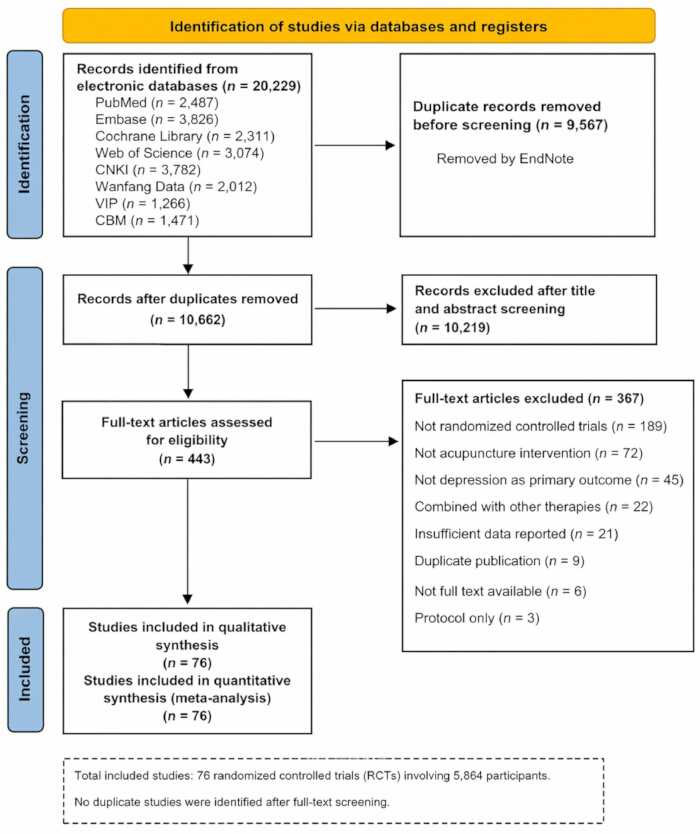
Figure 1. Study selection process and identification of eligible studies. PRISMA 2020 flow diagram illustrating the study selection process for the systematic review and meta-analysis. Records were identified through searches of eight electronic databases, screened after duplicate removal, assessed for eligibility through full-text review, and included according to predefined inclusion and exclusion criteria. A total of 76 randomized controlled trials involving 5,864 participants were included in the qualitative synthesis and quantitative meta-analysis. Abbreviations: CBM, China Biomedical Literature Database; CNKI, China National Knowledge Infrastructure; PRISMA, Preferred Reporting Items for Systematic Reviews and Meta-Analyses. Please click here to view a larger version of this figure.
Data extraction
Two reviewers (JG and NW) independently extracted data using a standardized data extraction form (Supplementary File 3). Extracted information included study characteristics (first author, publication year, sample size, and randomization method), participant characteristics (age and diagnostic criteria), intervention details, outcome measures, and time points of outcome assessment. The characteristics of the included studies are summarized in Supplementary Table 1. Any discrepancies were resolved through discussion, with arbitration by a third reviewer (PL) when necessary.
Assessment of risk of bias in included studies
The risk of bias of included RCTs was assessed using the Cochrane Risk of Bias Tool version 2.0 (ROB 2.0). This tool evaluates bias across domains including the randomization process, deviations from intended interventions, missing outcome data, measurement of outcomes, and selection of reported results. Each study was rated as having low risk, some concerns, or high risk of bias. Two reviewers (JG and NW) independently performed the assessments, and disagreements were resolved through discussion or consultation with a third reviewer (PL).
Statistical analysis
Statistical analyses were performed using RevMan version 5.4. For continuous outcomes, mean differences (MDs) with corresponding 95% confidence intervals (CIs) were calculated.
Statistical heterogeneity was assessed using the Chi-square (χ2) test and the I2 statistic. Heterogeneity was interpreted as low (I2 < 50%), moderate (50%–75%), or substantial (>75%). Random-effects meta-analyses were performed using the DerSimonian–Laird random-effects model.
When substantial heterogeneity (I2 > 50%) was identified, subgroup analyses were conducted to explore potential sources of heterogeneity, including type of depression assessment scale (HAMD-17, HAMD-24, HAMD-NS), type of acupuncture intervention (manual versus electro-acupuncture), and treatment duration and follow-up time points. Predefined treatment-duration categories were 0–3 weeks, 4 weeks, 6 weeks, and 8–12 weeks. Follow-up analyses were performed according to the nearest reported assessment interval. Summary results of the primary, subgroup, and sensitivity analyses are presented in Supplementary Table 2.
Sensitivity analyses were performed by applying alternative statistical models (fixed-effects versus random-effects) and effect measures (mean difference versus standardized mean difference) to evaluate the robustness of pooled estimates.
If heterogeneity could not be adequately explained, results were interpreted cautiously, and the certainty of evidence was downgraded accordingly. Publication bias was assessed using funnel plots when at least 10 studies were available.
Certainty of evidence
The certainty of evidence for each outcome was assessed using the GRADE framework. Evidence from randomized controlled trials was initially rated as high certainty and subsequently downgraded based on five domains: risk of bias, inconsistency, indirectness, imprecision, and publication bias. The overall certainty of evidence was classified as high, moderate, low, or very low. The certainty-of-evidence assessments for all major outcomes are summarized in Table 1.
Table 1: Summary of Findings and GRADE certainty assessment for acupuncture and electroacupuncture interventions in patients with primary depression. Pooled effect estimates from randomized controlled trials comparing acupuncture, electroacupuncture, and their combinations with selective serotonin reuptake inhibitors (SSRIs) against psychotherapy, waitlist control, sham acupuncture, or SSRI treatment alone. Outcomes include Hamilton Depression Rating Scale (HAMD) scores at different treatment durations, Self-Rating Depression Scale (SDS) scores, and adverse effects assessed using the Side Effect Rating Scale for Antidepressants (SERS). For each outcome, the table presents the assessment of risk of bias, inconsistency, indirectness, imprecision, and publication bias according to the Grading of Recommendations Assessment, Development and Evaluation (GRADE) framework, together with the number of participants and studies, pooled effect estimates expressed as mean differences (MDs) with 95% confidence intervals (CIs), and the overall certainty of evidence. Certainty ratings are categorized as high (⊕⊕⊕⊕), moderate (⊕⊕⊕◯), low (⊕⊕◯◯), or very low (⊕◯◯◯). Please click here to download this Table.
The interpretation of results was explicitly guided by the GRADE ratings, with findings supported by low or very low certainty evidence interpreted cautiously and described using non-causal, uncertainty-aware language.
Access restricted. Please log in or start a trial to view this content.
Results
Results of search
A total of 20,229 records were identified through electronic database searches. After removal of 9,567 duplicate records using EndNote, 10,662 records remained for screening. No duplicate studies were identified after full-text screening. Following title and abstract screening, 10,572 records were excluded based on the predefined inclusion and exclusion criteria. The full texts of 90 potentially eligible articles were assessed for eligibility, of which 14 were excluded according to ...
Access restricted. Please log in or start a trial to view this content.
Discussion
From 10,572 screened records, this systematic review and meta-analysis identified 76 randomized controlled trials involving 5,864 participants with primary depression. Across included studies, depressive symptom severity was primarily assessed using validated scales, including HAMD, SDS, and WHOQOL-BREF. The findings suggest that acupuncture may be associated with reductions in depressive symptom severity, particularly when used as an adjunct to SSRI therapy, and may offer advantages in treatment tolerability. When compa...
Access restricted. Please log in or start a trial to view this content.
Disclosures
Conflict of Interest:
The authors declare that they have no competing interests and no conflicts of interest related to this work.
Acknowledgements
The authors used Claude (Anthropic) in a limited capacity to assist with language editing, clarity of expression, and structuring of the manuscript and revision responses. No artificial intelligence tools were used for study design, data extraction, statistical analysis, or generation of scientific conclusions. All AI-assisted content was critically reviewed, verified, and approved by the authors, who take full responsibility for the accuracy and integrity of the work.
Access restricted. Please log in or start a trial to view this content.
Materials
| Name | Company | Catalog Number | Comments |
|---|---|---|---|
| Cochrane Risk of Bias Tool Version 2.0 (ROB 2.0) | Cochrane Collaboration | RRID:SCR_018214 | Used for risk-of-bias assessment of included randomized controlled trials. |
| EndNote X9 (reference management software) | Clarivate Analytics | RRID:SCR_014001 | Used for reference management, deduplication, and study screening. |
| GRADEpro Guideline Development Tool (GRADEpro GDT) | McMaster University / Evidence Prime | RRID:SCR_018239 | Used to generate GRADE certainty-of-evidence assessments and Summary of Findings tables. |
| PRISMA 2020 Checklist | N/A | N/A | Reporting guideline used for conducting and reporting the systematic review and meta-analysis. |
| PROSPERO database | Centre for Reviews and Dissemination, University of York | N/A | International prospective register of systematic reviews (Registration No. CRD42024526811). |
| Review Manager (RevMan) Version 5.4 | Cochrane Collaboration | RRID:SCR_003581 | Used for statistical analyses and meta-analysis. |
| Standardized data extraction form | Author-developed | N/A | Used for extraction of study characteristics, intervention details, comparator information, outcome measures, and adverse-event data. The form is provided in Supplementary File 3. |