This review emphasizes buckwheat's potential as a climate-smart crop, highlighting its physiological and genetic mechanisms, ecological benefits, stress resilience, and its role in sustainable agriculture. It also identifies research gaps and future strategies for increasing productivity in the face of changing climate conditions.
Review Article
Buckwheat: A Sustainable Alternative Crop Under Changing Climate
In This Article
Summary
Abstract
Buckwheat (Fagopyrum spp.), a pseudocereal crop with high nutritional and ecological values, is gaining global attention as a climate-smart crop suitable for sustainable agriculture. Its short life cycle, adaptability to marginal environments, and natural resilience to various abiotic and biotic stresses make it a promising crop for future cropping systems. Buckwheat, being a fast-growing and short-duration crop, fits seamlessly into crop rotation schedules and intercropping systems, especially in temperate and high-altitude regions. Recent literature clearly demonstrates the ability of buckwheat to withstand a wide range of stressors. Consequently, there is a great need to report the scientific findings backing the stress tolerance through underpinning physiological, molecular, and genetic insights behind its resilience. Additionally, buckwheat is reported to improve soil health, supporting biodiversity, and contributing to low-input farming systems. Current research gaps and strategic directions for breeding and biotechnological interventions to enhance buckwheat's resilience and productivity under changing climatic conditions have been highlighted in this study.
Introduction
Climate-smart agriculture (CSA) is an integrated approach that simultaneously enhances agricultural productivity, strengthens resilience to climate variability, and reduces greenhouse gas emissions. Climate change is increasingly disrupting agricultural systems through rising temperatures, erratic rainfall, and frequent extreme events such as droughts and floods. These stresses interfere with planting and harvesting cycles, degrade soil fertility, and ultimately reduce crop productivity. Major staple crops such as wheat, rice, and maize are particularly vulnerable, with global yield reductions projected to range from approximately 3%–12% by mid-century, with localized losses exceeding 25% under high-emission scenarios1. Elevated temperatures further accelerate crop phenology, shortening growth duration by 5–15 days per degree increase and negatively affecting grain filling2. These challenges highlight the urgent need for adaptive strategies to bridge emerging yield gaps and ensure food security3. CSA provides practical solutions through the adoption of stress-resilient crops, efficient resource management, and sustainable farming practices, including precision irrigation, agroforestry, and soil carbon enhancement4,5. Within this framework, underutilized crops with inherent climate resilience are gaining importance. Buckwheat (Fagopyrum esculentum), a nutrient-rich pseudocereal, is emerging as a promising climate-smart crop due to its adaptability, low input requirements, and multifunctional benefits6,7. Buckwheat is well-suited to marginal and resource-poor environments where conventional cereals often fail. It thrives in acidic and low-fertility soils (pH 5.0–6.5) with minimal fertilizer input, reducing dependence on agrochemicals and lowering production costs8. Its short life cycle (60–90 days) and rapid canopy establishment enable efficient weed suppression, reducing herbicide requirements by up to 30%–50%9. Additionally, its relatively low susceptibility to pests and diseases can reduce pesticide use by up to 70%, making it particularly suitable for sustainable and organic farming systems10,11.
From a resource-use perspective, buckwheat demonstrates high water-use efficiency, requiring 40%–60% less water than wheat while maintaining reasonable productivity12. Its rapid growth allows it to function effectively as a catch crop, utilizing fallow periods and enhancing overall land-use efficiency13. The crop also contributes significantly to soil health: its fibrous root system improves soil structure, enhances porosity, and facilitates water infiltration14. Moreover, buckwheat releases organic acids that mobilize insoluble phosphorus, thereby improving nutrient availability and benefiting subsequent crops15. These characteristics support nutrient cycling, soil conservation, and long-term sustainability in cropping systems16. Buckwheat also plays an important ecological role by supporting pollinator populations. Its nectar-rich flowers attract a wide range of pollinators, including honeybees, bumblebees, and hoverflies, during its short but intense flowering period17. This contributes to maintaining pollinator diversity and can enhance the productivity of nearby insect-pollinated crops through spillover effects18. Such ecosystem services further strengthen their value within climate-resilient agricultural systems. Although not fully drought-tolerant, buckwheat performs well under rainfed conditions due to its short growth duration, which allows it to escape severe drought periods. It can tolerate moderate water stress and is adaptable to diverse agro-climatic conditions, including high-altitude regions such as the Kashmir Valley19. This adaptability makes it particularly relevant for climate-vulnerable regions where environmental variability limits crop choices.
In addition to its agronomic and ecological benefits, buckwheat offers significant nutritional advantages. It contains high-quality protein with a balanced amino acid profile, including lysine, which is typically limited in cereals12. It is also rich in bioactive compounds such as rutin and quercetin, which exhibit antioxidant and anti-inflammatory properties20. Its high dietary fiber content supports cardiovascular health and glycemic control, while its gluten-free nature makes it suitable for individuals with coeliac disease21. Furthermore, compounds such as D-chiro-inositol contribute to improved insulin sensitivity, highlighting its potential in managing metabolic disorders. Buckwheat's versatility extends to its economic potential, as it can be processed into various value-added products, including gluten-free flour, noodles, and functional beverages such as buckwheat tea15. This enhances its market value and provides additional income opportunities for farmers. Despite these advantages, the integration of buckwheat into climate-smart agricultural systems remains underexplored, particularly at the molecular level. Most existing studies emphasize agronomic and physiological traits, with limited focus on advanced regulatory mechanisms that govern stress adaptation. Understanding these mechanisms is critical for unlocking its full potential as a climate-resilient crop. In this context, the present review aims to synthesize current knowledge on buckwheat's role in CSA while highlighting emerging molecular perspectives that can drive future research and crop improvement strategies. The goal of CSA is to increase food production without endangering the environment or the needs of future generations. A pseudocereal with substantial agroecological and nutritional value, buckwheat (Fagopyrum esculentum) is becoming increasingly well-known throughout the world as a crop that is both sustainable and climate-adapted (Figure 1).
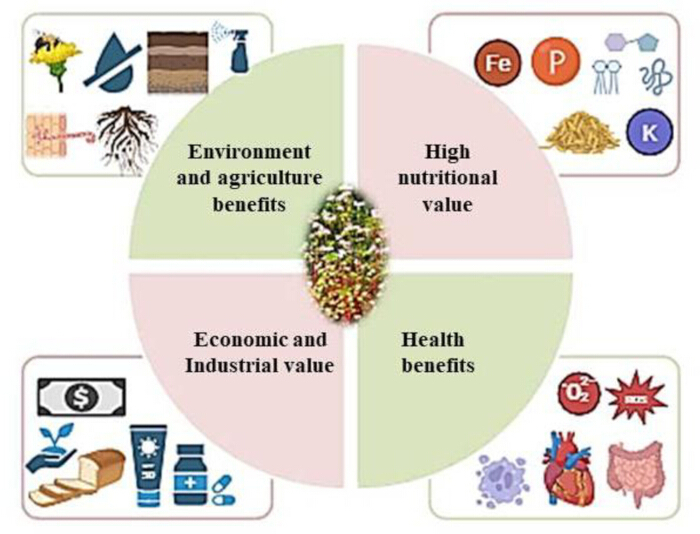
Figure 1: Multifunctional benefits of buckwheat in nutrition, health, economy and sustainable agriculture. This illustration depicts the major functional attributes of buckwheat. At the center, the buckwheat plant is surrounded by four domains that collectively show its broad biological significance. (i) High nutritional value: Buckwheat grains provide a balanced amino acid profile, bioavailable minerals, proteins, dietary fiber, and essential vitamins, supporting its role as a nutrient-dense pseudocereal. (ii) Health benefits: The crop is enriched in antioxidants such as flavonoids, particularly rutin and quercetin, that confer strong free radical scavenging activity and contribute to the mitigation of oxidative stress. It also supports cardiovascular and gut health. Bioactive phytochemicals exhibit antiproliferative, pro-apoptotic, and immunomodulatory activities, indicating potential roles in cancer prevention and complementary therapeutics. (iii) Economic and industrial value: Buckwheat is economically valuable, as it supports food, cosmetic, nutraceutical, and sustainable industrial markets. (iv) Environmental and agricultural benefits: Buckwheat enhances agro-ecosystem resilience through low input requirements, weed suppression, soil enrichment, pollination, and adaptability to marginal or variable environments. Together, these features underscore buckwheat's value as a nutritionally superior, health-promoting, and ecologically sustainable crop. Please click here to view a larger version of this figure.
The literature for this review was gathered through a comprehensive search of important scientific databases, including Web of Science, Scopus, PubMed, and Google Scholar. To locate relevant studies, combinations of keywords such as buckwheat, Fagopyrum esculentum, climate-smart agriculture, abiotic stress tolerance, drought tolerance, heat stress, salinity stress, omics in buckwheat, and sustainable agriculture were employed. The search was primarily focused on publications published between 2000 and 2025, with an emphasis on recent advancements in physiological, molecular, and omics-based research. Only peer-reviewed, English-language papers were considered. Research relevant to the role of buckwheat in climate resilience, stress tolerance mechanisms, and sustainable agricultural systems was selected. Articles that had redundant data, lacked strong experimental support, or had nothing to do with the goals of the review were excluded.
Review and Perspective
Buckwheat and climate smart agriculture
Future climate variability will significantly impact agricultural productivity, especially in climate-sensitive regions like India, according to projections from Global Circulation Model (GCM) simulations. According to reports from the Food and Agriculture Organization (FAO) and the Intergovernmental Panel on Climate Change (IPCC), agricultural output is expected to decrease under current climate trajectories, mainly because of resource constraints and an increase in the frequency of extreme weather events. This agreement emphasizes how urgently integrated adaptation and mitigation methods that concurrently address sustainability, resilience, and productivity are needed. In order to fulfill the growing demand for food, global evaluations indicate that agricultural production must rise by over 60% by 2050. This creates a crucial conflict between environmental sustainability and productivity growth. The importance of climate-smart agriculture (CSA) as a strategy framework is further supported by the fact that lowering emission intensity per unit of produce has become a top objective in this context.
By combining adaptation, mitigation, and production objectives, CSA is largely acknowledged as a successful strategy for balancing these conflicting needs. There is broad consensus among research that methods like climate-resilient crop adoption, conservation agriculture, and sustainable resource management can increase system-level resilience while reducing environmental effects. However, the degree of these advantages frequently varies based on crop varieties, management techniques, and geographical conditions, suggesting that CSA results are context-dependent and call for location-specific improvement. According to this concept, climate-smart crops are characterized by their capacity to achieve three main goals: lowering greenhouse gas emissions, increasing climate variability resistance, and maintaining or increasing yield. Research indicates that these crops have innate qualities such as adaptability to marginal areas, resilience to abiotic stresses (such as heat, salinity, and drought), and flexible growth cycles that allow them to avoid harsh weather conditions12.
Adaptation (to abiotic stress, marginal environments)
Numerous studies have demonstrated buckwheat's (Fagopyrum spp.) ability to tolerate a variety of abiotic challenges and thrive in marginal areas, making it a widely acknowledged climate-resilient crop. Its brief growth cycle (about 70–90 days), which allows the crop to avoid terminal pressures like drought and heat waves, is a recurring characteristic mentioned in the literature. This characteristic is thought to be an important adaptive strategy, especially in areas with increasingly unpredictable climates. Buckwheat does better under low-input conditions than main crops like wheat, requiring less fertilizer and irrigation. In contrast to conventional crops, which frequently show notable yield reductions, buckwheat can sustain growth and reproductive success under elevated CO₂, higher temperatures, and water-limited conditions, according to evidence from comparative studies, including those carried out under simulated future climate scenarios22.
An increasing amount of data suggests that buckwheat uses a variety of stress-responsive mechanisms at the physiological and molecular level to preserve cellular homeostasis in challenging circumstances. These include the build-up of osmoprotectants, the activation of antioxidant enzymes, and the control of genes that respond to stress, all of which work together to lessen oxidative damage23. Buckwheat triggers a series of physiological and metabolic reactions that support cellular integrity in the face of abiotic stressors, including drought, high temperatures, or salinity (Figure 2).
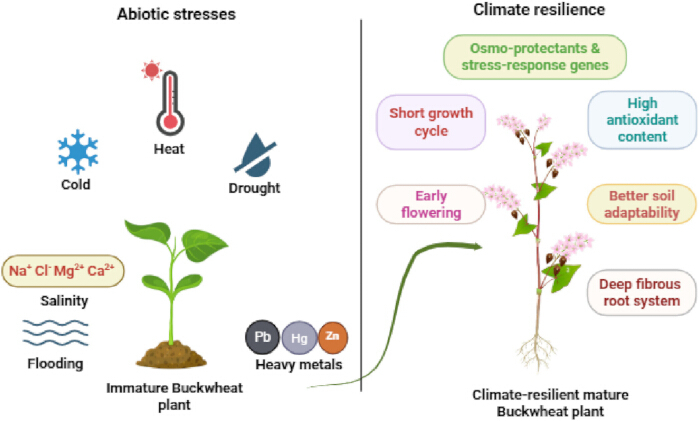
Figure 2: Abiotic stress response and climate-resilient traits in buckwheat. The figure illustrates how buckwheat develops climate resilience as it transitions from an immature seedling to a mature plant under abiotic stresses such as heat, cold, drought, salinity, heavy metals, and flooding. Stress exposure during early growth activates physiological and molecular adaptations that culminate in several resilience traits in the mature plant, including a short growth cycle, early and rapid flowering onset, high antioxidant content, accumulation of osmo-protectants and stress-responsive genes, enhanced soil adaptability, and a deep fibrous root system. These characteristics collectively enable buckwheat to thrive under harsh and variable environmental conditions, underscoring its potential as a climate-resilient crop for sustainable agriculture. Please click here to view a larger version of this figure.
Mitigation (low carbon footprint, efficient nutrient cycling)
Buckwheat (Fagopyrum spp.) is becoming more widely acknowledged as a low-carbon substitute for traditional cereal crops, with multiple studies emphasizing its potential contribution to mitigating climate change. The literature consistently finds that, in comparison to high-input systems like rice and wheat cultivation, its low input requirements, particularly its decreased reliance on synthetic fertilizers, pesticides, and irrigation, translate into lower greenhouse gas (GHG) emissions23. Comparative analyses indicate that buckwheat-based systems can significantly lower carbon dioxide equivalent (CO₂e) emissions compared to rice-based systems in several agroecological contexts, particularly in temperate and subtropical countries. The degree of mitigation benefits is context-specific, as evidenced by the fact that these estimates differ based on management methods, system boundaries, and analytical approaches utilized in emission computations.
Buckwheat's capacity to improve nutrient cycle, especially phosphorus availability, is a crucial factor underpinning its potential for mitigation. According to several studies, buckwheat roots release organic acids like citric and malic acids, which improve the availability of nutrients for both the present and future crops by mobilizing insoluble phosphates in the soil24. This method can lessen the need for external phosphate fertilizers, whose manufacture and excessive use are linked to high emissions of nitrous oxide (N2O). Although this role is widely recognized, the effectiveness of phosphorus mobilization can differ depending on the type of soil, microbial interactions, and environmental factors, indicating that additional field-based assessment of its wider agronomic influence is necessary. In addition to nutrient dynamics, buckwheat improves soil organic matter (SOM) by incorporating biomass and organic wastes when used as green manure or in crop rotations, which helps sequester carbon. Long-term data evaluating the stability and durability of sequestered carbon are still scarce, despite a number of studies showing beneficial effects on soil carbon pools. This underscores a crucial area for further investigation.
Productivity (short duration, multiple harvests)
Buckwheat (Fagopyrum spp.) is widely regarded as a high-potential crop for enhancing agricultural productivity, particularly in low-input and marginal systems, primarily due to its short growth cycle and rapid maturity. A consistent observation across studies is that its 70–90-day life cycle enables flexible integration into diverse cropping systems, including use as a catch crop, intercrop, or cover crop between major cropping seasons25. This temporal flexibility represents a significant agronomic advantage, allowing for improved land-use efficiency without the need for additional inputs or expansion of cultivated area. Evidence from regional studies supports the productivity benefits of such systems. For instance, double-cropping strategies involving buckwheat following wheat harvest have demonstrated increased overall land productivity under suitable climatic conditions, such as those reported in Central New York.
In regions with extended growing seasons, buckwheat's short duration further enables multiple harvest cycles within a single year. Studies from the Eastern Himalayan region of India indicate that two cropping cycles—before and after the monsoon—can be achieved without significant depletion of soil fertility26. From an economic perspective, buckwheat is increasingly recognized as a high-value crop due to growing demand for its gluten-free grain and nutritionally rich products. In countries such as Japan, where it is used in traditional foods like soba noodles, buckwheat supports value addition and market diversification27. Nevertheless, market-driven productivity gains are influenced by supply chains, processing infrastructure, and consumer demand, which may limit scalability in certain regions.
Drought tolerance mechanisms in buckwheat (Fagopyrum spp.)
Drought stress is widely recognized as one of the most limiting abiotic factors affecting buckwheat productivity, primarily through its adverse effects on photosynthesis, nutrient uptake, and overall plant growth. Across multiple studies, a consistent physiological response to drought in Fagopyrum spp. is the accumulation of osmoprotectants such as proline and soluble carbohydrates, coupled with reductions in photosynthetic rate, stomatal conductance, and transpiration28. This pattern suggests that osmotic adjustment is a central and well-established mechanism enabling cellular water balance under stress. The observed increase in intercellular CO₂ concentration alongside reduced photosynthesis further indicates non-stomatal limitations, likely associated with impaired biochemical processes during severe stress conditions.
However, the magnitude and effectiveness of these responses appear to vary across species and genotypes. F. tataricum is consistently reported to exhibit greater drought tolerance compared to F. esculentum, as evidenced by its stronger osmotic adjustment capacity, enhanced antioxidant activity, and relatively stable metabolic functions under stress. In contrast, F. esculentum has been suggested to adopt a drought avoidance strategy rather than true tolerance, relying on morphological and phenological adjustments such as improved root traits and altered growth patterns29. These contrasting strategies highlight important species-specific differences in drought response, although variability in experimental conditions and stress severity may also contribute to the observed discrepancies. At the biochemical level, drought stress induces significant alterations in antioxidant systems, with increased activities of enzymes such as superoxide dismutase (SOD), peroxidase (POD), and catalase (CAT), alongside elevated levels of reactive oxygen species (ROS) markers like H₂O₂30. While these responses are widely reported, their temporal dynamics differ across studies, with enzyme activities often increasing during initial stress exposure and declining under prolonged or severe drought, suggesting a threshold beyond which protective mechanisms may become insufficient.
At the molecular level, abscisic acid (ABA)-mediated signaling pathways play a critical role in coordinating drought responses. In F. tataricum, increased expression of ABA receptor genes (e.g., FtPYL14 and FtPYL15) under drought conditions highlights their involvement in stress signaling and grain development. While these findings provide important insights into regulatory mechanisms, most evidence is derived from controlled experimental systems, and their functional relevance under field conditions remains to be fully established.
High temperature stress tolerance in buckwheat
Temperature is a critical determinant of reproductive success in buckwheat, with numerous studies indicating that F. esculentum is particularly sensitive to heat stress, especially during the flowering stage. There is strong agreement that optimal temperatures for growth and reproduction range between 18–23 °C, while deviations from this range—both below and above—negatively affect flowering, fertilization, and seed development31. Elevated temperatures, in particular, have been consistently associated with impaired embryological development, reduced seed set, and lower final yield. However, responses to high temperature are not uniform across genotypes or species. For instance, variability in heat tolerance among F. esculentum accessions, such as "Panda" and "PA15," highlights the importance of genetic factors in determining reproductive stability under stress. Similarly, while F. esculentum is generally considered heat-sensitive, comparative observations suggest that F. tataricum may exhibit relatively greater resilience under elevated temperatures, although direct comparative evidence remains limited.
At the morphological and physiological levels, high temperature induces complex and sometimes contrasting responses. For example, elevated temperatures have been shown to accelerate phenological development, leading to earlier flowering, reduced internode length, and increased node number32. Reproductive processes appear to be particularly vulnerable to heat stress. Studies consistently report a decline in the number of properly developed embryo sacs and increased rates of seed abortion at elevated temperatures (e.g., ≥28–30 °C)33. Interestingly, while pollen production in F. esculentum may increase under higher temperatures, this does not necessarily translate into improved fertilization success, possibly due to its self-incompatibility system and heat-induced damage to female reproductive structures. This highlights a key discrepancy between male and female reproductive responses under heat stress.
At the biochemical level, both F. esculentum and F. tataricum exhibit enhanced antioxidant activity under elevated temperatures, suggesting activation of defense mechanisms against heat-induced oxidative stress34. Notably, reproductive tissues such as inflorescences often show stronger antioxidant responses than vegetative tissues, indicating a prioritization of reproductive protection. Molecular studies further reveal that heat stress disrupts hormonal signaling pathways, particularly those involving abscisic acid (ABA). For example, reduced expression of ABA receptor genes (e.g., FtPYL16 and FtPYL17) under extreme temperatures (38 °C) suggests impaired stress signaling and regulation. While these findings provide insights into underlying regulatory mechanisms, their functional implications under field conditions remain largely unexplored. Interestingly, under combined stress scenarios involving elevated CO₂ and high temperature, F. esculentum has been shown to maintain relatively stable water status, photosynthetic activity, and water-use efficiency compared to conventional crops such as wheat35.
Low temperature stress tolerance in buckwheat
Cold stress represents a significant constraint to buckwheat growth, with susceptibility varying markedly across developmental stages and species. Evidence consistently indicates that early growth stages, particularly from primary to secondary leaf development, are the most vulnerable to low temperatures. Tissue-specific responses have also been reported, with hypocotyls exhibiting greater sensitivity to cold-induced osmotic adjustments such as sucrose and galactoside accumulation compared to cotyledons and roots in F. esculentum. This suggests that cold stress responses are not uniform within the plant and may involve differential regulation of carbohydrate metabolism across tissues. Comparative studies highlight notable interspecific variation in cold tolerance. F. tataricum is generally reported to exhibit greater resilience than F. esculentum, as evidenced by improved root growth, enhanced photosynthetic efficiency, and reduced oxidative damage under cold stress conditions36. These findings suggest that improved maintenance of physiological processes and oxidative balance are key determinants of cold tolerance. However, even within F. tataricum, tolerance is not absolute; extremely low temperatures can inhibit germination and early growth, as observed in genotypes such as "Dingku1"37.
At the biochemical level, moderate cold stress (e.g., around 16 °C) has been associated with increased accumulation of secondary metabolites such as flavonoids and phenolics, which are known to play protective roles against oxidative damage. While this response is widely observed, its contribution to overall stress tolerance may depend on the balance between protective metabolite accumulation and the extent of cellular damage under prolonged or severe stress conditions. Emerging molecular evidence further highlights the role of epigenetic and transcriptional regulation in cold stress adaptation. In F. tataricum, cold exposure has been shown to alter DNA methylation patterns and modulate the expression of genes involved in metabolic and regulatory pathways, including FtDHE1, FtCuAO, and FtRPB138. The involvement of DNA methylation in regulating metabolite accumulation, such as lysine content, suggests a potential link between epigenetic modification and metabolic adaptation under stress.
Salinity stress tolerance in buckwheat
Salinity is a major abiotic constraint limiting buckwheat productivity, primarily through its negative effects on plant water relations, ion balance, and nutrient uptake. Across studies, a consistent trend is the reduction in growth parameters such as plant height, biomass accumulation, root length, and stem diameter with increasing NaCl concentrations, indicating a dose-dependent inhibitory effect of salinity on plant development. For instance, multiple F. tataricum genotypes exhibit progressive growth suppression and visible stress symptoms, including leaf yellowing, dehydration, and tissue deterioration, under elevated salt conditions39. However, responses to salinity are not strictly linear, and moderate stress levels may induce adaptive or stimulatory effects in certain genotypes.
At the molecular level, a substantial body of research has focused on transcription factors (TFs) and signaling pathways associated with salinity tolerance, particularly in F. tataricum. Genes such as FtbZIP83, FtNAC31, and FtWRKY46 have been shown to enhance salt tolerance when overexpressed in model systems like Arabidopsis thaliana, leading to improved germination, root development, chlorophyll retention, and osmoprotectant accumulation, along with reduced oxidative damage40. Similarly, FtMAPK1 has been implicated in regulating downstream TFs (e.g., FtMYB21, FtNAC4/6/9) and enhancing antioxidant enzyme activity under salt stress41. Although the majority of the evidence comes from transgenic or controlled experimental systems, which could not adequately reflect the complexity of field situations, these findings offer important insights into the genetic basis of salinity tolerance. Furthermore, little is known about how these genes interact functionally and how they integrate with physiological reactions.
Root traits in buckwheat under moisture stress
Buckwheat (Fagopyrum spp.) demonstrates considerable adaptability to a wide range of soil types, although there is general agreement that it performs optimally in light- to medium-textured soils such as sandy loam, loam, and silt loam, which are prevalent in regions like the Eastern Himalayan Region (EHR). Its tolerance to acidic soils further enhances its suitability for marginal environments. However, soil type alone does not determine productivity; moisture availability remains a critical limiting factor, particularly during winter seasons when water scarcity constrains crop performance. Under such moisture-limited conditions, buckwheat exhibits notable resilience, which has been largely attributed to its adaptive root system. Several studies suggest that buckwheat can maintain growth under water stress by modifying root architecture to access deeper soil moisture and nutrients42. This capacity for root plasticity is considered a key adaptive trait; however, there is some inconsistency in the characterization of its root system. While some reports emphasize its ability to develop deeper and more exploratory roots under stress, others describe a relatively limited number of fine roots and simplified branching patterns43. More broadly, root traits such as increased rooting depth, enhanced surface area, and dynamic branching patterns are widely recognized as critical determinants of drought tolerance across plant species44.
Molecular and genetic advances in buckwheat
Growing interest in buckwheat's nutritional content and ability to adapt to stressful situations has made it a valuable model for molecular and genetic investigations (Fagopyrum spp.). The creation of draft genome assemblies for F. esculentum and F. tataricum has been made possible by the advancement of high-throughput sequencing technology, offering crucial platforms for trait mapping, gene identification, and comparative genomics. The two species differ significantly in terms of genome size, structural organization, and the quantity of repetitive sequences, according to comparative genomic studies45,46. These genetic differences are frequently associated with phenotypic divergence, such as variances in stress tolerance, with F. tataricum typically showing more resilience in challenging environmental circumstances.
Although the availability of genomic resources has significantly advanced buckwheat research, their practical application in crop improvement is still evolving. Many identified genes and genomic regions associated with stress tolerance require further functional validation, particularly under field conditions. Therefore, integrating genomic data with physiological and agronomic studies will be essential to translate these insights into effective breeding strategies.
Overview of omics resources in buckwheat
Advances in omics technologies, including genomics, transcriptomics, proteomics, and metabolomics, have substantially improved our understanding of plant biological systems by enabling multi-layered analysis of gene function, regulation, and phenotype expression46,47,48. In buckwheat (Fagopyrum spp.), these approaches have been increasingly applied to dissect the genetic and molecular basis of key agronomic traits such as stress tolerance, nutritional quality, and yield stability under variable environmental conditions49. At the genomic level, the availability of draft genome assemblies for F. esculentum and F. tataricum has provided a critical foundation for genetic analysis and crop improvement. Comparative genomics reveals substantial differences in genome organization, including genome size and repeat content, with F. esculentum (~1.2 Gb) exhibiting a more complex and repetitive genome compared to the relatively compact genome of F. tataricum (~510 Mb)46. These structural differences are often associated with functional divergence, particularly in stress responsiveness, as F. tataricum generally demonstrates greater tolerance to abiotic stresses.
Transcriptomic analysis provides dynamic insights into gene expression patterns under developmental and stress conditions. RNA sequencing studies consistently report the upregulation of stress-responsive genes, including those encoding late embryogenesis abundant (LEA) proteins, dehydrins, and key transcription factor families such as DREB, NAC, and WRKY under abiotic stresses like drought, salinity, and cold50. Integrated transcriptome metabolome studies further highlight coordinated regulation of metabolic pathways, particularly flavonoid biosynthesis. For example, increased expression of genes such as CHS, CHI, and F3H has been linked to enhanced accumulation of antioxidant compounds, suggesting a functional link between gene expression and stress mitigation. Nevertheless, most transcriptomic studies are conducted under controlled conditions, and their reproducibility under field environments remains a key limitation. Proteomic investigations complement transcriptomic data by revealing post-transcriptional and post-translational modifications that directly influence stress adaptation. Under abiotic stress conditions, buckwheat plants exhibit increased abundance of proteins involved in stress defense, including heat shock proteins (HSPs), antioxidant enzymes, and detoxification-related proteins51.
Metabolomic studies further elucidate the biochemical basis of stress tolerance by profiling primary and secondary metabolites involved in cellular protection. A consistent finding is the accumulation of osmolytes (e.g., proline, glycine betaine), organic acids, and polyphenolic compounds under stress conditions23. A table summarizing major omics techniques, including genomics, transcriptomics, proteomics, metabolomics, and genome editing, along with their key findings, applications, and associated literature in Fagopyrum species is provided in Table 152,53,54,55,56,57,58,59,60,61.
Genome editing for trait improvement in buckwheat
With the ability to make targeted changes at particular genomic loci and the promise to speed up crop improvement, genome editing is a major development in precision plant breeding62,63,64. However, as stable and regular genome-editing pathways are not yet fully developed in buckwheat (Fagopyrum spp.), their application should still be viewed as emerging and primarily prospective.
Currently, buckwheat-specific genome editing is still in the conceptual or early experimental stage, with the majority of advancements concentrated on candidate gene identification rather than verified genome-edited phenotypes. Potential targets include genes linked to metabolic control and stress response. For instance, based on data from other crop systems, transcription factors like DREB2A, which are known to control plant responses to heat and drought stress, are seen as potential targets for enhancing abiotic stress tolerance in buckwheat65. Similarly, it is thought that genes like PAL (phenylalanine ammonia-lyase), which are essential to the production pathways of flavonoids and phenylpropanoids, could be targets for increasing the accumulation of bioactive substances like rutin. Furthermore, potential genes for enhancing photoperiod adaptation and yield stability in a variety of settings have been proposed, including flowering timing regulators like FT (Flowering Locus T). It is crucial to stress that, rather than being confirmed by genome editing in buckwheat, these functional roles are mostly deduced from conserved gene functions in other plant species.
A major limiting factor for genome editing in buckwheat is the difficulty of efficient plant regeneration from tissue culture systems, which varies significantly among cultivars and remains a key bottleneck for stable transformation. Nevertheless, several methodological advances provide initial experimental groundwork:
(i) Transient expression systems and protoplast assays, which enable preliminary functional validation of gene-editing constructs at the cellular level in a non-regenerative context.
(ii) Agrobacterium-mediated transformation approaches, where recent use of morphogenic regulators such as BABY BOOM (BBM) and WUSCHEL2 (WUS2) has shown potential to improve regeneration efficiency in recalcitrant plant systems66.
(iii) Particle bombardment methods, which are being explored as an alternative DNA delivery strategy, although their efficiency in buckwheat remains variable and genotype-dependent.
Overall, these approaches should be viewed as enabling technologies rather than fully optimized systems for routine genome editing in buckwheat.
Emerging genome editing technologies associated with CRISPR/Cas systems
The accuracy and adaptability of targeted genetic change in plants have increased with recent developments in genome editing technologies. Specifically, base editing reduces the possibility of genomic instability and minimizes off-target effects by enabling targeted nucleotide alterations without causing double-strand breaks. Prime editing, a more modern CRISPR/Cas-derived technique, offers additional versatility for creating complicated features by enabling accurate insertions, deletions, and base conversions63,67.
Although these technologies have shown impressive results in a number of model and crop species, their use in buckwheat is still mostly theoretical until effective transformation and regeneration mechanisms are developed. Therefore, their relevance to buckwheat enhancement should currently be considered as future-oriented potential rather than demonstrated competence.
Despite these developments, a number of obstacles still prevent widespread adoption in less developed transformation systems like buckwheat. These include the possibility of inadvertent mutations that could impact trait stability and the requirement for better delivery methods, especially DNA-free techniques like ribonucleoprotein (RNP)-based editing, which are becoming more and more popular due to biosafety and regulatory concerns. Furthermore, the speed at which laboratory research is translated into field deployment may be further impacted by differences in national regulatory frameworks and low public acceptability of genome-edited crops.
Crucially, genome editing should be seen as a complementary part of integrated breeding frameworks, such as traditional breeding and marker-assisted selection, rather than as a stand-alone approach. When trustworthy transformation systems for buckwheat are developed, their most potential use will be to expedite the validation and implementation of candidate genes. Additionally, it is anticipated that the combination of multi-omics methods (metabolomics, transcriptomics, and genomics) would enhance functional annotation and candidate gene discovery, facilitating more accurate trait-target selection in future genome-editing strategies.
Conclusions
Buckwheat (Fagopyrum spp.) is a climate-resilient and nutritionally rich pseudocereal with strong potential for sustainable agriculture. This review synthesizes recent advances in understanding the physiological, molecular, and genetic bases of its stress tolerance, productivity, and nutraceutical traits. The integration of multi-omics approaches, including genomics, transcriptomics, proteomics, and metabolomics, has enabled the identification of key genes and regulatory pathways associated with abiotic stress adaptation and bioactive compound accumulation.
These insights highlight buckwheat's suitability for cultivation in marginal environments, its low-input requirements, and its contributions to soil health, biodiversity, and ecosystem sustainability. However, the functional validation of candidate genes and their effective translation into breeding programs remain key challenges.
Future research should prioritize high-resolution trait mapping, functional genomics, and the application of advanced genome editing tools such as CRISPR/Cas systems to accelerate crop improvement. Strengthening value chains and promoting farmer adoption will further enhance its agricultural relevance. Overall, buckwheat represents a strategic crop for addressing food security, nutritional demands, and climate change challenges in vulnerable agroecosystems.
| OMICS area | Key Insights | Applications | Reference/s |
| Genomics | Draft genomes of F. esculentum and F. tataricum | Marker-assisted selection; gene discovery | 52 |
| Comparative analysis among F. esculentum, F. tataricum, and related Polygonaceae species | Revealed conserved gene clusters for stress tolerance, secondary metabolite synthesis, and flowering regulation. | 53 | |
| Gene cloning & overexpression (e.g., FtMYB, FtDFR, FtFLS) | MYB and bHLH transcription factors regulate flavonoid biosynthesis and stress tolerance. | 54 | |
| Transcriptomics | Gene expression changes under drought, salt, and cold stress | Understanding stress signaling pathways | 55 |
| RNA-Seq under abiotic stresses (salt, drought, cold) | Identification of differentially expressed genes (DEGs) related to antioxidant defense, osmoprotection, and phenylpropanoid metabolism. | 56 | |
| Proteomics | Heat shock proteins, LEA proteins, antioxidant enzymes | Identification of stress-responsive proteins | 57 |
| 2D-Gel electrophoresis and LC–MS/MS | Characterized stress-responsive proteins involved in ROS scavenging, energy metabolism, and seed storage proteins. | 58 | |
| Metabolomics | Accumulation of rutin, quercetin, and other flavonoids; LC–MS-based profiling of flavonoids and phenolic compounds | Nutritional enhancement and stress tolerance; identified high rutin, quercetin, and catechin levels; correlated metabolite accumulation with expression of biosynthetic genes | 59 |
| Genome Editing | CRISPR/Cas9 targeting stress and metabolic genes | Precision breeding and functional genomics | 60 |
| CRISPR/Cas9 in F. tataricum | Successful transformation and knockout of candidate genes (e.g., FtPDS) validated editing feasibility; tool for future trait improvement. | 61 |
Table 1: Overview of omics approaches in buckwheat and their key insights and applications.
This table summarizes major omics techniques, including genomics, transcriptomics, proteomics, metabolomics, and genome editing, along with their key findings, applications, and associated literature in Fagopyrum species.
Disclosures
The authors declare no conflict of interest
Acknowledgements
The authors gratefully acknowledge financial support from the Department of Biotechnology (DBT), Government of India, under the project entitled Deciphering the Genetics for Enhancing Yield and Nutritional potential of Buckwheat vide no. number BT/PR45195/NER/95/1930/2022; dated: 30-09-2024. Dr. Sajad Ali acknowledges support from the Deanship of Scientific Research, Vice Presidency for Graduate Studies and Scientific Research, King Faisal University, Saudi Arabia (KFU262762).