Public-cohort analyses and glioma cell–based experiments identify MRC2 as a poor-prognosis marker associated with enhanced proliferation, migration, invasion, and β-catenin/EMT-related changes in glioma.
Research Article
Mannose Receptor C Type 2 Predicts Poor Outcome in Glioma and is Associated With Invasive Phenotypes and β-Catenin/EMT-related Changes
Yanni Yu*1 , Lijing Ji*2 , Juan Li3 , Yu Tian4,5 , Zhiwen Wang1 , Yanyang Tu4
tufmmu@188.com
13991998909@163.com
Dr_leixu.china@outlook.com
1Medical school Vocational Technical College Yueyang, 2Department of Ultrasound Medicine, Nanfang Hospital, Southern Medical University, 3Department of Neurosurgery, Xijing Hospital, Fourth Military Medical University, 4Science Research Center, Huizhou Central People's Hospital, 5School of Public Health, Benedictine University, 6Department of Neurosurgery, Chongqing Emergency Medical Center, Chongqing University Central Hospital, School of Medicine, Chongqing University
Corresponding Authors: Yanyang Tu <tufmmu@188.com>, Haining Zhen <13991998909@163.com>, Lei Xu <Dr_leixu.china@outlook.com>
* These authors contributed equally
Opens in a new tab
In This Article
Summary
Loading...
$$\rightleftharpoonup{xx}$$
$$\longleftharp{xx}$$,
$$\longrightharp{xx}$$,
Abstract
Loading...
$$\rightleftharpoonup{xx}$$
$$\longleftharp{xx}$$,
$$\longrightharp{xx}$$,
Glioma remains a lethal malignancy of the central nervous system, and additional biomarkers that improve prognostic stratification and inform therapeutic exploration are still needed. This study evaluated mannose receptor C-type 2 (MRC2/Endo180) by integrating public transcriptomic cohorts with in vitro validation. Expression profiles and matched clinical annotations were obtained from The Cancer Genome Atlas (TCGA) and the Genotype-Tissue Expression (GTEx) project for tumor–normal comparisons and pan-cancer screening, and prognostic associations were further examined in the Chinese Glioma Genome Atlas (CGGA) cohort. MRC2 expression was assessed in glioma cell lines by reverse transcription quantitative PCR (RT-qPCR) and immunoblotting, and stable MRC2 knockdown was established in U87 and U251 cells using lentiviral short hairpin RNAs (shRNAs). Cell growth and clonogenicity were evaluated using CCK-8 and colony formation assays, whereas migration and invasion were assessed using porous-membrane insert assays. CDK4, CDK6, and β-catenin/epithelial–mesenchymal transition (EMT)-related markers were analyzed by immunoblotting. Across datasets, MRC2 was elevated in glioma, and higher expression was associated with worse overall survival, disease-specific survival, and progression-free interval. In vitro, MRC2 depletion reduced proliferation, clonogenicity, migration, and invasion, accompanied by decreased CDK4 and CDK6 protein levels and changes in β-catenin and EMT-related markers. Together, these findings support MRC2 as a candidate prognostic biomarker associated with aggressive glioma phenotypes and warrant further mechanistic and in vivo investigation.
Introduction
Loading...
$$\rightleftharpoonup{xx}$$
$$\longleftharp{xx}$$,
$$\longrightharp{xx}$$,
Gliomas represent the most common primary tumors arising in the central nervous system and account for a substantial fraction of intracranial neoplasms1,2. Epidemiologic studies estimate an incidence on the order of a few cases per 100,000 people each year, with geographic and sex-related differences reported across populations3,4. Clinically, gliomas span a broad spectrum of behavior: lower-grade gliomas can follow a prolonged course, whereas high-grade disease—particularly glioblastoma—remains rapidly fatal for most patients5,6,7,8. Modern WHO classifications integrate histology with key molecular features (e.g., IDH mutation, TERT promoter alteration, MGMT promoter methylation, and 1p/19q co-deletion), which refine diagnosis and inform prognosis9,10. Despite multimodal management combining surgery, radiotherapy, and chemotherapy, recurrence is common, and long-term outcomes for high-grade tumors remain poor. Therefore, identifying additional prognostic markers and targetable vulnerabilities remains an urgent priority.
MRC2 (mannose receptor C-type 2; also referred to as Endo180/CD280/uPARAP) is a transmembrane member of the C-type lectin receptor family11. It is enriched in stromal and immune compartments, such as fibroblasts and macrophages, and participates in extracellular matrix (ECM) turnover, fibrosis-related remodeling, and tumor–microenvironment interactions12,13. Structurally, MRC2 contains an N-terminal cysteine-rich region, a fibronectin type II domain that binds collagen, multiple C-type lectin-like domains, a transmembrane segment, and a cytoplasmic tail14,15. Through collagen internalization and remodeling, MRC2 can facilitate cell motility and tissue invasion, and elevated MRC2 has been linked to aggressive behavior in several cancers, including breast, pancreatic, prostate, melanoma, and glioblastoma11,14,16,17,18. Prior work also suggests connections between MRC2 and pro-invasive signaling programs (e.g., TGF-β–associated pathways), matrix metalloproteinase activity, and EMT-like phenotypic changes, as well as roles in cancer-associated fibroblast and macrophage states17,18,19,20,21. However, the clinical significance of MRC2 in glioma and the functional consequences of MRC2 dysregulation in glioma cells remain unclear.
Although MRC2 has been implicated in extracellular matrix remodeling and invasive behavior in several malignancies, its clinical significance in glioma has not been systematically established across independent transcriptomic cohorts, and its phenotype-associated effects in glioma cells have not been evaluated within an integrated framework combining public dataset analysis with functional validation. This study, therefore, hypothesized that MRC2 is associated with adverse clinical outcomes and malignant phenotypes in glioma. To address this question, pan-cancer screening, independent glioma-cohort validation, and stable knockdown experiments in glioma cell lines were integrated to evaluate the prognostic significance of MRC2 and its association with proliferation, migration, invasion, and changes in β-catenin/EMT-related markers. Because MRC2 belongs to the mannose receptor family and glioma progression is also shaped by the tumor microenvironment, an additional exploratory analysis of MRC1 expression by IDH status was included to provide contextual information on immune-related differences across glioma subtypes.
The novelty of this work lies in the combined assessment of MRC2 across public glioma datasets and in vitro functional assays, thereby providing complementary clinical and experimental evidence for its relevance in glioma. Compared with single-cohort analyses or cell-only studies, this integrated workflow offers several practical advantages. The incorporation of TCGA, GTEx, and CGGA enables cross-cohort validation and reduces dependence on a single dataset. In addition, coupling public-cohort analyses with glioma cell knockdown assays links clinical associations to phenotype-level evidence. Finally, the use of complementary readouts, including RT-qPCR, immunoblotting, CCK-8, colony formation, and porous-membrane insert assays, enables the assessment of transcriptional, protein-level, proliferative, and motility-related changes in parallel. The overall study design and analytical workflow are summarized in Figure 1. Together, this strategy improves the robustness and biological interpretability of the findings relative to bioinformatics-only or single-assay approaches.
Protocol
Loading...
$$\rightleftharpoonup{xx}$$
$$\longleftharp{xx}$$,
$$\longrightharp{xx}$$,
This study used publicly available, de-identified datasets (TCGA, GTEx, and CGGA) and established commercial cell lines. No newly recruited human participants, identifiable patient information, or patient-derived specimens were involved. All analyses were conducted in accordance with relevant institutional and international guidelines for the use of publicly available data. Therefore, no additional institutional ethics approval or informed consent was required for this study.
1. Bioinformatic workflow and data preprocessing
Gene-expression profiles and matched clinical annotations were obtained from publicly available resources, including The Cancer Genome Atlas (TCGA), the Genotype-Tissue Expression (GTEx) project, and the Chinese Glioma Genome Atlas (CGGA). Expression matrices and clinical metadata were imported into R and harmonized according to sample identifiers. Duplicate or unmatched entries were removed, and samples lacking essential survival information were excluded from survival analyses. MRC2 expression values and corresponding clinicopathologic variables were extracted for downstream analyses. For tumor-normal comparisons, MRC2 expression was compared across cancer types using TCGA-only data when matched normal tissues were available and using integrated TCGA–GTEx data when additional normal controls were required. For glioma-focused analyses, patients in the TCGA-LGG and CGGA cohorts were stratified into high- and low-expression groups according to the cohort median MRC2 expression level. Kaplan-Meier survival analysis, time-dependent receiver operating characteristic (ROC) analysis, and Cox proportional-hazards regression were then performed to evaluate the prognostic relevance of MRC2. Cox models included available covariates such as age, sex, WHO grade, and other clinicopathologic variables, depending on data completeness within each cohort. Subgroup analyses were performed according to variables including age, histologic subtype, WHO grade, IDH mutation status, 1p/19q codeletion status, and treatment-related information, where available. Figures were generated using standard statistical plotting workflows in R and GraphPad Prism.
2. Pan-cancer expression and survival analyses
MRC2 expression was compared between tumor and normal tissues across cancer types using TCGA and GTEx datasets. Differences were visualized using boxplots and summarized using radar plots. Cox proportional hazards regression analyses were performed to evaluate associations between MRC2 expression and overall survival (OS), disease-specific survival (DSS), and progression-free interval (PFI) across cancer types. Hazard ratios and corresponding significance levels were visualized using forest plots and heatmaps.
3. Prognostic validation and subgroup analyses in glioma cohorts
In the TCGA lower-grade glioma (TCGA-LGG) cohort, patients were stratified into high- and low-MRC2 expression groups. Kaplan–Meier survival analyses were performed to compare OS, DSS, and PFI between groups. Time-dependent receiver operating characteristic (ROC) curves were generated to assess predictive performance. Univariate and multivariate Cox regression analyses were conducted to evaluate the independent prognostic value of MRC2. External validation was performed using the CGGA glioma dataset, including Kaplan–Meier survival analysis, ROC analysis, and Cox regression. Subgroup analyses were conducted to evaluate MRC2 expression across clinicopathologic variables, including age, tumor grade, histological subtype, IDH mutation status, 1p/19q codeletion status, and treatment-related variables.
4. MRC1 expression in IDH-mutant versus IDH-wildtype gliomas
The association between MRC1 expression and IDH mutation status was evaluated using the GlioVis web platform and the TCGA GBMLGG dataset. Cases were grouped based on annotated IDH status into IDH-mutant and IDH-wildtype gliomas. MRC1 mRNA expression was queried within the selected dataset, and expression levels between the two groups were compared using the platform’s built-in statistical analysis function. Group-wise expression distributions were displayed as generated by the platform, and statistical significance was defined as P < 0.05.
5. Cell culture
Human glioma cell lines and normal human astrocytes were obtained from established cell repositories. Cells were cultured in Dulbecco’s modified Eagle’s medium (DMEM) supplemented with 10% fetal bovine serum (FBS) and maintained at 37 °C in a humidified incubator containing 5% CO₂ and approximately 95% relative humidity. U87 and U251 cells were selected for loss-of-function experiments because baseline screening across the tested glioma cell panel showed that these two cell lines expressed relatively higher MRC2 levels and were therefore suitable for knockdown-based functional analyses.
6. Lentiviral knockdown of MRC2
Short hairpin RNAs (shRNAs) targeting MRC2 and a non-targeting control were cloned into lentiviral vectors. Lentiviral particles were produced by co-transfecting HEK293T cells with transfer plasmids and packaging plasmids using a standard transfection reagent. Viral supernatants were collected at 48 h and 72 h after transfection, centrifuged at 2,100 × g for 5 min to remove packaging cells and cell debris, and then passed through a 0.45 µm filter before immediate use or storage at −80 °C19. Virus-containing supernatants were used immediately or aliquoted and stored at −80 °C. Repeated freeze–thaw cycles were avoided. Glioma cells were infected with lentiviral particles in the presence of polybrene. After infection, cells were selected with puromycin to establish stable knockdown cell lines. The sequences used were as follows: sh-MRC2-1: 5′-GAAATGAATGAGCAGCAAGAA-3′; sh-MRC2-2: 5′-CCGGTATTGCTATAAGGTGTT-3′; sh-NC: 5′-TTCTCCGAACGTGTCACGT-3′.
7. Validation of MRC2 knockdown by RT-qPCR and immunoblotting
Total RNA was extracted using TRIzol reagent, and cDNA was synthesized using a reverse-transcription kit according to the manufacturer’s instructions. Quantitative PCR was performed using SYBR Green chemistry under the following cycling conditions: initial denaturation at 95 °C for 30 s, followed by 40 cycles of 95 °C for 5 s and 60 °C for 30 s, with a dissociation curve analysis performed at the end of amplification. The primer sequences were as follows: MRC2 forward, 5′-GGCAAGGACAAGAAGTGCGTGT-3′; MRC2 reverse, 5′-CTTTGGTGACGTTGCTGCGCTT-3′; GAPDH forward, 5′-TCCACCCATGGCAAATTCC-3′; and GAPDH reverse, 5′-TCGCCCCACTTGATTTTGG-3′. Relative mRNA expression was calculated using the comparative Ct (2^-ΔΔCt) method with GAPDH as the internal control20. Immunoblotting was performed in parallel to confirm MRC2 knockdown at the protein level. For RT-qPCR, three independent biological replicates were analyzed, and each sample was run in technical triplicate.
8. Cell proliferation assay
Cell proliferation was assessed using the CCK-8 assay. Cells were seeded into 96-well plates at an appropriate density and cultured for the indicated time periods. At each time point, CCK-8 reagent was added to each well and incubated according to the manufacturer’s instructions, after which absorbance at 450 nm was measured using a microplate reader. At least three independent biological replicates were performed.
9. Colony formation assay
Cells were seeded at low density into six-well plates and cultured for 10–14 days. Colonies were fixed with 4% paraformaldehyde for 15 min at room temperature and stained with 0.1% crystal violet for 15 min. Colonies were washed with phosphate-buffered saline (PBS), air-dried, and counted manually or using image analysis software21. At least three independent biological replicates were performed.
10. Cell migration and invasion assays
Cell migration and invasion were evaluated using porous-membrane insert assays22. For invasion assays, the upper inserts were pre-coated with extracellular matrix gel; for migration assays, uncoated inserts were used. Cells suspended in serum-free medium were added to the upper chamber, and medium containing serum was placed in the lower chamber as a chemoattractant. After incubation, nonmigrated cells on the upper membrane surface were gently removed with a cotton swab. Cells that had migrated or invaded the lower surface were fixed with 4% paraformaldehyde for 15 min, stained with 0.1% crystal violet for 15 min, rinsed with cold phosphate-buffered saline, air-dried, and imaged under an inverted microscope at ×200 magnification. Cells were counted in five randomly selected microscopic fields per insert. At least three independent biological replicates were performed.
11. Western blot analysis
Cells were lysed in RIPA buffer supplemented with protease inhibitors, and protein concentration was determined using a BCA assay. Equal amounts of total protein were separated by SDS-PAGE and transferred to PVDF membranes. Membranes were blocked in 5% non-fat milk for 1 h at room temperature and incubated with primary antibodies overnight at 4 °C. The following primary antibodies and working dilutions were used for western blotting: anti-MRC2 (1:5,000), anti-CDK4 (1:1,000), anti-CDK6 (1:2,000), anti-β-catenin (1:5,000), anti-E-cadherin (1:10,000), anti-N-cadherin (1:3,000), and anti-β-actin (1:5,000). After washing, membranes were incubated with horseradish peroxidase-conjugated goat anti-mouse IgG or goat anti-rabbit IgG secondary antibodies (1:5,000) for 1 h at room temperature. Signals were visualized using chemiluminescence, and band intensities were quantified and normalized to β-actin. At least three independent biological replicates were performed.
12. Statistical analysis
Statistical analyses were performed using R and GraphPad Prism. Survival curves were compared using the log-rank test. Cox proportional hazards regression models were used for univariate and multivariate analyses. For cell-based experiments, data are presented as mean ± SD. Before parametric testing, normality was assessed using the Shapiro–Wilk test. For normally distributed data, differences between two groups were evaluated using Student’s t-test, and comparisons among multiple groups were performed using one-way ANOVA. If normality assumptions were not satisfied, the corresponding nonparametric tests were used. P values were adjusted for multiple testing using the Benjamini–Hochberg false discovery rate procedure23,24. A two-sided P < 0.05 was considered statistically significant.
Results
Loading...
$$\rightleftharpoonup{xx}$$
$$\longleftharp{xx}$$,
$$\longrightharp{xx}$$,
Pan-cancer expression and prognostic landscape of MRC2
Pan-cancer analyses were first performed to characterize the expression pattern and prognostic relevance of MRC2 across human malignancies. Comparisons based on TCGA and GTEx datasets showed that MRC2 expression differed significantly between tumor and normal tissues in multiple cancer types (Figure 2A, 2B). A radar plot summary further illustrated the broad variation in MRC2 expression across cancers (Figure 2C). To assess whether MRC2 expression was clinically relevant at the pan-cancer level, Cox regression analyses were conducted for overall survival (OS), disease-specific survival (DSS), and progression-free interval (PFI) (Figure 2D, 2F). Heatmap summaries further visualized the direction and magnitude of the prognostic associations across tumor types (Figure 2G–2I). These findings indicate that MRC2 is broadly dysregulated across cancers and support a focused analysis of its potential clinical significance in glioma.
Prognostic significance of MRC2 in the TCGA-LGG cohort
The prognostic significance of MRC2 was next evaluated in the TCGA lower-grade glioma (TCGA-LGG) cohort. Patients were stratified into high- and low-expression groups according to MRC2 levels, and Kaplan–Meier analysis showed that elevated MRC2 expression was associated with significantly shorter OS, DSS, and PFI (Figure 3A–3C). Time-dependent receiver operating characteristic (ROC) analyses further indicated that MRC2 had moderate predictive value for 1-, 3-, and 5-year survival outcomes (Figure 3D). To determine whether MRC2 retained prognostic value after accounting for available clinicopathologic variables, univariate and multivariate Cox regression analyses were performed, which supported MRC2 as an independent prognostic factor in the TCGA-LGG cohort (Figure 3E–3G). Together, these data indicate that high MRC2 expression is associated with unfavorable clinical outcomes in TCGA-LGG.
External validation of MRC2 in the CGGA glioma cohort
The clinical relevance of MRC2 was further examined in an independent glioma dataset from the Chinese Glioma Genome Atlas (CGGA). Kaplan–Meier analysis showed that patients with high MRC2 expression had significantly poorer overall survival than those with low expression (Figure 4A). Time-dependent ROC analysis demonstrated that MRC2 also showed predictive value for 1-, 3-, and 5-year survival in the CGGA cohort (Figure 4B). Univariate and multivariate Cox regression analyses further supported the association between elevated MRC2 expression and adverse overall survival after adjustment for available covariates (Figure 4C, 4D). In addition, MRC2 expression differed significantly across multiple clinicopathologic subgroups, including age, histology, WHO grade, IDH mutation status, 1p/19q codeletion status, and chemotherapy status (Figure 4E). These findings externally validate the prognostic relevance of MRC2 in glioma and support its association with clinically aggressive disease features.
Contextual analysis of MRC1 expression according to IDH status in gliomas
To further characterize microenvironment-related differences across glioma subtypes, MRC1 mRNA expression was analyzed according to IDH mutation status using the GlioVis platform based on the TCGA GBMLGG dataset. Samples were stratified into IDH-mutant and IDH-wildtype groups using the platform's built-in grouping function, and expression differences were assessed using its integrated statistical module; P < 0.05 was considered statistically significant. MRC1 expression differed significantly between the two groups (P < 0.001), with markedly higher mRNA levels observed in IDH-wildtype gliomas than in IDH-mutant gliomas (Figure 5). As MRC1 is commonly associated with macrophage-related immune phenotypes, this result suggests differences in the immune microenvironment between IDH-defined glioma subtypes. Together, these findings indicate that MRC1 expression is associated with IDH mutation status in gliomas.
MRC2 knockdown suppresses the proliferative capacity of glioma cells
To explore the biological relevance of MRC2 in glioma cells, baseline MRC2 expression was examined in a panel of glioma cell lines together with a normal astrocyte control. U87 and U251 cells showed relatively higher MRC2 expression and were therefore selected for loss-of-function experiments (Figure 6A). Stable knockdown of MRC2 was confirmed by RT-qPCR and immunoblotting in both cell lines. Compared with sh-NC cells, MRC2 mRNA levels were reduced to 26.4% and 35.5% in sh-MRC2-1 and sh-MRC2-2 U87 cells, respectively, and to 27.6% and 25.4% in sh-MRC2-1 and sh-MRC2-2 U251 cells, with concordant decreases observed at the protein level (Figure 6B). Functional assays showed that MRC2 depletion significantly reduced cell growth in CCK-8 assays (Figure 6C) and impaired clonogenic capacity in colony formation assays (Figure 6D). In parallel, immunoblotting showed lower CDK4 and CDK6 protein abundance in MRC2-silenced cells than in control cells (Figure 6E). These results suggest that MRC2 expression is associated with enhanced proliferative capacity in glioma cells.
MRC2 knockdown is associated with reduced migration and invasion and with EMT-related marker changes
Given MRC2's established involvement in extracellular matrix remodeling and invasive behavior, the effect of MRC2 depletion on glioma cell motility was next assessed. Porous-membrane insert assays showed that MRC2 knockdown significantly reduced both migration and invasion in U87 and U251 cells (Figure 7A). Immunoblotting further showed decreased β-catenin and N-cadherin, together with increased E-cadherin, following MRC2 silencing (Figure 7B). These findings indicate that reduced MRC2 expression is associated with attenuation of invasive behavior and changes in β-catenin/EMT-related markers in glioma cells.
DATA AVAILABILITY:
The public transcriptomic and clinical datasets analyzed in this study were obtained from TCGA (https://portal.gdc.cancer.gov/), GTEx (https://gtexportal.org/), and CGGA (http://www.cgga.org.cn/), are available from the corresponding public repositories. The experimental source data supporting the findings of this study are provided as Supplementary File 1 submitted with this manuscript.
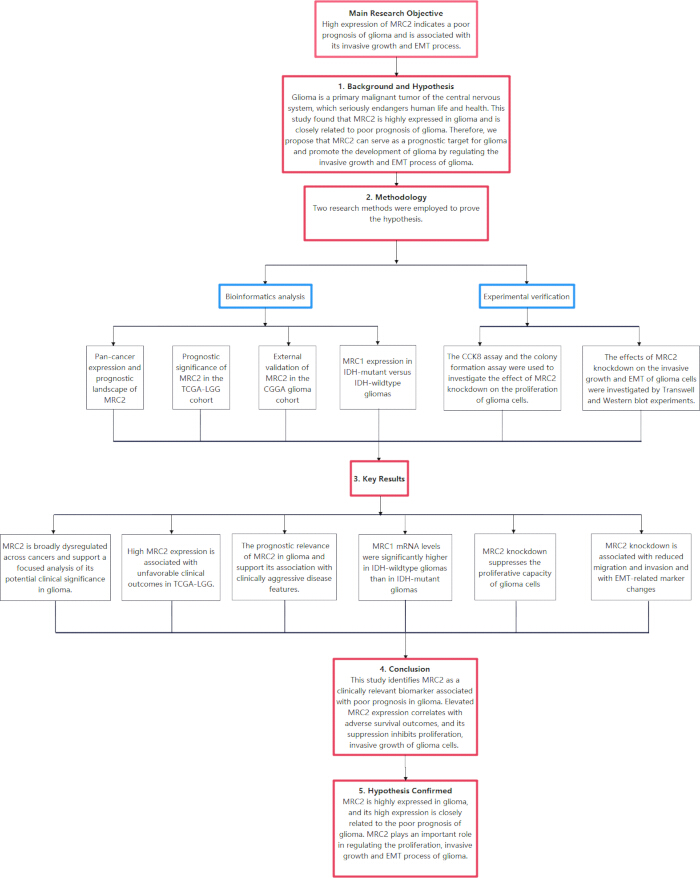
Figure 1: Overview of the study design and analytical workflow. Public transcriptomic and clinical data were obtained from TCGA, GTEx, and CGGA for pan-cancer expression analysis, glioma prognostic validation, and clinicopathologic subgroup analyses of MRC2. Functional validation was performed in glioma cell lines through stable MRC2 knockdown followed by RT-qPCR, western blotting, CCK-8, colony-formation, and migration/invasion assays, together with analysis of CDK4/CDK6 and β-catenin/EMT-related markers. Please click here to view a larger version of this figure.
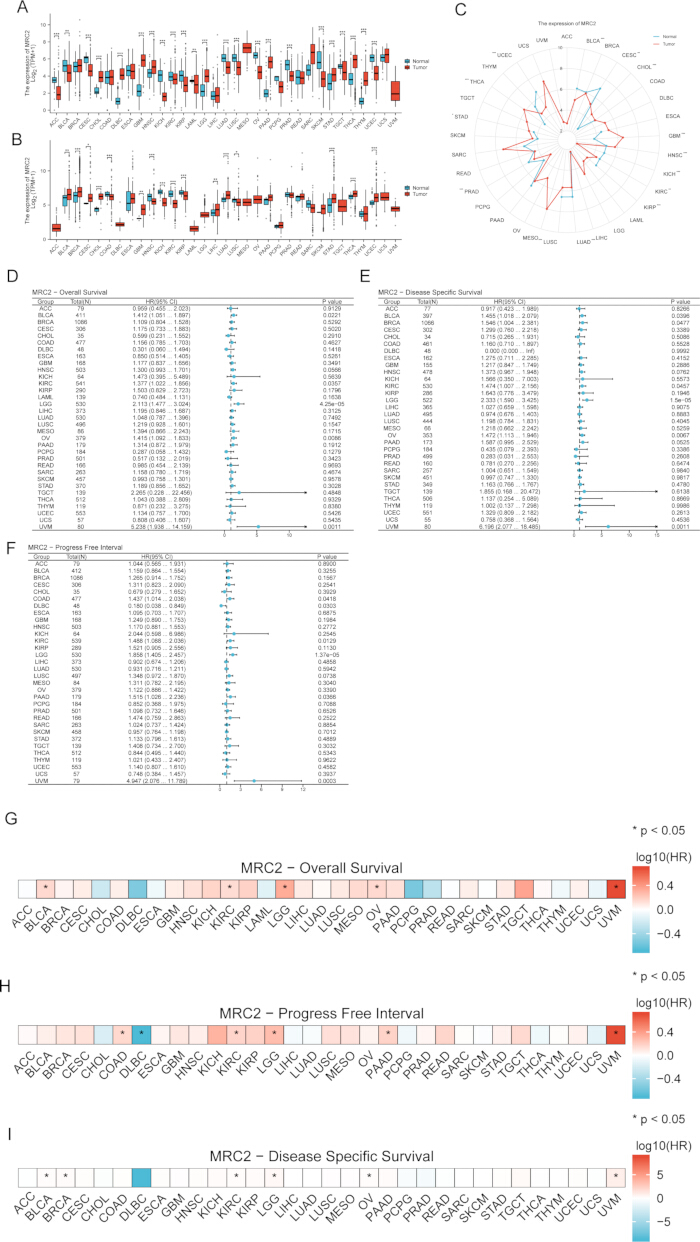
Figure 2: Pan-cancer landscape of MRC2 expression and clinical associations. (A) Differential expression of MRC2 between tumor and normal tissues across TCGA cancer types with available normal controls. (B) Differential expression of MRC2 between tumor and normal tissues across integrated TCGA and GTEx datasets. (C) Radar-plot summary of MRC2 expression across cancer types in normal and tumor tissues. (D–F) Forest plots showing the association between MRC2 expression and overall survival (OS), disease-specific survival (DSS), and progression-free interval (PFI), respectively, across cancer types. Hazard ratios (HRs) with 95% confidence intervals (CIs) were estimated using Cox proportional-hazards regression. (G–I) Heatmap summaries of the prognostic associations between MRC2 expression and OS, PFI, and DSS, respectively, across cancer types. Color intensity reflects log10(HR), and asterisks indicate statistically significant associations (*P < 0.05). For panels A and B, tumor-normal comparisons were performed using rank-based tests as described in the Methods. For panels D–I, Cox regression was performed separately for each cancer type. Please click here to view a larger version of this figure.
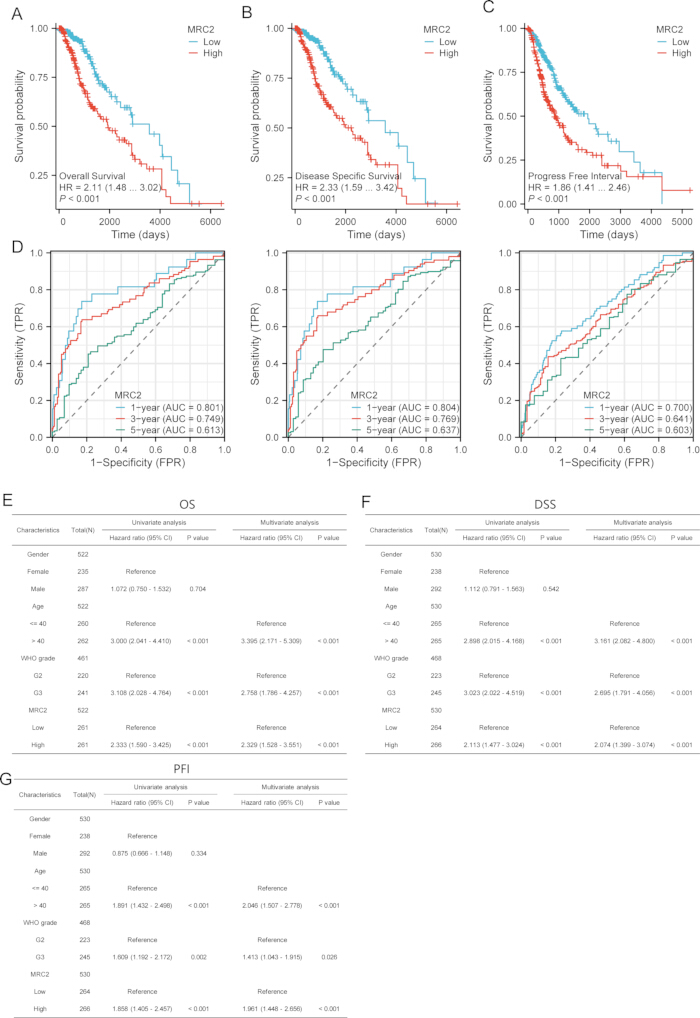
Figure 3: Prognostic significance of MRC2 in LGG. (A–C) Kaplan-Meier survival curves comparing patients with high and low MRC2 expression in the TCGA-LGG cohort. Patients were stratified according to the cohort median MRC2 expression level. HRs and log-rank P values are shown in the panels. (D) Time-dependent ROC curves evaluating the predictive performance of MRC2 expression for 1-, 3-, and 5-year survival outcomes in TCGA-LGG. The AUC values for each time point are shown in the panel. (E–G) Univariate and multivariate Cox regression analyses of survival outcomes in the TCGA-LGG cohort. Covariates included sex, age, WHO grade, and MRC2 expression level, as available for each analysis. HRs with 95% CIs and corresponding P values are shown. Total sample numbers for each analysis are listed in the tables. Abbreviations: OS, overall survival; DSS, disease-specific survival; PFI, progression-free interval; AUC, area under the curve; HR, hazard ratio; CI, confidence interval. Please click here to view a larger version of this figure.
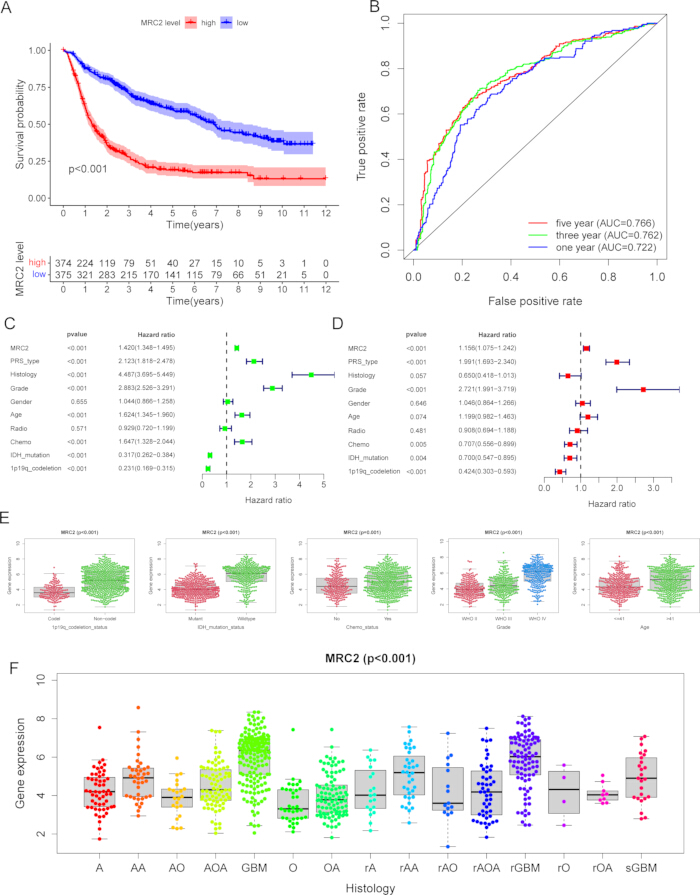
Figure 4: Prognostic validation of MRC2 in the CGGA glioma cohort. (A) Kaplan-Meier overall survival analysis comparing the high- and low-MRC2 groups in the CGGA glioma cohort. Patients were dichotomized according to the cohort median MRC2 expression level. The number of patients at risk is shown below the curve, and the log-rank P value is indicated in the panel. (B) Time-dependent ROC curves for 1-, 3-, and 5-year overall survival prediction based on MRC2 expression in the CGGA cohort. Corresponding AUC values are shown in the panel. (C) Univariate Cox regression analysis in the CGGA cohort, including MRC2 and available clinicopathologic covariates. (D) Multivariate Cox regression analysis in the CGGA cohort showing the independent prognostic contribution of MRC2 after adjustment for available covariates. (E) MRC2 expression across selected clinicopathologic subgroups in the CGGA cohort, including 1p/19q codeletion status, IDH mutation status, chemotherapy status, WHO grade, and age group. (F) Distribution of MRC2 expression across histologic subtypes in the CGGA cohort. For subgroup comparisons, statistical tests were performed as described in the Methods. For Cox analyses, HRs with 95% CIs and P values are shown in the corresponding panels. Please click here to view a larger version of this figure.
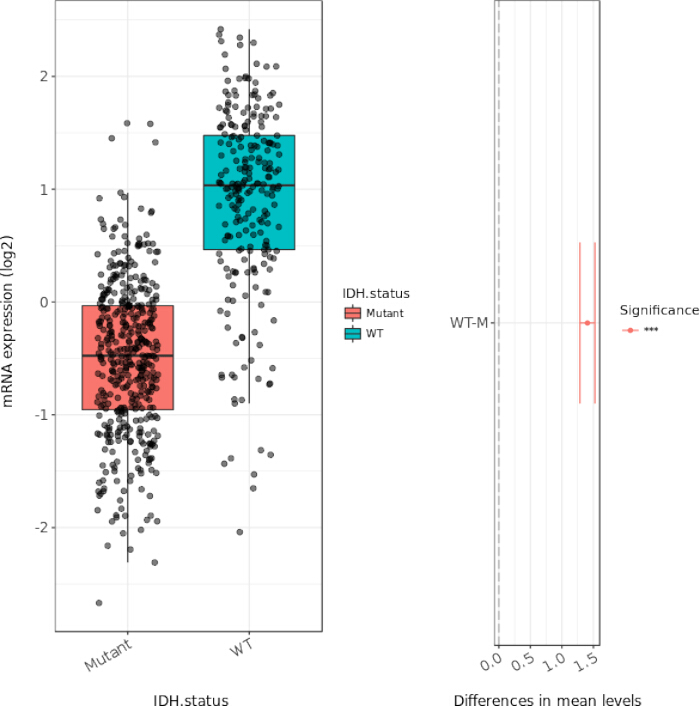
Figure 5: MRC1 expression according to IDH mutation status in gliomas. MRC1 mRNA expression was analyzed using the GlioVis platform based on the TCGA GBMLGG dataset. The boxplot shows the distribution of MRC1 expression in IDH-mutant and IDH-wildtype glioma samples. The center line indicates the median, the box bounds indicate the interquartile range (IQR), and the whiskers indicate the range within 1.5 × IQR. Each dot represents one sample. Statistical significance was determined using the platform's built-in statistical module, and *** indicates P < 0.001. Source data for quantitative analyses are provided in Supplementary File 1. Please click here to view a larger version of this figure.
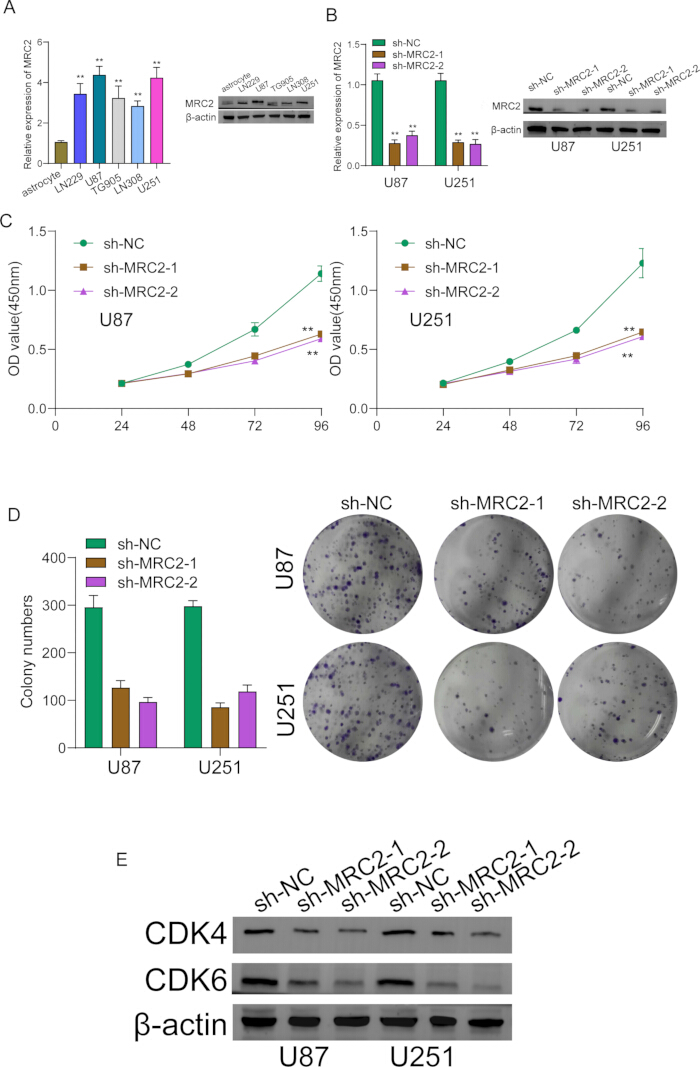
Figure 6: Silencing MRC2 reduces the proliferative capacity of glioma cells. (A) Baseline MRC2 expression in glioma cell lines (U251, U87, TG905, LN308, and LN229) relative to a normal astrocyte control, assessed by RT-qPCR and/or immunoblotting as shown. U251 and U87 displayed relatively higher MRC2 expression and were selected for subsequent loss-of-function experiments. (B) Validation of stable MRC2 knockdown in U251 and U87 cells using RT-qPCR and western blotting. Relative MRC2 mRNA expression was normalized to GAPDH in RT-qPCR assays, and β-actin was used as the loading control for western blotting. Cells were transduced with sh-NC, sh-MRC2-1, or sh-MRC2-2 lentiviral constructs. (C) CCK-8 assays showing reduced cell growth after MRC2 depletion in U87 and U251 cells over the indicated time course. (D) Colony-formation assays showing impaired clonogenic capacity in MRC2-silenced U87 and U251 cells. Representative images and quantification are shown. (E) Western blot analysis showing decreased protein abundance of CDK4 and CDK6 in MRC2-knockdown cells. β-actin was used as the loading control. For quantitative panels, data are presented as mean ± SD from three independent biological replicates; for RT-qPCR, each biological replicate was analyzed in technical triplicate. Statistical significance for panels B and D was assessed by one-way ANOVA. For panel C, differences among groups at each time point were assessed by one-way ANOVA. Significance notation: *P < 0.05, **P < 0.01, ***P < 0.001. Source data for quantitative analyses are provided in Supplementary File 1. Please click here to view a larger version of this figure.
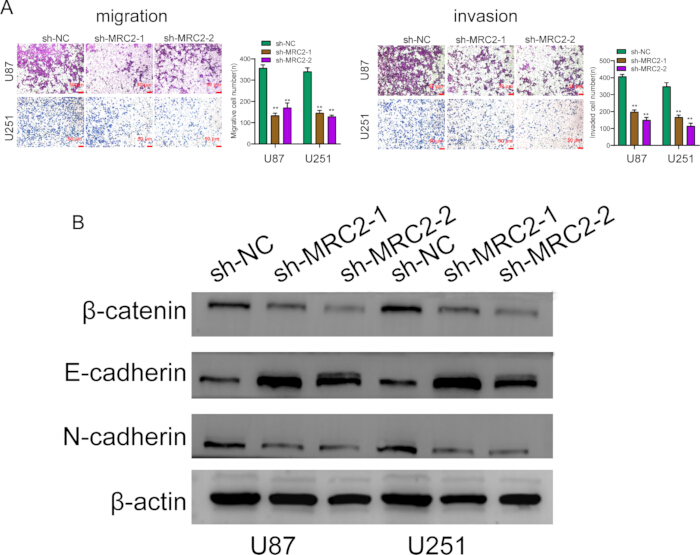
Figure 7: MRC2 knockdown is associated with reduced migration and invasion, as well as changes in β-catenin/EMT-related markers in glioma cells. (A) Cell migration and invasion assays in U87 and U251 cells after MRC2 knockdown. Representative images are shown together with quantitative analysis of migrated or invaded cells. Representative fields were imaged using an inverted microscope at ×200 magnification. Scale bar = 50 µm. (B) Western blot analysis of β-catenin, E-cadherin, and N-cadherin expression in sh-NC, sh-MRC2-1, and sh-MRC2-2 U87 and U251 cells. β-actin was used as the loading control. For quantitative analyses in panel A, data are presented as mean ± SD from three independent biological replicates. Cells were counted in five randomly selected microscopic fields per insert, and the average count per insert was used for statistical analysis. Statistical significance was assessed by one-way ANOVA. Significance notation: *P < 0.05, **P < 0.01, ***P < 0.001. Please click here to view a larger version of this figure.
Supplementary File 1: Raw quantitative data (CCK-8, colony formation, migration/invasion assays) and uncropped western blot images corresponding to Figure 5 and Figure 6.Please click here to download this file.
Discussion
Loading...
$$\rightleftharpoonup{xx}$$
$$\longleftharp{xx}$$,
$$\longrightharp{xx}$$,
Standard-of-care therapy for glioma relies on maximal safe resection followed by radiotherapy and chemotherapy, most commonly temozolomide4. Nevertheless, diffuse infiltration frequently limits complete surgical removal and contributes to inevitable relapse, particularly in high-grade disease3,25. Several molecular features—including MGMT promoter methylation, IDH mutation, 1p/19q co-deletion, and EGFR alterations—are used clinically for prognosis and treatment planning26,27,28. However, these markers have practical or biological limitations and, in many settings, are insufficient alone for accurate risk stratification26,27,28. Accordingly, additional biomarkers that can improve prognostic resolution and reveal targetable pathways remain needed.
Growing evidence links MRC2 to aggressive tumor behavior in multiple malignancies. For example, elevated MRC2 has been reported in head and neck squamous cell carcinoma and is associated with advanced disease features and poorer survival18. In hepatocellular carcinoma, MRC2 upregulation correlates with unfavorable outcomes and has been linked to pro-migratory effects downstream of TGFβ1 signaling17. Mechanistically, MRC2 (Endo180/uPARAP) is known to participate in extracellular matrix remodeling and collagen turnover, processes that are closely associated with tumor invasion and metastasis20,21. In glioma, previous studies have suggested that MRC2 contributes to cytoskeletal remodeling and invasive behavior, and that its downregulation reduces migration and invasion in glioblastoma models29,30. These findings provide a rationale for systematically evaluating MRC2 in glioma cohorts and for investigating its functional role in glioma cells.
Consistent with these reports, the present analyses demonstrate that high MRC2 expression is associated with shorter OS, DSS, and PFI in glioma. Across pan-cancer datasets, elevated MRC2 similarly tracks with unfavorable outcomes in several tumor types. Importantly, in LGG, MRC2 remained prognostic after multivariable adjustment and was validated in the independent CGGA cohort using Kaplan–Meier, ROC, and Cox regression analyses. Moreover, MRC2 expression varied across clinically relevant subgroups, including age, tumor grade, IDH status, and 1p/19q codeletion, suggesting that MRC2 may complement existing molecular markers in glioma stratification.
Mechanistically, invasive growth in glioma is frequently associated with epithelial–mesenchymal transition (EMT)-like programs and activation of signaling pathways such as Wnt/β-catenin31,32. Upon activation, β-catenin accumulates and translocates into the nucleus, where it cooperates with TCF/LEF transcription factors to regulate genes involved in proliferation and migration33,34,35. EMT-related phenotypes are typically characterized by decreased epithelial markers, such as E-cadherin, and increased mesenchymal markers, such as N-cadherin, thereby facilitating enhanced cellular motility36,37,38,39. In line with this framework, the present results show that MRC2 knockdown is accompanied by reduced β-catenin and N-cadherin levels and increased E-cadherin expression, consistent with attenuation of EMT-associated cellular states.
Wnt/β-catenin signaling has also been implicated in glioma stemness, invasion, and resistance to therapy40,41,42,43. Although this study does not establish a direct mechanistic link between MRC2 and Wnt pathway components, the coordinated changes in β-catenin and EMT-related markers suggest that MRC2 may influence signaling contexts that support β-catenin activity. Further studies incorporating pathway perturbation, transcriptomic analyses, and in vivo models will be required to determine whether MRC2 directly regulates Wnt/β-catenin signaling or acts through upstream microenvironmental remodeling.
Functionally, MRC2 knockdown in U251 and U87 cells suppressed proliferation and clonogenic survival and was accompanied by reduced CDK4 and CDK6 expression, consistent with impaired cell-cycle progression. In addition, MRC2 depletion markedly reduced migration and invasion, in parallel with EMT-related marker changes. Together with the clinical association analyses, these findings support a role for MRC2 in promoting both proliferative and invasive phenotypes in glioma.
Several limitations should be acknowledged. First, functional validation was limited to two glioma cell lines, and gain-of-function or rescue experiments were not performed. Second, no in vivo models were included to validate the observed phenotypes in a physiological context. Third, although associations with Wnt/β-catenin signaling and EMT-related markers were observed, direct mechanistic interactions were not experimentally demonstrated. Finally, the cohort analyses were retrospective and dependent on available public datasets1,2. Future studies integrating in vivo validation and mechanistic dissection will be essential to further define the role of MRC2 in glioma progression.
In summary, this study identifies MRC2 as a clinically relevant biomarker associated with poor prognosis in glioma. Elevated MRC2 expression correlates with adverse survival outcomes, and its suppression inhibits proliferation, migration, and invasion of glioma cells. These effects are accompanied by changes in cell-cycle regulators and EMT-related markers. Collectively, these findings support further investigation of MRC2 as a potential prognostic indicator and therapeutic target in glioma.
Disclosures
Loading...
$$\rightleftharpoonup{xx}$$
$$\longleftharp{xx}$$,
$$\longrightharp{xx}$$,
The authors report no competing interests.
Acknowledgements
Loading...
$$\rightleftharpoonup{xx}$$
$$\longleftharp{xx}$$,
$$\longrightharp{xx}$$,
This work received financial support from the Medical Science and Technology Research Fund of Guangdong Province (No. A2024508), the Provincial Science and Technology Expert Workstation program at Huizhou Central People’s Hospital, and the Huizhou Science and Technology Innovation and Entrepreneurship Leading Talent Project (No. 2025EQ050012).
Materials
| Name | Company | Catalog Number | Comments |
|---|---|---|---|
| anti-CDK4 antibody | Proteintech Group, Inc., USA | 11026-1-AP | Primary antibody for western blotting. RRID:AB_2078702. |
| anti-CDK6 antibody | Proteintech Group, Inc., USA | 66278-1-Ig | Primary antibody for western blotting. RRID:AB_2881661. |
| anti-E-cadherin antibody | Proteintech Group, Inc., USA | 20874-1-AP | Primary antibody for western blotting. RRID:AB_10697811. |
| anti-MRC2 antibody | Proteintech Group, Inc., USA | 86028-1-RR | Primary antibody for western blotting. RRID:AB_2879692. |
| anti-N-cadherin antibody | Proteintech Group, Inc., USA | 22018-1-AP | Primary antibody for western blotting. RRID:AB_2813891. |
| anti-β-actin antibody | Proteintech Group, Inc., USA | 66009-1-Ig | Loading control antibody for western blotting. RRID:AB_2687938. |
| anti-β-catenin antibody | Proteintech Group, Inc., USA | 51067-2-AP | Primary antibody for western blotting. RRID:AB_2086128. |
| BCA protein assay kit | Beyotime Biotechnology, China | P0012 | BCA protein assay kit for protein concentration determination. |
| Cell Counting Kit-8 (CCK-8) | Dojindo Laboratories, Japan | CK04-500T | Cell viability/proliferation assay. |
| Chemiluminescence imaging system | Uvitec Limited, France | Alliance Q9 Advanced Manual | Image acquisition system for western blot detection. |
| CO2 incubator | Generic laboratory equipment | Not specified | Humidified CO2 incubator used for cell culture at 37 °C and 5% CO2. |
| Crystal violet solution (0.1%) | Beyotime Biotechnology, China | C0121-100 mL | Crystal violet staining solution used at a 0.1% working concentration. |
| DMEM, high glucose | Gibco, Thermo Fisher Scientific, USA | C11995500BT | Basal medium for glioma cell culture. |
| Fetal bovine serum (FBS) | ExCell Bio, China | FSP500 | Serum supplement for cell culture. |
| GlioVis | gliovis.bioinfo.cnio.es | Not applicable | Web-based platform for visualization and analysis of brain tumor expression datasets, particularly gliomas. |
| GraphPad Prism | GraphPad Software, USA | Version 10.4.0 | Statistical analysis and graphing software. RRID:SCR_002798. |
| HEK293T cells | Type Culture Collection of the Chinese Academy of Sciences, Shanghai, China | GNHu43 | Packaging cell line used for lentiviral production. RRID:CVCL_0063. |
| HRP-conjugated Goat Anti-Mouse IgG (H+L) | Proteintech Group, Inc., USA | SA00001-1 | Secondary antibody for western blotting. RRID:AB_2722565. |
| HRP-conjugated Goat Anti-Rabbit IgG (H+L) | Proteintech Group, Inc., USA | SA00001-2 | Secondary antibody for western blotting. RRID:AB_2722564. |
| Human astrocytes | Type Culture Collection of the Chinese Academy of Sciences, Shanghai, China | Not publicly available | Normal human astrocytes used as the non-tumor control; catalog number not publicly available. |
| Inverted microscope | Generic laboratory equipment | Not specified | Inverted microscope used for image acquisition in migration and invasion assays. |
| Matrigel matrix | Corning, USA | 354234 | Basement membrane matrix used to coat inserts for invasion assays. |
| Microplate reader | Generic laboratory equipment | Not specified | Microplate reader used for absorbance measurement at 450 nm in CCK-8 assays. |
| PAGE Gel Preparation Kit, 10% | EpiZyme, China | PG212 | SDS-PAGE gel preparation kit. |
| PAGE Gel Preparation Kit, 7.5% | EpiZyme, China | PG111 | SDS-PAGE gel preparation kit. |
| Paraformaldehyde solution (4%) | Beyotime Biotechnology, China | P0099-100 mL | 4% paraformaldehyde fixative for colony formation and migration/invasion assays. |
| Penicillin-Streptomycin solution | Gibco, Thermo Fisher Scientific, USA | 15140163 | Antibiotic supplement for cell culture. |
| Polybrene | Beyotime Biotechnology, China | C0351-1 mL | Hexadimethrine bromide solution (10 mg/mL) used to facilitate lentiviral transduction. |
| Prestained protein marker | Elabscience, China | E-IR-R331 | Protein molecular weight marker. |
| PrimeScript RT Reagent Kit | Takara Bio Inc., Japan | RR047A | Reverse transcription kit for cDNA synthesis. |
| Puromycin | Beyotime Biotechnology, China | ST551-10 mg | Puromycin dihydrochloride used for selection of stable knockdown cells. |
| PVDF membrane | Beyotime Biotechnology, China | FFP20 | Hydrophilic PVDF membrane (0.45 µm) for western blot transfer. |
| R | R Foundation for Statistical Computing, Austria | Version 4.5.1 | Statistical computing environment used for bioinformatic analyses. RRID:SCR_001905. |
| RIPA lysis buffer | Beyotime Biotechnology, China | P0013B | RIPA lysis buffer (strong) for protein extraction. |
| SDS-PAGE loading buffer (5×) | Beyotime Biotechnology, China | P0015L | Protein sample loading buffer. |
| SYBR Premix Ex Taq II | Takara Bio Inc., Japan | RR066A | qPCR master mix. |
| Transwell inserts, 8.0-µm pore size | Corning, USA | 3422 | Cell culture inserts with an 8.0 µm pore-size polycarbonate membrane; standard 24-well format for migration and invasion assays. |
| TRIzol reagent | Invitrogen, Thermo Fisher Scientific, USA | 10296010CN | RNA extraction reagent. |
| U251 glioma cells | National Collection of Authenticated Cell Cultures, China | SCSP-559 | Human glioma cell line used for knockdown and functional assays. RRID:CVCL_0021. |
| U87 glioma cells | National Collection of Authenticated Cell Cultures, China | SCSP-5432 | Human glioma cell line used for knockdown and functional assays. RRID:CVCL_0022. |
Reprints and Permissions
Request permission to reuse the text or figures of this JoVE article
Request Permission