This study evaluates serum C1q/tumor necrosis factor–related protein 7 as a potential biomarker of diabetic kidney disease and examines the effects of dapagliflozin on renal function, inflammation, and oxidative stress using cross-sectional and longitudinal analyses.
Research Article
Serum C1q/TNF-Related Protein 7 and Dapagliflozin in Diabetic Kidney Disease: A Cross-Sectional and Longitudinal Study
Opens in a new tab
In This Article
Summary
Loading...
$$\rightleftharpoonup{xx}$$
$$\longleftharp{xx}$$,
$$\longrightharp{xx}$$,
Abstract
Loading...
$$\rightleftharpoonup{xx}$$
$$\longleftharp{xx}$$,
$$\longrightharp{xx}$$,
Sodium-glucose cotransporter 2 inhibitors reduce the risk of kidney disease progression in patients with diabetic kidney disease (DKD); however, evidence describing early clinical and biological changes following treatment initiation in routine clinical practice remains limited. This study used a dual-phase design to evaluate serum C1q/tumor necrosis factor–related protein 7 (CTRP7) and the effects of dapagliflozin in DKD. In the cross-sectional phase, 108 participants were categorized into healthy controls, type 2 diabetes without kidney disease, and DKD groups to assess serum CTRP7 expression. In the longitudinal phase, 48 patients with DKD received dapagliflozin therapy and were followed for 12 weeks to monitor clinical and biochemical changes. Serum CTRP7 levels increased progressively with disease severity. A nomogram integrating systolic blood pressure, glycated hemoglobin, body mass index, and serum CTRP7 demonstrated strong predictive performance for identifying DKD risk. After 12 weeks of dapagliflozin treatment, urinary albumin-to-creatinine ratio and blood pressure were reduced. Improvements were accompanied by decreased malondialdehyde levels and increased superoxide dismutase levels, suggesting attenuation of oxidative stress. These findings suggest that serum CTRP7 may serve as a potential biomarker of DKD and that dapagliflozin treatment is associated with improvements in renal and inflammatory profiles.
Introduction
Loading...
$$\rightleftharpoonup{xx}$$
$$\longleftharp{xx}$$,
$$\longrightharp{xx}$$,
Diabetic nephropathy (DN), also referred to as diabetic kidney disease (DKD), is one of the most serious microvascular complications of type 2 diabetes mellitus (T2DM) and remains a leading cause of end-stage renal disease (ESRD) worldwide1. With the increasing global prevalence of diabetes, DKD has become a major public health concern and imposes a substantial clinical and economic burden. In China, a recent meta-analysis estimated the pooled prevalence of DKD among patients with T2DM to be 21.8% [95% confidence interval (CI): 18.5–25.4%]2. Despite standard therapeutic strategies, including glycemic control and inhibition of the renin–angiotensin–aldosterone system, many patients continue to experience progressive renal dysfunction. This residual risk highlights the need to further investigate the mechanisms underlying DKD progression and to identify sensitive biomarkers that may improve early detection, risk stratification, and therapeutic monitoring.
The pathogenesis of DKD is complex and multifactorial. While chronic hyperglycemia and hemodynamic abnormalities, such as glomerular hyperfiltration3, have traditionally been viewed as primary drivers, accumulating evidence suggests that chronic low-grade inflammation and oxidative stress are also associated with the initiation and progression of renal injury4. Hyperglycemia-associated metabolic disturbances are frequently accompanied by the overproduction of reactive oxygen species (ROS) and reduced antioxidant defenses, including superoxide dismutase (SOD) and glutathione peroxidase (GSH-Px)5. These alterations are associated with activation of inflammatory pathways and increased expression of cytokines such as interleukin-6 (IL-6), tumor necrosis factor-α (TNF-α), and monocyte chemoattractant protein-1 (MCP-1)6. Collectively, these processes are associated with podocyte injury, mesangial expansion, and tubulointerstitial fibrosis. Therefore, biomarkers reflecting inflammatory and metabolic alterations associated with DKD may have potential clinical value.
In the search for such biomarkers, the C1q/tumor necrosis factor-related protein (CTRP) family has garnered increasing attention because of its potential regulatory roles in glucose metabolism and inflammation7. Among these proteins, CTRP7 has emerged as a potential candidate associated with metabolic dysfunction. Previous studies have reported elevated circulating CTRP7 levels in obesity and insulin-resistant states, which may reflect a compensatory response to metabolic stress8,9. However, the expression profile and clinical relevance of CTRP7 in DKD remain insufficiently characterized. In particular, it remains unclear whether serum CTRP7 levels are associated with the severity of renal impairment or with oxidative stress-related alterations during disease progression. Furthermore, the potential utility of CTRP7, combined with conventional clinical risk factors, for constructing predictive models for DKD risk warrants further investigation.
Sodium-glucose cotransporter 2 (SGLT2) inhibitors have emerged as an important therapeutic strategy for patients with DKD. Clinical studies, including the Dapagliflozin and Prevention of Adverse Outcomes in Chronic Kidney Disease (DAPA-CKD) trial, demonstrated that dapagliflozin slows chronic kidney disease progression and reduces albuminuria10,11,12. Although the renoprotective effects of dapagliflozin are partly attributed to hemodynamic mechanisms, including restoration of tubuloglomerular feedback, experimental studies also suggest that SGLT2 inhibitors may be associated with anti-inflammatory and antioxidative effects12. For example, animal studies have reported that SGLT2 inhibition may reduce renal oxidative stress and suppress pro-inflammatory cytokine expression13. However, clinical evidence evaluating the relationship between dapagliflozin treatment and changes in novel biomarkers such as CTRP7 remains limited. In particular, whether improvements in renal parameters following dapagliflozin therapy are associated with modulation of serum CTRP7 levels and restoration of redox homeostasis in clinical settings requires further investigation.
Therefore, this study employed a dual-phase design to evaluate the clinical associations of CTRP7 in DKD. First, a cross-sectional analysis was conducted to characterize serum CTRP7 expression across different stages of T2DM and to assess its associations with clinical and metabolic parameters. A nomogram integrating CTRP7 and conventional risk factors was subsequently developed to evaluate its potential predictive value for DKD risk stratification. Second, a longitudinal study was performed to examine changes in renal function, serum CTRP7 levels, inflammatory markers, and oxidative stress-related parameters following 12 weeks of dapagliflozin treatment. This study aimed to further characterize the relationship between CTRP7 and DKD progression and to investigate whether dapagliflozin-associated improvements in renal parameters were accompanied by changes in inflammatory and oxidative stress profiles.
Protocol
Loading...
$$\rightleftharpoonup{xx}$$
$$\longleftharp{xx}$$,
$$\longrightharp{xx}$$,
This study used clinical data collected from the Department of Endocrinology at Chongqing Red Cross Hospital, Chongqing, China, between April 2019 and November 2021. The study consisted of a cross-sectional analysis of baseline clinical characteristics followed by a longitudinal interventional study. The study protocol was approved by the Ethics Committee of Chongqing Red Cross Hospital (Approval No. 2024CQRCLL(K)-012-01) and was conducted in accordance with the Declaration of Helsinki. The requirement for informed consent was waived because of the retrospective nature of the study.
Study Population and Grouping
Adult patients aged ≥18 years with T2DM were screened and stratified according to urinary albumin-to-creatinine ratio (UACR) criteria established by the American Diabetes Association (ADA). T2DM was diagnosed based on the World Health Organization (WHO) 1999 criteria and the Guidelines for the Prevention and Treatment of Type 2 Diabetes Mellitus in China (2020 edition). A total of 108 participants were enrolled and categorized into three groups: (1) healthy control group (n = 21), consisting of individuals with normal glucose tolerance and no history of renal disease; (2) T2DM without DN group (n = 39), comprising patients with persistent normoalbuminuria (UACR <30 mg/g); and (3) DN group (n = 48), including patients with microalbuminuria (UACR 30–300 mg/g) or macroalbuminuria (UACR >300 mg/g). Healthy controls were excluded if they had a history of chronic disease, acute infection, or recent medication use. Persistent albuminuria was confirmed by at least two repeated UACR measurements obtained at a 3-month interval. Urine samples were collected from the first-morning midstream void. Urinary albumin concentrations were measured using immunoturbidimetry, and urinary creatinine concentrations were measured using an enzymatic assay. UACR values are expressed as mg/g. This stratification enabled evaluation of biomarker trends across different stages of disease progression.
Interventional Study Protocol
Following the cross-sectional assessment, the 48 patients identified in the DN group entered a longitudinal interventional study using consecutive enrollment. These patients initiated dapagliflozin therapy at a standard dose of 10 mg once daily in addition to standard glycemic and blood pressure control regimens. Concomitant medications, including metformin and angiotensin-converting enzyme inhibitor (ACEI) or angiotensin receptor blocker (ARB) agents, were permitted provided that dosages remained unchanged throughout the follow-up period; no additional renoprotective agents were introduced. Treatment adherence was monitored using patient medication diaries and pill counts. Missing longitudinal data were handled using the last observation carried forward (LOCF) method. All patients had complete paired clinical and laboratory data available at baseline and after 12 weeks of continuous treatment. Patients were excluded if they met any of the following criteria: type 1 diabetes mellitus or secondary diabetes; acute metabolic complications (e.g., diabetic ketoacidosis); severe infectious diseases or active malignancy; severe hepatic or renal failure (estimated glomerular filtration rate [eGFR] <45 mL/min/1.73 m2); concomitant use of other SGLT2 inhibitors or immunosuppressive agents within the previous 3 months; or pregnancy. Exclusion criteria were monitored throughout the study period. The eGFR was calculated using the 2021 Chronic Kidney Disease Epidemiology Collaboration (CKD-EPI) equation without a race coefficient, based on serum creatinine measured using an enzymatic assay traceable to isotope-dilution mass spectrometry (IDMS).
Routine Clinical Measurements
Anthropometric data, including age, sex, height, weight, body mass index (BMI), and blood pressure (SBP/DBP), were recorded for all participants at baseline. All measurements were performed by trained nurses using standardized procedures and calibrated instruments following a 15-min rest period. Blood pressure measurements were obtained in triplicate, and the average value was used for analysis. Venous blood samples were collected after an 8–12 h overnight fast. Blood samples were collected in EDTA-K2 anticoagulation tubes, processed within 30 min of collection, centrifuged at 3,000 × g for 10 min, and stored at −80°C until analysis. Samples were thawed only once prior to biochemical analysis. Routine metabolic parameters were assessed at baseline for all groups and reassessed after 12 weeks for the intervention group. These measurements included glycemic indices, renal function indicators, and lipid profiles. Biochemical analyses were performed using standardized assay methods according to the manufacturers’ instructions. The eGFR value was calculated using the 2021 CKD-EPI equation based on standardized serum creatinine measurements traceable to IDMS.
Assessment of Inflammatory and Oxidative Biomarkers
To investigate inflammatory and oxidative stress-related alterations, serum concentrations of biomarkers were quantified using enzyme-linked immunosorbent assay (ELISA) kits according to the manufacturers’ instructions. All assays were performed in triplicate, and laboratory personnel were blinded to participant grouping during analysis. Absorbance values were measured using a standard microplate reader according to the manufacturers’ instructions. Sample dilution conditions, assay sensitivity, and detection ranges were determined according to the specifications provided with each assay kit. Inflammatory biomarkers included CTRP7, IL-6, TNF-α, and MCP-1. Oxidative stress status was assessed by measuring SOD activity using the xanthine oxidase method, GSH-Px activity using the DTNB colorimetric method, and malondialdehyde (MDA) levels using the thiobarbituric acid colorimetric method. These biomarkers served as indicators for evaluating inflammatory and oxidative stress-related changes following dapagliflozin treatment.
Statistical Analysis
Statistical analyses were performed using R software (version 4.4.1) with the following packages: tidyverse, rms, pROC, rmda, forestplot, and pheatmap. Normality was assessed using the Shapiro–Wilk test (P >0.05 indicating normal distribution). Continuous variables are presented as mean ± standard deviation (SD) or median (interquartile range [IQR]), as appropriate. Parametric data were analyzed using one-way analysis of variance (ANOVA) followed by Tukey–Kramer post hoc correction, whereas nonparametric data were analyzed using the Kruskal–Wallis test followed by Dunn’s post hoc test. Pearson correlation analysis was used to evaluate associations between CTRP7 and clinical parameters, and heatmaps were generated using the pheatmap package after verification of normality assumptions.
Independent risk factors for DN were identified using univariate and multivariate logistic regression analyses. Variables with P <0.1 in univariate analysis were included in the multivariate model using stepwise selection. Based on the multivariate model, a nomogram was constructed to predict DN risk. Model performance was evaluated using the concordance index (C-index), calibration curves, and decision curve analysis (DCA). Internal validation was performed using bootstrap resampling with 1,000 iterations to estimate model optimism and calibration performance.
For the longitudinal interventional analysis, within-patient changes between baseline and 12-week post-treatment measurements were analyzed using paired t-tests or Wilcoxon signed-rank tests, as appropriate. Missing longitudinal data were handled using the LOCF method. Predefined subgroup analyses were performed according to age (<60 vs. ≥60 years), BMI (<24 vs. ≥24 kg/m2), and baseline SBP (<130 vs. ≥130 mmHg). Interaction testing was additionally performed to evaluate subgroup-specific treatment-associated effects. A two-tailed P <0.05 was considered statistically significant. Forest plots were generated to visualize subgroup-specific treatment-associated effects and corresponding 95% CIs.
The de-identified participant-level dataset used for statistical analyses is provided in Supplementary Table 1.
Results
Loading...
$$\rightleftharpoonup{xx}$$
$$\longleftharp{xx}$$,
$$\longrightharp{xx}$$,
Baseline Clinical Characteristics and CTRP7 Expression
A total of 108 subjects were included in the cross-sectional analysis and categorized into three groups: healthy controls (n = 21), patients with T2DM without nephropathy (DM group, n = 39), and patients with DN (DN group, n = 48). Baseline demographic and clinical characteristics are summarized in Table 1. No significant differences in BMI were observed among the three groups (P > 0.05). However, significant differences were identified in metabolic and hemodynamic parameters. The DN group exhibited significantly higher SBP (140.06 ± 19.53 mmHg) compared with the DM group (127.54 ± 15.38 mmHg) and control group (122.29 ± 14.99 mmHg; P < 0.001).
| Variable | Control (n = 21) | DM (n = 39) | DN (n = 48) | P-value |
| Age (years) | 51.52 ± 10.87 | 56.38 ± 10.95 | 59.73 ± 10.24 | 0.014 |
| BMI (kg/m²) | 24.00 ± 2.73 | 24.46 ± 2.76 | 24.96 ± 3.69 | 0.492 |
| SBP (mmHg) | 122.29 ± 14.99 | 127.54 ± 15.38 | 140.06 ± 19.53 | <0.001 |
| HbA1c (%) | 5.63 ± 0.25 | 7.10 ± 1.85 | 7.30 ± 1.70 | <0.001 |
| UACR (mg/g) | 28.20 ± 55.61 | 13.64 ± 9.51 | 198.20 ± 316.35 | <0.001 |
| eGFR (mL/min/1.73 m²) | 97.64 ± 20.69 | 101.63 ± 25.06 | 97.31 ± 29.33 | 0.726 |
| CTRP7 (ng/mL) | 26.95 ± 11.48 | 59.91 ± 16.48 | 63.03 ± 15.24 | <0.001 |
| IL-6 (pg/mL) | 17.31 ± 6.47 | 37.24 ± 8.26 | 36.32 ± 9.01 | <0.001 |
| TNF-α (pg/mL) | 30.42 ± 8.02 | 65.41 ± 15.32 | 60.26 ± 14.09 | <0.001 |
Table 1: Baseline demographic, metabolic, inflammatory, and oxidative stress characteristics of the study population. Baseline demographic, metabolic, inflammatory, and oxidative stress characteristics were compared among healthy controls (Control, n = 21), patients with type 2 diabetes mellitus without diabetic nephropathy (DM, n = 39), and patients with diabetic nephropathy (DN, n = 48). Data are presented as mean ± standard deviation (SD). Statistical comparisons among groups were performed using one-way analysis of variance (ANOVA) or Kruskal–Wallis test, as appropriate. Abbreviations: BMI, body mass index; CTRP7, C1q/tumor necrosis factor-related protein-7; DM, diabetes mellitus without nephropathy; DN, diabetic nephropathy; eGFR, estimated glomerular filtration rate; HbA1c, glycated hemoglobin; IL-6, interleukin-6; MDA, malondialdehyde; SBP, systolic blood pressure; SOD, superoxide dismutase; TNF-α, umor necrosis factor-α; UACR, urinary albumin-to-creatinine ratio.
Serum CTRP7 levels demonstrated a stepwise increase across disease groups (Figure 1). The control group exhibited the lowest circulating CTRP7 levels (26.95 ± 11.48 ng/mL), whereas CTRP7 levels increased to 59.91 ± 16.48 ng/mL in the DM group (P < 0.001 vs. control). The DN group showed the highest CTRP7 levels (63.03 ± 15.24 ng/mL). Although the difference between the DM and DN groups was not statistically significant (P > 0.05), these findings suggest that CTRP7 elevation may occur during early metabolic dysregulation in diabetes. Inflammatory and oxidative stress markers also differed significantly among groups. Compared with healthy controls, patients with DN exhibited significantly higher levels of IL-6, TNF-α, and MDA, accompanied by lower SOD and GSH-Px levels (P < 0.001).
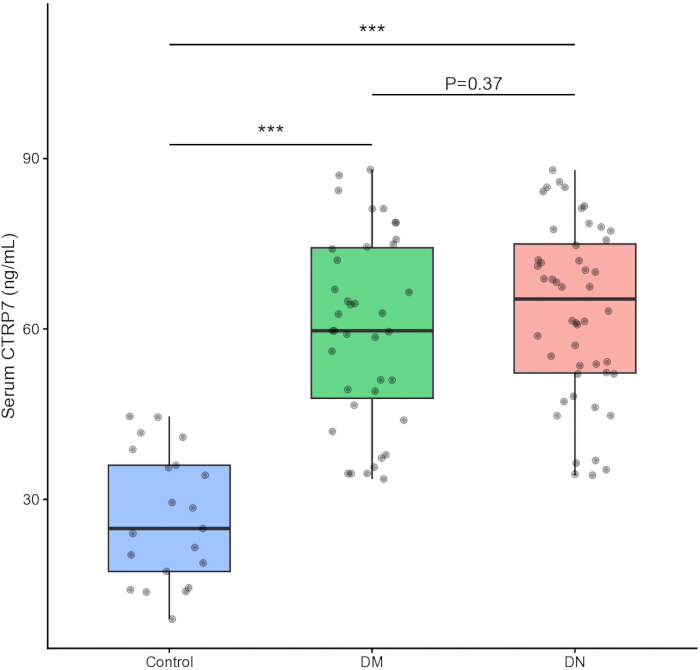
Figure 1. Gradient elevation of serum CTRP7 levels across study groups. Serum CTRP7 concentrations were compared among healthy controls (Control, n = 21), patients with type 2 diabetes mellitus without diabetic nephropathy (DM, n = 39), and patients with diabetic nephropathy (DN, n = 48). Boxplots display the median, interquartile range, and full data distribution, with individual participant values overlaid as scatter points. Statistical comparisons were performed using one-way ANOVA or Kruskal–Wallis test followed by post hoc analysis, as appropriate. ***P < 0.001. CTRP7 concentrations are expressed in ng/mL. Abbreviations: CTRP7, C1q/tumor necrosis factor-related protein-7; DM, diabetes mellitus without nephropathy; DN, diabetic nephropathy. Please click here to view a larger version of this figure.
Correlation Between CTRP7 and Clinical Parameters
Pearson correlation analysis was performed to evaluate the associations between serum CTRP7 levels and clinical parameters (Figure 2). Serum CTRP7 levels were positively correlated with HbA1c (r = 0.72), indicating an association with chronic hyperglycemia. CTRP7 also demonstrated positive correlations with the oxidative stress marker MDA (r = 0.70) and inflammatory cytokines, including IL-6 and TNF-α. In contrast, CTRP7 levels were negatively correlated with the antioxidant enzyme SOD (r = −0.25). A moderate positive correlation was additionally observed between CTRP7 and SBP (r = 0.45). These findings indicate that elevated CTRP7 levels are associated with inflammatory and oxidative stress markers linked to metabolic and vascular dysfunction.
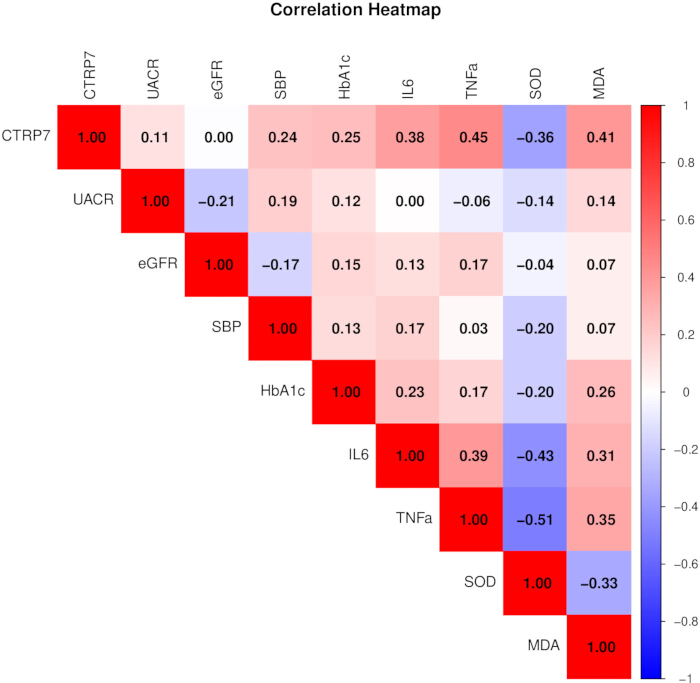
Figure 2. Correlation analysis between serum CTRP7 and clinical parameters. Pearson correlation heatmap illustrating the relationships between serum CTRP7 levels and clinical, inflammatory, and oxidative stress parameters in the study population. Correlation coefficients (r values) are displayed within each cell. The color scale represents the strength and direction of correlations, ranging from negative correlations (blue) to positive correlations (red). Parameters analyzed included urinary albumin-to-creatinine ratio (UACR), estimated glomerular filtration rate (eGFR), systolic blood pressure (SBP), glycated hemoglobin (HbA1c), interleukin-6 (IL-6), tumor necrosis factor-α (TNF-α), superoxide dismutase (SOD), and malondialdehyde (MDA). Abbreviations: CTRP7, C1q/tumor necrosis factor-related protein-7; eGFR, estimated glomerular filtration rate; HbA1c, glycated hemoglobin; IL-6, interleukin-6; MDA, malondialdehyde; SBP, systolic blood pressure; SOD, superoxide dismutase; TNF-α, tumor necrosis factor-α; UACR, urinary albumin-to-creatinine ratio. Please click here to view a larger version of this figure.
Diagnostic Value and Risk Factors for Diabetic Nephropathy
ROC curve analysis was performed to evaluate the diagnostic performance of serum CTRP7 (Figure 3). CTRP7 demonstrated high diagnostic accuracy in distinguishing patients with DN from healthy controls, with an AUC of 0.97 (95% confidence interval [CI]: 0.94–1.00). In contrast, the ability of CTRP7 to differentiate DN from patients with diabetes mellitus without nephropathy (DM group) was limited (AUC = 0.55), indicating substantial overlap between diabetic groups.
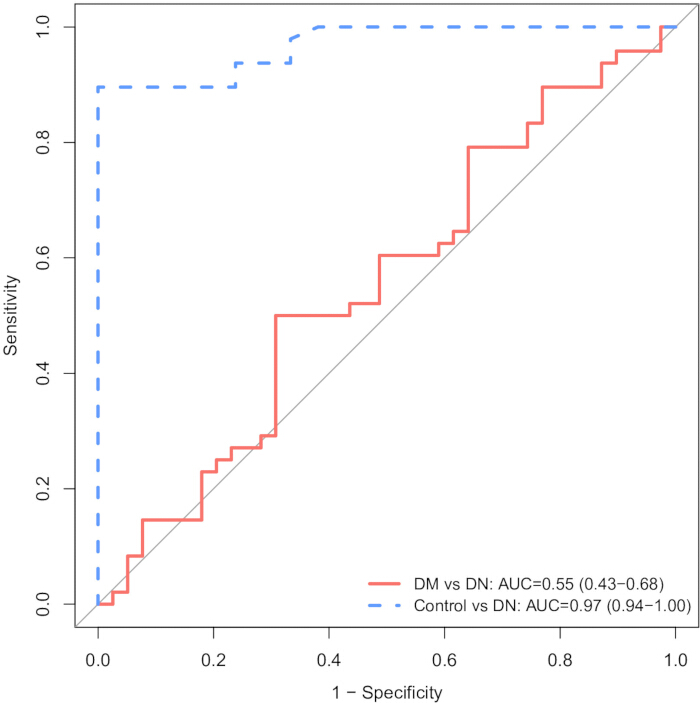
Figure 3. Receiver operating characteristic (ROC) analysis of serum CTRP7 for diabetic nephropathy discrimination. ROC curve analysis was performed to evaluate the diagnostic performance of serum CTRP7 for distinguishing diabetic nephropathy (DN) from other study groups. The blue curve represents discrimination between healthy controls and DN patients, with an area under the curve (AUC) of 0.97 (95% confidence interval [CI]: 0.94–1.00). The red curve represents discrimination between DM and DN groups, with an AUC of 0.55 (95% CI: 0.43–0.68). Sensitivity and specificity are plotted on the y-axis and x-axis, respectively. Abbreviations: AUC, area under the curve; CI, confidence interval; DM, diabetes mellitus without nephropathy; DN, diabetic nephropathy; ROC, receiver operating characteristic. Please click here to view a larger version of this figure.
To identify independent risk factors associated with DN, clinical parameters were compared between the DM and DN groups (Table 2). Univariate analysis identified SBP as the most significant factor associated with DN (P = 0.001). Multivariate logistic regression analysis (Table 3) further demonstrated that SBP (odds ratio [OR] = 1.044, P = 0.004) remained an independent predictor of DN. Although CTRP7 was not independently associated with DN in the multivariate model (P = 0.520), it was retained in the prediction model because of its observed associations with metabolic and inflammatory parameters.
| Variable | DM Group (n = 39) | DN Group (n = 48) | P-value |
| Age (years) | 56.38 ± 10.95 | 59.73 ± 10.24 | 0.149 |
| BMI (kg/m²) | 24.46 ± 2.76 | 24.96 ± 3.69 | 0.471 |
| SBP (mmHg) | 127.54 ± 15.38 | 140.06 ± 19.53 | 0.001 |
| HbA1c (%) | 7.10 ± 1.85 | 7.30 ± 1.70 | 0.613 |
| CTRP7 (ng/mL) | 59.91 ± 16.48 | 63.03 ± 15.24 | 0.366 |
| eGFR (mL/min/1.73 m²) | 101.63 ± 25.06 | 97.31 ± 29.33 | 0.461 |
Table 2: Univariate analysis of risk factors associated with diabetic nephropathy. Clinical and biochemical variables were compared between patients with type 2 diabetes mellitus without diabetic nephropathy (DM group, n = 39) and patients with diabetic nephropathy (DN group, n = 48). Data are presented as mean ± standard deviation (SD). Statistical comparisons were performed using Student’s t-test or Mann–Whitney U test, as appropriate. Abbreviations: BMI, body mass index; CTRP7, C1q/tumor necrosis factor-related protein-7; DM, diabetes mellitus without nephropathy; DN, diabetic nephropathy; eGFR, estimated glomerular filtration rate; HbA1c, glycated hemoglobin; SBP, systolic blood pressure.
| Variable | Beta | OR | 95% CI (Lower) | 95% CI (Upper) | P-value |
| Intercept | −6.602 | 0.001 | 0 | 0.254 | 0.013 |
| SBP | 0.043 | 1.044 | 1.014 | 1.075 | 0.004 |
| HbA1c | 0.038 | 1.039 | 0.808 | 1.337 | 0.765 |
| CTRP7 | 0.010 | 1.010 | 0.980 | 1.040 | 0.520 |
| BMI | 0.010 | 1.010 | 0.878 | 1.161 | 0.891 |
Table 3: Multivariate logistic regression analysis for predictors of diabetic nephropathy. Multivariate logistic regression analysis was performed to identify independent predictors associated with diabetic nephropathy (DN). Regression coefficients (Beta), odds ratios (ORs), 95% confidence intervals (CIs), and P-values are presented for each variable included in the model. Statistical significance was defined as P < 0.05. Abbreviations: BMI, body mass index; CI, confidence interval; CTRP7, C1q/tumor necrosis factor-related protein-7; DN, diabetic nephropathy; HbA1c, glycated hemoglobin; OR, odds ratio; SBP, systolic blood pressure.
Construction and Validation of a Clinical Prediction Nomogram
Based on the multivariate logistic regression results, a nomogram model was constructed to estimate the probability of DN using SBP, HbA1c, serum CTRP7, and BMI (Figure 4A). Within the model, SBP contributed the highest point allocation, followed by HbA1c and CTRP7. The nomogram demonstrated acceptable predictive performance, with a concordance index (C-index) of 0.710, indicating moderate discrimination ability. The calibration curve (Figure 4B) showed good agreement between predicted and observed probabilities, with a mean absolute error of 0.017. DCA (Figure 4C) demonstrated that the nomogram provided greater net clinical benefit than the “treat-all” or “treat-none” strategies across a threshold probability range of 10%–80%, suggesting potential utility for risk stratification in patients with diabetes mellitus.
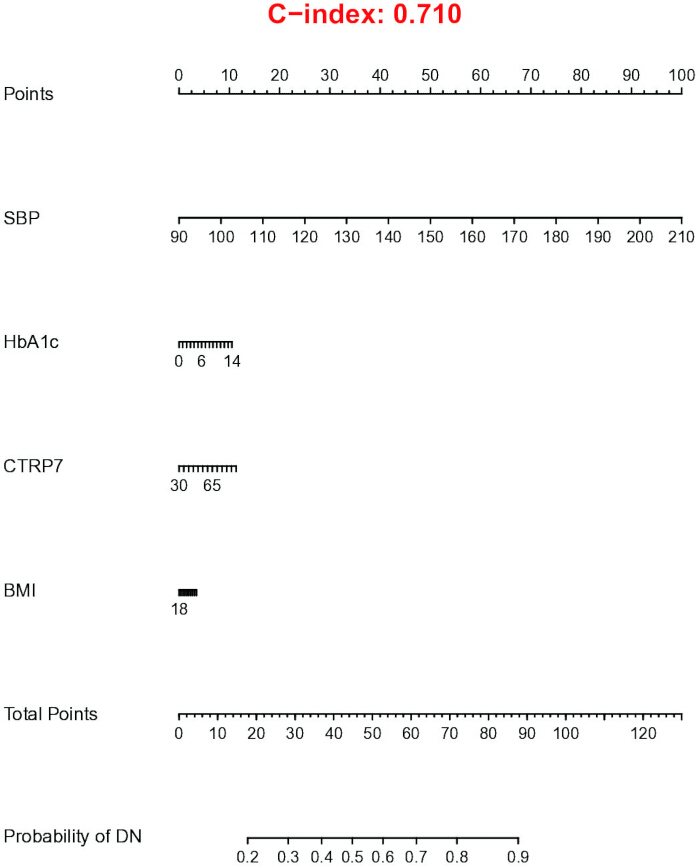
Figure 4. Construction of a nomogram model for predicting diabetic nephropathy risk. Nomogram model developed to estimate the probability of diabetic nephropathy (DN) using systolic blood pressure (SBP), glycated hemoglobin (HbA1c), serum CTRP7, and body mass index (BMI). Individual variable scores are assigned on the points scale, summed to generate total points, and translated into predicted DN probability. The nomogram demonstrated acceptable discrimination performance (C-index = 0.710). Abbreviations: BMI, body mass index; CTRP7, C1q/tumor necrosis factor-related protein-7; DN, diabetic nephropathy; HbA1c, glycated hemoglobin; SBP, systolic blood pressure. Please click here to view a larger version of this figure.
Therapeutic Efficacy of Dapagliflozin
The effects of 12 weeks of dapagliflozin treatment were evaluated in 48 patients with DN, and significant improvements were observed in renal and metabolic parameters (Table 4). The UACR decreased significantly from 198.20 ± 316.35 mg/g at baseline to 165.33 ± 295.83 mg/g after treatment (mean reduction: −32.87 mg/g, P = 0.011). Serum CTRP7 levels also decreased significantly from 63.03 ± 15.24 ng/mL to 46.63 ± 13.67 ng/mL (P < 0.001), as illustrated in the paired estimation plot (Figure 5). Dapagliflozin treatment was additionally associated with reductions in inflammatory and oxidative stress markers. Significant decreases were observed in IL-6, TNF-α, and MDA, whereas SOD and GSH-Px levels increased significantly following treatment (all P < 0.001). Furthermore, significant reductions were observed in SBP (−8.02 mmHg, P = 0.003), HbA1c (−0.67%, P < 0.001), and BMI (−0.78 kg/m2, P < 0.001). The eGFR remained relatively stable, with a small non-significant decrease observed after treatment (−2.34 mL/min/1.73 m2, P = 0.121), which is consistent with previously reported hemodynamic effects of SGLT2 inhibitors.
| Variable | Baseline | Post-treatment | Mean Change | P-value |
| BMI (kg/m²) | 24.96 ± 3.69 | 24.18 ± 3.77 | −0.78 | <0.001 |
| SBP (mmHg) | 140.06 ± 19.53 | 132.04 ± 16.05 | −8.02 | 0.003 |
| HbA1c (%) | 7.30 ± 1.70 | 6.63 ± 1.21 | −0.67 | <0.001 |
| UACR (mg/g) | 198.20 ± 316.35 | 165.33 ± 295.83 | −32.87 | 0.0108 |
| eGFR (mL/min/1.73 m²) | 97.31 ± 29.33 | 94.98 ± 31.07 | −2.34 | 0.121 |
| CTRP7 (ng/mL) | 63.03 ± 15.24 | 46.63 ± 13.67 | −16.60 | <0.001 |
| IL-6 (pg/mL) | 36.32 ± 9.01 | 28.74 ± 7.53 | −7.52 | <0.001 |
| TNF-α (pg/mL) | 60.26 ± 14.09 | 47.43 ± 10.67 | −12.80 | <0.001 |
| SOD (U/mL) | 172.50 ± 33.71 | 206.01 ± 37.11 | 33 | <0.001 |
| GSH-Px (U/mL) | 130.02 ± 29.25 | 155.50 ± 30.65 | 25.9 | <0.001 |
| MDA (nmol/mL) | 6.43 ± 1.95 | 4.28 ± 1.86 | −2.15 | <0.001 |
Table 4: Changes in clinical and biochemical parameters after 12 weeks of dapagliflozin treatment. Clinical, metabolic, inflammatory, and oxidative stress parameters were evaluated before and after 12 weeks of dapagliflozin treatment in patients with diabetic nephropathy (n = 48). Data are presented as mean ± standard deviation (SD). Mean changes and corresponding P-values are reported for each parameter. Statistical comparisons between baseline and post-treatment values were performed using paired t-test or Wilcoxon signed-rank test, as appropriate. Abbreviations: BMI, body mass index; CTRP7, C1q/tumor necrosis factor-related protein-7; eGFR, estimated glomerular filtration rate; GSH-Px, glutathione peroxidase; HbA1c, glycated hemoglobin; IL-6, interleukin-6; MDA, malondialdehyde; SBP, systolic blood pressure; SOD, superoxide dismutase; TNF-α, tumor necrosis factor-α; UACR, urinary albumin-to-creatinine ratio.
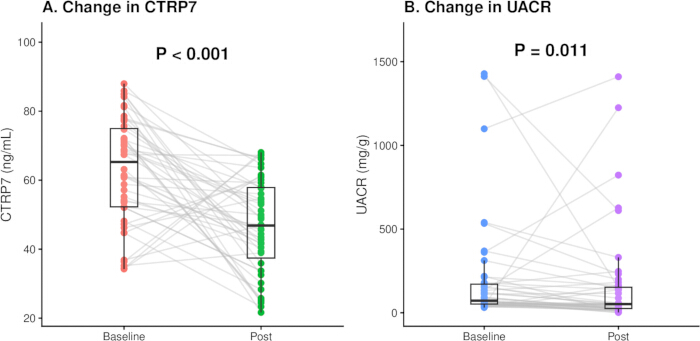
Figure 5. Changes in serum CTRP7 and urinary albumin-to-creatinine ratio after dapagliflozin treatment. Paired comparison plots showing within-patient changes following 12 weeks of dapagliflozin treatment in patients with diabetic nephropathy (n = 48). (A) Serum CTRP7 concentrations before and after treatment. (B) Urinary albumin-to-creatinine ratio (UACR) before and after treatment. Individual participant values are connected by gray lines to illustrate paired longitudinal changes. Boxplots display the median and interquartile range. Statistical significance was evaluated using paired t-test or Wilcoxon signed-rank test, as appropriate. P-values are indicated within each panel. Abbreviations: CTRP7, C1q/tumor necrosis factor-related protein-7; UACR, urinary albumin-to-creatinine ratio. Please click here to view a larger version of this figure.
Subgroup Analysis
Subgroup analyses were performed to evaluate the consistency of dapagliflozin-associated changes in UACR according to baseline age (<60 vs. ≥60 years), BMI (<24 vs. ≥24 kg/m2), and SBP (<130 vs. ≥130 mmHg). As illustrated in the forest plot (Figure 6), numerical reductions in mean UACR were consistently observed across all evaluated subgroups following 12 weeks of treatment. Statistically significant reductions were specifically noted in patients aged ≥60 years (P = 0.032), those with a BMI ≥24 kg/m2 (P = 0.026), and those with baseline SBP < 130 mmHg (P = 0.019). Although the reductions in the corresponding counterpart subgroups (Age < 60 years, BMI < 24 kg/m2, SBP ≥130 mmHg) did not reach statistical significance (P > 0.05), this variation is likely attributable to the limited sample sizes and reduced statistical power within these stratified sub-cohorts. These findings suggest a generally consistent trend of UACR reduction, while highlighting subgroups that may exhibit more readily detectable early responses.
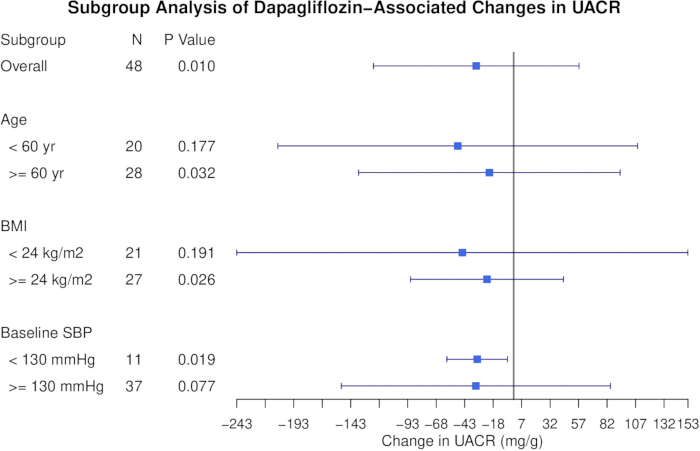
Figure 6. Subgroup analysis of dapagliflozin-associated changes in urinary albumin-to-creatinine ratio. Forest plot summarizing subgroup analyses of changes in urinary albumin-to-creatinine ratio (UACR) following 12 weeks of dapagliflozin treatment. Subgroups were stratified according to age (<60 years vs. ≥60 years), body mass index (BMI; <24 kg/m2 vs. ≥24 kg/m2), and baseline systolic blood pressure (SBP; <130 mmHg vs. ≥130 mmHg). Data are presented as mean changes in UACR with corresponding subgroup P-values. Abbreviations: BMI, body mass index; SBP, systolic blood pressure; UACR, urinary albumin-to-creatinine ratio. Please click here to view a larger version of this figure.
Overall, the findings demonstrated that serum CTRP7 levels were elevated in patients with T2DM and DN and were correlated with inflammatory and oxidative stress markers. Dapagliflozin treatment was associated with improvements in renal and metabolic parameters, accompanied by reductions in CTRP7 and inflammatory biomarkers. These results suggest that CTRP7 may have potential utility as a biomarker associated with metabolic and renal dysfunction in DN.
Data Availability:
The fully de-identified raw datasets supporting the clinical findings, biochemical measurements, and biomarker quantifications presented in this study are provided in Supplementary Table 1 accompanying this manuscript submission. The dataset includes participant-level demographic, clinical, inflammatory, oxidative stress, and renal function variables used for the statistical analyses and figure generation described in this study.
Supplementary Table 1. De-identified participant-level clinical, inflammatory, oxidative stress, and renal biomarker dataset used for statistical analyses. This table contains the complete de-identified raw dataset used for cross-sectional and longitudinal analyses in this study. Variables include participant demographics, anthropometric measurements, blood pressure, glycemic indices, renal function parameters, inflammatory biomarkers, oxidative stress-related markers, and treatment-group classifications. Data were used for statistical modeling, correlation analyses, nomogram development, subgroup analyses, and figure generation. Please click here to download this file.
Discussion
Loading...
$$\rightleftharpoonup{xx}$$
$$\longleftharp{xx}$$,
$$\longrightharp{xx}$$,
In the present study, using a combined cross-sectional and longitudinal design, we evaluated the clinical relevance of the adipokine CTRP7 in DN. The principal findings were threefold. First, serum CTRP7 levels demonstrated a stepwise increase across disease groups and were associated with metabolic, inflammatory, and oxidative stress parameters. Second, a nomogram incorporating CTRP7 demonstrated acceptable discrimination and potential clinical utility for predicting DN risk. Third, 12 weeks of dapagliflozin treatment was associated with reductions in albuminuria, serum CTRP7 levels, and oxidative stress-related markers. Collectively, these findings suggest that CTRP7 may represent a biomarker associated with metabolic and inflammatory alterations observed in DN and may also reflect treatment-associated changes following SGLT2 inhibitor therapy.
DN is influenced by a complex interplay of metabolic, hemodynamic, inflammatory, and oxidative stress-related processes1,3. Although hyperglycemia remains a primary initiating factor, increasing evidence indicates that oxidative stress and chronic low-grade inflammation contribute substantially to renal injury progression14,15. Therefore, identifying biomarkers associated with inflammatory and metabolic alterations may improve understanding of DN pathophysiology and disease monitoring. Previous studies investigating the CTRP family7 primarily focused on obesity and insulin resistance8. Petersen et al.9 demonstrated that CTRP7 deletion attenuated obesity-associated inflammation, suggesting a potential association between CTRP7 and metabolic stress responses. In the present study, serum CTRP7 levels were elevated in patients with DN compared with healthy controls and were numerically higher than those observed in patients with T2DM without nephropathy. Correlation analyses additionally demonstrated positive associations between CTRP7 and HbA1c, MDA, IL-6, and TNF-α, whereas negative correlations were observed with SOD. These findings suggest that elevated CTRP7 levels may be associated with inflammatory and oxidative stress pathways linked to metabolic dysfunction. This interpretation is consistent with previous evidence indicating that hyperglycemia-induced reactive oxygen species accumulation may reduce antioxidant defenses, activate inflammatory signaling pathways, and contribute to renal cellular injury4,5,6,16,17.
Early identification of patients at increased risk for DN remains important for preventing disease progression. In the present study, multivariate regression analysis identified SBP as the strongest independent factor associated with DN, consistent with the established contribution of hemodynamic stress to renal injury progression3. Based on these findings, a nomogram integrating SBP, HbA1c, BMI, and CTRP7 was constructed. The model demonstrated acceptable discrimination performance (C-index = 0.710), and decision curve analysis suggested potential clinical utility for risk stratification. Although CTRP7 was not independently associated with DN in the multivariate model, inclusion of CTRP7 in the nomogram may provide additional information related to metabolic and inflammatory status beyond conventional clinical variables.
SGLT2 inhibitors have substantially influenced the management of DN, as demonstrated in large clinical trials such as the DAPA-CKD trial11,13. Although their renoprotective effects are partly attributed to hemodynamic mechanisms10, accumulating evidence suggests that SGLT2 inhibitors may also be associated with reductions in inflammatory and oxidative stress-related pathways18. In the present study, dapagliflozin treatment was associated with significant reductions in UACR, inflammatory cytokines, and oxidative stress markers after 12 weeks of follow-up19. In addition, serum CTRP7 levels decreased following treatment and showed concurrent improvement alongside oxidative stress-related markers, including reductions in MDA and increases in SOD and GSH-Px. Experimental studies using empagliflozin have suggested that SGLT2 inhibition may reduce proximal tubular glucose reabsorption, oxygen consumption, and oxidative stress13,20. It is important to note that, because SGLT2 inhibitors exert systemic and multifaceted metabolic and hemodynamic effects, the post-treatment reduction in serum CTRP7 may not represent an isolated independent event. Instead, this reduction is likely associated with the overall improvement in the patients’ metabolic and hemodynamic status, including concurrent improvements in HbA1c, SBP, and UACR. Collectively, these findings suggest that CTRP7 may have potential value as a circulating biomarker associated with treatment-related metabolic and inflammatory changes.
Despite the known heterogeneity in albuminuria responses to renoprotective therapies21,22, subgroup analyses demonstrated that consistent numerical reductions in UACR following dapagliflozin treatment were observed across subgroups stratified by age, BMI, and baseline blood pressure. While statistical significance was reached primarily in specific subsets (e.g., older patients and those with higher BMI), the overall trajectory of albuminuria reduction remains consistent with the broad efficacy profiles reported in previous clinical studies11. The lack of statistical significance in certain smaller subgroups likely reflects limited statistical power secondary to sample stratification, rather than a true absence of therapeutic effect. The observed treatment-associated changes in inflammatory and oxidative stress markers across multiple patient subgroups may support the potential applicability of SGLT2 inhibitor therapy in diverse DN populations, including older individuals and patients with obesity.
Several limitations should be acknowledged. First, circulating biomarkers reflect integrated systemic signals and may fluctuate independently of renal hemodynamic changes23. Although significant correlations were identified, the tissue origin of circulating CTRP7 could not be determined, and contributions from adipose tissue or other metabolic organs cannot be excluded24. Second, this was a single-center study with a relatively limited sample size, which may have reduced the statistical power for extensive multivariable adjustment and subgroup analyses. Third, the 12-week follow-up period represented short-term observation only. Additional longitudinal studies with larger multicenter cohorts are needed to determine whether reductions in CTRP7 are associated with long-term preservation of eGFR or prevention of ESRD. Future mechanistic investigations may also help clarify the biological role of CTRP7 in metabolic and inflammatory pathways associated with DN progression. In summary, serum CTRP7 levels were associated with oxidative stress and inflammatory status in patients with DN. A nomogram integrating systolic blood pressure and CTRP7 demonstrated potential utility for DN risk stratification. Dapagliflozin treatment was associated with improvements in renal and metabolic parameters, accompanied by reductions in serum CTRP7 and oxidative stress-related markers. Collectively, these findings suggest that CTRP7 may represent a potential biomarker associated with metabolic and inflammatory alterations in DN and may have utility for monitoring treatment-associated changes following SGLT2 inhibitor therapy.
Disclosures
Loading...
$$\rightleftharpoonup{xx}$$
$$\longleftharp{xx}$$,
$$\longrightharp{xx}$$,
Conflict of Interest:
The authors declare no conflicts of interest.
Acknowledgements
Loading...
$$\rightleftharpoonup{xx}$$
$$\longleftharp{xx}$$,
$$\longrightharp{xx}$$,
The authors acknowledge the support provided by the Beijing Medical Reward Foundation (Grant No. YXJL-2024-0350-0166) and the Chongqing Jiangbei District Joint Medical Research Project of Science and Health (Grant No. [2023]19).
Materials
| Name | Company | Catalog Number | Comments |
|---|---|---|---|
| Automated biochemical analyzer | Routine biochemical analysis system | Beckman Coulter, Brea, CA, USA | AU5800 |
| C1q/Tumor Necrosis Factor-Related Protein-7 (CTRP7) ELISA kit | Human serum biomarker quantification | CUSABIO Technology, Wuhan, China | CSB-EU06195HU |
| Dapagliflozin tablets (10 mg) | Sodium-glucose cotransporter 2 inhibitor | AstraZeneca, Cambridge, UK | N/A |
| Fasting plasma glucose assay | Enzymatic glucose measurement assay | Beckman Coulter, Brea, CA, USA | OSR6121 |
| Glutathione peroxidase assay kit | Oxidative stress biomarker assay | Elabscience Biotechnology, Wuhan, China | E-BC-K096-M |
| Glycated hemoglobin assay kit | HbA1c measurement assay | Tosoh Bioscience, Tokyo, Japan | G8 HPLC Analyzer |
| Interleukin-6 (IL-6) ELISA kit | Human serum inflammatory biomarker quantification | Elabscience Biotechnology, Wuhan, China | E-EL-H6156 |
| Malondialdehyde assay kit | Lipid peroxidation and oxidative stress assay | Elabscience Biotechnology, Wuhan, China | E-BC-K025-M |
| Monocyte chemoattractant protein-1 (MCP-1) ELISA kit | Human serum inflammatory biomarker quantification | CUSABIO Technology, Wuhan, China | CSB-E04655h |
| R statistical software | Statistical analysis software (Version 4.4.1) | R Foundation for Statistical Computing, Vienna, Austria | N/A |
| Serum creatinine assay | Enzymatic renal function assay | Beckman Coulter, Brea, CA, USA | OSR61204 |
| Superoxide dismutase assay kit | Oxidative stress biomarker assay | Elabscience Biotechnology, Wuhan, China | E-BC-K019-M |
| Tumor necrosis factor-α (TNF-α) ELISA kit | Human serum inflammatory biomarker quantification | Elabscience Biotechnology, Wuhan, China | E-EL-H0109 |
| Urinary albumin assay | Immunoturbidimetric urinary biomarker assay | Beckman Coulter, Brea, CA, USA | OSR6132 |
| Urinary creatinine assay | Enzymatic urinary creatinine assay | Beckman Coulter, Brea, CA, USA | OSR6178 |
Reprints and Permissions
Request permission to reuse the text or figures of this JoVE article
Request Permission