This protocol demonstrates a randomized split-face method for evaluating the efficacy and safety of Advanced Optimal Pulse Technology compared with standard Optimal Pulse Technology for treating erythromelanosis follicularis of faciei and colli.
Method Article
Standardized Application of Advanced Optimal Pulse Technology for Erythromelanosis Follicularis of Faciei and Colli: A Split-face Method
Opens in a new tab
In This Article
Summary
Loading...
$$\rightleftharpoonup{xx}$$
$$\longleftharp{xx}$$,
$$\longrightharp{xx}$$,
Abstract
Loading...
$$\rightleftharpoonup{xx}$$
$$\longleftharp{xx}$$,
$$\longrightharp{xx}$$,
Erythromelanosis follicularis of faciei and colli (EFFC) is a chronic dermatological disorder characterized by hyperpigmentation, erythema, and follicular papules. Management remains challenging, as conventional treatments such as pulsed dye lasers can induce purpura and pose a risk of post-inflammatory hyperpigmentation, particularly in individuals with darker skin types. This article presents a standardized and reproducible clinical protocol using Advanced Optimal Pulse Technology (AOPT), a tunable intense pulsed light system, to target the vascular and pigmentary components of EFFC. A randomized, split-face clinical study involving 14 patients is described. Specific parameter settings, including dual-band vascular filters and adjustable pulse structures, were applied to the intervention side and compared with standard Optimal Pulse Technology (OPT) on the contralateral side. Quantitative assessments were performed using a skin colorimetric probe and a digital skin analysis imaging system to objectively evaluate lesion clearance. All 14 patients completed follow-up without attrition. The AOPT-treated side showed statistically significant reductions in erythema and melanin indices compared with the OPT control, with substantial inter-rater reproducibility for clinical evaluations. Additionally, the procedure was generally well tolerated, with few adverse events and limited downtime. Methodological limitations of this study include the small sample size, the absence of long-term follow-up (>6 months) to assess recurrence rates, and the lack of prospective clinical trial registration. This protocol provides clinicians with a standardized approach for applying AOPT to EFFC and may help address some limitations of traditional laser modalities in selected patients.
Introduction
Loading...
$$\rightleftharpoonup{xx}$$
$$\longleftharp{xx}$$,
$$\longrightharp{xx}$$,
Erythromelanosis follicularis of faciei and colli (EFFC) is a distinct and persistent dermatological condition, particularly prevalent among young Asian males1,2,3. It is defined by well-demarcated erythema (telangiectasia), hyperpigmentation, and follicular papules, typically presenting symmetrically on the preauricular areas, cheeks, and lateral neck1,4. Although the etiopathogenesis is multifactorial, encompassing genetic predisposition and follicular keratinization abnormalities, the clinical impact can be substantial5. The reddish-brown plaques may cause aesthetic concern, and symptoms are frequently exacerbated by environmental triggers such as heat and sunlight, contributing to psychosocial distress and reduced quality of life2,6. The complexity of EFFC arises from its mixed pathology: intertwined vascular (redness), pigmentary (melanin deposition), and textural (follicular roughness) components, requiring a treatment modality capable of addressing these features together7.
Current management strategies are often limited. Conventional topical therapies, including keratolytic agents (e.g., salicylic acid, urea) and retinoids, primarily address follicular hyperkeratosis but yield minimal improvement in vascular and pigmentary manifestations8,9. For vascular lesions, the pulsed dye laser (PDL, 595 nm) has long been regarded as a standard treatment option10,11. However, PDL presents notable drawbacks in this population: high-energy settings necessary for vessel coagulation frequently result in immediate purpura, leading to prolonged social downtime (7–14 days)11. In patients with Fitzpatrick skin types III–IV, epidermal injury induced by PDL can also increase the risk of post-inflammatory hyperpigmentation (PIH), potentially exacerbating the pigmentation component of EFFC12,13. Traditional intense pulsed light (IPL) has been used as a milder alternative, but outcomes vary due to inconsistent parameter selection and limited control over pulse configuration, which may result in suboptimal lesion clearance13,14.
Advanced Optimal Pulse Technology (AOPT) is a tunable light-based modality that may help address some limitations of conventional treatments for EFFC15. Operating as an evolution of modern intense pulsed light (IPL) platforms, AOPT differs from traditional IPL and standard Optimal Pulse Technology (OPT) by enabling independent adjustment of sub-pulse duration, fluence, and waveband selection through specialized filters. This tunability may be useful for managing the complex pathology of EFFC. For example, dual-band vascular filters allow simultaneous targeting of superficial and deep vasculature, while optimized pulse delays, such as 25 ms, may help protect the melanin-rich epidermis common in Asian skin, thereby reducing the risk of post-inflammatory hyperpigmentation (PIH) while delivering thermal energy to target chromophores15. By integrating these capabilities, AOPT provides a multidimensional treatment approach that addresses both erythema and pigmentation in a single session with attention to safety.
Despite its technological advantages, a standardized protocol for applying AOPT to EFFC remains lacking. Current literature is largely limited to case reports or studies without controlled comparisons to earlier technologies6,14. There is therefore a need for a reproducible clinical framework that specifies key parameters, including filter selection, pulse width, and energy density, to optimize the balance between efficacy and safety, especially in patients with darker skin types.
The primary objective of this study is to present a detailed clinical protocol for treating EFFC using AOPT. To evaluate its performance, a randomized split-face design was used to compare AOPT with standard OPT within the same individuals, thereby reducing inter-subject variability. The methodology includes pre-treatment assessment using a skin analysis imaging system and quantification via a skin colorimetric probe, followed by controlled application of dual-pulse parameter settings. By establishing a standardized treatment algorithm, this protocol provides clinicians with a reproducible approach that may reduce the prolonged downtime associated with PDL and the inconsistent outcomes reported with conventional IPL.
Protocol
Loading...
$$\rightleftharpoonup{xx}$$
$$\longleftharp{xx}$$,
$$\longrightharp{xx}$$,
All methods described in this protocol were approved by the Medical Ethics Committee of Huashan Hospital (Approval No.: KY2017-004). Written informed consent was obtained from all participants before enrollment (Figure 1).
1. Patient selection and preparation
- Screen patients for inclusion based on a clinical diagnosis of Erythromelanosis Follicularis of Faciei and Colli (EFFC), characterized by reddish-brown pigmentation, telangiectasia, and follicular papules on the preauricular area, maxilla, or neck.
- Exclude patients with a history of deep vein thrombosis, connective tissue disease, immunosuppression, or predisposition to hypertrophic scars/keloids.
- Exclude patients who have used oral isotretinoin within the previous 2 months, received light-based facial treatments within the last 6 months, or are currently pregnant or lactating.
- Instruct the patient to wash their face thoroughly with a mild cleanser and water to remove all makeup, sebum, and dirt.
- Acclimatize the patient in a controlled environment with a temperature of 22–25 °C and relative humidity of 50–60% for 20 min before assessment to stabilize skin blood flow.
2. Pretreatment assessment and imaging
- Quantitative skin analysis
- Launch the skin analysis imaging system software on the computer.
- Instruct the patient to remove all jewelry and pull hair back to fully expose the face and neck.
- Position the patient’s chin on the chin rest and forehead against the head support. Ensure the patient maintains a neutral expression and closes their eyes.
- Select Standard Light, Cross-Polarized, and UV Light modes in the software interface.
- Click Capture to take images from the front, left, and right angles.
- Use the software analysis tool to delineate the region of interest (ROI) on the cheeks. Apply the same anatomical ROI on both sides and at each visit when possible.
- Record the baseline quantitative values for “Red Areas” (representing hemoglobin) and “Brown Spots” (representing melanin).
- Colorimetric measurement
- Calibrate the skin colorimetric probe according to the manufacturer’s instructions before each session.
- Place the probe perpendicular to the skin surface on the most prominent lesion area of the left cheek. Apply constant, gentle pressure until the device beeps to confirm measurement.
- Record the Erythema Index (EI) and Melanin Index (MI).
- Repeat the measurement on the symmetrical lesion area of the right cheek.
- Calculate the mean of three consecutive measurements for each side to minimize variability.
3. Preparation of the IPL system
- Turn on the intense pulsed light (IPL) system.
CAUTION: Ensure that both the operator and the patient wear appropriate wavelength-specific protective eyewear throughout the laser procedure to prevent retinal injury. - Clean the sapphire light guide of the handpiece with a saline wipe or saline-soaked cotton ball to ensure maximum light transmission.
- Apply a layer of cold, colorless ultrasound transmission gel (approximately 2–3 mm thick) over the entire treatment area (cheeks and neck).
NOTE: The gel acts as an optical coupling agent and protects the epidermis from thermal injury.
4. Split-face treatment procedure
- Randomization
- Assign one side of the face (left or right) to the Advanced Optimal Pulse Technology (AOPT) group and the contralateral side to the Optimal Pulse Technology (OPT) group using a random number table.
- Record the assignment in the patient’s file to ensure consistency in subsequent sessions.
- AOPT mode treatment (intervention side)
- Select the AOPT mode on the device interface.
- Insert the vascular filter (Dual-band: 530–650 nm and 900–1,200 nm) into the handpiece.
- Configure the pulse structure to Dual-Pulse mode. Set the pulse duration (width) to 4.0 ms for both pulses. Set the delay between pulses to 25.0 ms.
- Adjust the fluence based on the patient’s skin phototype (Fitzpatrick III-IV) and tolerance. Start at the lower end of the range for Fitzpatrick IV skin or low pain tolerance, and increase only within the specified range if the endpoint in Step 4.2.9 is not achieved.
- Set the first sub-pulse energy density to 9–12 J/cm2.
- Set the second sub-pulse energy density to 7–9 J/cm2.
- Place the sapphire crystal light guide perpendicular to the skin surface, ensuring full contact with the gel.
- Depress the hand switch to deliver the pulse.
- Move the handpiece to the adjacent area with approximately 10% overlap between light spots to ensure uniform energy distribution.
- Treat the entire affected area on the assigned side once.
- Observe the skin for the immediate endpoint, which is defined as mild transient erythema and slight darkening of pigmented lesions.
NOTE: If distinct whitening (epidermal burn) or excessive pain occurs, decrease the fluence immediately and reassess before continuing.
- OPT mode treatment (Control Side)
- Switch the treatment mode to OPT (or standard IPL mode) on the interface.
- Remove the vascular filter and insert the 560 nm cut-off filter.
- Configure the pulse structure to Dual-Pulse mode. Set the pulse duration to 4.0 ms and the pulse delay to 25.0 ms.
- Set the fluence to a total energy density of 16–20 J/cm2.
- Perform the treatment on the contralateral side using the same technique (perpendicular contact, 10% overlap) described in steps 4.2.5–4.2.8.
5. Posttreatment care
- Gently wipe off the ultrasound gel with a soft spatula or tissue. Clean the face with water to remove any residue.
- Apply a cold compress (ice pack wrapped in sterile gauze) to the treated areas for 15–20 min to reduce heat accumulation and minimize the risk of purpura or blistering.
- Inspect the skin for any immediate adverse reactions such as blistering or pronounced purpura.
NOTE: If vesicles appear, instruct the patient not to scratch or puncture them. Prescribe a topical antibiotic ointment if necessary. - Instruct the patient to apply a broad-spectrum sunscreen (SPF ≥ 30) and avoid direct sun exposure for at least 4 weeks.
- Advise the patient to use a gentle moisturizer and avoid using functional cosmetics (e.g., exfoliants, retinoids) for 1 week.
6. Follow-up and longitudinal analysis
- Schedule the patient for follow-up treatment sessions at 4-week intervals.
- Repeat the entire procedure (sections 1–5) for up to 3 sessions, depending on lesion clearance.
- Perform data collection (imaging and colorimetric measurements as described in section 2) at each follow-up visit before the new treatment session begins.
- Conduct the final assessment 1 month after the last treatment session.
- Ask the patient to rate their satisfaction with the improvement on each side using a standardized quartile scale (0–3).
- Have two blinded dermatologists evaluate the clinical improvement by comparing baseline and post-treatment photographs using a 4-point scale (Poor to Excellent).
Results
Loading...
$$\rightleftharpoonup{xx}$$
$$\longleftharp{xx}$$,
$$\longrightharp{xx}$$,
Baseline characteristics
A total of 14 patients with clinically diagnosed erythromelanosis follicularis of faciei and colli (EFFC) were enrolled in this split-face study. The enrollment, allocation, and follow-up processes are detailed in the study flowchart (Figure 1). The cohort consisted of 12 males and 2 females, with ages ranging from 16 to 31 years (mean disease duration: 12.2 ± 3.83 years). Before treatment, there were no statistically significant differences in objective severity measures between the two allocated facial sides for Erythema Index (P = 0.330), Melanin Index (P = 0.820), red area count (P = 0.697), and brown spot count (P = 0.652), supporting matched baseline severity and the split-face randomization. All patients completed the 3 treatment sessions at 4-week intervals (n = 14 at each analysis point, with no dropouts). Detailed demographic information and matched baseline characteristics are summarized in Table 1.
Clinical efficacy evaluation and reproducibility
Clinical improvement was assessed by two blinded, independent dermatologists based on reductions in telangiectasia and hyperpigmentation. The inter-rater agreement (Cohen’s kappa) was substantial for both the AOPT-treated side (κ = 0.774) and the OPT-treated side (κ = 0.883), supporting reproducibility for the image-based evaluations (Figure 2). The AOPT-treated side showed a higher effective rate than the OPT-treated side across the treatment course. After the final session, the clinical effectiveness rate (defined as achieving a ‘Good’ or ‘Excellent’ clearance score of ≥2) was 57.1% (8/14) for the AOPT group, compared with 14.3% (2/14) in the OPT group (Table 2).
Patient satisfaction
Quantitative analysis of patient satisfaction scores (on a scale of 0–3) favored the AOPT-treated side. The mean satisfaction score for the AOPT-treated side was 1.71 ± 0.73, which was significantly higher than the 0.71 ± 0.73 reported for the OPT-treated side (P = 0.005, Wilcoxon signed-rank test).
Quantitative analysis of vascular and pigmentary clearance
Objective measurements using the skin colorimetric probe and digital skin analysis imaging system were consistent with the visual assessments, showing distinct clearance patterns between the two modalities (Figure 3). Erythema Index (EI): The AOPT mode induced a sustained reduction in skin redness. Statistically significant reductions in mean EI were observed after the first session and persisted through the third treatment session compared with baseline (P < 0.001). In contrast, the OPT mode achieved a smaller reduction (P = 0.033 at Tx1, P < 0.001 at Tx3), and the degree of clearance was lower than that observed with AOPT (Figure 3A). Melanin Index (MI): Regarding pigmentation, the AOPT side showed a significant decrease in MI values after the second session (P < 0.001). A smaller progressive decrease was also observed on the OPT-treated side over the treatment course (P < 0.05), but the magnitude of improvement was lower than that observed with AOPT (Figure 3B). Feature Counts: Digital skin analysis further supported these findings. AOPT treatment led to significant reductions in “Red Area” features after the first (P = 0.013), second (P < 0.001), and third (P < 0.001) sessions (Figure 3C). For “Brown Spots,” the AOPT mode showed its most pronounced effect after the third session (P < 0.001), whereas the OPT mode showed smaller statistical improvements that appeared less pronounced than those observed with AOPT (Figure 3D).
Representative clinical outcomes
Visual improvements were consistent with the quantitative data. Figure 4 illustrates representative cases. In Case 1, an 18-year-old male showed a marked reduction in diffuse erythema and follicular pigmentation on the AOPT-treated cheek compared with the OPT side after two sessions (Figure 4A). Similarly, Case 2, a 25-year-old female, showed clearance of follicular papules and improvement in skin texture after three AOPT sessions, with greater redness reduction compared with the contralateral side (Figure 4B).
Safety profile and adverse events
Both treatment modalities were generally well tolerated. Immediate post-treatment reactions were limited to mild erythema and edema, which resolved spontaneously within a few hours. Two specific adverse events were recorded in the entire cohort (2/14 patients), as shown in Figure 5. One patient developed transient purpura on the treated area, which resolved without sequelae within two weeks. Another patient experienced scattered small vesicles (approximately soybean size) following a high-fluence session, which healed within 3 days without scarring or post-inflammatory hyperpigmentation. No additional complications were observed during the available follow-up.
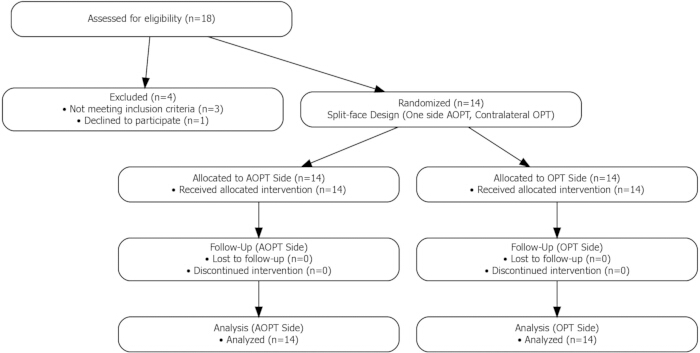
Figure 1. Study flowchart illustrating the split-face design. A total of 14 patients with erythromelanosis follicularis of faciei and colli were enrolled. Each patient served as their own control, with one side of the face randomized to receive Advanced Optimal Pulse Technology treatment and the contralateral side receiving standard Optimal Pulse Technology treatment. All 14 patients completed follow-up and were included in the final analysis. Treatment parameters and assessment methods are detailed in the protocol section. Abbreviations: OPT = Optimal Pulse Technology; AOPT = advanced OPT. Please click here to view a larger version of this figure.
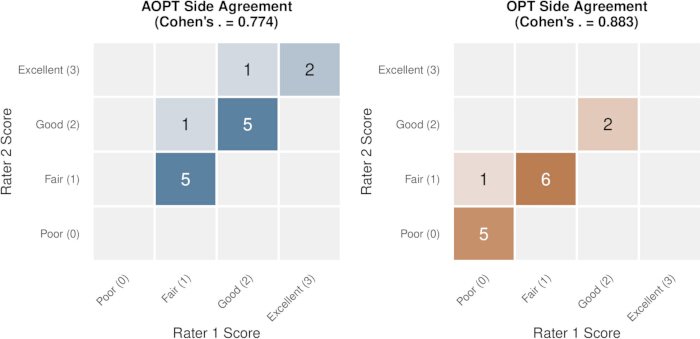
Figure 2. Heatmap of inter-rater agreement for clinical evaluations. The agreement between two blinded independent dermatologists evaluating the final clinical outcomes is shown for the AOPT-treated side (left panel, Cohen’s κ = 0.774) and the OPT-treated side (right panel, Cohen’s κ = 0.883). Scores range from 0 (Poor) to 3 (Excellent). The concentration of observations along the diagonal indicates substantial reproducibility of the image-based clinical assessments. Abbreviations: OPT = Optimal Pulse Technology; AOPT = advanced OPT. Please click here to view a larger version of this figure.
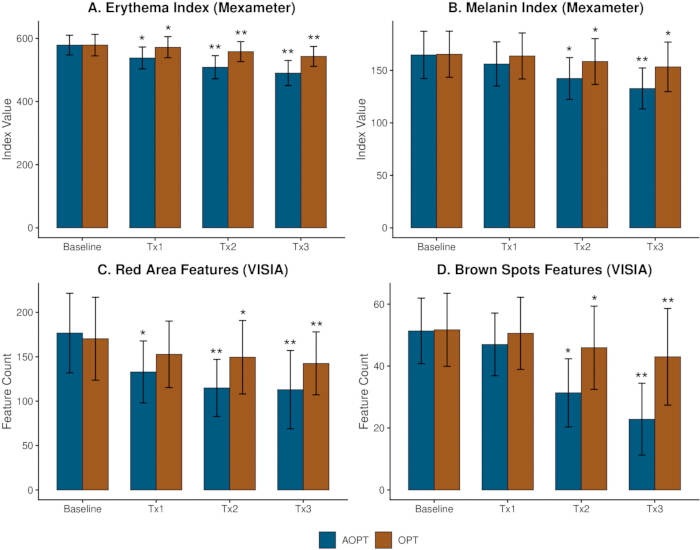
Figure 3. Quantitative assessment of treatment efficacy. Comparison of objective measurements between AOPT and OPT modes across three treatment sessions. (A) Erythema Index and (B) Melanin Index as measured by a skin colorimetric probe. Feature counts for (C) Red Areas and (D) Brown Spots as quantified by a digital skin analysis imaging system. Data represent mean ± SD at baseline (Pre-Tx) and after 1, 2, and 3 treatment sessions (n = 14 per time point). Statistical significance versus baseline is indicated by asterisks (*P < 0.05; **P < 0.001). Abbreviation: Tx = treatment. Please click here to view a larger version of this figure.
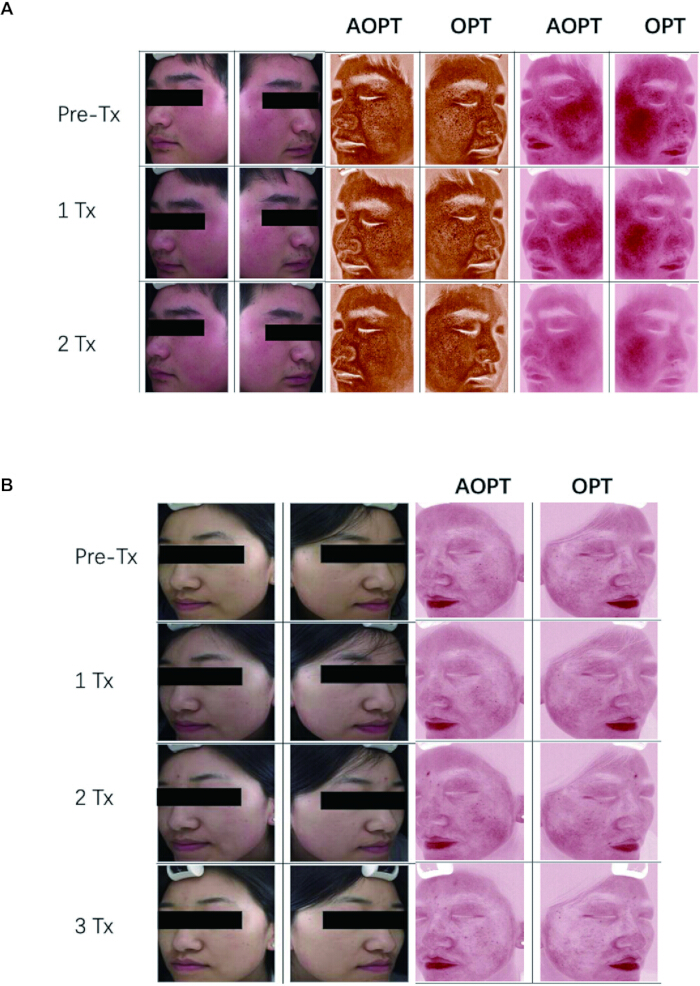
Figure 4. Representative clinical outcomes. (A) Case 1: An 18-year-old male with EFFC. Clinical photography and digital skin analysis (Brown/Red modes) show reduced erythema and pigmentation on the AOPT-treated side compared with the OPT side after two treatment sessions. (B) Case 2: A 25-year-old female. Clinical presentation shows clearance of follicular papules and improved skin texture after three treatment sessions, with greater visual improvement on the AOPT-treated side. Abbreviations: EFFC = erythromelanosis follicularis of faciei and colli; OPT = Optimal Pulse Technology; AOPT = advanced OPT. Please click here to view a larger version of this figure.
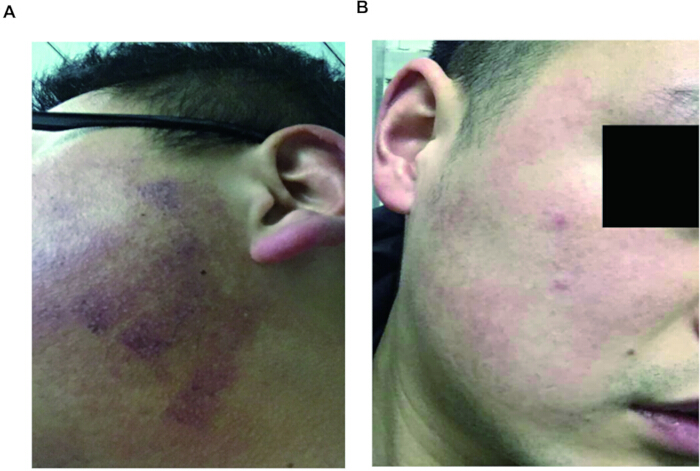
Figure 5. Safety profile and representative adverse events. Clinical presentation of the two specific adverse events recorded during the study. (A) Transient purpura appeared on the cheek several hours post-treatment and resolved spontaneously without intervention within two weeks. (B) Small vesicles (approximately soybean size) were observed in one patient following a high-fluence session and healed completely within 3 days without scarring or post-inflammatory hyperpigmentation. Both events underscore the importance of parameter management and adequate post-treatment cooling. Please click here to view a larger version of this figure.
| Characteristic | AOPT Side | OPT Side | P-value |
| Total Patients (n) | 14 | 14 | - |
| Age (years, Mean ± SD) | 21.7 ± 4.2 | - | - |
| Sex, Male / Female (n) | 2/12 | - | - |
| Disease Duration (years, Mean ± SD) | 12.0 ± 4.2 | - | - |
| Fitzpatrick Skin Type III / IV (n) | 6/8 | - | - |
| Baseline Erythema Index (Mean ± SD) | 578.6 ± 31.2 | 578.8 ± 34.1 | 0.962 |
| Baseline Melanin Index (Mean ± SD) | 164.6 ± 22.5 | 165.4 ± 22.0 | 0.568 |
| Baseline Red Area Features (Mean ± SD) | 176.7 ± 44.8 | 170.4 ± 46.7 | 0.081 |
| Baseline Brown Spots Features (Mean ± SD) | 51.4 ± 10.6 | 51.7 ± 11.8 | 0.652 |
Table 1: Patient demographics and matched baseline characteristics. Summary of the 14 patients enrolled in the study, including age, sex, disease duration, Fitzpatrick skin type, and objective baseline measurements for both facial sides. The lack of statistically significant differences (P > 0.05) between the assigned sides supports matched baseline severity before intervention.
| Treatment Group | Total Patients (n) | Good (Score = 2) | Excellent (Score = 3) | Effective Rate (%) |
| AOPT Side | 14 | 6 | 2 | 57.10% |
| OPT Side | 14 | 2 | 0 | 14.30% |
Table 2: Comparison of clinical efficacy between AOPT and OPT modes. Evaluation based on the blinded assessment scores at the end of the treatment course. The effective rate is defined as the percentage of patients achieving a “Good” (Score = 2) or “Excellent” (Score = 3) final clearance evaluation.
Discussion
Loading...
$$\rightleftharpoonup{xx}$$
$$\longleftharp{xx}$$,
$$\longrightharp{xx}$$,
EFFC remains a therapeutic challenge due to its multifactorial pathogenesis involving follicular hyperkeratosis, vascular dilation, and epidermal hyperpigmentation. While existing therapies such as topical keratolytics and pulsed dye laser (PDL) have demonstrated variable success, they are often constrained by limited efficacy or adverse effects, including purpura and PIH, particularly in Fitzpatrick skin types III–IV. In this randomized split-face study, AOPT showed greater clearance of both erythema and pigmentation compared with standard OPT, with generally good tolerability and few adverse events, and all 14 enrolled patients completed follow-up.
These findings support emerging evidence that IPL-based modalities are viable alternatives to PDL for persistent facial erythema. Tsunoda et al. recently reported that IPL effectively reduces skin roughness and redness in EFFC patients, underscoring its advantage over single-wavelength lasers due to broader spectral coverage14. This study adds to that evidence by comparing two IPL-based technologies in a split-face design. The improved outcomes observed with AOPT may be attributed to its tunable pulse structure and dual-band filtering. Unlike standard OPT, AOPT allows fine-tuned control over individual sub-pulses, which is relevant given the differing depths of oxyhemoglobin and melanin in the skin. The use of the vascular filter (530–650 nm and 900–1,200 nm) in the AOPT group enabled selective targeting of superficial capillaries while aiming to preserve epidermal integrity, a mechanism consistent with the findings of Tang et al., who reported that narrow-band IPL offers a favorable safety and efficacy profile compared with broad-band IPL or PDL in treating erythematotelangiectatic rosacea13.
Managing pigmentary changes in EFFC is especially challenging in Asian populations. A reduction in Melanin Index (MI) and visible brown spots was observed on the AOPT-treated side, whereas the OPT-treated side showed smaller improvement. This difference may be related to AOPT’s ability to deliver energy in a square-wave pulse pattern, maintaining a more stable thermal dose and reducing collateral tissue damage. Mechanistic insights from Wang et al. indicate that AOPT downregulates key melanogenesis pathways, such as SCF/c-KIT signaling, and suppresses mast cell infiltration in melasma models15. Although melasma and EFFC are distinct conditions, the shared pathway of inflammation-driven pigmentation suggests that these mechanisms may also contribute to the observed effects of AOPT in EFFC. By avoiding excessive thermal spikes, AOPT may reduce the risk of PIH, a well-documented complication following PDL treatment.
Regarding safety, PDL has long been considered a standard option for vascular lesions, but its purpuric endpoint can be a deterrent for patients seeking reduced-downtime procedures. Wang Z et al. reported that while 595-nm PDL is effective for EFFC, transient purpura is an almost universal side effect10. In contrast, this study recorded one case of mild purpura in the AOPT group and one case of scattered vesicles. To optimize safety and address such occurrences, a clear troubleshooting protocol is essential in clinical practice. If excessive pain or distinct epidermal whitening occurs during the procedure, the operator must immediately decrease the fluence or adjust the pulse delay. For post-treatment purpura or excessive heat accumulation, extending the application of cold compresses (15–20 min) can help mitigate further thermal damage. If vesicles develop, patients must be instructed not to scratch or puncture the lesions, and a topical antibiotic ointment should be prescribed to prevent secondary infection. This aligns with the broader consensus in managing keratosis pilaris (KP) and its variants, where recent guidelines by Kodali et al. advocate for shifting towards modalities that balance efficacy with patient quality of life9. Furthermore, as highlighted by Wong et al. in their review of treatment paradigms, assessing effectiveness across modalities requires standardized scoring systems, such as the investigator global assessment score recently developed by Wang et al., to better quantify outcomes in follicular disorders16,17. It is also important to differentiate idiopathic cases from drug-induced variants, such as those described by Beniwal et al., to tailor appropriate therapeutic strategies18. Finally, the visualization of follicular plugging and vascular networks via dermoscopy, as described by Maouni et al., may aid in monitoring these subtle treatment endpoints without the need for invasive biopsies7.
Limitations of this study include the small sample size and the absence of long-term follow-up (>6 months) to assess recurrence rates. Furthermore, as an early-stage exploratory proof-of-concept pilot study, this trial was retrospectively reviewed by the institutional ethics committee but was not prospectively registered in a public clinical trial database, which represents a methodological limitation. Additionally, while the skin analysis imaging system and skin colorimetric probe provide objective data, future studies could incorporate histological or confocal microscopy analysis to quantify the reduction in follicular plugging and vascular density. In conclusion, AOPT may offer an incremental advantage over standard OPT for treating EFFC in Chinese patients. Its dual-targeting capability addresses the “red” and “brown” components of the disease simultaneously, offering a standardized treatment approach with limited downtime in this exploratory cohort.
Disclosures
Loading...
$$\rightleftharpoonup{xx}$$
$$\longleftharp{xx}$$,
$$\longrightharp{xx}$$,
The authors have no conflicts of interest to declare. AI-based tools were used only for language polishing and grammar correction during revision. No AI tools were used for data generation, statistical analysis, or scientific interpretation. The authors take full responsibility for the manuscript content.
Materials
| Name | Company | Catalog Number | Comments |
|---|---|---|---|
| Anthelios Melt-in Milk Sunscreen (SPF 60) | La Roche-Posay | https://www.laroche-posay.com | Generic name used in text: broad-spectrum sunscreen |
| Aquasonic 100 Ultrasound Transmission Gel | Parker Laboratories, Inc. | 01-50 | Generic name used in text: ultrasound transmission gel |
| CeraVe Moisturizing Cream | L'Oréal (CeraVe) | https://www.cerave.com | Generic name used in text: gentle moisturizer |
| Cetaphil Gentle Skin Cleanser | Galderma Laboratories, L.P. | https://www.cetaphil.com | Generic name used in text: mild cleanser |
| GraphPad Prism (Version 9.0) | GraphPad Software, LLC | https://www.graphpad.com | Statistical analysis and graphing software |
| IBM SPSS Statistics (Version 26.0) | IBM Corp. | https://www.ibm.com/products/spss-statistics | Statistical analysis software |
| M22 Universal IPL System (AOPT and OPT Modules) | Lumenis Be Ltd. | https://lumenis.com/aesthetics/products/m22/ | Generic name used in text: intense pulsed light (IPL) system |
| Mexameter MX 18 | Courage + Khazaka Electronic GmbH | MX 18 | Generic name used in text: skin colorimetric probe |
| R (Version 4.1.2) | The R Foundation for Statistical Computing | https://www.r-project.org/ | Statistical computing environment |
| VISIA Complexion Analysis System (Generation 7) | Canfield Scientific, Inc. | VISIA-7 | Generic name used in text: skin analysis imaging system |
Reprints and Permissions
Request permission to reuse the text or figures of this JoVE article
Request Permission