This study integrates transcriptome-wide association analysis and Mendelian randomization to systematically identify drug targets for osteomyelitis. Leveraging genetic databases, the authors identified LYNX1 and MS4A14 as key candidate genes, highlighting critical molecular pathways and informing precise therapeutic strategies for managing bone infections.
Research Article
Integrative Transcriptome-Wide Association Study and Mendelian Randomization Identify LYNX1 and MS4A14 as Therapeutic Targets for Osteomyelitis
Opens in a new tab
In This Article
Summary
Loading...
$$\rightleftharpoonup{xx}$$
$$\longleftharp{xx}$$,
$$\longrightharp{xx}$$,
Abstract
Loading...
$$\rightleftharpoonup{xx}$$
$$\longleftharp{xx}$$,
$$\longrightharp{xx}$$,
Osteomyelitis is a severe infectious disease characterized by profound inflammation of the bone and bone marrow and is predominantly caused by bacterial pathogens such as Staphylococcus aureus (S. aureus). However, current treatment regimens are significantly hindered by the emergence of antibiotic resistance and recurrent infections, driven by robust biofilm formation and intracellular bacterial persistence. Thus, there is an urgent need to identify novel therapeutic targets beyond conventional antimicrobials. An integrative computational approach combining a transcriptome-wide association study (TWAS) with summary-based Mendelian randomization (SMR) analysis was applied to systematically identify causal susceptibility genes underlying osteomyelitis. Large-scale genetic variants were leveraged as instrumental variables to predict gene expression across tissues, enabling the exploration of causal associations between these targets and disease risk. The integrative framework identified LYNX1 and MS4A14 as key candidate genes and potential therapeutic targets. Specifically, LYNX1 was associated with increased susceptibility to osteomyelitis, whereas MS4A14 exhibited potential protective properties. These findings highlight the regulatory roles of these genes in host immune response and inflammatory modulation during bone infection. This study bridges the gap between genome-wide association findings and biological interpretation, advancing the understanding of the genetic basis of osteomyelitis and supporting the development of targeted precision medicine strategies to enhance host defense and overcome therapeutic resistance.
Introduction
Loading...
$$\rightleftharpoonup{xx}$$
$$\longleftharp{xx}$$,
$$\longrightharp{xx}$$,
Osteomyelitis is a severe infectious disease characterized by profound inflammation of the bone and bone marrow. It is frequently initiated by bacterial invasion, with Staphylococcus aureus (S. aureus) being a common pathogen across acute and chronic hematogenous presentations1,2. While S. aureus is prominent, osteomyelitis is often polymicrobial, and eradication of S. aureus alone does not always resolve the infection due to the persistence of uncultivable microorganisms and dynamic biofilm interactions3,4. In susceptible hosts, pathogens employ intricate evasion strategies, including intracellular persistence within macrophages and the formation of dense biofilms. These biofilms, composed of extracellular DNA, polysaccharides, and specialized proteins, create formidable physical barriers that resist host immune defenses and limit the penetration of conventional antimicrobial agents5,6. Consequently, although clinical management typically involves aggressive surgical debridement and prolonged antibiotic therapy, the presence of resilient biofilms and polymicrobial communities significantly reduces treatment efficacy, leading to prolonged morbidity and recurrent infections7,8. Elucidation of the molecular architecture underlying host–pathogen interactions remains critical for identifying novel therapeutic targets9.
Genome-wide association studies (GWAS) have advanced the understanding of osteomyelitis by identifying multiple genetic loci associated with disease susceptibility10. However, due to stringent multiple testing thresholds and limitations in statistical power and sample size, many critical loci influencing osteomyelitis susceptibility are likely to remain undetected7. Furthermore, interpretation of GWAS findings remains challenging, as most identified variants are located in non-coding or intergenic regions, suggesting regulatory effects on gene expression rather than direct alterations in protein structure11. In addition, primary GWAS data lack direct tissue specificity, necessitating complementary downstream analyses to determine the cellular contexts in which these variants exert their effects. Transcriptome-wide association studies (TWAS) address these limitations by integrating genetically predicted gene expression from reference panels into existing GWAS datasets, enabling systematic identification of functionally relevant disease-associated genes across multiple tissues12.
To strengthen causal inference, Mendelian randomization (MR) employs genetic variants as instrumental variables, leveraging the random allocation of alleles at conception to reduce confounding and reverse causation13,14. Expression quantitative trait loci (eQTL) analyses further link GWAS variants to gene transcription15, while summary-based Mendelian randomization (SMR) integrates GWAS and QTL datasets to prioritize causal genes and distinguish them from associations driven by linkage disequilibrium through heterogeneity testing16.
This study represents the first application of an integrative TWAS and MR framework specifically focused on osteomyelitis, addressing the gap between GWAS findings and clinically actionable insights. By combining experimental transcriptomic data with large-scale population-genetic data, disease-susceptibility genes were systematically mapped and causal relationships inferred. This integrative strategy aims to uncover previously unrecognized molecular pathways involved in host resistance to osteomyelitis and to identify candidate targets for precision therapeutic development.
Protocol
Loading...
$$\rightleftharpoonup{xx}$$
$$\longleftharp{xx}$$,
$$\longrightharp{xx}$$,
All summary statistics utilized in the Mendelian Randomization (MR) and Transcriptome-Wide Association Study (TWAS) analyses were derived strictly from previously published, de-identified datasets. Ethical approval and individual consent for the original studies are documented in their respective publications. Consequently, additional ethical approval for this data-mining study was waived by the Institutional Review Board of Tongde Hospital of Zhejiang Province (Zhe Tongde Lunshen 2024 [Yan] No. 028-JY). The tools used for this research are listed in the Table of Materials.
1. RNA-seq data acquisition and processing
Transcriptome data were obtained from the Gene Expression Omnibus (GEO) database (GSE272198) to assess conservation of innate immune pathways across mammalian species for initial validation17. Bone marrow-derived macrophages (BMDMs) were infected with S. aureus (multiplicity of infection, MOI = 10) for 1 h, followed by treatment with lysostaphin (20 µg/mL) and gentamicin (50 µg/mL) to remove extracellular bacteria. After three washes with phosphate-buffered saline (PBS), BMDMs were cultured for 24 h, lysed in a total RNA extraction reagent, and sequenced.
RNA quality was assessed using an automated electrophoresis system to ensure integrity. Libraries were prepared from three independent experiments and sequenced on a high-throughput sequencing platform. Raw reads were aligned to the mouse genome (GRCm38, mm10) using STAR (v2.7.10a). Differentially expressed genes (DEGs) were identified using DESeq2 (v1.38.0). To mitigate false positives, statistical significance was defined as an adjusted p-value (FDR) < 0.05 and |log₂ fold change| > 1. Gene Ontology (GO) analysis was performed using clusterProfiler (v4.6.0), and Gene Set Enrichment Analysis (GSEA) was conducted using GseaVis (v0.0.5). Heatmaps were generated using the pheatmap package (v1.0.12) in R (v4.2.0).
TWAS analysis
Whole-blood RNA sequencing and whole-genome sequencing (WGS) data were obtained from the Genotype-Tissue Expression (GTEx) project (V8)18. Pre-trained gene expression models were utilized from a public repository (https://doi.org/10.5281/zenodo.3842289). Osteomyelitis summary statistics for TWAS were retrieved from the FinnGen consortium, comprising 2,336 cases and 473,264 controls12.
TWAS was conducted using three algorithms: joint-tissue imputation (JTI), PrediXcan19, and UTMOST12,20. JTI estimates gene expression similarity and epigenetic chromatin accessibility to optimize prediction accuracy. PrediXcan applies elastic net regression with fivefold cross-validation, while UTMOST enhances accuracy by leveraging multi-tissue expression data using sparse group LASSO. The modified UTMOST framework described by Zhou et al.12 standardizes hyperparameters for unbiased estimation. Genes with stable cross-validation scores—pre-defined as a correlation coefficient r > 0.1 and predictive significance p < 0.0521—were retained as imputable. Whole-blood transcriptome models were established using SNP covariance matrices from the 1000 Genomes reference dataset.
Associations between predicted gene expression and osteomyelitis risk were subsequently analyzed. To account for multiple testing, statistical significance for TWAS was primarily defined using a False Discovery Rate (FDR) threshold of < 0.05. Given the hypothesis-generating nature of this multi-stage study, loci meeting a suggestive (nominal) threshold of p < 0.05 were also prioritized for downstream Mendelian randomization (SMR) and colocalization analyses. This integrative strategy aims to maximize the capture of potential regulatory drivers while relying on multi-omic cross-validation (TWAS + SMR) to ensure the robustness of the prioritized candidates.
SMR Analysis
This study adhered to the Strengthening the Reporting of Observational Studies in Epidemiology (STROBE) guidelines22. To computationally define a phenotype representing genetic predisposition to mitochondrial dysfunction (hereafter termed “mitodys” for analysis purposes), transcripts corresponding to all known mitochondrial-related genes were extracted from the MitoCarta3.0 database23. This gene set served as a predefined, biology-informed basis for subsequent polygenic risk prediction. All downstream functional interpretations relating to “mitodys” are derived from this computational inference and should be considered predictive and hypothesis-generating.
Expression quantitative trait loci (eQTL) instruments were generated using variants within 1000 kb of coding sequences (cis-eQTLs). Summary statistics were sourced from the eQTLGen Consortium and GTEx V824. A total of 8,932,843 SNPs linked to 1,013 mitodys-related transcripts were selected based on a genome-wide significance threshold P < 5E-8. Baseline GWAS statistics for osteomyelitis outcomes were obtained from FinnGen20.
Summary-data-based Mendelian Randomization (SMR) analysis was performed using SMR (version 1.0.3) with default parameters to estimate pleiotropic associations between gene expression traits and osteomyelitis outcomes. The causal effect beta_mitodys–osteomyelitis represents the estimated log-odds effect size of mitochondrial dysfunction on osteomyelitis and is calculated as:

Odds ratios (ORs) represent the change per one-unit natural logarithmic increase in standardized gene expression levels. Co-localization was further evaluated using the heterogeneity in dependent instruments (HEIDI) test.
Results
Loading...
$$\rightleftharpoonup{xx}$$
$$\longleftharp{xx}$$,
$$\longrightharp{xx}$$,
Characterization of bulk RNA-sequencing and functional enrichments
Following the methodology used to isolate uninfected (control) versus S. aureus-infected BMDMs, 3,775 DEGs were identified in the experimental group, comprising 1,686 upregulated and 2,089 downregulated genes. GO analysis revealed a network strongly enriched for innate immune activation, including positive regulation (GO:0045089) and activation (GO:0002218) of the innate immune response, reflecting canonical cytokine-driven pathogen defense mechanisms. Modulation of leukocyte proliferation (GO:0070661) highlighted key immune effector dynamics. Notably, responses to viral stimuli (GO:0009615) were also enriched, indicating potential cross-reactivity in which bacterial sensing activates overlapping pathogen-associated molecular pattern (PAMP) signaling cascades. Consistent with these findings, GSEA confirmed activation of TNF, NOD-like receptor, and Toll-like receptor signaling pathways, establishing a foundational inflammatory framework for host–pathogen interactions in osteomyelitis (Figure 1A–F).
Transcriptome-wide association analysis
TWAS analysis of osteomyelitis risk identified multiple genetic variants reaching nominal significance (p < 0.05), providing a broad set of candidates for multi-omic prioritization. Suggestive associations included SNP rs11191048 near POLL (chromosome 10; Z = 2.01, p < 0.05) and rs11246311 proximal to EFCAB4A (chromosome 11; Z = 2.10, p < 0.05), as well as additional signals such as rs2855469 (MXI1) and rs4075326 (UROS) (Figure 2A; Table 1).
Evaluation of predicted gene expression further implicated RRAS2, MS4A14, FADS2, and RAB38 in osteomyelitis susceptibility (P < 0.05). While these loci exhibited varying degrees of statistical evidence in the initial TWAS, their consistent direction of effect and biological relevance to bone remodeling and inflammatory pathways justified their inclusion in subsequent SMR analysis to refine candidate disease drivers (Figure 2B).
MR analysis of genome-wide cis-eQTLs in the eQTLGen consortium dataset and osteomyelitis outcome
Mendelian randomization analysis using eQTLGen-derived cis-variants linked to mitochondrial gene expression and osteomyelitis outcomes demonstrated significant pleiotropic associations (P_SMR < 0.05). HEIDI testing yielded P_HEIDI > 0.05, indicating no evidence of confounding due to horizontal pleiotropy and supporting the presence of shared causal variants (Figure 3A, B).
By applying a stringent integrative filter, requiring both TWAS nominal significance and SMR-validated pleiotropy, several high-priority genes were identified. AMIGO1 (chromosome 1; rs534135) showed notable SMR pleiotropy, while FCER1G (chromosome 1) exhibited a negative β value suggestive of a potential protective effect. Additional associations were observed for ARHGAP18 (chromosome 6), MXI1 (chromosome 10), and LYNX1 (chromosome 8; rs60096034). MS4A14 (chromosome 11; rs3816270) emerged as a prominent regulatory candidate, demonstrating strong association with osteomyelitis outcomes (Figure 3C–F).
MR analysis of genome-wide cis-eQTLs in the GTEx dataset and structural colocalization
Validation using the GTEx reference dataset further supported the multigenic nature of osteomyelitis susceptibility. Identified signals included genes involved in immune regulation (TNFRSF18, B3GALT6), bioenergetic processes (ATAD3A), and cell cycle regulation (CDK11A), suggesting that disease progression may involve combined disruptions in immune function and cellular metabolism (Figure 3A).
Integration across datasets prioritized two key candidate genes: LYNX1 and MS4A14 (Figure 4A). LYNX1, located on chromosome 8, showed a consistent positive association with osteomyelitis through the risk allele (A) at rs13279795 (b_GWAS = 0.065; b_SMR = 0.179; p_SMR < 0.05) (Figure 4B, C). In contrast, MS4A14 (chromosome 11) exhibited an inverse association (b_GWAS = −0.077; b_SMR = −0.161; p_GWAS < 0.05), indicating a potential protective effect (Figure 4D, E).
Collectively, these findings identify LYNX1 and MS4A14 as key loci linking genetic variation to osteomyelitis susceptibility and support their prioritization as candidate targets for future precision therapeutic strategies.
DATA AVAILABILITY:
All data generated or analyzed during this study are included in Supplementary File 1. Publicly available datasets were utilized, including RNA-seq data from GEO (GSE272198); genotype and expression data from the GTEx project V8 (https://www.gtexportal.org/); pre-trained models from Zenodo (https://doi.org/10.5281/zenodo.3842289); osteomyelitis GWAS summary statistics from the FinnGen consortium (https://www.finngen.fi/en); and eQTL summary data from the eQTLGen Consortium (https://eqtlgen.org/).
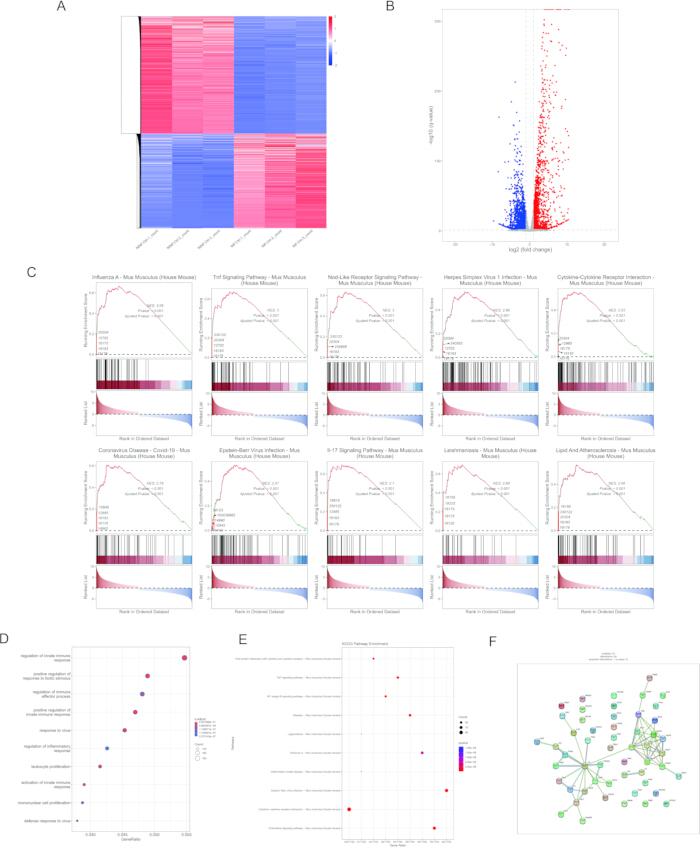
Figure 1: Transcriptomic and pathway enrichment analyses reveal key genetic markers and molecular pathways involved in the pathogenesis of osteomyelitis. (A) Heatmap showing differentially expressed genes (DEGs) between control and osteomyelitis samples. (B) Volcano plot illustrating the distribution of DEGs, highlighting upregulated (red) and downregulated (blue) genes. (C) Gene Set Enrichment Analysis (GSEA) identifies significant pathways, including TNF signaling, Toll-like receptor signaling, and cytokine–cytokine receptor interaction, which are critical for immune response and inflammation. (D) Gene Ontology (GO) enrichment analysis of DEGs, emphasizing processes such as immune regulation and response to bacterial infection. (E) Kyoto Encyclopedia of Genes and Genomes (KEGG) pathway enrichment analysis highlighting pathways implicated in osteomyelitis. (F) Protein–protein interaction (PPI) network revealing critical nodes and potential therapeutic targets. Please click here to view a larger version of this figure.
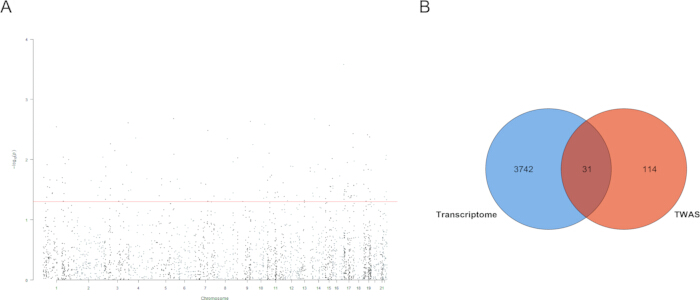
Figure 2: Identification of genetic markers associated with osteomyelitis through transcriptomic and TWAS analyses. (A) Manhattan plot showing genetic associations across chromosomes, with the red line indicating the significance threshold (p < 0.05). (B) Venn diagram illustrating the overlap between differentially expressed genes (DEGs) identified via transcriptome analysis (blue) and genes associated with osteomyelitis through TWAS (orange), highlighting 31 shared genes as potential targets for further investigation. Please click here to view a larger version of this figure.
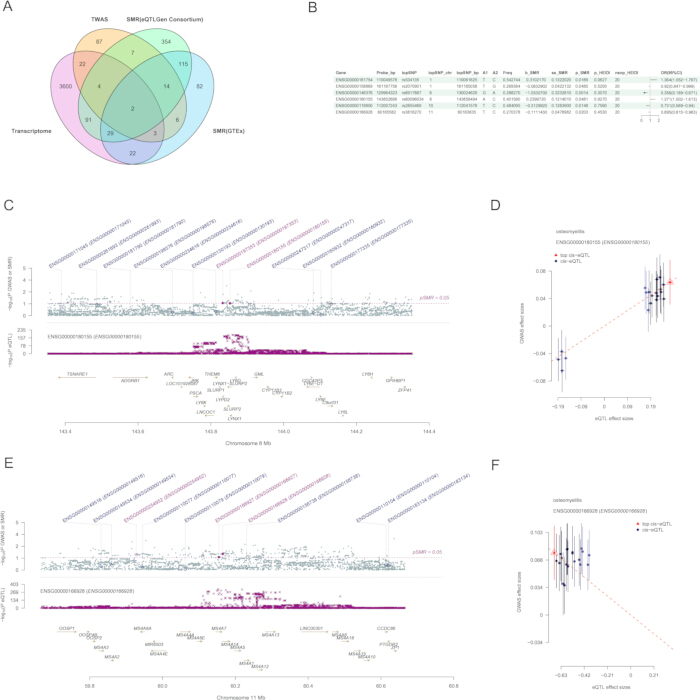
Figure 3: Integration of TWAS, SMR, and transcriptomic data reveals causal genes and genetic loci associated with osteomyelitis. (A) Venn diagram illustrating the overlap between genes identified through TWAS, SMR (eQTLGen and GTEx datasets), and transcriptomic analysis, highlighting shared genetic targets. (B) Summary of significant genes identified in the SMR analysis, including effect sizes and p-values. (C, E) Regional association plots showing the genetic loci of interest on chromosomes 8 and 11, with significant SNPs and genes highlighted. (D, F) Colocalization analyses demonstrating the association between gene expression and osteomyelitis risk, confirming causal relationships between eQTLs and osteomyelitis-related traits for key genes such as LYNX1 and MS4A14. Please click here to view a larger version of this figure.
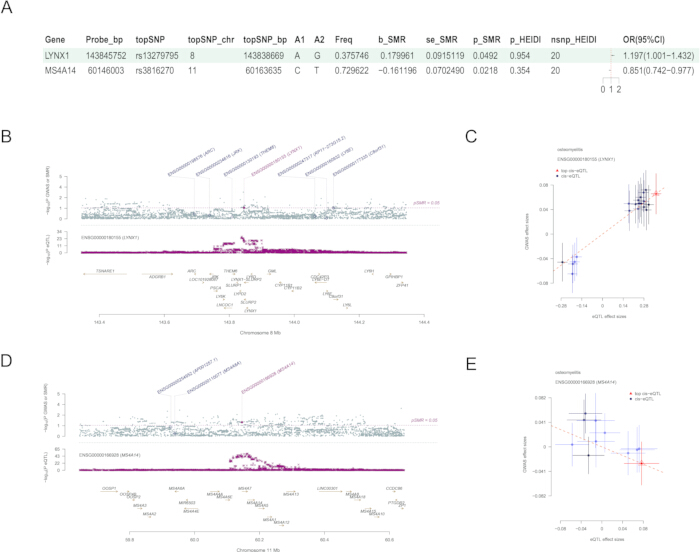
Figure 4: SMR and colocalization analyses identify LYNX1 and MS4A14 as potential causal genes for osteomyelitis. (A) Summary table of key findings for LYNX1 and MS4A14, including top SNPs, allele frequencies, effect sizes (b_SMR), and odds ratios (ORs) with confidence intervals. (B, D) Regional association plots for LYNX1 (chromosome 8) and MS4A14 (chromosome 11), showing significant SNPs and gene locations. (C, E) Colocalization plots demonstrating the relationship between eQTL effect sizes and osteomyelitis-associated genetic effects, supporting the causal role of LYNX1 and MS4A14 in osteomyelitis pathogenesis. Please click here to view a larger version of this figure.
| ID | CHR | Start | End | NSNP | MODELCV.R2 | MODELCV.PV | TWAS.Z | TWAS.P |
| MXI1 | 10 | 111967363 | 112047121 | 60 | 0•013 | 0•011 | −3•01163 | 0•0026 |
| RRAS2 | 11 | 14299467 | 14380729 | 11 | 0•022 | 0•0013 | −2•65545 | 0•00792 |
| MS4A14 | 11 | 60145958 | 60185226 | 87 | 0•35 | 1•20E−40 | −2•02585 | 0•04278 |
| FADS2 | 11 | 61583728 | 61634825 | 71 | 0•02 | 0•002 | −2•09819 | 0•03589 |
| RAB38 | 11 | 87846431 | 87908599 | 126 | 0•018 | 0•0037 | 2•03299 | 0•04205 |
| PNP | 14 | 20937542 | 20945246 | 84 | 0•096 | 5•50E−11 | 2•09143 | 0•03649 |
| UNC45B | 17 | 33474836 | 33516363 | 65 | 0•078 | 3•30E−09 | 2•24229 | 0•02494 |
| SCPEP1 | 17 | 55055468 | 55084127 | 41 | 0•033 | 1•00E−04 | 2•02606 | 0•04276 |
| SKA2 | 17 | 57187308 | 57232800 | 42 | 0•052 | 1•30E−06 | 2•04604 | 0•04075 |
| FPR1 | 19 | 52249027 | 52255150 | 82 | 0•14 | 6•30E−16 | −2•11566 | 0•03437 |
| SMPDL3B | 1 | 28261504 | 28285662 | 51 | 0•069 | 3•10E−08 | −2•028833 | 0•04248 |
| AMIGO1 | 1 | 110049447 | 110052336 | 46 | 0•13 | 3•80E−14 | 2•285688 | 0•02227 |
| S100A8 | 1 | 153362509 | 153363549 | 60 | 0•014 | 0•0089 | −2•324516 | 0•0201 |
| PMF1 | 1 | 156182784 | 156209831 | 63 | 0•032 | 0•00014 | 2•256026 | 0•02407 |
| FCER1G | 1 | 161185087 | 161189038 | 72 | 0•015 | 0•0077 | −2•605905 | 0•00916 |
| CACYBP | 1 | 174968571 | 174981163 | 35 | 0•02 | 0•002 | 2•518477 | 0•01179 |
| TTC38 | 22 | 46663861 | 46689903 | 60 | 0•13 | 6•00E−15 | −2•11449 | 0•03447 |
| TMEM163 | 2 | 135213331 | 135525334 | 190 | 0•016 | 0•0061 | 2•28176 | 0•0225 |
| MFSD6 | 2 | 191273081 | 191367041 | 75 | 0•0052 | 0•074 | 2•0585 | 0•03954 |
| ATIC | 2 | 216176692 | 216214477 | 75 | 0•017 | 0•0044 | −2•27154 | 0•02311 |
| METTL6 | 3 | 15422784 | 15469042 | 65 | 0•0014 | 0•21 | 2•35198 | 0•01867 |
| UBA7 | 3 | 49842639 | 49851391 | 30 | 0•016 | 0•0053 | −2•06285 | 0•03913 |
| NT5DC2 | 3 | 52558386 | 52569093 | 50 | 0•028 | 0•00037 | −2•77722 | 0•00548 |
| EPHB3 | 3 | 184279587 | 184300195 | 49 | 0•04 | 2•40E−05 | 2•50233 | 0•01234 |
| NCAPG | 4 | 17812525 | 17846485 | 34 | 0•028 | 0•00035 | 2•1399 | 0•03236 |
| HOPX | 4 | 57514154 | 57547872 | 55 | 0•013 | 0•01 | −2•8473 | 0•00441 |
| DHFR | 5 | 79922045 | 79950800 | 65 | 0•18 | 1•10E−19 | 2•2207 | 0•0264 |
| SLC25A27 | 6 | 46620679 | 46645925 | 82 | 0•023 | 0•0011 | −2•165 | 0•0304 |
| ARHGAP18 | 6 | 129898241 | 130031370 | 157 | 0•023 | 0•0012 | −2•0071 | 0•0447 |
| PAG1 | 8 | 81880048 | 82024303 | 137 | 0•022 | 0•0014 | 1•99846 | 0•04567 |
| LYNX1 | 8 | 143845758 | 143859640 | 41 | 0•1 | 1•40E−1 | 2•09611 | 0•03607 |
Table 1: Transcriptome-wide association study results: significant genes associated with osteomyelitis. The table summarizes genes with significant or nominal associations with osteomyelitis identified by TWAS analysis.
Supplementary File 1: Integrated datasets generated and analyzed in this study. Includes GO and KEGG enrichment results, TWAS data, and SMR (including WB-SMR) datasets.Please click here to download this file.
Discussion
Loading...
$$\rightleftharpoonup{xx}$$
$$\longleftharp{xx}$$,
$$\longrightharp{xx}$$,
By integrating TWAS and SMR analyses across translational datasets, this study identified a core network of genetic loci associated with osteomyelitis phenotypes. The identification of LYNX1 and MS4A14 as candidate gene targets represents a key contribution, providing mechanistic insight beyond conventional GWAS findings by incorporating transcriptomic context. This integrative approach highlights the potential of precision medicine strategies to advance the clinical management of severe bone infections.
Methodologically, the use of Mendelian randomization to infer causal relationships between gene expression and osteomyelitis represents a significant analytical advantage. As genetic variants are randomly allocated at conception, MR approximates the structure of randomized trials and reduces the influence of confounding and reverse causation inherent in observational studies3.
A central finding is the identification of MS4A14 and LYNX1 as potential protective and risk-associated factors for osteomyelitis, respectively. However, as the direct roles of these genes in bone infection have not been previously established, the functional interpretations remain hypothesis-generating and require cautious interpretation. MS4A14 was identified as a genetically protective axis16. While its specific physiological role in osteomyelitis remains uncharacterized, it belongs to the tetraspan MS4A family, which has been documented to participate in signal transduction, calcium mobilization, and cell adhesion in immune cells16. Based on these established family traits, MS4A14 may enhance host clearance of pathogens and apoptotic cells by modulating activation thresholds, migration, and efferocytosis in innate immune cells, such as macrophages. Such a mechanism could theoretically limit excessive localized inflammation and restrict the establishment of chronic infection, although this putative protective axis requires further functional validation.
In contrast, LYNX1 was identified as a risk-associated factor25. Based on its known function as a modulator of nicotinic acetylcholine receptors (nAChRs), LYNX1 may influence the cholinergic anti-inflammatory pathway within the inflammatory microenvironment of osteomyelitis, a recognized regulatory axis in macrophage and neutrophil function. Dysregulated LYNX1 expression may disrupt inflammatory homeostasis, leading to enhanced pro-inflammatory signaling or impaired immune cell recruitment and phagocytic activity, thereby exacerbating tissue damage and facilitating bacterial persistence. These proposed mechanisms provide a theoretical framework for how LYNX1 might influence osteomyelitis susceptibility.
The identification of MS4A14 as a protective axis and LYNX1 as a risk-associated factor suggests that targeted modulation of these pathways may represent potential therapeutic strategies. If validated, enhancing MS4A14-associated pathways may improve immune surveillance and pathogen clearance, whereas inhibition of LYNX1-associated signaling may restore balanced inflammatory responses. Such approaches may also influence the local immune microenvironment, potentially reducing excessive inflammation and indirectly limiting biofilm persistence through improved macrophage-mediated bacterial clearance3. Targeting host immune mechanisms may therefore provide alternative strategies to address antibiotic resistance and persistent infections associated with biofilm formation and intracellular bacterial survival1.
Despite these findings, several limitations should be considered. The analyses were conducted using datasets derived primarily from European populations (e.g., FinnGen and GTEx), and the generalizability of these findings requires validation in diverse populations. Crucially, while SMR supports causal inference, the functional interpretations of MS4A14 and LYNX1 are derived from computational integration; rigorous experimental validation in in vitro and in vivo systems is required to confirm the underlying biological mechanisms. In addition, the experimental framework focuses on S. aureus infection in isolated BMDMs, and extrapolation to complex polymicrobial biofilm environments should be interpreted with caution.
In summary, integrative genomic analysis highlights LYNX1 and MS4A14 as key candidate genes associated with osteomyelitis susceptibility. By linking population-scale genetic variation with inflammatory transcriptomic signatures, this study provides a foundation for the development of targeted precision therapies to reduce the burden of chronic bone infections.
Disclosures
Loading...
$$\rightleftharpoonup{xx}$$
$$\longleftharp{xx}$$,
$$\longrightharp{xx}$$,
The authors declare that they have no conflicts of interest.
Acknowledgements
Loading...
$$\rightleftharpoonup{xx}$$
$$\longleftharp{xx}$$,
$$\longrightharp{xx}$$,
The authors gratefully acknowledge the financial support for this research. This work was supported by the National Health Commission Scientific Research Fund—Major Health Science and Technology Plan of Zhejiang Province [grant number WKJ-ZJ-2419]; Zhejiang Clinovation Pride (Clinical Innovation Team for Traumatic Osteomyelitis) [grant number CXTD202501009]; and the Chinese Medicine Research Program of Zhejiang Province [grant numbers 2024ZL040, 2025ZL024].
Materials
| Name | Company | Catalog Number | Comments |
|---|---|---|---|
| clusterProfiler | Guangchuang Yu's Team (Sun Yat-sen University) | NA | Used for Gene Ontology (GO) functional enrichment analysis of differentially expressed genes. |
| DESeq2 | Bioconductor Project (Open Source) | NA | Used to identify differentially expressed genes (DEGs) |
| GSEA / GseaVis | Broad Institute / Open Source Community | NA | Used for Gene Set Enrichment Analysis (GSEA) to identify coordinately expressed gene sets. GseaVis is likely used for visualization. |
| HEIDI (Heterogeneity in Dependent Instruments) test | Integrated function within the SMR software | NA | Used to test if the association observed in SMR is driven by linkage disequilibrium rather than a shared causal variant. P_HEIDI > 0.05 indicates no major heterogeneity |
| JTI (Joint-Tissue Imputation) | Zhou et al. (Open Source Model) | NA | A TWAS algorithm that estimates gene expression similarity and epigenetic chromatin accessibility to optimize prediction accuracy. |
| pheatmap | Raivo Kolde (R package) | NA | Used to generate heatmaps of differentially expressed genes for data visualization. |
| PrediXcan | Gamazon et al. (Open Source Model) | NA | A TWAS algorithm that applies elastic net regression with five-fold cross-validation to impute gene expression and test for association with disease risk. |
| SMR (Summary-data-based Mendelian Randomization) | Developed by a team at Fudan University (Open Source Software) | NA | Used to perform summary-based Mendelian randomization analysis to explore causal associations between gene expression and osteomyelitis risk. Version 1.0.3 was used. |
| STAR | Alexander Dobin (Cold Spring Harbor Laboratory) | NA | Used to align RNA-seq reads to the reference genome (mouse genome GRCm38/mm10). |
| UTMOST | Hu et al. (Open Source Model) | NA | A TWAS algorithm that enhances prediction accuracy by leveraging multi-tissue expression data using a sparse group LASSO framework. |
Reprints and Permissions
Request permission to reuse the text or figures of this JoVE article
Request Permission