This review examines evidence-based preventive and interceptive measures in orthodontics during mixed dentition, focusing on diagnosis, appliance selection, timing of intervention, and prevailing clinical issues.
Review Article
Evidence-Based Evaluation of Malocclusion Management in the Mixed Dentition: From Prevention to Clinical Controversy
Opens in a new tab
In This Article
Summary
Loading...
$$\rightleftharpoonup{xx}$$
$$\longleftharp{xx}$$,
$$\longrightharp{xx}$$,
Abstract
Loading...
$$\rightleftharpoonup{xx}$$
$$\longleftharp{xx}$$,
$$\longrightharp{xx}$$,
The management of malocclusion during the mixed dentition is a crucial time for preventive and interceptive orthodontic intervention, given the complex interactions among craniofacial growth, tooth eruption, and orofacial function. Despite widespread use of early orthodontic treatment, uncertainty still remains about the optimal timing, choice of appliance, and long-term stability. This review collates recent evidence and proposes a functional-preventive approach to managing malocclusion in the mixed dentition, emphasizing risk assessment, etiologic control, and individualized treatment planning rather than traditional appliance therapy. A structured literature search was performed across PubMed/MEDLINE, Scopus, and Web of Science, including clinical trials, cohort studies, and systematic reviews on epidemiology, diagnosis, prevention, and interceptive treatment. The existing evidence supports early treatment for certain conditions, such as functional crossbites, developing Class III malocclusion, transverse maxillary deficiency, and space loss due to premature tooth loss. On the other hand, early treatment of Class II malocclusion and vertical discrepancies remains debatable due to limited long-term benefit. Preventive measures like caries prevention, space maintenance, and myofunctional treatment play a critical role in treatment stability. Emerging technologies, such as digital diagnostics, artificial intelligence-assisted analysis, and airway assessment, may enhance patient selection and treatment precision, but their clinical use should be interpreted with caution. In summary, this review shows a shift towards interdisciplinary, evidence- and biology-based decision-making to achieve stable occlusal and balanced craniofacial development.
Introduction
Loading...
$$\rightleftharpoonup{xx}$$
$$\longleftharp{xx}$$,
$$\longrightharp{xx}$$,
Mixed dentition is a significant phase in tooth development, during which primary and permanent teeth coexist, typically occurring between the ages of 6 and 12 years. At this stage, the face and jaws are rapidly growing, and the orofacial muscles involved in chewing, swallowing, and breathing are still developing and have not yet reached full functional maturation. Relationships observed in the occlusal state at this age are not definitive but represent a process of continuous development. In mixed dentition, large population studies show that 58–80% of children have some form of malocclusion, indicating that malocclusion is a common condition in children1,2,3. Malocclusion can disrupt chewing and speech, affect facial appearance, and compromise self-esteem and social well-being during a sensitive period of child development1,4. These are some of the reasons why mixed dentition is a significant potential target of early screening, diagnosis, and selective intervention.
The biological reasoning for management at an early age is based on the growth potential during the young years. Eruption of the tooth is active, alveolar bone is responsive to change, and skeletal growth continues to occur. These aspects enable clinicians to control eruption, minimize functional disruption, and guide arch development with less force and less complex interventions than those necessary in adolescence5,6. These biological considerations underpin the current philosophies on the treatment of mixed dentition orthodontics. Notably, orthodontics in contemporary practice does not support treating all malocclusions at an early age. Rather, recent evidence supports identifying conditions that may deteriorate or cause harm, such as functional crossbites with jaw displacement, severe transverse constriction, emerging Class III patterns, or loss of space following early tooth loss, while monitoring those that are unlikely to progress or cause harm. Several factors contribute to malocclusion in mixed dentition. Jaw size and shape are determined by genetics, but environmental and behavioral factors also contribute to the development of malocclusion. Premature loss of primary molars due to dental caries may result in reduced arch length, crowding, or abnormal eruption of permanent teeth3. Oral habits such as thumb sucking and mouth breathing may disrupt the tongue-lips-cheek relationship, which leads to narrow upper arches, open bites, and bulging incisors2,4. Studies demonstrate that altered perioral muscle pressures contribute to both the development of malocclusion and its post-treatment stability7. This clinically assists in treating functional causes rather than focusing solely on position.
There has been an expansion of treatment options in mixed dentition. Customary interceptive techniques, such as space maintainers, selective extractions, and limited fixed appliances, remain applicable for managing space and correcting anterior issues. The use of eruption guidance appliances and elastodontic devices is designed to assist the natural eruptive forces in promoting desirable oral posture and muscle balance8,9,10,11,12. Clear aligner therapy in children has been developed as an option in selected cases, but since the evidence is still in its developmental stages, the success of treatment largely relies on compliance13,14. Myofunctional treatment is currently being applied more to enhance breathing, swallowing, and tongue position, and is aimed at preventing relapse by correcting underlying functional factors7,12.
The mixed dentition diagnosis has become more integrated and comprehensive. Clinical examination, supported by radiographs, is used to identify eruption issues, tooth absences, and impaction risk15,16. Intraoral scanning, three-dimensional planning, and analysis with AI have become digital tools that enable more accurate monitoring and individual treatment planning10,17,18. These tools should be applied selectively when they affect clinical decision-making.
Lastly, the consideration of airways has become significant. Sleep-disordered breathing has been associated with narrow upper jaws, and early maxillary expansion could benefit the breathing of selected children19. This underscores the contribution of early orthodontic treatment to overall child health, and this may require collaboration with pediatric dentists and ear, nose, and throat specialists. Mixed dentition management may therefore be considered developmental care to enhance function, growth, and long-term stability, rather than focusing solely on tooth alignment. Figure 1 overviews the parallel skeletal-dental and functional-environmental pathophysiologic determinants involved in the development of malocclusion in the mixed dentition and shows how these two interact to increase treatment complexity and diminish long-term treatment stability in the case of non-intervention.
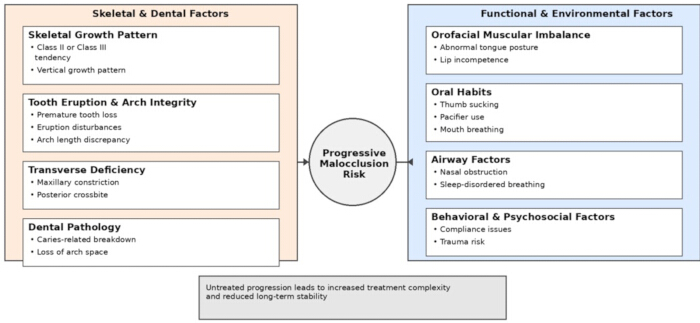
Figure 1: Determinants of malocclusion development in the mixed dentition. This is a conceptual schematic representing the interaction between skeletal-dental and functional-environmental factors in the development of malocclusion during the mixed dentition stage. The convergence of these factors increases the treatment complexity and may reduce long-term stability in the absence of preventive and selective interceptive interventions. Please click here to view a larger version of this figure.
This review was conducted using a structured literature search strategy. Electronic databases (PubMed/MEDLINE, Scopus, and Web of Science) were searched to identify relevant articles on mixed dentition malocclusion, prevalence, detection, prevention, and interceptive orthodontic care. The search included clinical trials, cohort studies, and systematic reviews published in peer-reviewed journals.
Studies were selected based on clinical significance, strength of evidence, and understanding of biological and functional processes that lead to malocclusion. Preference was given to higher-level evidence such as systematic reviews and randomized controlled trials, where available. However, a substantial proportion of the available literature consists of observational studies that may introduce selection bias, thereby limiting the strength and generalizability of conclusions.
As this is a narrative review, no quantitative synthesis (meta-analysis) was undertaken. But we have attempted to critically summarize the evidence, considering comparisons of studies with respect to study design, study population, and reported outcomes. This approach aims to provide a transparent, clinically relevant synthesis while acknowledging the inherent limitations of the available evidence.
Review and Perspective
Loading...
$$\rightleftharpoonup{xx}$$
$$\longleftharp{xx}$$,
$$\longrightharp{xx}$$,
Although many preventive and interceptive measures exist, their use varies and may be influenced by clinician preference. Additionally, the available evidence is heterogeneous in terms of study design, sample size, and outcome variables measured, which limits direct comparison and generalization of findings. To overcome this drawback, the evidence synthesized in the present study contributes to a functional-preventive model of mixed dentition orthodontics, in which intervention is determined by etiologic risk, functional imbalance, and biological timing rather than chronological age. In this model, the process of early care is based on four relationships: (1) risk stratification, based upon clinical indicators and validated tools to identify the presence of malocclusions with risk of progression; (2) etiologic modification, aimed at caries, premature tooth loss, oral behaviors, and airway-functional dysfunction; (3) functional normalization, involving myofunctional and behavioral therapy to restore physiologic forces balance; (4) selective choice of orthodontic mechanisms, based on the promise of clear benefit 6,7,8,12,20. Clinically, the model follows a multistep approach: first, the risk of progression is identified; then, the etiologic factors are modified; next, the balance of the functional system is assessed, and finally, the selection of orthodontic mechanics is made only if it is expected to have a beneficial clinical impact. Etiologic modification targets underlying causal factors (e.g., caries, premature tooth loss, oral habits), whereas functional normalization addresses physiologic dysfunctions (neuromuscular imbalances) through myofunctional and behavioral approaches.
It has been proposed as an alternative interpretation of interceptive orthodontics, not primarily as early correction but as an early stabilization approach, aiming to improve long-term functional stability and reduce future treatment complexity. This model is presented as an evidence-informed, integrated framework to inform treatment decision-making, rather than as a validated treatment model. This method merges biological opportunity with clinical necessity by clearly incorporating preventive, functional, and selective mechanics; it provides an operational framework for decision-making in mixed dentition care.
The functional-preventive model goes beyond a narrative summary by offering a systematic approach to integrate risk assessment, etiologic modification, functional normalization, and mechanism-based intervention into a single decision-making framework. By focusing on the interaction between biological and functional determinants, this approach offers person-specific and time-specific treatment strategies, rather than the traditional appliance-based approach.
Crucially, the model is clinically applicable, with specific malocclusion profiles linked to biological outcomes and interceptive approaches, enabling more efficient treatment. Although the elements of this approach are not new, their integration into a unified and mechanism-based conceptual framework is a novel addition to the management of mixed dentition malocclusion.
Clinical significance of mixed dentition malocclusion and epidemiology
Malocclusion in the mixed dentition is one of the most common developmental disorders that occur in pediatric oral health. Epidemiological studies in populations with geographic and ethnic diversity consistently report prevalence rates of about 58–80%1,2,3. These results show that malocclusion is not an isolated condition in childhood but rather reflects dynamic interactions between growth, tooth eruption, and environmental factors. Notably, malocclusion has a greater epidemiologic impact than dental irregularity, with consequences for mastication, phonation, facial esthetics, psychosocial development, and overall quality of life1,2,3,4.
East and Southeast Asian studies depict the magnitude and heterogeneity of mixed dentition malocclusion. Yu et al. observed that almost four out of five children in Shanghai had at least one occlusal anomaly, with Angle Class II relationships predominant among children aged 7–9 years 1. Similar results in southern China found anterior crossbite and excessive overjet as typical examples, whereas in Thailand, the prevalence of malocclusion was considered to be related to alterable etiologic determinants rather than strictly hereditary characteristics2,3. All the mentioned observations emphasize an essential idea: malocclusion in mixed dentition is not only widespread but also does not necessarily follow a single clinical path.
As a public health issue, these prevalence figures raise a significant question: should we treat all of the malocclusions early? According to modern evidence, prevalence is not enough to warrant action. Instead, the clinical significance of malocclusion in mixed dentition is that it can lead to progression, functional deficiency, or indirect effects if its condition is not addressed. This difference is the basis of contemporary interceptive orthodontics, which emphasizes risk over population prevalence.
These epidemiological insights support a systematic, risk-based approach to the management of these infections and support the functional-preventive model to inform early clinical decision-making.
The rationale of risk stratification and its etiologic complexity
There is an inherent multifactorial nature of malocclusion etiology, i.e., interactions between genetic predisposition and environmental modifiers. Although the patterns of skeletal development and tooth-size correlations are influenced by heredity, acquired factors often determine the severity, time, and manifestation of malocclusion in the mixed dentition period2,3. In a cohort of Thai children, Rapeepattana et al. showed that severe factors can explain almost a third of all cases of malocclusion by dental caries and premature loss of primary teeth3.
Premature loss of teeth, caused by caries, interferes with arch length maintenance, facilitates mesial movement of permanent molars, and alters eruption pathways, often resulting in crowding and impaction. Furthermore, parafunctional oral habits, such as prolonged thumb sucking, pacifier sucking, and mouth breathing, disrupt the balance of perioral musculature, which can also cause transverse constriction, anterior open bite, and sagittal discrepancies2,4. Declercq et al. quantitatively validated distorted patterns of lip, cheek, and tongue pressure in children with malocclusion and provided objective evidence that neuromuscular imbalance represents a key functional factor influencing the development and progression of malocclusion7.
These results support the application of the structured risk assessment tools in the early orthodontic treatment. The Baby-ROMA index has been confirmed as a workable tool for identifying children with urgent need of intervention, systematic follow-up, or precautionary counseling during the primary and initial mixed dentition21,22. Risk stratification transforms orthodontic practice from reactive to proactive management. Instead of being reactive, which enables the clinician to act selectively in cases with a high risk of progression and functional limitation without over-treating transient or self-limiting cases.
Prevention as a biological modifier of occlusal development
Preventive orthodontics plays a central role in the management of mixed dentition, as it is a biological modifier, not passively used as an adjunct. The primary prevention of dental caries, the maintenance of the primary dentition, and the timely restorative treatment have a direct impact on the arch integrity and the guidance of the eruption3,23. It has consistently been shown that premature loss of primary molars triggers a series of events, including space loss, midline deviation, and aberrant eruption, which replicate the effects of traumatic tooth loss20. Much of the evidence comes from observational studies and smaller clinical trials, which may be prone to biases and limited external validity.
Reviews demonstrate the success of passive lingual arches to maintain mandibular arch length and use leeway space to reduce anterior crowding6. Nevertheless, clinical opinion highlights that the intact primary tooth remains the best space maintainer, which is why it is important, clinically, to prevent pediatric dental caries using prophylactic dentistry20. This confirms the need for collaboration between orthodontists and pediatric dentists at a very young age.
Another principle of preventive orthodontics is the removal of habits. The presence of non-nutritive sucking past early childhood is linked to anterior open bite, maxillary incisor thrust, and transverse deficiency4,23. Behavioral counseling, reminder therapy, and habit-breaking appliances can disrupt these behaviors, but permanent correction may require addressing underlying neuromuscular dysfunction. Myofuctional therapy aims to restore normal tongue position, lip competence, and swallowing patterns7,2. Preventatively, early-stage modification of function can possibly minimize the extent and length of subsequent orthodontics. Figure 2 shows that preventive care, functional normalization, and selective interceptive orthodontics are biological modulators that disrupt skeletal-dental and functional-environmental pathways, thereby altering growth patterns and slow the development of malocclusion throughout the mixed dentition.
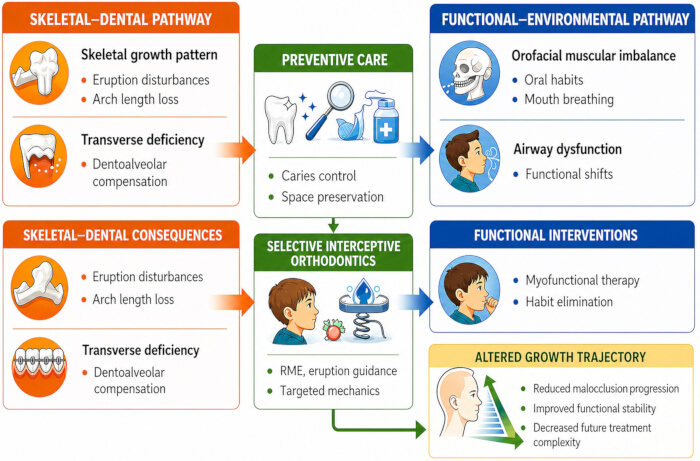
Figure 2: Early intervention as a biological modulator of malocclusion progression in the mixed dentition. This is a conceptual schematic illustrating how preventive care, functional normalization, and selective interceptive orthodontic interventions modify skeletal-dental and functional-environmental pathways. These interventions may alter growth trajectory, improve functional stability, and reduce the complexity of future orthodontic treatment. Please click here to view a larger version of this figure.
The diagnostic evolution: The morphology of the diagnostic to the integrated functional assessment
The diagnosis of imxed dentition orthodontics has changed its previous approach of focusing on morphology to a multidimensional approach that includes skeletal, dental, functional, and airway-related factors. The traditional clinical examination cannot be forgotten, and it is inclusive of examining sagittal, transverse, and vertical relationships, eruption sequence, and morphology of the soft tissues. Panoramic radiography still remains a key element in discovering age discrepancies in dentals, agenesis, supernumerary teeth, and eruption disturbances15,16.
Digital intraoral scanning has enabled more accurate three-dimensional assessment and monitoring of occlusal development. These electronic journals allow personalized appliance creation and objective examination of treatment outcomes. Lanteri et al. demonstrated the superiority of digitally customized eruption guidance appliances over prefabricated models in terms of dentoalveolar outcomes, providing evidence of the clinical benefit of personalization10.
Cephalometric analysis with the aid of artificial intelligence is a possible supplement to the conventional diagnostics. Research has demonstrated that convolutional neural networks can identify cephalometric landmarks with the same level of accuracy as highly trained clinicians, and may eliminate inter-examiner variation and the time required to perform the analysis17,18. Notably, AI is not important for judgment replacement, but it can increase the consistency and precision of decisions.
One of the recent expansions in diagnosis has been the addition of airway assessment. Clinical relevance of early transverse correction has been extended because of evidence that maxillary constriction is a cause of pediatric obstructive sleep apnea. Among meta-analytic evidence, rapid maxillary expansion has been associated with improvements in airway function and reductions in the apnea-hypopnea index in selected patients19. This reconceptualizes interceptive orthodontics as a health system partner and system organizer, which requires cooperation with otolaryngology and sleep medicine.
Condition-specific interceptive management
Class II malocclusion
The second type of orthodontic referral during mixed dentition is class II malocclusion. Early intervention can reduce overjet and enhance molar relationships, which can help decrease trauma risk24,25. The evidence from randomized controlled trials, mainly derived from studies of specific functional appliances, such as the Twin-block, indicates that early functional appliance treatment may not necessarily result in better long-term skeletal and psychosocial outcomes than single-phase adolescent treatment26. But this evidence is limited, and conclusions should be drawn carefully from this evidence to all functional appliances. In addition, differences in study protocols and outcome measures across studies weaken inferences about long-term effectiveness.
The dentoalveolar effectiveness and positive long-term stability of eruption guidance appliances have been shown in a few cases8,27,28. Elastodontic appliances provide a dual dentoalveolar and functional treatment, and in the studies, there was an increase in the overjet, overbite, and palatal morphology11. All these findings, combined, support the idea of a selective approach to early Class II treatment, balancing short-term benefit and treatment burden with long-term stability.
Even though there are no studies to support the routine early treatment of all Class II malocclusions, selective early treatment is nevertheless justified in certain clinical cases. Early sagittal discrepancy reduction can be of benefit to children exhibiting very high levels of overjet and risk of incisal trauma, high levels of psychosocial distress, or functional impairment associated with mandibular retrusion24,25,26. Under those circumstances, early treatment is aimed at reducing risks and improving functionality, rather than a final skeletal correction. These data support the idea that personalized decision-making would require early Class II treatment for high-risk subgroups, while most patients may be adequately managed with observation and well-timed adolescent intervention.
Class III malocclusion
Class III malocclusion, on the other hand, is progressive and therefore can be treated early on. Rapid maxillary expansion with facemask therapy has been the method of maxillary protraction in mixed dentition29. Adjustments in protocols that include Alt-RAMEC have shown increased skeletal effects in certain situations30. It has been shown that the results are more favorable when treatment is performed in early mixed dentition compared with later stages31,32.
Transverse and vertical discrepancies
Strong signs in favor of early interception are functional anterior crossbites and transverse deficiencies. This is offered by fixed appliances such as the 2 x 4 system and the quad-helix, with limited assistance of compliance33,34,35. Vertical discrepancies must have finer timing. It has been indicated in systematic reviews that deep bite treatment is more stable when it is started in late mixed or early permanent dentition36, whereas anterior open bite treatment depends on the removal of habits and rectifying tongue posture9,12.
Arch length discrepancy and crowding
There is an imbalance between the size of the tooth and the arch perimeter, which is exemplified by crowding. The first interceptive approaches are preservation and strategic use of leeway space. Passive lingual arches are useful in the maintenance of mandibular arch length6, although incisor proclination can take place37. Space regaining, arch development, or serial extraction can also be indicated in severe cases5,38. In theory, space in mixed dentition is an exhaustible biological resource - better conserved before it is re-used or lost. Table 1 summarizes typical interceptive approaches in mixed dentition orthodontics that provide a relationship between clinical goals and etiologic goals and the choice of appliances based on the mechanism with which to help risk-driven, biologically informed decisions.
Mechanism-based appliance selecting
The choice of appliances used in mixed dentition must relate to biological mechanisms, and not the type of device. Fixed appliances offer structural control; eruption guidance appliances tap into physiologic forces, functional appliances adjust growth, elastodontic appliances, implants, and clear aligners provide digitally planned accuracy to the chosen signals7,8,9,10,11,12,13,14,38. Appliances will not be able to replace poor diagnosis, inappropriate timing, and dysfunctional functions that have not been resolved.
Clinical controversies and evidence-based decision making
There is growing research challenging the idea that earlier treatment is always better. Premature intervention prolongs treatment length and load, and must be supported by long-term potential profitability26,39. Instead of just timing, the correction of etiologic and functional factors is more important for stability9,12,36. Risk-based, selective interception is the most reasonable compromise between good and evil.
Although therapeutic options have increased, some pitfalls continue to reduce the efficacy of mixed dentition orthodontics. Appliance-driven intervention is one of the most prevalent mistakes: a treatment is started because of the availability of the device, or due to perceived innovation, as opposed to etiologic indication. In addition, early intervention for Class II malocclusions without a specific risk factor can prolong treatment without enhancing the long-term prognosis26. Relapse is also predisposed by failure to treat functional contributory factors- oral habits, tongue posture, and dysfunction of the airways7,9,12. Such traps point to the importance of making diagnosis, functional, and risk assessment more central than early mechanical correction, which makes the selective, stability-focused approach ideal.
This epidemiological risk-based model, coupled with a biologically based intervention, is clinically applicable and offers a means of improving efficiency and long-term stability in mixed dentition orthodontics.
Future directions: Digital innovation, artificial intelligence, and interdisciplinary care
The continual development and advances in digital technology, artificial intelligence (AI), and interdisciplinary clinical integration are shaping the future of mixed dentition orthodontics. These developments represent not only technical improvement but also a conceptual shift towards precision interceptive orthodontics, where diagnosis, timing, and intervention are increasingly personalized.
Digital technologies, including intraoral scanning, three-dimensional modeling, and computer-aided design, enable more accurate monitoring of eruptive changes and support individualized treatment planningce10. This transition toward patient-specific approaches may result in better treatment outcomes and reduced dentoalveolar complications.
The use of AI-assisted cephalometric analysis may further improve diagnosis and minimize observer bias; however, its clinical application requires further validation17,18. Rather than replacing clinical judgment, these technologies should be considered as supportive tools within a biologically guided treatment framework. Despite these advancements, current evidence remains limited, and further high-quality studies are needed to establish the clinical effectiveness and long-term benefits of these technologies.
Another important development is the consideration of the airway during interceptive orthodontics. There are increasing associations between a narrow maxilla and obstructive sleep apnea in children that suggest early intervention in the transverse dimension will have a systemic effect on health19. This supports a more collaborative approach to care, including the inclusion of otolaryngology and sleep medicine.
Multidisciplinary care is also evident outside of the airway. Preventive orthodontics now crosses into the field of pediatric dentistry, myofunctional, and behavioral intervention. Early intervention for caries prevention, space preservation, habit elimination, and myofunctional retraining remain important to reduce orthodontic risk and improve the long-term stability of treatment results7,20.
Despite these advances, research is still needed. There is little longitudinal research evaluating current treatment options, such as elastodontic appliances and clear aligner therapy11,14. This should include consideration of clinically important outcomes, such as stability, function, and treatment complexity, rather than the initial alignment. Further, the effectiveness of new digital and AI technologies depends on validation across different populations and on their incorporation into evidence-based decision-making for treatment. The existing evidence is limited by variability and the lack of long-term, prospective studies, which underscores the need for randomized, well-designed studies and standardized outcome measures.
Conclusions
Loading...
$$\rightleftharpoonup{xx}$$
$$\longleftharp{xx}$$,
$$\longrightharp{xx}$$,
The mixed dentition phase is a critical period for influencing occlusal development, requiring more than early appliance placement. The available evidence suggests that selective interceptive orthodontics based on risk, etiological, biological, and functional considerations may assist in clinical decision-making, rather than age-based considerations. Early treatment should focus on preventing health issues through caries prevention, primary tooth retention, space maintenance, and habit cessation.
Interceptive treatment appears to be most effective in cases with a high risk of progression or complications, while routine early treatment, especially for Class II discrepancies, may not consistently provide long-term benefits and may increase treatment complexity. Appliance selection should be guided by underlying biological mechanisms and functional considerations. Mixed dentition orthodontics should therefore be considered as a strategy for promoting long-term functional and craniofacial development through selective intervention. But such recommendations need to be viewed with caution due to the diversity of the evidence, and long-term studies are required to support this strategy.
| Clinical indication | Etiological factors | Biological objective | Interceptive strategy | Evidence | Reference |
| Premature loss of teeth | Early exfoliation, Caries | Preserve arch length | Band and loop; passive lingual arch | Lingual arch maintains mandibular leeway space, | 23,37 |
| Mild eruption disturbance | Alter eruption sequence | Guide physiologic eruption | 2x4 appliance, Eruption guidance appliance | Stability depends on growth timing | 8,10 |
| Transverse maxillary deficiency | Functional shift, skeletal constriction | Orthopedic expansion | Rapid maxillary expansion, Quad helix | Timely correction prevents mandibular asymmetry | 19, 35 |
| Class II discrepancy | Mandibular retrusion | Reduce trauma risk | EGAs, elastodontic devices | Early treatment is reserved for high risk | 28 |
| Class III malocclusion | Functional crossbite, Maxillary deficiency | Maxillary protraction | Alt-RAMEC | Outcomes are high when start in early mixed dentition | 29 |
| Vertical discrepancies | Tongue posture | Normalize eruption pattern | Elastodontic appliances | Etiology driven | 9, 12 |
| Functional imbalance | Orofacial muscular dysfunction | Restore force equilibrium | Myofunctional therapy appliances | Critical for stability | 7, 12 |
| Mild moderate crowding | Arch length deficiency | Preserve and regain space | Limited arch development | Incisor proclination may occur | 7 |
| Digitally guided interception | Alignment needs | Precision control | Clear aligner therapy | Emerging evidence, depends on compliance | 14 |
Table 1: Mechanism-based interceptive strategies in mixed dentition orthodontics. This table summarizes clinical indications associated with etiological factors, biological objectives, and corresponding interceptive strategies in mixed dentition orthodontics. Evidence statements are provided to reflect the current level of clinical and research-based support for each approach. Abbreviations: EGA: Eruption guidance appliance; Alt-RAMEC: Alternate rapid maxillary expansion and constriction protocol; RME: Rapid maxillary expansion.
Disclosures
Loading...
$$\rightleftharpoonup{xx}$$
$$\longleftharp{xx}$$,
$$\longrightharp{xx}$$,
The authors have nothing to disclose.
Reprints and Permissions
Request permission to reuse the text or figures of this JoVE article
Request Permission