This protocol demonstrates the surgical technique for repairing nasal defects using a nasolabial fold retrograde island flap, combined with immediate postoperative local heparin sodium microinjection to prevent venous congestion and enhance flap survival.
Method Article
Nasolabial Fold Retrograde Island Flap With Local Heparin Injection For Nasal Defect Repair Following Basal Cell Carcinoma Excision
June 12th, 2026
Opens in a new tab
In This Article
Summary
Loading...
$$\rightleftharpoonup{xx}$$
$$\longleftharp{xx}$$,
$$\longrightharp{xx}$$,
Abstract
Loading...
$$\rightleftharpoonup{xx}$$
$$\longleftharp{xx}$$,
$$\longrightharp{xx}$$,
Basal cell carcinoma (BCC) frequently involves the external nose, necessitating radical surgical excision that often results in complex soft-tissue defects. While the nasolabial fold retrograde island flap offers an aesthetically superior reconstructive option due to its excellent color and texture match, its reliance on a reverse-flow subcutaneous pedicle makes it highly susceptible to venous congestion, which can compromise flap survival. The goal of this protocol is to demonstrate a modified surgical technique that incorporates immediate postoperative local microinjection of heparin sodium to mitigate this specific vascular risk. The procedure involves the radical excision of the nasal tumor, followed by the harvesting and rotation of a subcutaneous pedicle island flap from the ipsilateral nasolabial fold. To address the challenge of venous stasis, heparin sodium is micro-injected into the full thickness of the flap in a multi-point grid pattern immediately after suturing. This intervention utilizes both pharmacological anticoagulation to prevent microthrombosis and mechanical decompression via needle puncture to facilitate venous drainage. In a clinical application involving 24 patients, this protocol achieved a 100% flap survival rate. Early signs of severe venous congestion observed in three cases (12.5%) were successfully reversed within one week through continuous local heparin therapy. Advanced clinical data analysis indicated that flap size was not an independent predictor of venous congestion, demonstrating the robustness of this technique even for larger defects. Furthermore, systemic safety assessments confirmed no clinically significant coagulation abnormalities or adverse events. This method offers a safe, reproducible, and effective strategy for ensuring high-quality flap survival and favorable aesthetic outcomes in nasal reconstruction, avoiding the risks associated with systemic anticoagulation.
Introduction
Loading...
$$\rightleftharpoonup{xx}$$
$$\longleftharp{xx}$$,
$$\longrightharp{xx}$$,
Basal cell carcinoma (BCC) represents the most prevalent form of cutaneous malignancy worldwide, accounting for approximately 80% of all non-melanoma skin cancers. Its incidence has been steadily rising over the past few decades, posing a growing burden on global healthcare systems1. The etiology of BCC is multifactorial, with cumulative exposure to ultraviolet (UV) radiation recognized as the primary environmental driver. Consequently, the tumor predominantly affects sun-exposed anatomical regions, particularly the head and neck. Beyond UV radiation, therapeutic ionizing radiation has also been identified as a significant risk factor; patients with a history of radiation therapy are at a heightened risk for developing basal cell and squamous cell carcinomas within the irradiated fields2. Epidemiological studies further corroborate that the external nose, being the most prominent and exposed feature of the face, is the single most frequently affected site3.
Clinically, BCC is often characterized by an indolent growth pattern and an exceedingly low potential for distant metastasis, which can lead to a false sense of security among patients and clinicians4. However, specific histological subtypes exhibit aggressive biological behaviors. Studies have shown that tumors expressing markers such as alpha-smooth muscle actin are prone to deep local infiltration5. In the nasal region, the skin is thin and closely adherent to underlying structures. Neglected or high-risk lesions frequently exhibit “subclinical extension,” where microscopic tumor spread extends significantly beyond the clinically visible borders, infiltrating the subcutaneous fat, muscle fascia, and even the delicate nasal cartilage6. To ensure oncological clearance and prevent recurrence, radical surgical resection remains the gold standard of care. Comprehensive guidelines and long-term randomized clinical trials comparing various modalities have consistently demonstrated that surgical excision, whether via standard wide excision or Mohs micrographic surgery, offers superior cure rates compared to non-surgical interventions like cryotherapy or photodynamic therapy7,8. Although Mohs surgery is widely considered the gold standard for high-risk nasal BCCs due to its maximal tissue preservation and superior margin control, standard wide local excision with a 5 mm margin was utilized in this specific cohort. This approach was chosen primarily due to institutional resource availability and specific patient preferences, particularly among elderly individuals unable to tolerate the prolonged duration of Mohs procedures. Regardless of the excision modality, the paramount objective is to achieve tumor-free margins; however, on the nose, this often necessitates the removal of substantial amounts of tissue, creating complex full-thickness defects that pose a formidable reconstructive challenge7.
Reconstructing nasal defects requires a meticulous balance between functional preservation (maintaining airway patency) and aesthetic restoration. The nose is the focal point of the face, and even minor asymmetries or scarring can be visually distracting. While skin grafting is a technically simple option for covering large defects, it often yields suboptimal results on the nose. Grafts frequently result in “patch-like” deformities due to discrepancies in color, texture, and thickness compared to the surrounding sebaceous nasal skin. Moreover, secondary contraction of grafts can distort the alar rim, resulting in functional impairment. Consequently, local flap transfer is the preferred method for nasal reconstruction9. The choice of flap depends heavily on the defect’s size and location. Traditional local flaps, such as the rhomboid, bilobed, and dorsal nasal flaps, are excellent for small-to-medium defects but are limited by tissue availability and may cause distortion of adjacent landmarks if stretched over larger areas10. For extensive defects, the paramedian forehead flap is considered the workhorse; however, it requires a two-stage procedure and leaves a conspicuous vertical scar on the forehead, which many patients find acceptable only as a last resort. Based on the outcomes observed in this clinical series, the nasolabial fold retrograde island flap combined with local heparin injection may be considered a preferred option for medium-to-large defects (approximately 2.5–4.5 cm) located on the mid-to-distal nose (dorsum, sidewall, and ala). This single-stage approach is particularly advantageous when the primary goal is to achieve superior texture matching while avoiding the significant donor site morbidity and staged surgical commitment associated with forehead flaps9,10.
In this context, the nasolabial fold emerges as an ideal donor site. It provides a generous reservoir of mobile, non-hair-bearing skin that closely matches the color and texture of the nose. The donor site can be closed primarily within the natural nasolabial crease, rendering the postoperative scar virtually imperceptible11. The nasolabial subcutaneous pedicle retrograde island flap is particularly versatile. Unlike traditional transposition flaps, it relies on a “retrograde” blood supply (often a random pattern or reverse flow from the distal branches of the angular and facial arteries), allowing it to reach the distal nose and ala effectively11. However, this unique vascular anatomy is also its “Achilles’ heel.” The flap’s survival depends on a delicate subcutaneous pedicle that must be rotated up to 180°. This torsion can mechanically compress the vascular channels. Physiologically, veins have thinner walls and lower intraluminal pressure than arteries; thus, even mild twisting or postoperative edema can collapse the venous outflow tract while arterial inflow persists. This hemodynamic imbalance leads to venous congestion, a critical complication where blood enters the flap but cannot escape.
Venous congestion is widely regarded as more detrimental to flap survival than arterial insufficiency. Persistent stasis increases hydrostatic pressure within the capillary bed, forcing fluid into the interstitial space and causing severe edema. This swelling further compresses the microvasculature, creating a vicious cycle of ischemia, hypoxia, and eventually, necrosis. At the microcirculatory level, stasis promotes platelet aggregation and microthrombus formation, leading to the “no-reflow” phenomenon. Current salvage strategies for congested flaps, such as systemic anticoagulants or leeches, carry risks of systemic bleeding or infection. This study proposes a novel, targeted intervention: the immediate local micro-injection of heparin sodium. Pharmacologically, high local concentrations of heparin prevent microthrombosis within the compromised vascular bed. Mechanically, the needle puncture sites create artificial outflow tracts, allowing controlled oozing that physically decompresses the flap and reduces venous load until the native drainage system equilibrates.
Despite the theoretical benefits, standardized protocols for this technique are lacking. This study aims to evaluate the clinical efficacy of combining the nasolabial retrograde island flap with a rigorous postoperative local heparin sodium injection protocol. By analyzing outcomes in 24 patients, we assess the impact of this method on flap perfusion, survival quality, and aesthetic results, offering a refined solution for high-risk nasal reconstruction.
Protocol
Loading...
$$\rightleftharpoonup{xx}$$
$$\longleftharp{xx}$$,
$$\longrightharp{xx}$$,
The study protocol was conducted in strict accordance with the Declaration of Helsinki and was approved by the Ethics Committee of Wuxi No.2 People’s Hospital (Approval number: 2024Y-155). All patients provided written informed consent for both the surgery and the publication of their medical images.
1. Patient selection and preparation
- Inclusion criteria: Select patients with pathologically confirmed basal cell carcinoma (BCC) of the external nose who require surgical excision and flap reconstruction.
- Pre-operative assessment: Perform a comprehensive physical examination and assess the size, location, and depth of the tumor. Evaluate the laxity of the skin at the donor site (nasolabial fold).
- Exclusion criteria: Exclude patients with distant metastasis, severe systemic coagulation disorders, uncontrolled hypertension, or other surgical contraindications (Figure 1).
- Patient positioning: Place the patient in a supine position. Clean the surgical site with a standard iodophor disinfectant, then drape it with sterile towels.
- Anesthesia: Administer local infiltration anesthesia around the tumor and the nasolabial fold donor site using 2% lidocaine injection.
2. Tumor excision
- Marking: Mark the tumor excision boundaries with a surgical marking pen, ensuring a 5 mm safety margin from the visible edge of the lesion.
- Excision: Use a standard No. 11 surgical blade to excise the tumor and the surrounding 5 mm of normal tissue down to the deep subcutaneous layer or perichondrium to ensure tumor-free margins.
- Hemostasis: Achieve rigorous hemostasis using electrocoagulation.
3. Flap design and harvesting (Retrograde Island Flap)
- Design: Design a fusiform or leaf-shaped skin flap along the ipsilateral nasolabial fold. The size of the flap should match the defect size (ranging from approximately 2.0 cm × 1.6 cm to 4.2 cm × 4.6 cm).
- Incision: Incise the skin and subcutaneous tissue along the design lines using a No. 11 surgical blade. Ensure the incision length corresponds to the intended flap length (ranging from 2.6 to 4.5 cm).
- Flap Dissection: Dissect the flap from the distal end (near the oral commissure) towards the proximal end (alar base).
- Pedicle Preservation: Preserve a subcutaneous tissue pedicle at the proximal end (near the nasal alar) to maintain the retrograde blood supply from the angular and facial artery branches. Do not skeletonize the vascular pedicle; retain a wide base of sufficient subcutaneous fat to ensure venous drainage. During dissection, rigorously ensure the pedicle is not thinned out excessively to avoid compromising the micro-vascular network (See Figure 2A).
- Tunneling/Transfer: Loosen the tissue between the pedicle and the defect to create a subcutaneous tunnel or rotation arc.
4. Flap transfer and suturing
- Transfer: Rotate the island flap approximately 180 around the pedicle pivot point to cover the nasal defect without excessive tension. Critically, observe the pedicle during rotation to ensure there is no kinking, sharp torsion angles greater than 180, or external compression from the edges of the skin tunnel, as this will immediately compromise the fragile venous outflow.
- Donor site closure: Undermine the wound edges of the nasolabial donor site and close it directly in layers to hide the scar within the nasolabial fold.
- Flap fixation: Suture the flap to the recipient site edges using 6–0 non-absorbable surgical sutures. Ensure precise alignment of the skin edges(See Figure 2B).
5. Local Heparin Sodium injection protocol
Note: This is the critical intervention for preventing venous congestion.
- Preparation: Withdraw standard Heparin Sodium Injection fluid (e.g., 12,500 units/2 mL or similar standard concentration) using a 5 mL disposable syringe.
- Immediate post-operative injection: Immediately after suturing, perform local micro-injections into the flap.
- Injection Technique: Insert the needle into the deep dermal and subdermal plexus layers of the flap. Adopt a multi-point injection pattern (Grid pattern) to ensure uniform fluid distribution across the entire flap surface. Administer approximately 1–2 drops of heparin sodium per 0.5 cm2 of flap surface area(See Figure 2C).
- Endpoint: Continue the micro-injections until the flap color transitions from dark red/pale to a healthy pale pink, indicating improved microcirculation. Note: The determination of this endpoint currently relies on the surgeon’s subjective post-operative visual clinical judgment (color transition and a normalized capillary refill time of 1–2 s), rather than on automated objective perfusion-monitoring devices.
6. Post-operative care and monitoring
- Dressing: Cover the incision with sterile petrolatum gauze and apply medical sterile gauze. Apply a pressure dressing to the wound area.
- Medication: Administer routine antibiotic prophylaxis and anti-inflammatory treatment.
- Post-operative Heparin maintenance: Monitor the flap daily for signs of venous congestion (dark purple color, swelling). Administration does not follow a fixed schedule for all patients; it is based solely on daily clinical observation. If congestion is observed, repeat the local heparin sodium micro-injection (same dosage: 1–2 drops/0.5 cm2) once daily until the flap color stabilizes to light pink (typically requiring 3 to 7 days of intervention).
- Safety considerations and bleeding management: Due to the use of local anticoagulants, monitor the puncture sites and the donor site closely for excessive bleeding or hematoma formation. If continuous or excessive oozing occurs, temporarily halt the heparin injections and apply mild, intermittent external pressure. Ensure this protocol is strictly avoided in patients with known severe systemic coagulopathies.
- Monitoring metrics: Assess flap color (Red/Pale/Dark Purple), temperature, swelling, and capillary refill time daily. Monitor wound exudation/bleeding.
- Safety check: Perform blood routine and coagulation function tests (platelet count, prothrombin time (PT), and activated partial thromboplastin time (APTT)) one week post-operatively to exclude systemic coagulation abnormalities.
- Follow-up: Remove sutures at 7 days post-operatively. Evaluate the final aesthetic outcome (scarring, texture, color match) at 1 month and 3 months.
Results
Loading...
$$\rightleftharpoonup{xx}$$
$$\longleftharp{xx}$$,
$$\longrightharp{xx}$$,
Patient demographics and clinical characteristics
A total of 24 patients with nasal basal cell carcinoma (BCC) were enrolled in this study between June 2024 and June 2025. The cohort consisted of 14 males and 10 females, with a mean age of 72.0 years ± 12.8 years (range: 50–94 years). The tumor locations were primarily on the nasal dorsum (n = 15), followed by the nasal ala (n = 5) and nasal tip (n = 4). Detailed demographic and baseline characteristics are summarized in Table 1. Surgical data analysis revealed a standardized and efficient procedure. Linear regression analysis demonstrated a statistically significant negative correlation between defect area and operation time (R = -0.45, P = 0.028; Figure 3A), indicating that surgical efficiency was maintained even for larger defects. Regarding flap design, the mean flap-to-defect area ratio was 0.92 (Figure 3B), confirming the strategy of harvesting a flap slightly smaller than the defect to utilize skin elasticity for tension-free closure.
Flap survival and management of venous congestion
The primary outcome of flap survival was 100% (24/24 cases), with no instances of total necrosis. In the early post-operative period, venous congestion was observed in 3 patients (12.5%). The diagnosis of congestion followed a structured clinical assessment protocol rather than descriptive observation alone: all three cases exhibited a capillary refill time (CRT) >3 s, objective decrease in local skin temperature (assessed via digital palpation compared to the surrounding skin), and Grade 2–3 swelling (marked edema with tension). Comparative analysis showed no statistically significant difference in flap area between the congestion and non-congestion groups (P = 0.85; Figure 3C), suggesting that larger flap size was not an independent predictor of venous congestion in this protocol. Individual data-point distributions confirming this overlap are shown in Figure 3C.
The three congested cases received a standardized rescue treatment consisting of 1–2 drops of heparin sodium (62.5–125 units) per 0.5 cm2 of flap surface area per session. On average, each patient received 625 units ± 50.0 units of heparin sodium daily. Following this intervention, clinical signs of congestion resolved sequentially: CRT normalized to 1–2 s and local skin temperature returned to baseline within 48–72 h. The flap color transitioned to a healthy pale pink within 7 days. The average duration of wound exudation from the injection sites was 6 days ± 1.25 days, which effectively alleviated the venous return load. The direct temporal link between local heparin administration and the reversal of stasis is illustrated in Figure 4A–F, which visually demonstrates the transition from severe dark purple congestion to a healthy pale pink recovery.
Aesthetic and functional outcomes
All patients were followed up for at least 3 months. The flaps demonstrated excellent texture and color matching with the surrounding nasal skin. Patient satisfaction analysis revealed no significant difference between patients who experienced congestion and those who did not (P = 0.22; Figure 3D), confirming that the rescue protocol effectively salvaged the compromised flaps without impacting the final aesthetic outcome. Figure 5A–H illustrates a representative uncomplicated case progression from pre-operative design to final recovery.
Systemic safety assessment
The local administration of heparin sodium did not result in systemic adverse events. There were no incidents of hematoma, uncontrollable bleeding, or clinically significant coagulation dysfunction. As shown in Table 2 and Figure 6A–D, comparison of pre-operative and post-operative blood parameters demonstrated no statistically significant decline in hemoglobin (Hb) levels, PT, or APTT (P > 0.05), further validating the localized nature of the intervention. Specifically, the mean pre-operative Hb was 133.8 g/L ± 11.0 g/L, and the post-operative Hb was 127.7±13.2g/L(P = 0.086). Although a statistically significant decrease was observed in platelet counts (Figure 6B, P < 0.01), the mean post-operative value (234.2 /L ± 45.1 × 10⁹/L) remained well within the normal physiological range (125–350 × 109/L), indicating no clinical risk of systemic coagulopathy.
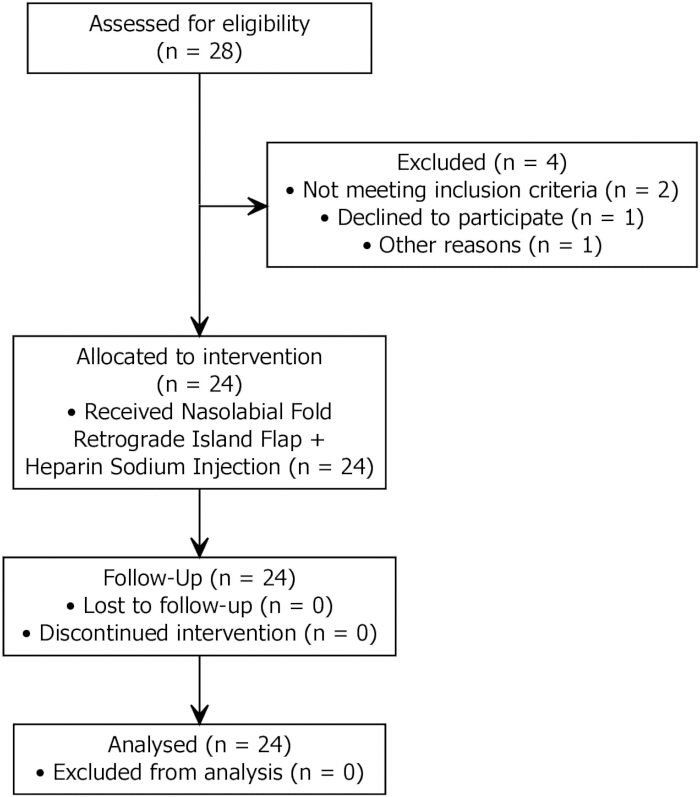
Figure 1: Flow diagram of patient enrollment and study conduct. This flowchart illustrates the recruitment process for the study conducted between June 2024 and June 2025. Out of 28 patients assessed for eligibility, 24 patients met the inclusion criteria (histologically confirmed BCC, adequate donor site laxity) and underwent nasal reconstruction using the nasolabial fold retrograde island flap combined with local heparin sodium injection. All 24 patients completed the follow-up and were included in the final analysis. Please click here to view a larger version of this figure.
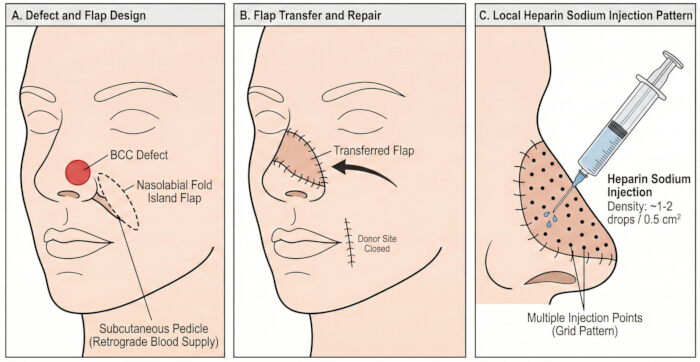
Figure 2: Schematic illustration of the surgical technique and local heparin sodium injection protocol. (A) Pre-operative design. The basal cell carcinoma (BCC) defect is located on the nasal sidewall (red circle). A fusiform or leaf-shaped island flap is designed along the ipsilateral nasolabial fold. The proximal subcutaneous pedicle (near the alar base) is preserved to maintain retrograde blood supply (arrow). (B) Flap transfer. The flap is rotated approximately 180° to cover the defect, and the donor site is closed directly in layers. (C) Post-operative local heparin sodium injection. Immediately after suturing, heparin sodium is micro-injected into the full thickness of the flap using a 5 mL syringe. Injections are distributed in a grid pattern (black dots) across the flap surface. The injection density is 1–2 drops per 0.5 cm2, continued until the flap color transitions to a healthy pale pink, promoting venous drainage and preventing congestion. Please click here to view a larger version of this figure.
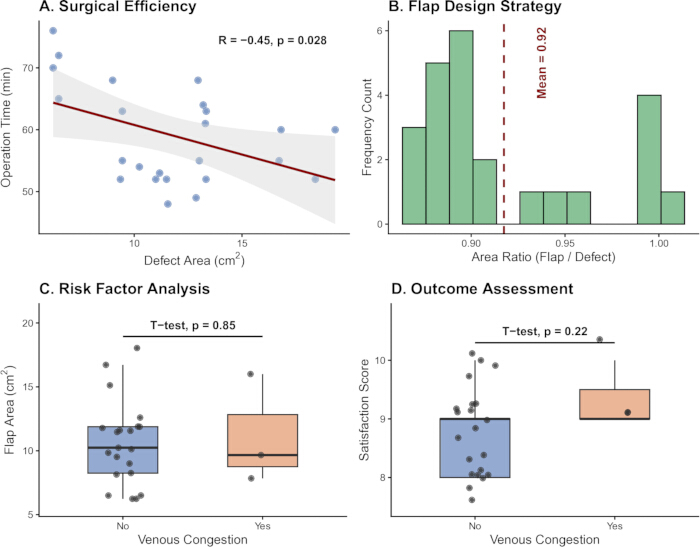
Figure 3: Advanced clinical data analysis revealing surgical efficiency, design strategy, and outcomes (n = 24). (A) Surgical Efficiency: Linear regression analysis of defect area versus operation time demonstrates a statistically significant negative correlation (R = -0.45, P = 0.028). (B) Flap Design Strategy: Frequency distribution of the flap-to-defect area ratio (Mean = 0.92). (C) Risk Factor Analysis: Comparative analysis of flap dimensions between patients with and without venous congestion (P = 0.85). Individual data points are overlaid to demonstrate specific distributions. (D) Outcome Assessment: Comparison of patient satisfaction scores (P = 0.22). Please click here to view a larger version of this figure.
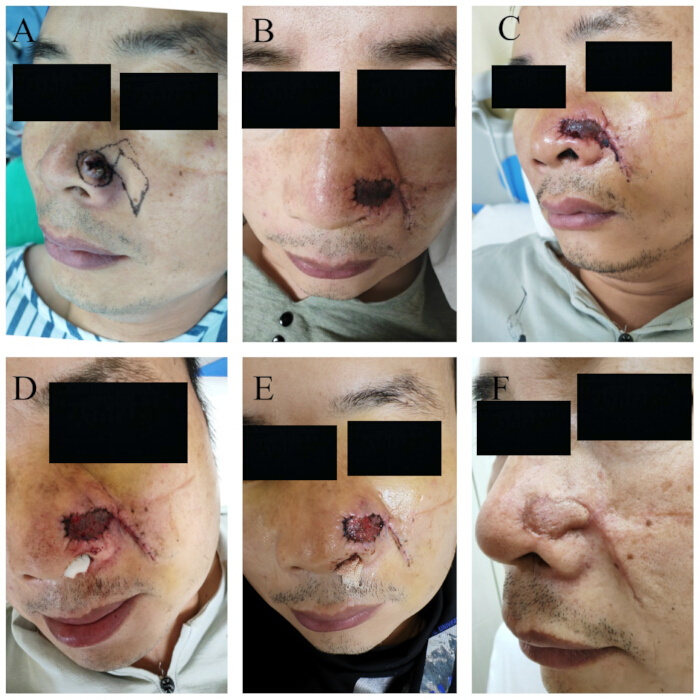
Figure 4: Representative clinical progression of venous congestion salvage. (A) Before operation. (B) Post-operative Day 1: The flap showed relatively severe dark purple swelling (venous congestion). Local micro-injection of heparin sodium was initiated (1–2 drops per 0.5 cm2). (C) Post-operative Day 3: The flap remained purplish-red; local injections were continued. (D) Post-operative Day 5: Partial transition from purplish-red to light red is observed. (E) Post-operative Day 7: The flap has completely transitioned to a healthy pale pink, and the injection protocol was discontinued. (F) One month after surgery, showing successful flap survival and early aesthetic recovery. Please click here to view a larger version of this figure.
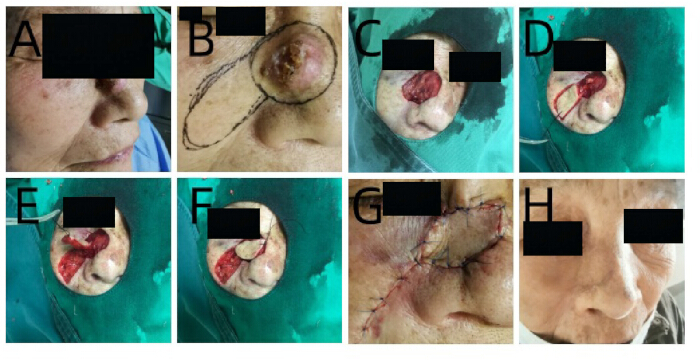
Figure 5: Representative clinical progression of uncomplicated nasal reconstruction. (A) Pre-operative view. (B) Operative design. (C) Remove 5 millimeters of normal tissue around the tumor to ensure complete tumor excision. (D) Excise the flap, with the pedicle oriented superiorly. Following dissection through the subcutaneous layer, the flap was elevated from the subcutaneous fat layer and meticulously thinned. Adjustments were made as necessary. (E–G) Rotating the flap 180° around the pedicle to cover the defect, followed by meticulous suturing. Suture donor site skin to the nasolabial fold. (H) Close-up view of the donor site at three-month follow-up showing the inconspicuous scar well-concealed within the nasolabial fold. Please click here to view a larger version of this figure.
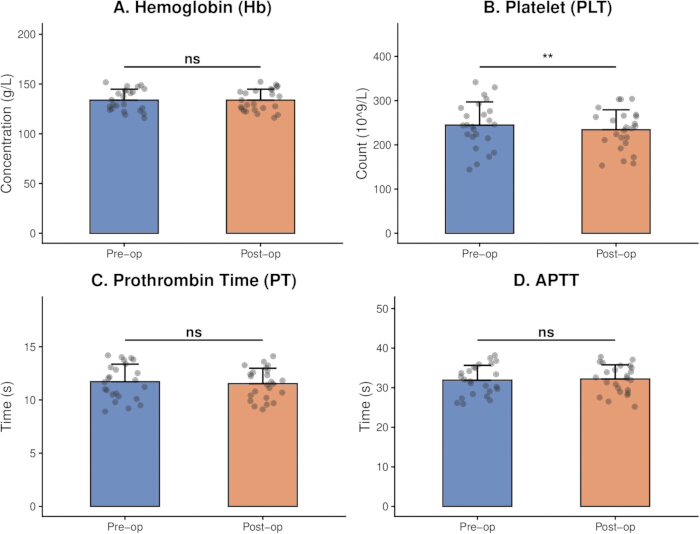
Figure 6: Assessment of systemic safety following local heparin sodium administration. (A) Hemoglobin (Hb) concentration. (B) Platelet (PLT) count. (C) Prothrombin Time (PT). (D) Activated Partial Thromboplastin Time (APTT). Data are presented as Mean ± SD. Paired t-tests showed no significant differences for Hb, PT, and APTT (P > 0.05). Although PLT showed a statistically significant decrease (P < 0.01), values remained within the normal physiological range. Please click here to view a larger version of this figure.
| Characteristic | Data / Value |
| Age (Years) | |
| Mean ± SD | 72.0 ± 12.8 |
| Range | 50–94 |
| Gender, n (%) | |
| Male | 14 (58.3%) |
| Female | 10 (41.7%) |
| Tumor Location, n (%) | |
| Nasal Dorsum | 15 (62.5%) |
| Nasal Ala | 5 (20.8%) |
| Nasal Tip | 4 (16.7%) |
| Defect Size (cm) | |
| Length (Range) | 2.6–4.6 |
| Width (Range) | 2.4–4.2 |
| Flap Size (cm) | |
| Length (Range) | 2.6–4.5 |
| Width (Range) | 2.2–4.1 |
Table 1: Summary of patient demographics and tumor characteristics. This table details the baseline characteristics of the 24 patients included in the study, including age, gender distribution, specific tumor locations (nasal tip, ala, dorsum), defect dimensions, and the dimensions of the harvested flaps.
| Parameter | Pre-operative (Mean ± SD) | Post-operative (Mean ± SD) | P-value |
| Hemoglobin (Hb, g/L) | 133.8 ± 11.0 | 127.7 ± 13.2 | 0.086 |
| Platelet Count (PLT, × 109/L) | 244.5 ± 52.4 | 234.2 ± 45.1 | 0.001 |
| Prothrombin Time (PT, s) | 11.7 ± 1.7 | 11.5 ± 1.5 | 0.237 |
| Activated Partial Thromboplastin Time (APTT, s) | 31.9 ± 3.8 | 32.2 ± 3.6 | 0.348 |
Table 2: Comparison of perioperative hematological and coagulation parameters. A statistical comparison of Hemoglobin (Hb), Platelet count (PLT), Prothrombin Time (PT), and Activated Partial Thromboplastin Time (APTT) measured pre-operatively and one week post-operatively. The results demonstrate the systemic safety of the local heparin sodium injection protocol. Values are expressed as Mean ± SD. Paired t-tests showed no significant difference for Hb, PT, and APTT (P > 0.05). Although a statistically significant decrease was noted in platelet counts (P < 0.01), the mean post-operative values remained well within the normal physiological range, indicating no clinical risk.
Discussion
Loading...
$$\rightleftharpoonup{xx}$$
$$\longleftharp{xx}$$,
$$\longrightharp{xx}$$,
BCC represents a significant and growing public health challenge, accounting for most cutaneous malignancies worldwide. Epidemiological trends over the past decade have demonstrated a consistent rise in incidence, particularly among aging populations with a history of cumulative ultraviolet radiation exposure12,13. The external nose, serving as the central aesthetic unit of the face, is disproportionately affected, hosting a high frequency of these lesions due to its prominence and sun exposure. While Mohs micrographic surgery is widely considered the gold standard for its superior margin control and tissue preservation in high-risk areas like the nose, standard wide excision with a 5 mm margin was utilized in this specific cohort due to institutional resource availability and patient preference. Regardless of the surgical modality chosen, the resultant soft tissue defects pose a formidable reconstructive challenge14. The nose is a complex three-dimensional structure composed of distinct aesthetic subunits (tip, ala, dorsum, sidewall), and the skin in this region is uniquely sebaceous, porous, and adherent to the underlying cartilage. Consequently, reconstructing large defects requires tissue that not only fills the void but also matches the color, texture, and contour of the native nasal skin to avoid “patch-like” deformities.
Surgeons are often faced with a choice between skin grafts and local flaps. While skin grafts are technically simpler, they are prone to secondary contraction and poor color matching, often leading to alar retraction or visible scarring. Local flaps are therefore preferred for optimal aesthetic outcomes. Among the various local flap options, such as the bilobed flap, rhomboid flap, and frontonasal flap, the nasolabial fold retrograde island flap stands out as an anatomically ideal solution. It harvests tissue from the nasolabial fold, a natural reservoir of excess skin that closely mimics the quality of nasal tissue. Furthermore, the donor site can be closed primarily within the natural shadow of the nasolabial crease, rendering the post-operative scar virtually imperceptible. However, despite these aesthetic advantages, the utility of this flap has historically been limited by its vascular reliability. Unlike axial flaps supplied by a robust, named artery, the retrograde island flap relies on a subcutaneous pedicle with a reverse-flow or random-pattern blood supply. This anatomical configuration makes the flap inherently susceptible to hemodynamic instability, particularly venous congestion15.
The primary physiological hurdle in the survival of reverse-flow flaps is venous drainage, not arterial inflow. Research by Kerrigan et al. has fundamentally established that venous ischemia is significantly more deleterious to tissue survival than arterial ischemia of comparable duration16. In a retrograde flap, the pedicle must be twisted or tunneled to reach the defect. Since veins have thinner walls and lower intraluminal pressure than arteries, they are the first to collapse under mechanical torsion or external compression from post-operative edema. When venous outflow is obstructed while arterial inflow persists, hydrostatic pressure within the capillary bed rises precipitously. This triggers a cascade of pathological events: fluid extravasation into the interstitial space causes severe edema, which further compresses the microvasculature, creating a vicious cycle of congestion. At the cellular level, stasis promotes the accumulation of toxic metabolites, endothelial injury, and the activation of the coagulation cascade. Platelets aggregate in the sluggish microcirculation, leading to the formation of widespread microthrombi. Once this “no-reflow” phenomenon is established, tissue necrosis is often irreversible, regardless of subsequent interventions17,18. Therefore, the critical window for intervention is the immediate post-operative period.
Addressing venous congestion has long been a holy grail in reconstructive microsurgery. Traditional salvage strategies have included mechanical decompression (e.g., removing sutures), medicinal leech therapy (Hirudo medicinalis), and systemic pharmacological anticoagulation. Leech therapy, while effective, is associated with psychological distress for patients, prolonged bleeding, and the risk of Aeromonas hydrophila infection. Systemic anticoagulants, such as intravenous heparin or dextran, have been shown to improve microvascular patency19,20. However, the systemic administration of these potent agents carries a non-negligible risk of generalized complications, including hematoma formation, gastrointestinal bleeding, and heparin-induced thrombocytopenia. As highlighted by Boyko et al., the use of systemic anticoagulation necessitates rigorous and frequent monitoring of coagulation parameters (PT, APTT), adding to the clinical burden and cost21. Given these limitations, there is a clear clinical need for a protocol that maximizes local efficacy while minimizing systemic risks.
This study introduces a standardized protocol of immediate local micro-injection of heparin sodium, which distinguishes itself from previous methods described by Sawada et al., who utilized topical application22. This approach leverages a dual mechanism of action to ensure flap survival. Pharmacologically, injecting heparin directly into the flap tissue achieves a high local concentration of the drug exactly where it is needed in the compromised microvasculature. Heparin acts by binding to antithrombin III, accelerating the inhibition of thrombin and Factor Xa, thereby preventing the formation of fibrin clots in the sluggish venous channels. By limiting the drug to the local tissue, we avoid the systemic anticoagulation that leads to adverse events. Our safety data corroborates this: comparisons of pre- and post-operative hemoglobin, platelet counts, and coagulation times (PT, APTT) revealed no statistically significant differences, confirming that the systemic impact of this protocol is negligible. Mechanically, the multi-point puncture technique plays a crucial, often underappreciated role. The needle tracks created during injection serve as artificial drainage conduits. As observed in the results, the injection sites exhibited prolonged, controlled oozing for an average of 6 days. This “therapeutic bleeding” effectively decompresses the flap, lowering interstitial pressure and allowing arterial perfusion to continue during the critical phase of neovascularization. This concept mimics the benefits of leech therapy but in a sterile, controlled, and pharmacological manner.
For successful implementation, several critical steps and troubleshooting measures must be highlighted. The most crucial factors influencing successful outcomes are the meticulous preservation of a wide subcutaneous pedicle during dissection and the strict avoidance of pedicle kinking during the 180° rotation. If venous congestion persists or worsens despite the daily heparin injections, surgeons should troubleshoot by selectively releasing tension-bearing sutures at the recipient site to mechanically decompress the flap. If persistent stasis progresses toward necrosis, alternative salvage methods such as medicinal leech therapy may still be required. Conversely, if prolonged or excessive bleeding occurs at the puncture sites or the donor site, local heparin administration must be immediately halted, and mild, intermittent external pressure should be applied to achieve hemostasis. Beyond nasal reconstruction, the principles of this protocol may have broader clinical applications. The dual mechanism of localized pharmacological anticoagulation and mechanical decompression could potentially be adapted to salvage other high-risk random-pattern or reverse-flow flaps, such as distally based limb flaps or complex keystone flaps, where venous congestion remains a primary cause of failure.
While this protocol achieved a 100% survival rate in this cohort of 24 patients, these outcomes must be interpreted cautiously. Notably, three patients exhibited severe signs of early venous congestion (dark purple discoloration and swelling), which are typically harbingers of partial or total necrosis. In all three cases, the aggressive application of this local injection protocol successfully reversed the congestion within one week. This suggests that the window of reversibility for venous stasis can be extended by preventing local microthrombosis and facilitating drainage. Furthermore, the long-term aesthetic outcomes were excellent. The flaps maintained their bulk and texture without the atrophy often seen in skin grafts, and the donor sites healed inconspicuously. This high level of patient satisfaction underscores the value of the nasolabial flap when its vascular risks are effectively managed.
While the findings are promising, several limitations must be acknowledged. First, this was a single-center study with a relatively small sample size (n = 24). Second, the study design was a prospective case series without a randomized control group. Crucially, explicitly acknowledging the absence of a control or comparator group (e.g., a cohort receiving saline injections or needle punctures alone) limits our ability to definitively attribute the positive outcomes solely to the heparin injection protocol. It remains difficult to precisely isolate the pharmacological benefit of the antithrombotic drug from the mechanical decompression provided by the needle tracks. While historical controls and literature data suggest a higher rate of venous complications in untreated retrograde flaps, a direct comparison with a control group receiving saline injections or no treatment would provide stronger evidence of efficacy. However, ethical considerations regarding withholding potentially limb- (or nose-) saving treatment make such a design challenging. Future research could focus on comparative studies with other anticoagulants (e.g., LMWH) or determining the optimal dosage and frequency of injections through animal models23,24. Additionally, quantitative methods to assess tissue perfusion, such as laser Doppler flowmetry or indocyanine green (ICG) angiography, could provide more objective data on the hemodynamic changes induced by local heparin injections.
In conclusion, the reconstruction of nasal defects following BCC excision requires a reliable, aesthetically superior solution. The retrograde island flap of the nasolabial fold offers excellent tissue matching but is hampered by the risk of venous congestion. This study suggests that immediate, continuous local microinjection of heparin sodium provides a safe, effective, and easily reproducible method to overcome this vascular vulnerability. By combining mechanical decompression with potent local antithrombotic effects, this protocol may enhance flap survival quality, minimize systemic risks, and ensure favorable aesthetic rehabilitation for patients. This technique represents a valuable addition to the reconstructive surgeon’s armamentarium, particularly for high-risk facial flaps.
Disclosures
Loading...
$$\rightleftharpoonup{xx}$$
$$\longleftharp{xx}$$,
$$\longrightharp{xx}$$,
The authors declare no competing financial or non-financial interests.
Acknowledgements
Loading...
$$\rightleftharpoonup{xx}$$
$$\longleftharp{xx}$$,
$$\longrightharp{xx}$$,
Funding: This work was supported by the top Talent Support Program for young and middle-aged people of Wuxi Health Committee (BK2023039).
Materials
| Name | Company | Catalog Number | Comments |
|---|---|---|---|
| Heparin Sodium Injection | Tianjin Biochem Pharmaceutical Co., Ltd. (Tianjin, China) | H12020511 | Core intervention for preventing venous congestion |
| Iodophor | Shanghai Likang Disinfection High-Tech Co., Ltd. (Shanghai, China) | No. 0001 | For surgical site disinfection |
| Lidocaine injection | Hebei Tiancheng Pharmaceutical Co., Ltd. (Cangzhou, China) | H13022313 | For local infiltration anesthesia |
| No. 11 surgical blade | Shanghai Pudong Jinhwan Medical Supplies Co., Ltd. (Shanghai, China) | 20212020377 | For tumor excision and flap harvesting |
| 6-0 Non-absorbable Surgical Suture | Jiahe Medical Materials Co., Ltd. (Suzhou, China) | 20162020017 | For flap fixation and skin closure |
| Sterile petrolatum Gauze | Zhende Medical Products Co., Ltd. (Shaoxing, China) | 20163141626 | For initial incision dressing |
| Medical sterile gauze | Xuchang Zhende Medical Dressing Co., Ltd. (Xuchang, China) | 20172140450 | For pressure dressing |
Reprints and Permissions
Request permission to reuse the text or figures of this JoVE article
Request Permission