This review examines how artificial intelligence transforms the assessment of cardiac remodeling across structural, functional, and electrophysiological domains, and discusses the path towards its clinical integration.
Review Article
Artificial Intelligence in Cardiac Remodeling Assessment: From Models to Clinical Integration
* These authors contributed equally
Opens in a new tab
In This Article
Summary
Loading...
$$\rightleftharpoonup{xx}$$
$$\longleftharp{xx}$$,
$$\longrightharp{xx}$$,
Abstract
Loading...
$$\rightleftharpoonup{xx}$$
$$\longleftharp{xx}$$,
$$\longrightharp{xx}$$,
Artificial intelligence (AI) is increasingly being applied to the assessment of cardiac remodeling across structural, functional, and electrophysiological domains. In structural remodeling, AI supports automated chamber segmentation, volumetric quantification, tissue characterization, and identification of remodeling subtypes from imaging data. In functional assessment, AI improves measurement of ventricular function, strain, and hemodynamic parameters, and supports the detection of subclinical dysfunction and longitudinal monitoring of dynamic changes. In electrophysiological remodeling, AI facilitates the analysis of electrocardiographic signals, electrocardiogram (ECG) images, and optical mapping data to detect concealed conduction abnormalities, estimate arrhythmic risk, and support mechanistic interpretation. Multimodal data fusion further enhances risk assessment by integrating imaging, electrocardiography, and clinical information. This article reviews the current state of AI applications in cardiac remodeling and examines how these technologies enable more comprehensive, personalized evaluations, shifting practice from single-parameter assessment to multidimensional prediction. Furthermore, we discuss the key challenges and limitations that must be addressed to realize this potential, along with feasible solutions and future directions for the field.
Introduction
Loading...
$$\rightleftharpoonup{xx}$$
$$\longleftharp{xx}$$,
$$\longrightharp{xx}$$,
Cardiac remodeling is an adaptive pathophysiological response that follows initial myocardial injury from conditions such as myocardial infarction. Its hallmarks include progressive changes in chamber geometry, tissue composition, systolic and diastolic function, and electrophysiological properties1. Left unchecked, remodeling may progress to decompensation and lead to heart failure (HF)2. The process encompasses alterations at multiple levels, including gene regulation, molecular signaling, cellular behavior, and the tissue microenvironment. Recent studies indicate that cardiac remodeling and chronic HF retain potential for partial reversal2. For example, long-term mechanical circulatory support can facilitate reverse remodeling by providing ventricular unloading and hemodynamic support. Precise assessment of remodeling is therefore critical for cardiovascular research, accurate disease staging, individualized treatment planning, and prognostic stratification.
Despite considerable research progress, optimizing diagnosis, treatment, and prognosis assessment remains challenging. The underlying disease pathways are inherently complex and heterogeneous. As interventional therapies for structural heart disease become more widespread and populations age, the clinical need for multidimensional, precise assessment of cardiac remodeling is increasing3. Current traditional assessment methods, however, depend heavily on operator experience, rely on a narrow set of extracted parameters, and exhibit measurement variability, so they cannot satisfy the demands of precision medicine4,5.
AI is a branch of computer science that seeks to emulate human thought, learning, and knowledge representation. A prominent AI approach in cardiology is machine learning (ML), which uses algorithms to extract patterns from data and generate predictions. Deep learning (DL) is a subset of ML that employs multi-layer neural networks to model complex patterns. By approximating aspects of human brain function, DL enables automated image interpretation and other advanced tasks6. Data-driven AI encompasses a range of ML paradigms, including supervised, semi-supervised, unsupervised, and reinforcement learning models. By integrating multi-source heterogeneous data with complex algorithmic models7, AI offers a new paradigm for overcoming bottlenecks in assessing cardiac remodeling. With automated analysis8, high measurement accuracy9, and rapid data-processing capabilities10, it shifts cardiovascular diagnosis and treatment from experience-driven to data-driven approaches and provides new solutions for multidimensional assessment of cardiac remodeling.
Previous reviews of AI assessment of cardiac remodeling have typically concentrated on specific techniques or single aspects of application. Thus, they lack an integrated approach that encompasses structural, functional, and electrophysiological dimensions. They have also offered a limited discussion of AI's role in early warning and long-term management.
This review aims to provide a more integrated perspective in two ways. First, we systematically summarize advances in AI evaluation across three dimensions—structural, functional, and electrophysiological remodeling—and clarify how these dimensions jointly illuminate the complex mechanisms of cardiac remodeling. Second, we focus on how AI-driven multimodal data fusion can support clinical pathways from early detection to prognostic management. We hope this integrated framework will guide the field toward more systematic and clinically actionable approaches.
Access restricted. Please log in or start a trial to view this content.
Review and Perspective
Loading...
$$\rightleftharpoonup{xx}$$
$$\longleftharp{xx}$$,
$$\longrightharp{xx}$$,
Advances in AI for assessing structural cardiac remodeling
AI-based assessment of structural cardiac remodeling has evolved along three main directions: (1) automated chamber segmentation and volumetric quantification, (2) myocardial tissue characterization, and (3) predictive modeling and subtype identification. Across studies, AI algorithms have achieved expert-level accuracy in segmenting cardiac chambers and calculating volumes and ejection fraction from CMR and 3DE, substantially reducing manual workload and inter-operator variability. Beyond volume assessment, AI enables detection and quantification of myocardial fibrosis, scar, and adipose tissue by integrating advanced CMR sequences or motion-corrected reconstruction techniques, thereby moving from anatomical measurement toward tissue-level characterization. More recently, predictive models that integrate imaging data with clinical parameters have been developed to provide early warning of adverse remodeling, while unsupervised learning approaches have been used to identify latent structural subtypes. Collectively, these advances suggest a transition from manual, unidimensional measurement to integrated, multidimensional evaluation. This progression from isolated quantification toward integrated, multi-dimensional assessment is conceptualized in Figure 1 as a three-pathway AI framework for structural remodeling.
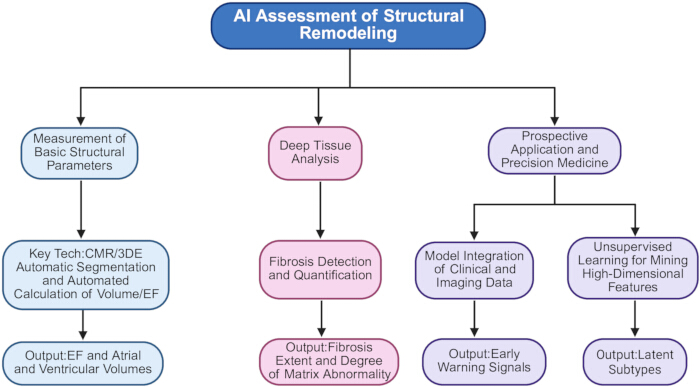
Figure 1: A framework for AI assessment of cardiac structural remodeling. The diagram outlines three vertical pathways progressing from top to bottom. The left pathway automates basic structural quantification (chamber segmentation, volume/EF calculation). The middle pathway adds tissue characterization (fibrosis detection and quantification). The right pathway moves toward precision medicine by integrating multimodal data for early warning and using unsupervised learning to identify latent remodeling subtypes. The three pathways are arranged left to right in order of increasing analytical complexity. Arrows indicate top-to-bottom sequential processing within each pathway. Although not all functions are yet fully integrated in current clinical practice, this framework illustrates how AI could be deployed in future workflows to combine structural, tissue, and predictive analyses into a unified assessment. Please click here to view a larger version of this figure.
Automated chamber segmentation and volumetric quantification
AI–based automatic quantification is increasingly applied to overcome limitations of traditional imaging in cardiac chamber segmentation, volume quantification, and structural remodeling assessment. CMR remains the gold standard for myocardial tissue and volume assessment, yet its adoption is limited by accessibility, expertise, and cost. AI algorithms have achieved expert-level accuracy in CMR segmentation and functional analysis, offering faster processing, reduced variability, and greater consistency than manual methods. For instance, orthogonal component analysis can directly extract independent remodeling features from ventricular shape, avoiding the redundancy inherent to traditional geometric indices11. Moreover, AI-enabled CMR analysis extends beyond volume quantification to myocardial infarction and scar detection as well as outcome prediction, offering reproducibility advantages over conventional manual approaches12.
In parallel, transthoracic echocardiography (TTE) serves as the preferred initial imaging modality given its safety and practicality13. While two-dimensional echocardiography machine learning frameworks have demonstrated value for predictive analytics and phenotyping14, three-dimensional TTE (3DE) improves accuracy by reducing geometric assumptions15. Consistent with this advantage, AI-driven three-dimensional ultrasound has been shown to improve the accuracy of left ventricular volume measurement compared with traditional two-dimensional imaging16. Nevertheless, 3DE remains time-consuming and expertise-intensive. AI has bridged this efficiency gap by automating left ventricular (LV) and right ventricular (RV) segmentation and volume quantification.
Tsang et al.17 first demonstrated that a fully automatic adaptive analysis algorithm could simultaneously measure left atrial (LA), LV volumes, and LV ejection fraction from 3DE data, reducing analysis time by approximately 50–80% depending on whether contour adjustment was performed. The algorithm achieved coefficients of variation below 10% for all volumetric parameters after contour adjustment. Subsequently, Narang et al.18 reported an automated machine learning algorithm that dynamically measured LV and LA volumes throughout the entire cardiac cycle with volume-time curves generated in a processing time of only 35 ± 17 seconds, while additionally calculating ejection and filling parameters.
These modality-specific advances reflect a broader trend toward comprehensive AI-driven automation of chamber analysis. Commercial AI-based three-dimensional echocardiographic analysis platforms employ adaptive analytics on 3DE images to automate border detection and LV quantification19, whereas recent fully automated AI methods have expanded the analytical scope to left atrial parameters, including left atrial volume index and left atrial reservoir strain20. Across studies, AI is recognized to reduce manual workload, accelerate analysis, and improve consistency in chamber segmentation and volume assessment6,21.
Nevertheless, CMR-based AI excels in tissue characterization and reproducibility but is limited by cost and scan time, whereas echocardiography-based AI is more accessible and faster yet sensitive to image quality. Although 3DE improves accuracy over 2D by minimizing geometric assumptions, contour standardization and cross-vendor variability still hinder its clinical adoption. Notably, consistency across different AI software for automated echocardiographic measurements remains unclear and is under investigation22, highlighting an additional layer of uncertainty in the translation from research algorithms to clinical practice. For instance, Szasz et al.22 directly compared two approved commercial artificial intelligence–based echocardiographic analysis platforms. Both platforms performed automated measurements on the same set of echocardiographic images from 116 subjects. This cohort included healthy individuals and patients with various cardiac diseases. The two systems differed significantly in six of ten core parameters. Inter-platform variability was comparable to expert inter-observer variability. If different AI platforms are used interchangeably during follow-up, observed changes may reflect algorithmic differences rather than true disease progression, potentially compromising clinical decisions.
Analysis of myocardial tissue characteristics
AI has shown the ability to detect and quantify myocardial fibrosis features from structural reconstructions23. Quantitative magnetic resonance imaging (MRI) T1/T2 mapping provides objective tissue characterization but is limited by breath-hold requirements. AI integration enables noninvasive, precise myocardial tissue characterization while mitigating these constraints. Qi et al.24 proposed an end-to-end deep learning reconstruction method (MoCo-MoDL), based on a motion-correction model, for free-breathing whole-heart coronary magnetic resonance angiography (CMRA). Felsner et al.25 further extended this approach to compare different image contrasts. Deep learning models have accelerated 3D whole-heart T1/T2 mapping during free breathing. CMR augmented with AI can automatically identify myocardial fibrosis and can also detect adipose-like tissues such as epicardial adipose tissue (EAT) and pericoronary adipose tissue (PCAT)26,27,28.
In addition, AI-derived features such as the extent of fibrosis and ventricular shape metrics are key predictors of prognosis. Several studies have developed personalized computational cardiac models by integrating cardiac magnetic resonance imaging data to quantify the distribution of patient-specific fibrosis. These models have been successfully employed to predict the risk of sudden death in patients with hypertrophic cardiomyopathy. The predictive efficacy demonstrated sensitivity, specificity, and accuracy rates of 84.6%, 76.9%, and 80.1%, respectively, significantly surpassing existing clinical risk prediction indicators29. Rohan Shad et al. introduced the first video-based echocardiography machine-learning system to detect subtle regional myocardial motion abnormalities that manual echocardiography misses. And they applied these signals to downstream clinical analyses to enable early identification of postoperative right heart failure30.
Predictive model and data-driven phenotypic stratification of cardiac remodeling
The AI prediction model enables early warning of structural remodeling by integrating clinical and imaging data. Machine learning algorithms can identify abnormal left ventricular geometry (LVG) before left ventricular hypertrophy (LVH) onset using clinical and ECG features31. In patients with myocardial infarction (MI), three-dimensional LV surface point set analysis provides morphological descriptors of remodeling32. In heart failure with reduced ejection fraction (HFrEF) patients with diabetes, machine learning analysis confirmed the positive effects of sodium-glucose cotransporter-2 inhibitors (SGLT2i) on LV remodeling and function. Explainable AI (XAI) algorithms revealed potential predictors of clinical response, demonstrating their ability to move beyond simple HF phenotypes and predict treatment response in advanced remodeling33.
The value of AI in structural assessment extends beyond quantifying a single metric; it also integrates high-dimensional radiomic features via unsupervised learning to reveal cardiac remodeling subtypes that traditional classification cannot detect. For example, in patients with dilated cardiomyopathy, a data-driven approach identified distinct subtypes that differed in clinical progression trajectories and treatment responses34. This shift shows that AI evaluation is moving from reporting parameters to analyzing heterogeneous disease mechanisms.
Innovative applications of AI in assessing functional cardiac remodeling
Cardiac functional remodeling manifests as systolic and diastolic dysfunction, hemodynamic abnormalities, and changes in subclinical mechanical properties. AI offers distinct advantages for precise assessment, early detection, and dynamic prediction of this remodeling through automated quantification, advanced parameter analysis, and sequential pattern mining. An overview of this functional assessment framework is presented in Figure 2.
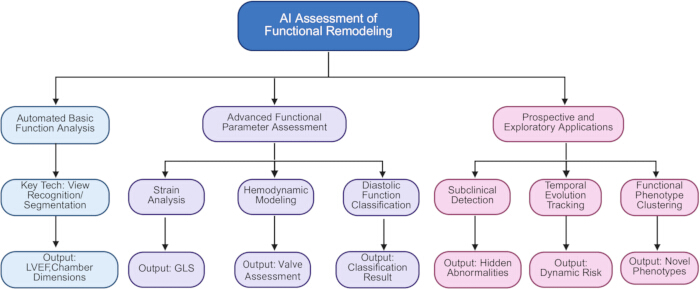
Figure 2: A framework for AI assessment of cardiac functional remodeling. The diagram illustrates three vertical pathways progressing from top to bottom. The right pathway automates basic functional quantification (view recognition and segmentation, yielding LVEF and chamber dimensions). The middle pathway assesses advanced functional parameters, including strain analysis (GLS), hemodynamic modeling (valve assessment), and diastolic function classification. The left pathway explores prospective applications: subclinical detection (hidden abnormalities), temporal evolution tracking (dynamic risk), and functional phenotype clustering (novel phenotypes). The three pathways are arranged from right to left in order of increasing analytical depth, from routine quantification to advanced assessment to exploratory applications. Arrows indicate top-to-bottom sequential processing within each pathway. Although full integration is not yet routine, this framework illustrates how AI could unify basic, advanced, and exploratory functional analyses in future clinical workflows. Please click here to view a larger version of this figure.
Automated functional analysis based on echocardiography
Echocardiography is key for cardiac structure/function assessment and remodeling monitoring35,36. Integrating AI with echocardiographic data mitigates manual limitations and expands applications into hemodynamic modeling and occult disease detection37,38. The multimodal AI system integrates guideline criteria and fuses imaging data from echocardiography and cardiac MRI to automatically identify pathological substrates of diastolic dysfunction, such as myocardial fibrosis and scars, and to accurately classify dysfunction grade (normal/mild/moderate/severe). Its consistency and accuracy exceed those of traditional methods, providing a potentially efficient approach for dynamic monitoring of cardiac remodeling39.
AI improves the efficiency of functional assessment by automating view identification, image segmentation, and chamber quantification. Deep learning models can automatically recognize standard views and measure key parameters such as left ventricular ejection fraction (LVEF), thereby reducing reliance on manual operations and lowering subjective error6,40. Xiaoshan Li et al.41 developed a deep learning-based system for real-time echocardiographic quality assessment and LVEF estimation. Trained on a large multicenter dataset, the system provided objective image quality scoring and accurate LVEF measurements with high repeatability. Similarly, Slivnick et al.42 developed a deep learning system for regional wall motion abnormality detection, achieving an AUC of 0.96 and a sensitivity of 92%. It outperformed two of three novice readers (p < 0.05) and performed comparably to six expert readers (F1 94 vs 90). These findings suggest that AI can serve both as a clinical support tool and as a training aid for less experienced readers.
Strain analysis and hemodynamic parameter estimation
In strain analysis, machine learning has been applied to assess left ventricular remodeling and prognosis by integrating clinical and echocardiographic data43. Extending this approach, deep learning-based algorithms enable fully automated global longitudinal strain (GLS) calculation by directly extracting strain curves from raw ultrasound images. Across two test-retest datasets, AI reduced minimal detectable change (MDC) from 5.5 to 3.7 (Dataset I) and from 5.2 to 3.9 (Dataset II), eliminated systematic inter-reader bias in 13 of 24 comparisons, and achieved beat-to-beat reproducibility of MDC 1.5 versus 2.1–2.3 for human readers, with processing times of 7.9 ± 2.8 seconds44.
These advances converge with multicenter efforts to standardize functional assessment. Knackstedt et al.45 demonstrated that fully automated machine-learning–based analysis can rapidly measure left ventricular volume, ejection fraction, and longitudinal strain, supporting automated assessment in heart failure–related remodeling. Collectively, studies indicate that AI mitigates systematic manual biases and enhances measurement precision and standardization.
However, whether these improvements translate into clinically meaningful differences in patient outcomes remains to be established, as single-center retrospective designs predominate and multicenter validation is sparse45. Thus, differences in validation rigor and generalizability continue to separate research promise from routine clinical adoption.
In hemodynamic modeling, AI combines Doppler flow velocities with geometric parameters to build individualized models for assessing valvular regurgitation severity and ventricular pressure changes. Aaron Long et al.46 showed that a deep learning system can accurately classify mitral regurgitation severity after training on comprehensive transthoracic echocardiography data, demonstrating significant clinical utility. Later, the same group reported that this AI system can accurately classify Aortic Regurgitation (AR), Mitral Regurgitation (MR), and Tricuspid Regurgitation (TR) and predict MR progression beyond established risk factors47. Ongoing advances in AI architectures and training methods are steadily improving their clinical utility.
Experienced cardiologists routinely synthesize multimodal data, but AI extends this practice by enabling large-scale, quantitative analysis with reproducibility beyond human consistency. For example, 12-lead ECG-based AI models can identify left atrial dysfunction and Heart Failure with preserved Ejection Fraction (HFpEF) remodeling features through patterns imperceptible to the human eye48. Thus, AI adds value not by replacing clinical judgment, but by extracting subtle, high-dimensional biomarkers to support dynamic monitoring.
AI identification of subclinical dysfunction
AI excels at extracting complex patterns from multimodal data, enabling detection of subtle ventricular wall motion features that conventional echocardiography misses. Unlike operator-dependent analysis of static parameters, deep learning analyzes ultrasound videos frame by frame to capture time-varying motion dynamics. This allows early identification of subclinical functional abnormalities, providing a critical window for intervention before irreversible remodeling occurs. Attia et al.49 trained a convolutional neural network to identify patients with asymptomatic left ventricular dysfunction using only electrocardiogram data, enabling earlier diagnosis and treatment, preventing progression to irreversible pathological remodeling, and potentially reducing the risk of serious complications such as heart failure.
Defining novel subtypes
In addition, AI-driven clustering of functional performance is being used to define new functional phenotypes50. Deep analysis of echocardiographic videos can separate patient subgroups with markedly different prognoses by identifying complex motion patterns51. This data-driven approach stratifies patients with similar clinical symptoms into distinct mechanistic subgroups. It thereby advances clinical decision-making from group-based guidelines toward individualized treatment strategies.
AI in the assessment of cardiac electrophysiological remodeling
Cardiac electrophysiological remodeling—driven by altered ion channel function, connexin expression, and fibrosis—creates the substrate for arrhythmias52, yet conventional ECG interpretation often misses its subtle manifestations53. In contrast, deep learning can extract high-level features from standard ECGs for early arrhythmia risk warning and mechanistic analysis54,55, enabling high-dimensional, time-resolved signal analysis. Figure 3 outlines this electrophysiological assessment framework.
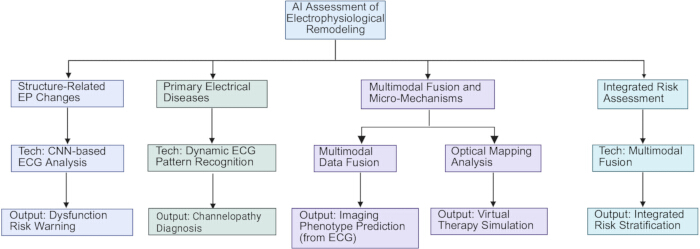
Figure 3: A framework for AI assessment of electrophysiological remodeling. The diagram outlines four vertical pathways progressing from top to bottom. The first pathway (leftmost) detects structure-related electrophysiological changes using CNN-based ECG analysis to generate warnings of dysfunction risk. The second pathway identifies primary electrical diseases through dynamic ECG pattern recognition for channelopathy diagnosis. The third pathway examines multimodal fusion and micro-mechanisms, including multimodal data fusion to predict imaging phenotypes from ECG and optical mapping, and simulation of virtual therapies. The fourth pathway (rightmost) integrates electrophysiological data with other clinical information to produce comprehensive risk stratification. The four pathways are arranged from left to right in order of increasing analytical complexity and clinical integration, from single-modality detection to multimodal mechanistic analysis to comprehensive risk assessment. Arrows indicate top-to-bottom sequential processing within each pathway. Although not yet fully implemented in routine practice, this framework illustrates how AI could integrate detection, mechanistic understanding, and risk prediction to support electrophysiological remodeling in future clinical workflows. Please click here to view a larger version of this figure.
Notably, deep learning does not replace human expertise but complements it. While AI excels at detecting subtle patterns and standardizing large-scale screening, human readers remain superior in interpreting atypical presentations and handling poor-quality signals—skills that current AI models lack54,55,56,57.
AI for automated detection and risk analysis of electrophysiological changes secondary to structural remodeling
Structural remodeling from heart disease produces characteristic ECG changes, such as repolarization abnormalities or fragmented QRS complexes58. Deep neural networks (DNNs) can identify electrophysiological abnormalities associated with structural remodeling from resting 12-lead electrocardiograms (ECGs). For instance, a study developed a DNN model integrating age, gender, and ECG data to predict new-onset atrial fibrillation (AF) within one year, achieving an area under the receiver operating characteristic (AUROC) of 0.85, significantly outperforming models that used only traditional risk factors. In simulated clinical deployment, the model successfully identified 62% of high-risk individuals who subsequently experienced AF-related stroke events, demonstrating the practical potential of ECG-based AI models in screening for occult electrophysiological changes and providing early risk warnings56. Recent research has shifted focus from ECG signals to ECG images, which are more readily available in clinical practice. A study proposed in 2025 introduced an ECG-image-aware network (EIANet) capable of directly analyzing ECG images obtained during emergency triage to predict early cardiac arrest in the emergency room. The model achieved an AUROC of 0.896 in internal validation and maintained an AUROC of 0.803 on an external independent dataset57, demonstrating the feasibility of image-based ECG analysis for emergency risk prediction. However, without direct comparison to human ECG readers, whether EIANet identifies missed arrests or simply automates existing pattern recognition remains unknown. This approach may assist in prioritizing high-risk cases for timely intervention.
Deep learning in identifying concealed ion channel and conduction abnormalities
Artificial intelligence can not only detect secondary electrophysiological changes due to structural heart disease but also improve diagnosis of primary ECG disorders arising from ion-channel or conduction-system abnormalities. Brugada syndrome stems from mutations in specific ion-channel genes and often produces intermittent or induction-dependent ECG manifestations that are highly insidious and difficult to detect59. Deep learning models can extract weak signal features and dynamic evolution patterns from continuous ECG recordings that traditional methods miss, thereby improving diagnostic sensitivity. By analyzing dynamic morphological changes in J waves and ST segments using a Vision Transformer, a recent study demonstrated superior performance in identifying high-risk Brugada syndrome patients. The model achieved 89% accuracy and 94% specificity on a balanced dataset of 278 ECGs, while maintaining 90% sensitivity and 95% negative predictive value on an imbalanced test set reflecting real-world clinical prevalence, indicating its efficacy in detecting individuals at high risk60.
AI-Enabled optical mapping: Unraveling microscopic mechanisms and driving novel therapeutic strategies
While surface ECG-AI improves clinical detection, understanding microscopic mechanisms requires direct visualization. Optical mapping was developed specifically for this purpose.
Optical mapping employs voltage- and calcium-sensitive dyes with high-speed cameras to record transmembrane potentials and calcium transients noninvasively at high resolution, providing details for arrhythmia mechanisms61,62. However, analyzing the resulting massive spatiotemporal datasets presents challenges, including motion artifacts, signal attenuation, and difficulties in interpretation63,64. Deep learning models based on convolutional neural networks (CNNs) have been used to automatically detect and quantify key arrhythmic features, including phase singularities and conduction block lines, in optical mapping videos64. A deep learning model developed by Lebert et al. achieved real-time localization and phase mapping of cardiac excitation waves in ex vivo animal hearts. The model reported a phase prediction accuracy of 97–98% (angular accuracy) on optical mapping data from porcine and rabbit models of ventricular fibrillation, demonstrating its potential to substantially enhance the analytical efficiency and reliability of such data65.
Multimodal data fusion: From electrophysiological assessment to integrated risk prediction
Evaluation models that integrate multi-source information can capture the true extent of cardiac remodeling more comprehensively. In electrophysiology, recent studies have shown the strong effectiveness of such multimodal fusion. Turgut et al. developed a deep learning strategy that combines multimodal contrastive learning with masked data modeling66. The model uses paired ECG and CMR data during pre-training to transfer high-resolution structural information from CMR to ECG representations. During clinical inference, the model requires only a standard 12-lead ECG. In a study of 40,044 UK Biobank subjects, it achieved ROC AUC scores of 73.00% for coronary artery disease, 74.11% for atrial fibrillation, and 75.56% for diabetes mellitus, outperforming models using CMR alone (71.88%, 73.11%, and 74.24%) and ECG alone (66.90%, 69.76%, and 67.35%)66. This approach can be regarded as an advanced “information transfer” fusion strategy:structural knowledge learned from CMR during pre-training is transferred to ECG-based inference, enabling richer representations from a widely accessible modality.
As noted above, the same multimodal fusion logic applies to evaluating structural and functional reconfiguration. Multimodal data fusion is a key technical approach for advancing artificial intelligence from unidimensional measures of cardiac remodeling to comprehensive risk-assessment models. The objective is to integrate evidence across structure, function, electrophysiology, and clinical information to produce a unified assessment of a patient's cardiac status and prognosis. The MAARS model developed by the Johns Hopkins University team exemplifies this approach; by combining cardiac magnetic resonance data with electronic health records, it improved prediction accuracy for sudden cardiac death in patients with hypertrophic cardiomyopathy66. These developments indicate that AI-driven assessment is advancing to a more integrated, predictive, and individualized phase, offering critical decision support for precision medicine. AI-based assessment of structural, functional, and electrophysiological remodeling forms an integrated framework that links multi-source data to clinical decision-making. Figure 4 integrates these three dimensions into a unified assessment workflow. Table 1 summarizes the performance metrics and validation details of the studies discussed above.
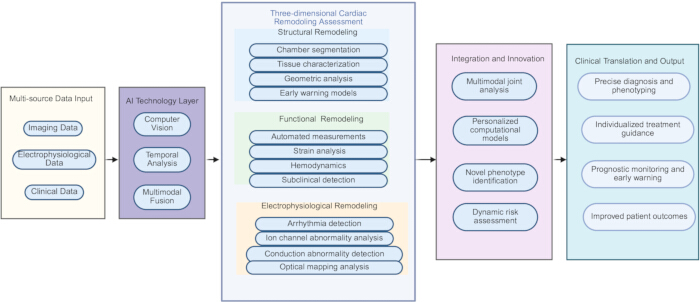
Figure 4: An integrated framework for AI assessment of cardiac remodeling. The diagram illustrates a complete workflow from raw data to clinical application, organized into five blocks, each connected to the next by arrows. Data first enter through multiple sources (imaging, electrophysiological, and clinical data). An AI technology layer then processes these inputs using computer vision, temporal analysis, and multimodal fusion. These processed data feed into the core assessment block, where structural, functional, and electrophysiological remodeling are evaluated in parallel—each representing a distinct dimension of cardiac remodeling. The results are then integrated and refined through multimodal analysis, personalized modeling, phenotype identification, and dynamic risk assessment. Finally, the integrated information is translated into clinical outputs: precise diagnosis, individualized treatment, prognostic monitoring, and improved outcomes. Arrows represent the sequential flow of data and information from left to right, from collection to processing to assessment to integration to clinical application. This framework illustrates how AI can coordinate multi-source data, multidimensional assessment, and clinical decision-making as an integrated system within future clinical workflows, rather than functioning as isolated tools. Please click here to view a larger version of this figure.
Table 1: Performance metrics and validation details for AI studies in cardiac remodeling assessment. Please click here to download this Table.
Challenges and future directions
Although AI has achieved promising results in cardiac remodeling assessment, its clinical translation remains limited by several issues. To address the heterogeneity of AI evidence, we classified included studies into three distinct tiers based on diagnostic performance and validation rigor (Table 2). This framework reveals that a substantial proportion of current evidence falls into the third category, which helps explain the persistent gap between research metrics and clinical adoption. Most available evidence is retrospective, and robust prospective data demonstrating clinical benefit are still lacking. In addition, performance often depends on modality, data quality, and patient population, making generalization across centers and workflows difficult.
Table 2: Classification of Studies Based on AI Performance. Nature of Contribution were defined as follows: (1) Genuine capability beyond human performance; (2) equivalent accuracy with superior efficiency; and (3) Promising but unvalidated claims. Please click here to download this Table.
Data heterogeneity and limited generalizability
A key limitation of current AI models is the variability of performance across datasets, scanners, and institutions. This is especially evident in echocardiographic and CMR-based models for segmentation, quantification, and functional assessment16,18,19,24,25,41,42,44,45. For instance, Bland-Altman analysis in Narang et al. revealed limits of agreement as wide as ±50% to ±88% for several LA and LV filling parameters—indicating poor individual-level agreement—despite small mean biases (<10%). Combined with the study's small sample size (n=20), single-center design, and exclusion of 17% of cases due to suboptimal image quality, these findings highlight how such variability limits generalizability to routine clinical populations18. Although these systems may perform well in internal validation, their accuracy can decline in external settings or in studies requiring manual correction16,19,41,44. Similar concerns apply to prediction models built on retrospective ECG, imaging, or multimodal datasets29,30,32,34,46,47,56,57,60,66.
Retrospective performance versus prospective utility
Another major issue is the gap between retrospective performance and prospective clinical usefulness. Many studies report high AUCs, correlations, or agreement metrics, but fewer show that AI improves decision-making, treatment selection, or outcomes in real practice11,14,30,34,46,47,56,57. For example, AI-based echocardiographic analysis can reduce processing time and variability44,45, but its effect on downstream management remains unclear. Therefore, future studies should include prospective validation and evaluate whether AI meaningfully changes clinical workflow.
Interpretability, integration, and governance
Deep learning models often function as black boxes, which may limit clinician trust, especially in ECG-based risk prediction and multimodal decision support56,57,60,66. In parallel, clinical integration remains challenging because models must fit existing imaging and reporting workflows16,18,19,41,42,44,45. Ethical and regulatory issues, including bias, accountability, and post-deployment monitoring, also need to be addressed67. Future work should prioritize interpretable design, calibration, and multicenter validation with standardized data collection68.
Access restricted. Please log in or start a trial to view this content.
Conclusions
Loading...
$$\rightleftharpoonup{xx}$$
$$\longleftharp{xx}$$,
$$\longrightharp{xx}$$,
Current evidence indicates that AI can outperform conventional human assessment in specific technical tasks, particularly when the goal is high-throughput, reproducible measurement. This advantage is most evident in automated segmentation, volumetric quantification, strain analysis, and ECG-based pattern recognition, where AI may reduce observer variability, shorten analysis time, and detect subtle abnormalities that are difficult to appreciate visually. In these settings, AI is best viewed as a tool that complements and...
Access restricted. Please log in or start a trial to view this content.
Disclosures
Loading...
$$\rightleftharpoonup{xx}$$
$$\longleftharp{xx}$$,
$$\longrightharp{xx}$$,
The project is supported by Jilin Provincial Science and Technology Department (YDZJ202501ZYTS071).
Reprints and Permissions
Request permission to reuse the text or figures of this JoVE article
Request Permission