This protocol details a non-destructive, quantitative 3D digital method for evaluating residual periodontal ligament on extracted teeth. Using intraoral scanning and reverse-engineering software, we established an ex vivo workflow for periodontal assessment, providing a methodological basis for comparing extraction techniques in preclinical research.
Method Article
Non-Destructive 3D Quantitative Analysis of Residual Periodontal Ligament on Extracted Human Premolars Using Intraoral Scanning
1Department of Cariology and Endodontology, Peking University School and Hospital of Stomatology & National Center for Stomatology & National Clinical Research Center for Oral Diseases & National Engineering Research Center of Oral Biomaterials and Digital Medical Devices, 2Department of General Dentistry, First Clinical Division, Peking University School and Hospital of Stomatology & National Center for Stomatology & National Clinical Research Center for Oral Diseases & National Engineering Research Center of Oral Biomaterials and Digital Medical Devices, 3Department of Oral Medicine, Shanxi Provincial People's Hospital, The Fifth Clinical Medical College of Shanxi Medical University
Opens in a new tab
In This Article
Summary
Loading...
$$\rightleftharpoonup{xx}$$
$$\longleftharp{xx}$$,
$$\longrightharp{xx}$$,
Abstract
Loading...
$$\rightleftharpoonup{xx}$$
$$\longleftharp{xx}$$,
$$\longrightharp{xx}$$,
Intentional tooth replantation is a valuable treatment for preserving natural teeth with endodontic lesions. Its success critically depends on the viability and structural integrity of the residual periodontal ligament (PDL). Traditional evaluation methods, such as histological sectioning or two-dimensional photography, are either destructive or limited by projection errors. To address these limitations, this protocol presents a non-destructive, quantitative method for evaluating residual PDL using high-precision intraoral scanning. Extracted teeth were stained to visualize the PDL tissue and three-dimensionally scanned to generate high-fidelity digital models. The data were analyzed using reverse engineering software, where a region of interest was defined, and residual PDL coverage was quantified via color thresholding. This approach calculated the true 3D coverage area of the PDL without compromising the biological sample. To evaluate the sensitivity and utility of this protocol, it was applied to compare minimally invasive (MI) extractions using periotomes against conventional forceps extractions. Digital analysis revealed that the MI method preserved significantly more PDL tissue (61.99%) than the conventional method (50.46%). Furthermore, a subsequent cell viability assay corroborated the digital findings, demonstrating significantly higher metabolic activity in the MI group. Ultimately, this work establishes a proof-of-concept workflow for ex vivo quantitative PDL assessment, providing a robust methodological basis for comparing extraction techniques in preclinical research.
Introduction
Loading...
$$\rightleftharpoonup{xx}$$
$$\longleftharp{xx}$$,
$$\longrightharp{xx}$$,
Intentional tooth replantation is increasingly recognized as a viable, last-resort treatment modality for preserving natural teeth that would otherwise be deemed hopeless. It is indicated for managing persistent periapical lesions, inaccessible canal perforations, or extensive resorptive lesions that cannot be managed non-surgically1,2. The standard procedure involves the intentional extraction of the affected tooth, followed by extraoral visual inspection, therapeutic intervention (including root-end resection, preparation, and root-end filling), and subsequent replantation into the original socket1,2.
The presence and integrity of viable residual periodontal ligament (PDL) tissue on the root surface are the most critical prognostic factors determining the pattern of healing following tooth replantation3,4. A healthy, intact PDL barrier is essential for re-establishing physiological mobility and preventing complications such as replacement resorption (ankylosis) or inflammatory root resorption. However, the avulsion of a tooth from the alveolar socket, whether traumatic or intentional, inherently disrupts the PDL fiber attachment and severs the neurovascular supply5. Consequently, the biological reconstruction of the PDL is crucial for the periodontal healing of replanted teeth3. Extensive research has established that maximizing the vitality and volume of residual PDL tissue during extraoral clinical procedures constitutes a critical prognostic factor, and its importance for the long-term functional survival of replanted teeth is well documented in the literature6,7.
Given that extraction inherently disrupts PDL attachment, the choice of extraction technique directly influences the volume and viability of residual PDL tissue remaining on the root surface. Conventional extraction with forceps applies rotational and traction forces that can crush the PDL against the alveolar bone or strip it through friction. To minimize this trauma, minimally invasive (MI) extraction methods have been developed. Previous studies have reported that MI methods can significantly reduce surgical trauma to the periodontium of the affected teeth8. Techniques utilizing periotomes to sever the PDL attachment, or vertical extraction systems that avoid leverage forces, have been developed to preserve the residual PDL on the root surface. For example, case reports have documented improved clinical outcomes in intentional tooth replantation and surgical extrusion when MI systems were employed9,10. These findings suggest that minimizing extraction traumas may improve the retention of residual PDL tissue on the root surface.
However, despite clinical consensus on the benefits of atraumatic extraction, there is limited direct evidence quantifying the extent of residual PDL tissue preserved when using MI methods compared with conventional techniques. This gap in knowledge stems largely from the limitations of available evaluation methodologies. Existing research predominantly employs subjective or destructive evaluation methods to assess the residual PDL on the root surface. Histological sectioning remains the standard for cellular analysis11, but it is inherently destructive, rendering the sample unusable for further studies. Alternatively, staining combined with two-dimensional (2D) photographing has been used to characterize residual PDL12. However, these methods are inadequate for quantifying residual PDL tissue of the entire root surface. A 2D photograph cannot accurately map the surface area of a complex, curved three-dimensional root; it inevitably introduces projection errors and distortion, leading to inaccurate quantifications.
In recent years, intraoral digital scanning technology has advanced significantly, offering high precision and rapid data acquisition. The digital method has been employed in previous studies to measure impressions and soft-tissue changes, or to assess tooth wear in young individuals13. Applications have even expanded to complex volumetric analyses, such as evaluating facial swelling in oral surgery14. These technologies allow for the creation of high-fidelity three-dimensional (3D) models that can be manipulated and measured in reverse engineering software, offering a potential solution for non-destructive, quantitative analysis. However, to date, the potential application of intraoral scanning for assessing the residual PDL of extracted teeth has not yet been explored.
The overarching goal of this protocol is to establish a standardized, non-destructive workflow that combines biological staining with high-precision intraoral scanning and 3D reverse engineering. By creating high-fidelity digital models with color-textured surface maps, this method allows for more objective, reproducible measurement of residual PDL across the entire root surface. This study applies the proposed workflow to compare the residual PDL coverage of two extraction techniques, periotome-assisted MI extraction versus conventional forceps extraction, in human premolars. It is hypothesized that the MI method preserves a greater proportion of residual PDL coverage than the conventional method.
Importantly, this protocol is designed strictly as an ex vivo research tool for laboratory or preclinical settings. The procedure involves staining, air-drying, digital scanning, and software-based segmentation, with a total analysis time that is incompatible with intraoperative use during intentional replantation, where extraoral time must be minimized. Consequently, this method is appropriate for (i) comparing the PDL-preserving efficacy of different extraction techniques under controlled conditions; (ii) training and calibration in educational settings; and (iii) validation studies linking digital PDL coverage metrics to biological outcomes. Its applicability to multi-rooted teeth with complex anatomies requires further investigation.
Protocol
Loading...
$$\rightleftharpoonup{xx}$$
$$\longleftharp{xx}$$,
$$\longrightharp{xx}$$,
The research protocol was performed in compliance with the guidelines of the Ethics Committee of the Peking University School of Stomatology (PKUSSIRB-202054022).
1. Patient selection and group allocation
- Select patients requiring extraction of premolars for orthodontic purposes. Ensure premolars meet the inclusion criteria with the absence of caries or periodontal disease.
- Exclude patients with high blood pressure, diabetes, history of smoking, or those aged less than 16 years or greater than 45 years.
- Randomly allocate the premolars into two experimental groups: the Control Group (conventional extraction) and the Minimally Invasive (MI) Group (periotome-assisted extraction).
- Randomly assign the teeth from each group to either the 3D scanning analysis pathway or the biological validation (CCK-8) pathway, ensuring independent samples are used for each evaluation method.
2. Tooth extraction procedures
- Perform all extractions under standard local anesthesia.
- Method A: Conventional extraction (Control group)
- Perform gingival separation around the tooth neck.
- Position dental forceps at the cervical area of the tooth crown.
- Apply rotational forces until the tooth is loosened. Remove the tooth from the alveolar socket using the forceps.
- Method B: Minimally invasive extraction (MI group)
- Perform gingival separation.
CAUTION: Handle the periotome carefully to avoid soft tissue injury or instrument breakage. - Insert a periotome into the PDL space as deep as possible, reaching at least two-thirds of the root length.
- Circumferentially sever the PDL fibers around the root using the periotome. Loosen the tooth.
- Vertically pull the tooth out of the alveolar socket using dental forceps.
- Perform gingival separation.
3. Sample preparation and staining
- Immediately upon extraction, rinse the teeth with sterile saline for 10 min to remove blood and debris.
CAUTION: Toluidine blue is a hazardous chemical. Wear appropriate personal protective equipment (gloves, goggles) when handling. - Stain the root surface by immersing the tooth in a 0.1% toluidine blue solution (prepared in phosphate-buffered saline, PBS) for 40 min to visualize the PDL tissue.
- Rinse with saline for 10 min to remove the dye solution and gently blow-dry the surface with a three-way syringe to remove excess moisture.
NOTE: The root surface is expected to exhibit a uniform blue-purple coloration, while the exposed cementum should remain unstained, appearing light beige.
4. 3D digital Scanning
- Calibrate the intraoral digital scanner according to the manufacturer's instructions to ensure an accuracy of 0.02 mm.
- Secure the tooth crown using hemostatic forceps to avoid obstructing the root surface view.
- Scan the entire root surface under standard scanning conditions. Perform a complementary scan of the crown to complete the 3D model.
- Use the scanner's proprietary software to export the digital scan data as a high-resolution 3D object (OBJ) file and associated data package; the texture image is saved in JPG format.
NOTE: The live scan preview must display a continuous, high-density mesh devoid of any holes or artifacts on the root surface. The texture image should clearly distinguish the blue-stained regions from the unstained root surface.
5. 3D model reconstruction and quantitative analysis
- Image pre-processing
- Threshold calibration
- Import the JPG texture map into image editing software. Convert the image to 8-bit grayscale.
- Open the Threshold tool (Image > Adjust > Threshold) and inspect the histogram to record the minimum grayscale value capturing all blue-stained PDL pixels. Determine the minimum grayscale threshold using three independent observers.
- Import the original JPG texture map into image editing software. Navigate to Select > Color Range. Choose Shadows mode and set Range to 65 and Tolerance to 20% (calibrated from the 5.1.1 threshold data).
NOTE: Verify that all blue-stained PDL regions are fully selected and that no unstained root surface is included. - Copy the selected, blue-stained regions and paste them onto a new white layer to generate a binary mask (blue for PDL, white for bare root). Save the processed texture image to overwrite the original JPG file.
- Threshold calibration
- Quantitative measurement
- Import the processed 3D model into reverse engineering software.
- Use Polygons > Trim to define the Region of Interest (ROI) to exclude gingival and periapical tissues. Set the upper boundary of the ROI at 2 mm below the cementoenamel junction (CEJ). Exclude the apical 3 mm from the analysis.
- Select the "enhanced blue regions" within the ROI. After selection, the residual PDL tissue is accentuated in red.
- Navigate to Analysis > Compute > Compute Area to calculate the total surface area of the ROI and the surface area of the blue regions (residual PDL).
- Calculate the percentage of PDL coverage using Equation 1:
PDL Coverage (%) = (Area of Residual PDL/Total Area of ROI) x 100
- Visualization
- Capture images of the four root surfaces (buccal, lingual, mesial, and distal) perpendicular to the tooth axis for detailed visual assessment.
6. Biological validation (Cell viability assay)
NOTE: This section describes the validation steps performed on a subset of samples (n = 8 per group) to corroborate the digital analysis.
- Immediately after extraction, place the teeth in a sterile centrifuge tube containing pre-warmed (37 °C) culture medium.
- Transport samples to the laboratory in an ice box at 4°C within 1 h. Use Dulbecco’s Modified Eagle Medium, supplemented with 10% fetal bovine serum, 100 U/mL penicillin, and 100 µg/mL streptomycin for sample transport and cell viability testing.
- Rinse the teeth with sterile phosphate-buffered saline (PBS) in a biosafety cabinet immediately upon arrival.
- Carefully scrape the PDL tissue from the middle third of the root (ROI is defined by graduated periodontal probe) using a sterile scalpel blade at room temperature within 10 min of arrival to maximize cell viability.
- Digest the collected tissue with 0.25% trypsin-EDTA for 30 min. Centrifuge the cell suspension at 120 × g for 5 min at room temperature (22–25 °C) to obtain the cell-containing precipitate.
NOTE: Following centrifugation, a discernible white pellet should form at the bottom of the tube. If no pellet is observed, the sample should be re-centrifuged at 120 × g for an additional 1 min. - Resuspend the precipitate in a mixture of 600 µL Cell Counting Kit-8 (CCK-8) solution and medium at a 1:10 ratio (v/v), prepared according to the manufacturer's instructions.
- Aliquot this suspension at 200 µL per well into a 96-well plate (3 technical replicates per sample). Incubate the plate at 37°C in a humidified incubator with 5% CO2 for 3 h.
- Transfer 50 µL of the supernatant from each well to a new 96-well plate.
- Measure the absorbance (Optical Density, OD) at 450 nm using a microplate reader. Record the mean OD values for statistical comparison.
CAUTION: (i) Collect Toluidine blue staining solution and rinse waste as hazardous chemical waste and dispose of them according to institutional chemical safety guidelines; (ii) Treat PDL tissue, used scalpels, and cell culture waste as biological hazardous waste (Biosafety Level 1) and autoclave or incinerate them per institutional biosafety protocols; (iii) Discard PPE (gloves, pipette tips, paper towels) in designated biohazard containers.
7. Statistical analysis and methodological validation
- Data collection: Compile the quantitative data, including the total root surface area (mm2), total stained area (mm2) from the 3D analysis, PDL coverage percentage (%), and the OD values from the biological assay.
- Normality test: Assess the data distribution for normality using the Shapiro-Wilk test.
- Group comparison:
- Compare the PDL coverage and OD values between the MI and Control groups.
- Use an unpaired Student’s t-test for normally distributed data or a Mann-Whitney U test for non-normally distributed data.
- Calculate the effect size (Cohen’s d) to determine the magnitude of the difference.
- Methodological robustness analysis:
- Perform a linear regression analysis with "Root Surface Area" as the independent variable and "PDL Coverage" as the dependent variable.
- Calculate the Pearson correlation coefficient (r) to assess if the measurement method is biased by tooth size. A non-significant correlation (P > 0.05) indicates robustness.
- Reliability analysis:
- Generate violin plots combined with box plots to visualize the probability density and distribution characteristics of the data.
- Compare the shape and concentration of the data distribution between groups.
- Intra-observer and inter-observer reliability testing:
- Randomly select 16 samples from the total dataset (8 per group) for reliability assessment.
- For intra-observer repeatability, repeat the full segmentation and measurement procedure on the same 16 samples at one-week intervals for a total of two trials.
- For inter-observer agreement, provide standardized training to two additional independent observers on the segmentation protocol.
- Have all three observers independently perform ROI definition, color thresholding, and area computation on the same 16 samples.
- Calculate Intraclass Correlation Coefficient ICC(A,1) with 95% confidence intervals to quantify absolute agreement for both intra-observer and inter-observer comparisons. Report ICC values >0.90 as excellent, 0.75–0.90 as good, 0.50–0.75 as moderate, and <0.50 as poor.
- Perform Bland-Altman analysis for all pairwise comparisons. Calculate the mean difference (bias) and 95% limits of agreement (mean difference +/- 1.96 SD). A non-significant paired t-test result (P > 0.05) indicates negligible systematic bias.
- Software: Perform all statistical analyses using appropriate software. Consider P < 0.05 as statistically significant.
Results
Loading...
$$\rightleftharpoonup{xx}$$
$$\longleftharp{xx}$$,
$$\longrightharp{xx}$$,
The experimental workflow established in this study successfully demonstrated a non-destructive protocol for the quantitative assessment of residual PDL on extracted teeth. As outlined in the experimental design (Figure 1), the protocol integrated clinical extraction procedures with digital acquisition and biological validation. The application of intraoral digital scanning, followed by 3D reverse engineering, enabled precise reconstruction of the root surface (Figure 2). The digital models effectively differentiated between the stained PDL tissue, and the exposed root surface based on color thresholding, with the ROI excluding gingival and apical variations to focus the analysis on the functional root surface.
The 3D digital analysis revealed distinct morphological patterns of residual PDL between the two extraction methods, providing quantitative evidence of the protocol's sensitivity (Figure 3A,B). In the MI group, residual PDL tissue typically exhibited a dense, reticular, or large patch-like distribution covering most of the root surface. Conversely, the Control group displayed residual PDL retention primarily as isolated dots or fragmented patches, with significantly larger areas of exposed root surface, particularly on the lingual aspect. The total root surface areas were comparable between the groups (MI: 137.0 ± 24.17 mm2; Control: 142.4 ± 24.21 mm2; P > 0.05), ensuring that the geometric dimensions of the teeth did not bias the comparative analysis. Quantitatively, the digital measurement confirmed that the MI group retained a significantly higher percentage of PDL tissue compared to the Control group, with a mean coverage area of 61.99 ±14.95% versus 50.46 ±13.29%, respectively (P = 0.0484; Cohen’s d = 0.815).
The biological data corroborated the morphological findings (Figure 4). The variance of the OD values was not homogeneous, and a Mann-Whitney U test indicated a statistically significant difference between the groups (P < 0.05, two-tailed, 95% confidence interval -0.48 to -0.043). The MI group exhibited significantly higher cell viability, with a median OD of 0.341 (IQR: 0.195, 0.630), compared with the Control group, which had a median OD of 0.146 (IQR: 0.118, 0.212). The observed effect size was large (Cohen’s d = 1.39). However, it should be acknowledged that while the CCK-8 assay confirms greater overall cell metabolic activity in the MI group, it does not directly validate the exact spatial topography of the digital red/blue segmented areas.
The methodological robustness and reliability of the digital protocol were further comprehensively evaluated (Figure 5 and Figure 6). Linear correlation analysis assessed the influence of tooth morphology on PDL coverage. No statistically significant association was detected between root surface area and PDL coverage in either the MI group (Pearson’s r = 0.385, P = 0.194) or the Control group (Pearson’s r = 0.142, P = 0.643) (Figure 5A), indicating the method is independent of tooth size.
Furthermore, intra-observer and inter-observer reliability were formally tested on a randomly selected subset of samples. The ICC values for both absolute agreement and repeatability are summarized in Table 1. For intra-observer repeatability, the ICC(A,1) was 0.963 (95% CI: 0.90–0.99, P < 0.001), indicating excellent measurement stability. For inter-observer agreement, the ICC(A,1) was 0.872 (95% CI: 0.15–0.97, P = 0.011), demonstrating good overall agreement. The wider confidence interval for inter-observer reliability reflects the inherent minor variability between operators during manual threshold adjustments on a limited sample size. Bland-Altman plots (Figure 6A,B) visually confirmed these findings. The intra-observer assessment showed a minimal mean difference (bias) of 0.8% with 95% limits of agreement (LOA) ranging from -7.1% to 8.7%. Similarly, the inter-observer comparison demonstrated a minor systematic bias of -6.0% (95% LOA: -15.5% to 3.4%). These well-defined intervals and acceptable bias values validate that the digital quantification method possesses robust repeatability and minimal systematic error.
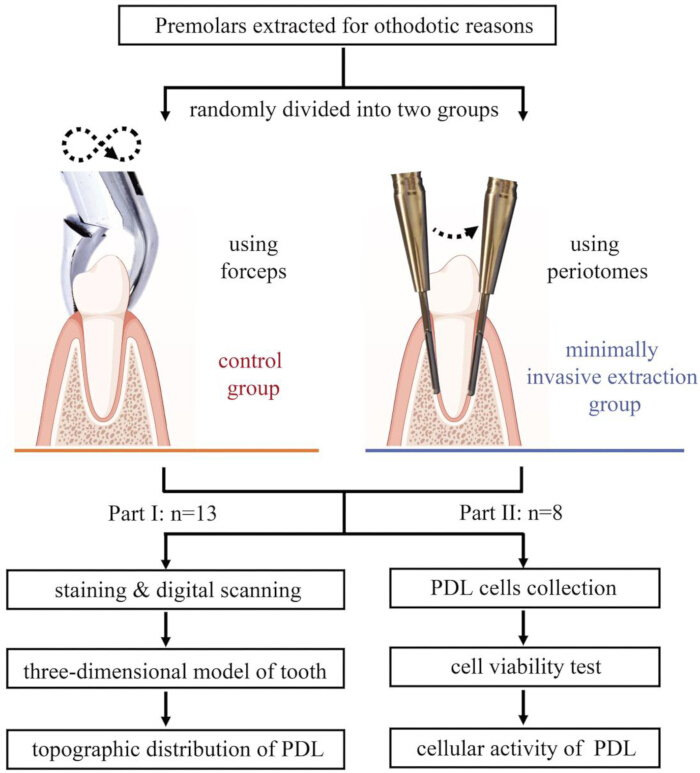
Figure 1. Schematic representation of experimental design and workflow. The study design includes patient selection, randomization into the Control group (conventional extraction) or the MI group (periotome-assisted extraction). The extracted teeth were subjected to two parallel evaluation pathways: (1) 3D digital quantification of residual PDL morphology (n = 13 per group), and (2) biological validation using a CCK-8 cell viability assay (n = 8 per group). Please click here to view a larger version of this figure.
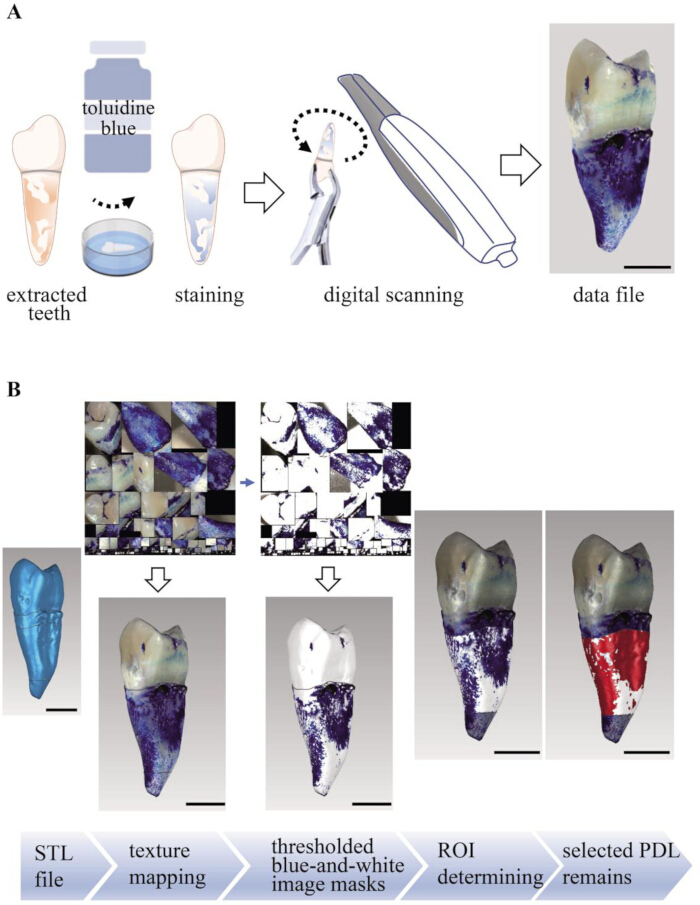
Figure 2. 3D digital modeling and quantification analysis. (A) 3D digital model acquisition: A three-dimensional model of the stained root surface is obtained using an intraoral digital scanner with an accuracy of 0.02 mm. (B) Quantitative analysis in reverse engineering software: The digital model is imported into software. A Region of Interest (ROI) is defined to exclude gingival and apical tissues. The blue-stained residual PDL areas are selected via color thresholding, and the software calculates the coverage area. Bar = 5 mm. Please click here to view a larger version of this figure.
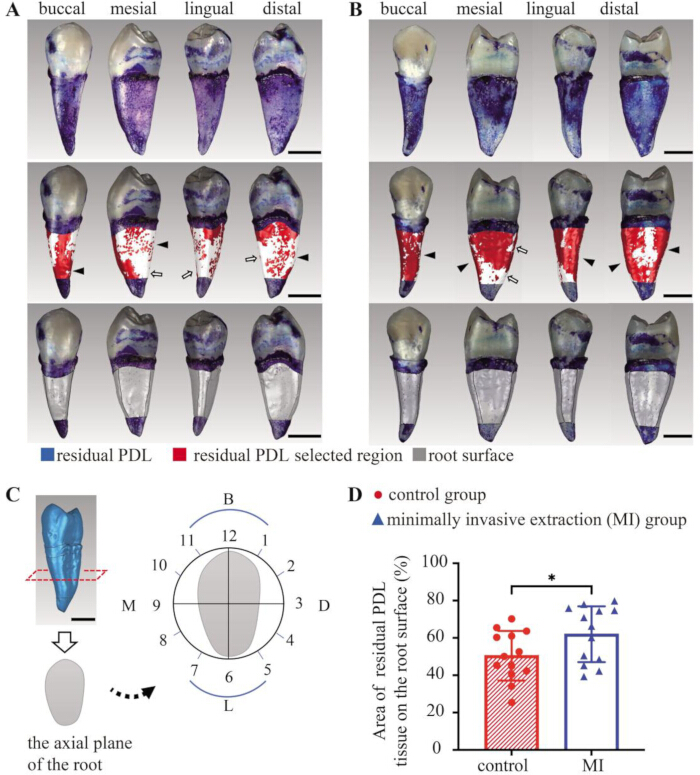
Figure 3. Representative 3D models and morphological assessment of residual PDL. (A) Representative 3D model from the Control group, showing residual PDL primarily as isolated dots or fragmented patches with large areas of exposed root surface (white arrows). (B) Representative 3D model from the MI group, exhibiting a dense, reticular, or plaque-like PDL distribution covering the majority of the root surface (black arrows). (C) Standardized four-view perspective (buccal, lingual, mesial, and distal) defined in the clockwise direction at the axial plane for detailed visual assessment. (D) Statistical comparison of PDL coverage. The MI group retained a significantly higher percentage of PDL (61.99 ± 14.95%) compared to the Control group (50.46 ± 13.29%). Data are presented as the mean ± SD. * = P < 0.05 (t-test). Bar = 5mm. Please click here to view a larger version of this figure.
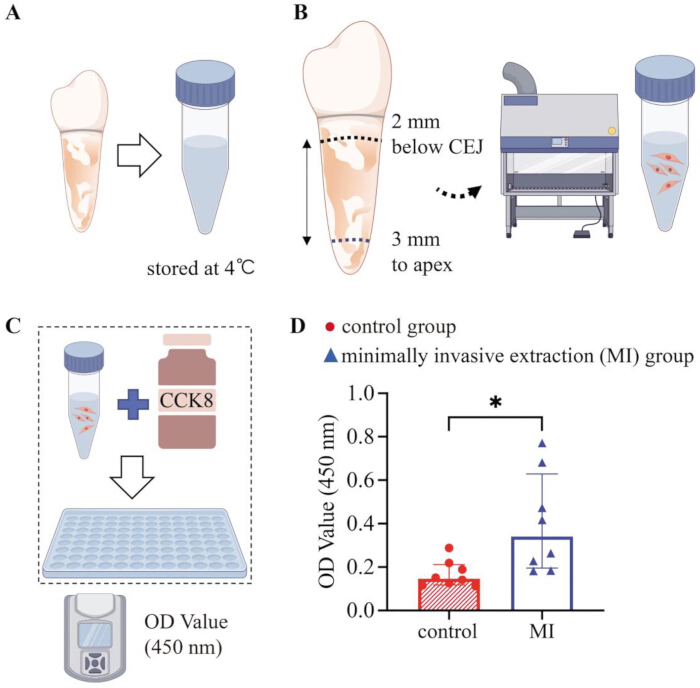
Figure 4. Biological validation via CCK-8 cell viability assay. (A) Sample preparation: Extracted teeth are immediately placed in culture medium containing antibiotics. (B) Cell extraction: PDL tissue is scraped from the root surface and enzymatically digested with trypsin to obtain a cell-containing precipitate. (C) OD value measurement: The cell suspension is incubated with CCK-8 solution, and the optical density (OD) is measured at 450 nm using a microplate reader. (D) Statistical comparison of cell viability. The MI group (median: 0.341; IQR: 0.195–0.630) exhibited significantly higher cell viability compared to the Control group (median: 0.146; IQR: 0.118–0.212). Data are presented as median with interquartile range (IQR) and individual data points. P < 0.05 (Mann-Whitney U test). Please click here to view a larger version of this figure.
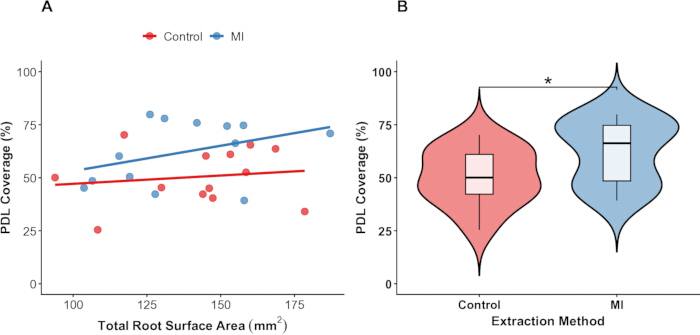
Figure 5. Methodological robustness and distributional analysis of the 3D digital evaluation protocol. (A) Robustness analysis: Scatter plot with linear regression lines showing the relationship between total root surface area (mm2) and PDL coverage (%). No significant correlation was found in either group, indicating the measurement method is unbiased by tooth size. (B) Violin plots combined with box plots illustrate the probability density and distribution characteristics of PDL coverage. The MI group (blue) shows a higher overall median and a narrower interquartile range than the Control group (red). P < 0.05 (Independent Student's t-test). Please click here to view a larger version of this figure.
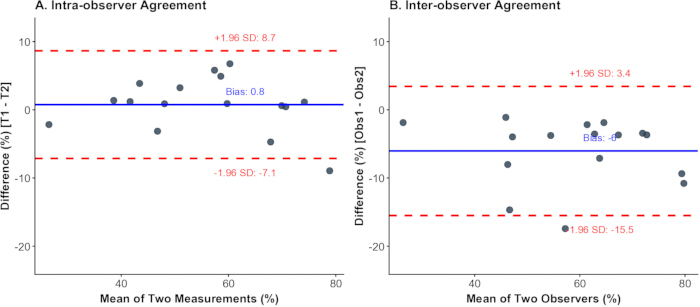
Figure 6. Bland-Altman plots for reliability assessment of the 3D digital quantification method. (A) Intra-observer agreement: The plot demonstrates a minimal mean difference (bias) of 0.8% between two measurements taken one week apart by the same observer. The solid blue line represents the bias, and the dashed red lines represent the 95% limits of agreement (LOA: -7.1% to 8.7%). (B) Inter-observer agreement: The plot shows a minor systematic bias of -6.0% between two independent observers, with a 95% LOA of -15.5% to 3.4%. Both plots indicate acceptable repeatability and minimal systematic error for the digital protocol. Please click here to view a larger version of this figure.
| Reliability Assessment | ICC (A,1) | 95% CI | P-value |
| Intra-observer repeatability (T1 vs. T2) | 0.963 | 0.90 - 0.99 | < 0.001 |
| Inter-observer agreement (Obs1 vs. Obs2) | 0.872 | 0.15 - 0.97 | 0.011 |
Table 1: Reliability Assessment of the 3D Digital Quantification Method. Summary of the Intraclass Correlation Coefficient (ICC) values for both intra-observer repeatability and inter-observer agreement. The 95% Confidence Intervals (CI) and P-values are provided to demonstrate measurement stability.
Discussion
Loading...
$$\rightleftharpoonup{xx}$$
$$\longleftharp{xx}$$,
$$\longrightharp{xx}$$,
The success of intentional replantation hinges critically on the preservation of viable PDL cells on the root surface. While MI extraction methods have been clinically advocated to reduce trauma8,9,10, quantifying their biological benefit on residual PDL tissue has remained a challenge due to the lack of objective evaluation tools. This study established a proof-of-concept, non-destructive 3D digital analysis protocol to quantify residual PDL tissue. These findings support the hypothesis that the MI method provides significantly greater preservation of residual PDL tissue on the root surface relative to the conventional extraction method.
The primary contribution of this study is the validation of an intraoral scanning-based workflow for ex vivo PDL assessment. Traditional histological methods provide cellular detail but destroy the sample11. Conversely, previous 2D photographic methods suffer from projection distortion when mapping the complex, curved geometry of tooth roots12. The present protocol overcomes these limitations by combining high-precision intraoral scanning (accuracy < 20 µm) with reverse-engineering software. This approach allows for the calculation of the true surface area of residual PDL on the entire root, rather than a projected approximation. Furthermore, the color-coded 3D models allow visual comparison of PDL distribution patterns between extraction groups, which may reveal spatial differences not readily apparent from 2D images alone. Color image analysis is widely used in histomorphometric analyses; this threshold method can achieve high accuracy through color selection with software15.
The quantitative data in this study revealed that the MI group retained significantly more residual PDL tissue (61.99%) than the Control group (50.46%). This is because the periotome-assisted method severs the PDL fibers and lightly expands the alveolar socket via wedging rather than leverage16, thereby preserving the delicate residual PDL. In contrast, the conventional extraction method involves scraping, applying pressure, and pulling the root within the alveolar socket, which results in more extensive damage to the cementum and PDL tissue17. Cells dissociated from the residual PDL tissue have been subjected to assessments of periodontal cell viability in the PDL tissue that remains on the root surfaces18,19. In the present study, the cell viability test results showed that the MI group retained significantly more metabolically active cells than the Control group, a finding directionally consistent with the digital PDL coverage evaluation.
To ensure the success and reproducibility of this protocol, several critical steps and troubleshooting strategies must be highlighted. First, to prevent uneven staining, ensure complete immersion and gentle agitation of the tooth, avoiding overcrowding in the staining dish. If uneven staining occurs, extending the immersion time by 10 min or preparing a fresh toluidine blue solution is recommended. Second, to avoid scan artifacts, thorough drying of the root surface with a three-way syringe is essential, as residual moisture causes reflection anomalies. If artifacts persist, re-dry the surface and rescan, ensuring that the hemostatic forceps secure the crown without obscuring the root surface. Third, to address thresholding inconsistency, operators should strictly adhere to the calibrated tolerance settings and confirm visual consistency against the training set. If inter-observer variation exceeds acceptable limits, recalibration sessions should be conducted on non-study teeth. Lastly, to minimize ROI selection variability, the CEJ and the boundary 3 mm coronal to the root apex must be carefully identified anatomically on the 3D model.
Furthermore, the methodological reliability of this protocol was confirmed. The resulting high ICC and narrow Bland-Altman limits of agreement demonstrate that the digital thresholding and segmentation steps are highly reproducible. The correlation analysis found no significant link between root surface area and PDL coverage in both the MI and Control Groups. These findings provide preliminary evidence that PDL coverage measurements are not substantially biased by tooth size within the premolar morphologies examined, although this observation is limited by the modest sample size (n = 13 per group) and the relatively narrow morphological range of premolars. Broader validation across a larger sample and more diverse tooth types, including multi-rooted molars, would be needed to support generalizability beyond the present proof-of-concept scope.
It was observed that the root surface morphology influences the distribution of residual PDL tissue to some extent (Figure 3A). The forces applied during tooth loosening and avulsion from the alveolar socket may affect PDL retention depending on root surface curvature and anatomical position. Therefore, the action of inserting a periotome into the PDL space may affect the PDL and cementum of the extracted teeth, especially when the root contour is irregular. These findings align with previous observations that some areas of the root surface are more susceptible to mechanical trauma during extrusion20. However, consensus on the optimal tooth extraction methods for intentional replantation has not yet been reached2. The current protocol is designed as an ex vivo research tool to facilitate objective comparisons of extraction methods. Further research is needed to evaluate the relationship between preoperative destruction of the PDL connection and postoperative periodontal healing when using these tooth extraction methods.
Several limitations should be acknowledged. Firstly, the sample size was relatively small, although the power analysis confirmed it was sufficient for the primary outcome. Secondly, the study was conducted on premolars extracted for orthodontic reasons, so the findings may differ for multi-rooted molars with more complex root anatomies. Thirdly, the CCK-8 assay shows that the MI group retained more metabolically active PDL cells overall, but it does not confirm that the segmented regions in the digital model correspond precisely to viable tissue. Lastly, as a proof-of-concept study, this research does not establish clinical prognostic value; linking digital PDL coverage metrics to actual replantation healing outcomes necessitates longitudinal clinical trials.
Conclusion
In conclusion, the 3D digital analysis protocol developed in this study offers an objective, non-destructive, and quantifiable method for evaluating residual PDL on extracted teeth. Using this protocol, we found that minimally invasive extraction significantly preserved a greater proportion of residual PDL tissue than the conventional method. This work provides a preliminary methodological framework for the ex vivo quantitative evaluation of residual PDL and for comparing extraction techniques in controlled research settings. Its clinical translation would require validation against longitudinal replantation outcomes.
Disclosures
Loading...
$$\rightleftharpoonup{xx}$$
$$\longleftharp{xx}$$,
$$\longrightharp{xx}$$,
All authors have disclosed no conflicts of interest.
Acknowledgements
Loading...
$$\rightleftharpoonup{xx}$$
$$\longleftharp{xx}$$,
$$\longrightharp{xx}$$,
This work was supported by Peking University School and Hospital of Stomatology (Grant PKUSSNKP-202107), Key Program for Science and Technology Cooperation Projects of Shanxi Province (202204041101041) and Peking University Medicine Fund of Fostering Young Scholars’ Scientific & Technological Innovation (BMU2022PY005). We thank the picture materials by Figdraw (www.figdraw.com).
Materials
| Name | Company | Catalog Number | Comments |
|---|---|---|---|
| 96-well plate | Servicbio | CCP-96H | Multi-well plate for cell culture and absorbance measurement |
| Biosafety cabinet | Thermo Fisher Scientific | 1300 Series4 A2 | Class II biological safety cabinet for sterile procedures |
| Cell Counting Kit-8 (CCK-8) solution | MedChemExpress | HY-K0301 | Cell viability assay reagent |
| Centrifuge | Ustc Zonkia Zcientific Instruments | SC-3610 | Laboratory centrifuge for cell precipitation |
| Culture medium | Gibco | DMEM 11965 | Basal medium for cell transport and incubation |
| Dental forceps | Jinzhong Surgical instruments | K0F130/K0F100 | Standard dental extraction instrument |
| Fetal bovine serum | Anhui Kangyuan Biotechnology Co., Ltd | KY-01003S | Fetal bovine serumsupplement for culture medium |
| Graduated periodontal probe | Jinzhong Surgical instruments | K6F040 | Assist in scraping the PDL from the middle third of the root |
| Hemostatic forceps | Jinzhong Surgical instruments | J31130 | Surgical tool used to secure the tooth during scanning |
| Humidified incubator | Thermo Fisher Scientific | Forma | Cell culture incubator maintained at 37°C with 5% CO2 |
| Image editing software | Adobe Systems Inc. | Adobe Photoshop CC 2018 | Software for color selection |
| Image editing software | Wayne Rasband, National Institutes of Health | ImageJ2 v2.14.0 | Software for color threshold |
| Intraoral digital scanner | Aidite (Qinhuangdao) Technology Co., Ltd. | Aidite Cameo | Optical scanner for 3D digital model acquisition |
| Local anesthesia | Produits Dentaires Pierre Rolland | Primacaine Articaine | Dental anesthetic agent (e.g., Articaine or Lidocaine) |
| Microplate reader | Biotek | Elx808 | Spectrophotometer for measuring OD at 450 nm |
| Penicillin/Streptomycin | Gibco | 15070063 | Antibiotic supplement for culture medium |
| Periotome | Carl Martin | LS529PT | Minimally invasive extraction instrument |
| Reverse engineering software | Geomagic Inc. | Geomagic Studio 2013 | 3D modeling software for surface area calculation |
| Sterile centrifuge tube | Servicbio | EP-1500-J | Plastic tube for sample collection and processing |
| Sterile phosphate-buffered saline (PBS) | Gibco | 10010 | Washing buffer for biological samples |
| Sterile scalpel blade | Jiayuan Medical Devices | Sterile Scalpel Blade | Blade for PDL tissue scraping |
| Sterile sline | Servicbio | G4702-500ML | Saline solution for rinsing extracted teeth |
| Toluidine blue | General laboratory supplier | Toluidine blue (0.1% solution) | Biological stain for periodontal ligament visualization |
| Trypsin | Gibco | 25200056 | Enzymatic reagent for tissue digestion |
Reprints and Permissions
Request permission to reuse the text or figures of this JoVE article
Request Permission