This protocol describes intravenous administration of an indole-producing attenuated Brucella melitensis strain to NOD/ShiLtJ mice, followed by longitudinal diabetes monitoring, pancreatic histology, and optional high-plex spatial proteomics and single-cell RNA sequencing to assess islet immune reprogramming.
Method Article
A Single Intravenous Dose of Indole-producing Attenuated Brucella in NOD Mice: Assessment of Type 1 Diabetes Onset and Islet Immune Remodeling
Kaylee Delgado*1 , Leslie G. Adams*2 , Paul de Figueiredo3
paullifescience@missouri.edu
jus35@tamu.edu
Corresponding Authors: Paul de Figueiredo <paullifescience@missouri.edu>, Jianxun Song <jus35@tamu.edu>
* These authors contributed equally
Opens in a new tab
In This Article
Summary
Loading...
$$\rightleftharpoonup{xx}$$
$$\longleftharp{xx}$$,
$$\longrightharp{xx}$$,
Abstract
Loading...
$$\rightleftharpoonup{xx}$$
$$\longleftharp{xx}$$,
$$\longrightharp{xx}$$,
Type 1 diabetes (T1D) results from autoimmune destruction of pancreatic β cells, and current therapies fail to restore durable immune tolerance. Metabolically engineered bacteria producing immunomodulatory metabolites represent a promising single-dose therapeutic strategy. Here, this paper presents a comprehensive protocol in which a single intravenous administration of an indole-producing attenuated Brucella melitensis strain BmΔvjbR::tnaA is used to assess effects on the onset of autoimmune diabetes in prediabetic female NOD/ShiLtJ mice.
The protocol begins with preparing BmΔvjbR::tnaA from frozen glycerol stocks, growing it in selective media to mid-log phase, and calculating colony-forming units based on optical density. Female NOD mice, <5-week-old are restrained without anesthesia and injected intravenously via lateral tail vein with a defined bacterial dose in phosphate-buffered saline while maintained on heating pads. Blood glucose is monitored 2x weekly after a 2 h fast for 70–105 days, with diabetes defined as glucose ≥250 mg/dL on two consecutive readings. At experimental endpoints, harvested pancreas are fixed in neutral-buffered formalin for 72 h, paraffin-embedded, and sectioned for hematoxylin and eosin staining, insulin immunohistochemistry, and total islet area quantification. Formalin-fixed paraffin-embedded sections are submitted for spatial proteomics with a 25-marker antibody panel to visualize regulatory and effector immune populations. Finally, fresh pancreatic tissue undergoes single-cell isolation, 3′ library preparation, sequencing, and Seurat-based bioinformatics analysis to profile transcriptional changes across immune and stromal populations.
This integrated protocol enables reproducible single-dose bacterial therapy delivery and multi-modal characterization of islet immune remodeling, providing a framework for testing metabolite-engineered microbes in autoimmune models and dissecting tissue-specific immune mechanisms at single-cell resolution.
Introduction
Loading...
$$\rightleftharpoonup{xx}$$
$$\longleftharp{xx}$$,
$$\longrightharp{xx}$$,
Type 1 diabetes (T1D) is a chronic autoimmune disease characterized by immune-mediated destruction of insulin-producing pancreatic β cells, leading to lifelong insulin dependence and increased risk of vascular complications1. The NOD/ShiLtJ mouse recapitulates key features of human autoimmune diabetes, including spontaneous insulitis and progression to overt diabetes, and is widely used as a preclinical model for mechanistic and therapeutic studies1,2,3. Current T1D therapies—including immunosuppressive drugs, monoclonal antibodies, and adoptive regulatory T-cell (Treg) therapies—can transiently slow disease progression but often fail to provide durable restoration of immune tolerance or sustained preservation of β-cell mass1,2,4,5,6,7,8,9,10,11.
Targeting Tregs and other regulatory populations is a major focus of emerging T1D therapies, including autologous polyclonal Treg infusions, engineered antigen-specific Tregs, and IL-2–based regimens1,2,4,5,6,7,8,9,10,11. However, a pro-inflammatory microenvironment within pancreatic islets can undermine the efficacy of these approaches, emphasizing the need to locally reprogram tissue-resident immune networks2,7. Microbial-derived tryptophan metabolites, particularly indole and related compounds, can modulate both innate and adaptive immunity by promoting regulatory T-cell differentiation, inducing anti-inflammatory macrophage polarization, and suppressing Th17 responses12,13. Live microbial therapeutics and metabolically engineered bacteria therefore represent a promising strategy to deliver immunomodulatory metabolites in situ and reshape tissue immunity12,13,14,15,16,17,18.
We previously developed a metabolically engineered Brucella melitensis strain, BmΔvjbR::tnaA, that constitutively produces indole and controls autoimmune arthritis by expanding Tregs and remodeling inflammatory microenvironments14,15,16. Attenuated Brucella strains such as BmΔvjbR have been extensively characterized as vaccine platforms and can be genetically modified to carry immunoregulatory payloads14,15,16.
Here, we present a detailed protocol for evaluating a single intravenous dose of BmΔvjbR::tnaA in the NOD/ShiLtJ model, including bacterial preparation, standardized intravenous administration, diabetes monitoring, and multi-modal analysis of pancreatic tissue by histology, high-plex spatial proteomics, and single-cell RNA-seq. This workflow provides a practical framework for testing metabolite-engineered microbes as single-dose immunotherapies in organ-specific autoimmunity. A prior dose-response analysis demonstrated safety and tolerability up to 1 × 10¹⁰ CFU of the attenuated strain.
Protocol
Loading...
$$\rightleftharpoonup{xx}$$
$$\longleftharp{xx}$$,
$$\longrightharp{xx}$$,
All animal experiments were conducted in strict accordance with ethical guidelines and approved by the Institutional Animal Care and Use Committee (IACUC) of Texas A&M University (Protocol Number: 2021-0123).
1. Preparation and characterization of BmΔvjbR::tnaA
- Bacterial strain background and storage
NOTE: BmΔvjbR::tnaA is derived from Brucella melitensis 16M with deletion of the vjbR virulence regulator and insertion of the Escherichia coli tnaA gene for constitutive indole production, as previously described14,15,16.- Maintain glycerol stocks at −80 °C in 20% glycerol.
- Bacterial culture on selective agar
- Retrieve a frozen glycerol stock from −80 °C storage. Streak 10–20 µL onto tryptic soy agar (TSA) plates supplemented with chloramphenicol (25–30 µg/mL).
- Incubate plates at 37 °C under ambient CO₂ conditions for 48–72 h until individual colonies (2–3 mm diameter) are visible.
CAUTION: Work with Brucella strains requires appropriate biosafety level facilities (minimum BSL2). Follow institutional biosafety protocols and required approvals.
- Liquid culture preparation
- Select a fresh TSA plate (≤1 week old). Pick 2–3 isolated colonies using a sterile loop.
- Inoculate into 10 mL of tryptic soy broth (TSB) supplemented with chloramphenicol (25–30 µg/mL) in a sterile 15 mL tube. Incubate at 37 °C with shaking at 250 rpm under ambient CO₂ conditions.
NOTE: For scale-up, use a 250 mL baffled Erlenmeyer flask.
- Growth monitoring and harvest
- Blank the spectrophotometer using sterile TSB supplemented with chloramphenicol.
- Measure OD₆₀₀ every 2–3 h.
- Continue incubation until OD₆₀₀ reaches 2.0 ± 0.2 (approximately 18–24 h).
CRITICAL STEP: Harvest at OD₆₀₀ = 2.0 ± 0.2 for consistent bacterial concentration and viability.
NOTE: Under these conditions, OD₆₀₀ ≈ 2.0 corresponds to mid-to-late log phase.
- CFU estimation
- Estimate bacterial concentration using the relationship:
OD₆₀₀ = 1 corresponds to 5 × 10⁹ CFU/mL.
NOTE: A 10 mL culture at OD₆₀₀ = 2.0 contains approximately 1 × 10¹¹ CFU. - OPTIONAL: Prepare 10-fold serial dilutions (10⁻6 to 10⁻9) in sterile PBS. Plate 100 µL onto TSA supplemented with chloramphenicol. Incubate at 37 °C for 48–72 h. Count colonies to confirm CFU.
- Estimate bacterial concentration using the relationship:
- Bacterial harvest and concentration
- Transfer the 10 mL culture to a sterile 15 mL conical tube.
- Centrifuge at 3,000–4,000 × g for 10 min at room temperature.
- Carefully aspirate and discard the supernatant without disturbing the pellet.
- Resuspension for injection
- Add 1 mL of sterile, endotoxin-free 1× phosphate-buffered saline (PBS, pH 7.4) to the bacterial pellet. Gently resuspend by pipetting 10–15x until a homogeneous suspension is achieved with no visible clumps.
NOTE: The final concentration is approximately 1 × 10¹¹ CFU/mL.
- Add 1 mL of sterile, endotoxin-free 1× phosphate-buffered saline (PBS, pH 7.4) to the bacterial pellet. Gently resuspend by pipetting 10–15x until a homogeneous suspension is achieved with no visible clumps.
- Storage and use
- Keep the bacterial suspension on ice in a closed tube. Use the suspension for intravenous injections within 4 h of preparation.
NOTE: Do not freeze or store overnight, as bacterial viability decreases.
PAUSE POINT: Bacteria may be held on ice for up to 4 h; same-day use is recommended.
- Keep the bacterial suspension on ice in a closed tube. Use the suspension for intravenous injections within 4 h of preparation.
2. NOD/ShiLtJ mouse procurement, housing, and preparation
- Obtain female NOD/ShiLtJ mice. Acclimate mice for at least 7 days prior to experimentation.
NOTE: Use female mice due to higher and more consistent diabetes incidence. - House mice in individually ventilated cages under specific pathogen-free conditions. Maintain up to five mice per cage.
- Provide bedding, environmental enrichment, food, and water ad libitum. Maintain temperature at 20–24 °C, humidity at 40–60%, and a 12 h light/dark cycle.
- Use mice younger than 5 weeks of age. Record baseline body weights.
- Randomize mice at the cage level into treatment and control groups. Assign unique identifiers (ear tag or tail tattoo) to each mouse.
NOTE: Maintain a master record of all mice and group assignments. - Transfer cages to the procedure room at least 30 min prior to injection. Place the cages on heating pads set to 37–40 °C to promote tail vein dilation.
3. Intravenous administration via lateral tail vein
- Using sterile technique, draw 100 µL of the bacterial suspension into sterile insulin syringes (29G–30G). Label each syringe with the corresponding mouse ID.
- Prepare control syringes containing 100 µL of sterile PBS.
NOTE: Prepare syringes immediately before injection. - Place each mouse in a restrainer, allowing access to the tail.
NOTE: Do not use anesthesia for tail vein injections. - Wipe the tail with 70% ethanol and allow to air dry.
- Visualize the lateral tail veins under adequate lighting.
TIP: Warm the tail if veins are not visible. - Hold the distal third of the tail with gentle tension. Insert the needle bevel-up at a shallow angle (10–15°) into the lateral vein.
- Inject 100 µL slowly over 5–10 s. Withdraw the needle and apply gentle pressure with sterile gauze.
CRITICAL STEP: Confirm successful intravenous injection by absence of resistance, swelling, or blanching. - Return the mouse to its cage on a heating pad. Observe for 5–10 min for signs of distress. Record any adverse events.
- Perform injections for all mice in randomized order within a 2 h window.
4. Blood glucose monitoring and diabetes definition
- Begin glucose monitoring 7 days after injection. Measure blood glucose 2x weekly until study endpoint.
- Remove food 2 h prior to measurement while maintaining water access.
- Restrain the mouse. Clean the tail tip with 70% ethanol.
- Nick the tail using a sterile lancet or needle. Discard the first drop of blood. Collect the second drop on a glucometer test strip. Record blood glucose values along with mouse ID and date.
NOTE: Use a new site if the tail tip becomes scarred. - Define diabetes as blood glucose ≥ 250 mg/dL on two consecutive measurements separated by at least 24 h.
- Euthanize mice exhibiting severe disease signs according to institutional guidelines.
5. Pancreas harvest, fixation, and processing
- Euthanize mice according to approved protocols. Dissect and collect the pancreas carefully, including all lobes.
- Place the pancreas into 10% neutral buffered formalin at a minimum 10:1 fixative-to-tissue volume ratio. Fix for 72 h at room temperature.
CAUTION: Handle formalin in a chemical fume hood with appropriate PPE. - Transfer tissues to 70% ethanol after fixation.
- Submit fixed tissues to a histology core facility for paraffin embedding, sectioning at 5 µm thickness on positively charged slides, hematoxylin and eosin staining, and insulin immunohistochemistry.
NOTE: Request unstained sections if additional downstream analyses are planned.
6. Histological evaluation and islet area quantification
- Acquire whole-slide images using a slide scanner or microscope.
- Open images in the referenced software. Manually annotate islets using appropriate tools.
- Measure islet area using annotation tools.
- Export measurements for analysis.
NOTE: Total islet area includes endocrine and infiltrating cells.
7. Various downstream analyses
- Calculate mean islet area per mouse. Compare groups using appropriate statistical tests.
- Optional: Spatial proteomics analysis (see Supplemental Table S1)
- Prepare FFPE sections on positively charged slides. Submit samples to a spatial proteomics service provider. Provide antibody panel specifications.
- Optional: Single-cell RNA sequencing (see Supplemental Table S2)
- Harvest pancreas and place them in cold medium.
- Submit samples to a genomics core facility for single-cell isolation and library preparation.
- Process sequencing data using appropriate pipelines (e.g., Cell Ranger, Seurat).
- Deposit sequencing data in a public repository prior to publication.
Results
Loading...
$$\rightleftharpoonup{xx}$$
$$\longleftharp{xx}$$,
$$\longrightharp{xx}$$,
While the broader protocol described in this manuscript has since been optimized into a single-dose preventive regimen, these pilot outcomes are presented here solely to illustrate the expected histological and glycemic readouts achievable with this workflow.
The overall disease context and contrast between healthy and type 1 diabetic pancreas are illustrated schematically in Figure 1A. The autoimmune destruction of β cells and resulting loss of insulin production depicted in this schematic reflect the established pathogenesis of T1D in both humans and NOD mice 1B. Female NOD/ShiLtJ mice were enrolled according to the experimental scheme summarized in Figure 2A.
The representative proof-of-concept data shown in Figure 3 (glucose trajectories and total islet area) were derived from an initial pilot cohort that utilized a two-dose administration schedule (Day 0 and Day 21). In this study, longitudinal blood glucose measurements demonstrated that BmΔvjbR::tnaA-treated mice maintained more stable glycemia and showed delayed onset of hyperglycemia compared with vehicle-treated controls (Figure 3A). Histologic and morphometric analyses further evaluated islet preservation. Quantification of total islet area revealed higher islet area fractions in BmΔvjbR::tnaA-treated mice relative to diabetic controls (Figure 3B), consistent with sustained islet mass6,19.
Representative H&E and insulin immunohistochemistry images showed severe insulitis, islet disruption, and reduced insulin staining in diabetic control mice, whereas non-diabetic controls and BmΔvjbR::tnaA-treated mice (both non-diabetic and recovered T1D) displayed preserved islet architecture and robust insulin expression (Figure 3C) 6.
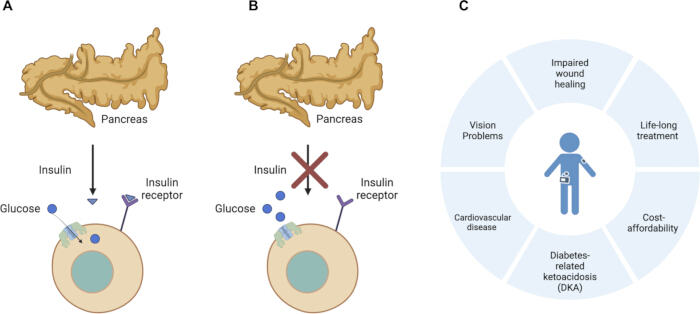
Figure 1. Schematic of healthy versus type 1 diabetic pancreas and disease burden and treatment challenges. Schematic illustration of glucose homeostasis in a (A) healthy pancreas versus a (B) type 1 diabetic pancreas. In the healthy state, β cells in the pancreas produce insulin, which binds insulin receptors on peripheral tissues to promote glucose uptake and maintain normoglycemia. In type 1 diabetes, autoimmune destruction of β cells leads to a damaged pancreas, reduced or absent insulin production, inactive insulin receptors, and sustained hyperglycemia. (C) Major complications of T1D, including vision problems, cardiovascular disease, diabetic ketoacidosis, impaired wound healing, and life-long treatment requirements. Please click here to view a larger version of this figure.
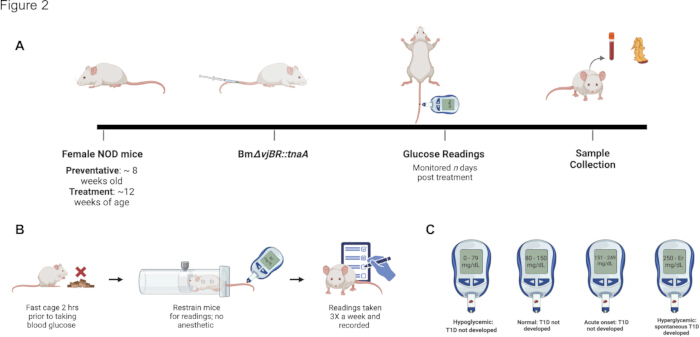
Figure 2. Experimental design for single-dose BmΔvjbR::tnaA treatment in NOD mice. Overview of the experimental design used to evaluate BmΔvjbR::tnaA in NOD/ShiLtJ mice. Female NOD mice are enrolled at pre-diabetic stages. A single intravenous dose of BmΔvjbR::tnaA is administered, and blood glucose is monitored two times per week following a 2 h fast, without anesthesia, for the duration of the study. Mice are classified as diabetic when blood glucose exceeds the predefined threshold on two consecutive measurements. At experimental endpoints, pancreatic and other tissues are collected for histology, immunohistochemistry, spatial proteomics, and single-cell RNA sequencing. Please click here to view a larger version of this figure.
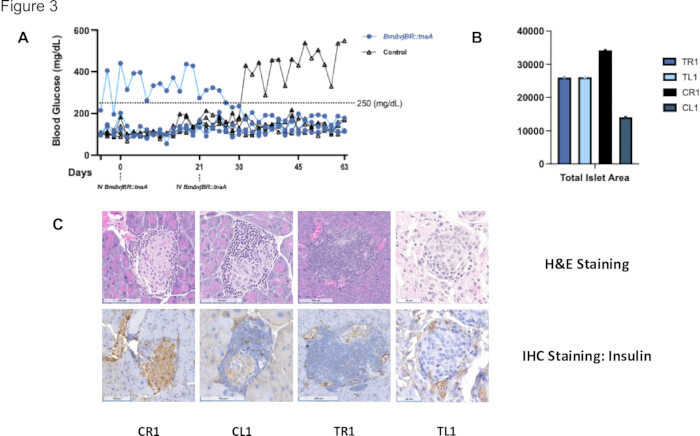
Figure 3. Pilot study showing representative glycemic and histological outcomes following BmΔvjbR::tnaA treatment. Pilot evaluation of BmΔvjbR::tnaA in female NOD mice. (A) Longitudinal blood glucose measurements (mg/dL) over time demonstrate glycemic trends in BmΔvjbR::tnaA-treated mice compared with vehicle-treated controls. (B) Islet area fraction for individual mice is shown. (C) Representative pancreatic histology: H&E staining and insulin IHC from non-diabetic control, diabetic control, BmΔvjbR::tnaA-treated non-diabetic, and BmΔvjbR::tnaA-treated recovered T1D mice. Abbreviations: CR1: Control - not diabetic at time of collection; CL1: Control - diabetic at time of collection; TR1: TNA-treated - not diabetic at time of collection; TL1: TNA-treated - recovered T1D; IHC = immunohistochemistry; H&E = hematoxylin and eosin. Please click here to view a larger version of this figure.
Supplemental Table S1. Complete Akoya spatial proteomics antibody panel. This table lists the 25 markers (including DAPI) used for high-plex spatial profiling of formalin-fixed paraffin-embedded pancreatic sections.Please click here to download this file.
Supplemental Table S2. Single-cell RNA sequencing cluster annotations. This table provides cluster-to-cell-type assignments and key identifying marker genes (e.g., Foxp3, Ms4a1) for the 17 distinct cellular clusters identified in the transcriptomic analysis.Please click here to download this file.
Discussion
Loading...
$$\rightleftharpoonup{xx}$$
$$\longleftharp{xx}$$,
$$\longrightharp{xx}$$,
A critical limitation of the representative outcomes presented herein is that the data provided to illustrate the analytical endpoints (Figure 3) were derived from an early pilot cohort utilizing a two-dose schedule. Because this protocol has been refined to a single-dose preventative regimen, future larger-scale studies utilizing the optimized single-dose protocol described here are required to establish formal statistical efficacy.
This JoVE protocol describes a single-dose intravenous administration of an indole-producing attenuated Brucella melitensis strain in NOD/ShiLtJ mice, combined with standardized monitoring and histologic assessment, and demonstrates that this workflow can capture pilot efficacy signals in type 1 diabetes. In the pilot cohort presented here, BmΔvjbR::tnaA delayed diabetes onset and preserved islet architecture relative to vehicle controls, as evidenced by longitudinal blood glucose measurements and increased total islet area with maintained insulin staining (Figure 3A–C)6. These findings are in line with prior studies showing that metabolic engineering of bacteria and microbial-derived tryptophan metabolites can suppress inflammation and promote regulatory immune programs12,13,14,16.
Relative to existing T1D interventions such as autologous Treg infusions or IL-2–based therapies1,2,4,5,10, a live metabolically engineered bacterium offers several conceptual advantages. First, sustained in situ metabolite production may support immune modulation following administration, as suggested by expanded preventative cohorts reported elsewhere14,15. This supports the idea that sustained in situ metabolite production and immune “re-training” may substitute for repeated administration of biological agents4,7. Second, the BmΔvjbR::tnaA strain is attenuated yet immunogenic, enabling transient interaction with host immune cells while maintaining an acceptable safety profile in preclinical models14,15,16. Third, microbial manufacturing is scalable and could be more cost-effective than complex cell-based therapies, consistent with broader efforts to harness microbes as therapeutic platforms for autoimmunity14,15,16,17,18.
Several limitations of the current implementation should be acknowledged. The pilot cohort is small and provides proof-of-concept rather than definitive efficacy estimates; larger, randomized studies will be needed to fully characterize dose–response relationships and long-term protection. A parental BmΔvjbR control group was not included in this pilot, limiting the ability to dissect contributions of the Brucella backbone versus indole production14,15. Quantitative morphometry focused on total islet area rather than β-cell–specific area and did not systematically incorporate markers of β-cell stress or proliferation; thus, the protocol as presented primarily distinguishes gross islet preservation versus destruction and does not resolve finer β-cell biology6,9.
The protocol includes optional modules for spatial proteomics and single-cell RNA-seq that are not fully illustrated in the pilot data here but can be integrated in future experiments. High-plex spatial proteomics can be used to map T-cell and macrophage phenotypes around islets and to identify tolerant versus inflammatory cellular neighborhoods, extending prior work on indole, Tregs, and macrophage polarization12,13,14. Similarly, coupling this workflow to single-cell RNA-seq and Seurat-based analysis20 allows investigation of transcriptional reprogramming across multiple immune and stromal compartments. In separate studies, we and others have used such approaches to link regulatory T cells, IL-10 signaling, and M2-like macrophage signatures to restored tolerance in autoimmune disease1,2,4,5,6,7,8,9,10,11; these findings, although not shown in detail here, illustrate the analytical potential of the protocol beyond the pilot readouts.
Future applications of this protocol could address the current limitations and broaden its translational scope. Including treatment arms with parental BmΔvjbR, exogenous indole, or additional engineered strains will help parse mechanistic contributions of bacterial components and metabolite production12,13,14,16. Refining image analysis pipelines to quantify insulin-positive β-cell area and integrating β-cell identity and stress markers would deepen insights into β-cell preservation versus regeneration6,9,10,19. Extending spatial and single-cell workflows to draining lymph nodes and systemic lymphoid organs may reveal how local islet reprogramming integrates with systemic immune changes in T1D 2,7,17. Finally, adapting this pipeline to humanized mouse models and other organ-specific autoimmune diseases could test the broader generalizability of metabolically engineered Brucella strains and related microbial platforms as single-dose immunotherapies11,16,17,18.
Overall, this article provides a reproducible framework for delivering an engineered live bacterial therapeutic in NOD mice and for measuring key pilot endpoints—blood glucose trajectories and islet structure—while also outlining optional extensions to high-dimensional spatial and single-cell analyses19,20.
Disclosures
Loading...
$$\rightleftharpoonup{xx}$$
$$\longleftharp{xx}$$,
$$\longrightharp{xx}$$,
The authors have no competing financial interests.
Acknowledgements
Loading...
$$\rightleftharpoonup{xx}$$
$$\longleftharp{xx}$$,
$$\longrightharp{xx}$$,
This work was supported by National Institutes of Health Grants R01CA273002 and R21AI167793 to J.S. and P.d.F., and by an NIH Institutional National Research Service Award (T32) supporting K.D. We acknowledge the Texas A&M University Health Science Center for institutional support. We thank Dr. Yava Jones-Hall for blinded histopathology assessments, the Song laboratory for pilot and animal technical support, the Texas A&M Institute for Genome Sciences & Society (TIGSS) Molecular Genomics Workspace for single-cell RNA-seq library preparation and sequencing, the TIGSS Bioinformatics Core for data analysis and interpretation, and Akoya Biosciences for spatial proteomics services. We acknowledge the support of the Texas A&M Institute for Genome Sciences & Society (TIGSS) Bioinformatics Core (TBC) for their assistance.
Materials
| Name | Company | Catalog Number | Comments |
|---|---|---|---|
| 10% Neutral Buffered Formalin (NBF) | VWR | 10790-714 | |
| 10x Genomics Chromium Controller | TIGSS Molecular Genomics Workspace, Texas A&M University | ||
| 70% Ethanol | VWR | 89125-164 | |
| Adhesive microscope slides for FFPE | Leica Biosystems | 3800084E | |
| Akoya mouse FFPE antibody panel (~25 markers) | Akoya Biosciences | [Panel ID/custom panel] | |
| Bioanalyzer or TapeStation with DNA HS kits | TIGSS Molecular Genomics Workspace, Texas A&M/ Agilent | ||
| BmΔvjbR::tnaA bacterial strain | Lab stock (Song/de Figueiredo labs) | ||
| Cell Ranger pipeline | 10x Genomics | v7.1 | |
| Chloramphenicol | Research Products International | 56-75-7 | |
| Chromium Next GEM Single Cell 3' kit | 10x Genomics via TIGSS core | ||
| Collagenase from Clostridium histolyticum | Millipore Sigma | C7657-100MG | |
| DAPI nuclear stain | Akoya Biosciences | [Service-provided] | |
| FFPE embedding, H&E staining, insulin IHC, and slide scanning | VMBS Histology Laboratory, Texas A&M University | https://vetmed.tamu.edu/vmbs-histology-lab/ | |
| Glucose test strips | EKF Diagnostics / Fisher Scientific | 22-022-649 | |
| Glucose test strips (alternate) | Ascensia Diabetes Care | CONTOUR NEXT test strips | |
| Glycerol (bulk, 500 mL) | Millipore Sigma | G7893-500ML | |
| Glycerol (sterile, 100 mL) | Sigma Aldrich (G Biosciences) | G5516-100ml | |
| GraphPad Prism (or R survival package) | GraphPad Software / R | v10.2 | |
| Handheld glucometer | Ascensia Diabetes Care | CONTOUR NEXT EZ | |
| Illumina NextSeq 2000 sequencer | TIGSS Molecular Genomics Workspace, Texas A&M University | ||
| Insulin syringes,29–30 G (U-100) | VWR | 10002-702 | |
| Lancets for diabetes testing | Becton, Dickinson and Company (BD) | 366594 | |
| Liberase TL Research Grade | Millipore Sigma | 5401020001 | |
| Low-temperature heating pads | Conduct Science | RWD-69025 | |
| Miltenyi nuclei/cell isolation kit | TIGSS Molecular Genomics Workspace, Texas A&M/ Miltenyi Biotec | ||
| Mouse heating pad (alternate) | Kent Scientific | RightTemp | |
| Mouse restrainers | Braintree Scientific | TV-RED 150-STD | |
| NOD/ShiLtJ mice (female, 5 weeks) | The Jackson Laboratory | Strain #001976 | |
| P2 XLEAP 100-cycle flow cell kit | Illumina via TIGSS core | ||
| PhenoCycler data acquisition and QC service | Akoya Biosciences | ||
| PhenoCycler reagents and imaging workflow | Akoya Biosciences | [Service-provided] | |
| PhenoCycler-Fusion system | Akoya Biosciences | ||
| Phosphate-buffered saline (PBS), 1x | Thermo Fisher | 10010023 | |
| Protector RNase Inhibitor | Millipore Sigma | 3335402001 | |
| Qubit Fluorometer and dsDNA HS Assay Kit | TIGSS Molecular Genomics Workspace, Texas A&M/ Thermo Fisher | ||
| QuPath | Open source | v0.4.3 | |
| R software | R Project | v4.0+ | |
| Seurat (R package) | Satija Lab / CRAN | v4.3 | |
| StarDist | Open source | v0.8.3 | |
| Tryptone Soy Agar (TSA) | VWR | CA90002-706 |
Reprints and Permissions
Request permission to reuse the text or figures of this JoVE article
Request Permission