This review summarizes microbiome-related mechanisms linking acupuncture to inflammatory skin diseases, proposing that acupuncture may modulate the gut–skin axis through neuro–endocrine–immune modulation, barrier restoration, and microbial ecological remodeling.
Review Article
Application of Acupuncture in the Management of Skin Diseases: A Review from the Perspective of the Microbiome
1Outpatient Office, The Third Affiliated Hospital of Zhejiang Chinese Medical University, 2Acupuncture, Massage and Rehabilitation Department, Pan'an County Hospital of Traditional Chinese Medicine, 3Traditional Chinese Medicine Nursing Clinic, The Third Affiliated Hospital of Zhejiang Chinese Medical University, 4Acupuncture Department, The Third Affiliated Hospital of Zhejiang Chinese Medical University
* These authors contributed equally
Opens in a new tab
In This Article
Summary
Loading...
$$\rightleftharpoonup{xx}$$
$$\longleftharp{xx}$$,
$$\longrightharp{xx}$$,
Abstract
Loading...
$$\rightleftharpoonup{xx}$$
$$\longleftharp{xx}$$,
$$\longrightharp{xx}$$,
Inflammatory skin diseases (e.g., atopic dermatitis, psoriasis, acne vulgaris, and chronic urticaria) are increasingly recognized as systems-level disorders arising from the interplay among immune dysregulation, barrier impairment, neuroendocrine imbalance, and microbial dysbiosis. High-resolution microbiome studies have moved the field beyond species-level associations to strain-level and functional insights, highlighting pathogenic Staphylococcus aureus lineages in atopic dermatitis (AD), disease-relevant Cutibacterium acnes phylotypes in acne, and gut microbial signatures that may prime type 17 helper T cell/regulatory T cell (Th17/Treg) imbalance and systemic inflammation across multiple dermatoses. Acupuncture is widely applied in dermatology to alleviate pruritus and reduce disease burden, with emerging sham-controlled trials and high-quality randomized evidence in chronic spontaneous urticaria (CSU) suggesting clinically meaningful symptomatic improvement. Mechanistically, acupuncture can engage neuro–immune circuits (including vagal anti-inflammatory pathways), modulate cytokine networks, and improve epithelial barrier integrity—host processes that strongly shape microbial ecology and metabolite production. Meanwhile, accumulating microbiome-focused studies in non-dermatologic conditions indicate that acupuncture can alter gut microbiota composition and diversity, as well as microbial metabolites (e.g., short-chain fatty acids), providing a plausible biological bridge to the gut–skin axis. In this narrative review, we synthesize evidence linking (i) skin/gut microbiome dysbiosis with inflammatory skin pathogenesis, (ii) acupuncture-mediated neuro–endocrine–immune modulation, and (iii) microbiome remodeling as a potential mediator of systemic and cutaneous immune modulation. We propose an integrative mechanistic framework and discuss methodological pitfalls (heterogeneous acupuncture protocols, challenges with sham designs, limited dermatology-specific microbiome endpoints, and gaps in causal inference), providing actionable directions for multi-omics longitudinal trials and mechanistic validation.
Introduction
Loading...
$$\rightleftharpoonup{xx}$$
$$\longleftharp{xx}$$,
$$\longrightharp{xx}$$,
Inflammatory skin diseases, including atopic dermatitis (AD), psoriasis, acne vulgaris, and chronic urticaria, affect many patients worldwide and often cause long-term discomfort and reduced quality of life1,2. These conditions are now understood to involve not only local skin inflammation but also systemic immune dysregulation, impaired epidermal barrier function, and alterations in both skin and gut microbial communities. Recent advances in high-throughput sequencing have expanded the understanding of these diseases by highlighting the importance of microbial composition, strain-level variation, and functional microbial profiles3. In AD, increased Staphylococcus aureus is often associated with more severe disease, reduced microbial diversity, and impaired skin barrier function4,5,6. Genomic analyses further reveal strain-specific virulence and toxin profiles that differentially influence immune activation7. Similarly, psoriasis has been linked to changes in gut microorganisms, which may promote systemic inflammation and affect type 17 helper T-cell (Th17)-related immune responses8,9,10. In acne vulgaris, different strains of Cutibacterium acnes and biofilm formation may contribute to local inflammation through activation of the NOD-like receptor family pyrin domain-containing 3 (NLRP3) inflammasome and interleukin-1β (IL-1β) production11,12,13. Although chronic urticaria has less disease-specific microbiome evidence than AD, psoriasis, or acne, it is included because neuroimmune activation, systemic inflammation, and gut–immune interactions may also contribute to symptom persistence and treatment response.
The gut–skin axis has emerged as a mechanistic framework linking intestinal dysbiosis to systemic immune modulation. Microbial metabolites, particularly short-chain fatty acids (SCFAs), regulate regulatory T cell (Treg) differentiation and suppress interleukin-1β (NF-κB)–mediated inflammation14,15. Increased intestinal permeability and circulating lipopolysaccharide (LPS) levels may further amplify systemic inflammation and lower the threshold for cutaneous immune activation16. Because these microbial effects are strongly shaped by host immunity, epithelial barrier integrity, autonomic tone, and neuroendocrine stress responses, interventions that modulate the host environment may, in turn, influence microbial ecological stability.
Acupuncture is widely used as an integrative treatment for inflammatory skin diseases and has shown anti-inflammatory and immune-regulating effects in experimental and clinical studies17,18,19. Recent evidence suggests that acupuncture can modulate autonomic tone and the vagal anti-inflammatory pathway, mechanisms that may influence mucosal immunity and microbial composition20,21. However, previous reviews have generally discussed acupuncture therapy and microbiome dysbiosis separately. Acupuncture-focused reviews have mainly emphasized clinical symptom relief, neuroimmune regulation, and anti-inflammatory effects, whereas microbiome-focused reviews have mainly described microbial alterations and mechanisms of the gut–skin axis in inflammatory skin diseases. This review differs from previous work by integrating these two fields into a microbiome-centered host–microbiome interaction framework. We propose that acupuncture may indirectly reshape microbial communities by regulating neuro–endocrine–immune pathways, improving epithelial barrier function, and reducing inflammatory niche pressure. The specific gap addressed by this review is the lack of an integrated framework explaining how acupuncture-mediated host modulation may interact with microbial remodeling and metabolite-driven immune feedback along the gut–skin axis. This perspective provides a mechanistic bridge between acupuncture biology and microbiome research and highlights the significance of microbiome-aware acupuncture studies in inflammatory skin diseases.
Review and Perspective
Loading...
$$\rightleftharpoonup{xx}$$
$$\longleftharp{xx}$$,
$$\longrightharp{xx}$$,
Skin and Gut Microbiome in Inflammatory Skin Diseases: Mechanistic Insights
Homeostatic Functions of the Cutaneous Microbiome
The skin microbiome forms a dynamic ecological network shaped by anatomical site, sebaceous activity, moisture, and host immunity22. Commensal microorganisms actively interact with keratinocytes through pattern recognition receptors, including Toll-like receptors (TLRs), contributing to antimicrobial peptide production and immune surveillance23. Resident microbes also modulate immune tolerance and regulatory T-cell differentiation, supporting epidermal homeostasis2424. Recent shotgun metagenomic studies demonstrate that microbial function—rather than composition alone, determines inflammatory potential25. For instance, commensal Staphylococcus epidermidis strains can inhibit pathogenic S. aureus colonization through phenol-soluble modulins and other resistance mechanisms26. Such findings highlight the importance of functional microbiome profiling in dermatologic disease research.
Microbial Dysbiosis and Barrier Dysfunction in AD
AD is characterized by reduced microbial diversity and increased Staphylococcus aureus abundance during disease flares27. Longitudinal studies show that microbial shifts precede clinical exacerbation, suggesting a potential causal role28. Strain-level genomic analyses reveal toxin-producing lineages associated with barrier disruption and type 2 helper T-cell (Th2) polarization29. Key virulence factors include α-toxin, which damages keratinocytes, and δ-toxin or staphylococcal superantigens, which promote mast cell activation, immunoglobulin E (IgE)-related inflammation, and type 2 immune amplification. Microbial dysbiosis also interacts with impaired filaggrin expression and reduced tight junction proteins, exacerbating transepidermal water loss30. Elevated skin surface pH may impair acid-mantle function and favor S. aureus growth. Interleukin-4 (IL-4) and interleukin-13 (IL-13) signaling further suppress antimicrobial peptides, facilitating pathogenic overgrowth31. These feedback loops position microbial imbalance as both driver and amplifier of AD inflammation.
Psoriasis and the interleukin-23/interleukin-17 Axis: Microbial Contributions
Psoriasis is driven primarily by interleukin-23/interleukin-17 (IL-23/IL-17)–mediated immune activation32. Recent gut microbiome studies report reduced SCFA-producing bacteria and increased pro-inflammatory taxa in psoriatic patients33,34. Meta-analyses suggest that microbial diversity inversely correlates with Psoriasis Area and Severity Index (PASI) scores35. Among microbial metabolites, SCFAs such as butyrate and propionate are particularly relevant because they signal through free fatty acid receptor 2 (FFAR2/GPR43), G protein-coupled receptor 109A (GPR109A), and histone deacetylase inhibition. These pathways promote regulatory T-cell differentiation and restrain NF-κB-mediated inflammatory signaling. They may also reduce pathogenic Th17 polarization by affecting STAT3- and RORγt-related transcriptional programs36. In this context, reduced SCFA availability may weaken Treg-mediated immune restraint and indirectly favor activation of the IL-23/IL-17 axis. However, SCFAs effects on IL-23 production may be context-dependent rather than uniformly suppressive. Such systemic immune priming may lower the threshold for keratinocyte hyperproliferation and plaque formation37.
Acne Vulgaris: Strain-Specific Inflammation and Host Microenvironment
In acne, disease relevance lies in phylotype distribution of Cutibacterium acnes rather than total bacterial abundance38. The pilosebaceous unit provides a sebum-rich, lipid-dense, and relatively hypoxic microenvironment that can influence C. acnes metabolic activity, biofilm formation, and inflammatory phenotype. Certain C. acnes strains are more prone to biofilm formation and inflammasome activation, but their pathogenic behavior is also shaped by host factors, including sebaceous lipid composition, follicular occlusion, androgen-related sebum production, and local innate immune responsiveness39. NLRP3-mediated IL-1β secretion plays a central role in lesion development40. These findings reinforce a host–microbe interaction model in which acne reflects both strain-specific microbial features and microenvironment-induced pathogenic phenotypes, rather than species-level dysbiosis alone.
Neuro–Endocrine–Immune Integration in Host–Microbiome Interactions
Peripheral Neural Activation and the Vagal Anti-Inflammatory Circuit
Acupuncture stimulation activates somatosensory afferent fibers, particularly Aδ and C fibers, transmitting signals to the spinal cord and supraspinal centers, including the hypothalamus and brainstem nuclei41,42. However, the vagal–adrenal anti-inflammatory response is not a nonspecific effect of all forms of acupuncture stimulation. Neuroanatomical studies have demonstrated that electroacupuncture at Zusanli (ST36) can selectively engage prokineticin receptor 2 (Prokr2)-expressing somatic sensory neurons in deep tissue regions, thereby driving the vagal–adrenal anti-inflammatory axis43. This pathway induces adrenal dopamine release and suppresses systemic tumor necrosis factor-α (TNF-α) and interleukin-6 (IL-6) production43,44. This acupoint- and neuron type-dependent mechanism integrates into the broader “inflammatory reflex,” whereby vagal efferents modulate immune cell activity via α7 nicotinic acetylcholine receptors45. From a microbiome perspective, systemic cytokine tone is a critical ecological determinant. Elevated pro-inflammatory cytokines alter epithelial tight junction integrity, antimicrobial peptide production, and mucosal immune activity—key regulators of microbial niche structure46,47. Therefore, acupuncture-induced autonomic modulation may indirectly reshape microbial habitat stability by modulating systemic inflammatory signals, but this effect is likely dependent on acupoint location, stimulation parameters, and recruited sensory neuronal populations.
Hypothalamic–Pituitary–Adrenal (HPA) Axis Modulation and Barrier Homeostasis
Psychological stress is a recognized trigger for AD and psoriasis flares48. Stress activates the HPA axis, increasing circulating corticotropin-releasing hormone (CRH), adrenocorticotropic hormone (ACTH), and cortisol, thereby influencing immune polarization and epithelial barrier function49. The skin also expresses a peripheral equivalent of the HPA axis. Keratinocytes and mast cells produce CRH and related peptides that regulate local inflammatory responses50. Dysregulated stress signaling impairs tight junctions and increases transepidermal water loss51, whereas acupuncture may normalize stress-induced HPA hyperactivity and stabilize intestinal barrier integrity, reducing systemic LPS translocation52,53. This pathway should be understood as a feedback loop rather than a simple linear sequence. Barrier disruption promotes LPS translocation and systemic inflammation, whereas LPS–TLR4/NF-κB signaling can further damage tight junctions and reinforce dysbiosis-related inflammation54. Thus, acupuncture may influence microbial ecology by restoring neuroendocrine regulation of epithelial and immune homeostasis, while the microbiota–LPS–barrier axis feeds back on systemic inflammation.
Autonomic Balance and Intestinal Barrier Integrity
Sympathetic overactivation increases intestinal permeability and alters mucus secretion, favoring dysbiosis55, whereas enhanced vagal tone supports tight junctions and anti-inflammatory signaling56. Electroacupuncture improves occludin and zonula occludens-1 (ZO-1) expression in models of intestinal inflammation57. However, barrier function is also actively regulated by microbiota-derived signals. By limiting systemic dissemination of microbial products, improved epithelial homeostasis reduces immune priming and stabilizes commensal communities dependent on host nutrients, immune factors, and mucus integrity58. Conversely, microbiota-derived metabolites may also regulate barrier function: SCFAs such as butyrate support epithelial metabolism and tight-junction integrity, whereas tryptophan-derived metabolites can activate aryl hydrocarbon receptor (AhR) signaling and influence antimicrobial peptide expression and epithelial repair59,60. Thus, autonomic balance, intestinal permeability, and microbial ecology should be viewed as a bidirectional regulatory network rather than a one-way pathway.
Acupuncture-Associated Remodeling of Gut Microbiota
High-throughput sequencing studies increasingly report that acupuncture alters gut microbial diversity and relative abundance in metabolic and inflammatory disorders61,62, with increased short-chain fatty acid-producing bacteria observed after electroacupuncture. SCFAs such as butyrate regulate histone acetylation, promote regulatory T-cell differentiation, and suppress Th17 polarization. Given the central role of Th17 cells in psoriasis pathogenesis, such microbial shifts may provide a biologically plausible bridge linking acupuncture to systemic immune modulation63. Microbial metabolites also interact with the aryl hydrocarbon receptor (AhR) signaling, thereby influencing keratinocyte differentiation, barrier integrity, and epidermal immune balance60. Nevertheless, current evidence does not prove a one-way causal chain from acupuncture to microbiota remodeling to clinical improvement. Future studies should determine whether microbial and metabolite changes precede, accompany, or follow improvements in barrier function and inflammation.
Host Environment as the Central Mediator of Acupuncture-Related Host–Microbiome Interactions
Acupuncture should be viewed not as a direct microbial modulator, but as a regulator of the host environment. By recalibrating neuro–endocrine–immune circuits, acupuncture modifies the ecological landscape in which microbial communities reside. Reduced systemic inflammation, restored barrier integrity, and balanced autonomic signaling may shift host–microbiome interactions toward homeostasis46,58,64. In this framework, microbial alterations are not merely secondary consequences but potential feedback mediators of immune and barrier homeostasis. This perspective aligns with emerging systems biology paradigms in microbiome research, in which host regulatory networks and microbial metabolic outputs jointly determine microbial community structure and inflammatory potential65.
Disease-Specific Integration: Microbiome-Centered Interpretation of Acupuncture Effects
AD: Microbial Instability and Th2 Polarization
AD is characterized by reduced microbial diversity66,67. Staphylococcus aureus dominance during flares, and strain-level virulence factors associated with disease severity and barrier impairment68. Type 2 helper T-cell cytokines, such as interleukin-4 and interleukin-13, suppress antimicrobial peptide expression and weaken epidermal tight junctions, thereby facilitating microbial overgrowth69. Conversely, restoration of microbial diversity has been associated with clinical improvement70. Clinical trials suggest that acupuncture may reduce pruritus severity and serum IgE levels in AD patients71,72. However, these clinical trials did not directly assess skin or gut microbiome endpoints. Therefore, the proposed link between acupuncture, reduced type 2 inflammation, and microbial restoration remains indirect. Reduced type 2 inflammation may improve barrier function and lower inflammatory niche pressure, thereby favoring microbial equilibrium. Because early-life gut microbial composition may influence AD susceptibility73, acupuncture-associated gut microbial changes should be interpreted as a plausible but unproven mechanism that may attenuate systemic type 2 immune priming and flare frequency.
Psoriasis: Th17 Axis and Gut–Skin Crosstalk
Psoriasis is driven by IL-23–mediated Th17 activation and keratinocyte hyperproliferation74. Recent gut microbiome analyses have reported decreased SCFAs-producing taxa and enrichment of pro-inflammatory bacteria in psoriatic cohorts75,76. SCFAs regulate Treg/Th17 balance and suppress inflammatory gene transcription77. Thus, reduced microbial SCFAs production may contribute to Th17 polarization. Experimental studies indicate that electroacupuncture reduces IL-17A and TNF-α expression in psoriasis-like murine models78. By modulating systemic inflammatory tone, acupuncture may influence gut–skin immune signaling. However, current evidence does not prove that acupuncture improves psoriasis by restoring specific short-chain fatty acid-producing bacterial taxa. Recent metagenomic studies further highlight functional pathway alterations rather than simple taxonomic changes in taxonomic abundance in psoriasis-associated microbiomes79. Therefore, future acupuncture trials in psoriasis should integrate metagenomic and metabolomic analyses to determine whether acupuncture affects microbial functional pathways and metabolite production, rather than focusing only on bacterial abundance.
Acne Vulgaris: Strain-Specific Inflammation and Sebaceous Microenvironment
Acne pathogenesis involves strain-level differences of Cutibacterium acnes, biofilm formation, and inflammasome activation80,81. NOD-like receptor family pyrin domain-containing 3 (NLRP3) activation and IL-1β release drive neutrophil recruitment and lesion development82. Emerging data suggest that gut microbial composition may influence systemic inflammatory and insulin signaling, both implicated in acne83. However, C. acnes occupies the pilosebaceous unit, a niche distinct from the gut; therefore, gut microbial changes are unlikely to affect acne through direct microbial replacement. Instead, gut microbiome-related signals may affect the sebaceous microenvironment indirectly through circulating inflammatory mediators, microbial metabolites, neuroendocrine regulation, or insulin-related metabolic pathways. Clinical evidence indicates that acupuncture may reduce lesion counts and inflammatory severity in patients with acne84, but because microbiome sequencing was not included, this mechanism remains hypothetical. The host-microbiome interaction framework suggests an indirect pathway in which acupuncture recalibrates systemic inflammatory or metabolic signals affecting the sebaceous microenvironment.
Chronic Urticaria: Neuroimmune Modulation and Systemic Inflammation
Chronic spontaneous urticaria (CSU) involves mast cell activation and histamine release. Neuroimmune interactions contribute to symptom exacerbation85. High-quality randomized controlled trials demonstrate that acupuncture can improve Urticaria Activity Scores beyond sham controls58. Stress and autonomic imbalance are recognized as exacerbating factors in CSU86. However, CSU-specific microbiome data remain limited, and direct evidence linking acupuncture-induced microbiome changes to mast cell regulation in this disease is lacking. Systemic inflammatory status and intestinal permeability have been associated with mast cell reactivity87. Therefore, acupuncture-mediated normalization of autonomic and immune signaling may indirectly influence microbial–immune homeostasis. This interpretation should be viewed as an extrapolated mechanism based on neuroimmune and barrier-related evidence rather than as disease-specific proof of neuro–immune–microbial crosstalk in CSU. Future studies in CSU should combine symptom scores, mast cell-related biomarkers, autonomic function measures, and gut microbiome profiling to determine whether a disease-specific neuro–immune–microbial pathway exists.
Convergent Mechanistic Themes
Across these dermatologic conditions, convergent mechanistic patterns become evident when viewed through a host–microbiome interaction framework. Microbial dysbiosis does not merely accompany inflammation but actively contributes to immune polarization, whether through Th2-skewed responses in AD or Th17-dominant pathways in psoriasis. Barrier dysfunction further amplifies inflammatory feedback loops by increasing epithelial permeability and facilitating sustained immune activation. At the systemic level, inflammatory tone influences microbial ecological stability, as cytokine gradients, antimicrobial peptide expression, and metabolic signaling collectively shape microbial niche conditions. Within this shared regulatory landscape, acupuncture may operate as an upstream modulator by recalibrating neuro–immune–endocrine networks that govern these ecological determinants. By attenuating inflammatory signaling, restoring barrier integrity, and stabilizing autonomic balance, acupuncture modifies the host environment in which microbial communities reside, thereby indirectly influencing microbial remodeling. This convergence supports a systems-level interpretation in which acupuncture functions as a host-directed ecological regulator rather than a direct antimicrobial intervention 65,88. To facilitate reproducibility and integrate disease-specific evidence with standardized intervention parameters, key immunological features, microbial characteristics, and acupuncture protocols reported in dermatologic studies are summarized in Table 1.
Critical Appraisal: Methodological and Conceptual Challenges
Despite growing interest in the microbiome-mediated mechanisms of acupuncture, current evidence remains limited by small sample sizes, short follow-up periods, incomplete blinding, heterogeneous protocols, and variable clinical endpoints. First, most dermatologic acupuncture studies lack microbiome sequencing endpoints, leaving links between clinical improvement and microbial remodeling indirect89. Future trials should integrate standardized endpoints, longitudinal microbiome sampling, and immune phenotyping to establish temporal relationships. Second, heterogeneity in acupuncture selection, stimulation frequency, and treatment duration limits reproducibility90. Because microbial communities are sensitive to environmental and dietary variation91, studies should standardize protocols and record diet, antibiotic or probiotic use, concomitant medications, disease severity, and sampling site. Third, reliance on 16S rRNA sequencing limits strain-level and functional resolution92. As pathogenicity in AD and acne may be strain-dependent, future studies should use shotgun metagenomics, metabolomics, or targeted metabolite analyses when feasible93. Fourth, causality remains unproven, as microbial changes may be secondary to reduced inflammation rather than mediators of benefit. Establishing causality will require longitudinal mediation analysis, multi-omics validation, and microbial transfer or microbiota-humanized models94. These limitations highlight the need for mechanistically rigorous, microbiome-aware clinical trials that can distinguish association, temporal sequence, and true causal mediation.
Future Directions: Multi-Omics and Systems-Level Validation
Future research should move from broad mechanistic speculation to testable, microbiome-aware study designs. A priority should be longitudinal randomized controlled trials that combine standardized acupuncture protocols with predefined clinical, immunological, barrier-related, and microbiome endpoints.
Longitudinal Multi-Omics Trials With Defined Endpoints
Future trials should collect skin and stool samples at baseline, during treatment, at the end of treatment, and during follow-up. Combining metagenomics, metatranscriptomics, metabolomics, and host transcriptomics can reveal functional shifts beyond taxonomic composition95. Inflammatory dermatoses are increasingly understood as metabolite-driven immune disorders; thus, profiling SCFAs, tryptophan derivatives, and bile acid metabolites should be paired with predefined clinical endpoints, such as Eczema Area and Severity Index for AD, Psoriasis Area and Severity Index for psoriasis, inflammatory lesion counts for acne, and Urticaria Activity Score over 7 days for CSU96. Single-cell RNA sequencing of immune populations in skin lesions before and after acupuncture may reveal shifts in Th17/Treg balance and dendritic cell activation states97. Integration with microbiome-derived metabolomic data would enable systems-level modeling.
Precision Microbiome-Stratified Acupuncture
Emerging microbiome research suggests that host genetic background, diet, and circadian rhythms shape microbial ecosystem dynamics98. Therefore, future trials should record these variables prospectively and incorporate them into stratified analyses. Microbiome-stratified studies should test whether baseline skin or gut microbial signatures predict response to acupuncture. Patients could be stratified by microbial diversity, abundance of disease-relevant taxa, or metabolite-related functional pathways. Precision microbiome therapeutics are increasingly being explored in inflammatory diseases99. Within this paradigm, acupuncture may function as a host-directed modulator that enhances microbial resilience rather than directly targeting pathogens.
Establishing Causality
To determine whether microbial remodeling mediates acupuncture efficacy, future studies should combine longitudinal mediation analysis with germ-free or microbiota-humanized animal models100. These approaches will clarify whether microbiome shifts are causal mediators or secondary epiphenomena, helping distinguish correlation, temporal sequence, and true mediation.
Clinical Translation of Microbiome-Informed Acupuncture
Microbiome-informed acupuncture may support individualized management by using baseline skin or gut microbiome features to predict benefit, monitor response, and guide adjunctive strategies. However, implementation is limited by protocol heterogeneity, patient variability, and limited routine microbiome testing. Thus, it should be viewed as a translational research direction rather than an established clinical standard.
Proposed Integrative Mechanistic Model
The cumulative evidence synthesized throughout this review supports a systems-level interpretation in which acupuncture functions as a regulator of host ecological stability rather than as a direct antimicrobial intervention. Peripheral needle stimulation activates somatosensory afferent fibers and engages central autonomic circuits, leading to vagal-mediated suppression of systemic pro-inflammatory cytokines and normalization of hypothalamic–pituitary–adrenal axis activity. These regulatory adjustments influence epithelial permeability, antimicrobial peptide expression, and mucosal immune tone—core determinants of microbial habitat conditions. By modulating inflammatory thresholds and restoring barrier integrity, acupuncture may modify the host environment that shapes microbial community resilience.
To synthesize these multidimensional interactions, we propose an integrative neuro–endocrine–immune–microbial interaction framework (Figure 1).
As illustrated in Figure 1, acupuncture-mediated neural activation may initiate autonomic neuroendocrine recalibration, immune modulation, and barrier stabilization, thereby altering ecological pressures that shape microbial communities. In the gut, acupuncture has been associated with increased SCFA–producing taxa59,60, while SCFAs promote regulatory T-cell differentiation, suppress Th17 polarization, inhibit nuclear factor-κB-mediated inflammation, and support epithelial barrier integrity61,77. Tryptophan-derived metabolites also activate the aryl hydrocarbon receptor, influencing keratinocyte differentiation, antimicrobial peptide expression, and mucosal immune tolerance63. These findings support a bidirectional host–microbiome model, but evidence for this complete loop in dermatologic acupuncture remains indirect and largely derived from non-dermatologic inflammatory or metabolic models59,60. Therefore, Figure 1 should be interpreted as a plausible, testable framework rather than a confirmed dermatology-specific mechanism, especially as multi-omics studies emphasize microbial functional pathways and metabolites over taxonomic abundance alone95,96.
Although the upstream regulatory cascade may be shared, downstream effects are likely disease-specific: in AD, reduced Th2 inflammation and restored barrier function may limit Staphylococcus aureus overgrowth66,67,68,69,70; in psoriasis, Th17 attenuation may dampen IL-23/IL-17 signaling74–79; in acne, immune modulation may affect inflammasome activation and sebaceous stability80,81,82,83; and in chronic urticaria, autonomic normalization may reduce mast cell hyperreactivity85,86,87. Thus, acupuncture can be conceptualized as a shared upstream regulator whose ecological consequences may differ across inflammatory phenotypes.
Future studies should validate this framework using longitudinal clinical trials that incorporate shotgun metagenomics, metabolomics, and immune profiling. Such designs could determine whether microbial functional restoration temporally precedes clinical improvement. Mediation analyses and microbiota-transfer experiments may clarify whether microbiome remodeling is necessary for therapeutic benefit or represents a downstream consequence of immune normalization. By positioning acupuncture within host–microbiome systems biology paradigms98,99,100, this model reframes acupuncture as a host-directed modulator of microbial–immune equilibrium.
Conclusions
Loading...
$$\rightleftharpoonup{xx}$$
$$\longleftharp{xx}$$,
$$\longrightharp{xx}$$,
Inflammatory skin diseases arise from interconnected disturbances in the immune, barrier, neuroendocrine, and microbial systems. This review highlights that acupuncture should not be viewed only as a symptomatic intervention for pruritus or inflammation, but may also be interpreted as a host-directed modulator of host–microbiome interactions. By modulating autonomic activity, neuro–endocrine–immune signaling, epithelial barrier function, and systemic inflammatory tone, acupuncture may indirectly influence microbial community structure and metabolic output along the gut–skin axis. The major implication of this framework is that acupuncture may contribute to inflammatory skin disease management by improving the host environment that supports microbial–immune homeostasis, rather than by directly targeting specific microorganisms. However, direct dermatology-specific evidence linking acupuncture-induced microbiome remodeling to clinical benefit remains limited. Future studies should use longitudinal, microbiome-aware designs with standardized acupuncture protocols, disease-specific clinical endpoints, multi-omics profiling, and causal inference methods. If validated, this framework may shift acupuncture research from symptom-based evaluation toward mechanism-driven, microbiome-informed, and individualized integrative dermatology.
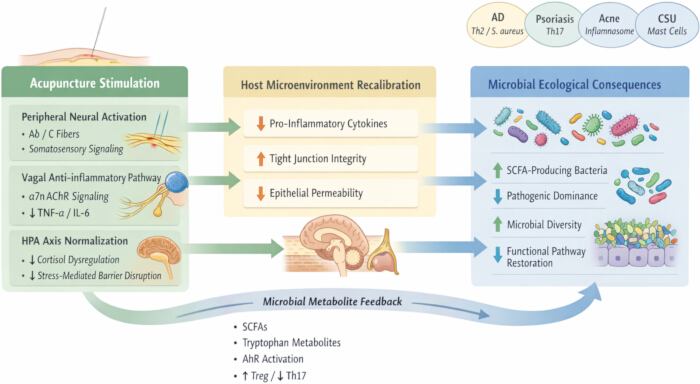
Figure 1: Proposed neuro–endocrine–immune–microbial integrative model of acupuncture in inflammatory skin diseases. Acupuncture stimulation activates peripheral neural pathways and engages central autonomic circuits, leading to vagal-mediated suppression of systemic pro-inflammatory cytokines and normalization of hypothalamic–pituitary–adrenal axis activity. These host-level modulatory effects may stabilize epithelial barrier integrity, reduce inflammatory niche pressure, and reshape microbial ecological conditions. Increased abundance of short-chain fatty acid–producing bacteria and restoration of microbial functional pathways may subsequently reinforce immune homeostasis through metabolite-mediated feedback mechanisms. This model conceptualizes acupuncture as a host-directed ecological modulator of host–microbiome interactions rather than a direct antimicrobial intervention. Solid arrows indicate the proposed primary regulatory pathway, whereas the curved arrow indicates putative microbial metabolite-mediated feedback. These pathways should be interpreted as a conceptual framework based on current evidence and biological plausibility rather than as fully proven causal relationships. Please click here to view a larger version of this figure.
| Disease | Immunological Profile | Reported Microbial Features | Representative Acupuncture Parameters Reported in Studies | Reported Immunological or Clinical Outcomes | Microbiome Assessment in Study |
| Atopic dermatitis | Th2-dominant inflammation; increased interleukin-4, interleukin-13, and serum immunoglobulin E | Reduced microbial diversity; Staphylococcus aureus overgrowth during flares | Acupoints: Zusanli (ST36) and Quchi (LI11); manual acupuncture; needle depth, 15–25 mm; session duration, 20–30 min; frequency, 2–3 sessions/week; treatment duration, 8–12 weeks | Reduced serum immunoglobulin E, pruritus severity, and inflammatory cytokines | Not assessed in clinical trials |
| Psoriasis | Th17-driven inflammation; increased interleukin-17A, interleukin-23, and tumor necrosis factor-α | Decreased short-chain fatty acid-producing taxa; altered gut microbial composition | Acupoints: Zusanli (ST36) with or without Xuehai (SP10); electroacupuncture; stimulation frequency, 2/15 Hz; session duration, 20 min; frequency, 3 sessions/week; treatment duration, 4–8 weeks | Reduced interleukin-17A and tumor necrosis factor-α in animal models | Limited preclinical sequencing data |
| Acne vulgaris | Inflammasome activation; increased interleukin-1β; neutrophilic inflammation | Strain-specific Cutibacterium acnes distribution | Acupoints: Quchi (LI11) and Neiting (ST44); manual acupuncture; session duration, 20–25 min; frequency, 2 sessions/week; treatment duration, 6–8 weeks | Reduced inflammatory lesion count and erythema | Not assessed |
| Chronic spontaneous urticaria | Mast cell activation; histamine-mediated response | Limited microbiome data; possible gut permeability involvement | Acupoint: Zusanli (ST36); manual acupuncture; session duration, 20 min; frequency, 2–3 sessions/week; treatment duration, 6 weeks | Reduced Urticaria Activity Score over 7 days and improved symptom control | Not assessed |
Table 1: Disease-specific immunological characteristics, microbial features, and standardized acupuncture parameters in dermatologic studies relevant to host–microbiome interactions. The acupuncture parameters listed in this table are representative protocols extracted from published clinical or preclinical studies and are intended to improve reproducibility. They should not be interpreted as universally standardized or guideline-recommended protocols. Reporting was harmonized across diseases by specifying acupoints, stimulation method, session duration, treatment frequency, and total treatment duration where available. Abbreviations: Th2, type 2 helper T cell; Th17, type 17 helper T cell; IL, interleukin; IgE, immunoglobulin E; TNF-α, tumor necrosis factor-α; SCFAs, short-chain fatty acid; UAS7, Urticaria Activity Score over 7 days.
Disclosures
Loading...
$$\rightleftharpoonup{xx}$$
$$\longleftharp{xx}$$,
$$\longrightharp{xx}$$,
The authors declare that they have no conflicts of interest.
Acknowledgements
Loading...
$$\rightleftharpoonup{xx}$$
$$\longleftharp{xx}$$,
$$\longrightharp{xx}$$,
The authors thank all researchers whose work contributed to the advancement of microbiome and integrative medicine research. This work was supported by the Zhejiang Provincial Traditional Chinese Medicine Science and Technology Program, Grant No. 2023ZL477.
Reprints and Permissions
Request permission to reuse the text or figures of this JoVE article
Request Permission