This protocol describes an integrated workflow to assess transduction efficiency and cell specificity of cell-penetrating peptides, using the lung-targeting peptide cyclized R11A (cR11A; KAPWHLSSQYSAT) as an example. The workflow combines paired-fraction FACS followed by single-cell RNA sequencing, flow cytometry in AT2 reporter mice, and confocal z-stack imaging to confirm AT2-associated peptide target engagement.
Method Article
Assessing Transduction Efficiency And Cell Targeting By Cell-penetrating Peptides In The Mouse Lung
Corresponding Authors: Maliha Zahid <Zahid.Maliha@mayo.edu>
Opens in a new tab
In This Article
Summary
Loading...
$$\rightleftharpoonup{xx}$$
$$\longleftharp{xx}$$,
$$\longrightharp{xx}$$,
Abstract
Loading...
$$\rightleftharpoonup{xx}$$
$$\longleftharp{xx}$$,
$$\longrightharp{xx}$$,
Cell-penetrating peptides (CPPs) are short peptides (5–30 amino acids) capable of crossing cell membranes and delivering macromolecular cargoes without the need for transfection reagents. However, defining in vivo. cellular selectivity requires validation at the cell-type level. An integrated workflow is presented to assess the transduction efficiency of a Cy5.5-labeled cyclized CPP, cR11A, within alveolar epithelial type II (AT2) cells following retro-orbital intravenous injection in mice. Lungs were harvested at 15 or 60 min post-injection and analyzed using complementary readouts, including paired-fraction fluorescence-activated cell sorting (FACS) to isolate Cy5.5⁺ and Cy5.5⁻ lung single-cell suspensions followed by single-cell RNA sequencing, flow cytometry of lung single cells from Sftpc-CreERT2(+/−);LSL-GFP(+/−) AT2 reporter mice to quantify GFP⁺/Cy5.5⁺ events, and confocal z-stack imaging of lung cryosections to confirm colocalization of cR11A-Cy5.5 with AT2-associated signal. This protocol yields concordant evidence of cell-type engagement using multiple complementary readouts and provides a reproducible framework for evaluating cell-specific targeting of CPPs, with modifications for different target organs.
Introduction
Loading...
$$\rightleftharpoonup{xx}$$
$$\longleftharp{xx}$$,
$$\longrightharp{xx}$$,
Cell-penetrating peptides (CPPs) are 5–30 amino acid peptides that can traverse cell membranes and facilitate intracellular delivery of macromolecular cargoes in an intact, fully functional form without the need for transfection reagents1,2. Prior work using in vitro and in vivo phage display combinatorial methodologies identified a 12-amino acid cardiac-targeting peptide (APWHLSSQYSRT) that is taken up specifically by cardiomyocytes within as little as 5 min3,4. To investigate its mechanism of transduction, an alanine scan was conducted, leading to the discovery of two variants, S7A and R11A (APWHLSSQYSAT), that unexpectedly exhibited lung enrichment in vivo. and were therefore termed lung-targeting peptides (LTPs)5. Furthermore, N-terminal lysine addition and head-to-tail cyclization generated a cyclic version of R11A (cR11A) with significantly improved serum stability and markedly enhanced intracellular uptake compared to its linear counterpart5.
LTPs have the potential to precisely deliver therapeutics to distal lung epithelial populations, including alveolar epithelial type II (AT2) cells. These cells are critical for maintaining surfactant homeostasis and serve as progenitors for alveolar regeneration6. However, a major challenge in LTP development is the rigorous assessment of in vivo cellular selectivity. Organ-level biodistribution alone cannot distinguish true cellular transduction from vascular signal, extracellular retention, or phagocytic clearance and must therefore be complemented by single-cell–resolved measurements7. To address this limitation, this workflow integrates single-cell transcriptomic assignment, reporter-based flow cytometry, and confocal z-stack imaging to generate cell-type-level evidence of peptide engagement beyond organ-level fluorescence or biodistribution readouts8,9.
The overall goal of this protocol is to provide a reproducible, multi-readout workflow for validating the in vivo transduction efficiency and cell specificity of Cy5.5-labeled cR11A in the distal lung, with a focus on AT2 cells following retro-orbital injection. The protocol defines peptide-associated cell identity using complementary and independent readouts, including paired-fraction fluorescence-activated cell sorting (FACS) (Cy5.5⁺ vs Cy5.5⁻) followed by single-cell RNA sequencing to map peptide-associated populations, quantitative uptake assessment in AT2 reporter lungs via flow cytometry, and confocal z-stack imaging of lung cryosections to confirm colocalization of cR11A-Cy5.5 with AT2-associated signal. This protocol can be readily adapted to other LTPs or delivery vectors and applied to the lung or other organ systems to assess the cell specificity of CPPs under development. It is particularly suitable for applications requiring cell-type-level validation of CPP targeting in vivo rather than assessment of organ-level accumulation alone.
Protocol
Loading...
$$\rightleftharpoonup{xx}$$
$$\longleftharp{xx}$$,
$$\longrightharp{xx}$$,
All animal procedures were conducted in accordance with the guidelines of the Institutional Animal Care and Use Committee (IACUC) at Mayo Clinic and were approved under protocol number A00006842-22-R25. All efforts were made to minimize animal suffering and to ensure ethical handling in compliance with relevant national and institutional regulations. The research tools used for this protocol are listed in the Table of Materials.
1. Animals
- Use adult mixed-sex C57BL/6J mice (6–8 weeks old) obtained from The Jackson Laboratory (Strain #000664).
- For AT2-specific quantification, use Sftpc-CreERT2(+/+) (Jax Strain #028054) crossed with LSL-GFP(+/+) (Jax Strain #007906) to generate Sftpc-CreERT2(+/−);LSL-GFP(+/−) AT2 reporter mice.
- House mice in individually ventilated cages. Ensure that all animal protocols are approved by the Institutional Animal Care and Use Committee.
- Perform tamoxifen induction in Sftpc-CreERT2(+/−);LSL-GFP(+/−) mice. When mice are ≥6 weeks old, administer 100 mg/kg tamoxifen dissolved in corn oil via oral gavage for three doses over 7 days. Perform experiments at least 2 weeks after the final dose to allow for maximum recombination efficiency.
2. Reagent and equipment preparation
- Prepare anesthesia (ketamine/xylazine working mix).
- Prepare a 5 mL working solution: ketamine (1 mL of 50 mg/mL), xylazine (50 µL of 100 mg/mL), and sterile saline (3.95 mL).
- Administer 1 µL/g body weight via .intraperitoneal injection (final dose: 10 mg/kg ketamine and 1 mg/kg xylazine).
- Prepare peptide (cR11A-Cy5.5).
- Obtain CPPs as lyophilized powders. Store powders at −20 °C for up to 2 years or as stock solutions in DMSO at −80 °C for up to 6 months in light-protected tubes. Avoid freeze–thaw cycles and minimize light exposure. Prepare a 10 mM stock solution of cR11A-Cy5.5 in DMSO.
- Weigh the mouse, calculate the dose, and dilute the stock to 1 mg/kg in nuclease-free water to a final volume of 100 µL per mouse.
- Prepare digestion buffer (fresh; keep on ice).
- Prepare digestion buffer containing 2 mg/mL Dispase II, 0.1 mg/mL DNase I, DMEM/F12, and 1% (v/v) penicillin-streptomycin.
- Use 3 mL per mouse.
- Prepare non-specific protease enzyme wash buffer (keep on ice).
- DMEM/F12 containing 0.05 mg/mL DNase I and 1% (v/v) penicillin-streptomycin.
- Use 10 mL per mouse.
- Prepare red blood cell lysis buffer (keep on ice).
- Dilute 10× lysis buffer to 1× with PBS.
- Use 2 mL per sample.
- Prepare perfusion buffer.
- Use ice-cold DMEM/F12 (10 mL per mouse).
- Prepare wash buffer.
- Use DMEM/F12 with 2% FBS.
- Pre-cool centrifuges to 4 °C.
3. Retro-orbital administration of cR11A-Cy5.5
- Anesthetize the mouse using the ketamine/xylazine working solution. Confirm adequate anesthesia by the lack of limb withdrawal in response to toe pinch.
- Inject 100 µL of cR11A-Cy5.5 (1 mg/kg) via retro-orbital intravenous injection using an insulin syringe.
- Start the timer and maintain the mouse on a heating pad under appropriate monitoring for 15 or 60 min.
4. Lung harvest and perfusion
- Euthanize the mouse according to approved protocols (e.g., CO₂ inhalation followed by cervical dislocation). Place the mouse in a supine position and spray the thorax with 70% ethanol.
- Open the thoracic cavity to expose the heart and lungs.
- Make an incision in the right atrium to allow drainage during perfusion.
- Insert a 26 G needle attached to a 10 mL syringe containing ice-cold DMEM/F12 into the right ventricle. Keep the right atrial incision open throughout perfusion to allow drainage.
- Perfuse manually without a syringe pump by slowly and steadily injecting 10 mL of DMEM/F12 over approximately 1-2 minutes. Maintain low pressure during injection and avoid visible lung overinflation or leakage from the ventricular wall. Continue until the lungs become uniformly pale.
5. Lung inflation and digestion
- Cannulate the trachea with a 20G IV catheter and secure with 3-0 silk suture. Instill 1 mL digestion buffer via a 1 mL syringe to inflate the lungs.
- Dissect the lungs as a single intact unit and transfer immediately to a pre-chilled 100 mm dish on ice.
- Separate lung lobes and transfer to a 15 mL conical tube containing 2 mL cold digestion buffer (one lung per tube).
- Incubate at 4 °C for 20 h on a rotating rocker (10–15 rpm).
NOTE: Refer to Janas PP. et al.10 for detailed methodology.
6. Tissue dissociation
- Place a 100 µm cell strainer over a 50 mL conical tube and pre-wet with 1 mL non-specific protease enzyme wash buffer.
- Transfer lung tissue onto the strainer and gently dissociate using a sterile syringe plunger.
- Rinse with 10 mL non-specific protease enzyme wash buffer.
- Centrifuge at 130 × g for 15 min at 4 °C.
- Resuspend the pellet in 2 mL 1× RBC lysis buffer for 90 s at room temperature.
- Quench lysis with 10 mL wash buffer.
- Filter through a 40 µm strainer and rinse with wash buffer.
- Centrifuge at 300 × g. for 5 min at 4 °C.
- Resuspend cells in 500–1,000 µL PBS + 2% FBS (≥1 × 10⁶ cells/mL).
- Pass through a 35 µm filter cap into a FACS tube.
NOTE: Refer to Konishi S. et al.11 for detailed methodology.
7. Paired-fraction FACS sorting
- Perform sorting using a flow cytometer.
- Use PBS-injected lungs as a negative control to define the Cy5.5 gate.
- Apply standard gating: debris exclusion, singlets, and Cy5.5⁺ cells.
- Sort Cy5.5⁺ and Cy5.5⁻ populations into separate tubes.
8. scRNA-seq sample preparation
- Keep sorted samples on ice.
- Centrifuge at 300 × g. for 5 min at 4 °C and resuspend in 500 µL buffer.
- Proceed only if viability ≥80%.
- Prepare libraries and sequencing as required.
9. Flow cytometry in AT2 Reporter Mice
- Prepare lung single-cell suspensions as described in Sections 5–6.
- Stain with a fixable live/dead dye (1:1,000) for 30 min (protect from light).
- Wash and centrifuge at 300 × g. for 5 min at 4 °C.
- Filter and keep samples on ice.
- Acquire data on a flow cytometer.
- Perform gating to identify cells, select singlets, exclude dead cells, and define GFP and Cy5.5 populations.
- Quantify GFP⁺/Cy5.5⁺ events as a percentage of GFP⁺ cells.
10. Fixation and cryoprotection
- Inflate lungs with 1 mL 4% PFA and secure the trachea.
- Fix in 10 mL 4% PFA overnight at 4 °C.
- Wash with PBS (3×).
- Incubate in 15% sucrose overnight.
- Transfer to 30% sucrose for ~48 h.
11. Embedding and cryosectioning
- Prepare cryo-molds with OCT and position lungs and embed in OCT.
- Freeze using liquid nitrogen. Store at ˗80 °C.
- Section at 10 µm after equilibration. Air-dry slides overnight.
12. Imaging and analysis
- Wash sections with PBS (3×).
- Mount with DAPI medium.
- Acquire confocal z-stacks.
- Use appropriate imaging settings.
- Perform 3D reconstruction.
- Quantify colocalization using consistent thresholds.
Optional methods:
These optional methods are not included in the representative workflow but may be incorporated to enable depletion or analysis of the CD45⁺ immune cell population, which constitutes a large proportion of lung cells12.
NOTE: Use CD45⁺ depletion or exclusion when analysis is focused on non-immune lung populations, as these steps remove or separate immune-cell uptake signals and alter the cellular composition of the sample. CD45 staining may also be used to analyze the CD45⁺ immune-cell population separately.
13. Deplete CD45+ cell population
- After tissue dissociation (Step 6), use either a CD45 antibody conjugated to a magnetic bead (Miltenyi Biotech 130-052-301) or a CD45 antibody conjugated to a fluorophore that is compatible with Cy5.5, GFP, and the live/dead stain, for example CD45-BV605 (BioLegend #103140). Stain for 20 minutes at 4°C in the dark.
- If performing CD45-magnetic bead depletion, follow the manufacturer's instructions for use of the Lineage Depletion (LD) column (Miltenyi Biotech 130-042-901) and proceed with Magnetic Cell Separation (MACS) (Miltenyi Biotech). Then proceed to paired-fraction FACS sorting (step 7).
- If performing CD45 depletion using a fluorescently conjugated antibody, first wash the cell suspension with wash buffer to remove excess antibody. Then proceed to step 7. After establishing gates to exclude doublets and debris (Step 7.3), insert an additional gate to exclude the CD45+ population. Then proceed to Step 7.4.
14. Analyze the CD45+ cell population during flow cytometry
- After Step 9.3, use a CD45 antibody conjugated to a fluorophore that is compatible with Cy5.5, GFP, and the live/dead stain, for example CD45-BV605 (BioLegend #103140). Stain for 20 minutes at 4°C in the dark.
- Wash the cell suspension with wash buffer to remove excess antibody. Then proceed to step 9.4. After establishing gates to exclude doublets and debris (Step 9.6), insert an additional gate to exclude the CD45+ population before gating to establish the GFP+ and Cy5.5+ populations12.
Results
Loading...
$$\rightleftharpoonup{xx}$$
$$\longleftharp{xx}$$,
$$\longrightharp{xx}$$,
Successful application of this protocol should generate concordant evidence from three complementary readouts: paired-fraction scRNA-seq, reporter-based flow cytometry, and confocal z-stack imaging.
In the paired-fraction scRNA-seq analysis, Cy5.5⁻ and Cy5.5⁺ lung single-cell fractions were recovered after systemic administration of cR11A-Cy5.5 and analyzed separately. UMAP visualization identified major lung cell populations, including immune, endothelial, epithelial, and mesenchymal compartments (Figure 1A, B). Although immune cells represented the dominant population in both sorted fractions, the Cy5.5⁺ fraction showed relative enrichment of non-immune compartments, including epithelial cells (Figure 1C). Epithelial subset analysis showed a greater representation of AT2 cells in the Cy5.5⁺ fraction than in the Cy5.5⁻ fraction, whereas AT1 cells remained low in both fractions (Figure 1D). These results indicate that paired-fraction scRNA-seq can identify enrichment of AT2 cells within the cR11A-Cy5.5–positive lung cell fraction.
Flow cytometry was used to quantify cR11A-Cy5.5 signal within reporter-defined AT2 cells. Representative gating included selection of total cells by FSC-A/SSC-A, two sequential singlet gates, live-cell gating, and final GFP versus. Cy5.5 analysis (Figure 2A–E). In the control sample, GFP⁺/Cy5.5⁺ events were minimal, establishing the background fluorescence threshold. Following cR11A-Cy5.5 administration, GFP⁺/Cy5.5⁺ AT2 reporter-positive events increased to 7.99% at 15 min and 7.41% at 60 min post-injection in this representative dataset (Figure 2E). These results support detectable cR11A-Cy5.5 signal in AT2 reporter-positive cells in vivo.
Confocal z-stack imaging provides spatial validation of peptide-associated fluorescence in lung tissue sections. A non-reporter control was included to assess background fluorescence and showed minimal signal in the GFP and Cy5.5 channels. In cR11A-Cy5.5-treated AT2 reporter lungs, Cy5.5 fluorescence was detected in proximity to GFP⁺ AT2 reporter-positive cells, and the Imaris-generated colocalization channel identified overlap between GFP and Cy5.5 signals (Figure 3A). Representative Imaris colocalization analysis showed 89.6% and 86.8% colocalization within the GFP⁺ AT2 compartment at 15 min and 60 min, respectively (Figure 3B).
Suboptimal results may include high background Cy5.5 fluorescence in control samples, poor epithelial cell recovery, low cell viability, or weak separation of GFP⁺/Cy5.5⁺ events. These issues typically indicate incomplete perfusion, excessive tissue disruption, inadequate compensation, or inconsistent imaging thresholds.
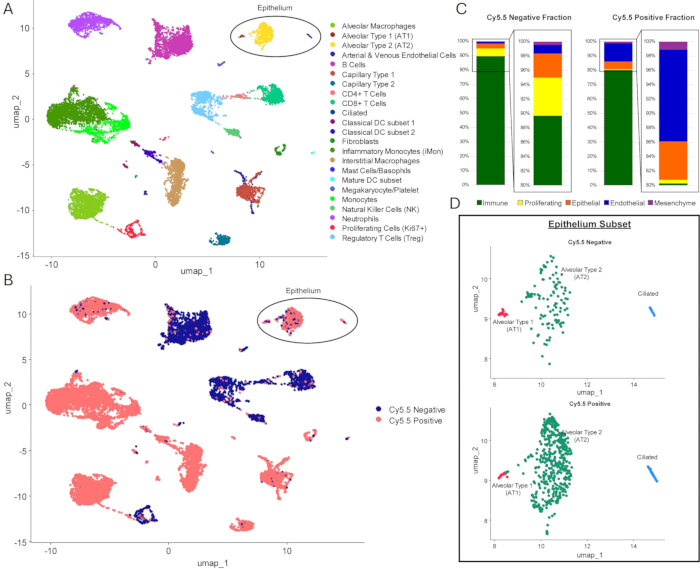
Figure 1: Paired-fraction scRNA-seq identifies enrichment of alveolar epithelium in the cR11A-Cy5.5–positive lung fraction. Lung single-cell suspensions were sorted into Cy5.5⁻ and Cy5.5⁺ fractions following retro-orbital injection of cR11A-Cy5.5, and each fraction was analyzed by single-cell RNA sequencing. (A) UMAP plots show cell-type clusters in matched fractions from a representative mouse. (B) UMAP overlay shows the distribution of Cy5.5⁻ and Cy5.5⁺ cells. The circled regions in (A) and (B) indicate the epithelial compartment highlighted for epithelial subset analysis. (C) Immune populations are highly prevalent in both fractions, representing over 80% of each. Compared to the Cy5.5⁻ fraction, the Cy5.5⁺ fraction contains a larger proportion of endothelial, epithelial, and mesenchymal populations, indicating uptake of cR11A within these populations. (D) Within the epithelial population, AT2 cells are more highly represented in the Cy5.5⁺ fraction than in the Cy5.5⁻ fraction, whereas AT1 cells remain low in both fractions. Please click here to view a larger version of this figure.
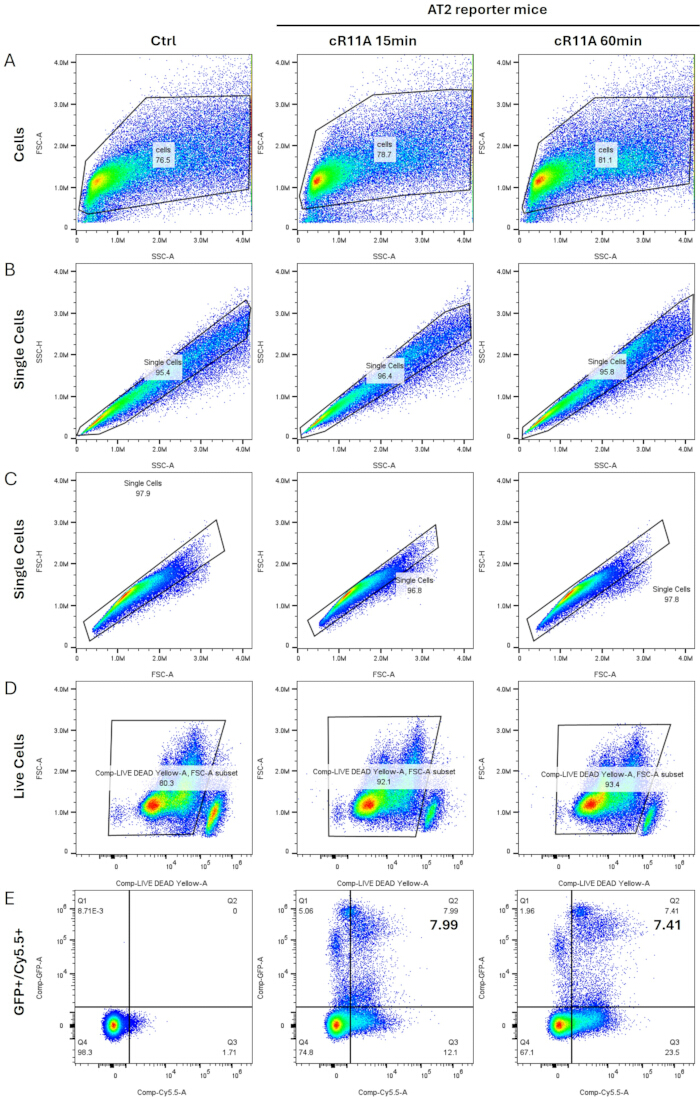
Figure 2: Flow cytometry validation of cR11A-Cy5.5 uptake in AT2 reporter lungs. AT2 reporter mice were administered cR11A-Cy5.5 via retro-orbital intravenous injection, and lungs were harvested at 15 min or 60 min post-injection for single-cell preparation. Representative gating is shown for a PBS vehicle control (Ctrl) and cR11A-Cy5.5-treated samples: (A) cells were selected by FSC-A/SSC-A, (B, C) singlets were gated by scatter-based doublet exclusion, (D) live cells were identified by viability dye exclusion, and (E) GFP (AT2 reporter) versus. Cy5.5 was used to quantify GFP⁺/Cy5.5⁺ events. In this representative dataset, GFP⁺/Cy5.5⁺ AT2 events were approximately 8% at both 15 min and 60 min after cR11A-Cy5.5 administration. Please click here to view a larger version of this figure.
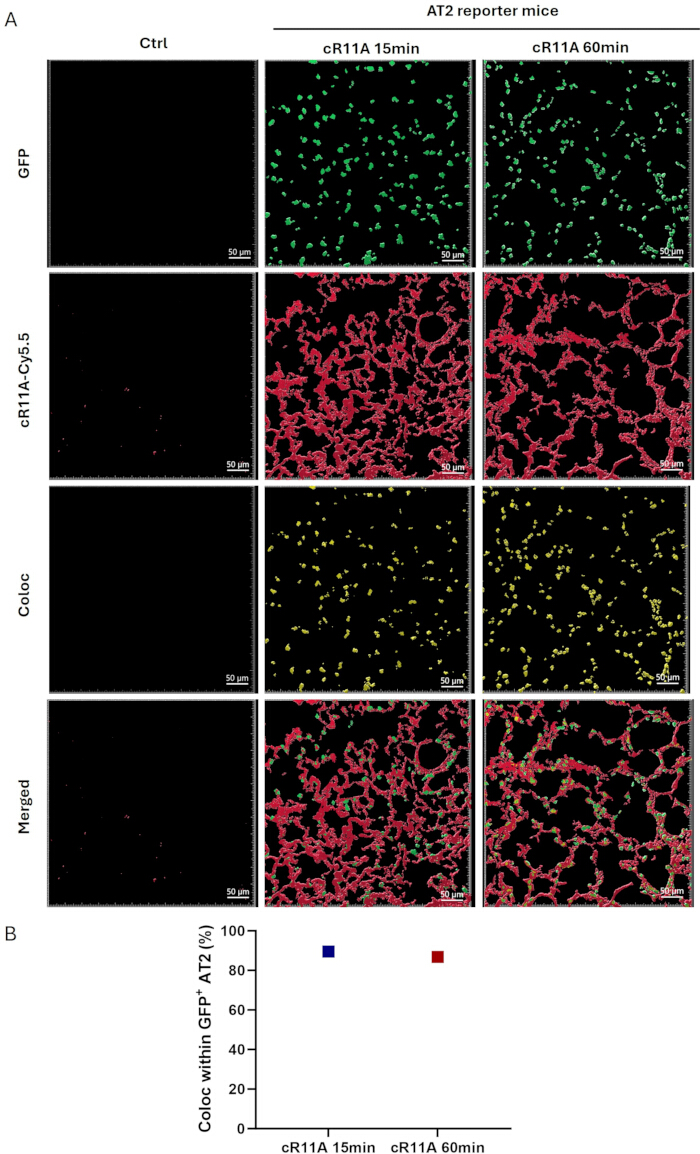
Figure 3: Confocal imaging and Imaris colocalization analysis of cR11A-Cy5.5 uptake in AT2 reporter lungs. (A) Representative fields are shown for a non-reporter control (Ctrl) and cR11A-Cy5.5-treated AT2 reporter lungs harvested at 15 min or 60 min post-injection for cryosectioning and confocal z-stack imaging. GFP signal (green) marks AT2 cells, and cR11A-Cy5.5 fluorescence (red) indicates peptide-associated signal. The “Coloc” panel displays pixels or objects classified as colocalized by Imaris (yellow), and merged images illustrate spatial overlap between the two channels. The non-reporter control was included to assess background fluorescence in the GFP and Cy5.5 channels. (B) Quantification of colocalization within the GFP⁺ AT2 compartment shows that 89.6% and 86.8% of the GFP signal colocalized with cR11A-Cy5.5 at 15 min and 60 min, respectively. These data indicate robust overlap with GFP⁺ AT2 cells at both time points, supporting preferential engagement of the AT2 compartment in vivo. Please click here to view a larger version of this figure.
Discussion
Loading...
$$\rightleftharpoonup{xx}$$
$$\longleftharp{xx}$$,
$$\longrightharp{xx}$$,
This protocol identifies peptide targeting of specific cell populations using multiple independent readouts operating at complementary resolutions: transcriptome-level mapping (paired-fraction scRNA-seq), quantitative event-based measurement (reporter flow cytometry), and spatial confirmation (confocal z-stacks). Together, these approaches reduce common ambiguities inherent to fluorescence- or bulk biodistribution-based studies at the organ level, such as confounding vascular fluorescence or extracellular retention, as well as the inability to assign peptide-associated signal to specific lung cell populations7.
Several steps require particular attention. Perfusion quality strongly affects background fluorescence and downstream sorting performance; sufficient perfusion is characterized by a uniform, ivory-white appearance of all lung lobes, whereas incomplete perfusion can elevate Cy5.5 signal in non-target compartments. For tissue dissociation, prolonged cold digestion (4 °C, 20 h) is used rather than typical digestion conditions (37 °C, 1–2 h) to preserve epithelial populations and improve recovery of fragile cells, particularly alveolar type I (AT1) cells10. AT1 cells are easily lost during isolation because their large, thin morphology makes them highly sensitive to mechanical digestion. Beyond standard laboratory practices, including consistent digestion, compensation, gating, and thresholding, 3D colocalization analysis helps determine whether the peptide signal overlaps with the AT2 reporter signal rather than relying on two-dimensional fluorescence overlap alone13.
A CD45⁺ immune cell depletion step may be considered prior to scRNA-seq or flow cytometry quantification. Immune cells constitute a large proportion of lung cell populations and may uptake CPPs as part of a typical immune response to foreign particles. To more accurately quantify CPP uptake within non-immune populations, including endothelial, epithelial, and mesenchymal compartments, CD45⁺ cell depletion may improve sensitivity. This can be achieved using bead-based depletion prior to sorting or by excluding CD45⁺ cells during flow cytometry analysis12. However, this modification should be used selectively because it removes immune cell uptake information and alters the cellular composition of the analyzed sample.
Several limitations of this workflow should be considered. Cy5.5 fluorescence identifies peptide-associated signal but does not, by itself, distinguish internalized peptide from membrane-adherent or pericellular signal. Paired-fraction scRNA-seq is also affected by tissue dissociation, cell recovery, sorting thresholds, and the relative abundance of each lung cell population. Therefore, rare populations such as basal cells or ionocytes may be underrepresented or missed. Reporter mouse flow cytometry provides stronger cell-type assignment but requires an appropriate reporter line or validated antibody panel. In addition, a vehicle control using reporter mice would better define background colocalization within GFP⁺ AT2 cells in imaging assays. Interpretation should therefore rely on concordant evidence across scRNA-seq, flow cytometry, and confocal imaging rather than any single readout.
This workflow is modular and can be adapted to alternative fluorophores, reporter mouse lines, dosing regimens, or harvest time points. For studies developing additional cell- or organ-specific CPPs, the paired-fraction scRNA-seq design can be applied with modifications to other organs (e.g., liver, kidney, or brain). This protocol provides an efficient approach to compare peptide-associated populations within a single organ from the same animal, thereby improving interpretability while reducing inter-animal variability. Future applications include screening additional CPPs, testing CPP–cargo conjugates, comparing linear and cyclic peptide designs, and applying the workflow to disease models in which tissue architecture or target cell abundance is altered.
Disclosures
Loading...
$$\rightleftharpoonup{xx}$$
$$\longleftharp{xx}$$,
$$\longrightharp{xx}$$,
The authors declare no competing interests.
Acknowledgements
Loading...
$$\rightleftharpoonup{xx}$$
$$\longleftharp{xx}$$,
$$\longrightharp{xx}$$,
This work was supported by NHLBI R01 grant HL153407, NIH grant HL092961, and NHLBI F32 grant HL175907.
Materials
| Name | Company | Catalog Number | Comments |
|---|---|---|---|
| Anti-mouse CD45-BV605 antibody | BioLegend | 103140 | Used for identification or exclusion of CD45+ cells |
| C57BL/6J mice | The Jackson Laboratory | Strain #000664 | Wild-type mice used for experiments |
| CD45 MicroBeads, mouse | Miltenyi Biotec | 130-052-301 | Used for magnetic depletion of CD45+ cells |
| Cell counter | Invitrogen | Countess 3; AMQAX2000 | Automated cell counting |
| CO2 incubator | Thermo Scientific | Heracell VIOS 160i; TSH160IDS | Cell incubation |
| Confocal microscope | Zeiss | LSM 980; 1872-551 | Used for acquisition of z-stack images |
| cR11A-Cy5.5 peptide | Mayo Clinic Proteomics Core | Custom synthesis; no catalog number | Fluorescently labeled CPP used for in vivo delivery |
| Cryostats | Leica Biosystems | Leica CM1950 | Used for tissue sectioning |
| Dispase II | Sigma-Aldrich | D4693-1G | Enzyme used for lung tissue digestion |
| DMEM/F12 | Gibco | 11330-032 | Cell dissociation and washing buffer |
| DNase I | Roche | 10104159001 | Reduces DNA-mediated cell clumping |
| FACS cell sorter | BD Biosciences | BD FACSAria II, 4 laser system | Used for sorting Cy5.5+ and Cy5.5- cells |
| FBS | Gibco | A52567-01 | Added to buffers to improve cell viability |
| FlowJo software | FlowJo | Version 10.10.0 | Flow cytometry data analysis |
| GraphPad Prism software | GraphPad Software | Version 10 | Statistical analysis and plotting |
| Imaris software | Oxford Instruments | Version 9.9.1 | 3D visualization and colocalization analysis |
| Incubated orbital shaker | Thermo Scientific | Solaris; 01-258-086 | Used for tissue digestion |
| Ketamine | WestWard (Hikma) | NDC 0143-9508-01 | |
| LD Columns | Miltenyi Biotec | 130-042-901 | Used for magnetic cell separation (MACS) |
| LD Columns | Miltenyi Biotec | 130-042-901 | |
| Live/dead fixable yellow dead cell stain kit | Invitrogen | L34968 | Used for viability staining in flow cytometry |
| Live/dead fixable yellow dead cell stain kit | Invitrogen | L34968 | |
| LSL-GFP reporter mice | The Jackson Laboratory | Strain #007906 | Cre-inducible GFP reporter line |
| LSL-GFP reporter mice | The Jackson Laboratory | Strain #007906 | |
| Microcentrifuge | Eppendorf | EPP-5427R | Sample centrifugation |
| Microcentrifuge | Eppendorf | EPP-5427R | |
| Mounting medium with DAPI | Abcam | AB104139 | Nuclear counterstain for imaging |
| Mounting medium with DAPI | Abcam | AB104139 | |
| Nuclease-free water | Qiagen | 175034992 | |
| Oral gavage needle | Braintree Scientific | N-PK 020 | |
| PBS | Gibco | 10010-023 | General washing buffer |
| PBS | Gibco | 10010-023 | |
| Penicillin-Streptomycin | Gibco | 15140-122 | Prevents bacterial contamination |
| Penicillin-Streptomycin | Gibco | 15140-122 | |
| Refrigerated centrifuge | Thermo Scientific | ST16R; TSST16R | Cell pelleting at controlled temperature |
| Refrigerated centrifuge | Thermo Scientific | ST16R; TSST16R | |
| Saline | Baxter | 2F7124 | |
| Sftpc-CreERT2 mice | The Jackson Laboratory | Strain #028054 | AT2-specific inducible Cre line |
| Sftpc-CreERT2 mice | The Jackson Laboratory | Strain #028054 | |
| Sftpc-CreERT2(+/−);LSL-GFP(+/−) AT2 reporter mice | In-house breeding | Generated by crossing Sftpc-CreERT2(+/+) mice with LSL-GFP(+/+) mice | Used for AT2-specific GFP labeling |
| Sftpc-CreERT2(+/−);LSL-GFP(+/−) AT2 reporter mice | In-house breeding | Generated by crossing Sftpc-CreERT2(+/+) mice with LSL-GFP(+/+) mice | |
| Silk suture | Look | SP117 | |
| Single-cell RNA sequencing service | Mayo Clinic Genome Analysis Core | https://www.mayo.edu/research/core-resources/genome-analysis-core/services | Library preparation and sequencing |
| Single-cell RNA sequencing service | Mayo Clinic Genome Analysis Core | https://www.mayo.edu/research/core-resources/genome-analysis-core/services | |
| Tamoxifen | Sigma-Aldrich | T5648 | |
| Water bath incubator | Fisherbrand | Isotemp GPD 28 | Temperature-controlled incubation |
| Water bath incubator | Fisherbrand | Isotemp GPD 28 | |
| Xylazine (Rompun) | Dechra | NADA #047-956 |
Reprints and Permissions
Request permission to reuse the text or figures of this JoVE article
Request Permission