This study demonstrates a digital-twin-based workflow for proactive enterprise management, integrating IoT data, nonlinear modeling, state estimation, uncertainty propagation, and predictive control to computationally investigate operational stability, risk reduction, and data-driven decision-support behavior within a simulation environment.
A subscription to JoVE is required to view this content. Sign in or start your free trial.
Method Article
A Digital Twin Framework for Proactive Enterprise Management: Research on Operational Decision-making Integrating IoT Data and Computational Modeling
In This Article
Summary
Abstract
Digital twin technology provides a powerful computational approach for representing and controlling complex enterprise systems by continuously integrating real-time sensing with dynamic modeling and predictive analytics. The main aim of this study is to develop and demonstrate a reproducible protocol for constructing an IoT-enabled digital twin that enables proactive, data-driven enterprise management. The methodology integrates nonlinear dynamic modeling, observer-based state estimation, uncertainty propagation, risk quantification, and stochastic model predictive control into a unified cyber-physical decision framework. Simulated sensor measurements are assimilated by a state estimator to synchronize the digital twin with the modeled enterprise system, enabling simulation-based prediction of future operational states within a defined computational environment. Uncertainty and risk measures are propagated through the dynamic model to identify emerging instabilities before they escalate into critical failures. A predictive control layer then optimizes multi-objective performance by generating control actions intended to reduce operational risk, stabilize system behavior, and evaluate potential long-term operational efficiency improvements within the simulated scenario. Representative results obtained from a simplified production–inventory–energy simulation model demonstrate the potential advantages of the digital-twin-driven method compared with conventional reactive strategies. The computational example shows smoother operational trajectories, lower cumulative risk, reduced uncertainty, and improved control efficiency across several evaluated performance dimensions. However, these findings are based on a defined simulation workflow and should be interpreted as a proof-of-concept demonstration rather than direct evidence of universal real-world performance. Although the protocol is computational, platform-independent, and potentially adaptable to enterprise domains such as manufacturing, logistics, supply-chain operations, and energy-intensive systems, broader deployment in practical industrial environments would require additional validation using real operational datasets and large-scale implementation studies. By following this procedure, researchers and practitioners can reproduce and further evaluate a scalable, data-driven, and risk-aware digital twin framework for enterprise decision-support applications.
Introduction
Modern enterprises operate in increasingly complex environments characterized by large volumes of data, interconnected operational processes, and substantial uncertainty. Traditional reactive management strategies often struggle to maintain operational stability and resilience under these conditions, particularly when enterprise systems involve tightly coupled processes such as production scheduling, logistics coordination, inventory management, energy utilization, and risk mitigation1,2,3. These processes frequently exhibit nonlinear interactions and multi-scale dependencies that evolve dynamically over time. As organizations transition toward cyber-physical infrastructures supported by interconnected sensing systems and distributed digital intelligence, maintaining accurate and timely awareness of system states becomes a critical requirement for effective decision-making4,5,6,7.
Digital twin technology has emerged as a promising paradigm for addressing these challenges. A digital twin can be defined as a continuously evolving virtual representation of a physical asset, process, or enterprise system that remains synchronized with its physical counterpart through the integration of real-time data and dynamic system models8,9,10. Unlike conventional static simulation frameworks, digital twins function as dynamic computational ecosystems capable of monitoring operational conditions, forecasting system behavior, and supporting optimization-based decision-making11,12. Extensive research has demonstrated the value of digital twins in a variety of domains, including advanced manufacturing systems, smart logistics networks, supply-chain optimization, and energy management infrastructures13,14,15,16,17. These studies suggest the potential of digital twins to enhance situational awareness, improve operational efficiency, and support predictive management strategies in simulation and experimental environments. Despite these advances, implementing digital twin technology for enterprise-level decision support remains challenging. Enterprise systems often involve heterogeneous subsystems that interact through complex nonlinear relationships, while operational data collected from sensing infrastructures may contain delays, noise, or missing values. These factors can significantly reduce the reliability of conventional monitoring or control strategies. Addressing these challenges requires integrated frameworks that combine dynamic system modeling, data assimilation, uncertainty quantification, and predictive optimization within a unified architecture18,19,20,21,22. Recent studies have therefore emphasized the importance of combining real-time sensing with advanced estimation methods and predictive control techniques to create closed-loop cyber-physical decision systems capable of continuously adapting to changing operational conditions23,24,25,26.
However, an important methodological limitation remains insufficiently addressed in many existing digital twin and model predictive control frameworks. A considerable portion of current studies focuses either on isolated predictive optimization algorithms, static simulation environments, or domain-specific digital twin implementations without providing a reproducible and unified workflow that integrates dynamic enterprise modeling, state estimation, uncertainty propagation, probabilistic risk evaluation, and predictive decision optimization within a single operational protocol. In addition, many reported frameworks provide conceptual architectures without clearly describing how sensing data, estimation procedures, uncertainty modeling, and control optimization interact iteratively in a closed-loop computational workflow suitable for enterprise-scale decision support. This limitation reduces the practical reproducibility and transferability of many existing approaches across different enterprise applications. Consequently, there remains a need for a transparent and computationally reproducible protocol that systematically demonstrates how these interconnected components can be integrated into a coherent cyber-physical enterprise management framework capable of supporting proactive operational analysis and decision-making.
Another key challenge arises from the presence of uncertainty and operational risk within enterprise environments. Production systems, supply chains, and energy networks are inherently exposed to stochastic disturbances, including demand fluctuations, equipment degradation, supply interruptions, and human factors. Without explicit mechanisms for modeling uncertainty and quantifying risk, enterprise control strategies may fail to detect early indicators of instability or operational degradation27,28,29,30. Incorporating probabilistic modeling and risk assessment within the digital twin framework, therefore, plays a critical role in enabling proactive enterprise management and improving long-term system resilience.
Predictive control techniques provide a natural decision-making mechanism for digital twin systems operating under uncertainty. By leveraging forecasts generated by the digital twin model, predictive control strategies can compute future-oriented control actions that optimize operational performance while respecting system constraints. Compared with conventional rule-based or proportional control strategies, predictive control approaches have demonstrated superior capability in managing nonlinear dynamics, balancing multiple objectives, and maintaining stable operation in complex cyber-physical environments31,32,33,34,35. Nevertheless, many existing implementations primarily emphasize control optimization performance while giving comparatively limited attention to the integrated interaction between state reconstruction, uncertainty evolution, probabilistic risk propagation, and adaptive enterprise monitoring. The practical usefulness of enterprise digital twins depends not only on predictive control accuracy but also on the ability to continuously assimilate operational information, evaluate uncertainty, quantify emerging risk conditions, and update control decisions within a reproducible computational workflow. Figure 1 depicts the iterative workflow, showing the bidirectional exchange between the physical system, IoT sensing layer, digital twin model, state estimator, optimization engine, and performance evaluation modules.
The main objective of this study is to develop a reproducible protocol for implementing a digital-twin-based framework that supports proactive enterprise management through integrated dynamic modeling, state estimation, uncertainty propagation, and predictive decision optimization. The proposed protocol combines nonlinear enterprise system modeling, data-driven state reconstruction, probabilistic risk evaluation, and predictive control into a unified cyber-physical workflow that continuously monitors and stabilizes enterprise operations. Unlike many existing conceptual or application-specific frameworks, the proposed methodology explicitly demonstrates the sequential interaction between sensing inputs, state estimation, uncertainty propagation, risk quantification, predictive optimization, and performance evaluation within a transparent computational protocol that can be systematically reproduced and adapted to different enterprise scenarios. By integrating these components within a closed-loop architecture, the digital twin can forecast operational evolution and recommend control actions that reduce risk, improve efficiency, and enhance system stability.
The framework presented in this work is designed to be adaptable to a wide range of enterprise contexts, including manufacturing environments, supply chain networks, logistics operations, and energy-intensive production systems. The representative results demonstrate that the proposed digital-twin-driven methodology produces smoother operational trajectories, improved estimation accuracy, reduced uncertainty propagation, and lower cumulative operational risk compared with conventional reactive management strategies within the defined computational example considered in this study. In addition to demonstrating predictive optimization performance, the proposed workflow provides a practically useful protocol for illustrating how enterprise digital twins can integrate sensing, estimation, uncertainty analysis, risk assessment, and decision optimization into a unified computational framework suitable for simulation-based enterprise evaluation and future real-world extension. These findings support the growing recognition that tightly integrated digital twins, advanced estimation techniques, and predictive optimization strategies are fundamental components for enabling resilient, intelligent, and data-driven enterprise management in modern cyber-physical environments36,37,38,39.
Access restricted. Please log in or start a trial to view this content.
Protocol
1. Define and initialize the enterprise digital twin system.
- Define enterprise system variables.
- Define the enterprise state vector:
x(t) = [x1,x2,x3]T - For reproducibility, use a production–inventory–energy enterprise example where x1 = production rate (units/h), x2 = inventory level (units), and x3 = energy consumption (kWh).
- Define the control input vector:
u(t) = [u1,u2]T - Define u1 = production adjustment and = energy allocation control.
- Define stochastic disturbances:

- Set the random seed before simulation execution:
MATLAB: rng(1)
Python: numpy.random.seed(1)
- Define the enterprise state vector:
- Construct the enterprise dynamic model.
- Implement nonlinear enterprise dynamics:

- Define:



- Define noise process:

- Use Euler numerical integration:

- Set Simulation horizon: T = 1,000 iterations.
Δt = 0.1 - Store all parameters in configuration files:
config.mat (MATLAB)
config.json (Python)
- Implement nonlinear enterprise dynamics:
- Initialize system states.
- Initialize:
x(0) = [10,50,20]T - Initialize digital twin estimate:
![Equation of initial state vector x-hat(0)=[9,48,19] transpose; linear algebra formula.](/files/ftp_upload/71231/71231eq17.jpg "figure-protocol-8")
- Initialize covariance:
Σx(0) = 0.1I - Preallocate storage matrices:
X(T,3),Xhat(T,3),U(T,2),Risk(T,1),Covariance(T,3)
- Initialize:
- Configure software environment.
- Implement MATLAB R2023a using Optimization Toolbox and Control System Toolbox.
- Implement Python 3.11 using NumPy, SciPy, cvxpy, matplotlib, and pandas.
- Use quadprog (MATLAB) or OSQP solver in cvxpy (Python).
2. Integrate synthetic IoT measurements into the digital twin.
- Generate enterprise measurement data.
- Define measurement model:

- Use h(x) = x.
- Define measurement noise:

- Simulate noisy measurements at each iteration.
- Store measurements in matrix Y(T,3).
- Define measurement model:
- Preprocess measurements.
- Apply moving-average filter: Window size = 3 samples.
- Remove abnormal measurements exceeding 3\sigma threshold.
- Configure the digital twin observer.
- Implement observer:
![State estimation equation, \(\hat{x}(t) = f(\hat{x},u,d)+K[y(t)-h(\hat{x}(t))]\), formula.](/files/ftp_upload/71231/71231eq24.jpg "figure-protocol-11")
- Define observer gain:
K = diag(0.5,0.5,0.5) - Update observer numerically using Euler integration.
- Implement observer:
- Execute computational estimation workflow.
- For each simulation iteration k:
- Simulate physical enterprise dynamics.
- Generate noisy IoT measurements.
- Apply filtering.
- Update observer estimate.
- Propagate covariance.
- Compute risk metrics.
- Solve MPC optimization problem.
- Apply first control action.
- Store outputs for visualization.
- Compute synchronization error:

- Store synchronization error trajectory.
- For each simulation iteration k:
3. Evaluate enterprise uncertainty and operational risk.
- Propagate uncertainty.
- Update covariance:

- Use Q = 0.01I.
- Compute Jacobian matrix numerically.
- Store covariance diagonal elements for plotting.
- Update covariance:
- Compute operational risk.
- Define hazard function:
λ(t) = 0.01x2(t) - Compute cumulative failure probability:
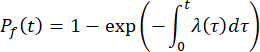
- Numerically integrate using trapezoidal integration.
- Store risk trajectories.
- Define hazard function:
4. Implement model predictive control.
- Define MPC optimization problem.
- Define cost function:
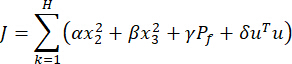
- Set a = 1, β = 0.5, y = 2, δ = 0.1.
- Set prediction horizon: .
- Define optimization variables:
U = [u1(1), u2(1),..., u1(H),u2(H)]
- Define cost function:
- Define operational constraints.
- Apply 0 < u1 <20 and 0 <u2 <10.
- Enforce and 0 < x2 <100 and 0 <x3 <50.
- Solve MPC problem.
- Linearize dynamics locally at each iteration.
- Formulate quadratic programming problem.
- Solve using:
- MATLAB quadprog:
Algorithm = interior-point-convex
Python cvxpy:
Solver = OSQP - Use maximum solver iterations: 1000.
- Apply only first optimal control action.
- Execute receding-horizon loop.
- Update enterprise state.
- Shift prediction horizon.
- Recompute optimization.
- Repeat until k=T.
5. Perform multiobjective optimization.
- Define objectives.
- Evaluate Operational cost, Energy usage, Risk level, Inventory deviation.
- Normalize all objectives before optimization.
- Execute weighted-sum optimization.
- Generate 10 weight combinations:
![Parametric constraint equation (α, β, γ) ∈ [0.5, 1, 2], mathematical formula.](/files/ftp_upload/71231/71231eq42.jpg "figure-protocol-16")
- Solve optimization for each weight combination.
- Store Pareto-optimal solutions.
- Rank solutions based on total cost and risk reduction.
- Generate 10 weight combinations:
6. Validate digital twin stability.
- Define Lyapunov function.
- Use V(e) = eTPe.
- Set P = I.
- Verify convergence.
- Compute |Ie(t)I|2.
- Verify |Ie(t)I|→0.
- Store convergence metrics.
7. Generate figures and plotted outputs.
- Store trajectories.
- Save State trajectories, Estimated states, Control inputs, Covariance evolution, Risk curves, Synchronization errors.
- Generate plots.
- Use MATLAB plot() or Python matplotlib.pyplot.
- Generate Production trajectories, Inventory evolution, Energy consumption, Risk probability, Covariance evolution, Control actions, Pareto front plots.
- Export figures: PNG format, 600 dpi resolution.
- Save figures: Figure_1.png, Figure_2.png, …, Figure_N.png.
- Export supplementary files.
- Upload MATLAB scripts (.m), Python scripts (.py), Configuration files, Generated datasets, Figure-generation scripts.
- Include README documentation for reproduction instructions and provide the complete computational implementation, configuration files, generated datasets, and figure-generation scripts as Supplementary File 1.
Access restricted. Please log in or start a trial to view this content.
Results
Execution of the proposed protocol produces a set of measurable performance indicators that illustrate how the digital twin framework improves enterprise operational stability, prediction accuracy, and risk mitigation compared with a conventional reactive control strategy. All results are generated using the explicitly defined production–inventory–energy system described in the protocol, with initial conditions
Access restricted. Please log in or start a trial to view this content.
Discussion
The protocol presented in this study demonstrates a structured workflow for implementing a digital twin capable of supporting proactive enterprise management through integrated modeling, estimation, risk evaluation, and predictive optimization. A critical aspect of the protocol is the accurate definition of the enterprise dynamic model and state variables at the initialization stage. The representation of enterprise states, control inputs, and disturbances determines how effectively the digital twin can reproduce the beh...
Access restricted. Please log in or start a trial to view this content.
Disclosures
The author has no conflicts of interest to declare.
Acknowledgements
This work was supported by the National Natural Science Foundation of China (Grant No. 2345678).
Access restricted. Please log in or start a trial to view this content.
Materials
| Name | Company | Catalog Number | Comments |
|---|---|---|---|
| High-Performance Workstation | Dell Technologies, Round Rock, TX, USA | DELL-PREC-T5820 | Multi-core computing workstation used to execute simulations, estimation algorithms, and predictive control computations |
| Industrial IoT Sensors (Optional for future real-world deployment) | Siemens AG, Munich, Germany | SI-IOT-SEN-100 | Industrial sensors used to collect real-time operational measurements such as production rate, energy usage, and environmental conditions |
| MATLAB R2024a | MathWorks Inc., Natick, MA, USA | ML-R2024a | Numerical computing environment used for implementing enterprise dynamic models, running simulations, and evaluating control strategies |
| MQTT IoT Gateway (Optional for future real-world deployment) | Eclipse Foundation | MQTT-3.1.1 | Messaging protocol gateway used for receiving and transmitting real-time sensor data streams between devices and the digital twin system |
| NumPy | NumPy Developers | NP-1.26 | Scientific computing library providing array operations and linear algebra routines for numerical simulations |
| Optimization Toolbox | MathWorks Inc., Natick, MA, USA | OPT-TBX-2401 | Toolbox used to formulate and solve constrained optimization problems in predictive control |
| Pandas | Pandas Development Team | PD-2.1 | Data analysis library used for preprocessing, managing, and analyzing time-series enterprise data |
| Python 3.11 | Python Software Foundation, Wilmington, DE, USA | PY-311 | Open-source programming environment used as an alternative platform for numerical modeling and digital twin implementation |
| SciPy | SciPy Developers | SP-1.11 | Scientific computing library used for solving differential equations, signal processing, and optimization routines |
| Simulink | MathWorks Inc., Natick, MA, USA | SL-10.8 | Graphical block-diagram environment used to construct dynamic system models and simulate control workflows |
| Statistics and Machine Learning Toolbox | MathWorks Inc., Natick, MA, USA | ST-ML-2401 | Toolbox used for probabilistic modeling, uncertainty propagation, and statistical analysis of system states |