This protocol describes tunnel handling and environmental enrichment procedures for repeated whole-body plethysmography to reduce stress-associated respiratory variability during longitudinal studies in mice.
A subscription to JoVE is required to view this content. Sign in or start your free trial.
Method Article
Tunnel Handling and Environmental Enrichment for Repeated Whole-Body Plethysmography in Mice
In This Article
Summary
Abstract
Repeated whole-body plethysmography (WBP) is widely used for longitudinal assessment of respiratory function in mice. However, handling-induced stress can introduce physiological variability that confounds treatment effects and reduces experimental reproducibility. Traditional tail handling methods may produce sustained stress responses and poor habituation across repeated sessions, potentially affecting experimental outcomes. This protocol describes refined handling and housing methods integrating tunnel handling and environmental enrichment for repeated WBP sessions. Six wild-type 129S1/SvImJ mice (3 males, 3 females) received tunnel handling and continuous environmental enrichment throughout a 10-week study. Animals underwent repeated WBP sessions, and acclimation periods were analyzed at baseline, early-study, mid-study, and late-study timepoints. Respiratory frequency during initial chamber placement (finitial, 0–2 min) and stable baseline (fbaseline, 8–10 min) were quantified to assess longitudinal acclimation patterns. Progressive changes were observed across the study timeline under the implemented conditions. Mean initial respiratory frequency decreased from 345 ± 111 SD breaths/min at baseline to 267 ± 43 SD breaths/min during late-study sessions, accompanied by reduced coefficient of variation (32% to 16%). Baseline respiratory measurements also decreased from 255 ± 67 to 193 ± 43 breaths/min (p = 0.033), consistent with improved measurement stability during later sessions. Behavioral observations showed calm acclimation with minimal defecation, urination, or agitation. This protocol provides a practical approach for laboratories performing repeated respiratory assessments in mice. Tunnel handling and environmental enrichment were associated with progressive acclimation and reduced respiratory variability during longitudinal WBP studies.
Introduction
Whole-body plethysmography (WBP) enables non-invasive assessment of respiratory function in conscious, unrestrained rodents and has become an indispensable tool for longitudinal studies in respiratory physiology, inhalation toxicology, and disease modeling1,2. The technique’s primary advantages, including its non-invasive nature and suitability for repeated measurements, make it particularly valuable for tracking respiratory changes across disease progression, therapeutic interventions, or exposure time courses. Glaab and Braun2 highlighted that noninvasive head-out body plethysmography is a reliable method for repeated lung function measurements in conscious mice, providing essential tools for translational research in airway diseases, including emerging respiratory infections. However, the quality and reproducibility of WBP measurements depend critically on achieving low respiratory frequency states consistent with behavioral quiescence, which may be compromised by handling-induced stress. Handling stress represents a well-recognized but often underappreciated source of experimental variability that can confound physiological measurements and compromise data quality. Standard laboratory practice typically involves tail handling, in which mice are grasped by the tail for transport and manipulation3,4.
Standard laboratory practice typically involves tail handling, in which mice are grasped by the tail for transport and manipulation. Gouveia and Hurst3 demonstrated that tail handling induces anxiety in mice, with handled animals showing elevated anxiety-like behavior in the elevated plus maze compared to tunnel-handled controls. This anxiety response is associated with altered physiological parameters. Rasid et al.4 used WBP to quantify the respiratory effects of routine laboratory procedures, finding that restraint and handling significantly altered minute volume in a sex-dependent manner, with effects persisting for up to 24 h post-procedure. The magnitude and duration of these handling-induced effects underscore that respiratory measurements obtained shortly after tail handling may reflect acute stress physiology rather than stable baseline function.
The broader literature on restraint and handling stress reveals impacts extending beyond immediate behavioral responses. Buynitsky and Mostofsky5 reviewed the extensive effects of restraint stress on physiological, immunological, endocrine, and developmental processes, emphasizing that stress-related confounds are often insufficiently documented in research articles. For respiratory studies specifically, the problem is compounded by the requirement for repeated measurements. Each handling event may reset the stress response, limiting progressive habituation and producing inconsistent baseline measurements across longitudinal timepoints. DeLorme and Moss1 compared restrained versus unrestrained plethysmography approaches in mice with known interstrain physiological differences, finding that although unrestrained single-chamber systems provided improved analysis of airway reactivity, the challenge of obtaining reproducible baseline measurements remained.
Tunnel handling, in which mice voluntarily enter a tunnel for transport, has emerged as an evidence-based alternative that substantially reduces handling-induced anxiety. The method’s efficacy has been demonstrated across multiple strains and experimental contexts. Gouveia and Hurst3 showed that tunnel-handled mice exhibited greater willingness to interact with handlers and lower anxiety-like behavior in elevated plus maze testing compared to tail-handled mice, with benefits observed even when tunnels were unfamiliar. Importantly, these benefits extend beyond the immediate post-handling period. Sensini et al.6 examined the effects of handling technique and handling frequency across sexes, finding that frequent tail handling reduced wellbeing-associated behaviors, such as burrowing, and increased despair-like behavior in males, whereas tunnel handling was preferred by both sexes and associated with more positive approach behaviors and fewer defensive responses. Furthermore, Davies et al.7 demonstrated that the benefits of non-tail handling persist during complex procedures. Mice exposed to tail handling throughout their laboratory experience, including during restraint procedures, showed increased responsiveness to environmental stimuli and reduced ease of handling compared to mice handled exclusively by cupping or tunnel methods.
Beyond handling method selection, systematic habituation to experimental procedures may further reduce stress-induced variability. Sorli et al.8 investigated training mice for head-out plethysmography, a restraint-based system, and found that five consecutive days of training improved tolerance, with mice demonstrating improved behavioral stability by the second day, although breathing parameters stabilized within 5 min during all sessions. Similarly, Ueno et al.9 demonstrated that repetitive gentle handling of male C57BL/6 mice before behavioral testing reduced anxiety-like behavior in elevated plus maze testing and improved spatial cognition, indicating that repeated contact with handlers can produce measurable habituation effects. These findings suggest that combining non-aversive handling methods with systematic habituation protocols may provide cumulative benefits for reducing physiological variability during repeated measurements.
Environmental enrichment represents an additional factor that can influence stress responsiveness and baseline physiology, although its effects are complex and context dependent. While enrichment generally promotes positive welfare, excessive or unpredictable enrichment may paradoxically increase physiological variability and stress-associated behaviors in some experimental contexts10,11. A balanced approach that maintains stable core elements, such as nesting material, while providing manageable novelty through periodic rotation of enrichment items may optimize welfare without introducing confounding variation12. The interaction between enrichment, handling method, and habituation protocols remains understudied in the context of repeated respiratory measurements, highlighting the need for integrated protocols that address all three factors simultaneously.
Despite growing recognition of handling effects on physiological measurements, standardized protocols specifically designed to minimize handling stress during repeated WBP sessions remain limited. Existing WBP protocols typically rely on extended acclimation periods (10–30 min per session) to allow stress-induced tachypnea to subside but rarely address the underlying handling method or systematically evaluate whether progressive habituation occurs across sessions. Furthermore, most studies do not assess whether animals achieve physiological states consistent with behavioral quiescence, such as respiratory frequencies approaching ranges reported in the literature to be associated with quiescent or sleep-related states, or instead transition from acute stress to chronic low-level arousal. Here, we present a protocol integrating tunnel handling, balanced environmental enrichment, and repeated WBP sessions across a 10-week longitudinal study. We describe an approach associated with progressive changes in respiratory frequency consistent with habituation, including decreasing initial respiratory frequencies across sessions and baseline measurements approaching ranges reported in the literature to be associated with quiescent or sleep-related states. Importantly, this protocol is presented not only as an animal welfare refinement but also as an experimental design consideration that may help reduce variability and improve consistency during longitudinal respiratory measurements.
Access restricted. Please log in or start a trial to view this content.
Protocol
Perform all procedures in accordance with protocols approved by the Institutional Animal Care and Use Committee (IACUC Protocol #23-103) at the University of Miami. House mice in an AAALAC-accredited vivarium facility with environmental conditions maintained according to institutional standards.
1. Animal Selection and Housing Conditions
- Select and prepare animals for the study
- Select animals from an established breeding colony or obtain them from a commercial vendor. For this study, use six wild-type 129S1/SvImJ mice (3 males, 3 females).
- Maintain animals under SPF (specific pathogen-free) conditions in an AAALAC-accredited facility with routine health monitoring performed according to institutional standards.
- Confirm that animals are approximately 6 months of age (young adults) at study initiation.
NOTE: Mice in this study had prior exposure to tunnel handling as part of routine husbandry. For naïve mice, implement a conditioning period before beginning WBP sessions (see Step 3.2).
- Begin experimental procedures when mice reach the age appropriate for the study objectives. In this study, mice were approximately 6 months of age (young adults) at the start of WBP sessions. For reproducibility, use mice within a defined age range (e.g., ±1 month) and report the specific ages used, as age may influence baseline respiratory parameters and habituation kinetics.
2. Environmental Enrichment Protocol
- Provide constant nesting material
- Place one compressed cotton square (approximately 5 cm × 5 cm, ~2.5 g) in each cage at every cage change.
- Transfer most of the existing nest structure intact to the new cage during cage changes using both hands.
- If accumulated nesting material exceeds approximately 10 g (approximately twice the original mass), remove the oldest and most compacted portions from the bottom while preserving the external dome structure.
- Add one fresh cotton square (5 cm × 5 cm) to the clean cage to support continued nest construction and maintenance.
- Replace nesting material only if visibly wet (urine contamination covering >25% of the surface) or if the nest has been destroyed and not rebuilt within 48 h (Figure 1A and 1C).
NOTE: Preserve nest structure to minimize stress associated with cage changes and maintain consistent olfactory and tactile cues across the study. Nest quality serves as an indicator of animal welfare and health status13.
- Assess nest building weekly using the following standardized procedure
- At each cage change, transfer the intact nest carefully to a clean surface using both hands without disturbing the structure.
- Photograph the nest from directly above with the camera positioned 30–40 cm perpendicular to the surface to visualize overall structure and crater formation.
- Photograph the nest from the side at nest height to document wall integrity and dome characteristics.
- Score the nest using the standardized 5-point Deacon scale13, where 1 = nesting material largely untouched and 5 = dome-shaped nest with a clear crater. Refer to Figure 1A–1C for examples of score 5 nests.
- Return the nest carefully to the clean cage.
NOTE: Weekly nest photographs provide objective documentation of nest quality throughout the study. Deterioration in nest building may indicate illness, stress, or other welfare concerns requiring veterinary attention.
- Provide rotated enrichment changed weekly
- Select one enrichment item and place it in the cage. Use shredded paper (plain white paper, handful-sized portion), paper towels (2–3 sheets, unscented, white, folded or crumpled), or paper-based shelters (cardboard tubes or small boxes).
- Rotate enrichment items weekly according to a predetermined schedule (e.g., Week 1: shredded paper; Week 2: paper towels; Week 3: cardboard tube; Week 4: repeat) to maintain manageable novelty.
NOTE: Weekly rotation provides novelty without overwhelming mice. Avoid plastic enrichment items, such as plastic huts, balls, or rigid structures, which may increase physiological variability11. Replace all enrichment items at each cage change.
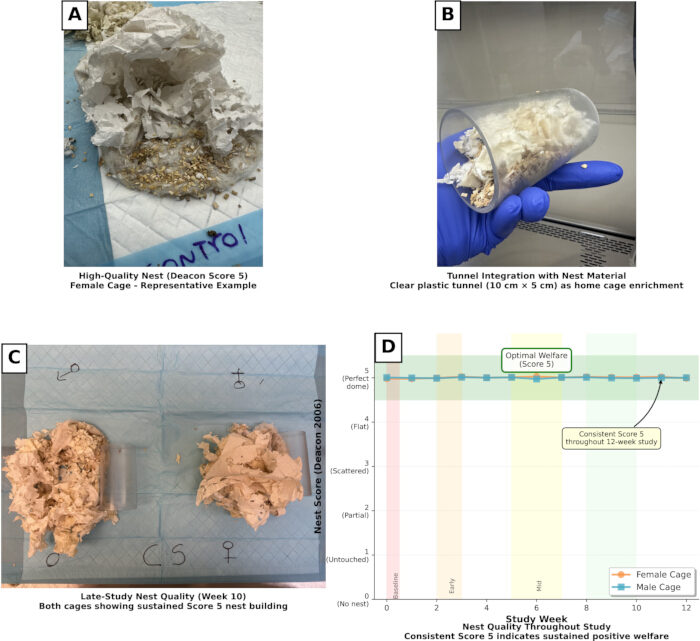
Figure 1. Protocol implementation and welfare indicators during longitudinal whole-body plethysmography (WBP) studies. (A) Representative high-quality nest (Deacon score 5) from a female cage showing a well-formed dome structure with a defined crater. (B) Clear polycarbonate handling tunnel (approximately 10 cm length × 5 cm internal diameter) integrated with nesting material in the home cage. Tunnels remained permanently in cages as enrichment and handling devices throughout the study. (C) Representative late-study nest quality (Week 10) showing sustained score 5 nest construction in both male and female cages. (D) Nest quality scores throughout the 10-week study period. Each data point represents the weekly nest score for a cage using the standardized 5-point Deacon scale13, where 1 = nesting material untouched and 5 = complete dome-shaped nest with a crater. Both cages maintained consistent score 5 nest quality throughout all study phases. The shaded green region denotes scores associated with optimal welfare conditions (scores 4–5). Study phases are indicated by colored background regions corresponding to Baseline (Week 0), Early-study (Weeks 2–3), Mid-study (Weeks 5–7), and Late-study (Weeks 8–10). Please click here to view a larger version of this figure.
3. Tunnel Handling Implementation
- Prepare handling tunnels
- Use clear polycarbonate tunnels (100 mm or 130 mm length × 50 mm internal diameter) with smooth, rounded edges (Figure 1B).
- Place one tunnel permanently in each home cage as part of the cage enrichment.
- Do not remove tunnels between handling events.
NOTE: Keeping the tunnel in the home cage allows it to acquire familiar cage odors and become associated with the home environment rather than handling procedures. Mice often use tunnels as refuges or nest sites. - At each cage change, wipe the tunnel interior with a small amount of used bedding from the previous cage before placing it in the clean cage.
- Autoclave tunnels or wash them with the same disinfectant agent used for cage sanitation if disinfection is required between uses. Rinse thoroughly and allow tunnels to air dry before returning them to the cage.
NOTE: Maintaining olfactory continuity helps minimize stress associated with unfamiliar scents. Tunnels are autoclavable and reusable.
- Condition mice to tunnel handling
- For naïve adult mice, implement a conditioning period of at least 1–2 weeks before initiating WBP sessions14,15.
- Place clear polycarbonate tunnels (see Step 3.1) permanently in the home cage and allow 3–7 days for passive familiarization.
- After passive exposure, perform daily gentle handling sessions. Encourage mice to enter the tunnel voluntarily, then lift the tunnel horizontally for 30–60 s before returning the mouse to the cage.
- Evaluate successful habituation using the following criteria: voluntary tunnel entry within 10–30 s, calm behavior inside the tunnel without escape attempts or vocalization, and spontaneous tunnel use for resting or exploration during routine cage observations14,15.
- Begin WBP sessions once all habituation criteria are met.
NOTE: Mice in this study had prior exposure to tunnel handling as part of routine husbandry before initiation of WBP sessions.
- Execute non-aversive handling
- Wear powder-free nitrile gloves for all handling procedures.
- Use tunnel handling as the primary handling method. If the mouse is inside the tunnel, lift the tunnel horizontally with one hand supporting the base.
- If the mouse is outside the tunnel, position the tunnel opening within 5–10 cm of the mouse and allow 10–30 s for voluntary entry without chasing or forcing.
- If the mouse does not enter within 30 s, encourage movement toward the tunnel using a cupped hand positioned behind the mouse without making contact.
- If the mouse does not enter after two attempts (maximum total 60 s), use the cupping method. Place a flattened hand near the mouse, allow voluntary approach for 10–20 s, then scoop the mouse gently using both hands while avoiding tail handling.
- Use the handling method that results in calm behavior, defined as absence of vocalization, escape attempts, or stress-associated defecation.
- Transfer mice to the plethysmography chamber
- Transfer the mouse from the tunnel to cupped hands before placing it into the chamber.
- Hold the tunnel horizontally and tilt the rear end (tail side) upward approximately 10–20°.
- Allow the mouse to back out of the tunnel, rear legs first, onto cupped hands.
- Lower both hands into the chamber and allow the mouse to step voluntarily onto the chamber floor within 5–10 s.
NOTE: This tunnel-to-hands-to-chamber transfer method provides improved control during chamber placement. - Alternatively, transfer the mouse directly from the tunnel into the chamber by tilting the tunnel over the chamber opening.
NOTE: Direct tunnel-to-chamber transfer provides less control during placement and was used less frequently in this study. - Never invert the tunnel vertically or shake it.
- Seal the chamber lid immediately after mouse placement and return the tunnel to the home cage.
CRITICAL STEP: Never grasp mice by the tail at any point during the study. If a mouse does not enter the tunnel within 30 s or approach a cupped hand, encourage movement gently with soft bedding without chasing or forcing interaction. Allow the mouse to choose tunnel or hand approach based on individual preference. Patience during initial sessions helps establish positive associations with non-aversive handling3,7.
4. WBP Session Protocol
- Prepare the plethysmography system
- Calibrate the whole-body plethysmograph once daily before data acquisition.
- With chambers empty and sealed, initiate the automated calibration sequence through FinePointe respiratory analysis software (target: 18–22 cm H₂O). Confirm successful calibration when the box flow effective range exceeds ±40 mL/s per site.
- Set bias flow to 1.0 L/min per chamber.
- Monitor chamber temperature (22°C–24°C) and humidity continuously using digital sensors.
- Place chambers in a quiet location with consistent lighting and minimal vibration.
NOTE: Maintain constant chamber conditions across all sessions. Temperature fluctuations alter breathing patterns and confound longitudinal comparisons1.
- Conduct WBP sessions during a consistent circadian phase
- Perform all measurements during the same time window of the light cycle.
- Conduct sessions between 08:00–10:00 (lights-on at 06:00) and avoid the first 2 h after lights-on when circadian rhythms are transitioning.
- Transport mice to the experimental room
- Transport home cages to the experimental room on a cart approximately 15 min before the session begins.
- Allow mice to acclimate to the experimental room environment while remaining in their familiar home cage.
- Place home cages near the plethysmography chambers.
- Use tunnel handling (see Steps 3.3–3.4) to transfer each mouse from the home cage to cupped hands and then into the chamber.
- Handle mice calmly and minimize abrupt movements during transfer.
NOTE: Individual mouse transfer requires only a few seconds.
- Place the mouse in the chamber
- Transfer the mouse gently from cupped hands into the chamber (see Step 3.4).
- Seal the chamber lid within 5 s of mouse placement.
- Begin acclimation and recording
- Start recording respiratory signals using the respiratory analysis software.
- Allow 10 min for acclimation without disturbance or intervention.
- Monitor behavioral stability during acclimation
- Observe the mouse continuously throughout the acclimation period.
- Record excessive movement, sustained immobility accompanied by signs of stress (e.g., rigid posture), or repeated escape attempts without periods of calm behavior in the session log.
- Recognize that such sessions may still provide valid finitial data; however, fbaseline measurements may be unreliable.
- Flag sessions with no observable calm periods during the acclimation window for potential exclusion from baseline analyses according to study-specific criteria.
- Retain all sessions in this study, as none met exclusion criteria based on acclimation behavior.
CRITICAL STEP: The 10-min acclimation period is essential for assessing habituation. Although some protocols use 20–30-min acclimation periods, well-habituated mice in this study reached stable respiratory patterns within 8–10 min, making extended acclimation unnecessary and potentially counterproductive because of increased movement.
- Observe mouse behavior during acclimation
- Observe mice continuously throughout the 10-min acclimation period through visual monitoring of the chambers.
- Note overt stress indicators, including defecation, urination, sustained escape attempts, or prolonged immobility.
- Record the presence and approximate quantity of fecal pellets and urine in the chamber after each session.
NOTE: These observations provide qualitative assessment of stress levels and habituation progress but were not formally scored using a standardized ethogram in this study.
- Analyze acclimation-phase respiratory metrics
- Use the respiratory analysis software to calculate respiratory frequency automatically from pressure signals using the default breath-detection algorithm and default threshold settings in this software.
- Acquire respiratory signals under stable airflow conditions (see Step 4.1) using standard acquisition parameters.
- Calculate mean respiratory frequency for two periods: finitial (0–2 min), representing the initial stress response and immediate post-handling physiology, and fbaseline (8–10 min), representing stabilized baseline respiratory frequency.
- Exclude periods with visible movement artifacts, defined as non-respiratory pressure deflections or irregular waveforms associated with animal movement or chamber disturbances.
NOTE: Visually inspect a subset of recordings (approximately 10%) to confirm accurate breath detection by the automated algorithm. Manual validation confirmed agreement between automated detection and observed respiratory patterns.
- Proceed with the experimental protocol if applicable
- Continue with experimental interventions after the 10-min acclimation period according to study design (e.g., aerosolized drug delivery, hypoxic challenge, exercise testing).
NOTE: No experimental interventions were performed during habituation assessment sessions in this study. The reported respiratory metrics (finitial and fbaseline) were obtained during acclimation-only sessions without additional procedures.
- Continue with experimental interventions after the 10-min acclimation period according to study design (e.g., aerosolized drug delivery, hypoxic challenge, exercise testing).
- Return the mouse to the home cage
- Use tunnel handling or cupped hands to transfer the mouse from the chamber back to the home cage.
- Observe the mouse for 5 min post-session to confirm normal behavior, including spontaneous movement, grooming, interaction with cage mates, and investigation of food and water.
- Extend observation and consult veterinary staff if abnormal behavior persists beyond 15 min, including prolonged immobility (>5 min), labored breathing, hunched posture, or failure to interact with cage mates.
NOTE: No abnormal post-session behaviors were observed in this study.
- Maintain consistent session frequency
- Conduct WBP sessions regularly throughout the longitudinal study period (10 weeks in this protocol).
- Perform sessions at weekly intervals to track habituation progression.
- Schedule sessions at consistent times of day (see Step 4.2) to maintain circadian and procedural consistency.
Access restricted. Please log in or start a trial to view this content.
Results
Application of this tunnel handling and environmental enrichment protocol to six wild-type 129S1/SvImJ mice (3 males, 3 females) across a 10-week longitudinal WBP study yielded evidence of progressive habituation and improved physiological stability. Respiratory frequency measurements were obtained during repeated WBP sessions conducted at regular longitudinal intervals, with data analyzed from four study phases: Baseline (Week 0), Early-study (Weeks 2–3), Mid-study (Weeks 5–7), and Late-study (Weeks 8–10).
Access restricted. Please log in or start a trial to view this content.
Discussion
This protocol describes an integrated approach combining tunnel handling, environmental enrichment, and repeated exposure in the context of longitudinal WBP. Under these conditions, respiratory frequency measurements showed progressive stabilization across repeated sessions, consistent with reduced arousal and progressive habituation. Several implementation factors appear important for successful protocol performance. First, tunnel handling should be introduced before experimental procedures begin. In this study, mice ha...
Access restricted. Please log in or start a trial to view this content.
Disclosures
The authors declare no conflicts of interest, financial or otherwise.
Acknowledgements
The authors acknowledge the assistance of Claude AI (Anthropic) in enhancing the grammar, style, and overall clarity of this manuscript. This artificial intelligence tool was used as a writing aid to improve readability and precision while maintaining the accuracy and integrity of the scientific content. All scientific content, data analysis, and conclusions are solely the work of the authors, who take full responsibility for the manuscript.
L.A.S. is supported by grants from the Department of Veterans Affairs Office of Research and Development Merit Review Award (1I01BX006199-01A1) and the Miami Heart Research Institute.
Access restricted. Please log in or start a trial to view this content.
Materials
| Name | Company | Catalog Number | Comments |
|---|---|---|---|
| Aspen Chip Bedding | Lab Supply | Aspen 323 | Aspen wood chip bedding. Autoclaved prior to use; placed to approximately 1 cm depth on cage floor. |
| Autoclaved Water | Facility-provided | Not applicable | Autoclaved municipal water provided ad libitum via standard water bottles. |
| Cardboard Tube | Facility-generated | Not applicable | Plain cardboard toilet paper roll. Used as rotated enrichment and shelter item. |
| Crink-I-Nest (Irradiated) | The Andersons / Lab Supply | CNKR | Shredded paper enrichment material. Gamma-irradiated. Provided as rotated enrichment on an alternating-week basis. |
| FinePointe Software | Data Sciences International | No catalog number | Respiratory data acquisition and analysis software, version 3.0. Used for WBP data collection and parameter calculation. |
| Individually Ventilated Cage (IVC) Rack | Allentown | EP5000E | Exhaust pak IVC rack, 140-cage capacity. Double-sided high-density system with automatic ventilation connections. |
| Irradiated Rodent Chow | Envigo | T.2918.15 | Standard irradiated rodent diet. Provided ad libitum via wire-bar hopper. |
| Mouse Transfer Tunnel | Braintree Scientific | TRANS-TUBE 100X50MM | Clear polycarbonate tunnel, 100 mm length × 50 mm internal diameter. Autoclavable and reusable. Used for low-stress animal transfer procedures. |
| Nestlets (Irradiated) | Lab Supply | IRR | Compressed cotton nesting squares (~5 cm × 5 cm, ~2.5 g each). Gamma-irradiated. Provided as constant enrichment; one per cage. |
| Nitrile Gloves, Powder-Free | Kimberly-Clark | KC500 | Purple nitrile powder-free exam gloves. Worn during all animal-contact procedures. |
| Non-Woven Gauze Sponge | Pivetal | 21295040 | Non-sterile, non-woven gauze sponge, 4-ply, 4 in × 4 in (10.16 cm × 10.16 cm). Used as enrichment material. |
| Paper Towel | Tork (Essity) | MB 540A | White multifold hand towel. Used as rotated enrichment material. |
| Smartphone Camera | Apple | No catalog number | iPhone smartphone camera. Used for weekly nest scoring documentation. |
| Whole-Body Plethysmography System | Data Sciences International | 10222C (2-site); 770621 (4-site) | FinePointe FP Series unrestrained whole-body plethysmography system for mice. Available in 2-site and 4-site configurations. |