This article presents a new 15-level asymmetric multilevel inverter with ten switches and three DC sources. By optimizing switching angles, an AI-based selective harmonic elimination technique lowers THD and boosts efficiency (>97%). Experiments and simulations validate improved power quality, fewer components, and medium-voltage application compatibility.
A subscription to JoVE is required to view this content. Sign in or start your free trial.
Research Article
A Novel Asymmetric Fifteen-Level Inverter for Medium Voltage Applications
In This Article
Summary
Abstract
A reduced-switch asymmetric fifteen-level multilevel inverter (MLI) topology for medium-voltage applications is shown in this article, coupled with a selective harmonic elimination (SHE) control technique aided by artificial intelligence (AI). Ten unidirectional switches and three unequal DC sources are used in the suggested arrangement to limit the total standing voltage (TSV) while producing a stepped output voltage. To find the most effective switching angles for various modulation indices, a hybrid control strategy that combines an artificial neural network (ANN) and the Newton-Raphson (NR) method is employed. A low-voltage experimental prototype is used to test the suggested topology's performance, which is assessed using MATLAB/Simulink simulations. The findings show that, under the evaluated operating conditions, the inverter can produce multi-level output waveforms with low lower-order harmonic content and good conversion efficiency. Over the assessed load range, the measured efficiency ranges from 98.6% to 97.1%, and under nominal conditions, total harmonic distortion (THD) is found to be 5.47%. The suggested topology achieves a lower switch count and competitive TSV and harmonic performance under comparable operating assumptions, according to a comparison analysis with a few multilevel inverter topologies from the literature. Nevertheless, because operational circumstances and control procedures are not completely standardized across research, these comparisons are just informative. While the suggested architecture is meant for scalable extension toward medium-voltage applications, experimental validation is carried out utilizing a low-voltage prototype to confirm switching behavior and control capabilities. The results show that the topology and control technique are feasible, even though the experimental validation is carried out at lower voltage levels. To achieve wider applicability, more validation under higher voltage circumstances and standardized benchmarking frameworks are needed.
Introduction
As a widely recognized renewable energy source, solar energy is attracting a lot of attention in the search for sustainable energy solutions. Solar technology has been widely used due to constant enhancements in efficiency and cost reduction. Solar power is essential for reducing dependency on fossil fuels and slowing down climate change as countries move toward greener energy systems. The cost-effectiveness and environmental advantages of photovoltaic (PV) energy make it unique. The goal of ongoing research and system development is to maximize PV cell energy extraction while guaranteeing smooth grid integration. Multilevel inverters (MLIs) have become an essential technology in recent years because of their capacity to manage large power levels and provide benefits like lower switching losses, better power quality, and less harmonic distortion with improved electromagnetic interference capabilities1,2,3,4,5.
MLIs use a broad range of DC sources and power electrical circuits made up of several semiconductor switches to create stepped voltage waveforms6. As more levels are added, the waveform's quality improves. However, the increasing number of components makes it difficult to achieve good reliability and efficiency, which raises costs7. For MLIs to operate well, especially in renewable energy applications, a steady and dependable DC power supply is essential. By controlling voltage levels and lowering fluctuations, DC/DC converters greatly improve voltage quality and system reliability. For example, a robust sliding mode control for a quadratic boost converter, as suggested in8, has shown enhanced dynamic response and system stability. In a comparable manner, a comparative analysis of high-gain DC/DC converter topologies in9 reveals sophisticated methods for boosting voltage, which qualify them for integration with MLIs in PV applications.
Flying capacitor (FC), cascaded H-bridge (CHB), and diode-clamped or neutral point clamped (NPC) are the three main MLI topologies10. Several single-phase H-bridge units make up the CHB inverter, which is further divided into symmetric and asymmetric variants according to the DC voltage levels11. Three output levels are produced by conventional CHB inverters: zero, negative, and positive. Each unit's individual output voltage is added up to determine the overall output voltage12,13. While FC and NPC inverters present difficulties in voltage balancing at higher voltage levels, CHB inverters are favored for medium- and high-voltage applications14.
A unique structure with fewer switches is suggested in15, although it has the drawback of requiring several power sources. To address these challenges, the optimal use of semiconductor devices is crucial. An asymmetric inverter topology with bidirectional power switches is presented in16, which raises the cost of the inverter by increasing the number of IGBTs. Other designs concentrate on raising voltage levels while decreasing the number of power switches17,18. A full-bridge converter is employed to transform the DC step output created by the systems into an AC step. Because of the voltage-blocking limitations of the full-bridge converter, applications are restricted to high-voltage situations.
Several innovative topologies, such as the three-phase system made up of three single-phase units described in a study19, are designed to reduce the number of components for single-phase and three-phase systems. Subunit MLIs are used by some topologies to produce multilevel outputs with fewer switches and DC sources20. Bidirectional switches connected in antiparallel are used in some systems to reduce the number of switches and allow current conduction in both directions21,22,23,24. Blocking voltage across switches is reduced by cascading subunits, creating a modular framework. Nevertheless, an increase in output levels causes a corresponding increase in the number of switches, which is still a disadvantage. Novel MLI configurations that offer various levels while cutting components and blocking voltage are therefore in constant demand, ultimately lowering inverter costs. A new MLI topology called a packed H-bridge has basic units connected on both sides of a whole bridge25,26. On the other hand, other designs focus on reducing voltage stress on circuit switches by doing away with the H-bridge. However, many of these topologies require many components. To minimize switches, capacitors, and standing voltage while optimizing output voltage steps27, investigates a hybrid cascade multilevel inverter (HCFMLI) design that includes a standard three-leg and H-bridge cells at the bottom section. In a study28,29, a comparison of cascaded MLI topologies using symmetric and asymmetric configurations is provided.
A study suggests a cascade design for multilevel converters based on sub-multilevel units connected in series, with two ways to calculate the magnitudes of DC sources30. A study describes a sparse 13-level inverter with 14 switches, four capacitors, and two diodes that uses a single DC source to provide a six-fold-boosted output voltage31. All possible output voltage levels are produced by the cascade topology suggested in a study32, and comparative analysis shows that it is superior to more modern multilevel converters33. A single-phase MLI with symmetrical and asymmetrical output voltages is introduced by the topology in another study34. Another research35 offers a single-phase-based multilevel topology that supports an asymmetric DC source configuration, which achieves a 15-level output while reducing space and cost.
Although several fifteen-level inverter topologies have been documented in the literature, different trade-offs in complexity, cost, and harmonic performance are caused by variations in switch count, DC source configuration, and control methodologies. Table 1 summarizes a structural comparison of representative fifteen-level inverter topologies to put the suggested design in context. The comparison focuses on important factors like the number of switches, DC sources, and control strategy. Because operating conditions and evaluation measures vary across research, this comparison is suggestive and based on stated configurations.
This work contribution can be formed into two classifications: (i) a topology contribution, which consists of a fifteen-level inverter based on an asymmetric topology with fewer switches; and (ii) a control contribution, which uses an AI-assisted selective harmonic elimination (SHE) technique to find the best switching angles to remove lower-order harmonics while preserving basic voltage control. The use of an artificial neural network (ANN) to learn the nonlinear relationship between modulation index and optimal switching angles derived from the selective harmonic elimination (SHE) formulation is particularly referred to as "AI-based" in this work. By offering near-optimal initial solutions that are then refined via the Newton-Raphson method, the ANN functions as a data-driven predictor that dramatically reduces computational effort. Compared to solely numerical methods, this hybrid approach allows for quicker convergence and easier practical application.
The key objective is to develop a novel single-phase system design that utilizes an asymmetrical source approach, enabling current conduction with a minimal number of power devices. This article proposes a fifteen-level (15L) inverter for low-voltage applications like solar energy generation, electric automobiles (EVs), and other high-powered specifications. Figure 1 illustrates the connection of rooftop solar panels, Battery, Fuel cells, Super Capacitor, a DC-DC converter, and Electric drive load through the proposed Multilevel Inverter (MLI). Scalable multilevel operation is the main emphasis of the suggested inverter's development. The design concepts are meant to facilitate extension toward medium-voltage applications, subject to suitable device selection, insulation design, and system-level concerns, even if the current work validates the topology using a low-voltage laboratory prototype. The following are the main contributions of this study: 1) A novel asymmetric MLI topology based on CHB, which maintains high output voltage levels while using fewer power semiconductor switches, 2) Optimization of the cost function and total standing voltage (TSV) to increase economy and efficiency and 3) Comparison analysis shows the proposed topology outperforms current systems in terms of efficiency and reduces total harmonic distortion (THD).
Access restricted. Please log in or start a trial to view this content.
Protocol
Topology configuration
Figure 2 displays the recommended architecture, which consists of 10 switches and three voltage sources arranged asymmetrically. The DC sources in the suggested 15-level inverter have a ratio of 1:2:4. This ratio is not arbitrary; it was selected to minimize the number of DC sources while allowing for the creation of a wide range of voltage combinations. The chosen values increase the number of output levels by permitting the production of discrete voltage steps without duplication. All materials used in this study are listed in the Table of Materials.
Switching modes
The switching states for this method are displayed in Figures 3 and 4. Red indicates the conducting path and green the non-conducting path of the matching switches in Figures 3 and 4. Ten switches with three preferred voltage sources are placed to create levels in a natural sequence of magnitude. Table 1 lists the switches that are utilized to produce the necessary voltage levels. In Table 2, 0 denotes nonconductivity, and 1 denotes the conductivity path of the switches. The operating modes of the proposed topology are as follows.
0Vdc: To attain zero voltage in this operating mode, either S1, S2, S3, S7, and S9 conducts as depicted Figure 3A.
±1Vdc: S1, S5, S6, S7, and S9 conduct in accordance with the modes shown in Figure 3B for acquiring +1Vdc output voltage. To get -1Vdc as output voltage, S2, S3, S4, S8, and S10 conduct as indicated by the corresponding modes in Figure 4A.
±2Vdc: To obtain +2Vdc as the output voltage, S3, S4, S6, S7, and S9 turn on in the manner shown in Figure 3C. S1, S2, S5, S8, and S10 are conducted in the same way as indicated in Figure 4B mode to achieve an output of -2Vdc.
±3Vdc: To provide +3Vdc output voltage depicted Figure 3D, S1, S3, S6, S7, and S9 conducts respectively. As demonstrated in Figure 4C S2, S4, S5, S8, and S10 conduct in a similar manner to produce -3Vdc output voltage.
±4Vdc: S1, S2, S3, S7, and S8 conducts in the manner illustrated in Figure 3E in to operate +4Vdc as the output voltage. S4, S5, S6, S9, and S10 are conducted in the sequences shown in Figure 4D, to get an output voltage of -4Vdc.
±5Vdc: The switching sequence for generating +5Vdc as output voltage is depicted in Figure 3F. Figure 4E exhibits the conductivity pattern of the switches to provide an output voltage level of -5Vdc.
±6Vdc: The corresponding switching patterns that yield +6Vdc as the output voltage are shown in Figure 3G. Figure 4F shows the switch pattern utilized to deliver an output voltage of -6Vdc.
±7Vdc: S1, S3, S6, S7, and S8 conducts as it is shown in Figure 3H to develop output voltage of +7Vdc. S2, S4, S5, S8, and S9 conduct as illustrated in Figure 4G to achieve an output voltage of -7Vdc.
Modulation method
In this work, a low-frequency control technique is used for analyzing the efficacy of the proposed inverter. Selective Harmonic Elimination (SHE) takes advantage of a low switching frequency methodology to perform the operation of the MLI. Low-order harmonics are efficiently eliminated via SHE, which additionally minimizes switching losses. However, using this method necessitates resolving several challenging transcendental equations. Figure 4 displays the switching angles taken into consideration for a quarter-wave symmetry. The waveform for an m-level (m is an odd number) output voltage waveform has 2(m-1) switching angles. Figure 5 shows the division of switching angles into four quadrants. Main switching angles are those in the first quadrant, which spans from 0 to π/2. The remaining quadrant angles can be readily determined using the major switching angles.
To reduce the inverter's overall total harmonic distortion (THD), the SHE technique aims to remove lower-order harmonics. Given that the output has 15 levels, the suggested inverter uses SHEPWM to target and eliminate lower-order harmonics like the third, fifth, seventh, ninth, eleventh, and thirteenth. Small filters can be used to successfully suppress higher-order harmonics. The output voltage waveform mathematical expressions are obtained using the Fourier series. The following equations provide these expressions:
 (1)
(1)
Where a0= DC component
an= Even Harmonic
bn=Odd Harmonic
In this case
 (2)
(2)
 (3)
(3)
![Fourier series coefficient equation \[b_n=\frac{1}{2\pi}\int_0^{2\pi} f(t)\sin n\omega t \,dt\].](/files/ftp_upload/71330/71330eq4.jpg "figure-protocol-4") (4)
(4)
The output waveform quarter-cycle symmetry cancels out the even-order harmonics (an = 0) and DC Component(a0 = 0), leaving just the odd harmonics (bn). Therefore, the multilevel inverter output equation is expressed as
 (5)
(5)
Since it is a 15-level inverter, for one quarter cycle, 7 firing angles are used to determine the peak voltage of each harmonic component. The following equations represent peak harmonic components.
 (6)
(6)
 (7)
(7)
![static equilibrium; b₅=ΔV₁c/5π[Σcos5α]; formula; relevant to physics calculations](/files/ftp_upload/71330/71330eq8.jpg "figure-protocol-8") (8)
(8)
![Fourier series equation; b_n = (4*A_c/pi) * [cos(7*a_1) + ... + cos(7*a_n)], n=7; mathematical formula.](/files/ftp_upload/71330/71330eq9.jpg "figure-protocol-9") (9)
(9)
 (10)
(10)
 (11)
(11)
 (12)
(12)
It is necessary to adjust the voltage magnitudes of the third, fifth, seventh, ninth, eleventh, and thirteenth order harmonics to zero of the above equations to remove them from the load.
 (13)
(13)
The modulation index (M) of the inverter can be computed by
 (14)
(14)
The Newton-Raphson (NR) method is used to compute the firing angles, and the main goal of SHE PWM is to reduce harmonic values as much as possible. The NR approach begins the solution of nonlinear equations with an initial estimate, which is a random number between 0 and 90◦. Iterations with numbers are represented by j and e. The NR approach involves the following actions.
Step 1: To find the firing angles, initial values are set.
![Mathematical sequence formula α^0 = [α1^0, α2^0, α3^0,..., αn^0], equation, research analysis.](/files/ftp_upload/71330/71330eq15.jpg "figure-protocol-15") (15)
(15)
Step 2: Use the Jacobian matrix for "n" variables in the "k" iterations to calculate the values for the nonlinear equation and dα.
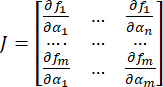 (16)
(16)
 (17)
(17)
Step 3: If δα is greater than the threshold, repeat step 4. If the threshold is equal to or greater than δα, stop the process.
Step 4: Once Equation (18) has updated the αvalue, move to Step 2.
 (18)
(18)
To determine the ideal switching angles, Artificial Neural Networks (ANN) and the Newton-Raphson approach are used. For its training procedure, an ANN needs initial inputs. The internal layers of the artificial neural networks employed in this method are depicted in Figure 6. To provide the ideal switching angles, it consists of two hidden layers (H1 and H2) placed between the input and output layers and a single input layer with a value of Vdc. The model is made nonlinear by using a "tanh" activation function, which has a range of -1 to 1′. By assigning a weight to each of their inputs, individual neurons (Yi) are computed. K is a value between 0 and the number of neurons in the preceding layer. The output values are scaled within the designated range by using the tanh function. The following is a description of this
 (19)
(19)
It should be mentioned that Wk stands for each neuron's weight, Xk for the kth neuron's output, and Bi for the hidden layer's bias. The error metrics are computed using the mean squared error (MSE) loss. The Back Propagation approach, which uses the Adam optimizer to modify the weights of each layer, is used to lessen error loss.
 (20)
(20)
The flowchart in Figure 7 describes the hybrid ANN-NR algorithm's optimization procedure. A hybrid Artificial Neural Network (ANN) and Newton-Raphson (NR) technique is used to guarantee accurate and computationally efficient calculation of optimal switching angles as nonlinear selective harmonic elimination (SHE) equations are solved using the Newton–Raphson method over a modulation index range of 0.6 ≤ M ≤ 1.0 to create the training dataset offline. Valid switching angle sets (α₁–α7) that meet harmonic removal requirements for the third, fifth, seventh, ninth, eleventh, and thirteenth harmonics are found and saved for each modulation index,2. One input neuron that represents the modulation index (M), two hidden layers, and seven output neurons that indicate switching angles α₁ through α7 make up a feedforward neural network. There are fifteen neurons in the first hidden layer and ten in the second. The output layer has a linear activation function, but the hidden layers employ hyperbolic tangent (tanh) activation functions to add nonlinearity. Both input and output data are standardized to the range [−1, 1] in order to enhance training stability and convergence. Before training, the modulation index and switching angles are appropriately scaled, and during inference, they are rescaled.
The dataset is split 60:20:20 into training, validation, and testing sets. The Adam optimization technique with a learning rate of 0.001 and mean squared error (MSE) as the loss function is used to train the network. To avoid overfitting, training is conducted for up to 1000 epochs with early halting. Training is stopped when the MSE drops below a predetermined threshold or when the validation loss does not improve over 50 consecutive epochs (patience criterion). Initial switching angle estimations for a specific modulation index are provided by the trained ANN during operation. The Newton–Raphson iterative solution then uses these estimations as starting conditions. The NR approach ensures accurate harmonic removal by fine-tuning the ANN outputs to perfectly fulfill the nonlinear SHE equations.
When the residual magnitudes of the intended harmonics (3rd–13th) are less than 0.5%, and the switching angles meet the necessary ordering restriction, a solution is deemed valid:
0 < α1 < α2 < α3 < α4 < α5 < α6 < α7 < π / 2. Rapid convergence and dependable harmonic suppression over the whole modulation index range are the results of this hybrid ANN–NR strategy, which combines the excellent accuracy of iterative numerical techniques with the quick prediction power of neural networks. Table 2 displays information on several parameters (α1 to α7) and measurements (5th, 7th, 11th, and 13th) for a range of MI values. These numbers appear to reflect measurements or traits associated with the MI values. Figure 8A shows how switching angles vary with respect to the modulation index, and Figure 8B shows how harmonic order varies with respect to the modulation index.
Performance analysis
In this study, we assess the performance of the suggested fifteen-level asymmetric inverter by concentrating on voltage stress distribution, conversion efficiency, power loss characteristics, and device utilization—all of which have a direct impact on practical implementation. The maximum blocking voltages across all switches under various operating conditions are added up to determine the total standing voltage (TSV). We note that voltage stress is not evenly distributed among devices based on the switching states indicated in Table 2. For instance, switches S1, S2, S5, S9, and S10 encounter blocking voltages of Vdc, 3Vdc, 2Vdc, 4Vdc, and 4Vdc, respectively, at the +6Vdc working level.
For this setup, the peak voltage stress of switching devices connected to the source (V3) is the same, whereas switching devices connected to sources (V1 and V2) have different values. The following equations display the switch's maximum voltage stress.
VS1 = VS4 = V1 = Vdc (21)
VS3 = VS5 = V2 = 2Vdc (22)
VS2 = VS6 = V1 + V2 = 4Vdc (23)
VS7 = VS8 = VS9 = VS10 = V3 = 4Vdc (24)
where VSn represents the device maximum voltage stress while it is in the off position. The total standing voltage (TSV) for the proposed design is expressed as (25).
TSV = 2 * VS1 + 2 * VS3 + 2 * VS2 + 4 * VS7 = 30 Vdc (25)
The asymmetric DC source arrangement and switching sequence directly result in the non-uniform stress profile depicted in Figure 9. The uneven distribution requires careful device rating and selection to prevent overstressing components, even though the overall TSV is lower than with traditional designs. In the framework of the suggested topology, we also evaluate the connection between the number of switches and attainable voltage levels. The current architecture uses 10 switches to accomplish fifteen levels, in contrast to traditional cascaded structures, where level enhancement usually requires proportionate increases in components. According to our investigation, conduction routes are reused across several operating modes to achieve this reduction. Nevertheless, this method restricts simple scalability to higher voltage levels and adds more restrictions to switching logic.
The equation (26) is obtained by computing the cost factor utilizing all the terms that depend on the number of sources (Ns), switch count (Nsw), gate driver circuit count (Ndrivers), diode count (ND), capacitor count (NC), cost factor (CF), and efficiency. In this case, δ represents the weighting factor. Components are given more weight when δ is less than 1, whereas Total Standing Voltage (TSV) (p.u.) is given more weight when δ is greater than 1. If δ = 1, then the component weights and TSV (p.u.) are equal. For all of the topologies discussed in this study, δ is assumed to be 1.
CF = Ns + Nsw + Ndrivers + ND + NC + δ*TSV(p.u.) (26)
The efficiency of the inverter is often expressed as equation (27).
 (27)
(27)
where power output, power input, and power losses are represented by Pout, Pin, and Plosses, respectively. Switching losses and conduction losses are the three types of power losses in the suggested topology. Switching losses: These losses result from quickly turning devices on and off in a single cycle. The formula is used to express the switching losses brought on by transitions.


 (28)
(28)


 (29)
(29)
The turn-on loss, turn-off loss, and off-state voltage of the ith switch are denoted by Pswlturnon(i), Pswltunoff(i), and Vswoff, respectively. ion and ioff represent the currents in the switch's on and off states. Equation (30) shows how these losses are added up to determine the overall switching losses (Psw(Total)).
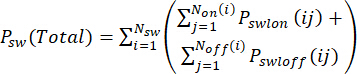 (30)
(30)
Conduction losses: A switch's conduction losses are represented as
 (31)
(31)
 (32)
(32)
where Vdon and Vswon represent the on-state voltage drops of the diode and switch, respectively, and PDcon and Pswcon represent the conduction losses of the diode and switch. The on-state resistance of the diode and switch is represented by RDon and Rswon, while the average and RMS currents of the switch are represented by iDavg, iswavg, iDrms, and iswrms.
For the chosen devices, standard datasheet-based characteristics are used to configure the PLECS semiconductor models. Switching losses (Pon, Poff), conduction parameters (RDon, VDon), and thermal resistances are specified using nominal datasheet values and scaled internally by PLECS in accordance with instantaneous operating circumstances when full curve-fitting from manufacturer data is not available.
Using the PLECS simulation platform depicted in Figure 10, we undertake loss analysis to assess power dissipation, considering device-level features for both conduction and switching losses. We find that the distribution of losses changes dramatically depending on the load. Conduction losses predominate under purely resistive loading because certain switches experience constant current flow. On the other hand, phase lag between voltage and current causes switching losses to rise for RL loads, which results in increased energy dissipation during switching transitions. Figures 11A and 11B demonstrate this behavior, with some switches continuously showing larger loss concentrations based on their conduction role.
As shown in Figure 12, the total efficiency of the inverter is calculated by comparing output power to input power throughout a variety of operating conditions (0–2000 W). According to our findings, efficiency drops to 97.1% close to rated circumstances from 98.6% at lower power levels. We explain this tendency by pointing out that when the current magnitude increases, switching and conduction losses contribute more. The observed change suggests that loss mechanisms become more prominent at greater load levels and should be taken into consideration in thermal design, even though the efficiency remains good.
It is crucial to stress that these performance measures are derived under simulation conditions, which presuppose simplified parasitic modeling and idealized switching behavior. In real-world applications, other elements like dead-time insertion, gate driver delays, stray inductances, and temperature-dependent device properties can change efficiency and loss distribution. Consequently, the results do not fully capture all real-world operating impacts, even if they offer a consistent basis for comparison evaluation. TSV, efficiency, and loss distribution are frequently employed as benchmarking criteria in multilevel inverter analysis, and the performance evaluation approach used in this work is in line with accepted procedures in this field. However, we point out that the topology, switching technique, and operating conditions considered in this work are intrinsically dependent on the quantitative results.
The suggested asymmetric fifteen-level inverter and a few multilevel inverter topologies from the literature are contrasted in Table 3. Key structural and performance-related factors, such as switch count, number of DC sources, control technique, and general operating characteristics, are the focus of the comparison. It has been noted that certain current arrangements, such as those in24,25, use more switches (up to 16) or rely on hybrid or high-frequency modulation techniques, which may result in increased control complexity and switching losses. Although they work under different modulation schemes and design limitations, other reduced-switch topologies, such as27, achieve a lower device count.
Under a low-frequency SHE-based control framework, the suggested architecture produces a fifteen-level output using ten switches and three DC sources. When compared to certain reference designs, the topology exhibits a lower switch count and a moderate total standing voltage (TSV) for this setup and operating state. It should be highlighted, nonetheless, that the provided comparisons are based on data from the literature, and that not all studies use the same operating circumstances, modulation systems, and load assumptions. As a result, it is impossible to prove direct one-to-one performance equivalency. Instead of offering a fully adjusted baseline, the comparison is meant to offer a structural and suggestive assessment. Overall, within the assessed working range, the suggested configuration provides a workable trade-off between component count, control complexity, and harmonic performance.
Access restricted. Please log in or start a trial to view this content.
Results
Simulation results
The fifteen-level operation is simulated using the MATLAB/Simulink interface. The load parameters are 100 Ω and 100 mH, respectively, and the source voltages for fifteen levels are classified as 100 V, 200 V, and 400 V. The suggested inverter operates at 50 Hz, which is its fundamental frequency. The inverter performance under resistive loading conditions is displayed in Figure 13. Figure 14 depicts...
Access restricted. Please log in or start a trial to view this content.
Discussion
The reduced-switch asymmetric fifteen-level inverter topology combined with an AI-assisted selective harmonic elimination (SHE) technique is presented in this article. The suggested arrangement is appropriate for medium-voltage applications like solar systems and electric drive interfaces because it strikes a good balance between switch count, total standing voltage (TSV), and harmonic performance. The topology can generate high-quality stepped voltage waveforms with a reported efficiency surpassing 97.1% under nominal o...
Access restricted. Please log in or start a trial to view this content.
Disclosures
The authors declare no conflicts of interest.
Acknowledgements
The authors declare that this research did not receive any specific grant from funding agencies in the public, commercial, or not-for-profit sectors.
Access restricted. Please log in or start a trial to view this content.
Materials
| Name | Company | Catalog Number | Comments |
|---|---|---|---|
| Current Sensor | Hall-effect sensor | — | Used for current measurement |
| DC Power Supply (Isolated) | Laboratory Supply | — | 10 V, 20 V, 40 V isolated DC sources |
| Digital Storage Oscilloscope (DSO) | Tektronix | — | Used for waveform observation and measurement |
| DSP Controller | Texas Instruments | TMS320F28379D | Used for pulse generation and control implementation |
| Gate Driver Circuit | Custom-built Driver IC | IR2110 | Used for MOSFET switching control |
| Inductive Load | — | — | 30 mH inductor |
| MATLAB/Simulink | MATLAB | Version (2025a) | Used for simulation and analysis |
| MOSFET | Infineon | IRFP460 | 500 V, 20 A power switch used in inverter |
| PCB / Breadboard Setup | Custom | — | Used for hardware implementation |
| Personal Computer | — | — | Used for simulation and DSP programming |
| PLECS Software | PLECS | Version (5.0.3.) | Used for thermal and loss analysis |
| Power Diode | ON Semiconductor | MUR860 | 600 V, 8 A fast recovery diode |
| Power Supply Unit | — | — | Auxiliary supply for control and driver circuits |
| Resistive Load | — | — | 30 Ω power resistor |
| Voltage Probe | Tektronix | — | Used for voltage waveform acquisition |