This protocol presents a reproducible survey workflow for data collection, quality screening, and moderated mediation analysis in college students.
Method Article
A Reproducible Survey Workflow for Examining Psychological Resilience, Sense of School Belonging, and Higher-Order Thinking in College Students
1Vocational Education Research Institute, Liuzhou Polytechnic University, 2College of Humanities, Qujing Normal University 222 Sanjiang Avenue, 3School of Educational Science, Yili Normal University, 4School of Distance Education, Universiti Sains Malaysia, 5School of Psychology, Shinawatra University
Opens in a new tab
In This Article
Summary
Loading...
$$\rightleftharpoonup{xx}$$
$$\longleftharp{xx}$$,
$$\longrightharp{xx}$$,
Abstract
Loading...
$$\rightleftharpoonup{xx}$$
$$\longleftharp{xx}$$,
$$\longrightharp{xx}$$,
This method article presents a reproducible cross-sectional self-report survey protocol for examining associations among psychological resilience, sense of school belonging (SSB), higher-order thinking, and internet gaming disorder (IGD) in college students. In this protocol, new employment patterns are treated as a contextual background shaped by generative artificial intelligence, platform-based work, and changing graduate skill expectations rather than as a participant-level exposure variable. The protocol integrates institutional sampling, questionnaire administration, translation documentation, response-quality screening, missing-data handling, scale scoring, common-method-bias screening, variable centering, and conditional process analysis into one standardized workflow. SSB is specified as a statistical mediator, and IGD is specified as a moderator within an association-based moderated mediation framework. Representative outputs include sample-flow records, descriptive statistics, correlation matrices, mediation and moderated mediation estimates, conditional indirect effects, the index of moderated mediation, and interaction plots. Because the representative dataset is cross-sectional and self-reported, the protocol supports transparent estimation of statistical associations rather than causal or longitudinal inference. By standardizing preprocessing decisions and model specifications before analysis, this workflow improves transparency, comparability, and reproducibility in educational and behavioral survey research.
Introduction
Loading...
$$\rightleftharpoonup{xx}$$
$$\longleftharp{xx}$$,
$$\longrightharp{xx}$$,
New employment patterns shaped by generative artificial intelligence, platform-based work, and cross-domain occupational integration have changed how universities discuss graduate preparedness and student development1. In this article, new employment patterns are treated as a contextual framing condition rather than a measured participant-level exposure. The protocol does not classify students according to their direct participation in platform labor, gig work, or artificial intelligence-mediated employment. Instead, this context explains why higher-order thinking (HOT), psychological resilience (PR), and school-based support are relevant constructs for college students facing increasingly uncertain educational and career transitions. This clarification is necessary because the protocol is designed for cross-sectional behavioral survey research rather than for estimating the effects of a measured employment-pattern exposure.
Within this context, graduates are increasingly expected to solve unfamiliar problems, transfer knowledge across domains, evaluate information critically, and make adaptive decisions under uncertainty2. Recent labor-market and higher-education discussions also point to a continuing mismatch between employer expectations and graduate preparedness, particularly in communication, collaboration, independent problem solving, and innovation3. These demands have made HOT a useful outcome construct in educational and behavioral research concerned with student adaptation under changing employment conditions4.
HOT refers to advanced cognitive activities beyond recall and basic comprehension, including analysis, evaluation, decision making, problem solving, and creative thinking5. Building on the classic distinction between lower-order and higher-order cognition, prior research emphasizes that HOT involves knowledge transformation rather than simple knowledge reproduction and that it is closely related to authentic problem contexts, integration of prior knowledge, and cognitive flexibility6. Under digitally mediated employment and learning environments, students are often required to interpret complex information, work with intelligent tools, and maintain cognitive autonomy when information is abundant but uneven in quality7. These conditions make HOT an appropriate focal construct for a reproducible behavioral research protocol.
PR is included in this protocol because it is theoretically and empirically related to students’ adaptive functioning under stress and uncertainty8. Although definitions of PR differ across outcome-based, trait-based, and process-based perspectives, most accounts converge on the idea that PR reflects the capacity to regulate oneself, recover from difficulty, and maintain functional adaptation in challenging conditions9. In the present protocol, PR is not treated as a proven causal determinant of HOT. Rather, it is modeled as an independent variable that may be statistically associated with HOT in a cross-sectional dataset. This wording is consistent with the design boundary of the study and avoids implying temporal ordering that the data cannot establish. This association is plausible because students with stronger PR may be more capable of maintaining goal-directed engagement, constructive coping, and adaptive reasoning when facing academic and career-related pressure10. Prior empirical work has linked PR with problem solving, critical thinking, and adaptive cognition, although direct evidence connecting PR to HOT remains limited11. For this reason, the present article uses the relationship between PR and HOT as a representative modeling example through which the full survey-to-analysis protocol can be demonstrated.
Sense of school belonging (SSB) is incorporated as a statistical mediator in the protocol. It is generally defined as students’ perceived experience of being accepted, respected, supported, and connected within the school community12. Most definitions emphasize an emotional and relational bond with the institution, teachers, and peers formed through participation, recognition, and support13. In a changing employment context, SSB is relevant because students often rely on university-based guidance, peer interaction, and institutional resources when preparing for uncertain academic and occupational futures14.
Existing studies suggest that PR is positively associated with SSB. Students with stronger PR may be more likely to seek support, maintain constructive engagement, and preserve a sense of connection with teachers and peers when facing stress15. SSB has also been associated with collaborative problem solving, critical thinking, creativity, and deeper engagement in learning activities16. On this basis, the present protocol specifies SSB as a statistical mediator between PR and HOT. This specification should be interpreted as an association-based mediation model suitable for cross-sectional survey data rather than as evidence that PR temporally causes SSB or that SSB causally produces HOT.
Internet gaming disorder (IGD) is included as a moderator because digital behavior may shape the strength of associations among PR, SSB, and HOT. IGD refers to persistent and recurrent gaming behavior associated with clinically meaningful impairment and has received increasing attention in student populations with intensive digital exposure17. Prior studies have linked problematic gaming with disrupted routines, reduced sleep quality, lower social support, weaker coping capacity, and poorer academic engagement18. These findings support the view that higher levels of IGD symptoms may weaken adaptive educational and psychosocial functioning.
At the same time, gaming-related behavior should not be interpreted simplistically. Some game environments involve strategic decision making, feedback-based learning, and cognitive challenge, but these features do not mean that IGD itself is beneficial19. In the present protocol, IGD is treated only as a statistical moderator of association patterns. Any interaction involving IGD is interpreted cautiously as a conditional association within the representative dataset rather than as clinical evidence that gaming disorder improves cognition or strengthens school functioning.
Despite growing interest in PR, SSB, HOT, and student digital behavior, a methodological gap remains. Many studies report associations among these constructs, but fewer provide a transparent and reproducible protocol linking participant recruitment, survey administration, translation documentation, invalid-response screening, missing-data handling, scale scoring, reliability screening, common-method-bias screening, variable centering, and conditional process analysis within one auditable framework. This gap is especially relevant for educational and behavioral survey research, where results may be difficult to reproduce if preprocessing rules and model decisions are only partially reported.
To address this gap, the present method article provides a reproducible protocol for conducting a cross-sectional self-report survey and generating representative moderated mediation outputs. The protocol uses PR, SSB, HOT, and IGD as an applied example, but its primary contribution is methodological rather than causal. The protocol demonstrates how to construct a sampling frame, administer a standardized questionnaire, document translation and scoring decisions, apply prespecified screening rules, prepare an analysis-ready dataset, and estimate conditional process Models 4 and 59 using fixed reporting rules. Compared with less standardized survey-analysis approaches, this protocol improves transparency, comparability, reproducibility, and auditability by documenting preprocessing decisions and model specifications before interpretation. By presenting these steps as a unified procedure, the article provides researchers with a reproducible framework for educational and behavioral survey research on college student adaptation and HOT development.
Protocol
Loading...
$$\rightleftharpoonup{xx}$$
$$\longleftharp{xx}$$,
$$\longrightharp{xx}$$,
This study was approved by the Ethics Committee of Liuzhou Vocational and Technical College (protocol code: LVTC-2024-02-879; approval date: February 1, 2024). Obtain electronic informed consent before questionnaire access. Remove direct identifiers before data export and analysis. Store raw, cleaned, analysis-ready, scoring, screening, and output files in restricted-access folders.
1. Recruit participants using a prespecified multistage random sampling workflow
- Build and lock the institutional sampling frame
- Define new employment patterns as the contextual background of the study rather than as a participant-level measured exposure.
- Identify candidate institutions through public education records, university websites, teaching-reform notices, employment-guidance documents, and curriculum or training announcements.
- Include institutions that are recognized higher-education institutions in mainland China, enroll full-time college students, maintain verifiable records of artificial intelligence-related, digital-learning, career-readiness, innovation, or HOT training, provide roster-based sampling access, and agree to the standardized anonymous online survey procedure.
- Exclude institutions without verifiable training records, current rosters, active student enrollment during the survey period, or the capacity to follow the same administration protocol.
- Retain 32 eligible institutions and assign institution codes from I-01 to I-32.
- Lock the institutional sampling frame before random selection. Use a prespecified sampling frame and fixed selection rule to reduce post hoc sampling decisions in multisite survey research20.
- Perform institution-level and student-level random selection
- Use a seed-based random-number procedure for institution-level selection.
- Set the random seed to 20241007.
- Generate random numbers for the 32 eligible institutions, sort the values in ascending order, and select the first three institution codes. Select institution codes I-07, I-18, and I-29.
- Obtain current class rosters from the three selected institutions and verify active enrollment during October 7, 2024 to November 15, 2024.
- Include full-time students aged 18-25 years who can read Chinese, appear on the institutional roster, access the online questionnaire, and provide electronic informed consent.
- Exclude students who are younger than 18 years, are not actively enrolled, are on exchange or leave, cannot complete the Chinese questionnaire independently, participated in the pilot test, declined consent, or submitted duplicate or invalid questionnaires.
- Stratify the student roster by institution and randomly select students within each institution using the same seed-based procedure.
- Invite 860 students, including 286 students from I-07, 287 students from I-18, and 287 students from I-29.
NOTE: Keep the institution-level and student-level selection procedures fixed after randomization. Perform any replacement using the same seed-based procedure.
- Define the collection window and finalize the analytic sample
- Collect data from October 7, 2024 to November 15, 2024.
- Distribute the questionnaire to the 860 invited students through institution-approved counselors using the same written script.
- Record the response flow as 860 invited students, 800 returned questionnaires, 60 nonresponses, 24 excluded invalid responses, and 776 retained cases. Record an overall response rate of 93.0%.
- Record the institution-level flow as follows: I-07, 267 returned questionnaires, 8 excluded responses, and 259 retained cases; I-18, 266 returned questionnaires, 7 excluded responses, and 259 retained cases; and I-29, 267 returned questionnaires, 9 excluded responses, and 258 retained cases.
- Apply the exclusion hierarchy in the following order: duplicate response, eligibility inconsistency, completion time, straight-line responding, and repeated-pattern responding.
- Exclude responses meeting any of the following criteria: duplicate submission, eligibility inconsistency, completion time of <360 s, the same option selected for ≥85% of Likert items, or a repeated alternating pattern across ≥15 consecutive Likert items. Do not use an attention-check item.
- Exclude 24 invalid responses, including 3 duplicate responses, 3 eligibility inconsistencies, 7 completion-time exclusions, 9 straight-line responses, and 2 repeated-pattern responses.
- Retain 776 valid cases. Record a final sample consisting of 219 males (28.2%) and 557 females (71.8%) aged 19–25 years.
NOTE: Use the corrected sample flow consistently throughout the manuscript: 860 invited students, 800 returned questionnaires, 24 excluded responses, and 776 retained cases.
2. Administer the questionnaire using a standardized online procedure
- Assemble the questionnaire and document language adaptation
- Assemble five questionnaire sections: demographics, PR, HOT, SSB, and IGD symptoms.
- Use 75 scored scale items, including 25 PR items, 23 HOT items, 18 SSB items, and 9 IGD items.
- Place the electronic informed-consent form before all survey items and require participant consent before questionnaire access. Use electronic consent and de-identified online responses to protect participant autonomy and privacy in behavioral survey research21.
- Use forced responses for all scale items and analytic demographic variables.
- Translate English-origin scales using forward translation, reconciliation, back translation, expert review, and pilot checking. Apply standard cross-cultural instrument-adaptation procedures to preserve semantic and conceptual equivalence22.
- Use two bilingual forward translators, one independent back translator, and at least three expert reviewers during questionnaire adaptation.
- Conduct a pilot check with 30 students who are not included in the final analytic sample.
- Document the item source, original wording, forward translation, back translation, final Chinese wording, and revision rationale in Supplementary Table 1.
- Lock the questionnaire before administration.
NOTE: Do not change item wording after questionnaire lock.
- Standardize the administration workflow across institutions
- Train counselors using the same written administration script.
- State that participation is voluntary, anonymous, unrelated to grades or evaluation, and may be declined without penalty.
- Administer the online questionnaire during class meetings without counselor interpretation of item content.
- Prevent counselors from viewing individual participant responses.
- Record the administration date, institution code, class context, counselor identifier, invitation count, returned count, session duration, and protocol deviations.
NOTE: Use the same consent procedure, anonymity statement, administration script, and response instructions across all participating institutions.
3. Score the measurement instruments using a locked scoring framework
- Score the Psychological Resilience Scale
- Use the 25-item Psychological Resilience Scale revised by Hu and Gan based on the Connor-Davidson framework23.
- Score all items using a 5-point Likert scale and compute the mean score. Interpret higher scores as higher PR.
- Record internal consistency as Cronbach’s alpha = 0.958.
- Score the Higher-Order Thinking Scale
- Use the 23-item Higher-Order Thinking Scale developed by Hwang and colleagues24.
- Score all items using a 5-point Likert scale and compute the mean score. Interpret higher scores as higher HOT.
- Record internal consistency as Cronbach’s alpha = 0.973.
- Score the School Belonging Scale
- Use the 18-item Chinese Psychological Sense of School Membership scale revised by Pan and colleagues based on Goodenow’s original school-membership framework25.
- Reverse-score Items 3, 6, 9, 12, and 16 using the following conversion rule: 1 = 5, 2 = 4, 3 = 3, 4 = 2, and 5 = 1.
- Compute the mean score after reverse coding. Interpret higher scores as higher SSB.
- Record internal consistency as Cronbach’s alpha = 0.838.
- Score the Internet Gaming Disorder Scale
- Use the 9-item Internet Gaming Disorder Scale aligned with DSM-5 criteria26.
- Score all items using a 5-point Likert scale and compute the mean score. Interpret higher scores as higher self-reported IGD symptoms.
- Treat IGD as a continuous symptom score rather than as a clinical diagnosis.
- Record internal consistency as Cronbach’s alpha = 0.941.
- Lock and audit the scoring decisions
- Use mean scores for all four variables: PR, HOT, SSB, and IGD.
- Use the same abbreviations consistently throughout the protocol and analysis workflow: PR, HOT, SSB, and IGD.
- Record the item count, response range, reverse-coded items, score direction, computation rule, demographic coding, and reliability values in Supplementary Table 2.
NOTE: Reverse-score SSB items before computing descriptive statistics, correlations, reliability estimates, or conditional process models.
4. Clean the dataset and create an analysis-ready file
- Export and version the data files
- Export the raw questionnaire file after survey closure.
- Keep the raw questionnaire file in read-only format.
- Create a separate working file for screening, cleaning, recoding, and scoring procedures.
- Create the final analysis-ready dataset after applying exclusions, reverse coding, score computation, demographic coding, and variable centering.
- Apply missing-data and response-quality screening
- Verify item-level missingness in the submitted dataset. Record 0 item-level missing values because forced responses were used during questionnaire administration.
- Do not impute missing data. Record 0 excluded cases for missing scale data and 0 imputed scale values.
- Apply response-quality screening to the 800 returned questionnaires using the exclusion criteria defined in Step 1.3.
- Exclude 24 invalid responses and retain 776 valid cases for analysis.
NOTE: Use the corrected sample flow consistently throughout the protocol and all representative outputs: 860 invited students, 800 returned questionnaires, 24 excluded responses, and 776 retained cases.
- Verify coding, recoding, and readiness for inferential analysis
- Verify reverse coding for SSB Items 3, 6, 9, 12, and 16 before score computation.
- Code gender as 0 = male and 1 = female.
- Code age as follows: 1 = 19 years, 2 = 20 years, 3 = 21 years, 4 = 22 years, 5 = 23 years, 6 = 24 years, and 7 = 25 years.
- Use the scored variables PR_mean, HOT_mean, SSB_mean, and IGD_mean for analysis preparation.
- Use the centered variables PR_c, SSB_c, and IGD_c for interaction analyses.
NOTE: Complete exclusion procedures, reverse coding, demographic coding, score computation, and variable centering before inferential analysis.
5. Conduct the statistical analyses using a prespecified workflow
- Record and lock the analysis environment
- Use a statistical environment that supports regression, bootstrapped mediation, moderated mediation, and interaction probing.
- Use a documented conditional process analysis macro, package, or syntax-based procedure capable of estimating mediation and moderated mediation models.
- Use Model 4 for mediation and Model 59 for moderated mediation. Apply conditional process analysis to estimate mediation, moderation, and moderated mediation in regression-based models27.
- Set bootstrap estimation to 5,000 bias-corrected resamples with 95% confidence intervals. Use bootstrap confidence intervals for indirect-effect estimation because the sampling distribution of indirect effects is often non-normal28.
- Mean-center focal continuous variables before constructing interaction terms: PR_c = PR_mean − mean(PR_mean), SSB_c = SSB_mean − mean(SSB_mean), and IGD_c = IGD_mean − mean(IGD_mean).
- Use PR_c × IGD_c for the moderated PR → SSB and PR → HOT paths. Use SSB_c × IGD_c for the moderated SSB → HOT path.
- Define low, mean, and high IGD as mean − 1 SD, mean, and mean + 1 SD.
- Enter age and gender as covariates using the locked coding scheme.
- Use the same coefficient scale, confidence-interval rule, centering rule, covariate coding, and model numbering across all analyses.
NOTE: Use Model 59, not Model 1, for the moderated mediation analysis.
- Screen for common method bias
- Use the 75 scored scale items from PR, HOT, SSB, and IGD for common-method-bias screening.
- Conduct Harman’s single-factor test using unrotated exploratory factor analysis.
- Record the number of factors with eigenvalues greater than 1, the cumulative variance explained, and the variance explained by the first unrotated factor.
- In the representative dataset, record nine factors with eigenvalues greater than 1, cumulative variance explained of 65.322%, and first-factor variance explained of 32.412%.
- Treat Harman’s single-factor test as a preliminary screening procedure rather than as a definitive test for eliminating common method bias. Interpret Harman’s test cautiously because it is not sufficient by itself to rule out same-source measurement bias29.
- Review the inter-construct correlation matrix and collinearity diagnostics as supplementary checks for excessive shared variance.
- Interpret common-method-bias screening in light of the cross-sectional self-report design.
NOTE: Interpret common-method-bias screening cautiously because all core variables are self-reported and measured at one time point.
- Generate descriptive statistics and correlations
- Calculate means and standard deviations for PR, HOT, SSB, and IGD using the final analysis-ready dataset.
- Generate descriptive statistics by gender and age code using the locked coding rules.
- Compute Pearson correlations among PR, HOT, SSB, and IGD.
- Summarize the sample characteristics and descriptive statistics using the final analytic sample.
- Summarize the Pearson correlation matrix for the four core variables.
- Confirm that descriptive statistics and correlations are based on the final analytic sample of n = 776.
- Apply the same gender and age coding used in the Protocol and Supplementary Table 2.
NOTE: Use the same final dataset, score directions, and demographic coding rules for all descriptive and correlation outputs.
- Run the mediation model
- Specify Model 4 in the conditional process procedure.
- Set PR as the independent variable, SSB as the mediator, and HOT as the dependent variable.
- Enter age and gender as covariates.
- Use 5,000 bias-corrected bootstrap resamples with 95% confidence intervals.
- Run the model using the final analysis-ready dataset of n = 776.
- Extract the coefficient, standard error, t value, p value, confidence interval, and model summary for the SSB and HOT equations.
- Extract the total effect, direct effect, indirect effect, bootstrap standard error, and bootstrap confidence interval.
- Interpret the mediation result as statistical mediation within a cross-sectional association model. Do not interpret cross-sectional mediation as evidence of temporal ordering or causal transmission30.
NOTE: Use B for unstandardized coefficients and β only for standardized coefficients.
- Run the moderated mediation model
- Specify Model 59 in the conditional process procedure.
- Set PR as the independent variable, SSB as the mediator, HOT as the dependent variable, and IGD as the moderator.
- Enter age and gender as covariates.
- Use the centered variables and interaction terms defined in Step 5.1.
- Use 5,000 bias-corrected bootstrap resamples with 95% confidence intervals.
- Run the model using the final analysis-ready dataset of n = 776.
- Extract the interaction coefficient for PR × IGD predicting SSB.
- Extract the interaction coefficient for PR × IGD predicting HOT.
- Extract the interaction coefficient for SSB × IGD predicting HOT.
- Extract conditional effects at low, mean, and high IGD levels, defined as mean − 1 SD, mean, and mean + 1 SD.
- Extract the conditional indirect effects of PR on HOT through SSB at low, mean, and high IGD levels.
- Extract the index of moderated mediation and its bootstrap confidence interval.
- Generate simple-slope plots using the same low, mean, and high IGD values used for the conditional effects.
NOTE: Use Model 59, not Model 1, for the moderated mediation analysis.
- Apply consistent inferential decision rules
- Use the same abbreviation set throughout the analysis: PR, HOT, SSB, and IGD.
- Use Model 4 for mediation and Model 59 for moderated mediation.
- Report unstandardized coefficients as B and standardized coefficients as β only when standardized estimates are generated.
- Use 95% confidence intervals as the decision rule for bootstrap indirect effects, conditional indirect effects, and the index of moderated mediation.
- Treat an effect as statistically supported when the relevant 95% confidence interval does not include zero.
- Report exact p values where available, except values below 0.001, which are reported as p < 0.001.
- Apply one-decimal-place formatting consistently to all statistical outputs.
NOTE: Keep the sample size, centering rule, coefficient notation, model number, and confidence-interval rule consistent across all analyses.
Results
Loading...
$$\rightleftharpoonup{xx}$$
$$\longleftharp{xx}$$,
$$\longrightharp{xx}$$,
Sample characteristics and preliminary variable patterns
The workflow successfully generated a complete sample-flow record before statistical modeling. As shown in Table 1, a total of 860 students were invited during the prespecified data-collection window, and 800 questionnaires were returned, giving an overall response rate of 93.0%. After response-quality screening, 24 invalid responses were excluded, leaving 776 valid cases in the final analysis-ready dataset. The retained sample included 219 males (28.2%) and 557 females (71.8%), with an age range of 19–25 years.
| Category | Group / variable | N | % | M | SD |
| Sample flow | Invited students | 860 | 100 | — | — |
| Sample flow | Returned questionnaires | 800 | 93 | — | — |
| Sample flow | Nonresponses | 60 | 7 | — | — |
| Sample flow | Invalid responses excluded | 24 | 3.0 of returned | — | — |
| Sample flow | Final analytic sample | 776 | 97.0 of returned | — | — |
| Institution | I-07 retained cases | 259 | 33.4 | — | — |
| Institution | I-18 retained cases | 259 | 33.4 | — | — |
| Institution | I-29 retained cases | 258 | 33.2 | — | — |
| Gender | Male | 219 | 28.2 | — | — |
| Gender | Female | 557 | 71.8 | — | — |
| Age | Age range | 776 | — | 19–25 years | — |
| Core variable | Psychological resilience | 776 | — | 3.204 | 0.703 |
| Core variable | Higher-order thinking | 776 | — | 3.709 | 0.681 |
| Core variable | Sense of school belonging | 776 | — | 3.257 | 0.569 |
| Core variable | Internet gaming disorder symptoms | 776 | — | 1.711 | 0.784 |
Table 1: Sample flow, demographic characteristics, and descriptive statistics for the final analytic sample. N = 776 for the final analytic sample. All four core variables were computed as mean scores on a 5-point response scale. Gender was coded as 0 = male and 1 = female, and age was coded from 1 to 7, corresponding to 19 to 25 years. The response rate was calculated as returned questionnaires divided by invited students, and the valid-case rate was calculated as retained cases divided by returned questionnaires.
Table 1 also summarizes the descriptive statistics for PR, HOT, SSB, and IGD symptoms. All four core variables were computed as mean scores. The overall sample showed moderate-to-high levels of PR (M = 3.204, SD = 0.703), HOT (M = 3.709, SD = 0.681), and SSB (M = 3.257, SD = 0.569). The mean IGD score was lower (M = 1.711, SD = 0.784), indicating a relatively low level of self-reported IGD symptoms in this representative dataset. Gender was coded as 0 = male and 1 = female, and age was coded from 1 to 7, corresponding to 19–25 years.
The Chinese questionnaire preparation workflow is documented in Supplementary Table 1, and the locked scoring and coding rules are summarized in Supplementary Table 2. Before model estimation, the data-screening log confirmed 0 item-level missing values because forced responses were used for all scale items and analytic demographic variables. No imputation was performed. The 24 excluded responses consisted of 3 duplicate responses, 3 eligibility inconsistencies, 7 completion-time exclusions, 9 straight-line responses, and 2 repeated-pattern responses. These representative outputs demonstrate how the protocol generated an auditable analysis-ready dataset before inferential modeling.
Common-method-bias screening
Common-method-bias screening was conducted before interpretation of the mediation and moderated mediation models. Using the 75 scored items from PR, HOT, SSB, and IGD, Harman’s single-factor test was performed through unrotated exploratory factor analysis. The representative output identified nine factors with eigenvalues greater than 1, with a cumulative variance explained of 65.322%. The first unrotated factor explained 32.412% of the total variance, which was below the prespecified 40% screening threshold.
This representative result indicates that no single dominant factor accounted for most of the covariance among the self-reported variables. However, Harman’s single-factor test was treated as a preliminary screening procedure rather than definitive evidence that common method bias was absent. Because all core variables were self-reported and measured at a single time point, same-source and same-time measurement remain relevant limitations. The subsequent correlation, mediation, and moderated mediation outputs were therefore interpreted as cross-sectional statistical associations rather than as evidence of temporal or causal relationships.
Correlation structure among core variables
The zero-order association pattern is summarized in Table 2. PR was positively correlated with HOT (r = 0.478, p < 0.001), PR was positively correlated with SSB (r = 0.543, p < 0.001), and SSB was positively correlated with HOT (r = 0.582, p < 0.001). These representative positive correlations confirmed that the core variables showed the expected directional associations before estimation of the mediation and moderated mediation models.
| Variable | 1 | 2 | 3 | 4 |
| PR | 1 | — | — | — |
| HOT | 0.478*** | 1 | — | — |
| SSB | 0.543*** | 0.582*** | 1 | — |
| IGD | −0.079* | −0.250*** | −0.252*** | 1 |
Table 2: Pearson correlations among PR, HOT, SSB, and IGD symptoms. This table reports Pearson product-moment correlations among PR, HOT, SSB, and IGD symptoms in the final analytic sample (N = 776). All variables were computed as mean scores. *p < 0.05; **p < 0.01; ***p < 0.001.
IGD showed negative correlations with PR (r = −0.079, p < 0.05), HOT (r = −0.250, p < 0.001), and SSB (r = −0.252, p < 0.001). The association between IGD and PR was weak, whereas the associations between IGD and both HOT and SSB were small-to-moderate in magnitude. These outputs demonstrate the preliminary association structure generated from the final analysis-ready dataset. Because all variables were measured simultaneously through self-report questionnaires, the correlations are interpreted as cross-sectional statistical associations and do not establish temporal or causal relationships.
Mediation model output
The representative mediation model was estimated using Model 4, with PR as the independent variable, SSB as the mediator, and HOT as the dependent variable. Age and gender were entered as covariates. Bootstrap estimation used 5,000 bias-corrected resamples with 95% confidence intervals. Because the conditional process output reports unstandardized regression coefficients, coefficients are reported as B rather than β.
The regression equations are summarized in Table 3. In the mediator equation, PR was positively associated with SSB (B = 0.4401, SE = 0.0246, t = 17.8963, p < 0.001, 95% CI [0.3918, 0.4883]). In the outcome equation, SSB was positively associated with HOT (B = 0.5398, SE = 0.0405, t = 13.3161, p < 0.001, 95% CI [0.4602, 0.6193]). PR also remained positively associated with HOT after inclusion of SSB in the model (B = 0.2329, SE = 0.0329, t = 7.0759, p < 0.001, 95% CI [0.1683, 0.2975]). The mediator equation produced an R2 of 0.3079, and the outcome equation produced an R2 of 0.3903. These representative outputs demonstrate that the protocol successfully generated interpretable mediation-model estimates from the analysis-ready dataset.
| Equation | Predictor | Outcome | B | SE | t | p | 95% CI |
| Mediator model | PR | SSB | 0.4401 | 0.0246 | 17.8963 | <0.001 | [0.3918, 0.4883] |
| Outcome model | SSB | HOT | 0.5398 | 0.0405 | 13.3161 | <0.001 | [0.4602, 0.6193] |
| Outcome model | PR | HOT | 0.2329 | 0.0329 | 7.0759 | <0.001 | [0.1683, 0.2975] |
| Model Summary | |||||||
| Equation | Outcome | R² | |||||
| Mediator model | SSB | 0.3079 | |||||
| Outcome model | HOT | 0.3903 | |||||
Table 3: Mediation model results for PR, SSB, and HOT in the final analytic sample (N = 776). Model 4 was used for the mediation analysis. Age and gender were entered as covariates. Coefficients are unstandardized and reported as B. CI = confidence interval.
The decomposition of total, direct, and indirect effects is presented in Table 4. The total association between PR and HOT was B = 0.4704 (Boot SE = 0.0307, 95% CI [0.4102, 0.5306]). The direct effect was B = 0.2329 (Boot SE = 0.0329, 95% CI [0.1683, 0.2975]), and the indirect effect through SSB was B = 0.2375 (Boot SE = 0.0271, 95% CI [0.1844, 0.2894]). The indirect effect accounted for 50.49% of the total statistical association. Because the bootstrap confidence interval for the indirect effect did not include zero, the representative mediation output supported a statistically detectable indirect association within the cross-sectional dataset. This decomposition is interpreted as a model-based statistical association rather than as evidence of temporal ordering or causal transmission.
| Effect | Path | B | Boot SE | 95% CI | Relative proportion |
| Total effect | PR → HOT | 0.4704 | 0.0307 | [0.4102, 0.5306] | 100.00% |
| Direct effect | PR → HOT | 0.2329 | 0.0329 | [0.1683, 0.2975] | 49.51% |
| Indirect effect | PR → SSB → HOT | 0.2375 | 0.0271 | [0.1844, 0.2894] | 50.49% |
Table 4: Total, direct, and indirect effects of PR on HOT through SSB in the final analytic sample (N = 776). Model 4 was used for the mediation analysis. Bootstrap standard errors and bias-corrected 95% confidence intervals are based on 5,000 bootstrap resamples. The indirect effect is interpreted as statistical mediation in a cross-sectional association model rather than as evidence of causal transmission.
Moderated mediation model output
The representative moderated mediation model was estimated using Model 59, with PR as the independent variable, SSB as the mediator, HOT as the dependent variable, and IGD as the moderator. Age and gender were retained as covariates. PR, SSB, and IGD were mean-centered before interaction-term estimation.
The regression coefficients are summarized in Table 5. In the mediator equation, PR was positively associated with SSB (B = 0.4338, SE = 0.0240, t = 18.0919, p < 0.001, 95% CI [0.3868, 0.4809]), whereas IGD was negatively associated with SSB (B = −0.1355, SE = 0.0220, t = −6.1479, p < 0.001, 95% CI [−0.1788, −0.0922]). The PR × IGD interaction was also statistically supported in predicting SSB (B = −0.0653, SE = 0.0229, t = −2.8534, p < 0.01, 95% CI [−0.1102, −0.0204]). These representative outputs indicate that the positive association between PR and SSB became weaker at higher IGD levels.
| Equation | Predictor | Outcome | B | SE | t | p | 95% CI |
| Mediator model | PR | SSB | 0.4338 | 0.024 | 18.0919 | <0.001 | [0.3868, 0.4809] |
| Mediator model | IGD | SSB | −0.1355 | 0.022 | −6.1479 | <0.001 | [−0.1788, −0.0922] |
| Mediator model | PR × IGD | SSB | −0.0653 | 0.0229 | −2.8534 | <0.01 | [−0.1102, −0.0204] |
| Outcome model | PR | HOT | 0.2603 | 0.0326 | 7.9846 | <0.001 | [0.1963, 0.3243] |
| Outcome model | SSB | HOT | 0.5263 | 0.041 | 12.8206 | <0.001 | [0.4457, 0.6068] |
| Outcome model | PR × IGD | HOT | −0.1036 | 0.0318 | −3.2522 | <0.01 | [−0.1661, −0.0410] |
| Outcome model | SSB × IGD | HOT | 0.2688 | 0.0485 | 5.5448 | <0.01 | [0.1737, 0.3640] |
Table 5: Moderated mediation model results with IGD symptoms as moderator in the final analytic sample (N = 776). Model 59 was used for the moderated mediation analysis. PR, SSB, and IGD were mean-centered before interaction-term estimation. Coefficients are unstandardized and reported as B. CI = confidence interval. The interaction terms are interpreted as conditional statistical associations within a cross-sectional self-report model.
In the outcome equation, PR was positively associated with HOT (B = 0.2603, SE = 0.0326, t = 7.9846, p < 0.001, 95% CI [0.1963, 0.3243]), and SSB was positively associated with HOT (B = 0.5263, SE = 0.0410, t = 12.8206, p < 0.001, 95% CI [0.4457, 0.6068]). The PR × IGD interaction was statistically supported (B = −0.1036, SE = 0.0318, t = −3.2522, p < 0.01, 95% CI [−0.1661, −0.0410]), and the SSB × IGD interaction was also statistically supported (B = 0.2688, SE = 0.0485, t = 5.5448, p < 0.01, 95% CI [0.1737, 0.3640]). Together, these representative outputs demonstrate that the protocol successfully generated interpretable conditional process estimates and interaction terms from the analysis-ready dataset. The interaction terms represent conditional statistical associations within a cross-sectional self-report model and should not be interpreted as evidence that internet gaming disorder symptoms have beneficial cognitive effects.
Conditional effects and visual interpretation
The conditional effects estimated from Model 59 are summarized in Table 6. Low IGD was defined as one standard deviation below the mean, mean IGD as the sample mean, and high IGD as one standard deviation above the mean.
| Effect / path | IGD level | Effect | Boot SE | 95% CI |
| PR → SSB | Low IGD | 0.4802 | 0.0302 | [0.4209, 0.5396] |
| PR → SSB | Mean IGD | 0.4338 | 0.0240 | [0.3868, 0.4809] |
| PR → SSB | High IGD | 0.3826 | 0.0286 | [0.3266, 0.4387] |
| PR → HOT | Low IGD | 0.3339 | 0.0427 | [0.2500, 0.4179] |
| PR → HOT | Mean IGD | 0.2603 | 0.0326 | [0.1963, 0.3243] |
| PR → HOT | High IGD | 0.1791 | 0.0375 | [0.1055, 0.2528] |
| SSB → HOT | Low IGD | 0.3352 | 0.0509 | [0.2353, 0.4351] |
| SSB → HOT | Mean IGD | 0.5263 | 0.0410 | [0.4457, 0.6068] |
| SSB → HOT | High IGD | 0.7371 | 0.0587 | [0.6219, 0.8522] |
| PR → SSB → HOT | Low IGD | 0.1610 | 0.0248 | [0.1142, 0.2115] |
| PR → SSB → HOT | Mean IGD | 0.2283 | 0.0271 | [0.1768, 0.2826] |
| PR → SSB → HOT | High IGD | 0.2821 | 0.0346 | [0.2164, 0.3537] |
| Index of moderated mediation | — | 0.0602 | 0.0189 | [0.0254, 0.0987] |
Table 6: Conditional effects and conditional indirect effects at low, mean, and high levels of IGD symptoms in the final analytic sample (N = 776). Model 59 was used for the moderated mediation analysis. Low IGD, mean IGD, and high IGD correspond to mean − 1 SD, mean, and mean + 1 SD, respectively. Coefficients are unstandardized. Bootstrap standard errors and bias-corrected 95% confidence intervals are based on 5,000 bootstrap resamples. The conditional indirect effects and index of moderated mediation are interpreted as conditional statistical associations within a cross-sectional self-report model.
For the PR → SSB path, the conditional association remained positive at low IGD (Effect = 0.4802, 95% CI [0.4209, 0.5396]), mean IGD (Effect = 0.4338, 95% CI [0.3868, 0.4809]), and high IGD (Effect = 0.3826, 95% CI [0.3266, 0.4387]). For the direct PR → HOT path, the conditional association was also positive at low IGD (Effect = 0.3339, 95% CI [0.2500, 0.4179]), mean IGD (Effect = 0.2603, 95% CI [0.1963, 0.3243]), and high IGD (Effect = 0.1791, 95% CI [0.1055, 0.2528]). For the SSB → HOT path, the conditional association was positive at low IGD (Effect = 0.3352, 95% CI [0.2353, 0.4351]), mean IGD (Effect = 0.5263, 95% CI [0.4457, 0.6068]), and high IGD (Effect = 0.7371, 95% CI [0.6219, 0.8522]). These representative outputs demonstrate how the estimated associations varied across different IGD levels within the analysis-ready dataset.
The conditional indirect effect of PR on HOT through SSB was 0.1610 at low IGD (Boot SE = 0.0248, 95% CI [0.1142, 0.2115]), 0.2283 at mean IGD (Boot SE = 0.0271, 95% CI [0.1768, 0.2826]), and 0.2821 at high IGD (Boot SE = 0.0346, 95% CI [0.2164, 0.3537]). The index of moderated mediation was 0.0602 (Boot SE = 0.0189, 95% CI [0.0254, 0.0987]). Because the bootstrap confidence intervals for the conditional indirect effects and the index of moderated mediation did not include zero, the representative output supported statistically detectable variation in the indirect association across IGD levels. These estimates remain cross-sectional statistical associations and do not establish temporal or causal relationships.
The three interaction plots provide a visual check of the conditional estimates generated by the protocol. Figure 1 shows that the PR–SSB association remained positive but became weaker at higher IGD levels. Figure 2 shows a similar weakening pattern for the direct PR–HOT association. Figure 3 shows the opposite pattern for the SSB–HOT association, in which the positive association became stronger at higher IGD levels.
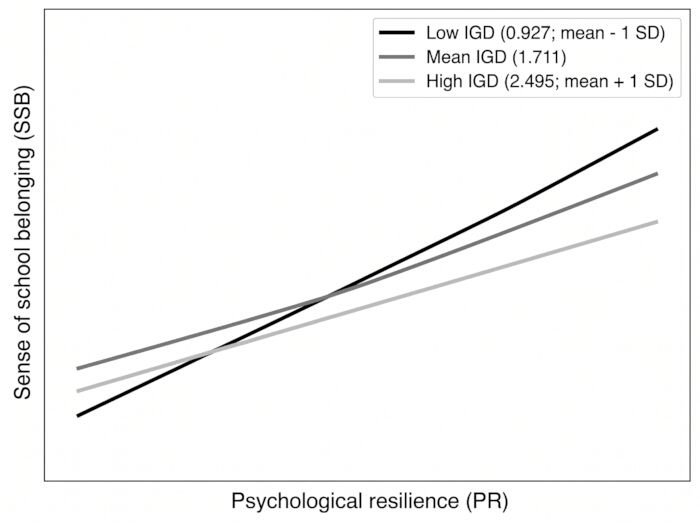
Figure 1. Internet gaming disorder symptoms moderate the association between psychological resilience (PR) and sense of school belonging (SSB). Simple-slope plot showing the interaction between PR and internet gaming disorder (IGD) symptoms (IGD) in predicting SSB in PROCESS Model 59. IGD levels are plotted as low (mean − 1 SD), mean, and high (mean + 1 SD). Higher PR was associated with higher SSB across IGD levels, although the positive PR–SSB association was weaker at higher IGD levels. Please click here to view a larger version of this figure.
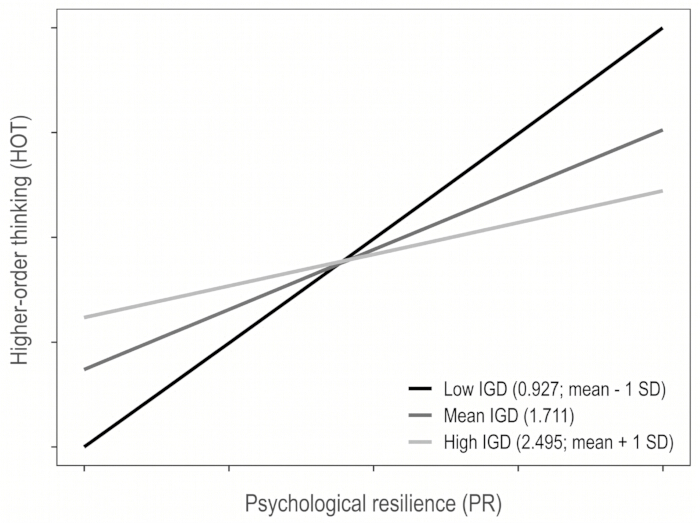
Figure 2. Internet gaming disorder symptoms moderate the direct association between PR and higher-order thinking (HOT). Simple-slope plot showing the interaction between PR and IGD symptoms in predicting HOT in PROCESS Model 59. IGD levels are plotted as low (mean − 1 SD), mean, and high (mean + 1 SD). Higher PR was associated with higher HOT across IGD levels, although the positive PR–HOT association was weaker at higher IGD levels. Please click here to view a larger version of this figure.
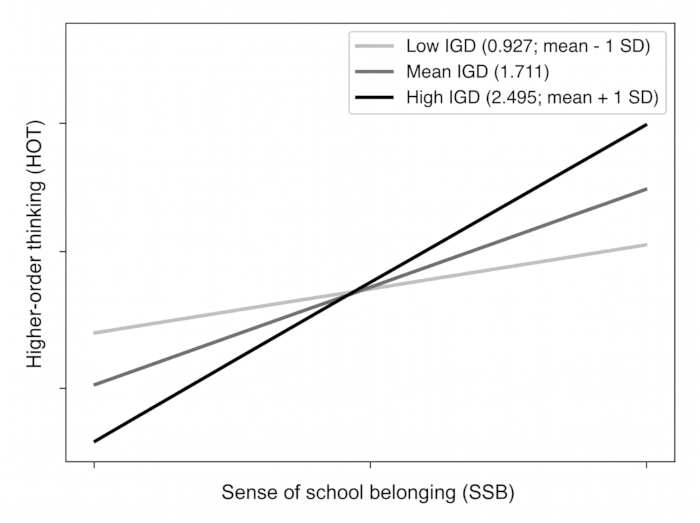
Figure 3. Internet gaming disorder symptoms moderate the association between SSB and HOT. Simple-slope plot showing the interaction between SSB and IGD symptoms in predicting HOT in PROCESS Model 59. IGD levels are plotted as low (mean − 1 SD), mean, and high (mean + 1 SD). Higher SSB was associated with higher HOT across IGD levels, and the positive SSB–HOT association was stronger at higher IGD levels. Interpret this interaction as a statistical association within a cross-sectional model rather than as evidence of a beneficial clinical effect of IGD. Please click here to view a larger version of this figure.
The full association-based moderated mediation structure is summarized in Figure 4. This figure integrates the three moderated paths estimated in Model 59: PR → SSB, PR → HOT, and SSB → HOT. The diagram serves as a statistical summary of the representative cross-sectional model generated through the workflow and should not be interpreted as evidence of temporal sequence or causal direction.
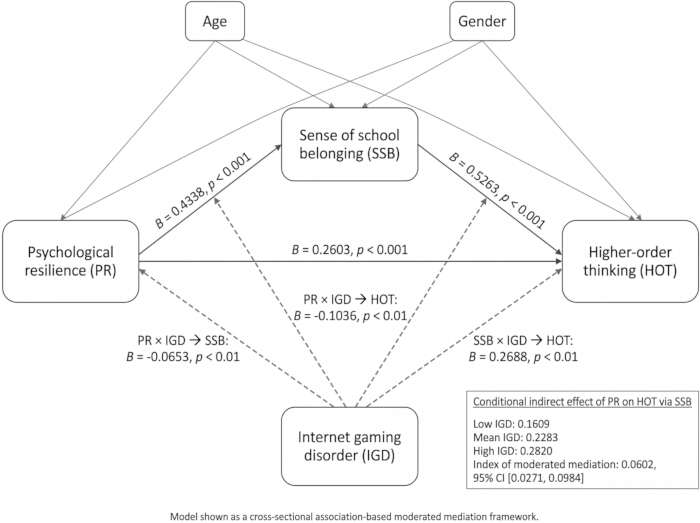
Figure 4. Association-based moderated mediation model for PR, SSB, HOT, and IGD symptoms. Conceptual diagram summarizing the tested PROCESS Model 59 structure. PR was modeled as the independent variable, SSB as the mediator, HOT as the dependent variable, and IGD symptoms as the moderator. IGD moderated the PR → SSB, PR → HOT, and SSB → HOT paths. The diagram represents a cross-sectional statistical model and does not imply temporal ordering or causality. Please click here to view a larger version of this figure.
Supplementary Table 1. Translation and adaptation record for the Chinese survey instruments. This table documents the source scale, original language, translation status, translation procedure, expert review, pilot checking, and final questionnaire documentation for each instrument. The pilot check involved 30 students who were not included in the final analytic sample and was conducted to assess comprehension, item clarity, completion burden, and platform function rather than final psychometric properties.Please click here to download this file.
Supplementary Table 2. Scoring and coding rules for all study variables. This table reports item count, response range, reverse-coded items, score direction, mean-score computation rules, variable abbreviations, demographic coding, and internal consistency values for PR, HOT, SSB, and IGD symptoms. All core construct scores were computed as mean scores to retain the original 1–5 scale metric. SSB Items 3, 6, 9, 12, and 16 were reverse-scored using the following conversion rule: 1 = 5, 2 = 4, 3 = 3, 4 = 2, and 5 = 1. Reliability values are Cronbach’s alpha coefficients from the final analytic sample.Please click here to download this file.
Discussion
Loading...
$$\rightleftharpoonup{xx}$$
$$\longleftharp{xx}$$,
$$\longrightharp{xx}$$,
This method article presents a reproducible survey-to-analysis workflow for examining association-based mediation and moderated mediation patterns among PR, SSB, HOT, and IGD symptoms in college students. The primary contribution of the workflow is methodological rather than causal because the protocol demonstrates how a cross-sectional self-report dataset can be collected, screened, scored, documented, and analyzed through a transparent sequence of prespecified procedures. In this revised protocol, new employment patterns are treated as a contextual framing condition rather than as a participant-level measured exposure, preventing the workflow from overstating what the dataset can operationally test31. This framing is appropriate because the protocol is intended to support reproducible educational and behavioral survey research under changing technology and employment expectations rather than to estimate the effects of direct exposure to platform work, gig work, or artificial-intelligence-mediated employment. By fixing the sampling frame, eligibility criteria, consent procedure, translation workflow, missing-data rules, response-quality thresholds, scoring logic, centering procedures, and conditional process models before interpretation, the workflow improves transparency and reproducibility in a research area where statistical outputs are often reported without a fully auditable preprocessing chain32.
The representative outputs illustrate how the workflow can be used to generate a coherent association-based conditional process model. PR was positively associated with SSB and HOT, and the indirect association through SSB was statistically supported. These representative findings are theoretically consistent with prior literature linking PR with adaptive functioning, persistence under uncertainty, and constructive engagement with learning demands33. SSB also provides an important relational context for student learning because feelings of acceptance, support, and institutional connection may encourage participation, help-seeking, collaborative reasoning, and sustained engagement with complex tasks34. However, the outputs should be interpreted as statistical mediation within a cross-sectional association model rather than as evidence that PR temporally produces SSB or that SSB causally improves HOT35. The use of Model 4 and Model 59 therefore provides a reproducible framework for estimating direct, indirect, and conditional indirect associations within a single conditional process workflow, but the resulting model structure should not be interpreted as evidence of longitudinal sequence or causal mechanism36.
A major strength of the revised protocol is that it makes the full survey-to-analysis workflow reproducible. The sample flow was corrected to 860 invited students, 800 returned questionnaires, 24 invalid responses excluded, and 776 retained cases, thereby removing the earlier arithmetic inconsistency. The response-quality procedures were operationalized using explicit thresholds for completion time, same-option responding, repeated-pattern responding, duplicate responses, and eligibility inconsistency, which reduces ambiguity during online survey screening37. The questionnaire workflow also documents forward translation, back translation, reconciliation, expert review, pilot checking, forced-response settings, reverse-coded items, and mean-score computation rules38. These procedures are important because differences in item adaptation, reverse coding, missing-data handling, or score computation can alter descriptive statistics, correlations, and conditional process estimates even when the same conceptual framework is applied39. Accordingly, the supplementary translation and scoring files function as integral components of the protocol’s reproducibility structure rather than as optional supporting appendices.
The moderated mediation output requires cautious interpretation. Higher IGD symptoms weakened the PR–SSB association and the direct PR–HOT association, which is consistent with evidence linking problematic gaming symptoms with reduced school engagement, disrupted routines, and weaker cognitive or emotional regulation40. By contrast, the stronger SSB–HOT association observed at higher IGD levels should not be interpreted as evidence that IGD has beneficial effects. A more appropriate interpretation is that SSB may function as an especially important supportive context for students with elevated digital-behavioral risk, or that unmeasured participant characteristics may contribute to this conditional association41. The IGD scale was applied as a continuous self-reported symptom measure rather than as a diagnostic interview; therefore, the protocol does not classify participants as clinically diagnosed cases42. Similarly, the common-method-bias screening requires cautious interpretation because, although Harman’s single-factor test remained below the prespecified threshold, all variables were still measured using self-report instruments at a single time point, meaning that same-source and same-context bias cannot be fully excluded43.
From a protocol perspective, several procedures are particularly important for researchers adapting this workflow. Preserve the raw dataset in an unchanged format after export, apply exclusions using the fixed screening hierarchy, reverse-score the SSB items before reliability or correlation analyses, and compute all four core variables as mean scores on the same response metric44. Construct interaction terms from mean-centered variables, and apply the same low, mean, and high moderator values consistently across conditional-effect tables and simple-slope figures45. The revised reporting framework also distinguishes unstandardized coefficients from standardized coefficients by reporting unstandardized estimates as B, thereby reducing coefficient-scale ambiguity. Bootstrap confidence intervals are used for indirect effects, conditional indirect effects, and the index of moderated mediation because indirect effects commonly show asymmetric sampling distributions46. Compared with less standardized survey-analysis approaches, this workflow requires more extensive procedural documentation before and during analysis; however, these additional reporting steps improve the auditability, reproducibility, and comparability of the final model across research teams47.
Several limitations remain. First, the cross-sectional design prevents causal inference and temporal ordering; therefore, future longitudinal or repeated-measures studies are needed to determine whether changes in PR precede changes in SSB and HOT48. Second, the reliance on self-report measures may introduce social desirability bias, recall bias, and common-method bias. Future adaptations of the workflow should therefore incorporate behavioral HOT tasks, teacher or peer reports, learning-platform records, or objective indicators of gaming behavior49. Third, the sample was drawn from only three institutions and showed a strong female predominance, which may limit generalizability beyond the participating Chinese college student population. Future replications should include additional institutions, more balanced gender recruitment, and subgroup sensitivity analyses50. Fourth, the protocol did not stratify participants according to major, academic discipline, socioeconomic background, counselor-administered versus independent survey context, or direct exposure to new employment patterns. Future adaptations should include measured indicators of artificial intelligence tool use, internship experience, platform-work exposure, perceived labor-market uncertainty, academic discipline, and socioeconomic status so that new employment patterns can be examined as measurable contextual variables rather than only as background conditions51.
Disclosures
Loading...
$$\rightleftharpoonup{xx}$$
$$\longleftharp{xx}$$,
$$\longrightharp{xx}$$,
The authors declare that they have no competing financial interests or personal relationships that could have appeared to influence the work reported in this paper.
Acknowledgements
Loading...
$$\rightleftharpoonup{xx}$$
$$\longleftharp{xx}$$,
$$\longrightharp{xx}$$,
This research was supported by Liuzhou Polytechnic University (Grant No. 2023SB16).
Materials
| Name | Company | Catalog Number | Comments |
|---|---|---|---|
| Institutions; codes I-01 to I-32 | Study team | N/A | Locked before random selection and used for institution-level randomization. |
| Institutional screening log | Study team | N/A | Documented institutional eligibility criteria, source documents, eligibility decisions, and institution codes. |
| Internet Gaming Disorder Scale | Lemmens, Valkenburg, and Gentile (2015), The Internet Gaming Disorder Scale, Psychological Assessment, 27(2), 567–582. doi:10.1037/pas0000062 | N/A | 9-item scale aligned with DSM-5 criteria and used as a continuous self-reported IGD symptom measure rather than as a clinical diagnosis. |
| Mediation model output | Study team | Model 4 output | Output for the mediation model with PR as X, SSB as M, and HOT as Y. |
| Moderated mediation model output | Study team | Model 59 output | Output for the moderated mediation model with IGD moderating the PR → SSB, PR → HOT, and SSB → HOT paths. |
| Online questionnaire platform | Wenjuanxing / Questionnaire Star | N/A | Web-based survey platform used for electronic informed consent, online questionnaire administration, forced-response settings, and survey-data export. |
| Pilot-check record | Study team | N/A | 30-student pilot-check record used to assess item clarity, comprehension, completion burden, and platform function. Pilot participants were not included in the final analytic sample. |
| Psychological Resilience Scale | Hu and Gan revision based on the Connor-Davidson framework | N/A | 25-item scale used to measure psychological resilience. Responses were scored on a 5-point Likert scale and computed as mean scores. |
| Psychological Sense of School Membership Scale | Chinese revised version based on Goodenow’s school-membership framework | N/A | 18-item scale used to measure school belonging. Items 3, 6, 9, 12, and 16 were reverse-scored before mean-score computation. |
| Randomization procedure | Study team | Random seed: 20241007 | Used for institution-level and student-level random selection through a seed-based random-number procedure. |
| Raw survey dataset | Study team | Raw_Survey_NEP_2024_800returned_locked.xlsx | Raw exported dataset containing 800 returned questionnaires before response-quality exclusion. |
| Response-quality screening log | Study team | N/A | Documented 24 excluded responses, including duplicate responses, eligibility inconsistencies, completion-time exclusions, straight-line responses, and repeated-pattern responses. |
| Response-quality screening rules | Study team | N/A | Exclusion criteria included duplicate submission, eligibility inconsistency, completion time <360 s, same option selected for ≥85% of Likert items, and repeated alternating patterns across ≥15 consecutive Likert items. |
| Scale reliability output | Study team | N/A | Output reporting Cronbach’s alpha values for PR, HOT, SSB, and IGD. |
| Scoring and coding reference file | Study team | Supplementary Table 2 | Documents item count, response range, reverse-coded items, score direction, mean-score computation, demographic coding, and reliability values. |
| Session administration log | Study team | N/A | Recorded administration date, institution code, class context, counselor identifier, invitation count, returned count, session duration, and deviations. |
| Statistical software | IBM Corp. | IBM SPSS Statistics, version 27.0 | Used for descriptive statistics, correlations, reliability analysis, exploratory factor analysis, regression, mediation, and moderated mediation analyses. |
| Student randomization log | Study team | Random seed: 20241007 | Documented student-level stratified random selection within the three selected institutions. |
| Supplementary Table 1 | Study team | Translation and adaptation record | Documents item source, original wording, forward translation, back translation, final Chinese wording, expert review, pilot feedback, and revision rationale. |
| Supplementary Table 2 | Study team | Scoring and coding rules | Documents scoring rules, reverse coding, demographic coding, variable abbreviations, and reliability values. |
| Translation and adaptation record | Study team | Supplementary Table 1 | Documents forward translation, reconciliation, back translation, expert review, pilot checking, and final Chinese wording. |
| Windows operating system | Microsoft Corp. | Windows 11 Pro, 64-bit | Operating system used for statistical analysis and output generation. |
Reprints and Permissions
Request permission to reuse the text or figures of this JoVE article
Request Permission