This review systematically elucidates the molecular mechanisms of acupuncture in treating Parkinson's disease via the mitochondrial ferroptosis pathway, highlighting the intervention specificity of core acupoint combinations and electroacupuncture parameters.
Review Article
Research Progress In Acupuncture For Parkinson’s Disease: Insights Into The Mitochondrial Ferroptosis Pathway
June 12th, 2026
Opens in a new tab
In This Article
Summary
Loading...
$$\rightleftharpoonup{xx}$$
$$\longleftharp{xx}$$,
$$\longrightharp{xx}$$,
Abstract
Loading...
$$\rightleftharpoonup{xx}$$
$$\longleftharp{xx}$$,
$$\longrightharp{xx}$$,
The pathogenesis of Parkinson's disease (PD) is highly complex, with mitochondrial ferroptosis—a novel regulated cell death modality—playing a critical role in dopaminergic neuronal degeneration. This review systematically elucidates the potential mechanisms of acupuncture in treating PD by modulating mitochondrial ferroptosis pathways, alongside analyzing the specificity of acupoint prescriptions and stimulation parameters. Databases, including PubMed and China National Knowledge Infrastructure (CNKI), were systematically searched for literature regarding acupuncture interventions in PD models and ferroptosis mechanisms. The analysis focused on acupuncture's regulation of mitochondrial iron overload, the System Xc⁻/glutathione (GSH)/glutathione peroxidase 4 (GPX4) antioxidant axis, and the nuclear factor erythroid 2-related factor 2 (Nrf2) signaling pathway. Acupuncture is proposed to mitigate mitochondrial ferroptosis through multidimensional synergistic mechanisms. First, it remodels iron metabolism by inhibiting transferrin receptor 1 (TFR1)/divalent metal transporter 1 (DMT1)-mediated iron uptake and upregulating ferritin heavy chain 1 (FTH1) to sequester iron harmlessly, thereby reducing the mitochondrial labile iron pool. Second, it may help restore antioxidant defenses by activating Nrf2 nuclear translocation, upregulating GPX4, and restoring the System Xc⁻/GSH pathway to scavenge lipid peroxides. Third, regarding intervention specificity, the Fengfu (GV16) and Taichong (LR3) combination primarily modulates neuroinflammation, whereas Baihui (GV20) penetration upregulates neurotrophic factors. Additionally, 2 Hz low-frequency electroacupuncture emerges as the optimal parameter for neuroprotection, while acupuncture also exerts systemic effects via synchronous brain-gut regulation. Acupuncture maintains mitochondrial homeostasis and inhibits neuronal ferroptosis by restoring the iron-lipid-antioxidant triangular balance. Future multi-omics and clinical translational research are required to optimize parameters and provide robust evidence for neuroprotective PD therapies.
Introduction
Loading...
$$\rightleftharpoonup{xx}$$
$$\longleftharp{xx}$$,
$$\longrightharp{xx}$$,
PD is a neurodegenerative disorder characterized by the progressive loss of dopaminergic neurons in the substantia nigra pars compacta and the pathological aggregation of α-synuclein (α-syn). Its pathogenesis is highly complex, involving the intricate interplay of multiple dimensions, including oxidative stress, mitochondrial dysfunction, and neuroinflammation1,2. Although current dopamine replacement therapies can alleviate motor symptoms to some extent, they fail to arrest the relentless progression of neuronal death. Furthermore, the clinical benefits of long-term medication are often limited by adverse side effects such as dyskinesia3. Therefore, elucidating the core mechanisms driving neuronal death in PD and identifying non-pharmacological interventions capable of halting disease progression at its source have become research hotspots in neuroscience. Recent studies indicate that the pathological progression of PD involves not only traditional apoptosis and dysregulated autophagy but is also closely associated with ferroptosis, an iron-dependent form of regulated cell death4.
Distinct from traditional apoptosis, ferroptosis is primarily characterized by intracellular iron overload, glutathione (GSH) depletion, and the lethal accumulation of lipid peroxides on cell membranes5. As the cellular "powerhouse" and redox center, mitochondria play a pivotal role in the execution of ferroptosis. Research has revealed that Nrf2, a key transcription factor in the antioxidant stress response, can maintain mitochondrial homeostasis and inhibit ferroptosis by regulating downstream target genes, thereby emerging as a highly promising therapeutic target for neurodegenerative diseases6.
Additionally, dysfunction of solute carrier family 7 member 11 (SLC7A11/System Xc⁻), a critical defense system against ferroptosis, not only leads to insufficient cystine uptake but also induces lysosomal acidification impairment and pathological α-syn accumulation, which further exacerbates the ferroptotic process in dopaminergic neurons7. Consequently, targeting the "mitochondria-ferroptosis" axis may offer a novel breakthrough for neuroprotective treatments in PD.
As an essential component of Traditional Chinese Medicine (TCM), acupuncture has been corroborated by extensive clinical and basic research to significantly ameliorate both motor and non-motor symptoms in patients with PD8. For instance, Yu et al. demonstrated that electroacupuncture interventions (at acupoints such as Zusanli and Taichong) effectively alleviated motor deficits in 6-OHDA-induced mouse models and modulated the expression of brain-gut peptides9. However, while the antioxidant and neuroprotective effects of acupuncture are widely recognized, there remains a lack of a systematic summary of whether its therapeutic efficacy is exerted through precise regulation of mitochondrial ferroptosis pathways (such as by intervening in the SLC7A11/GPX4 axis or the Nrf2 signaling cascade). By comprehensively reviewing recent literature, this article aims to explore the potential mechanisms of acupuncture in treating PD from the perspective of mitochondrial ferroptosis, with the ultimate goal of providing a more robust biological foundation for its clinical application.
Review and Perspective
Loading...
$$\rightleftharpoonup{xx}$$
$$\longleftharp{xx}$$,
$$\longrightharp{xx}$$,
Mitochondrial ferroptosis
Emerging evidence suggests that mitochondria are not only the epicenter of cellular energy metabolism but also critical hubs in the execution of ferroptosis. During the pathological progression of PD, a cascade of events—encompassing mitochondrial iron overload, metabolic enzyme dysfunction, and environmental toxin induction—collectively constitutes the core mechanism of dopaminergic neuronal death10.
To fully appreciate the therapeutic targets of acupuncture, it is essential to distinctly differentiate mitochondrial ferroptosis from general ferroptosis. General ferroptosis is predominantly characterized by cytosolic iron accumulation and lipid peroxidation localized to the plasma membrane11. In contrast, mitochondrial ferroptosis specifically hinges on the disruption of mitochondrial quality control and matrix metabolic homeostasis. Its core indicators encompass mitoferrin-mediated mitochondrial iron overload, mitochondrial reactive oxygen species (mtROS) bursts generated by the electron transport chain, and metabolic enzyme deficits (such as α-ketoglutarate dehydrogenase complex deficiency) that trigger tricarboxylic acid cycle reprogramming12. This localized breakdown causes catastrophic peroxidation of mitochondrial inner membrane lipids, leading to the characteristic morphological collapse of mitochondria. Acupuncture systematically orchestrates a causal rescue against this mitochondrial-specific cascade: by modulating upstream master regulators like Nrf2, acupuncture not only promotes the expression of standard ferroptosis defense proteins but specifically upregulates mitochondrial iron storage (FTH1) and limits mitochondrial iron importers (TFR1/DMT1). This directly suppresses mtROS generation and preserves mitochondrial structural integrity rather than merely buffering cytosolic iron, thereby establishing a direct causal link between acupuncture intervention and the mitigation of mitochondrial-specific cell death13.
Mitochondrial iron overload and reactive oxygen species (ROS) burst
Dysregulation of mitochondrial iron homeostasis is the initiating factor in ferroptosis. An abnormal elevation in intracellular LIP drives an excessive influx of iron ions into the mitochondrial matrix via the mitochondrial iron transporter mitoferrin14,15. Fundamental research by Ren et al. has confirmed that mitoferrin serves as the crucial solute carrier governing mitochondrial iron uptake, and its expression level directly dictates the degree of mitochondrial iron accumulation15. Under the pathological conditions of PD, the accumulation of ferrous iron (Fe²⁺) within mitochondria catalyzes the generation of large amounts of hydroxyl radicals via the Fenton reaction, leading to lipid peroxidation of the mitochondrial membrane. A recent 2024 study by Lei et al. demonstrated that targeted clearance of excess iron from the mitochondrial LIP can significantly suppress reactive oxygen species (ROS) generation and halt the ferroptotic process. This finding further substantiates the central role of mitochondrial iron overload in the neurodegeneration observed in PD14.
Lipid peroxidation driven by metabolic enzyme dysfunction
Beyond direct iron deposition, functional deficits in key enzymes of the mitochondrial tricarboxylic acid cycle serve as a significant endogenous driver of ferroptosis. Gao et al. elucidated a novel metabolic pathogenic pathway: the deletion of the PD-associated gene CHCHD2 leads to a decline in mitochondrial α-ketoglutarate dehydrogenase (KGDH) complex activity, which subsequently causes abnormal accumulation of its substrate, α-ketoglutarate. This metabolic reprogramming is not silently benign; rather, it actively propagates lipid peroxidation, ultimately inducing ferroptosis in dopaminergic neurons16. This discovery indicates that mitochondrial ferroptosis arises not only from aberrations in "iron" but is also inextricably linked to the collapse of mitochondrial "metabolic" homeostasis.
The "autophagy-ferroptosis" crosstalk induced by environmental toxins
The mechanistic role of environmental factors in PD pathogenesis also exhibits significant crosstalk with mitochondrial ferroptosis. Zhang et al.17 found that exposure to widely used pyrethroid pesticides (e.g., bifenthrin) specifically induced PD-like symptoms in Parkin knockout mice. The underlying mechanism involves aberrant activation of mitophagy pathways coupled with ferroptosis, suggesting that environmental toxins can accelerate neuronal ferroptosis by compromising mitochondrial quality control.
In summary, mitochondrial ferroptosis is a pivotal node within the complex pathological network of PD. From mitoferrin-mediated iron influx to KGDH enzyme dysregulation and the triggering effects of environmental toxins, these mechanisms synergistically orchestrate the irreversible damage inflicted upon neurons in the substantia nigra18.
Molecular mechanisms of acupuncture in regulating mitochondrial ferroptosis
Activation of the Nrf2/GPX4 axis
Nrf2 is regarded as the "master regulator" of the cellular antioxidant stress response. Its downstream target gene, GPX4, is currently the only known critical enzyme capable of directly reducing membrane lipid peroxides and specifically halting ferroptosis. Current evidence indicates that acupuncture interventions can precisely target this signaling axis to reverse mitochondrial lipid peroxidation damage in the pathological state of PD.
Promoting Nrf2 nuclear translocation and GPX4 transcriptional activation
In PD pathological models, Nrf2 in dopaminergic neurons is frequently cytoplasmic, rendering it inactive. This leads to reduced GPX4 expression and increased susceptibility to ferroptosis. A recent study by Wang et al. demonstrated that electroacupuncture (EA) stimulation (particularly at acupoints such as Baihui and Taichong) significantly promotes Nrf2 nuclear translocation, enabling it to bind to the antioxidant response element (ARE) and subsequently initiate the transcription and translation of the downstream GPX4 gene19. Through sophisticated molecular biological techniques, this study revealed that following EA intervention, GPX4 protein levels in the substantia nigra significantly rebounded, accompanied by the restoration of mitochondrial morphology and the clearance of lipid peroxides (LPOs), directly confirming the existence of the "EA-Nrf2-GPX4" anti-ferroptotic pathway.
Synergistic regulation of iron transporters to maintain mitochondrial iron homeostasis
The activation of the Nrf2/GPX4 axis by acupuncture is not an isolated event but is tightly coupled with the regulation of iron metabolism. Ma et al. found that EA intervention not only upregulated GPX4 expression but also synchronously inhibited DMT1 and upregulated FPN120. This regulatory pattern relies on GPX4 to scavenge generated lipid peroxides while simultaneously cutting off the raw material supply for the Fenton reaction at its source by reducing iron influx and promoting efflux. This dual mechanism supersedes monotherapy with antioxidants, highlighting the multi-target advantages of acupuncture.
The expanded Nrf2 defense network
From Anti-Inflammation to Brain-Gut Crosstalk. Notably, the effects of acupuncture-induced Nrf2 activation are pleiotropic. Zhang et al. reported that upon Nrf2 activation, EA not only upregulates antioxidant enzymes but also blocks pyroptosis by inhibiting the NLRP3 inflammasome/Caspase-1 pathway. This suggests that acupuncture may simultaneously modulate the crosstalk between ferroptosis and pyroptosis via the Nrf2 node21. Furthermore, research by Liu et al., based on the "brain-gut axis" theory, expanded the systemic nature of this mechanism. They discovered that EA not only ameliorated oxidative stress in the substantia nigra of the midbrain but also synchronously elevated glutathione peroxidase (GSH-Px) activity in colon tissue, reducing systemic reactive oxygen species (ROS) levels22. This indicates that acupuncture's regulation of the Nrf2/GPX4 axis may represent a systemic biological effect involving the remodeling of whole-body redox homeostasis23.
Importantly, the systemic anti-inflammatory and metabolic remodeling effects of acupuncture are now gaining profound international mechanistic validation. A landmark study published in Nature recently elucidated the precise neuroanatomical basis of electroacupuncture, demonstrating that specific acupoint stimulation (such as ST36) can drive the vagal-adrenal axis to exert powerful systemic anti-inflammatory effects24. This internationally recognized neural circuit provides a robust macroscopic biological foundation for acupuncture's capacity to remotely regulate colonic oxidative stress and, in turn, influence midbrain nigral ferroptosis via the brain-gut axis.
In summary, by relieving Nrf2 from its inhibited state, upregulating GPX4 expression, and synergistically modulating iron metabolism and neuroinflammation, acupuncture constructs a robust anti-ferroptotic defense line for impaired mitochondria.
Regulation of the System Xc⁻/GSH pathway
GSH is the core reducing agent for maintaining intracellular mitochondrial redox homeostasis, while the cystine/glutamate antiporter (System Xc⁻, primarily composed of the SLC7A11 subunit) serves as the "supply line" for GSH synthesis. In the pathology of PD, impaired System Xc⁻ function leads to intracellular cystine deficiency and GSH depletion, which, in turn, inactivates GPX4, ultimately inducing mitochondrial lipid peroxidation and ferroptosis4. Current research demonstrates that acupuncture can exert neuroprotective effects by repairing this metabolic supply line and restoring the intracellular GSH pool20.
Remodeling GSH antioxidant enzyme activity
The abundance of GSH directly dictates the catalytic capacity of GSH-Px/GPX4. From a systemic biology perspective of the "brain-gut axis," Liu et al.22 found that EA stimulation at acupoints such as Baihui and Zusanli significantly enhanced GSH-Px activity in the substantia nigra of PD model mice, while simultaneously upregulating antioxidant levels in colonic tissues and reducing systemic ROS accumulation. This suggests that acupuncture's modulation of the System Xc⁻/GSH pathway exerts a systemic metabolic remodeling effect, indirectly mitigating mitochondrial damage in nigral neurons by improving the body's overall oxidative stress state.
Targeted restoration of key enzyme GPX4 expression
As the core downstream effector molecule of the System Xc⁻/GSH pathway, the expression level of GPX4 is a critical indicator of anti-ferroptotic capacity. Ma et al. demonstrated that EA intervention effectively reversed the 6-OHDA/rotenone-induced downregulation of nigral GPX4 protein, accompanied by improved mitochondrial morphology20. Although this study primarily focused on downstream GPX4 changes, when combined with the recent findings of Wang et al.19, it becomes evident that this effect heavily relies on the upstream nuclear translocation and activation of the transcription factor Nrf2. Given that SLC7A11 is a classical target gene of Nrf2, the molecular mechanism by which EA functions through the "Nrf2-SLC7A11-GSH-GPX4" axis has been logically corroborated by multiple chains of evidence. Essentially, acupuncture ensures the uptake of raw materials by System Xc⁻ and the biosynthesis of GSH by activating upstream transcriptional regulation.
The correlation between behavioral improvement and metabolic homeostasis
The restorative effect of acupuncture on the System Xc⁻/GSH pathway ultimately translates into significant behavioral benefits. Research by Yu et al.9 showed that EA stimulation at Taichong and Zusanli significantly reduced Abnormal Involuntary Movement Scale (AIMS) scores and improved rotational behavior in PD rats. This recovery of motor function is closely correlated with the normalization of neurotransmitters and related brain-gut peptide metabolism, further substantiating the clinical potential of acupuncture in combating neurodegeneration by maintaining metabolic homeostasis.
In conclusion, acupuncture not only directly upregulates the downstream antioxidant enzyme GPX4 but also systematically modulates the GSH metabolic network, repairing the damaged System Xc⁻/GSH pathway and providing an abundant material basis to block mitochondrial ferroptosis.
Modulation of iron metabolism proteins (FTH1/TFR1)
The core driving force of mitochondrial ferroptosis lies in the abnormal expansion of the intracellular LIP, which subsequently catalyzes the generation of lethal amounts of ROS via the Fenton reaction. The maintenance of cellular iron homeostasis depends heavily on the dynamic coordination of iron uptake proteins (e.g., TFR1), iron storage proteins (e.g., FTH1), and iron efflux proteins. As PD progresses, this balance is disrupted, leading to elevated TFR1 and reduced FTH1 expression. Current evidence indicates that acupuncture can reduce the pathological accumulation of free iron in mitochondria by modulating multiple key proteins.
Enhancing FTH1-mediated iron "safe storage" mechanisms
Ferritin acts as the "safe warehouse" for intracellular free iron. Its subunit, FTH1, possesses ferroxidase activity, enabling it to convert cytotoxic ferrous iron (Fe2⁺) into non-toxic ferric iron (Fe3⁺) for storage, serving as the last line of defense against ferroptosis. Early classical studies confirmed that in MPTP-induced PD models, there is significant iron deposition and FTH1 downregulation in the substantia nigra pars compacta. Acupuncture at Taichong and Yanglingquan effectively reversed the pathological reduction of FTH1 and significantly diminished abnormal iron deposition as visualized by Prussian blue staining25. This established the fundamental mechanism by which acupuncture mitigates neuronal iron toxicity by enhancing iron storage capacity. A recent study by Liu et al.26 further corroborated this, finding that EA significantly upregulated FTH1 protein expression in a cerebral ischemia-reperfusion injury model. The conservation of this mechanism across the nervous system suggests that acupuncture protects mitochondria from oxidative attacks by promoting the "harmless sequestration" of iron.
Inhibiting TFR1/DMT1-mediated iron "excessive uptake"
In addition to increasing storage internally, acupuncture restricts iron influx into neurons at the source. TFR1 is responsible for endocytosing transferrin-bound iron into the cell, while DMT1 releases iron from the endosome into the cytoplasm. A recent study by Li et al.27 demonstrated that EA intervention significantly downregulates TFR1 expression, thereby reducing excessive cellular iron uptake. Similarly, Liu et al.26 observed that while elevating FTH1, EA concurrently downregulated TFR1 and DMT1 expressions. This synergistic "one up, one down" regulatory pattern effectively curbs LIP expansion. Furthermore, in research on post-stroke depression, Gao et al.28 observed that EA reversed the abnormal elevation of TFR1 in the prefrontal cortex, confirming that acupuncture's negative regulation of iron uptake proteins holds universal neuroprotective significance within the brain.
Upstream signal integration of iron metabolism regulation
Acupuncture's precise modulation of iron metabolism proteins does not occur in isolation but is governed by upstream transcription factors. Wang et al.19 noted that by activating the Nrf2 signaling pathway, EA not only upregulates GPX4 but may also directly regulate the transcription of iron metabolism genes via the Nrf2-FTH1 axis. Integrating the mechanistic explorations by Li et al., the inhibitory effect of EA on TFR1 and its upregulatory effect on FTH1 are partially negated in the presence of an Nrf2 inhibitor27. This suggests that the "acupuncture-Nrf2-FTH1/TFR1" axis may be the critical molecular pathway through which acupuncture maintains mitochondrial iron homeostasis and halts the ferroptotic cascade.
In conclusion, acupuncture reconstructs the iron metabolic balance in damaged neurons through a dual strategy of downregulating TFR1/DMT1 and upregulating FTH1, cutting off the foundational basis for mitochondrial ferroptosis at its source.
Specificity analysis of acupuncture interventions: synergistic effects of acupoint combinations and parameter optimization
A review of the included literature reveals that the formulation of acupuncture protocols is not random; rather, it exhibits a high degree of specificity and regularity. This is primarily reflected in two dimensions: the selection of core acupoint pairs and the precise control of electroacupuncture (EA) parameters (Table 1, Figure 1).
Regarding acupoint selection, studies demonstrate the principles of "local and distal coordination" and "meridian specificity." Notably, the combination of GV16 and LR3 is the most frequently used classic core formula, widely applied across numerous studies using rotenone- and 6-OHDA-induced models. This combination embodies the TCM theories of "treating from the Governor Vessel (Du Mai)" and the "homology of the liver and kidneys."
Multiple experiments have confirmed its efficacy in regulating the ubiquitin-proteasome system (UPS) and significantly suppressing the expression of neuroinflammatory mediators, including COX-2, TNF-α, and IL-1β21,22,29,30,31,32,33,34,35,36,37,38,39,40,41,42,43,44,45,46,47. Furthermore, scalp acupuncture holds a prominent position, particularly GV20 penetrating to Taiyang (EX-HN5) or GV20 combined with Dazhui (GV14). These approaches have been proven to effectively upregulate the mRNA expression of brain-derived neurotrophic factor (BDNF) and tyrosine hydroxylase (TH), indicating that penetration acupuncture targeting specific cranial acupoint zones may more directly modulate the neuroplasticity of the cortico-basal ganglia circuit45,48,49.
In terms of stimulation parameters, the choice of EA frequency plays a decisive role in inducing specific biological effects. The vast majority of included studies used 2 Hz low-frequency stimulation, widely considered the optimal parameter range for inducing neuroprotective and anti-inflammatory effects. For instance, 2 Hz stimulation has been proven to effectively regulate the Nrf2/NLRP3/Caspase-1 signaling pathway, thereby inhibiting pyroptosis and oxidative stress21. Notably, a few studies used 100 Hz high-frequency stimulation and found it has a specific advantage in regulating brain GABA levels. This suggests that different EA frequencies may exert their effects through differentiated neurotransmitter modulation mechanisms48,49. Regarding needle retention time, 20 to 30 minutes is the standard duration in most experiments, ensuring that cumulative stimulation is sufficient to cross the therapeutic threshold.
From an analytical perspective, the distinct efficacy of specific acupoints and stimulation frequencies in modulating ferroptosis can be attributed to their unique neuroanatomical and biophysical signaling pathways. Mechanistically, the combination of GV16 and LR3 acts as a synergistic hub for systemic and segmental integration. GV16, located adjacent to the medulla oblongata, directly influences central neuroinflammatory networks, while LR3 activates distal ascending somatosensory pathways. Together, they effectively alleviate the burden on the ubiquitin-proteasome system and prevent the pathological aggregation of α-synuclein, a major upstream trigger of mitochondrial metabolic enzyme dysfunction39. Conversely, cranial penetration acupuncture at GV20 leverages localized mechanotransduction to directly stimulate cortical neuroplasticity, preferentially upregulating brain-derived neurotrophic factor to enhance neuronal survival against lipid peroxidative stress48. Regarding biophysical parameters, the widespread superiority of 2 Hz low-frequency stimulation over 100 Hz high-frequency stimulation lies in its capacity to induce sustained, rhythmic intracellular calcium oscillations. These steady Ca2⁺ signals are optimal for triggering the continuous nuclear translocation of Nrf2, thereby establishing a stable, long-term antioxidant transcription program19. In contrast, 100 Hz high-frequency stimulation induces rapid, intense neuronal firing that primarily modulates fast amino acid neurotransmitters like γ-aminobutyric acid (GABA), which is effective for immediate symptomatic circuit relief but less efficient in driving the slow, gene-transcription-dependent remodeling of the System Xc⁻/GSH/GPX4 anti-ferroptotic defense line42.
In conclusion, current research on the mechanisms of acupuncture in PD reveals a pattern characterized by core targets (such as GV16, LR3, and GV20) and continuous low-frequency (2 Hz) stimulation as the primary parameter. This highly specific acupoint-parameter coupling model not only guarantees the reproducibility of experimental results but also provides a standardized physical input foundation for elucidating the "multi-target, multi-level" biological mechanisms underlying acupuncture treatment for PD.
Conclusions
Loading...
$$\rightleftharpoonup{xx}$$
$$\longleftharp{xx}$$,
$$\longrightharp{xx}$$,
The pathogenesis of PD is highly complex, with the interplay between mitochondrial dysfunction and ferroptosis emerging as a core mechanism of dopaminergic neuronal loss. Current evidence indicates that acupuncture acts as a multi-target ferroptosis inhibitor, potentially disrupting the lethal "iron-lipid peroxidation-mitochondrial damage" cycle by systematically remodeling mitochondrial homeostasis27.
Acupuncture is proposed to facilitate the restoration of the "iron-lipid-antioxidant" triangular balance through dual regulation. It mitigates iron overload by inhibiting TFR1/DMT1-mediated uptake and enhancing FTH1-mediated storage, thereby reducing the catalytic LIP. Concurrently, it activates Nrf2 nuclear translocation, upregulating the core enzyme GPX4 and restoring the System Xc⁻/GSH pathway, which collectively protects mitochondrial structural and functional integrity50.
Crucially, the biological efficacy of acupuncture is highly specific and parameter dependent. The combination of GV16 and LR3 serves as the core acupoint prescription for regulating the ubiquitin-proteasome system and suppressing neuroinflammation, while cranial penetration at GV20 (Baihui) directly promotes neuroplasticity by upregulating BDNF and TH. Furthermore, standardized 2 Hz electroacupuncture for 20–30 minutes has frequently been reported as the optimal parameter for inducing neuroprotection. Emerging evidence also highlights a novel systemic perspective: acupuncture exerts anti-ferroptotic effects via the "brain-gut" axis, concurrently ameliorating central pathology and peripheral colonic oxidative stress, which aligns closely with the gastrointestinal symptoms often present in early-stage PD48,49.
Despite these compelling findings, current research faces several limitations. First, the existing literature on acupuncture-mediated regulation of ferroptosis is geographically concentrated, with a predominance of studies originating from a limited number of research groups and regional journals. While these studies provide indispensable foundational data, it is imperative to validate these specific anti-ferroptotic mechanisms through broader, international, and independent multi-center cohorts. Second, current evidence relies predominantly on rodent models (e.g., rotenone or 6-OHDA), lacking validation from primate studies or clinical trials utilizing human ferroptosis biomarkers (such as serum ferritin or GSH levels)21.
Future research must leverage multi-omics technologies—such as single-cell sequencing and metabolomics—to construct a comprehensive landscape of acupuncture's regulation of mitochondrial ferroptosis. Additionally, rigorous, large-scale orthogonal design experiments and clinical trials are required to optimize stimulation parameters and ultimately establish a robust, evidence-based acupuncture protocol for the comprehensive neuroprotective management of PD.
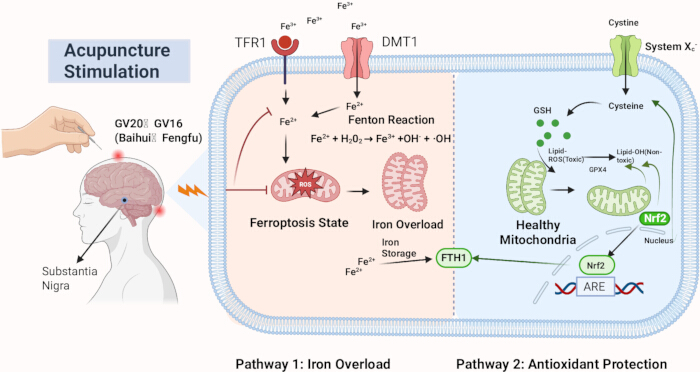
Figure 1: Schematic mechanisms of acupuncture protecting against mitochondrial ferroptosis in dopaminergic neurons of Parkinson’s disease. Acupuncture stimulation at GV20 (Baihui) and GV16 (Fengfu) has been associated with neuroprotective effects on dopaminergic neurons in the substantia nigra through two coordinated pathways. (Left) Pathway 1: Inhibition of Iron Overload. Acupuncture suppresses the expression of iron transporters TFR1 and DMT1, thereby restricting iron (Fe2+) influx. This reduces the intracellular LIP, preventing Fenton reaction-induced reactive oxygen species (ROS) accumulation and mitochondrial damage. (Right) Pathway 2: Antioxidant Defense and Iron Storage. Acupuncture promotes the nuclear translocation of Nrf2, which binds to the antioxidant response element (ARE). This transcriptional activation not only upregulates FTH1 for safe iron storage but also activates the System Xc⁻/GSH/GPX4 axis. GPX4 utilizes GSH to reduce toxic lipid peroxides (Lipid-ROS) into non-toxic lipid alcohols (Lipid-OH). Together, these synergistic pathways reshape the "iron-lipid-antioxidant" balance, may help restore mitochondrial homeostasis and mitigate neuronal ferroptosis. (Red T-bars indicate inhibition; Green arrows indicate promotion/activation). Created in BioRender: https://BioRender.com/8ob9wjn Please click here to view a larger version of this figure.
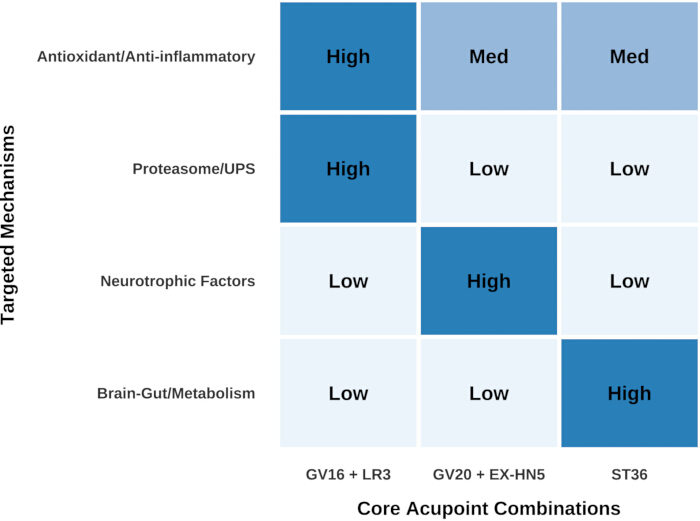
Figure 2: Heatmap of Specific Associations Between Core Electroacupuncture Acupoint Combinations and Targeted Biological Mechanisms in Parkinson's Disease Models. The heatmap is generated from data across the 22 included studies and illustrates the regulatory preferences of different acupoint protocols (X-axis) for specific pathological mechanisms (Y-axis). Darker colors (or labeled "High") indicate a higher frequency and stronger association of the acupoint combination with the corresponding mechanism. High: Primary target with highly concentrated evidence (supported by ≥3 included studies as the primary mechanism). Med: Secondary or adjunctive target (supported by 1-2 included studies). Low: Occasionally reported or non-specific regulation (rarely focused on or only mentioned as an indirect outcome). Abbreviations: GV = Governor Vessel; LR = Liver Meridian; ST = Stomach Meridian; UPS = Ubiquitin-Proteasome System; BDNF = Brain-Derived Neurotrophic Factor. Please click here to view a larger version of this figure.
| Study (Author, Year) | Model / Method | Acupoints | Frequency / Parameters | Target Mechanism | Outcome |
| Liu F et al., 202422 | Mouse (Rotenone) | Baihui (GV20), Quchi (LI11), Zusanli (ST36) | 2/15 Hz, 20 min | Brain-gut axis oxidative stress (ROS, Nrf2) | Improves gait and intestinal function, regulates oxidative stress in colon/substantia nigra |
| Zhang XL et al., 202421 | Mouse (Rotenone) | Fengfu (GV16), Taichong (LR3), Zusanli (ST36) | 2 Hz, 1 mA, 30 min | Nrf2/NLRP3/Caspase-1 pathway (Pyroptosis) | Inhibits pyroptosis in substantia nigra, attenuates neuroinflammatory response |
| Ma J et al., 201930 | Rat (Rotenone) | Fengfu (GV16), Taichong (LR3) | 2 Hz, 1 mA, 30 min | EIF2α-ATF4-GRP78/Bip (ER stress) | Downregulates α-syn and ER stress signals, upregulates TH expression |
| Jiang J et al., 202531 | Mouse (MPTP) | Baihui (GV20), Shenshu (BL23) | 2 Hz, 2 mA, 15 min | Notch1/Hes1 pathway, Microglia | Inhibits microglial activation, reduces neuroinflammation |
| Wang Y et al., 202232 | Mouse (Rotenone) | Fengfu (GV16), Taichong (LR3), Zusanli (ST36) | 2 Hz, 1 mA, 30 min | NF-κB/IL-6, Intestinal barrier (ZO-1) | Repairs intestinal barrier, inhibits intestinal and systemic inflammation |
| Hu MN et al., 202533 | Mouse (MPTP) | Fengfu (GV16), Taichong (LR3), Zusanli (ST36) | 2 Hz, 1 mA, 30 min | IGF-1R/IRS-1/PI3K/AKT (Insulin signaling) | Regulates insulin signaling pathway, improves bradykinesia |
| Wang Y et al., 202434 | Rat (Rotenone) | Fengfu (GV16), Taichong (LR3), Zusanli (ST36) | 2 Hz, 1 mA, 30 min | Sirt3/NLRP3/GSDMD | Clears abnormal α-syn accumulation, ameliorates mitochondrial damage |
| Liu YY et al., 202235 | Rat (6-OHDA) | Taichong (LR3), Fengfu (GV16) | 2 Hz, 1 mA, 30 min | NLRP3/Caspase-1 (Pyroptosis) | Inhibits pyroptosis of dopaminergic neurons |
| Wang YC et al., 201036 | Rat (6-OHDA) | 1. GV16, LR3; 2. Shuanggu Yitong | 2 Hz, 1 mA, 30 min | GDNF (Glial cell line-derived neurotrophic factor), Ret | "Shuanggu Yitong" method is superior to GV16+LR3 alone in increasing GDNF expression |
| Xia Y et al., 201237 | Clinical patients (PD with depression) | Baihui (GV20), Yintang (EX-HN3), Sishencong (EX-HN1), Taichong (LR3), Sanyinjiao (SP6) | Disperse-dense wave, 30 min | BDNF (Brain-derived neurotrophic factor) | Significantly increases serum BDNF level, alleviates depression symptoms |
| Li M et al., 202038 | Rat (6-OHDA) | Dazhui (GV14), Baihui (GV20) | 100 Hz, 3 mA, 30 min | Metabolic profile (Glx/Cr ratio) | Restores metabolic balance in motor cortex and striatum |
| Tu Q et al., 201539 | Rat (Rotenone) | Fengfu (GV16), Taichong (LR3) | 2 Hz, 1 mA, 20 min | 20S Proteasome (β1, β2, β5 subunits) | Protects proteasome activity and expression in substantia nigra |
| Wang YC et al., 201340 | Rat (Rotenone) | Fengfu (GV16), Taichong (LR3) | 2 Hz, 1 mA, 20 min | Ubiquitin-proteasome system (Parkin, UCH-L1) | Enhances ubiquitin-proteasome system function, reduces α-syn accumulation |
| Wang SJ et al., 201341 | Rat (Rotenone) | Fengfu (GV16), Taichong (LR3) | 2 Hz, 1 mA, 20 min | COX-2 (Cyclooxygenase-2), TH | Downregulates inflammatory mediator COX-2, upregulates TH expression |
| Du J et al., 201142 | Rat (6-OHDA) | Baihui (GV20), Dazhui (GV14) | 100 Hz, 3 mA, 30 min | GABA (γ-aminobutyric acid) | Regulates GABA content in cortex-striatum-cerebellum circuit |
| Wang YC et al., 201043 | Rat (6-OHDA) | Fengfu (GV16), Taichong (LR3) | 2 Hz, 1 mA, 30 min | Apoptosis, TH, Nissl bodies | Increases substantia nigra neurons, reduces apoptosis rate |
| Wang S et al., 201544 | Rat (6-OHDA) | Fengfu (GV16), Taichong (LR3) | 2 Hz, 1 mA, 30 min | GFAP, Cx43 (Astrocytes) | Inhibits astrocyte activation (GFAP/Cx43 downregulation) |
| Wang S et al., 200945 | Rat (6-OHDA) | Scalp acupuncture: Baihui (GV20) to Taiyang (EX-HN5) | 100 Hz, 1 mA, 20 min | TH mRNA, DAT mRNA | Promotes dopamine synthesis and reuptake |
| Ma Jun et al., 201546 | Rat (6-OHDA) | Fengfu (GV16), Taichong (LR3) | 2 Hz, 1 mA, 30 min | Cx43, Glutamate (Glu) | Downregulates striatal Glu content and Cx43 protein expression |
| Wang SJ et al., 201447 | Rat (Rotenone) | Fengfu (GV16), Taichong (LR3) | 2 Hz, 2 mA, 20 min | ERK 1/2 signaling, TNF-α, IL-1β | Downregulates p-ERK 1/2 pathway and inflammatory factors |
| Qi XJ et al., 201148 | Rat (6-OHDA) | Scalp acupuncture: Baihui (GV20) to Taiyang (EX-HN5) | 100 Hz, 20 min | BDNF mRNA | Promotes neurotrophic factor expression, protects dopaminergic neurons |
| Wang S et al., 200949 | Rat (6-OHDA) | Scalp acupuncture: Baihui (GV20) to Taiyang (EX-HN5) | 100 Hz, 1 mA, 20 min | BDNF, Apoptosis | Increases BDNF expression, reduces apoptosis |
Table 1: Basic characteristics, acupuncture parameters, and mechanisms of the included studies. Abbreviations: PD = Parkinson's disease; MPTP = 1-methyl-4-phenyl-1,2,3,6-tetrahydropyridine; 6-OHDA = 6-hydroxydopamine; TH = Tyrosine hydroxylase; α-syn = α-synuclein; BDNF = Brain-derived neurotrophic factor; GDNF = Glial cell line-derived neurotrophic factor; Nrf2 = Nuclear factor erythroid 2-related factor 2; NLRP3 = NOD-like receptor family pyrin domain containing 3. Please click here to download this Table.
Disclosures
Loading...
$$\rightleftharpoonup{xx}$$
$$\longleftharp{xx}$$,
$$\longrightharp{xx}$$,
The authors have no conflicts of interest to declare.
Acknowledgements
Loading...
$$\rightleftharpoonup{xx}$$
$$\longleftharp{xx}$$,
$$\longrightharp{xx}$$,
The authors gratefully acknowledge financial support from the Natural Science Foundation of Yuzhong District, Chongqing (Grant No. 20240136).
Reprints and Permissions
Request permission to reuse the text or figures of this JoVE article
Request Permission