This protocol describes the fabrication of polyacrylamide hydrogels with tunable stiffness to study the effects of matrix mechanics on stem Leydig cell behavior in a controlled two-dimensional culture system.
Method Article
Fabricating Tunable Polyacrylamide Hydrogels To Study Matrix Stiffness Effects On Stem Leydig Cells
1Scientific Research Center, The Seventh Affiliated Hospital of Sun Yat-sen University, 2School of Medicine, Shenzhen Campus of Sun Yat-sen University, 3Department of Urology, The Sixth Affiliated Hospital, Sun Yat-sen University, 4Center for Stem Cell Biology and Tissue Engineering, Key Laboratory for Stem Cells and Tissue Engineering, Sun Yat-sen University
Opens in a new tab
In This Article
Summary
Loading...
$$\rightleftharpoonup{xx}$$
$$\longleftharp{xx}$$,
$$\longrightharp{xx}$$,
Abstract
Loading...
$$\rightleftharpoonup{xx}$$
$$\longleftharp{xx}$$,
$$\longrightharp{xx}$$,
Extracellular matrix (ECM) stiffness critically regulates stem cell behavior. Previously, we demonstrated that pathological increases in matrix stiffness during aging disrupt stem Leydig cell (SLC) homeostasis, leading to a decline in testosterone. Building on this discovery, we here present a detailed protocol—originally developed in our laboratory—for fabricating polyacrylamide (PA) hydrogels with tunable stiffness to model the testicular microenvironment in vitro. This method enables reproducible casting of gels across a stiffness range of 1–100 kPa, covering physiological to pathological conditions. Key steps include precise mixing of acrylamide/bis-acrylamide, gel swelling equilibration, surface activation with Sulfo-SANPAH, and collagen coating to support SLC adhesion and culture. We provide optimized formulations for target stiffnesses and troubleshooting guidance for common issues such as incomplete polymerization and poor cell attachment. This system allows systematic investigation of how substrate stiffness modulates SLC proliferation, differentiation, and steroidogenic function under defined 2D conditions. Beyond reproductive biology, it also serves as a valuable platform for mechanobiological studies in other cell types and for screening therapeutics targeting stiffness-related dysfunction.
Introduction
Loading...
$$\rightleftharpoonup{xx}$$
$$\longleftharp{xx}$$,
$$\longrightharp{xx}$$,
The mechanical properties of the extracellular matrix (ECM) play a pivotal role in regulating stem cell fate, including proliferation, differentiation, and functional maintenance1,2,3,4. In the testis, age-related ECM stiffening has been implicated in the decline of testosterone production. However, the underlying mechanobiological mechanisms remain poorly understood, partly due to a lack of standardized in vitro models that faithfully recapitulate the physiological stiffness range of the testicular niche. The physiological stiffness of young mouse testicular tissue is approximately 1–15 kPa, whereas aged or fibrotic tissue can reach 20–30 kPa or higher.
Polyacrylamide (PA) hydrogels have emerged as a versatile platform for studying cell–matrix interactions because their stiffness can be precisely tuned by varying the ratio of acrylamide to bis-acrylamide5,6. Compared to other substrates such as collagen-coated glass or commercial hydrogels, PA gels offer independent control over stiffness and biochemical ligand density, enabling systematic dissection of mechanical cues. Although several protocols exist for PA gel fabrication7,8,9, they often lack detailed optimization for specific cell types, particularly for rare primary cells like SLCs.
Here, we present a robust and reproducible protocol for preparing PA hydrogels with defined stiffness (1–100 kPa) tailored for culturing mouse SLCs. The method includes step-by-step instructions for gel casting, swelling equilibration, surface functionalization with Sulfo-SANPAH, and collagen coating to promote cell adhesion. By following this protocol, researchers can generate substrates with tunable stiffness (ranging from 1 to 100 kPa) that mimic the mechanical environment of young (soft) and aged (stiff) testes, enabling quantitative investigation of stiffness-dependent SLC responses. The system is also adaptable to other mechanosensitive cell types and provides a platform for drug screening targeting stiffness-related pathologies.
Protocol
Loading...
$$\rightleftharpoonup{xx}$$
$$\longleftharp{xx}$$,
$$\longrightharp{xx}$$,
All animal procedures were approved by the Institutional Animal Care and Use Committee of Sun Yat‑sen University (Approval No. SYSU-IACUC-2026-B1278) and were performed in accordance with the institutional guidelines.
1. Isolation and culture of primary mouse SLCs
- Dissect testes from C57BL/6 mice and carefully remove the tunica albuginea.
- Mince the testes into small pieces.
- Dissociate interstitial cells from seminiferous tubules by incubating in 1 mg/mL collagenase type IV in DMEM/F12 at 37 ºC for 15 min.
- Add DMEM/F12 containing 10% fetal bovine serum to stop collagenase activity.
- Centrifuge at 1500 × g for 3 min at room temperature.
- Resuspend the pellet in PBS and filter through a 70 µm filter.
- Enrich CD51⁺ cells by fluorescence-activated cell sorting (FACS) using an Influx Cell Sorter.
- Seed the enriched cells in SLC culture medium composed of DMEM/F12 supplemented with: 1 nM dexamethasone, 1 ng/mL LIF, 5 µg/L insulin‑transferrin‑sodium selenite, 5% chicken embryo extract, 0.1 mM β‑mercaptoethanol, 1% nonessential amino acids, 1% N2, 2% B27, 20 ng/mL basic fibroblast growth factor, epidermal growth factor, platelet‑derived growth factor, and oncostatin M.
- Culture the SLCs under standard conditions (37 °C, 5% CO₂) until they reach the desired density for seeding onto hydrogels.
2. Assembling the gel casting glass container
- Carefully inspect and clean the specialized glass plates and spacers used for casting polyacrylamide gel electrophoresis (PAGE) gels, ensuring they are free of dust, damage, and residues.
- Correctly assemble the glass plates, spacers, and clamps according to the manufacturer's instructions, ensuring the assembly is well-sealed to prevent leakage during gel casting.
- Place the assembled glass container securely on a laboratory stand, ready for casting.
NOTE: The casting setup uses standard Western blot (sodium dodecyl sulfate [SDS]-PAGE) glass plates with fixed spacers of either 1.0 mm thickness, ensuring reproducible gel thickness and a flat surface for cell culture.
3. Preparing PAGE gel mix solution
- Precisely measure the following reagents according to the experimental design (see Table 1) into a 15 mL or 50 mL sterile centrifuge tube: 40% Acrylamide stock solution, 2% Bis-acrylamide stock solution, 1M HEPES buffer (pH 8.5), Sterile ddH₂O.
CAUTION: Acrylamide and bis‑acrylamide are neurotoxins. Always wear gloves and a dust mask when weighing dry powder to avoid skin contact and inhalation of airborne particles. Procedures should be performed within a fume hood.
4. Adding initiator and catalyst, and casting the gel
- Add the following to the mixed solution sequentially: 10% Ammonium Persulfate (APS): Acts as the initiator to start the polymerization reaction. N,N,N',N'-Tetramethylethylenediamine (TEMED): Acts as the catalyst to accelerate the polymerization reaction. For a total gel volume of 6 mL, add 60 µL of 10% APS and 6 µL of TEMED (see Table 1 for scaling).
NOTE: The polymerization reaction begins immediately after adding TEMED; therefore, subsequent steps must be performed swiftly.
5. Pouring the mixed solution
- Immediately pipette or pour the mixed solution steadily along one edge of the glass container to avoid creating bubbles.
6. Allowing the gel to polymerize
- Let the cast gel container sit undisturbed at room temperature.
NOTE: Polymerization usually takes 15–30 min at room temperature (20–25 °C). - Proceed to the next step once a clear interface between the unpolymerized gel mixture and the polymerized gel is visible and the gel is completely solid (the gel does not flow when the container is tilted).
- Immediately after casting, carefully overlay a thin layer of absolute ethanol (or water-saturated ethanol) on top of the gel mixture to exclude atmospheric oxygen, which inhibits radical polymerization. The ethanol also helps form a flat upper surface.
- After polymerization, remove the ethanol before disassembling the plates.
7. Disassembling the container and harvesting the gel
- Carefully disassemble the clamps and use a plastic wedge or spatula to gently pry the glass plates apart, allowing the polymerized PAGE gel to remain intact on one plate.
- Prepare a culture dish containing an ample amount of sterile PBS.
- Carefully peel the gel from the glass plate using a spatula or gloved hand, and let it slide smoothly into the PBS.
- Seal the dish containing the gel in PBS and incubate at 4 °C overnight.
NOTE: This step is crucial. The newly prepared gel is dehydrated and must fully absorb water and swell to its final dimensions in PBS. If this step is skipped and the gel is cut directly, it will continue to expand in subsequent cell culture medium, likely exceeding the area of the culture well and rendering it unusable. The gel thickness after swelling is 1 mm. This is critical because when the gel thickness falls below 100 µm, cells may sense the stiffness of the underlying rigid culture plate, which would interfere with the intended mechanobiological measurements.
8. Cutting and transferring the gel to a culture plate
- The next day, retrieve the gel from 4 °C. Using a sterile biopsy punch or blade cutter (with a diameter matching the well size of the culture plate, e.g., 6-well plate), cut the gel under sterile conditions.
- Within a biosafety cabinet, use sterile forceps to gently pick up the cut gel disc and place it in the center of an empty, sterile culture well.
9. Initial washing and UV irradiation
- Add sufficient sterile PBS to the well containing the gel, ensuring it is completely submerged.
- Gently rock the culture plate to wash the gel surface.
- Aspirate the PBS using a pipette.
- Repeat this washing process once more, for a total of two washes, each lasting 3 min.
- After washing, add sufficient sterile PBS to cover the gel again. Place the entire culture plate with the lid slightly ajar under a UV lamp (inside a biosafety cabinet or a dedicated UV crosslinker) and irradiate for 1 h for basic sterilization.
10. Activation of Sulfo-SANPAH crosslinker
- Inside the biosafety cabinet, carefully aspirate the PBS from the well.
- Before aspirating, gently separate the gel from the well walls and bottom using a pipette tip to avoid damaging the gel due to liquid surface tension.
- Transfer the gel to another clean well in the same culture plate using sterile forceps.
NOTE: When transferring the gel, first adding a small amount of PBS to the clean well can help expel air bubbles trapped between the well bottom and the gel upon placement, and also serves as an additional wash. - Prepare crosslinker working solution: Freshly prepare a 0.2 mg/mL Sulfo-SANPAH working solution by diluting the stock solution (see Table 1) using sterile water or the recommended buffer (e.g., PBS).
NOTE: Protect the solution from light. - Add sufficient Sulfo‑SANPAH working solution to cover the gel (e.g., 250 µL for a 12‑well plate, 500 µL for a 6‑well plate), ensuring the gel is completely covered.
- Place the plate under 365 nm wavelength /120 mJ/cm2 UV light and irradiate for 1 h.
NOTE: This step activates Sulfo-SANPAH, enabling it to bind to functional groups on the gel surface.
11. Crosslinker activation and final washes
- After irradiation, aspirate the Sulfo-SANPAH solution from the well inside the biosafety cabinet.
- Add sufficient sterile PBS to the well, gently rock to wash the gel surface, and aspirate the PBS.
- Repeat this washing process once more, for a total of two washes, each lasting 3 min, to thoroughly remove any unreacted Sulfo-SANPAH.
12. Preparing rat tail type I collagen working solution
- Use a 0.02 M acetic acid solution as a solvent to dilute the rat tail type I collagen stock solution.
- Adjust the final working solution concentration to 60–100 µg/mL. For example, if the collagen stock concentration is 4 mg/mL, add 15–25 µL of stock to 985–975 µL of 0.02 M acetic acid to obtain 1 mL of working solution.
13. Collagen coating and incubation
- Add the appropriate volume of collagen working solution to each well containing the activated gel according to the plate type: add 2 mL for a 6-well plate, or 1 mL for a 12-well plate.
- Gently swirl the culture plate to ensure the collagen solution evenly covers the gel and the well bottom.
- Cover the plate and incubate overnight in a 37 °C, 5% CO₂ incubator to allow the collagen to fix onto the gel surface via Sulfo-SANPAH crosslinking.
14. Secondary UV irradiation and fixation
- The next day, remove the plate and irradiate again under about 120 mJ/cm2 UV light for 1 h.
15. Remove unbound collagen and seed cells
- Inside the biosafety cabinet, carefully aspirate the rat tail type I collagen working solution from the wells.
- Add sterile PBS to the wells, gently rock to wash the gel surface, and aspirate the PBS.
- Repeat the wash once more, for a total of two washes, each lasting 3 min.
- After washing, the gel matrix is ready. Resuspend the prepared stem Leydig cells in the complete SLC culture medium (composition detailed in step 1).
- Seed the cell suspension directly onto the gel surface. The recommended seeding density is 2 × 10⁴ cells/cm2 (e.g., approximately 2 × 10⁵ cells per well for a standard 6-well plate).
- Incubate the culture plates at 37 °C in a humidified 5% CO₂ incubator.
- To maintain optimal cell viability and steroidogenic function, change the culture medium every 48 h.
Results
Loading...
$$\rightleftharpoonup{xx}$$
$$\longleftharp{xx}$$,
$$\longrightharp{xx}$$,
Successful execution of this protocol yields polyacrylamide hydrogels with defined stiffness (ranging from 1 to 100 kPa) that remain firmly attached to the culture plate and support robust SLC adhesion and spreading. Figure 1 provides a schematic overview of the entire workflow, from gel casting to cell seeding, enabling users to visualize the key stages of the protocol.
Mechanical validation of polyacrylamide hydrogels (target stiffness: 1, 5, 15, 30, 50, and 100 kPa) was performed using oscillatory rheometry (parallel plate geometry, 37 °C). The measured Young's moduli were 1.1 ± 0.2 kPa, 5.1 ± 0.6 kPa, 15.2 ± 2.1 kPa, 29 ± 3 kPa, 51.7 ± 3.7 kPa, and 96 ± 6 kPa, confirming that the described formulations cover the intended physiological and pathological stiffness range. Following overnight swelling in PBS at 4 °C, gels reach equilibrium dimensions and can be cut into uniform discs using a custom mold designed to match standard culture plate wells (Figure 2). After transfer to culture plates, the quality of collagen coating and cell seeding is assessed by morphology. As shown in Figure 3, successful seeding yields well-attached SLCs with flattened morphology and extended processes by 24 h, whereas unsuccessful seeding results in rounded, non-adherent cells forming clumps. Bright-field imaging confirms that SLCs cultured on both soft (1 kPa) and stiff (30 kPa) hydrogels exhibit comparable attachment and spreading (Figure 4A), demonstrating that the collagen-coated hydrogel surface supports robust cell adhesion across the tested stiffness range.
To validate the biological response to substrate stiffness, SLCs cultured on gels of 5, 15, 30, 50, and 100 kPa were analyzed by ELISA for testosterone and Western blot for steroidogenic markers CYP11A1, HSD3β, and STAR. The results demonstrate that stiff hydrogels (30 kPa) suppress testosterone secretion compared to soft ones (1 kPa). Protein expression of all three markers decreased progressively with increasing stiffness up to 50 kPa, with the most significant decline between 5–30 kPa and a plateau thereafter (Figure 4B,C). These results identify 5–15 kPa as the optimal stiffness range for maintaining SLC steroidogenic function, corresponding to the physiological stiffness of young (1–15 kPa) testicular tissue, and confirm that higher stiffness inhibits steroidogenic capacity as previously reported11.
These representative results demonstrate that the protocol reliably produces hydrogels with tunable mechanical properties and enables quantitative assessment of stiffness-dependent SLC functions. Researchers can use this system to investigate mechanotransduction pathways, screen for compounds that rescue stiffness-induced dysfunction, or adapt the method to other mechanosensitive cell types.
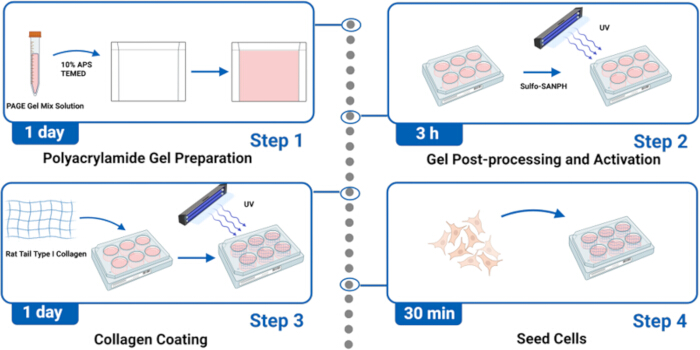
Figure 1: Schematic overview of the polyacrylamide hydrogel fabrication and cell seeding workflow. The protocol is divided into four main stages: (1) gel casting and polymerization, (2) gel post-processing and surface activation with Sulfo-SANPAH, (3) collagen coating, and (4) cell seeding. Each stage includes key steps as indicated. Created with BioRender.com under a publication license. Please click here to view a larger version of this figure.
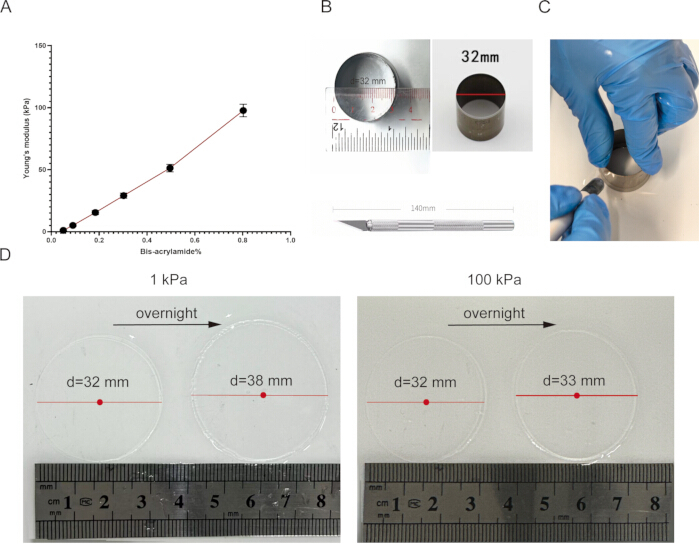
Figure 2: Fabrication and preparation of polyacrylamide hydrogels. (A) Measured Young's moduli (rheometry, 37 °C) for gels with increasing bis‑acrylamide content (see Table 1) were 1.1 ± 0.2 kPa (1 kPa target), 5.1 ± 0.6 kPa (5 kPa), 15.2 ± 2.1 kPa (15 kPa), 29 ± 3 kPa (30 kPa), 51.7 ± 3.7 kPa (50 kPa), and 96 ± 6 kPa (100 kPa), covering soft physiological to stiff pathological conditions. (B) The images show the two components of the excision tool: a cylindrical mold with an inner diameter of 32 mm and the associated cutting blade. The mold's diameter was specifically chosen to be slightly smaller than the 34.8 mm diameter of a standard 6-well plate well to facilitate clean and accurate gel coring. (C) The custom cutting mold, designed to match the dimensions of a standard 6-well plate, enables the preparation of multiple hydrogel discs of consistent size for high-throughput experiments. (D) Comparison of the sizes of polyacrylamide hydrogels with Young's moduli of 1 kPa and 100 kPa before and after incubation in PBS at 4°C overnight. The gels were allowed to swell under these conditions. Please click here to view a larger version of this figure.
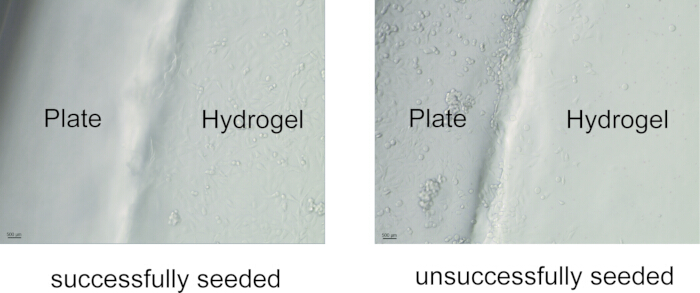
Figure 3. Representative images of successful and unsuccessful cell seeding on polyacrylamide hydrogels. Micrographs show the distinct morphological differences between cells that have properly attached and spread (successfully seeded) versus those that have failed to attach or have rounded up (unsuccessfully seeded) on the hydrogel surfaces. Scale bar, 500 µm. Please click here to view a larger version of this figure.
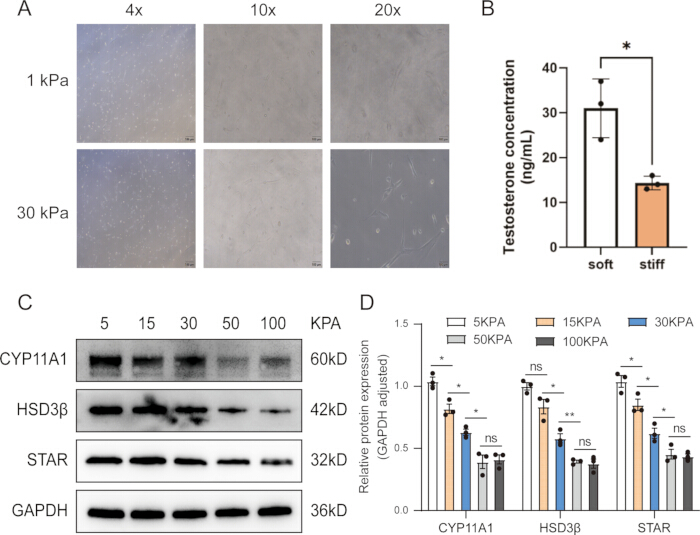
Figure 4. Expected outcomes of cell seeding and subsequent SLC culture. (A) Verification of successful cell seeding on soft (1 kPa) and stiff (30 kPa) matrices of polyacrylamide hydrogels. Representative bright-field images show well-attached and spread cells at various magnifications (4x, 10x, and 20x), confirming a suitable foundation for subsequent SLC culture. Scale bar, 100 µm. (B) Testosterone concentration analysis of SLC‑derived Leydig cells cultured on soft (1 kPa) and stiff (30 kPa) polyacrylamide hydrogels in 2D. The mean testosterone concentration is approximately 30 ng/mL on soft hydrogels and 15 ng/mL on stiff hydrogels, indicating that increased matrix stiffness impairs SLC differentiation and steroidogenic function. Data are presented as mean ± SEM (n = 3). *p < 0.05. (C,D) Western Blot analysis of SLCs cultured on polyacrylamide gels with stiffnesses of 5, 15, 30, 50, and 100 kPa. (C) Representative Western blots showing protein levels of the steroidogenic markers CYP11A1, HSD3β, and STAR in SLCs cultured on gels of 5, 15, 30, 50, and 100 kPa. GAPDH serves as the loading control. (D) Densitometric quantification of the Western blots shown in (C). Protein levels of all three markers decrease significantly with increasing substrate stiffness up to ~50 kPa, with the inhibitory effect plateauing thereafter. Data are presented as mean ± SEM (n = 3 independent experiments). *p < 0.05, **p < 0.01. These results identify the optimal stiffness range for SLC differentiation and support the trend that higher stiffness inhibits steroidogenic function. For two-group comparisons (B), a two-tailed unpaired Student's t‑test was used. For multi‑group comparisons (D), one‑way ANOVA with Tukey's post hoc test was used. *p < 0.05, *p < 0.01. Please click here to view a larger version of this figure.
Table 1: Composition of the solutions and gels used in this study. Please click here to download this Table.
Discussion
Loading...
$$\rightleftharpoonup{xx}$$
$$\longleftharp{xx}$$,
$$\longrightharp{xx}$$,
The mechanical properties of the extracellular matrix play a fundamental role in regulating stem cell behavior, yet the tools to systematically study these effects in reproductive cells remain limited. Our previous work demonstrated that pathological matrix stiffening during aging disrupts stem Leydig cell (SLC) homeostasis through the Piezo1/ROS/Gli1 axis, leading to testosterone decline10. Building on this discovery, we developed this polyacrylamide hydrogel protocol to provide a standardized, reproducible platform for investigating how substrate stiffness directly modulates SLC function. The ability to fabricate hydrogels across the physiological to pathological stiffness range (1–100 kPa) allows researchers to recapitulate the mechanical microenvironment of both young and aged testes in vitro.
The handling of polyacrylamide hydrogels is straightforward. Additionally, the protocol requires access to specialized equipment such as a UV crosslinker and, for stiffness validation, rheometry or atomic force microscopy, which may not be available in all laboratories. This model allows for experimental use after gel fabrication (overnight), surface activation (1 h), and collagen coating (overnight); the exact timing for cell seeding can be adjusted according to the user's laboratory schedule and experimental needs. The field of applications can be extensive due to the compatibility of these hydrogels with conventional downstream assays, including immunofluorescence staining, Western blot analysis, RNA extraction for gene expression studies, and hormone secretion measurements (e.g., testosterone ELISA). It is also possible to co-culture SLCs with other testicular cell types, such as Sertoli cells or peritubular myoid cells, by seeding them onto the same gel surface or using transwell inserts. The influence of pharmaceutical compounds on stiffness-dependent SLC dysfunction could also be tested in this model by treating cells on hydrogels of varying stiffness with candidate drugs before assessing steroidogenic marker expression or testosterone production. In fact, the use of 96-well plate-compatible gel formats can facilitate the implementation of high-throughput screening systems to accelerate the discovery of drugs against age-related hypogonadism and to evaluate potential side effects on Leydig cell function during drug development11.
One critical step in the presented method is the overnight swelling of polymerized gels in PBS at 4 °C. This step is essential because freshly cast gels are dehydrated and will continue to expand in culture medium if not pre-swollen, potentially exceeding the well area and rendering them unusable. Another critical consideration is the UV activation of Sulfo-SANPAH; insufficient exposure or use of degraded reagent leads to poor collagen crosslinking and subsequent gel detachment during washing or cell culture. We emphasize using a calibrated UV crosslinker at 365 nm for exactly 1 h and preparing Sulfo-SANPAH solutions fresh from aliquots stored at -20 °C protected from light. There is also a possible risk of mechanical damage to the gels during liquid handling; we recommend pipetting against the well wall and gently breaking the meniscus before aspiration to avoid lifting the gel.
While we have optimized this protocol for mouse SLCs, further investigations should test its applicability to other mechanosensitive cell types relevant to reproductive biology. For example, Leydig cells from different species, including human, may exhibit distinct stiffness optima and require adjustment of coating proteins or hydrogel formulations. In the context of aging research, it is known that comorbidities such as diabetes or metabolic syndrome can exacerbate testicular fibrosis and stiffening12. In the model described here, it is possible to simulate those conditions by treating cells with relevant factors before or during culture on defined stiffness substrates to investigate synergistic effects on SLC dysfunction.
The model is limited by the direct contact of cells with a static stiffness substrate, whereas native testicular tissue exhibits viscoelastic and dynamic mechanical properties due to constant remodeling13. Additionally, the protocol requires access to specialized equipment such as a UV crosslinker and, for stiffness validation, rheometry or atomic force microscopy, which may not be available in all laboratories. We confirmed the functional relevance of our stiffness range by using Western blot analysis of steroidogenic markers, which showed a progressive decline in CYP11A1, HSD3β, and STAR expression with increasing stiffness up to 50 kPa, consistent with the impaired testosterone production observed in aged testes. It is also possible to remove the gels and harvest cells for further analysis, including RNA-seq or proteomic profiling, to discover novel mechanosensitive pathways involved in SLC regulation.
In summary, this method represents a robust platform to analyze the effects of matrix stiffness on stem Leydig cell function with the potential to expand it for high-throughput drug screening. The protocol is reproducible, cost-effective, and adaptable to other cell types and disease models, providing a valuable tool for mechanobiological research in reproductive endocrinology and beyond.
Disclosures
Loading...
$$\rightleftharpoonup{xx}$$
$$\longleftharp{xx}$$,
$$\longrightharp{xx}$$,
The authors have nothing to disclose.
Acknowledgements
Loading...
$$\rightleftharpoonup{xx}$$
$$\longleftharp{xx}$$,
$$\longrightharp{xx}$$,
The funding for this project was provided by the National Key Research and Development Program of China Stem Cell and Translational Research(2021YFA1100601), National Natural Science Foundation of China (82371608), Guangdong Basic and Applied Basic Research Foundation (2023B1515020016), and Shenzhen Fundamental Research Program (JCYJ20240813150417024, JCYJ20240813150422030).
Materials
| Name | Company | Catalog Number | Comments |
|---|---|---|---|
| Acetic acid | Sigma-Aldrich | Cat#A6283 | Diluent for rat tail collagen (0.02 M) |
| Acryiamide | Sangon Biotech | Cat#A100341-0500 | Monomer for polyacrylamide gel preparation |
| Ammonium persulfate (APS) | Sangon Biotech | Cat#A100486-0100 | Initiator for gel polymerization |
| B27 supplement | Invitrogen | Cat#A1486701 | Defined supplement enriched for antioxidants and hormones; supports neuronal and stem cell survival (2% v/v) |
| Basic fibroblast growth factor (bFGF) | Invitrogen | Cat#13256029 | Mitogenic growth factor; promotes SLC proliferation and stemness (20 ng/mL) |
| Bis-acrylamide | Shanghai yuanye Bio-Technology | Cat#S14002 | Crosslinker for polyacrylamide gels |
| Chicken embryo extract | US Biologicals | Cat#C3999 | Rich source of growth factors and nutrients; supports SLC growth and viability (5% v/v) |
| Collagen, Type I, from rat tail | YEASEN | Cat#40125ES50 | Coats the Sulfo-SANPAH-activated polyacrylamide hydrogel surface to promote SLC adhesion and culture. |
| Collagenase Type IV | Gibco | Cat#17104-019 | 1 mg/mL in DMEM/F12 for testicular tissue digestion |
| CYP11A1 antibody | GeneTex | Cat#GTX56293 | For western blotting |
| Dexamethasone | Sigma-Aldrich | Cat#D1756 | Glucocorticoid receptor agonist; supports SLC proliferation and stemness maintenance (1 nM) |
| DMEM/F12 medium | Gibco | Cat#11320033 | Basal medium for digestion, washing, and SLC culture |
| Epidermal growth factor (EGF) | PeproTech | Cat#AF-100-15 | Stimulates SLC proliferation and maintains undifferentiated state (20 ng/mL) |
| Fetal Bovine Serum (FBS) | VISTECH | Cat#SE100-011 | Used at 10% to stop collagenase activity |
| Fiji | N/A | https://imagej.net/Fiji | Image analysis software |
| GADPH antibody | Proteintech | Cat#60004-1-Ig | For western blotting |
| Gel digestion enzymes | Accurate Biotechnology | Cat#GXDLFA | Enzyme mixture for testicular tissue digestion and SLC isolation |
| HEPES | Cytiva | Cat#SH30237.01 | Buffer to maintain pH 7.0–7.4 |
| HSD3β antibody | Santa Cruz | Cat#sc-515120 | For western blotting |
| Influx Cell Sorter | BD | https://www.bdbiosciences.com/content/dam/bdb/marketing-documents/BD_Influx_tech_specs.pdf | |
| Insulin-Transferrin-Sodium Selenite (ITS) | Sigma-Aldrich | Cat#11074547001 | Promotes cell survival, glucose uptake, and antioxidant defense (5 μg/L) |
| KnockOut serum replacement (KSR) | Gibco | Cat#10828-028 | Serum substitute for SLC culture medium |
| LIF (Leukemia Inhibitory Factor) | Millipore | Cat#LIF1010 | Cytokine that maintains stem cell pluripotency and self-renewal (1 ng/mL) |
| Mice testicles | This paper | N/A | Isolated from C57BL/6 mice |
| Mouse Testosterone ELISA Kit | Fine Biotech | Cat#40203ES80 | For quantification of testosterone in culture supernatants |
| Mouse: C57BL/6 | Shenzhen TopBiotech | N/A | Mouse strain used for testis collection |
| Mouse: Testicular Stem Leydig Cells (SLCs) | This paper | N/A | Primary cells isolated from mouse testes |
| N2 supplement | Invitrogen | Cat#17502001 | Defined serum-free supplement supporting neural and stem cell cultures (1% v/v) |
| Non-essential amino acids | HyClone | Cat#SH30050.03 | Provides nitrogen sources for protein synthesis and cell metabolism (1% v/v) |
| Oncostatin M (OSM) | PeproTech | Cat#300-10T | Cytokine involved in SLC differentiation regulation and Leydig cell maturation (20 ng/mL) |
| Phosphate-Buffered Saline (PBS) | Gibco | Cat#10010023 | Washing and resuspension buffer |
| Platelet-derived growth factor (PDGF) | PeproTech | Cat#100-14B | Supports cell proliferation, migration, and survival (20 ng/mL) |
| Prism 9.0 | GraphPad | https://www.graphpad.com/ | Software for statistical analysis and graphing |
| StAR antibody | Proteintech | Cat#67130-1-Ig | For western blotting |
| Sulfo-SANPAH | MACKLIN | Cat#102568-43-4 | Heterobifunctional crosslinker for gel surface activation |
| TEMED | Phygene | Cat#PH0341 | Catalyst for polymerization |
| β-Mercaptoethanol | Invitrogen | Cat#21985023 | Reduces oxidative stress and supports cell growth in culture (0.1 mM) |
References
Loading...
$$\rightleftharpoonup{xx}$$
$$\longleftharp{xx}$$,
$$\longrightharp{xx}$$,
- Gjorevski, N., et al. Designer matrices for intestinal stem cell and organoid culture. Nature. 539 (7630), 560-564 (2016).
- Smith, L. R., Cho, S., Discher, D. E. Stem cell differentiation is regulated by extracellular matrix mechanics. Physiology. 33 (1), 16-25 (2018).
- Chaudhuri, O., et al. Hydrogels with tunable stress relaxation regulate stem cell fate and activity. Nature Mater. 15 (3), 326-334 (2016).
- Nellinger, S., Kluger, P. J. How mechanical and physicochemical material characteristics influence adipose-derived stem cell fate. Int J Mol Sci. 24 (4), 3551(2023).
- Pelham, R. J., Wang, Y. L. Cell locomotion and focal adhesions are regulated by substrate flexibility. Proc Natl Acad Sci U S A. 94 (25), 13661-13665 (1997).
- Tse, J. R., Engler, A. J. Preparation of hydrogel substrates with tunable mechanical properties. Curr Protoc Cell Biol. , (2010).
- Sanzari, I., et al. Parylene C topographic micropattern as a template for patterning PDMS and polyacrylamide hydrogel. Sci Rep. 7 (1), 5764(2017).
- Kandow, C. E., Georges, P. C., Janmey, P. A., Beningo, K. A. Polyacrylamide hydrogels for cell mechanics: steps toward optimization and alternative uses. Methods Cell Biol. 83, 29-46 (2007).
- Aratyn-Schaus, Y., et al. Preparation of complaint matrices for quantifying cellular contraction. J Vis Exp. 46, e2173(2010).
- Huang, J., et al. High matrix stiffness triggers testosterone decline in aging males by disrupting stem Leydig cell pool homeostasis. Cell Rep. 44 (9), 116207(2025).
- Syed, S., Karadaghy, A., Zustiak, S. Simple polyacrylamide-based multiwell stiffness assay for the study of stiffness-dependent cell responses. J Vis Exp. 97, e52643(2015).
- Zheng, Y. C., et al. Islet transplantation ameliorates diabetes-induced testicular interstitial fibrosis and is associated with inhibition of TGF-β1/Smad2 pathway in a rat model of type 1 diabetes. Mol Med Rep. 23 (5), 376(2021).
- Trottmann, M., et al. Shear-wave elastography of the testis in the healthy man - determination of standard values. Clin Hemorheol Microcirc. 62 (3), 273-281 (2016).
Reprints and Permissions
Request permission to reuse the text or figures of this JoVE article
Request Permission