This study describes the implementation and evaluation of a hospital-operated Supply–Processing–Distribution (SPD) logistics model for medical consumables management in a stomatology department. The integrated SPD workflow improved consumable traceability, inventory governance, delivery efficiency, workload management, and operational standardization through barcode-enabled digital logistics coordination.
Research Article
Implementation of a Digital SPD Logistics Model in a Stomatology Department: A Quasi-experimental Study
Opens in a new tab
In This Article
Summary
Loading...
$$\rightleftharpoonup{xx}$$
$$\longleftharp{xx}$$,
$$\longrightharp{xx}$$,
Abstract
Loading...
$$\rightleftharpoonup{xx}$$
$$\longleftharp{xx}$$,
$$\longrightharp{xx}$$,
Efficient management of medical consumables is essential for maintaining patient safety, workflow efficiency, and financial sustainability in hospital settings. However, many departments continue to rely on decentralized and paper-based inventory coordination processes that may increase dispensing errors, administrative workload, and inventory costs. This study evaluated the implementation of a hospital-operated Supply–Processing–Distribution (SPD) logistics management model in the Department of Stomatology of a tertiary hospital. A quasi-experimental pre–post design was used, including a 6-month baseline period (January–June 2023) and a 6-month post-implementation period (July–December 2023). The SPD model integrated barcode-enabled smart storage cabinets, standardized consumables master-data management, and bidirectional connectivity with the hospital information system. Primary operational outcomes included delivery error rate, delivery time, staff workload, service satisfaction, and inventory capital occupation. Multivariable regression and interrupted time-series analyses were performed. A total of 31,248 dispensing events were evaluated. Following SPD implementation, delivery error rates decreased from 2.00% to 0.50%, and mean delivery time was reduced significantly. Staff workload decreased, while service satisfaction improved after implementation. Monthly inventory capital occupation also declined substantially, with interrupted time-series analysis demonstrating significant post-implementation changes in level and trend. Implementation of the hospital-operated SPD model was associated with improved operational efficiency, traceability of consumables, workflow standardization, and inventory management within the stomatology department. The findings support the potential value of digitally integrated logistics governance systems for optimizing hospital consumables management and reducing workflow interruptions during routine clinical operations.
Introduction
Loading...
$$\rightleftharpoonup{xx}$$
$$\longleftharp{xx}$$,
$$\longrightharp{xx}$$,
Medical consumables are essential to hospital operations, and their effective management directly influences patient safety, financial sustainability, and clinical workflow efficiency. Inventory governance in hospital supply chains is inherently complex because of high product diversity, fluctuating demand, expiration-sensitive materials, and regulatory oversight1,2. Inadequate management of consumables may contribute to stock shortages, delivery delays, increased manual workload, inventory obsolescence, and documentation errors, all of which can negatively affect operational performance and the continuity of clinical care.
In recent years, healthcare institutions have increasingly adopted digital supply-chain technologies to improve inventory traceability, accountability, and operational efficiency. Automated dispensing systems, barcode-enabled tracking, radio-frequency identification (RFID), and integration with hospital information systems (HIS) have been associated with improvements in workflow reliability, traceability, and inventory management performance3,4. However, many previous studies have focused primarily on isolated inventory-monitoring technologies rather than integrated logistics-management systems. In contrast, Supply–Processing–Distribution (SPD) logistics models represent broader operational frameworks that combine centralized consumable coordination, workflow standardization, digital traceability, replenishment governance, and integration between clinical and supply management processes. Accordingly, the present study extends beyond conventional digital inventory tracking by evaluating the real-world operational impact of an integrated hospital-operated SPD logistics model within a clinical stomatology department.
Although most published literature has focused on medication management systems, similar digital governance approaches may also improve the management of medical consumables through real-time transaction capture, standardized master data governance, and automated reconciliation processes. Recent operational studies have reported that digitalization of hospital supply chains may improve inventory visibility, reduce waste, strengthen operational resilience, and support cost containment2,5. Furthermore, integration between point-of-care inventory systems and centralized procurement or financial-management platforms has been associated with improved material-flow coordination and reduced inventory capital occupation1,2. Despite growing interest in the digitalization of healthcare logistics, relatively few empirical studies have evaluated hospital-operated SPD systems for consumable management in specialty clinical departments such as stomatology.
The stomatology department was selected as the implementation setting because it presents distinctive consumables-management challenges compared with many other hospital units. Daily clinical activities involve high-frequency use of diverse consumable items, frequent small-batch dispensing, rapid material turnover, and strict traceability requirements for infection control and procedural safety. These operational characteristics make stomatology departments particularly well-suited for evaluating integrated SPD logistics management systems.
Few previous studies have combined quasi-experimental operational evaluation with interrupted time-series analysis to assess the effects of SPD implementation on departmental logistics performance. Therefore, the present study evaluated the implementation of a hospital-operated SPD logistics model in the Department of Stomatology of a tertiary hospital. It was hypothesized that SPD implementation would be associated with reductions in delivery errors, improved delivery efficiency, lower staff workload, improved service satisfaction, and reduced inventory capital occupation. Using predefined pre–post comparison periods and multivariable, segmented regression analyses, this study aimed to provide reproducible operational evidence on SPD-based consumables governance in a real-world clinical environment.
From a healthcare operations management perspective, SPD systems may support supply chain coordination, consumable traceability, workflow standardization, and digital logistics governance within hospital environments. Integrated logistics management models may facilitate real-time monitoring, standardized replenishment processes, and improved coordination between clinical and supply management personnel. Accordingly, this study contributes practical evidence to the literature on hospital logistics management, healthcare quality improvement, and digital transformation by evaluating the operational impact of an integrated SPD logistics model in routine clinical practice. The study primarily assessed operational performance outcomes following SPD implementation while also examining the role of digital governance and workflow standardization in improving consumables management efficiency.
Protocol
Loading...
$$\rightleftharpoonup{xx}$$
$$\longleftharp{xx}$$,
$$\longrightharp{xx}$$,
1. Ethical approval and regulatory compliance
This study was conducted as a hospital-based quality-improvement and operational evaluation initiative within the Department of Stomatology at Guigang People’s Hospital. Ethical approval was obtained from the Ethics Committee of Guigang People’s Hospital (Approval No. GGPH-2022-061; approved December 15, 2022). The ethics committee approved the analysis of dispensing, inventory management, and logistics system data extracted from institutional information systems. Because no identifiable patient information was collected, informed consent from individual patients was waived. Staff workload and service-satisfaction surveys were conducted voluntarily and anonymously. Completion of the questionnaire was considered implied consent to participate. Survey responses were aggregated prior to analysis, and no personally identifiable information was collected. The workload and satisfaction questionnaires were developed using routine departmental operational indicators for the evaluation of consumables management. Questionnaire items were reviewed by departmental supervisors and pilot-tested for clarity and feasibility before implementation. The research tools used in this protocol are listed in the Table of Materials.
2. Study design and reporting framework
This single-center quasi-experimental pre–post study evaluated the implementation of a hospital-operated Supply–Processing–Distribution (SPD) logistics management model for medical consumables in the Department of Stomatology at Guigang People’s Hospital (Guangxi, China). The pre-implementation period extended from January 1, 2023, to June 30, 2023, and the post-implementation period extended from July 1, 2023, to December 31, 2023. The SPD system became operational on July 1, 2023. The study therefore included 52 weeks of observation, comprising 26 pre-implementation and 26 post-implementation weeks.
This quality-improvement study was reported according to the Standards for Quality Improvement Reporting Excellence (SQUIRE 2.0) guidelines6 and, where applicable, the Strengthening the Reporting of Observational Studies in Epidemiology (STROBE) recommendations7. Interrupted time-series (ITS) segmented regression was prespecified for outcomes with monthly aggregation and sufficient longitudinal observations (≥12 total time points)8. ITS analysis was selected because the intervention occurred at a clearly defined institutional implementation point and because the method is appropriate for evaluating longitudinal operational interventions in real-world healthcare settings.
3. Setting
The study was conducted in the Department of Stomatology of a tertiary hospital with approximately 2,400 outpatient visits and 180 minor dental procedures per month. Consumables included routinely used clinical and procedural items managed through the SPD system during the study period, including disposable dental materials, diagnostic consumables, treatment-support items, and temperature-sensitive consumables requiring monitored storage conditions.
Before SPD implementation, consumables management relied on an incomplete hospital information system (HIS), decentralized stock-holding locations, manual requisition procedures, spreadsheet-assisted inventory reconciliation, and manually performed periodic inventory counts.
4. Intervention: Hospital-operated SPD logistics model
The intervention consisted of implementation of a hospital-operated SPD logistics-management model integrating software infrastructure, barcode-enabled hardware systems, and operational-governance workflows.
An SPD implementation team was established, consisting of one project lead, two procurement officers, two warehouse managers, one information-technology engineer, and one quality supervisor. Standardized item master-data parameters—including unique item identifiers, supplier information, pricing, storage requirements, expiration parameters, and barcode encoding—were configured within the SPD platform.
Bidirectional synchronization between the SPD system and the HIS was implemented to enable real-time synchronization of requisitions, inventory movement records, dispensing documentation, and billing reconciliation.
Barcode-enabled smart storage cabinets were installed in clinical areas to support automated stock reduction during consumable dispensing. Relevant staff received standardized workflow training before implementation. Compliance with SPD workflows was monitored through routine departmental supervision and system-based traceability procedures.
Temperature-sensitive consumables were stored in monitored refrigeration units in accordance with institutional storage requirements. Refrigeration temperatures were routinely monitored to maintain recommended storage ranges, and deviations were managed in accordance with departmental consumables governance protocols.
Role-based access control (RBAC) was implemented to restrict access to the SPD system to authorized personnel. Before system activation, two complete-cycle simulation tests were conducted, including requisition submission, inventory receipt, consumable dispensing, billing reconciliation, and item returns. All personnel received role-specific training before the system went live. Daily operational briefings were conducted during the first two weeks after implementation to address technical and workflow issues.
For this study, delivery error was defined as any discrepancy between requested and delivered consumables, including mismatches in quantity, specification, or item type. Irrational usage refers to consumable utilization inconsistent with departmental consumption standards or clinical indications. Integrity incidents included compromised packaging, incomplete documentation, and failures in consumable traceability. Dispensing anomalies were defined as irregularities during the dispensing process, including mismatched items, missing items, or documentation discrepancies.
5. Data sources and eligibility criteria
Staff workload and service satisfaction were evaluated using weekly surveys administered to all personnel involved in consumables management within the Department of Stomatology (N = 18). Surveys were conducted throughout the 52-week observation period.
The maximum number of survey observations was 468 per study period (18 staff × 26 weeks). During the pre-implementation phase, 448 of 468 questionnaires were completed (95.7%), compared with 452 of 468 questionnaires (96.6%) during the post-implementation phase.
Staff workload was assessed using structured weekly time logs documenting hours spent on consumables-related activities, including requisition preparation, stock receiving, manual reconciliation, expiration management, and administrative documentation. Weekly workload was calculated as the mean number of hours per week across responding staff.
Delivery error rate was calculated using the following equation:
Delivery Error Rate (%) = (Number of Erroneous Dispensing Events ÷ Total Dispensing Events) × 100
Service satisfaction was evaluated using a five-item questionnaire scored on a 0–100 scale that assessed delivery timeliness, dispensing accuracy, product availability, requisition-workflow convenience, and overall consumables management satisfaction. Weekly satisfaction scores were calculated as the mean completed-item score.
Because repeated measurements were obtained from the same personnel, workload, and satisfaction outcomes were aggregated at the weekly level before statistical analysis to avoid treating repeated responses as independent observations.
6. Statistical analysis
All statistical analyses were performed using R software (version 4.3.1). Continuous variables were reported as mean ± standard deviation or median and interquartile range, as appropriate. Categorical variables were summarized using frequencies and percentages.
When normality assumptions were satisfied, paired t-tests were used to compare continuous outcomes before and after implementation. Otherwise, Wilcoxon signed-rank tests were applied. Two-proportion z-tests or Fisher’s exact tests were used for proportional outcomes, depending on expected cell counts.
Multivariable regression analyses were prespecified to adjust for potential confounding variables. Linear regression models were used to evaluate weekly mean delivery time, with implementation status as the primary independent variable and weekly consumable volume and clinical-visit frequency included as covariates. Logistic regression models were used to evaluate delivery-error events, adjusting for implementation status, weekly consumable volume, and item category. Adjusted odds ratios (ORs) and 95% confidence intervals (CIs) were reported.
For outcomes with monthly aggregation and sufficient time points, interrupted time-series segmented regression analysis was performed using the following model:
Yt = β0 + β1(Timet) + β2(Interventiont) + β3(Time After Interventiont) + εt
Where Yt represents the outcome at time point t; Timet represents the continuous time sequence; Interventiont represents the pre-implementation (0) and post-implementation (1) periods; Time After Interventiont represents elapsed time after SPD implementation; and εt represents the error term.
Autocorrelation was evaluated using the Durbin–Watson statistic, and Newey–West standard errors were applied when autocorrelation was detected. Statistical significance was defined as a two-sided p-value < 0.05. For segmented regression analyses, regression coefficients (β), standard errors (SEs), and 95% confidence intervals (CIs) were reported for both immediate level changes (β2) and post-intervention slope changes (β3).
Results
Loading...
$$\rightleftharpoonup{xx}$$
$$\longleftharp{xx}$$,
$$\longrightharp{xx}$$,
Study activity and volume
Clinical activity remained stable throughout the study period, suggesting that observed operational changes were unlikely to be attributable to differences in patient volume. Weekly surveys were administered to 18 staff members involved in consumables management. Of the 468 possible questionnaires per study period, 448 were completed during the pre-implementation phase (95.7%) and 452 during the post-implementation phase (96.6%). Staff-related outcomes were analyzed using weekly aggregated mean values (26 observations per period).
Primary outcome: delivery error rate
Delivery error rates decreased significantly following SPD implementation. During the pre-implementation phase, 312 delivery errors occurred among 15,604 dispensing events (2.00%; 95% confidence interval [CI]: 1.79%–2.23%). After implementation, 78 delivery errors were identified among 15,644 dispensing events (0.50%; 95% CI: 0.40%–0.63%). This represented an absolute reduction of 1.50 percentage points (p < 0.001).
Multivariable logistic regression adjusting for weekly dispensing volume and item category demonstrated that the post-implementation period was independently associated with a lower risk of delivery errors (adjusted odds ratio [OR] = 0.24; 95% CI: 0.19–0.31; p = 0.001) (Table 1).
| Variable | Pre-Implementation | Post-Implementation |
| Total dispensing events | 15,604 | 15,644 |
| Mean weekly dispensing volume (events) | 600.2 ± 34.8 | 601.7 ± 29.6 |
| Delivery errors, n | 312 | 78 |
| Delivery error rate (%) | 2.00% (95% CI: 1.79–2.23) | 0.50% (95% CI: 0.40–0.63) |
| Adjusted odds ratio for delivery error | Reference | 0.24 (95% CI: 0.19–0.31) |
| Abbreviations: SPD = Supply–Processing–Distribution; CI = confidence interval; OR = odds ratio. | ||
| Delivery error rates were compared using two-proportion tests. Adjusted odds ratios were derived from multivariable logistic regression controlling for weekly dispensing volume and item category. | ||
Table 1: Dispensing activity and delivery error outcomes before and after SPD implementation. Comparison of dispensing volume, delivery error rates, and adjusted odds ratios for delivery errors during the pre-implementation and post-implementation periods.
These findings suggest that SPD implementation improved dispensing accuracy and traceability of consumables within routine clinical operations.
Delivery time
Mean delivery time decreased from 42.6 ± 8.4 min during the pre-implementation period to 18.9 ± 5.7 min after SPD implementation, corresponding to a mean reduction of 23.7 min (95% CI: −26.4 to −21.0; p < 0.001).
Linear regression analysis demonstrated that the post-implementation period remained independently associated with shorter delivery times after adjustment for weekly dispensing volume and outpatient visit counts (β = −22.4 min; standard error [SE] = 1.7; p < 0.001).
These findings indicate that SPD implementation was associated with substantial improvements in consumables-distribution efficiency and workflow coordination within the stomatology department.
Inventory capital occupation
Monthly inventory capital occupation decreased from ¥1,246,000 ± 82,400 during the pre-implementation period to ¥872,000 ± 64,300 after SPD implementation, representing a 30.0% reduction (p < 0.001).
Interrupted time-series analysis demonstrated a significant immediate level change following implementation (β₂ = −341,200; p = 0.002) and a significant post-intervention slope change (β₃ = −18,600/month; p = 0.040). No significant autocorrelation was detected (Durbin–Watson statistic = 2.03)(Figure 1).
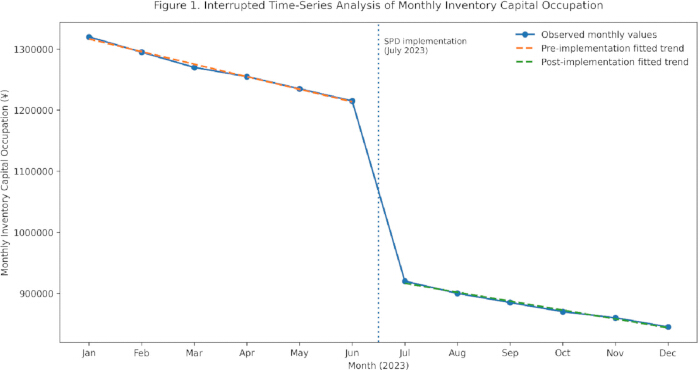
Figure 1: Interrupted time-series analysis of monthly inventory capital occupation before and after implementation of the hospital-operated SPD logistics model. Interrupted time-series segmented regression analysis of monthly inventory capital occupation before and after SPD implementation. Monthly inventory capital occupation values (¥) are shown for the pre-implementation period (January–June 2023) and post-implementation period (July–December 2023). The vertical dashed line indicates the implementation point of the SPD system (July 2023). Solid points represent observed monthly inventory values, and dashed lines represent fitted segmented-regression trends before and after implementation. SPD implementation was associated with a significant immediate reduction in inventory capital occupation and a significant post-intervention slope change. Please click here to view a larger version of this figure.
These findings suggest that SPD implementation improved inventory utilization efficiency and reduced financial resources occupied by consumables inventory.
Staff workload and service satisfaction
Mean staff workload related to consumables management decreased from 6.8 ± 1.2 h/week during the pre-implementation period to 3.1 ± 0.9 h/week after SPD implementation (mean difference = −3.7 h; 95% CI: −4.3 to −3.1; t(50) = 13.8; p < 0.001)(Figure 2).
Service-satisfaction scores increased from 71.4 ± 6.3 to 89.6 ± 4.8 on the 0–100 scale (mean difference = +18.2 points; 95% CI: 15.6–20.8; t(50) = 14.5; p < 0.001).
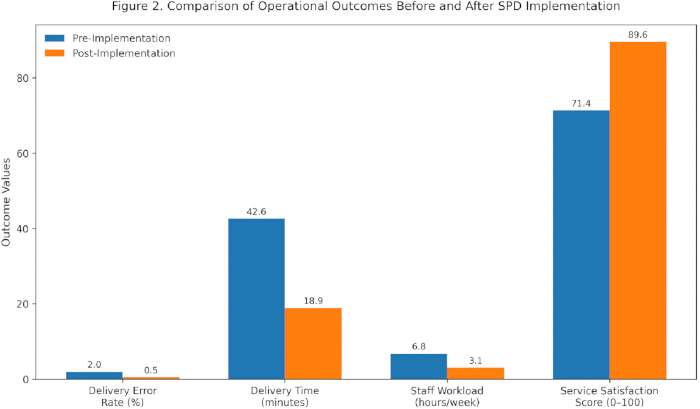
Figure 2: Comparison of key operational outcomes before and after implementation of the hospital-operated SPD logistics model. Comparison of operational outcomes before and after SPD implementation. (A) Delivery error rate, (B) mean delivery time, (C) weekly staff workload related to consumables management, and (D) service-satisfaction scores before and after implementation of the hospital-operated SPD logistics model. Bars represent mean values during the pre-implementation and post-implementation periods. SPD implementation was associated with improved operational efficiency, reduced staff workload, and improved service satisfaction. Please click here to view a larger version of this figure.
The observed improvement in staff satisfaction may be associated with reductions in manual inventory-management workload and increased workflow standardization following SPD implementation. Reduced time spent on repetitive dispensing, inventory checking, and replenishment activities likely contributed to improved operational efficiency and staff experience during routine clinical practice (Table 2).
| Outcome | Pre-Implementation | Post-Implementation | Mean Difference (95% CI) | Statistical Test | p-value |
| Delivery time (minutes) | 42.6 ± 8.4 | 18.9 ± 5.7 | −23.7 (95% CI: −26.4 to −21.0) | t(50) = 2.9 | <0.001 |
| Staff workload (hours/week) | 6.8 ± 1.2 | 3.1 ± 0.9 | −3.7 (95% CI: −4.3 to −3.1) | t(50) = 3.8 | <0.001 |
| Service satisfaction score (0–100) | 71.4 ± 6.3 | 89.6 ± 4.8 | +18.2 (95% CI: 15.6–20.8) | t(50) = 4.5 | <0.001 |
| Continuous outcomes were compared using paired t-tests. Values are presented as mean ± standard deviation unless otherwise specified. | |||||
Table 2: Operational efficiency and staff outcomes before and after SPD implementation. Comparison of delivery time, staff workload related to consumables management, and service-satisfaction scores between the pre-implementation and post-implementation periods.
Irrational usage and incident outcomes
The irrational-usage rate decreased from 3.00% (468/15,604 events) during the pre-implementation period to 1.00% (157/15,644 events) after SPD implementation (p < 0.001).
Adjusted logistic regression analysis demonstrated a significant reduction in irrational-usage events following SPD implementation (OR = 0.32; 95% CI: 0.27–0.38; p < 0.001). Five dispensing-related integrity incidents were recorded during the pre-implementation period, whereas no incidents occurred during the post-implementation period (Fisher’s exact test, p = 0.02). No confirmed information-security breaches were identified during either study period (Table 3).
The observed reductions in dispensing irregularities and workload indicators suggest improved standardization of consumables management procedures and more stable coordination between clinical and supply management processes.
| Outcome | Pre-Implementation | Post-Implementation | Effect Estimate | p-value |
| Mean monthly inventory value (¥) | 1,246,000 ± 82,400 | 872,000 ± 64,300 | −374,000 (−30.0%) | <0.001 |
| ITS immediate level change (¥) | — | −341,200 | β₂ = −341,200; SE = 102,400; 95% CI: −542,300 to −140,100 | 0.002 |
| ITS slope change (¥/month) | — | −18,600 | β₃ = −18,600/month; SE = 8,700; 95% CI: −35,700 to −1,500 | 0.04 |
| Irrational usage events, n | 468 | 157 | — | — |
| Irrational usage rate (%) | 3.00% | 1.00% | OR = 0.32 (95% CI: 0.27–0.38) | <0.001 |
| Integrity incidents, n | 5 | 0 | Absolute reduction of 5 incidents | 0.02 |
| Information-security incidents, n | 0 | 0 | No incidents observed during either study period | — |
| Inferential testing was performed for proportional and regression-based outcomes as specified in the Statistical Analysis section. Descriptive aggregate counts without independent denominators were not subjected to separate statistical comparison. | ||||
Table 3: Inventory, irrational usage, and safety-related outcomes before and after SPD implementation. Comparison of inventory capital occupation, irrational consumable usage, and integrity-related operational outcomes during the pre-implementation and post-implementation periods.
DATA AVAILABILITY:
The deidentified operational and aggregated survey data supporting the findings of this study are publicly available in the Zenodo repository at https://zenodo.org/uploads/20485044. The dataset includes dispensing event records, weekly operational data (delivery time, staff workload, and service satisfaction scores), and monthly inventory and safety outcome data corresponding to Tables 1, 2, and 3 reported in this manuscript.
Discussion
Loading...
$$\rightleftharpoonup{xx}$$
$$\longleftharp{xx}$$,
$$\longrightharp{xx}$$,
In this single-center quasi-experimental evaluation, implementation of a hospital-operated Supply–Processing–Distribution (SPD) logistics-management model was associated with significant improvements in consumables-management performance within the stomatology department. Following implementation, delivery-error rates decreased substantially, delivery time was reduced, staff workload associated with consumables management declined, and service-satisfaction scores improved. Inventory capital occupation also decreased significantly, while interrupted time-series analysis demonstrated both an immediate post-implementation level reduction and continued improvement over time. These findings are consistent with previous reports suggesting that digitally integrated inventory workflows and standardized supply-chain governance may improve traceability, reduce discrepancies and waste, and decrease time spent on manual logistics-management activities4.
The observed reduction in delivery and dispensing errors is consistent with the existing literature, which demonstrates that technology-enhanced supply-management systems—including barcode-enabled workflows, automated dispensing systems, and closed-loop inventory management—may improve operational accountability and traceability at the transaction level9. Although the present intervention focused on medical consumables rather than medications, similar operational principles apply. Automated documentation of consumable utilization at the point of care may reduce reconciliation discrepancies, improve inventory traceability, and decrease manual administrative workload. Previous studies evaluating RFID-enabled smart inventory systems have similarly reported improvements in traceability, reductions in stock mismatches, and lower inventory-management workload4. In the present study, reductions in irrational consumable usage and dispensing irregularities may partially reflect improved documentation accuracy and standardized digital traceability following SPD implementation. Nevertheless, enhanced traceability and workflow standardization remain important operational advantages of integrated SPD logistics systems.
The observed reduction in inventory capital occupation is also consistent with previous healthcare logistics research demonstrating that integrated inventory governance strategies may improve inventory turnover efficiency and reduce unnecessary stock accumulation10. Real-time inventory visibility and centralized logistics coordination may help address common operational challenges in hospital supply chains, including product expiration, demand uncertainty, and replenishment inefficiency. From an operational management perspective, improved inventory utilization may support more efficient allocation of departmental resources while reducing the burden associated with excessive stock management and the risk of consumable expiration.
Several operational mechanisms may plausibly explain the observed improvements. Standardized item identification and barcode-based transaction capture may reduce dispensing mismatches and improve traceability during requisition and dispensing procedures. Smart storage systems and monitored refrigeration units may improve inventory visibility and access governance while supporting management of temperature-sensitive consumables. In addition, bidirectional integration between the SPD platform and the hospital information system may facilitate reconciliation between requisition records, dispensing documentation, and billing processes within a unified digital audit trail. Similar operational mechanisms have previously been described in studies evaluating RFID-based and digitally integrated inventory management systems in healthcare settings 11.
The observed reductions in delivery time and staff workload are also consistent with previous reports indicating that automation and digitalization may reduce the administrative burden associated with manual inventory-management processes9. Shorter delivery times may improve consumable availability during routine stomatology procedures while reducing workflow interruptions associated with emergency replenishment or delayed inventory access. Improved coordination between clinical personnel and supply-management staff may also have contributed to smoother operational workflows and greater efficiency during routine clinical activities.
Implementation of SPD systems may nevertheless involve substantial organizational and operational challenges. During the early implementation phase, staff required adaptation to new dispensing procedures, barcode-based workflows, and digital reconciliation processes. Standardized workflow training, simulation exercises, and daily operational briefings were necessary to support implementation fidelity and user compliance. In addition, deployment of SPD systems required investment in smart storage infrastructure, barcode-scanning systems, hospital information system integration, and monitored refrigeration equipment, which may represent significant technical and financial barriers in resource-limited settings. Long-term sustainability of SPD implementation may also depend on institutional readiness, ongoing technical maintenance, staff engagement, and continued adherence to standardized workflows.
One strength of this study was the use of routinely generated transactional data from SPD and hospital information system interfaces, which minimized reliance on recall-based or subjective reporting for major operational outcomes, such as delivery errors, timestamps, and inventory values. The study also used predefined pre-implementation and post-implementation periods surrounding a clearly defined go-live date, while maintaining relatively stable clinical activity volumes between study phases. Furthermore, use of interrupted time-series segmented regression strengthened evaluation of temporal changes associated with SPD implementation beyond simple pre–post comparisons8.
This study also has several limitations. First, the quasi-experimental pre–post design lacked a concurrent control group, limiting the ability to fully account for unmeasured temporal or organizational confounding factors unrelated to SPD implementation. Therefore, causal inferences should be interpreted cautiously despite the observed operational improvements. Second, interrupted time-series analysis included a relatively limited number of monthly observations, which may have affected the robustness and stability of segmented-regression estimates. Third, this was a single-center study conducted within a specific institutional logistics environment, potentially limiting generalizability to hospitals with different operational structures or inventory-management systems. Fourth, workload and satisfaction outcomes were partially based on staff-reported survey data and may therefore have been influenced by response bias or novelty effects associated with the introduction of a new digital workflow system. Finally, information security and integrity incidents were infrequent during the study period; therefore, the absence of post-implementation incidents should not be interpreted as the complete elimination of operational or information security risk.
Despite these limitations, the findings support the feasibility and operational value of implementing hospital-operated SPD logistics systems for consumables management in specialty clinical departments. Departments with high consumable turnover, large inventories, and strict traceability requirements may particularly benefit from standardized digital logistics governance and barcode-enabled inventory-management workflows. The observed reductions in delivery errors, workload, and inventory capital occupation suggest that SPD implementation may improve operational efficiency while supporting consumables traceability and workflow standardization within routine clinical practice. Sustained long-term benefits may depend on continued staff training, workflow optimization, technical-system maintenance, and institutional support for logistics-governance initiatives.
Future studies should evaluate SPD implementation using multicenter or controlled study designs, including stepped-wedge or controlled interrupted time-series approaches, to strengthen causal inference and improve external validity. Additional research is also needed to evaluate implementation costs, long-term sustainability, and cost-effectiveness of SPD systems across different healthcare settings. Studies examining downstream clinical outcomes—including procedure delays, consumable stock-outs, infection-control compliance, and patient-flow efficiency—would further clarify the broader operational and clinical implications of integrated SPD logistics-management systems.
Disclosures
Loading...
$$\rightleftharpoonup{xx}$$
$$\longleftharp{xx}$$,
$$\longrightharp{xx}$$,
The authors declare that they have no competing financial interests or conflicts of interest related to this study.
Author contribution:
Yaoling Li: Conceptualization, Data curation, Formal analysis, Writing – original draft preparation.
Yucheng Liang: Software, Data curation, Information system integration, Writing – review and editing.
Zhen Han: Conceptualization, Methodology, Project administration, Supervision, Writing – review and editing.
Xiang Luo: Resources, Validation, Writing – review and editing.
Chunqin Jiang: Investigation, Data collection, Writing – review and editing.
Fumei Li: Investigation, Data collection, Writing – review and editing.
Li Huang: Investigation, Data collection, Writing – review and editing.
Zhijian Gao: Conceptualization, Funding acquisition, Supervision, Writing – review and editing.
Acknowledgements
Loading...
$$\rightleftharpoonup{xx}$$
$$\longleftharp{xx}$$,
$$\longrightharp{xx}$$,
The authors sincerely thank the staff members of the Department of Stomatology at Guigang People’s Hospital for their participation and operational support during implementation of the SPD logistics-management system.
Materials
| Name | Company | Catalog Number | Comments |
|---|---|---|---|
| Barcode scanner | Zebra Technologies | DS2208 | Used to scan item barcodes during dispensing and stock reconciliation |
| Computer workstation | Lenovo | ThinkCentre M720 | Used for SPD system access, data entry, and monitoring |
| Hospital Information System (HIS) | Hospital Information Technology Department | N/A | Integrated with SPD platform for bidirectional synchronization of requisitions, billing, and inventory data |
| Medical-grade refrigerator | Haier Biomedical | HYC-390 | Temperature-monitored refrigerator for storage of temperature-sensitive medical consumables |
| R statistical software | R Foundation for Statistical Computing | Version 4.3.1 | Used for statistical analysis including regression and interrupted time series analysis |
| Smart storage cabinet | HoloTech Medical Systems | SC-200 | Barcode-enabled cabinet used for point-of-care storage and automated stock deduction |
| SPD logistics management software platform | Hospital Information Technology Department | N/A | Software used for inventory management, requisition processing, and dispensing transaction recording |
| Staff workload and satisfaction survey questionnaire | Department of Stomatology | N/A | Weekly survey instrument used to collect staff workload hours and satisfaction scores |
Reprints and Permissions
Request permission to reuse the text or figures of this JoVE article
Request Permission