This protocol presents a standardized, intravascular ultrasound-guided intravascular lithotripsy method for treating severe coronary artery calcification. The goal is to use objective, real-time imaging to precisely size balloons, confirm calcium fractures, and optimize final stent expansion, thereby enhancing procedural safety and efficacy.
Method Article
Standardized Protocol for Intravascular Ultrasound-Guided Lithotripsy in Severely Calcified Coronary Lesions
Corresponding Authors: Gang Xiong <m13807165306@163.com>
Opens in a new tab
In This Article
Summary
Loading...
$$\rightleftharpoonup{xx}$$
$$\longleftharp{xx}$$,
$$\longrightharp{xx}$$,
Abstract
Loading...
$$\rightleftharpoonup{xx}$$
$$\longleftharp{xx}$$,
$$\longrightharp{xx}$$,
Severe coronary artery calcification poses a clinical challenge during percutaneous coronary intervention, significantly increasing the risk of stent underexpansion and subsequent adverse cardiovascular events. While intravascular lithotripsy (IVL) uses acoustic pressure waves to modify calcified plaques, its use without precise intracoronary imaging can lead to suboptimal balloon sizing and unpredictable anatomical outcomes. The primary goal of the presented protocol is to detail a standardized, step-by-step methodology for utilizing intravascular ultrasound (IVUS) to guide IVL therapy in patients with heavily calcified coronary lesions. The protocol delineates strict criteria for baseline IVUS evaluation to accurately identify calcium arcs greater than 180° and determine the exact reference vessel diameter, thereby enabling a precise 1:1 IVL balloon-to-artery sizing ratio. Subsequent steps detail the targeted delivery of acoustic pulses at working pressures of 4–6 atm, followed by mandatory post-intervention IVUS pullbacks to visually confirm the induction of multiplanar calcium fractures and ensure optimal final stent apposition. Application of this standardized workflow in a real-world, highly comorbid cohort of 44 patients resulted in a 100% procedural success rate. Quantitative imaging confirmed a statistically significant expansion of the minimum lumen area (MLA) from a baseline of 1.25 mm2 ± 0.25 mm2 to a final post-stent area of 8.56 mm2 ± 0.42 mm2, alongside the reduction in severity grade of concentric calcifications. Furthermore, the protocol demonstrated a favorable periprocedural safety profile, with no severe device-related complications, as evidenced by stable cardiac biomarker trajectories and a 0% incidence of major adverse cardiovascular events (MACE) over an extended clinical follow-up period of 6–18 months. Ultimately, adherence to this IVUS-guided IVL protocol provides a reproducible, systematic framework to optimize lesion preparation and facilitate robust stent deployment in complex cardiovascular interventions.
Introduction
Loading...
$$\rightleftharpoonup{xx}$$
$$\longleftharp{xx}$$,
$$\longrightharp{xx}$$,
The prevalence of coronary artery calcification (CAC) is increasing alongside the global aging of the population and the escalating incidence of metabolic comorbidities, such as diabetes mellitus, dyslipidemia, and chronic kidney disease1,2. Physiologically, the accumulation of calcium in the arterial wall typically accelerates after age 40, leading to significant alterations in vascular compliance and cardiovascular hemodynamics2. In the realm of interventional cardiology, moderate-to-severe CAC presents a significant clinical challenge during percutaneous coronary intervention (PCI)1,3. Heavily calcified, non-compliant plaques mechanically obstruct the delivery of therapeutic devices, damage the protective polymer coatings of drug-eluting stents, and impair local drug elution kinetics2,4. Consequently, failure to adequately modify calcified lesions results in incomplete stent expansion and strut malapposition, which are universally recognized as the primary biomechanical drivers of acute stent thrombosis and long-term in-stent restenosis5. Furthermore, the presence of severe calcific features serves as a robust, independent predictor of all-cause mortality and major adverse cardiovascular events (MACE)6,7.
Historically, interventionalists have relied on a variety of plaque-modification strategies to treat severe CAC before stent deployment1,8. High-pressure and ultra-high-pressure non-compliant balloons, alongside specialized scoring or cutting balloons, are frequently utilized; however, these balloon-based modalities often fail to fracture deep or unusually thick calcium rings and carry an inherent risk of inducing severe barotrauma, vessel dissection, or coronary perforation1,3. Alternatively, atherectomy devices, such as rotational and orbital atherectomy, effectively ablate superficial calcium3,4. Nevertheless, these techniques are technically demanding, require a steep learning curve, and are associated with specific periprocedural complications, including thermal injury, guidewire bias, and distal debris embolization that can trigger slow-flow or no-reflow phenomena1,8. Therefore, there remains a critical clinical need for safer, highly effective modalities to optimize PCI in these complex anatomies8.
To overcome the well-documented limitations of traditional ablative technologies, coronary intravascular lithotripsy (IVL) has emerged as a novel addition to the calcium modification armamentarium3,9. Adapting the fundamental principles of extracorporeal shockwave lithotripsy used for nephrolithiasis, IVL utilizes a fluid-filled balloon catheter to deliver localized, pulsatile acoustic pressure waves directly to the arterial wall3. These sonic waves selectively interact with high-density coronary calcium, safely inducing multiplanar micro-fractures in both superficial and deep calcium deposits while preserving the integrity of the compliant soft vascular tissues3,9. The landmark Disrupt CAD III prospective, multicenter trial (including its primary endpoint analysis and subsequent follow-ups) firmly established the safety and efficacy profile of IVL, demonstrating a high procedural success rate coupled with a low incidence of periprocedural MACE at both 1-year and 2-year follow-ups9,10,11. Subsequent robust meta-analyses and large real-world retrospective registries have further corroborated these findings, proving that IVL achieves significant acute luminal gain and remains effective across diverse patient demographics, including highly complex subsets such as calcified left main coronary artery disease3,12,13.
While IVL provides the necessary mechanical force to alter plaque compliance, the optimization of this therapy relies fundamentally on precise pre- and post-procedural imaging assessment14,15. Traditional coronary angiography lacks the spatial sensitivity required to accurately quantify the circumferential arc, depth, and longitudinal extent of the calcium burden4. Consequently, intravascular ultrasound (IVUS) has become an indispensable imaging modality for evaluating calcified lesions15,16. Although optical coherence tomography (OCT) offers superior axial resolution for penetrating and measuring calcium thickness or fracture depth, IVUS was specifically selected as the primary imaging modality for this protocol. IVUS does not require continuous contrast flushing, which is a critical advantage for minimizing the risk of contrast-induced nephropathy in high-risk cohorts with a substantial prevalence of chronic renal insufficiency4,17. Furthermore, advanced IVUS-derived calcium scoring systems have been validated to successfully predict the likelihood of subsequent stent underexpansion5. Crucially, IVUS is instrumental in guiding IVL interventions by facilitating exact 1:1 sizing of the IVL balloon to the reference vessel diameter, monitoring therapeutic efficacy by visualizing discrete calcium fractures, and definitively confirming optimal final stent apposition5,15,18.
Despite compelling individual evidence supporting IVL and IVUS, standardized clinical protocols that synergize both technologies for routine application remain highly variable1,15. The objective of the present study is to systematically present a standardized, step-by-step IVUS-guided IVL protocol. By investigating a retrospective, single-center cohort of patients with severe, highly angulated coronary calcifications, this methodology aims to outline the procedural reproducibility, essential troubleshooting strategies, and objective criteria for lesion preparation. The prespecified observational endpoints focus on achieving adequate calcium fractures (defined as a complete anatomical discontinuity of the echolucent calcium band) and facilitating optimal final stent expansion. The practical applicability of this protocol is most pronounced in high-risk patient subsets, particularly those with chronic kidney disease requiring zero or minimal contrast volume, elderly patients with highly tortuous anatomies, or scenarios involving severe concentric calcium arcs (>180°) where traditional balloon-based modalities are prone to failure. Furthermore, this standardized workflow provides interventional teams with a highly reproducible, algorithmic decision-making tree to mitigate the risks of stent underexpansion, especially in catheterization laboratories lacking rotational atherectomy infrastructure. While the practical applicability of this standardized IVUS-guided approach is highly relevant for safely managing complex calcified lesions, the primary limitation of this study is its single-arm, observational design without a comparative control group (e.g., rotational atherectomy). Consequently, the clinical outcomes reflect procedural feasibility within a specific cohort rather than proving comparative superiority, and broader generalizability requires validation in future randomized controlled trials.
Protocol
Loading...
$$\rightleftharpoonup{xx}$$
$$\longleftharp{xx}$$,
$$\longrightharp{xx}$$,
The clinical protocol was performed in compliance with the guidelines of the Ethics Committee of Wuhan Asia Heart Hospital. All patients provided written informed consent before the procedure.
1. Patient selection and evaluation
- Select patients diagnosed with stable angina pectoris, unstable angina pectoris, or occult coronary artery disease (defined objectively by documented silent ischemia on non-invasive stress testing) who require percutaneous coronary intervention (PCI).
- Ensure patients meet the angiographic inclusion criteria: presence of severely calcified de novo. coronary lesions with a reference vessel diameter of 2.5–4.0 mm and a lesion length of ≤ 40 mm (restricted to conform to the treatment capacity of a maximum of 80 pulses from a single 12 mm length intravascular lithotripsy (IVL) catheter (see Table of Materials), thereby avoiding confounding adjunctive therapies).
- Exclude patients presenting with left main coronary artery disease, acute myocardial infarction, hemodynamic instability, complex bypass graft lesions, or pre-existing dissections at the target site.
2. Pre-procedural preparation and angiography
- Administer a standard dual antiplatelet therapy regimen before the procedure (e.g., a loading dose of 300 mg aspirin combined with 300–600 mg clopidogrel or 180 mg ticagrelor) according to current revascularization guidelines.
- Establish vascular access via the radial artery as the default strategy. Femoral access is reserved exclusively for complex anatomical variations or radial crossover failure.
- Administer systemic anticoagulation (e.g., unfractionated heparin at 70–100 U/kg) at the operator's discretion to maintain an activated clotting time (ACT) > 250 s.
- Perform baseline coronary angiography using multiple orthogonal projections to initially locate and evaluate the target calcified lesion, assess vessel tortuosity, and accurately estimate the lesion length.
NOTE: In anatomically ambiguous lesions, intracoronary imaging may be cautiously attempted before guidewire crossing to clarify anatomy, provided it does not compromise vessel safety. - Adhere strictly to institutional biomedical waste and sharps disposal protocols for the handling of all contaminated invasive equipment throughout the procedure.
3. Baseline intravascular ultrasound (IVUS) assessment
- Advance a standard 0.014-inch coronary guidewire (see Table of Materials) across the target lesion.
- Troubleshooting Step: If the baseline IVUS catheter fails to cross the severe calcification, perform gentle pre-dilation utilizing a 1.0 to 1.5 mm semi-compliant balloon to establish a micro-channel before the initial IVUS pullback.
- CAUTION: When preparing, wiping, or cleaning the IVUS catheter and guidewires, use only a saline wipe or a cotton ball.
NOTE: Do not use alcohol wipes under any circumstances, as alcohol may compromise the hydrophilic coating of the intravascular devices. - Advance the IVUS imaging catheter (see Table of Materials) distal to the target lesion and perform an automated pullback at a constant speed of 0.5 mm/s to the guiding catheter.
- Assess the calcification severity. Confirm the inclusion criterion by identifying a calcification arc greater than 180° (Grades III or IV) to ensure the protocol is specifically applied to severely resistant concentric calcium.
- Measure the distal reference vessel diameter accurately using the IVUS console to guide the subsequent selection of the IVL balloon.
- Determine the reference vessel area by averaging the lumen areas of the most normal-appearing cross-sections within 5 mm proximal and distal to the target lesion.
4. Lesion preparation
- Perform mandatory pre-dilation of the calcified lesion.
- Utilize a semi-compliant balloon, non-compliant (NC) balloon, or scoring/cutting balloon (see Table of Materials) sized appropriately to the vessel to establish a preliminary channel.
- Ensure the lesion is adequately prepared (defined as establishing sufficient patency to allow the smooth delivery of the IVL catheter without requiring excessive pushing force).
5. Intravascular lithotripsy (IVL) procedure
- Select the appropriate IVL balloon catheter size in a 1:1 ratio based on the IVUS-derived reference vessel diameter (available sizes: 2.5–4.0 mm).
- Advance the IVL balloon catheter over the guidewire and position it precisely across the most severely calcified segment, utilizing the radiopaque balloon markers under fluoroscopy.
- Connect the proximal end of the IVL catheter to the generator cable (see Table of Materials).
NOTE: CAUTION: Acoustic pulse delivery is controlled exclusively via the hand switch on the connector cable. - Verify that the operator has clear access to the hand switch.
NOTE: A foot pedal is not utilized in this system. - Inflate the IVL balloon to a sub-nominal pressure of 4 atm to establish initial apposition against the vessel wall.
- Activate the hand switch to deliver acoustic pulses. Deliver 10 continuous pulses (one cycle) at a frequency of 1 pulse per s.
- Following the pulse cycle, inflate the balloon to the nominal pressure (6 atm) and actively observe the balloon silhouette under fluoroscopy for full expansion to maximize luminal gain.
- Deflate the balloon to allow distal blood perfusion.
- Repeat steps 5.5 through 5.8 as necessary. If the calcified segment is longer than the balloon, reposition the catheter with slight longitudinal overlap (1–2 mm) to ensure contiguous treatment.
- Deliver additional cycles (up to 80 pulses per catheter) until adequate vessel compliance is achieved.
6. Post-IVL assessment and stent implantation
- Perform a second IVUS pullback to evaluate the efficacy of the IVL treatment.
- Carefully inspect the IVUS cross-sections for the presence of longitudinal or transverse calcium fractures (defined objectively as a complete anatomical discontinuity of the echolucent calcium band) and an increase in the minimum lumen area (MLA).
- If residual stenosis remains > 50% or fluoroscopic balloon expansion is visibly suboptimal, consider delivering additional IVL pulses or utilizing a second IVL catheter.
- Once adequate lesion preparation is confirmed, deploy an appropriately sized drug-eluting stent (DES) (see Table of Materials) across the target lesion.
- Perform routine post-dilation using a non-compliant (NC) balloon at high pressure (≥ 14 atm) to ensure full stent expansion.
- Perform a final IVUS pullback to confirm optimal stent apposition, absence of major edge dissections (e.g., penetrating the media or > 60° in arc), and achievement of adequate final stent expansion (target > 90% compared to the reference vessel area).
7. Data collection and statistical analysis
- Record all procedural parameters into a standardized electronic clinical database, including IVL balloon sizes, maximum working pressures, total pulse frequencies, and any periprocedural complications (e.g., slow flow, dissection).
NOTE: Procedural success is defined as successful stent delivery with residual stenosis < 20% and final TIMI 3 flow without severe complications. - Collect blood samples post-procedure to monitor high-sensitivity cardiac troponin I (hs-cTNI) and CK-MB levels.
- Monitor clinical follow-up for 6–18 months to objectively assess Major Adverse Cardiovascular Events (MACE), strictly defined as a composite of cardiac death, non-fatal myocardial infarction, or target vessel revascularization.
- Perform quantitative IVUS measurements at three designated time points: pre-IVL, post-IVL, and post-stenting. Quantify the minimum lumen area (MLA) by manually tracing the leading edge of the luminal border at the cross-section demonstrating the most severe stenosis.
- Compile the data and analyze categorical variables using Chi-square or Fisher's exact tests.
NOTE: The dynamic quantitative changes in MLA across the three continuous procedural timepoints must be analyzed utilizing a Repeated-Measures Analysis of Variance (ANOVA) to ensure methodological rigor. Statistical analyses should be conducted using established statistical analysis software (see Table of Materials). Consider a P. value <0.05 as statistically significant.
Results
Loading...
$$\rightleftharpoonup{xx}$$
$$\longleftharp{xx}$$,
$$\longrightharp{xx}$$,
Baseline characteristics and comorbidity profile
A total of 44 patients with severe coronary artery calcification were consecutively enrolled in this study. The mean age of the cohort was 67.68 years ± 7.68 years, and 29 patients (65.9%) were male. The clinical presentation was primarily dominated by unstable angina pectoris (61.4%), followed by stable angina (31.8%) and occult angina (6.8%). Importantly, 16 patients (36.4%) presented with concurrent chronic renal insufficiency. The high prevalence of chronic kidney disease (CKD) in this cohort highlights the specific clinical utility of IVUS, which minimizes the need for repeated contrast volume flushes over alternative imaging modalities like OCT in high-risk populations.
Analysis of the patients' baseline health status revealed a highly complex, high-risk cohort with overlapping comorbidities. As mapped in the comorbidity network (Figure 1), most patients presented with multiple concurrent risk factors, most notably hypertension (81.8%), prior stroke or transient ischemic attack (TIA) (45.5%), type 2 diabetes mellitus (38.6%), and hyperlipidemia (18.2%). The target lesions were predominantly located in the left anterior descending artery (LAD, 81.8%), followed by the right coronary artery (RCA, 18.2%), with an average reference vessel diameter of 3.31 mm ± 0.36 mm and an average lesion length of 33.41 mm ± 5.48 mm (Table 1). Baseline IVUS evaluation confirmed the severity of the calcified plaques, demonstrating a mean calcium arc of 282.2° ± 51.6°.
Procedural Execution and Standardized Workflow
The intravascular ultrasound (IVUS)-guided intravascular lithotripsy (IVL) protocol was successfully executed in all 44 patients, yielding a 100% overall procedural success rate. Adherence to the standardized workflow (Figure 2) facilitated precise lesion evaluation and targeted acoustic energy delivery. The IVL catheter achieved a first-pass success rate of 95.5% (42/44 patients). In the remaining 2 cases in which the IVUS or IVL catheter initially failed to cross the severe stenosis, the protocol's troubleshooting pathway was successfully employed, using a 1.0–1.5 mm semi-compliant balloon for gentle pre-dilation to establish a micro-channel before further intervention. To ensure clinical transparency of this process, a step-by-step validation and tracking of each procedural phase to its measured metric are summarized in Table 2. To further underscore procedural safety and the practical advantage of IVUS guidance in minimizing dye usage, the mean total contrast volume utilized was limited to 115.4 mL ± 32.6 mL, and the mean fluoroscopy time was 22.5 min ± 7.8 min.
The immediate physical impact of this protocol is visually depicted in a representative angiographic and IVUS case, demonstrating baseline severe stenosis (Figure 3A), micro-channel creation via pre-dilation (Figure 3B), targeted acoustic balloon inflation (Figure 3C), excellent final angiographic lumen restoration (Figure 3D), a baseline IVUS cross-section with concentric calcium exceeding 180° (Figure 3E), and post-IVL multiplanar calcium fractures (Figure 3F). Furthermore, the procedural parameter landscape (Figure 4) illustrates the relationship between the post-IVL minimum lumen area (MLA) and the final stent expansion percentage, confirming that optimal lesion preparation correlates with robust stent deployment.
Efficacy: Dynamic IVUS Quantitative Changes and Calcium Modification
Quantitative intravascular imaging analysis confirmed statistically significant morphological improvements following IVL treatment (Figure 5). To ensure measurement reliability, intra- and inter-observer reproducibility analyses were conducted on a randomly selected subset of IVUS pullbacks, yielding high intraclass correlation coefficients (ICC > 0.90) for both MLA quantification and calcium fracture identification. The minimum lumen area (MLA) of the target lesions expanded incrementally, rising from a baseline of 1.25 mm2 ± 0.25 mm2 to 3.97 mm2 ± 0.30 mm2 immediately post-IVL, and reaching a final area of 8.56 mm2 ± 0.42 mm2 following stent implantation. A repeated-measures analysis of variance (ANOVA) demonstrated that this dynamic luminal gain across the three continuous procedural stages was highly significant (F = 6490.39, p. < 0.0001).
Beyond lumen expansion, IVL effectively modified the structural integrity of the calcified plaques (Figure 6). Post-IVL IVUS assessment revealed explicit calcium fractures in the vast majority of patients. Specifically, a single fracture was observed in 25 lesions (56.8%), double fractures in 10 lesions (22.7%), and multiple profound fractures in 7 lesions (15.9%). Only 2 lesions (4.5%) exhibited no visible fracture on IVUS, yet still permitted successful subsequent intervention. Ultimately, this acoustic calcium modification facilitated an excellent final mean stent expansion of 93.0% ± 4.4%.
Safety Profile and Clinical Outcomes
The clinical success rate was 100%. Importantly, there were no severe IVL-related complications, such as severe dissection, coronary perforation, acute vessel occlusion, or slow flow/no-reflow phenomena, observed during the periprocedural period (Table 1).
The periprocedural safety profile was further validated by the cardiac troponin I (cTNI) trajectory (Figure 7). The paired slope chart illustrates that most of the cohort maintained stable or clinically insignificant fluctuations in cTNI levels from baseline to post-procedure. While a small subset of patients (n = 2, 4.5%) exhibited transient, asymptomatic biomarker elevations indicative of periprocedural micro-infarction, the overall hemodynamic and cardiac stability remained uncompromised. To further confirm the durability and safety of the procedure beyond the acute phase, clinical follow-up was extended. Over a follow-up period ranging from 6–18 months, the incidence of major adverse cardiovascular events (MACE) remained consistently at 0%.
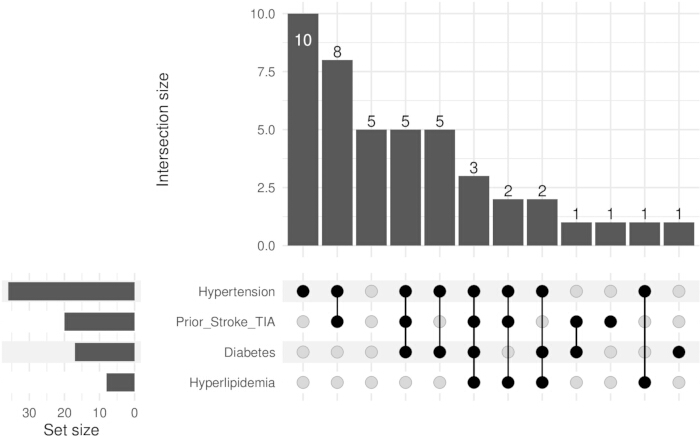
Figure 1: Comorbidity Network of the High-Risk Patient Cohort (UpSet Plot). An UpSet plot illustrates the intersections and overlaps of major cardiovascular comorbidities among consecutively enrolled patients (n = 44). The horizontal bars at the bottom left (Set Size) represent the total number of patients with each condition. The vertical bars (Intersection Size) represent the exact number of patients sharing specific concurrent comorbidity combinations, indicated by the connected black dots in the matrix below. Please click here to view a larger version of this figure.
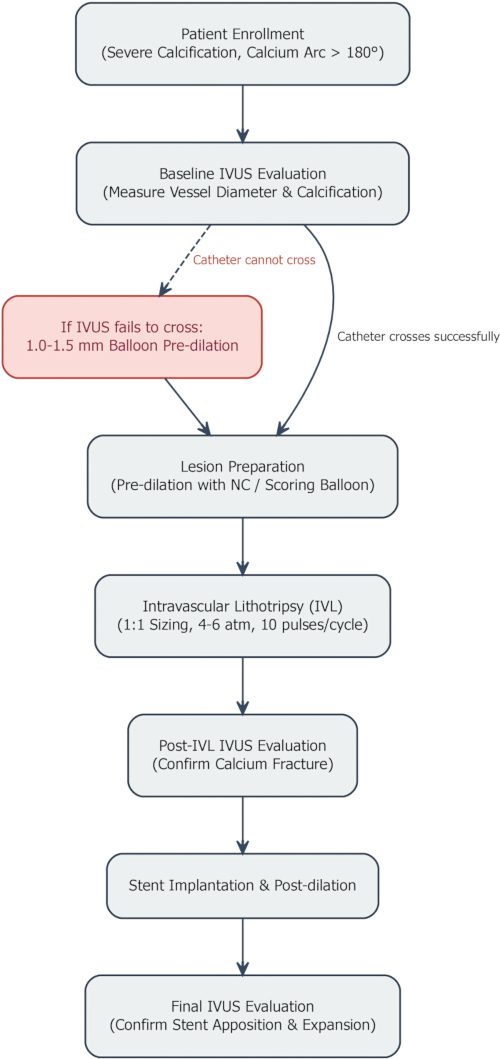
Figure 2: Standardized Workflow for Intravascular Ultrasound (IVUS)-Guided Intravascular Lithotripsy (IVL). A procedural methodology flowchart delineating the step-by-step standardized protocol for the management of severely calcified coronary lesions. The solid arrows indicate the standard successful pathway, while the dashed lines define the prespecified troubleshooting branch that uses small-balloon predilation (1.0–1.5 mm) to establish a microchannel in scenarios where the imaging or lithotripsy catheter fails to cross the lesion. Please click here to view a larger version of this figure.
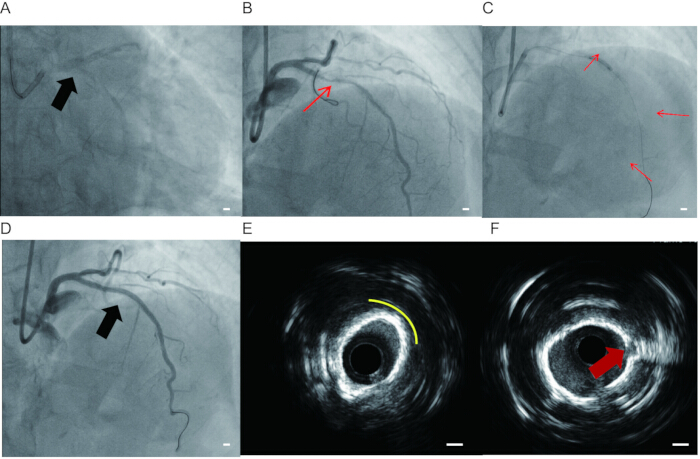
Figure 3: Representative Angiographic and Intravascular Ultrasound (IVUS) Panels of the Protocol. A consolidated composite panel demonstrating step-by-step clinical execution in a representative patient. (A) Baseline coronary angiography showing a severely calcified stenotic lesion in the target vessel (white arrow). (B) Lesion preparation and microchannel creation via small, semi-compliant balloon predilation. (C) Precise positioning and acoustic balloon inflation at the target site. (D) Final post-stent angiographic result showing excellent lumen restoration. (E) Baseline IVUS cross-section capturing a concentric, superficial calcium sheet; the yellow arc highlights a continuous calcium arc exceeding 180 degrees. (F) Post-IVL IVUS cross-section demonstrating multiple visible, profound calcium fractures (red arrows) penetrating the calcified plaque, facilitating subsequent stent expansion. Scale bars for IVUS panels indicate 1 mm. For angiographic panels (A-D), scale bars = 3 mm. Please click here to view a larger version of this figure.
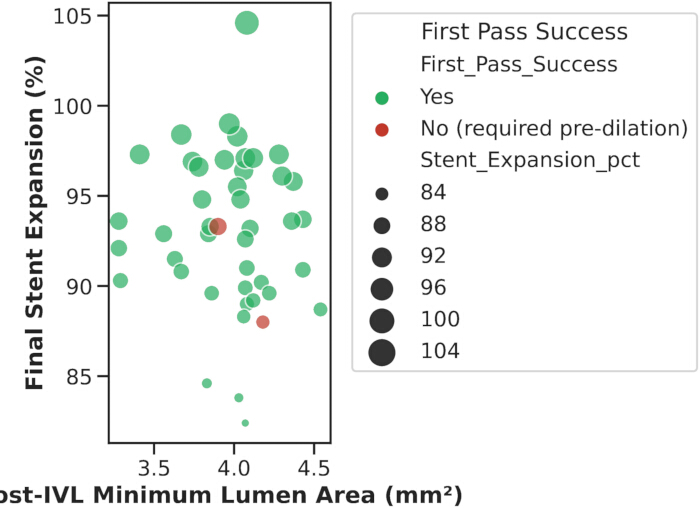
Figure 4: Relationship Between Post-IVL Minimum Lumen Area and Final Stent Expansion. A bubble scatter plot correlating the minimum lumen area achieved immediately after acoustic lithotripsy (Post-IVL MLA, x-axis) with the final stent expansion percentage (y-axis). The size of each bubble corresponds to the magnitude of stent expansion. The color of the bubbles distinguishes technical success categories: green bubbles represent first-pass catheter success, while red bubbles indicate complex lesions requiring adjunctive pre-dilation to enable device delivery. Please click here to view a larger version of this figure.
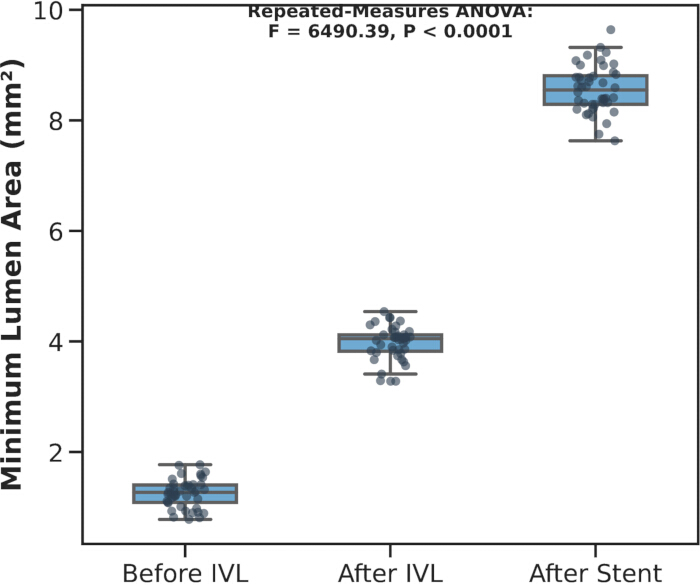
Figure 5: Dynamic Expansion of Minimum Lumen Area (MLA) Across Continuous Procedural Stages. A combined box-and-whisker and jitter plot tracking the quantitative expansion of the minimum lumen area across three continuous procedural timepoints: baseline (Before IVL), immediately following shockwave therapy (After IVL), and after final stent deployment (After Stent). Horizontal lines within boxes represent medians, boundaries represent interquartile ranges, and individual black dots represent independent patient trajectories. Overall statistical significance across the continuous stages is calculated via Repeated-Measures Analysis of Variance (ANOVA; F = 6490.39, p. < 0.0001). Please click here to view a larger version of this figure.
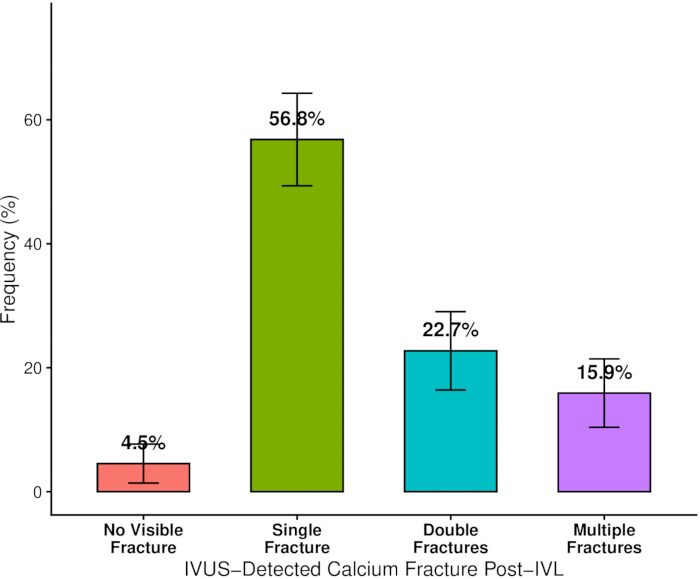
Figure 6: Distribution and Frequency of IVUS-Detected Calcium Fractures Post-IVL. A bar chart summarizing the mechanical efficacy of acoustic shockwaves in disrupting concentric calcium structures across the cohort (n = 44). The columns represent the percentage and exact count of lesions categorized by the number of distinct plaque fractures visualized on post-treatment intravascular imaging: no visible fracture, single fracture, double fractures, or multiple fractures. Please click here to view a larger version of this figure.
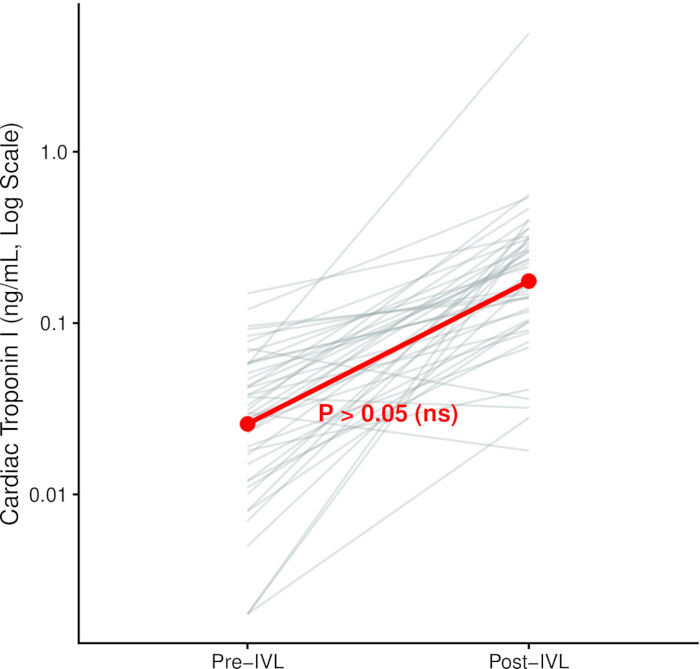
Figure 7: Periprocedural Safety Profile Evaluated by Cardiac Troponin I (cTNI) Trajectories. A paired slope line plot tracking individual patient serum cTNI variations from baseline (Pre-IVL) to 24 hours post-procedure (Post-IVL), plotted on a logarithmic scale (Log10). The flat trajectories across the majority of the cohort demonstrate minimal myocardial disruption, validating the safety profile of the standardized protocol, which achieved a 0% major adverse cardiovascular event (MACE) rate at long-term clinical follow-up. Please click here to view a larger version of this figure.
| Characteristics | Value (n = 44) |
| Demographics and Clinical Characteristics | |
| Age (years), mean ± SD | 67.68 ± 7.68 |
| Male, n (%) | 29 (65.9%) |
| Body mass index (kg/m²), mean ± SD | 24.91 ± 3.02 |
| Hypertension, n (%) | 36 (81.8%) |
| Type 2 diabetes mellitus, n (%) | 17 (38.6%) |
| Hyperlipidemia, n (%) | 8 (18.2%) |
| Chronic renal insufficiency, n (%) | 16 (36.4%) |
| Old cerebral infarction, n (%) | 20 (45.5%) |
| Clinical Presentation | |
| Stable angina pectoris, n (%) | 14 (31.8%) |
| Unstable angina pectoris, n (%) | 27 (61.4%) |
| Occult angina pectoris, n (%) | 3 (6.8%) |
| Target Lesion and IVUS Characteristics | |
| Left anterior descending artery (LAD), n (%) | 36 (81.8%) |
| Right coronary artery (RCA), n (%) | 8 (18.2%) |
| Reference vessel diameter (mm), mean ± SD | 3.31 ± 0.36 |
| Target lesion length (mm), mean ± SD | 33.41 ± 5.48 |
| Calcium arc (degrees), mean ± SD | 282.2 ± 51.6 |
| Procedural Details and Outcomes | |
| IVL first-pass success rate, n (%) | 42 (95.5%) |
| Overall IVL treatment success rate, n (%) | 44 (100%) |
| Maximum IVL working pressure (atm), mean ± SD | 6.27 ± 0.92 |
| Number of stents implanted per patient, mean ± SD | 2.47 ± 0.79 |
| Stent diameter (mm), mean ± SD | 3.07 ± 0.38 |
| Final stent expansion (%), mean ± SD | 93.0 ± 4.4 |
| Clinical success rate, n (%) | 44 (100%) |
| Severe IVL-related complications, n (%) | 0 (0%) |
| MACE at 30-day follow-up, n (%) | 0 (0%) |
Table 1: Baseline Clinical, Angiographic Characteristics, and Procedural Outcomes. Summary of the demographic, clinical, angiographic, and procedural parameters for the consecutively enrolled patient cohort (n = 44). Continuous variables are expressed as mean ± standard deviation, and categorical variables are presented as counts (percentages). Chronic renal insufficiency is highlighted to reflect the cohort's risk complexity and to contextualize imaging modality selection. IVL = intravascular lithotripsy; IVUS = intravascular ultrasound; LAD = left anterior descending artery; RCA = right coronary artery; MACE = major adverse cardiovascular events.
| Protocol Phase | Specific Action Taken | Measured Clinical Endpoint | Cohort Output (n = 44) | Validation Status |
| I. Imaging Access | Baseline IVUS automated pullback at a constant speed of 0.5 mm/s | First-pass imaging catheter crossing success rate | 95.5% (42/44) | Validated |
| II. Troubleshooting | Bailout pre-dilation using a 1.0–1.5 mm semi-compliant balloon at 6–8 atm | Crossability of the lesion for subsequent device delivery | 4.5% (2/44) | Validated |
| III. Balloon Sizing | Exact 1:1 diameter matching to distal reference vessel area via IVUS | Angiographic and visual confirmation of acoustic balloon apposition | 100% (44/44) | Validated |
| IV. Lithotripsy | Pulsatile delivery of 40–80 acoustic shockwave pulses at 4–6 atm | Post-procedural cross-sectional multiplanar calcium fracture rate | 95.5% (42/44) | Validated |
| V. Stent Optimization | Drug-eluting stent implantation followed by NC balloon inflation at $\ge$ 14 atm | Post-stent expansion threshold and strut apposition percentage | 93.0% ± 4.4% | Validated |
| VI. Safety Monitoring | Serial serum hs-cTnI tracking and longitudinal 6–18 month clinical follow-up | Cumulative incidence of periprocedural complications and MACE | 0% severe complications; | |
| 0% MACE |
Table 2: Step-by-Step Validation Table Linking Protocol Phases to Measured Endpoints. Continuous variables are expressed as mean ± standard deviation, and categorical variables are presented as percentages (counts). atm = atmospheres; hs-cTnI = high-sensitivity cardiac troponin I; IVL = intravascular lithotripsy; IVUS = intravascular ultrasound; MACE = major adverse cardiovascular events (defined as a composite of cardiac death, non-fatal myocardial infarction, or target vessel revascularization); NC = non-compliant balloon.
Discussion
Loading...
$$\rightleftharpoonup{xx}$$
$$\longleftharp{xx}$$,
$$\longrightharp{xx}$$,
The present study evaluated the efficacy and safety of a highly standardized, intravascular ultrasound (IVUS)-guided intravascular lithotripsy (IVL) protocol in a real-world cohort of 44 patients presenting with severe, heavily calcified coronary artery disease. Consistent with the foundational principles of plaque modification, the data demonstrate that targeted acoustic pressure waves, when meticulously sized and evaluated under intracoronary imaging, can safely and effectively fracture dense calcium rings, altering vessel compliance. An overall procedural and clinical success rate of 100% was achieved, characterized by a significant expansion of the minimum lumen area (MLA) from a baseline of 1.25 mm2 ± 0.25 mm2 to a final post-stent area of 8.56 mm2 ± 0.42 mm2 (F = 6490.39, p. < 0.0001 under a repeated-measures analysis of variance), alongside a substantial resolution of the narrowing rate. Importantly, these acute angiographic and anatomical successes were realized without the occurrence of any severe intraoperative complications, and the long-term safety profile was confirmed by a 0% major adverse cardiovascular events (MACE) rate over an extended clinical follow-up period ranging from 6–18 months. This outcome demonstrates the reliability of this protocol in a high-risk, highly comorbid demographic.
The integration of intracoronary imaging, specifically IVUS, is the cornerstone of the proposed methodology. Historically, operators have relied on angiography alone to estimate the extent of coronary calcification; however, angiography is insensitive to the depth, concentricity, and true morphological burden of calcium. As articulated by recent consensus documents regarding best practices in calcium modification, IVUS provides the critical spatial resolution required to accurately measure the distal reference vessel, which is imperative for the 1:1 balloon-to-artery sizing ratio mandated by IVL therapy16. Oversizing the IVL balloon risks severe barotrauma and vessel perforation, whereas undersizing diminishes the transmission of the acoustic shockwaves into the intimal and medial layers, leading to suboptimal calcium modification16. Crucially, the selection of IVUS over alternative high-resolution imaging modalities like optical coherence tomography (OCT) is supported by specific clinical imperatives within this cohort, where 36.4% of the patients presented with concurrent chronic renal insufficiency. Unlike OCT, which necessitates high-pressure, continuous contrast volume flushes to clear blood from the lumen, IVUS imaging does not rely on contrast clearance4,17. According to recent landmark multicenter evidence, utilizing an IVUS-guided revascularization strategy significantly lowers the cumulative contrast dose and minimizes the risk of contrast-induced nephropathy in patients with compromised baseline renal function17.
Furthermore, the protocol emphasizes the necessity of a post-IVL IVUS pullback to visually confirm therapeutic success. In the structural evaluation of lithotripsy mechanics, Ali et al. meticulously documented that the primary mechanism of MLA increase post-IVL is the induction of multiplanar (longitudinal and transverse) micro-fractures within the calcium ring18. The present real-world findings mirror this mechanistic validation; in this cohort, discrete fractures were visualized as clear interruptions within the highly echogenic calcium arc in 95.5% of the treated lesions (56.8% single, 22.7% double, and 15.9% multiple fractures), confirming that the physical compliance of the vessel had been successfully restored prior to stent deployment11,18. Without the real-time feedback loop provided by IVUS, operators may prematurely implant stents into inadequately prepared beds, precipitating underexpansion and subsequent stent failure.
The luminal gains observed in this cohort are consistent with outcomes reported in large, multicenter, real-world registries. For instance, in an Asian all-comers registry evaluating coronary IVL, investigators reported a significant increase in minimal lumen diameter post-stenting, with a clinical success rate of 90%19,20,21,22. The 100% clinical success rate obtained in this protocol reflects the procedural outcomes achieved through strict adherence to IVUS guidance within this specific cohort. Similarly, European multicenter experiences and the international BENELUX-IVL registry have demonstrated that IVL maintains a device success rate of approximately 98%, even when expanding its application to acute coronary syndromes and highly complex anatomies23,24. The fact that the study cohort consisted primarily of patients with unstable angina (61.4%) and multiple overlapping comorbidities (such as high rates of diabetes, hypertension, and prior cerebral infarction) suggests that the IVUS-guided IVL approach is a feasible and reproducible strategy in complex patient populations encountered in daily catheterization laboratory practice24.
Despite the mechanical forces required to fracture deep calcium, the periprocedural safety profile of IVL remains one of its most compelling advantages. In this report, there were no occurrences of coronary perforation, severe dissection, or acute vessel closure. The protocolized troubleshooting pathway successfully addressed the 4.5% of cases where severe stenosis initially prevented device delivery, utilizing a small 1.0–1.5 mm semi-compliant balloon to establish a micro-channel for subsequent catheter crossover without clinical sequelae. The occurrence of transient, asymptomatic elevations in high-sensitivity cardiac troponin I (cTNI) in a small subset of patients (4.5%) warrants careful consideration. Unlike rotational or orbital atherectomy, which relies on the high-speed physical ablation of tissue that inevitably generates distal micro-particulate debris, IVL utilizes unfocused sonic pressure waves that leave the overlying endothelium largely intact while fracturing the underlying calcium in situ.20,21,22,23,24,25,26. Nevertheless, the repetitive delivery of acoustic energy and the transient balloon inflations can still induce mild endothelial stunning or minor distal micro-embolization of fragmented plaque26. Interestingly, a recent propensity-matched multicenter study comparing IVL to rotational atherectomy demonstrated that IVL significantly better preserves coronary microvascular function and results in lower microcirculatory resistance post-procedure27. Therefore, while minor cardiac biomarker elevations can occur, they rarely translate into clinically significant myocardial infarctions or slow-flow phenomena27. Operators should, however, remain vigilant. Although IVL is broadly safe, rare complications such as side branch occlusion, caused by the shifting of fractured calcium plates into the ostium of a bifurcation, have been documented in the literature26. This further reinforces the necessity of the protocol’s step-by-step IVUS evaluation to anticipate such risks in complex bifurcation anatomies.
While we discuss future potential applications of this technology, it is important to clarify that these clinical scenarios are outside the scope of our current observational cohort. Looking beyond de novo. coronary lesions, the principles elucidated in this evaluation are rapidly being adapted for more challenging clinical scenarios. As noted in recent editorial reviews, the interventional paradigm is shifting "from rock to metal"28. Intravascular lithotripsy is increasingly being deployed as a rescue therapy for stent underexpansion caused by previously unrecognized, heavily calcified underlying plaques28. Furthermore, contemporary case series have demonstrated the feasibility of utilizing IVL to treat severely calcified in-stent restenosis within degenerated saphenous vein grafts29. These emerging applications are based on broader clinical experience rather than findings from the 44 patients reported herein; however, by adhering to the intracoronary imaging standards outlined in this protocol, future clinical inquiries may better assess the safety and efficacy of IVL in these complex arenas.
The primary limitation of this study is its single-arm, observational design conducted at a single center, which inherently introduces selection bias and limits direct comparative assessment with alternative calcium-modification strategies, such as rotational atherectomy. Consequently, our data should be interpreted as demonstrating procedural feasibility and safety within a specific high-risk population, and should not be construed as evidence of clinical superiority over other plaque-modification modalities. Second, the sample size of 44 patients, while sufficient to demonstrate safety and acute procedural reproducibility, is relatively modest and may not be powered to detect extremely rare periprocedural complications. Third, while the clinical follow-up was extended to 6–18 months to provide intermediate-term safety data, larger prospective studies with multi-year outcomes are necessary to conclusively evaluate long-term target lesion revascularization rates. Finally, although IVUS was specifically prioritized to protect patients with renal insufficiency from excess contrast volume, the lack of comparative optical coherence tomography (OCT) data limits high-resolution quantification of fracture depths.
The systematic application of an IVUS-guided IVL protocol offers an effective, safe, and reproducible solution for the management of severely calcified coronary lesions. By relying solely on real-time intravascular imaging for lesion assessment, precise balloon sizing, and confirmation of calcium fractures, operators can achieve optimal luminal expansion and stent apposition. This standardized approach mitigates the unpredictable risks historically associated with heavily calcified plaques, facilitating robust acute procedural outcomes for high-risk patients in the contemporary catheterization laboratory.
Disclosures
Loading...
$$\rightleftharpoonup{xx}$$
$$\longleftharp{xx}$$,
$$\longrightharp{xx}$$,
All authors have disclosed no conflicts of interest.
Materials
| Name | Company | Catalog Number | Comments |
|---|---|---|---|
| Acoustic Pulse Generator | Shockwave Medical / Johnson & Johnson MedTech | Ref: 80001 | IVL energy generator unit |
| Antiplatelet Drugs | Aspirin (300 mg); Clopidogrel (300–600 mg) | Standard dual antiplatelet therapy | |
| Anticoagulation Agent | Unfractionated Heparin (70–100 U/kg) | Systemic anticoagulant | |
| Cutting/Scoring Balloon | Boston Scientific | Ref: CS-1015 | Plaque modification device |
| Drug-Eluting Stent | Abbott | Ref: DES-3012-R | Metallic coronary stent |
| Guiding Catheter | Terumo | Ref: GC-6F-RB | 6F/7F radial access catheter |
| IVL Balloon Catheter | Shockwave Medical / Johnson & Johnson MedTech | Ref: IVL-3012-C | Intravascular lithotripsy catheter |
| IVUS Catheter & System | Philips | Ref: IVUS-PX-40 | Intracoronary ultrasound imaging device |
| Non-Compliant Balloon | Boston Scientific | Ref: NC-B-2512 | High-pressure dilation balloon |
| Saline Wipes | Ref: SW-NON-ALC | Non-alcoholic cleaning materials | |
| Standard Guidewire | Asahi Intecc | Ref: GW-014-S | 0.014-inch coronary guidewire |
| Statistical Analysis Software | IBM | Version: SPSS 26.0 / R 4.2 | Data analysis and statistical tool |
Reprints and Permissions
Request permission to reuse the text or figures of this JoVE article
Request Permission