This protocol describes lactulose hydrogen–methane breath testing for the clinical evaluation of adults with functional bloating. Combined hydrogen and methane measurements enable identification of distinct gas-production patterns associated with symptom burden and constipation-related features, supporting phenotypic characterization in clinical practice.
A subscription to JoVE is required to view this content. Sign in or start your free trial.
Research Article
Lactulose Hydrogen–Methane Breath Testing for Clinical Characterization of Small Intestinal Bacterial Overgrowth in Adults with Functional Bloating
In This Article
Summary
Abstract
Functional bloating is a common disorder of gut–brain interaction with heterogeneous symptom patterns and uncertain underlying mechanisms. Small intestinal bacterial overgrowth and intestinal methanogen overgrowth have both been implicated in gas-related symptoms; however, the clinical utility of combined lactulose hydrogen–methane breath testing for phenotypic characterization in patients with functional bloating remains incompletely defined. This cross-sectional observational study evaluated whether lactulose hydrogen–methane breath testing could distinguish clinically relevant subgroups among symptomatic patients with functional bloating. Ninety adults with functional bloating underwent standardized lactulose hydrogen–methane breath testing with serial sampling over 120 min. Demographic characteristics, symptom duration, bloating severity, abdominal pain, bowel habit patterns, and breath gas profiles were recorded. Breath test results were categorized as hydrogen-positive, methane-positive, mixed-positive, or negative according to predefined interpretation criteria. Breath testing was positive in 42 of 90 patients, including 24 hydrogen-positive, 12 methane-positive, and 6 mixed-positive cases. Patients with positive breath tests exhibited greater bloating severity than those with negative breath tests. Methane-positive and mixed-positive groups demonstrated a higher prevalence of constipation-related features, whereas the hydrogen-positive group showed greater overlap with mixed bowel habits. These findings demonstrate that combined lactulose hydrogen–methane breath testing can identify clinically meaningful gas-production phenotypes in adults with functional bloating and may support symptom-based clinical stratification.
Introduction
Functional bloating is one of the most common and clinically frustrating disorders encountered in gastroenterology. Although many patients describe it simply as “gas,” the symptom is rarely so straightforward. Current disorders of gut–brain interaction frameworks recognize bloating and visible distention as related yet distinct phenomena, both of which may significantly interfere with eating, work, social involvement, and quality of life1,2. Recent expert guidance also emphasizes that bloating should not be reduced to a single mechanism, as differences in bowel habit patterns, symptom intensity, associated pain, and treatment response may exist among patients with apparently similar complaints2. This clinical variability makes symptom-based assessment alone insufficient for many outpatients.
In recent years, a more comprehensive understanding of bloating pathophysiology has emerged. Microbial fermentation remains important; however, altered intestinal motility, abnormal gas handling, visceral hypersensitivity, carbohydrate intolerance, pelvic floor dysfunction, and abnormal viscerosomatic responses have also been implicated as contributing factors3. In some patients, visible abdominal distension may result from abdominophrenic dyssynergia rather than excess intraluminal gas, which may explain why symptom burden and objective gas volume do not always correlate4. These observations suggest that functional bloating is not a single entity but may involve multiple physiologic pathways, including potentially testable mechanisms such as small intestinal bacterial overgrowth.
Within this framework, small intestinal bacterial overgrowth and intestinal methanogen overgrowth are particularly relevant as microbiota-associated explanations for gas-related symptoms that do not require invasive assessment. Contemporary gastroenterology guidance continues to recognize bloating, abdominal discomfort, and altered bowel habits as common presenting complaints in patients evaluated for microbial overgrowth5,6. Hydrogen–methane breath testing is commonly used in this setting because it is practical, repeatable, and more feasible in routine clinical care than small-bowel culture; however, factors such as substrate selection, intestinal transit, and testing conditions must be considered during interpretation7,8. To promote standardized interpretation and improve diagnostic consistency, the present study applied the breath-testing protocols and diagnostic thresholds recommended by the North American Consensus on hydrogen and methane breath testing. In patients with functional bloating, combined hydrogen and methane measurement may be particularly important because reliance on a single gas could obscure biologically distinct patient subgroups.
Differences between hydrogen-predominant and methane-predominant breath profiles may extend beyond laboratory findings. Methane-associated overgrowth has increasingly been linked to slower intestinal transit and a constipation-predominant symptom phenotype, whereas other gas patterns do not consistently demonstrate the same association9. More broadly, breath gas profiles may reflect clinically meaningful microbial and symptom variability rather than random laboratory variation10. Furthermore, an expanding body of literature highlights the clinical utility of breath testing across a range of functional gastrointestinal disorders, demonstrating that specific breath-gas profiles may correlate with distinct clinical phenotypes, including constipation-predominant and diarrhea-predominant presentations11,12,13. However, studies specifically focused on patients whose primary complaint is functional bloating remain less common than those involving irritable bowel syndrome or mixed gastrointestinal symptom populations11. This gap supports a phenotype-oriented approach. Therefore, the present study used lactulose hydrogen–methane breath testing to clinically characterize adults with functional bloating and evaluate whether negative, hydrogen-positive, methane-positive, and mixed-positive breath-test profiles correspond to distinct symptom patterns. Rather than considering breath-test results solely as positive or negative, this approach explores their potential utility as a clinically meaningful classification framework for patients presenting with functional bloating.
Access restricted. Please log in or start a trial to view this content.
Protocol
This cross-sectional observational study was conducted in accordance with the Declaration of Helsinki and was approved by the Ethics Committee of Jinan Central Hospital (Approval No. 20250120022). All procedures involving human participants were reviewed and approved prior to study initiation. Written informed consent was obtained from all participants before enrollment.
Adult outpatients presenting to the gastroenterology clinic with functional bloating (FB) as their primary complaint were screened consecutively for study participation. Functional bloating was defined according to the Rome IV criteria as recurrent abdominal bloating or distension occurring at least 1 day per week on average during the previous 3 months, with symptom onset at least 6 months before diagnosis. A comprehensive clinical exclusion workup, including routine laboratory testing, abdominal imaging, and endoscopic evaluation when clinically indicated, was performed to exclude structural or metabolic causes of symptoms. Participants meeting diagnostic criteria for overlapping irritable bowel syndrome (IBS) subtypes (IBS-C, IBS-D, or IBS-M) were permitted to participate and were prospectively classified by subtype, provided that bloating remained their predominant and most bothersome presenting complaint.
To minimize confounding effects on baseline breath-gas profiles, participants with uncontrolled diabetes, prior major gastrointestinal surgery, or severe refractory constipation requiring daily medical intervention were excluded. In addition, a standardized pre-test medication washout protocol was implemented. Systemic antibiotics and probiotics were prohibited within 4 weeks before testing, whereas prokinetics, laxatives, opioids, and proton-pump inhibitors were withheld for at least 1 week before the procedure.
Participant recruitment was conducted between February 2025 and December 2025 at the outpatient gastroenterology clinic of Jinan Central Hospital. Eligible symptomatic adults were enrolled consecutively without additional arbitrary selection criteria to minimize selection bias. The overall study workflow is shown in Figure 11.
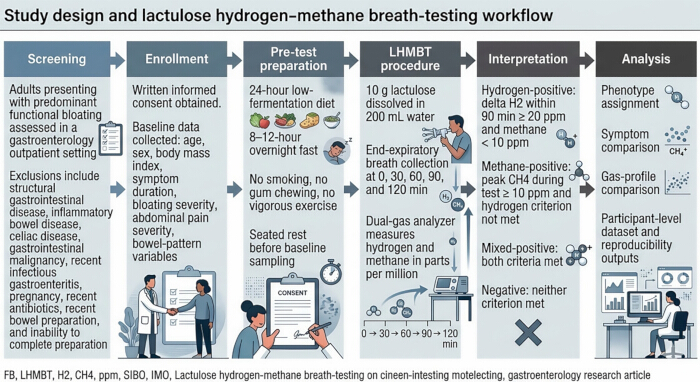
Figure 1. Study design and lactulose hydrogen–methane breath-testing workflow. Adult outpatients presenting with functional bloating were screened for eligibility and enrolled after written informed consent. Baseline demographic and clinical variables were recorded before testing. Participants underwent standardized pre-test preparation consisting of a 24 h low-fermentation diet and an 8–12 h overnight fast. Lactulose hydrogen–methane breath testing (LHMBT) was performed following ingestion of 10 g lactulose dissolved in 200 mL water, with end-expiratory breath samples collected at 0, 30, 60, 90, and 120 min. Breath-test results were interpreted using predefined hydrogen and methane criteria and participants were classified as negative, hydrogen-positive, methane-positive, or mixed-positive. Clinical symptom comparisons and phenotype-specific analyses were subsequently performed. Please click here to view a larger version of this figure.
Study Population, Eligibility, and Baseline Assessment
Eligible participants were adults aged 18–65 years who presented with recurrent or persistent bloating for more than 3 months, with symptom onset at least 6 months before enrollment. These temporal symptom requirements were selected to align with the Rome IV diagnostic framework for functional bowel disorders. Participants were also required to be capable of completing both the symptom assessment and the serial breath-testing procedure. Participants were excluded if they had inflammatory bowel disease, celiac disease, gastrointestinal malignancy, intestinal obstruction, prior significant small-bowel or colonic resection, decompensated liver disease, pregnancy, acute infectious gastroenteritis within the previous 4 weeks, systemic antibiotic exposure within the previous 4 weeks, colonoscopy bowel preparation within the previous 2 weeks, or an inability to comply with pre-test dietary and fasting instructions.
Age, sex, height, weight, body mass index (BMI), symptom duration, bloating severity, abdominal pain severity, average number of spontaneous bowel movements per week, and clinical subtype based on bowel habit pattern (functional bloating, IBS-C, IBS-D, or IBS-M) were prospectively recorded at enrollment using a structured case report form. Bloating severity and abdominal pain severity were assessed using a numerical rating scale (NRS) ranging from 0 to 10, where 0 indicated no symptoms and 10 indicated the most severe symptoms imaginable. Stool frequency was defined as the average number of spontaneous bowel movements per week during the preceding 4 weeks. The study variables and corresponding coding rules are summarized in Table 16.
| Variable / Term | Definition | Coding / Unit | Notes |
| Functional bloating (FB) | Recurrent or persistent bothersome abdominal bloating without identified structural gastrointestinal disease on routine evaluation | Inclusion variable | Required for enrollment |
| Lactulose hydrogen–methane breath testing (LHMBT) | Standardized lactulose-based dual-gas breath test measuring exhaled hydrogen and methane | Procedure | Main study test |
| Age | Age at enrollment | Years | Continuous |
| Sex | Biological sex recorded at enrollment | Male / Female | Categorical |
| Body mass index (BMI) | Weight divided by height squared | kg/m² | Continuous |
| Symptom duration | Duration of bloating symptoms before enrollment | Months | Continuous |
| Clinical subtype | Symptom-based bowel phenotype recorded at enrollment | Functional bloating / IBS-C / IBS-D / IBS-M | Categorical |
| Bloating severity | Participant-reported bloating severity | 0–10 NRS | 0 = none; 10 = most severe |
| Abdominal pain severity | Participant-reported abdominal pain severity | 0–10 NRS | 0 = none; 10 = most severe |
| Constipation score | Composite constipation burden | 0–3 | Higher score = greater constipation burden |
| Diarrhea score | Composite diarrhea burden | 0–3 | Higher score = greater diarrhea burden |
| H2_0 | Baseline exhaled hydrogen | ppm | Measured at 0 min |
| H2_30 | Exhaled hydrogen at 30 min | ppm | Raw gas variable |
| H2_60 | Exhaled hydrogen at 60 min | ppm | Raw gas variable |
| H2_90 | Exhaled hydrogen at 90 min | ppm | Raw gas variable |
| H2_120 | Exhaled hydrogen at 120 min | ppm | Raw gas variable |
| CH4_0 | Baseline exhaled methane | ppm | Measured at 0 min |
| CH4_30 | Exhaled methane at 30 min | ppm | Raw gas variable |
| CH4_60 | Exhaled methane at 60 min | ppm | Raw gas variable |
| CH4_90 | Exhaled methane at 90 min | ppm | Raw gas variable |
| CH4_120 | Exhaled methane at 120 min | ppm | Raw gas variable |
| Peak_H2_0_90 | Maximum hydrogen concentration observed from 0–90 min | ppm | Derived variable |
| Delta_H2_0_90 | Peak_H2_0_90 minus baseline H2_0 | ppm | Derived variable |
| Peak_CH4_0_120 | Maximum methane concentration observed from 0–120 min | ppm | Derived variable |
| H2_Positive | Hydrogen criterion met | True / False | Derived binary variable |
| CH4_Positive | Methane criterion met | True / False | Derived binary variable |
| SIBO criterion | Hydrogen increase ≥20 ppm above baseline within 90 min | Yes / No | Diagnostic threshold |
| IMO criterion | Methane concentration ≥10 ppm at any sampling time point | Yes / No | Diagnostic threshold |
| Negative phenotype | Neither SIBO nor IMO criterion met | Negative | Final classification group |
| Hydrogen-positive phenotype | SIBO criterion met and methane remained <10 ppm at all time points | Hydrogen-positive | Final classification group |
| Methane-positive phenotype | IMO criterion met and SIBO criterion not met | Methane-positive | Final classification group |
| Mixed-positive phenotype | Both SIBO and IMO criteria met | Mixed-positive | Final classification group |
| Overall_Positive | Any positive breath-test phenotype | True / False | Includes hydrogen-positive, methane-positive, and mixed-positive phenotypes |
| Severity_High | High bloating severity flag | 1 / 0 | 1 = bloating severity ≥7; 0 = bloating severity <7 |
| Technically valid test | Baseline sample present, successful lactulose ingestion, and all scheduled post-lactulose samples collected | Yes / No | Required for final analysis |
| Invalid test | Incomplete lactulose ingestion, vomiting, missing critical samples, or analyzer malfunction | Exclusion reason | Excluded from analysis |
Table 1: Variable definitions, diagnostic thresholds, and phenotype assignment rules. Definitions, coding schemes, units of measurement, derived variables, diagnostic thresholds, quality-control variables, and phenotype assignment criteria used for participant classification, dataset construction, and statistical analysis.
Pre-test Preparation
All participants received the same written and oral instructions before testing. Participants followed a restricted low-fermentation diet consisting of plain white rice, eggs, unseasoned chicken or fish, clear broth, water, and unsweetened, non-carbonated tea for 24 h before the test. Beans, whole grains, dairy products, fruits, fruit juices, onions, garlic, cabbage, alcohol, carbonated beverages, fiber supplements, and products containing sugar alcohols were prohibited during this period. Participants then underwent an overnight fast for 8–12 h before sample collection. On the morning of testing, smoking, chewing gum, vigorous exercise, and sleeping during the sampling period were not permitted. Before baseline breath collection, participants rinsed their mouths with plain water and remained seated for 10 min. Immediately before testing, clinical staff verified each participant's adherence to the 24 h dietary restrictions, 8–12 h overnight fast, and required medication washout protocols, as detailed in the study eligibility criteria, using a structured interview. Any medications that could not be safely interrupted were documented. These preanalytical controls were standardized to reduce background gas variability and improve comparability across participants8.
Lactulose Hydrogen–Methane Breath-Testing Procedure
Breath testing was performed in the morning with participants in a seated position using a digital breath analyzer capable of measuring exhaled hydrogen (H2), methane (CH₄), and carbon dioxide (CO2) concentrations. To ensure measurement accuracy, the analyzer was calibrated daily before testing using a standardized calibration gas mixture according to the manufacturer's instructions. Acceptable breath samples were verified using the device's built-in alveolar CO2 correction methodology, which automatically adjusts trace-gas concentrations expressed in parts per million (ppm) to account for potential room-air dilution during exhalation. All procedures were performed by trained clinical staff. The analyzer, calibration gas, sampling accessories, and lactulose substrate used in this study are listed in the Table of Materials.
A baseline end-expiratory breath sample was collected at 0 min. Immediately thereafter, each participant ingested 10 g of lactulose dissolved in 200 mL of room-temperature water within 2 min. Additional end-expiratory breath samples were collected at 30, 60, 90, and 120 min after lactulose ingestion. The 30 min sampling interval was selected to balance procedural feasibility and participant compliance within a routine outpatient clinical workflow. However, compared with the 15 min intervals recommended by some consensus guidelines, this wider sampling schedule represents a methodological limitation because it may fail to capture early or transient gas rises.
At each time point, participants inhaled normally, held their breath for 5 s, and then exhaled completely into the collection system to obtain an end-expiratory sample. Food intake, smoking, gum chewing, unnecessary walking, and sleeping were not permitted during the testing period. If coughing, interrupted exhalation, or obvious sample leakage occurred, the sample was recollected immediately.
The breath-testing timeline is shown in Figure 1. Raw H2 and CH4 values for all participants at each sampling time point are publicly available in the Zenodo repository (DOI: 10.5281/zenodo.20578413).
Breath-Test Interpretation and Phenotype Assignment
Breath-test interpretation criteria were predefined before clinical comparison. Small intestinal bacterial overgrowth (SIBO) was defined as an increase in exhaled H2 of at least 20 ppm above baseline within 90 min after lactulose ingestion. Intestinal methanogen overgrowth (IMO) was defined as a CH₄ concentration of at least 10 ppm at any time point during the test. Both definitions and diagnostic thresholds were applied in accordance with the North American Consensus guidelines. Participants were classified as hydrogen-positive when the H2 criterion for SIBO was met and CH₄ remained below 10 ppm at all recorded time points. Participants were classified as methane-positive when the IMO criterion was met and the hydrogen criterion for SIBO was not met. Participants were classified as mixed-positive when both the H2 criterion and the CH₄ criterion were met. Participants were classified as negative when neither criterion was met. These thresholds were applied uniformly across the entire cohort without post hoc modification. The classification rules used in the dataset are summarized in Table 114. Importantly, lactulose breath testing has recognized limitations. Because lactulose may accelerate orocecal transit and permit earlier colonic fermentation, false-positive breath-test results may occur in some individuals; therefore, breath-test positivity should be interpreted as a standardized phenotypic classification within the context of the present study rather than as definitive microbiologic confirmation of overgrowth.
Test Validity, Data Capture, and Quality Control
A breath test was considered technically valid only when all of the following conditions were met: availability of a baseline sample, successful lactulose ingestion, collection of all scheduled post-lactulose samples through 120 min, and absence of a major protocol deviation that would preclude interpretation. A test was excluded if lactulose ingestion was incomplete, vomiting occurred during the procedure, the participant withdrew before the 90 min sample, or device malfunction prevented reliable measurement. Raw gas values were entered directly into the study database as recorded, without interpolation, smoothing, or manual curve correction. Each participant occupied a single row in the analysis dataset, and each sampling time point had designated H2 and CH₄ data fields. Group assignment was generated strictly according to the predefined interpretation criteria and subsequently verified against the raw gas profile. Range checks were prespecified for key variables before database lock, and any out-of-range value required source verification. To support reproducibility, the de-identified study dataset and variable dictionary are publicly available in the Zenodo repository15.
Clinical Phenotypes and Statistical Analysis
Participants were classified into four phenotypic groups: negative, hydrogen-positive, methane-positive, and mixed-positive. The primary clinical outcome was bloating severity measured using a 0–10 numerical rating scale (NRS). Secondary variables included abdominal pain severity, symptom duration, stool frequency, constipation-related features, and bowel habit subtype. Constipation-related features were considered present if any of the following were documented during clinical assessment: fewer than three spontaneous bowel movements per week, straining, hard stools, or a sensation of incomplete evacuation. Continuous variables were summarized as mean ± standard deviation (SD) when approximately normally distributed and as median with interquartile range (IQR) when non-normally distributed. Categorical variables were summarized as counts and proportions.
The primary comparison contrasted participants with positive breath tests and those with negative breath tests. Secondary analyses compared the four phenotypic groups. For comparisons between two groups, continuous variables were analyzed using the independent-samples t-test or the Mann–Whitney U test, as appropriate. For comparisons among the four phenotypic groups, continuous variables were analyzed using one-way analysis of variance (ANOVA) or the Kruskal–Wallis test, as appropriate. Categorical variables were analyzed using the chi-square test or Fisher’s exact test. The normality of continuous variables was assessed using the Shapiro–Wilk test coupled with visual inspection of Q–Q plots. For comparisons among the four phenotype groups, statistical inference was based primarily on omnibus ANOVA or Kruskal–Wallis testing. Where appropriate, Bonferroni adjustment was considered to control for multiple comparisons. All statistical analyses were performed using SPSS Statistics version 27.0. All statistical tests were two-sided, and P < 0.05 was considered statistically significant. A noninvasive dual-gas protocol was used throughout because the objective of the study was reproducible outpatient phenotypic characterization within a standardized clinical workflow rather than invasive culture-based confirmation alone.
Access restricted. Please log in or start a trial to view this content.
Results
Study Population and Breath-Test Phenotype Classification
During the recruitment period, a total of 118 adult outpatients presenting with functional bloating were consecutively screened for eligibility. Among these, 28 were excluded prior to the final analysis: 15 did not meet the strict symptom-duration criteria, 8 declined to participate, and 5 were excluded due to invalid breath tests (e.g., incomplete lactulose ingestion) or pre-test protocol deviations. Consequently, a total of 90 participants w...
Access restricted. Please log in or start a trial to view this content.
Discussion
In this cohort of patients with functional bloating, lactulose hydrogen–methane breath testing identified clinically distinguishable gas-production phenotypes. Nearly half of the cohort had a positive breath test, and participants with positive results exhibited a greater overall symptom burden than those with negative results, particularly with respect to bloating severity and bowel-related symptom scores. When positive cases were further separated into hydrogen-positive, methane-positive, and mixed-positive pheno...
Access restricted. Please log in or start a trial to view this content.
Disclosures
Conflict of Interest:
The authors declare no conflicts of interest.
Acknowledgements
The authors would like to express their sincere gratitude to the School of Clinical Medicine at Shandong Second Medical University, Heze Third People’s Hospital, and the Healthcare Department of the Central Hospital Affiliated with Shandong First Medical University for providing administrative and clinical support throughout this research. The authors also thank the clinical staff and outpatients whose participation made the lactulose hydrogen–methane breath testing and data collection possible.
Access restricted. Please log in or start a trial to view this content.
Materials
| Name | Company | Catalog Number | Comments |
|---|---|---|---|
| BreathTracker SC Digital Breath Analyzer (230–240 V / 50 Hz) | QuinTron Instrument Company | QT05001-M | Digital breath analyzer used to measure exhaled hydrogen (H2), methane (CH4), and carbon dioxide (CO2) during lactulose hydrogen–methane breath testing. The 230–240 V / 50 Hz configuration was used for the study site. |
| Calibration Gas for BreathTracker Analyzer | QuinTron Instrument Company | QT07500-G | Standardized calibration gas mixture used for daily analyzer calibration according to the manufacturer’s instructions before participant testing. |
| QuinGas Regulator and Pressure Gauge | QuinTron Instrument Company | QT02772 | Regulator and pressure gauge used to connect the QuinGas calibration cylinder to the BreathTracker analyzer during daily calibration. |
| AlveoSampler Collection Kit, No Substrate | QuinTron Instrument Company | QT00827-P | Single-patient breath collection kit used to obtain acceptable end-expiratory/alveolar breath samples for H2, CH4, and CO2 measurement. |
| Disposable Plastic Mouthpiece, 20 mm | QuinTron Instrument Company | QT00991-P | Single-use mouthpiece used with the breath-sampling setup for participant hygiene and sample collection. |
| Lactulose Oral Solution/Syrup, Clinical Grade | Hospital pharmacy or approved clinical supplier | N/A; 10 g clinical dose | Breath-test substrate. Each participant ingested 10 g lactulose diluted in 200 mL room-temperature water within 2 min. Product registration number and batch/lot number should be retained in site source documentation if required. |
| Room-Temperature Water | Hospital supply | N/A | Used to prepare the lactulose-water solution; 200 mL was administered with 10 g lactulose. |
| Borosilicate Glass Beaker, 250 mL | Fisherbrand | FB100250 | Used for preparation of the lactulose-water solution before administration. |
| Graduated Cylinder or Measuring Cup, 200 mL | Hospital supply or Fisherbrand equivalent | N/A | Used to measure 200 mL water for standardized preparation of the lactulose substrate solution. |
| Digital Laboratory Timer | Fisherbrand Traceable | S94842 | Used to time baseline and post-lactulose sampling intervals at 0, 30, 60, 90, and 120 min. |
| Nitrile Examination Gloves | Kimtech / Ansell via Fisher Scientific | S78944 | Used for sample handling, participant-contact hygiene, and device-accessory handling during breath testing. |
| Plain Water and Disposable Rinse Cup | Hospital supply | N/A | Used for participant mouth rinsing before baseline breath collection. |
| Structured Participant Screening Checklist | Author-generated; Jinan Central Hospital | LHMBT-Screening-v1.0 | Used to document Rome IV symptom-duration criteria, exclusion criteria, medication washout, dietary restriction, fasting adherence, and consent status before testing. |
| Structured Case Report Form | Author-generated; Jinan Central Hospital | LHMBT-CRF-v1.0 | Used to record age, sex, height, weight, BMI, symptom duration, bloating severity, abdominal pain severity, bowel habit subtype, stool frequency, and constipation-related features. |
| Pre-test Diet and Medication Washout Instruction Sheet | Author-generated; Jinan Central Hospital | LHMBT-Pretest-Instructions-v1.0 | Written and oral participant instructions covering the 24 h low-fermentation diet, 8–12 h overnight fast, medication restrictions, and avoidance of smoking, chewing gum, exercise, and sleeping during testing. |
| Raw Breath-Gas Recording Worksheet | Author-generated; Jinan Central Hospital | LHMBT-Gas-Worksheet-v1.0 | Used to enter H2 and CH4 values at 0, 30, 60, 90, and 120 min exactly as recorded, without interpolation, smoothing, or manual curve correction. |
| IBM SPSS Statistics | IBM Corp. | Version 27.0 | Statistical software used for Shapiro–Wilk normality testing, t-test or Mann–Whitney U test, ANOVA or Kruskal–Wallis test, chi-square test, Fisher’s exact test, and Bonferroni-adjusted comparisons when appropriate. |
| Zenodo Repository | Zenodo / CERN | DOI: 10.5281/zenodo.20578413 | Public repository containing the de-identified participant-level dataset, raw hydrogen and methane breath-test measurements, symptom variables, phenotype classifications, variable dictionary, and supporting analysis documentation. |
| Variable Dictionary and Analysis Codebook | Author-generated | DOI: 10.5281/zenodo.20578413 | Documentation describing study variables, coding rules, diagnostic thresholds, quality-control variables, and phenotype assignment criteria. |
| Locked Analysis Dataset | Author-generated | DOI: 10.5281/zenodo.20578413 | Final de-identified analysis dataset used for the reported clinical comparisons and deposited with supporting documentation. |