This 6-year longitudinal study uses a standardized index to show that declining social engagement is significantly associated with an increased risk of sleep deprivation and non-restorative sleep among community-dwelling older adults, highlighting the potential value of social interaction screening in healthy aging.
Research Article
A Six-Year Longitudinal Cohort Study Assessing the Association Between Social Interaction Trajectories and Sleep Health in Older Adults
Ruifeng Zhao1,2 , Haotian Gao1 , Mingyu Cui3 , Shuanghong Li1 , Jinrui Zhang1 , Meiling Qian1 , Mengxuan Wang1 , Yang Liu4 , Yuko Sawada5 , Akihiro Kakuda5 , Dandan Jiao6 , Tokie Anme7
1Doctoral Program in Medical Sciences, Graduate School of Comprehensive Human Sciences, University of Tsukuba, 2School of Education, Qingdao Hengxing University of Science and Technology, 3Department of Nutrition and Food Hygiene, School of Public Health, Peking University, 4Key Laboratory of Digital-Intelligent Disease Surveillance and Health Governance, North Sichuan Medical College, 5Department of Physical Therapy, Morinomiya University of Medical Sciences, 6Department of Nursing, The First Affiliated Hospital, and College of Clinical Medicine, Henan University of Science and Technology, 7Faculty of Medicine, University of Tsukuba
Opens in a new tab
In This Article
Summary
Loading...
$$\rightleftharpoonup{xx}$$
$$\longleftharp{xx}$$,
$$\longrightharp{xx}$$,
Abstract
Loading...
$$\rightleftharpoonup{xx}$$
$$\longleftharp{xx}$$,
$$\longrightharp{xx}$$,
Sleep disturbances, including sleep deprivation and non-restorative sleep, pose a severe public health burden for aging populations. While social isolation is a recognized risk factor, rigorous longitudinal studies evaluating the prospective association between dynamic changes in social interaction and subsequent sleep health are lacking. This study details a 6-year longitudinal cohort study involving 473 community-dwelling older adults in Japan who exhibited normal baseline sleep. Social interactions were systematically evaluated using the standardized 18-item Index of Social Interaction. Participants were tracked from 2017 to 2023 to categorize their social trajectories into distinct subgroups, such as persistently high, declining, improving, or persistently low. Sleep duration and restoration were concurrently assessed using national health guidelines. Multivariable logistic regression models were constructed to evaluate the longitudinal relationship of these social trajectories with sleep outcomes, adjusting for baseline demographic, physical, and lifestyle covariates. The study observed that individuals experiencing a longitudinal decline in social interaction, or those remaining persistently isolated, faced a more than two-fold increased risk of developing sleep deprivation and non-restorative sleep compared to those maintaining robust social networks. Conversely, an incremental increase in continuous social interaction scores was significantly associated with a reduced risk of adverse sleep outcomes. These longitudinal findings offer observational evidence regarding the psychosocial determinants of sleep. Integrating standardized social interaction metrics into routine community health surveillance may facilitate early, targeted interventions to support sleep health and promote healthy aging.
Introduction
Loading...
$$\rightleftharpoonup{xx}$$
$$\longleftharp{xx}$$,
$$\longrightharp{xx}$$,
In modern society, the lack of proper sleep has emerged as a critical public health problem, with the course of insomnia in older adults increasingly demonstrating a trend toward chronic development1. A systematic evaluation has established that sleep disorders significantly elevate an individual’s risk of developing severe psychiatric conditions, including depression and accelerated cognitive decline2. Recognizing the severity of this issue, the Ministry of Health, Labor and Welfare (MHLW) in Japan established the basic policy of Health Japan 21. Within this framework, the national health goals concerning sleep are explicitly defined as achieving “an increase in the number of people who are rested from sleep” and “an increase in the number of people who are getting enough sleep”3. Consequently, accurately measuring and defining what constitutes good sleep duration within community settings is paramount for public health surveillance.
According to the MHLW’s National Healthy Sleep Guidelines, the recommended sleep duration for older adults in Japan is set at a minimum of 6 h per day3. Chronic deviation from these guidelines yields severe physiological consequences. Epidemiological studies have demonstrated that elderly individuals who consistently experience curtailed sleep, particularly those sleeping for 5 h or less per night, exhibit significantly higher mortality rates4. Furthermore, consistently shortened sleep duration disrupts essential hormonal balances, including cortisol and serotonin regulation, which in turn exacerbates stress responses, impairs emotional regulation, and fosters heightened states of depression, anxiety, and lower overall life satisfaction1,5.
While sleep duration provides a quantitative measure of sleep health, sleep restoration serves as a crucial subjective quality index, presumed to reflect true physiological sleep sufficiency. A critical, yet frequently under-assessed condition in aging cohorts is Non-Restorative Sleep (NRS). NRS describes a paradoxical state wherein an individual, despite achieving an adequate duration of sleep, continues to experience persistent fatigue or lacks a sense of restored energy upon waking6. Because older adults and the chronically ill are inherently more susceptible to the physiological and psychological impacts of poor sleep, NRS can silently precipitate a cascade of health complications7.
The psychological and cognitive toll of chronic NRS is heavily documented. Individuals suffering from NRS frequently exhibit symptoms of severe depression, anxiety, and irritability, as the lack of refreshing sleep fundamentally cripples emotional regulation8. Advanced analytical models, including latent profile analyses, have further associated NRS with an increased risk of psychosis-like experiences9 and identified it as a robust predictor of suicidal ideation in at-risk populations10. Cognitively, NRS hampers neuroplasticity and memory consolidation11, leading to deficits in attention, concentration, and decision-making12. In older demographics, persistent NRS is increasingly recognized as a potential risk factor that accelerates cognitive aging and contributes to neurodegenerative pathologies, such as Alzheimer’s and Parkinson’s disease13. Physiologically, the body’s failure to properly recover during sleep sustains prolonged systemic stress, contributing to inflammatory processes linked to cardiovascular diseases14, type 2 diabetes15, chronic pain16, and weakened immune function17.
Sleep health is governed by a complex matrix of biological, psychological, and social factors. Recently, social interaction has garnered significant attention as a primary determinant of both physical and mental well-being. Existing literature indicates that older adults suffering from diminished social networks or a reduced frequency of interpersonal interactions are highly susceptible to severe depression and anxiety18, as well as accelerated cognitive deterioration19. Conversely, active social relationships provide vital emotional support, cognitive engagement, and a structured daily routine, all of which act as protective mechanisms for overall health and psychological stability.
Despite this growing body of theoretical evidence regarding social isolation, a notable methodological gap persists in the literature. Most existing studies are limited by cross-sectional designs or single-timepoint assessments, which capture only a static snapshot of social engagement. Because social interaction is inherently dynamic and fluctuates with aging, retirement, and health transitions, single-timepoint methods inherently fail to evaluate long-term social trajectories or establish temporal sequence. There remains a distinct lack of rigorous, long-term prospective cohort studies capable of evaluating the longitudinal association between dynamic changes in social interactions and subsequent sleep status, particularly within the rapidly aging Japanese demographic. A longitudinal trajectory-based approach is therefore preferable and necessary, as it allows for the capture of cumulative social effects and shifting interpersonal patterns over time.
To address this critical gap, this study conducted a 6-year longitudinal analysis of community-dwelling older adults in Japan. By leveraging a validated 18-item Index of Social Interaction (ISI) alongside standardized MHLW sleep metrics, this study systematically tracked and visualized how distinct longitudinal trajectories of social interaction, categorized into subgroups representing persistent, declining, or improving social statuses, prospectively associate with the dual endpoints of sleep duration and sleep restoration. While this observational design cannot definitively establish causation, investigating these trajectory variables over an extended period yields valuable longitudinal evidence to inform and optimize targeted public health interventions for healthy aging. Readers should interpret the ISI trajectory categories as indicative trends of social behavior rather than absolute clinical diagnoses.
Protocol
Loading...
$$\rightleftharpoonup{xx}$$
$$\longleftharp{xx}$$,
$$\longrightharp{xx}$$,
This longitudinal cohort study was conducted in a suburban Japanese community as part of the Community Empowerment and Care (CEC) project and was approved by the Ethics Committee of the University of Tsukuba, Japan (Approval No. 1331-7). The research adhered to the principles of the Declaration of Helsinki, and written informed consent was obtained from all participants before study enrollment.
1. Participant recruitment and selection
A total of 473 community-dwelling older adults who completed the 6-year follow-up were enrolled based on predefined criteria. Participants were initially recruited via. mailed invitations distributed through local municipal registries. Eligibility was verified by trained research staff during an initial telephone screening or in-person interview, serving as the first validation checkpoint for cohort inclusion. Inclusion criteria comprised: age > 65 years; participation in the 2017 baseline survey; and presence of a normal sleep status at baseline, defined as sleeping ≥6 h per day and experiencing subjective sleep restoration. Exclusion criteria included: pre-existing sleep deprivation (<6 h of sleep per day) or non-restorative sleep (NRS) at baseline; complete loss of independent living ability; and missing core survey data or loss to follow-up during the 2017–2023 study period.
2. Baseline assessment and follow-up procedures
Participants completed standardized self-reported questionnaires at the 2017 baseline and the 2023 follow-up to collect demographic and lifestyle covariates. Data were primarily collected using paper-based, self-administered questionnaires. For participants requiring assistance, trained field investigators provided face-to-face standardized interviews to ensure data accuracy. To comply with data handling standards, all completed physical questionnaires were stored in secure, access-controlled filing cabinets at room temperature, while digitized data were encrypted and stored on password-protected institutional servers. Recorded data included age, sex, daily exercise habits, smoking status, alcohol intake, and subjective life satisfaction. Disease history was documented, specifically noting any hospitalization or treatment lasting more than 2 weeks in the past year. Furthermore, the participants' baseline nutritional and motor function levels were assessed using the validated subscale from the Ministry of Health, Labor and Welfare's Kihon Checklist. Follow-up evaluations were conducted 6 years post-baseline to reassess all core metrics and track longitudinal changes. The 2023 follow-up utilized the identical administration protocols, questionnaire formats, and data entry validation checks as the baseline to ensure strict longitudinal consistency.
3. Outcome definitions and social interaction categorization
The primary study endpoints were sleep duration and sleep restoration at the 6-year follow-up. Sleep duration was assessed using the specific prompt: “On average, how many hours of actual sleep do you get in 24 h?” Responses were recorded numerically and subsequently dichotomized, with insufficient sleep defined as <6 h per day. Sleep restoration was evaluated utilizing the binary (Yes/No) prompt derived from national guidelines: “Do you feel you get adequate rest from your sleep?” with a negative response indicative of NRS.
Social interactions were evaluated utilizing the 18-item Index of Social Interaction (ISI). Each of the 18 items was scored as 1 (indicative of positive social engagement) or 0 (indicative of negative or absent engagement). Total scores were computationally calculated by summing the item responses, yielding a potential range of 0 to 18. To quantify social trajectories, the continuous change in ISI score was calculated by subtracting the baseline score from the 2023 follow-up score. Additionally, participants were stratified into “high” (ISI ≥ 16) and “low” (ISI < 16) subgroups based on the cohort-derived median score calculated specifically from this study's baseline dataset (Median = 16). This enabled the construction of four distinct social interaction trajectory groups (low-to-low, high-to-low, low-to-high, and high-to-high) to monitor dynamic shifts over the 2017–2023 interval.
4. Statistical analysis workflow
Data analysis utilized SPSS software (version 26.0). Participants with missing data for core variables were excluded from the analytical sample using listwise deletion before modeling. Descriptive statistics were employed to summarize the demographic characteristics of the final analytical sample. Analytical approaches encompassed group comparisons using Chi-square tests for categorical variables, and Mann-Whitney U tests for continuous variables with skewed distributions.
To examine the associations between changes in social interaction and sleep outcomes, multivariable logistic regression models were constructed. Covariates included in these models were selected based on a priori clinical relevance and preliminary bivariate screening, retaining variables that demonstrated statistical significance (p. < 0.05) in unadjusted analyses. Before logistic regression, the assumption of no severe multicollinearity among independent variables was verified using Variance Inflation Factors (VIF < 5).
Operationally, the analyses were executed in SPSS using the “Analyze > Regression > Binary Logistic” workflow. The “Enter” method was specified to simultaneously include all selected covariates (e.g., age, exercise, life satisfaction) alongside the primary ISI predictors into the models (Addresses 5e). These models evaluated continuous changes, categorized changes, and median subgroup trends. Statistical significance was established at p. < 0.05 (two-tailed).
Results
Loading...
$$\rightleftharpoonup{xx}$$
$$\longleftharp{xx}$$,
$$\longrightharp{xx}$$,
Participant characteristics and study flow
The participant selection process for this 6-year longitudinal study is detailed in Figure 1. Of the initial 2,350 community-dwelling older adults invited to the 2017 baseline survey, 1,188 were excluded due to missing core data, loss of independent living, or pre-existing sleep issues (sleep deprivation or non-restorative sleep). This resulted in a baseline cohort of 1,162 individuals with normal sleep status. During the 6-year follow-up period, an additional 689 participants were excluded due to loss to follow-up, death, relocation, or incomplete data in the 2023 survey.
To assess potential attrition bias, baseline characteristics were compared between the final analytical cohort (n = 473) and those lost to follow-up (n = 689). No statistically significant differences were observed in baseline age (p = 0.12) or baseline mean ISI scores (p. = 0.09), suggesting that sample attrition was random and unlikely to bias the observed associations systematically.
As shown in Table 1, the final cohort (N = 473) had a mean age of 70.27 (SD = 6.50) years, with a higher proportion of females (56.7%). Most participants (88.6%) reported having at least one chronic disease, while over half engaged in daily exercise (56.2%) and expressed satisfaction with their current life (74.0%). By the end of the 6-year follow-up in 2023, 16.3% (n = 77) of the participants had developed sleep deprivation (<6 h per day), and 26.2% (n. = 124) reported experiencing non-restorative sleep (NRS).
Trajectories of social interaction (2017–2023)
The median Index of Social Interaction (ISI) score remained stable at 16 for both the 2017 and 2023 assessments. However, individual trajectories revealed significant shifts in social engagement over time, as visualized in the Sankey diagram (Figure 2). When categorized by the cohort median, the majority of participants (n = 255, 53.9%) maintained consistently high social interaction (High-to-High). Conversely, 22.0% (n = 104) experienced a decline from high to low interaction (High-to-Low), 18.8% (n = 89) remained persistently isolated (Low-to-Low), and only a small fraction (n. = 25, 5.3%) improved their social engagement from low to high.
Bivariate analysis of sleep outcomes
Preliminary bivariate analyses (Table 2) indicated that specific demographic and social factors were associated with subsequent sleep issues. Advancing age (p = 0.002) and continuous negative changes in ISI scores (p = 0.003) were significantly associated with the incidence of sleep deprivation. For sleep restoration, lack of daily exercise (p = 0.001), lower life satisfaction (p = 0.010), and negative changes in continuous ISI scores (p = 0.004) were significantly correlated with an increased risk of NRS. Furthermore, the categorized ISI subgroup trends were highly significant for both sleep deprivation and NRS (both p. < 0.001).
Association between social interaction changes and sleep duration
Multivariable logistic regression indicated that advancing age was an independent risk factor for sleep deprivation (OR = 1.052, 95% CI [1.013, 1.089], p = 0.007). Conversely, an incremental 1-point increase in the continuous ISI score was associated with a significantly reduced risk (OR = 0.912, 95% CI [0.847, 0.982], p. = 0.015), even after adjusting for age (Table 3).
The forest plot in Figure 3 further delineates these risks across categorized social changes. Compared to those with steady social interactions (reference group), participants exhibiting a negative change in ISI scores faced a 2.72-fold higher risk of sleep deprivation (OR = 2.72, 95% CI [1.38, 5.35], p = 0.004). Subgroup trend analysis revealed that, relative to the High-to-High reference group, the risk of sleep deprivation was significantly elevated in the High-to-Low group (OR = 2.61, 95% CI [1.41, 4.82], p = 0.002) and the Low-to-Low group (OR = 2.09, 95% CI [1.06, 4.10], p. = 0.032). Transitioning from Low-to-High did not yield statistically significant differences in sleep duration outcomes compared to the reference groups.
Association between social interaction changes and sleep restoration
Similar patterns were observed regarding sleep restoration. Multivariable models identified the lack of daily exercise (OR = 1.947, 95% CI [1.277, 2.968], p = 0.002) and the absence of life satisfaction (OR = 1.874, 95% CI [1.180, 2.977], p = 0.008) as independent risk factors for NRS. Adjusting for these covariates, which were selected based on a priori clinical relevance and preliminary bivariate associations, a 1-point increase in the continuous ISI score remained significantly associated with a lower risk of NRS (OR = 0.920, 95% CI [0.865, 0.978], p. = 0.007) (Table 3).
Figure 4 illustrates the categorized risk profiles for NRS. Participants with a negative overall change in social interaction were at a substantially higher risk of developing NRS compared to the steady interaction reference group (OR = 2.71, 95% CI [1.39, 5.32], p = 0.004). Trend analysis demonstrated that a decline in social status (High-to-Low) was the strongest predictor of NRS (OR = 3.01, 95% CI [1.64, 5.56], p < 0.001), followed by persistently low social interaction (Low-to-Low: OR = 2.67, 95% CI [1.36, 5.26], p. = 0.005). Consistent with the sleep duration findings, improving social interaction (Low-to-High) did not reach statistical significance for altering NRS risk.
DATA AVAILABILITY:
The raw data supporting the conclusions of this study, fully de-identified and anonymized to strictly protect participant confidentiality in accordance with the Ethics Committee's requirements, are provided in Supplementary File 1.
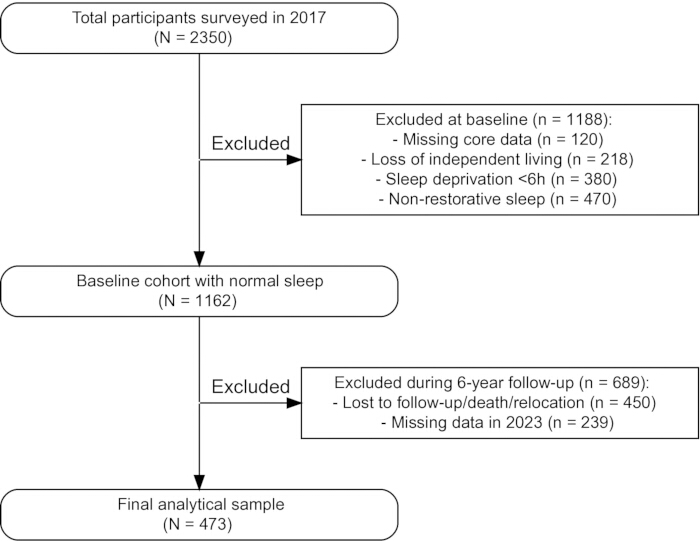
Figure 1: Flowchart of the study participant selection process. A total of 2,350 community-dwelling older adults initially participated in the Community Empowerment and Care (CEC) survey in 2017. Participants were excluded at baseline if they had missing core data (n = 120), complete loss of independent living ability (n = 218), or pre-existing sleep issues, including sleep deprivation (n = 380) and non-restorative sleep (n = 470). The resulting baseline cohort comprised 1,162 participants with normal sleep status. During the 6-year follow-up in 2023, 689 individuals were excluded due to loss to follow-up, death, or relocation (n = 450), and missing critical variables in the follow-up assessment (n = 239). The final longitudinal analysis included 473 participants. Please click here to view a larger version of this figure.
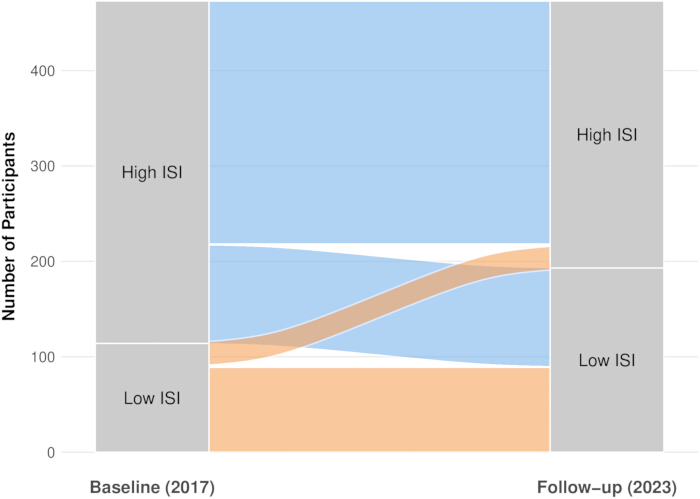
Figure 2: Sankey diagram illustrating the longitudinal trajectories of social interaction among participants from 2017 to 2023. Participants (N = 473) were categorized into “High ISI” (score ≥ 16) and “Low ISI” (score < 16) groups based on the median Index of Social Interaction (ISI) score at both baseline and follow-up. The flows represent the transition of individuals between these states over the 6 years, resulting in four distinct trajectory subgroups: persistently low (Low-to-Low), declining (High-to-Low), improving (Low-to-High), and persistently high (High-to-High). Please click here to view a larger version of this figure.
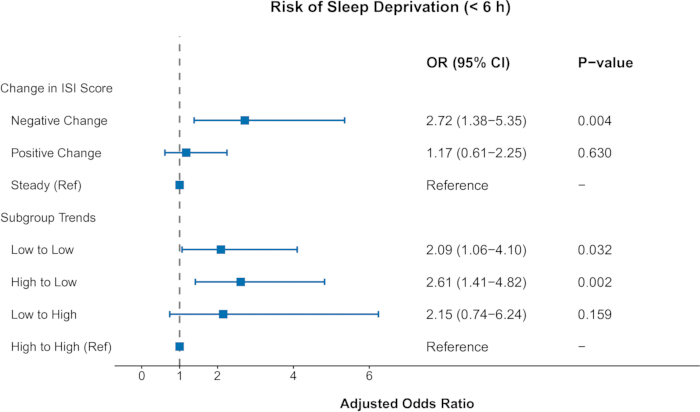
Figure 3: Forest plot of multivariable logistic regression analysis for the risk of sleep deprivation. The plot displays the adjusted Odds Ratios (OR) and 95% Confidence Intervals (CI) for the incidence of sleep deprivation (<6 h of sleep per day) after 6 years. The analysis evaluates two conceptualizations of social interaction changes: (1) categorized overall change in ISI scores (Negative, Positive, with Steady as the reference), and (2) subgroup trend transitions based on median scores (Low-to-Low, High-to-Low, Low-to-High, with High-to-High as the reference). Models were adjusted for age. A vertical dashed line indicates an OR of 1.0 (no effect). Please click here to view a larger version of this figure.
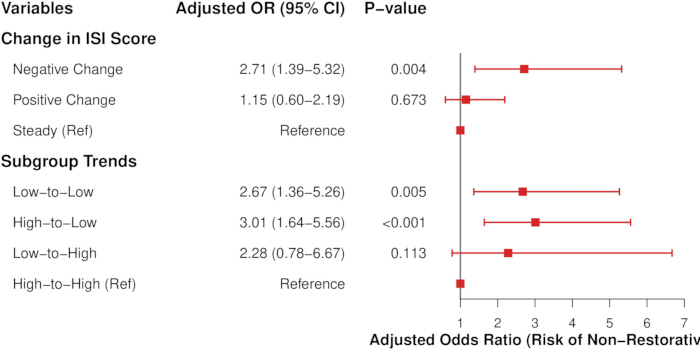
Figure 4: Forest plot of multivariable logistic regression analysis for the risk of non-restorative sleep (NRS). The plot displays the adjusted Odds Ratios (OR) and 95% Confidence Intervals (CI) for experiencing non-restorative sleep after 6 years. Similar to Figure 3, it evaluates the impact of categorized overall changes in ISI scores and subgroup trend transitions. Models were adjusted for daily exercise and life satisfaction. A vertical dashed line indicates an OR of 1.0 (no effect). Please click here to view a larger version of this figure.
| Variables | Categories | n | % |
| Age (years) | Mean ± SD | 70.27 ± 6.50 | |
| Sex | Male | 205 | 43.3 |
| Female | 268 | 56.7 | |
| Smoking status | Yes | 184 | 38.9 |
| No | 289 | 61.1 | |
| Alcohol consumption | Yes | 157 | 33.2 |
| No | 316 | 66.8 | |
| Chronic disease history | Yes | 419 | 88.6 |
| No | 54 | 11.4 | |
| Daily exercise habits | Yes | 266 | 56.2 |
| No | 207 | 43.8 | |
| Subjective life satisfaction | Yes | 350 | 74 |
| No | 123 | 26 | |
| Motor function level | Normal | 393 | 83.1 |
| Low | 80 | 16.9 | |
| Nutritional level | Normal | 463 | 97.9 |
| Low | 10 | 2.1 | |
| Sleep duration per day (2023) | ≥ 6 hours | 396 | 83.7 |
| < 6 hours | 77 | 16.3 | |
| Subjective restorative sleep (2023) | Yes | 349 | 73.8 |
| No | 124 | 26.2 | |
| ISI score in 2017 | Median [Q25–Q75] | 16 [14–17] | |
| ISI score in 2023 | Median [Q25–Q75] | 16 [15–17] |
Table 1: Baseline demographic and health-related characteristics of the study participants (N = 473). Abbreviations: SD, Standard Deviation; ISI, Index of Social Interaction; Q25-Q75, Interquartile Range.
| Variable | Categories / Metrics | Sleep Deprivation (< 6 h)n=77 | P-value | Non-Restorative Sleep (NRS) n=124 | P-value |
| Age (years) | Continuous | — | 0.002 | — | 0.504 |
| Change in ISI score | Continuous | — | 0.003 | — | 0.004 |
| Sex | Male | 32 | 0.73 | 52 | 0.713 |
| Female | 45 | 72 | |||
| Daily exercise habits | Yes | 41 | 0.563 | 54 | 0.001 |
| No | 36 | 70 | |||
| Subjective life satisfaction | Yes | 55 | 0.575 | 81 | 0.01 |
| No | 22 | 43 | |||
| ISI Trajectory Subgroup | High-to-High (Ref) | 21 | < 0.001† | 34 | < 0.001† |
| High-to-Low | 26 | 35 | |||
| Low-to-High | 10 | 22 | |||
| Low-to-Low | 20 |
Table 2: Bivariate associations between participant characteristics and sleep outcomes after 6 years. Categorical variables were analyzed using the Chi-square test, and continuous variables (Age and Change in ISI) were analyzed using the Mann-Whitney U test due to skewed distributions. Significant p.-values (< 0.05) indicate a statistical association with sleep deprivation or non-restorative sleep. Abbreviations: NRS, Non-restorative Sleep; ISI, Index of Social Interaction.
| Dependent Outcome | Independent Variables | Adjusted OR | 95% CI | P-value |
| Sleep Deprivation (< 6 h) | Age (per 1-year increase) | 1.052 | [1.013, 1.089] | 0.007 |
| Change in ISI score (per 1-point increase) | 0.912 | [0.847, 0.982] | 0.015 | |
| Non-Restorative Sleep (NRS) | Daily exercise habits (No vs. Yes) | 1.947 | [1.277, 2.968] | 0.002 |
| Subjective life satisfaction (No vs. Yes) | 1.874 | [1.180, 2.977] | 0.008 | |
| Change in ISI score (per 1-point increase) | 0.92 | [0.865, 0.978] | 0.007 |
Table 3: Multivariable logistic regression analysis of the association between continuous changes in social interaction and sleep outcomes. This table presents the protective effects of an incremental increase in social interaction on sleep health. The model evaluates the impact of a 1-point increase in the continuous ISI score from 2017 to 2023 on the risk of sleep deprivation (adjusted for age) and non-restorative sleep (adjusted for exercise and life satisfaction). Abbreviations: OR, Odds Ratio; CI, Confidence Interval; ISI, Index of Social Interaction.
Supplementary File 1: The raw data supporting the conclusions of this study. Please click here to download this file.
Discussion
Loading...
$$\rightleftharpoonup{xx}$$
$$\longleftharp{xx}$$,
$$\longrightharp{xx}$$,
Through a standardized 6-year longitudinal assessment, this study demonstrated that dynamic changes in the social interaction trajectories of older adults are prospectively associated with their subsequent sleep status. The results indicate that maintaining or improving social interactions is associated with a reduced risk of sleep deprivation and non-restorative sleep (NRS). Conversely, a reduction in social activities or prolonged social isolation more than doubles the risk of adverse sleep outcomes within this observational cohort.
These longitudinal findings provide valuable temporal evidence that reinforces previous cross-sectional observations. Prior research has widely documented a positive correlation between the quality of social relationships and sleep quality20. For instance, Troxel et al. found that high-quality marital relationships and strong social support systems can significantly buffer stress, thereby improving sleep architecture in older populations21,22. Prospective analyses by Yu et al. similarly emphasized that loneliness stemming from a lack of social interaction severely undermines sleep satisfaction and overall sleep quality in older adults23. Mechanistically, a scarcity of social relationships not only deprives older adults of critical emotional support systems but also predisposes them to negative psychological states, such as depression and anxiety24,25. If sleep disturbances induced by social isolation are left unchecked, sleep deprivation may impair the cardiovascular system’s self-repair capabilities26. Furthermore, sleep lacking restorative qualities exacerbates the risk of acute cardiovascular events and all-cause mortality27,28. Therefore, identifying trajectories of social decline early through rigorous, long-term follow-up holds substantial public health value for interrupting this vicious health cycle.
The core strength of this study lies in its integration with the large-scale longitudinal cohort platform of the Community Empowerment and Care (CEC) project29. Unlike traditional single-timepoint cross-sectional epidemiological surveys, the long-term tracking design of the CEC cohort allows for rigorous baseline control of confounding factors and the calculation of true disease incidence. A critical methodological step for successful implementation was the utilization of the fully validated Kihon Checklist from the Ministry of Health, Labor and Welfare to exclude older adults who had already developed severe disability30. This is paramount, as it effectively mitigates “reverse causality” bias driven by somatic diseases—namely, the confounding scenario where existing physical frailty simultaneously causes an inability to socialize and deteriorating sleep.
Furthermore, another cornerstone for the successful execution of this study was the adoption of the highly localized and standardized 18-item Index of Social Interaction (ISI). The ISI scale encompasses not only the frequency of social contacts but also comprehensively evaluates the quality and depth of those interactions. This tool has undergone rigorous development and validity testing among Japanese community residents31,32 and has been maturely applied in recent years to assess multiple dimensions, including social function decline, changes in environmental stimulation, and physical deterioration in community-dwelling older adults33,34. By converting the longitudinal score differences of this standardized tool into dynamic “trajectory subgroups” (e.g., High-to-Low, persistently low), this study precisely quantifies abstract social changes, providing clear, actionable assessment targets for future community interventions. From an implementation perspective, administering the ISI manually requires trained personnel to ensure consistent comprehension among older participants. A common troubleshooting consideration during data collection is addressing missing responses on multi-item scales; implementing structured face-to-face interviews for cognitively vulnerable individuals significantly improves data completeness and reproducibility.
During the 6-year follow-up, the precise capture of non-restorative sleep (NRS) was a core technical challenge. NRS is typically intertwined with various occult clinical features and adverse lifestyle habits, presenting as a complex syndrome35. Although this study primarily relied on self-reported data from participants to define sleep duration and restoration, which may inevitably introduce a certain degree of recall bias, this method of data collection possesses irreplaceable operational feasibility in large-scale population epidemiological surveys. More importantly, previous methodological studies on similar aging cohorts have demonstrated that during standardized community follow-ups, structured patient self-reported metrics exhibit highly consistent predictive validity with performance-based measures in forecasting functional decline and long-term health outcomes36.
Although this study demonstrates significant long-term predictive associations, its methodological limitations must be acknowledged. First, as previously noted, the assessment of sleep status did not incorporate objective physiological monitoring devices such as polysomnography (PSG) or actigraphy. A significant implementation challenge in this protocol is distinguishing between subjective sleep dissatisfaction and objective physiological disruptions. Future research should consider equipping specific high-risk subgroups with wearable sleep monitors in addition to administering the ISI questionnaire, thereby achieving multimodal cross-validation of subjective and objective data. Second, while controlling for baseline covariates, this analysis did not incorporate more microscopic socioeconomic factors, such as specific marital transitions, drastic shifts in household economic status, or the burden of family caregiving, into the final regression models. These potential confounders should be evaluated in detail in future studies. Finally, the data for the current analysis were primarily sourced from a suburban Japanese community. Whether its conclusions are fully generalizable to other countries with differing family structures and cultural norms remains to be validated through cross-cultural, multicenter collaborative studies.
Conclusion
In conclusion, this 6-year longitudinal study provides observational evidence that dynamic social trajectories are strongly associated with sleep health among community-dwelling older adults. By systematically deploying the 18-item Index of Social Interaction (ISI), this research demonstrates that a decline in social engagement, or persistent social isolation, substantially elevates the risk of both sleep deprivation and non-restorative sleep (NRS). Conversely, maintaining or enhancing social connections serves as a potential protective mechanism for restorative sleep architecture. The standardized assessment detailed herein offers a practical, cost-effective tool for large-scale public health surveillance. Integrating this tracking approach into routine geriatric care can empower clinicians and community health workers to identify at-risk individuals earlier, thereby facilitating targeted social interventions that promote healthy aging and mitigate the clinical cascade of sleep-related physiological decline.
Disclosures
Loading...
$$\rightleftharpoonup{xx}$$
$$\longleftharp{xx}$$,
$$\longrightharp{xx}$$,
All authors have disclosed no conflicts of interest.
Acknowledgements
Loading...
$$\rightleftharpoonup{xx}$$
$$\longleftharp{xx}$$,
$$\longrightharp{xx}$$,
The researchers express their deepest gratitude to all participants and staff members of Tobishima for their voluntary participation in this study. We would like to thank Editage (www.editage.jp) for English language editing. This research was supported by a Sasakawa Scholarship from the Japan-China Medical Association awarded to Haotian Gao, and in part by JST SPRING (JPMJSP2124).
Materials
| Name | Company | Catalog Number | Comments |
|---|---|---|---|
| IBM SPSS Statistics (Version 26.0) | IBM Corp. | RRID: SCR_019096 | |
| Index of Social Interaction (ISI) Questionnaire | Developed by Anme et al. | Anme, T.,et al.31 | |
| Kihon Checklist | Ministry of Health, Labour and Welfare, Japan | Satake, S. et al.30 | |
| Microsoft Excel | Microsoft Corporation | RRID: SCR_016137 |
Reprints and Permissions
Request permission to reuse the text or figures of this JoVE article
Request Permission