This protocol details a quantitative methodology using structural equation modeling to evaluate how the quality of mixed reality cultural narratives influences visitor immersion, perceived authenticity, emotional connection, and subsequent learning outcomes in digital heritage environments.
A subscription to JoVE is required to view this content. Sign in or start your free trial.
Method Article
Evaluating Visitor Engagement in Mixed Reality Digital Heritage Narratives via Structural Equation Modeling
In This Article
Summary
Abstract
This article presents a comprehensive protocol for evaluating the impact of mixed reality (MR) cultural narrative quality on visitor engagement and learning outcomes in digital heritage environments. While MR technologies offer novel platforms for cultural expression, a standardized method for quantifying their experiential and educational effectiveness remains limited. The protocol details a scenario-based, quantitative empirical research design utilizing a unified MR heritage prototype. Participants (N = 261) engage with the MR system, which integrates historical content, spatial narratives, and interactive information. Following the experience, data are collected using a structured questionnaire measuring core constructs: narrative quality, immersion, perceived authenticity, emotional connection, visitor engagement, and learning outcomes. The data are subsequently analyzed using partial least squares structural equation modeling (PLS-SEM) to map the structural relationships and mediating effects among these variables. Serving as representative results to validate this protocol, the findings confirm that high-quality MR narratives significantly enhance immersion and perceived authenticity, which subsequently drive emotional resonance and deeper visitor engagement. Ultimately, this heightened engagement translates into improved learning outcomes. By systematically capturing and analyzing these multilayered psychological and behavioral responses, this methodology provides a reliable framework for researchers and designers to assess and optimize the educational value of digital heritage experiences.
Introduction
Under the profound adjustment of the international paradigm for cultural heritage dissemination, exhibition logic has fundamentally transitioned from an object-centric approach to one that emphasizes the visitor experience1. Historically, museums and heritage sites relied predominantly on physical display cabinets and static textual plaques to present historical information in a unidirectional manner. Consequently, these traditional configurations are generally considered to be uninvolved in visitors’ active cognitive processes, rendering the audience mere spectators. However, the emergence and rapid evolution of Digital Humanities research have irrevocably altered this dynamic. The contemporary objective is no longer solely to preserve and passively display cultural relics, but to dynamically reconstruct the chronological timeline of history using interactive digital media as a bridging conduit2,3. Within this context, utilizing mixed reality (MR) technology compensates for the inherent limitations of purely digital virtual spaces, as well as the physical constraints of actual heritage site environments, thereby providing a robust hybrid platform for cultural expression.
The core mechanism of employing MR to realize the digital transformation of heritage lies in the systematic reorganization of spatial narratives. This approach significantly differs from traditional digital models, such as basic video tours or the simple superimposition of isolated augmented reality (AR) objects. Instead, MR realizes true spatial coexistence and environmental integration through advanced spatial perception mapping and projection technologies4. In such computationally augmented environments, visitors are no longer passive receivers of isolated historical facts; rather, they become active participants embedded in the real-time re-creation of cultural stories. The rules of engagement have fundamentally changed, redefining the structural relationship between tourists and heritage content. Cultural consumption is transformed into an active process of meaning construction5,6. Presenting digitized, historically accurate content in parallel with physical heritage sites effectively transforms dormant historical records into narrative fragments that resonate both spatially and emotionally7.
Despite these technological advancements, a critical review of the wider body of literature reveals a distinct methodological gap. Although the academic community has paid considerable attention to the applications of extended reality in heritage protection, the vast majority of current research remains heavily concentrated on technical realizations, hardware optimizations, and rudimentary usability assessments. While numerous previous studies have investigated the application efficacy of specific devices and sensory stimulation technologies, remarkably few have empirically examined their deeper structural relationships with cultural cognition, psychological immersion, and pedagogical outcomes8,9. Consequently, many existing digital heritage projects suffer from a disjointed design: they possess sophisticated technical support but lack compelling, structured narrative strategies. Although developers frequently strive to engineer a strong sense of spatial presence, it is fundamentally the depth, coherence, and quality of the narrative that act as the primary catalysts enabling visitors to effectively immerse themselves in the historical context10. To date, a systematic and quantitative methodological framework mapping how specific MR narrative designs influence nuanced visitor participation behaviors has not been comprehensively established. As a result, numerous high-cost digital heritage projects deliver striking visual stimuli but fail to exert considerable influence on long-term educational outcomes or the development of cultural identity11.
The overall goal of the method presented in this protocol is to provide a standardized, reproducible empirical framework for quantifying the experiential and educational efficacy of MR cultural narratives. The rationale behind the development of this specific technique is rooted in the understanding that the narrative design of an MR environment does not directly or instantaneously cause a behavioral learning response. Instead, it functions as a distal antecedent that operates through a sequence of intermediary psychological processes. We hypothesize that high-quality narrative-flow immersion effectively lowers tourists’ cognitive barriers, such as museum fatigue or historical jargon overload, making complex information more accessible. Simultaneously, perceived authenticity provides a critical cognitive bridge between the virtual narrative overlays and the tangible cultural heritage. Emotional resonance then elevates this baseline participation to a state of profound cultural connection. The protocol systematically confirms whether these latent psychological constructs function as necessary intermediaries, thereby demonstrating how this methodological framework can be utilized to evaluate how tourist engagement affects learning outcomes.
This proposed quantitative protocol offers significant advantages over alternative evaluative techniques. Previously, the evaluation of digital heritage experiences relied heavily on subjective post-visit qualitative interviews or unidimensional self-reported satisfaction surveys. These alternative methods frequently fail to capture the complex, multilayered psychological mechanisms occurring simultaneously during the actual spatial experience12,13. Traditional observational methods also lack the statistical rigor required to model latent psychological variables synchronously. In contrast, the methodology outlined herein utilizes a controlled MR digital heritage prototype combined with robust survey instruments and Partial Least Squares Structural Equation Modeling (PLS-SEM)14. PLS-SEM is particularly advantageous for this application because it allows for the rigorous assessment of complex path models and multiple mediating effects simultaneously, providing researchers with a highly accurate mapping of how narrative quality translates to learning rather than merely observing whether it does.
The information derived from executing this protocol will help readers determine whether this structural evaluation method is appropriate for their specific applications. This protocol is highly appropriate for digital humanities scholars, museum curators, and interactive system designers who aim to transition from purely descriptive evaluations of heritage technologies to rigorous predictive modeling. By isolating the specific narrative variables that drive visitor engagement, this method provides both theoretical support and actionable directions for optimizing the educational effectiveness of future MR cultural narrative systems.
Access restricted. Please log in or start a trial to view this content.
Protocol
All methods involving human participants were performed in accordance with relevant institutional guidelines and were approved by the Ethics Committee on Human Research Protection of Shanghai Daji Education Technology Co., Ltd. (Approval No. 4500AL0512). Written informed consent was obtained from all participants before participation.
1. System Development and Experimental Design
- Develop the MR digital heritage prototype
- Construct the MR prototype
- Construct a MR digital heritage prototype using Unity 2022.3 LTS.
- Deploy the application through a Microsoft HoloLens 2 head-mounted MR device capable of integrating virtual and physical content.
- Configure the MR prototype
- Configure the prototype to superimpose virtual cultural information within a three-dimensional physical environment.
- Integrate historical content, spatial narrative elements, and interactive information presentations into the system.
- Use the same device, application build, scene package, and interaction workflow for all participants.
- Prepare cultural heritage content
- Compile historical and cultural materials from publicly available museum records, local cultural heritage archives, exhibition texts, and expert-reviewed interpretive materials.
- Organize the collected materials into chronological and thematic narrative units.
- Ask two cultural heritage specialists to review the materials for historical accuracy, narrative coherence, and suitability for MR presentation before deploying the final prototype.
- Construct the MR prototype
- Design the MR environment
- Configure interaction components
- Incorporate spatial prompts, visual layers, and interaction feedback mechanisms into the MR environment.
- Ensure that these components support user navigation and engagement throughout the experience.
- Implement narrative-driven interaction
- Utilize narrative-driven storytelling to place participants within contextualized cultural scenarios.
- Replace traditional static presentation methods with interactive experiential content.
- Configure interaction components
- Establish the experimental framework
- Define the structural model
- Base the experimental framework on the proposed structural model outlining the core constructs and their operational dimensions (Figure 1).
- Define the primary independent variable
- Define MR cultural narrative quality as the primary independent variable within the framework.
- Evaluate its relationships with immersion and perceived authenticity.
- Define downstream outcome relationships
- Assess the subsequent influences of immersion and perceived authenticity on emotional connection, visitor engagement, and learning outcomes.
- Define the structural model
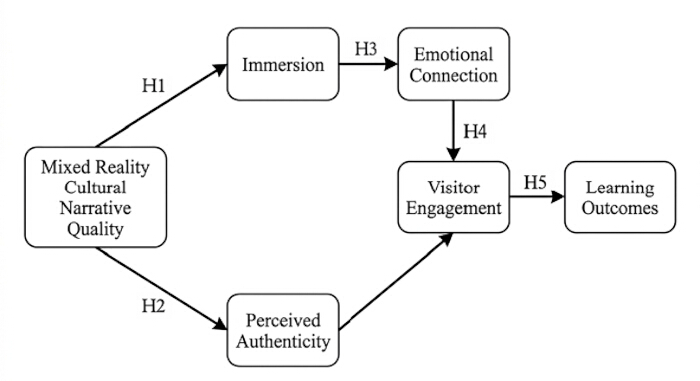
Figure 1. Experimental workflow for evaluating visitor engagement in mixed reality (MR) digital heritage experiences. Schematic overview of the study design and experimental procedure. The workflow illustrates system preparation, participant recruitment, MR experience exposure, questionnaire administration, and statistical analysis used to evaluate the relationships among narrative quality, immersion, perceived authenticity, emotional connection, visitor engagement, and learning outcomes. Please click here to view a larger version of this figure.
2. Participant Recruitment and Preparation
- Recruit eligible participants
- Define the target population
- Define the target population as individuals possessing foundational digital literacy.
- Recruit participants using stratified random sampling across university campuses and local cultural centers to promote demographic diversity.
- Apply inclusion criteria
- Enroll participants who are at least 18 years of age.
- Enroll participants who have normal or corrected-to-normal vision.
- Apply exclusion criteria
- Exclude individuals with a known history of severe motion sickness.
- Exclude individuals with prior exposure to the specific digital heritage content used in the study.
- Finalize participant enrollment
- Recruit participants according to the predefined eligibility criteria.
- Retain 261 valid participants in the final analysis dataset.
- Define the target population
- Standardize the experimental environment
- Standardize session conditions
- Maintain a consistent MR heritage experience environment across all participant sessions.
- Conduct all sessions in a quiet indoor room with stable lighting, limited external noise, and a predefined safe movement area.
- Standardize the hardware configuration, software environment, and interaction workflow throughout the experiment.
- Verify system readiness
- Minimize external technical discrepancies that may influence participant responses.
- Verify headset battery level, visual clarity, spatial mapping, gesture recognition, application startup, and environmental consistency before each experimental session.
- Standardize session conditions
3. Experimental Procedure
NOTE: The following procedure corresponds to the workflow illustrated in Figure 1. The phased design separates participant orientation from the formal experimental tasks to minimize the influence of technology unfamiliarity on the measured outcomes.
- Conduct participant introduction and consent procedures
- Provide participant orientation
- Brief participants on the study objectives, experimental workflow, and relevant safety guidelines before beginning the session.
- Obtain informed consent
- Obtain written informed consent from each participant prior to participation in the MR experience.
- Provide participant orientation
- Prepare participants for MR system use
- Provide system instructions
- Distribute the equipment user manual.
- Explain the operating procedures and interaction requirements of the MR system.
- Calibrate the MR hardware
- Guide participants through the placement and calibration of the MR hardware.
- Repeat calibration if the participant reports blurred vision, tracking instability, or difficulty completing the practice interaction.
- Conduct participant training
- Provide a standardized 5 min training session covering headset adjustment, gaze control, hand gestures, menu selection, and safety precautions.
- Provide system instructions
- Conduct the formal MR experience session
- Initiate the experience session
- Instruct participants to enter and explore the standardized MR digital heritage environment.
- Complete the narrative experience
- Direct participants to complete the full spatial narrative sequence, including viewing the integrated virtual exhibits and performing the required interactive exploration activities.
- Maintain the formal MR experience for approximately 12–15 min.
- Consider the session complete when the participant finishes the final narrative scene and returns to the starting interface.
- Initiate the experience session
- Administer the post-experience questionnaire
- Administer the questionnaire
- Administer the structured questionnaire immediately following completion of the MR experience session.
- Collect participant responses
- Instruct participants to self-report their perceptions of cultural narrative quality, immersion, perceived authenticity, emotional responses, visitor engagement, and learning outcomes.
- Administer the questionnaire
4. Measurement and Variable Operationalization
- Configure the questionnaire structure
- Define the response scale
- Structure the questionnaire using a 5-point Likert scale ranging from 1 ("Strongly Disagree") to 5 ("Strongly Agree") to quantify participants' perceptions and experiential responses.
- Define the scoring procedure
- Maintain a consistent response format across all measured constructs throughout the assessment process.
- Calculate each construct score as the arithmetic mean of its corresponding items.
- Exclude reverse-coded items from the questionnaire. Interpret higher scores as indicating higher levels of the corresponding construct.
- Define the questionnaire structure
- Use the final 30-item post-experience questionnaire provided as Supplementary File 1.
- Measure six constructs with five items each: MR cultural narrative quality, immersion, perceived authenticity, emotional connection, visitor engagement, and learning outcomes.
- Define the response scale
- Measure MR cultural narrative quality
- Assess narrative structure
- Assess MR cultural narrative quality by evaluating the logical organization and coherence of the story content presented within the MR environment.
- Assess narrative presentation
- Measure the attractiveness of the cultural information.
- Measure the clarity of situational guidance and the coherence of the interactive interpretation.
- Assess narrative structure
- Evaluate immersion
- Assess presence and involvement
- Evaluate immersion by measuring participants’ sense of presence and spatial involvement within the heritage environment.
- Assess attentional focus
- Assess participants’ sustained attentional focus during the MR experience.
- Assess presence and involvement
- Measure perceived authenticity
- Assess historical credibility
- Measure perceived authenticity by evaluating the extent to which participants perceive the digital enhancements as historically credible and culturally genuine.
- Assess environmental realism
- Assess whether the digital augmentations preserve the perceived reality of the physical heritage environment.
- Assess historical credibility
- Measure emotional connection
- Assess emotional resonance
- Assess emotional connection by evaluating participants’ cultural identification and emotional resonance with the historical content.
- Assess emotional attachment
- Measure participants’ meaningful emotional attachment to the heritage narratives presented during the experience.
- Assess emotional resonance
- Assess visitor engagement
- Assess cognitive engagement
- Assess visitor engagement by evaluating participants’ cognitive involvement and willingness to explore related cultural information.
- Assess behavioral engagement
- Measure participants’ psychological engagement and interaction intentions during the MR experience.
- Assess cognitive engagement
- Evaluate learning outcomes
- Assess learning acquisition
- Evaluate learning outcomes by measuring participants’ perceived knowledge acquisition and enhanced cultural understanding following the MR experience.
- Assess knowledge retention
- Assess participants’ retention of the presented heritage content as the final dependent variable.
- Assess learning acquisition
5. Data Screening and Statistical Analysis
- Screen and prepare the dataset
- Identify invalid responses
- Screen the collected questionnaire data to identify and exclude invalid responses, including duplicate entries and responses containing logical inconsistencies.
- Finalize the analysis dataset
- Retain only valid responses within the final analysis dataset to ensure the reliability of subsequent statistical analyses.
- Identify invalid responses
- Perform descriptive statistical analysis
- Calculate descriptive statistics
- Calculate descriptive statistics, including means, standard deviations, and correlation coefficients, to characterize the demographic structure and distribution features of the participant sample.
- Evaluate data distribution
- Evaluate the overall distribution characteristics of the collected data prior to structural model analysis.
- Calculate descriptive statistics
- Evaluate the measurement model
- Assess internal consistency
- Calculate Cronbach’s alpha and Composite Reliability values to assess the internal consistency of the measurement model.
- Consider reliability acceptable when both values exceed 0.70.
- Assess convergent validity
- Assess convergent validity using the Average Variance Extracted and indicator loadings.
- Consider convergent validity adequate when the Average Variance Extracted exceeds 0.50 and standardized indicator loadings are preferably above 0.70.
- Assess discriminant validity
- Establish discriminant validity using the Heterotrait-Monotrait ratio.
- Consider Heterotrait-Monotrait ratio values below 0.85 acceptable.
- Assess internal consistency
- Perform structural model analysis
- Estimate the structural model
- Conduct PLS-SEM to evaluate the structural relationships among the measured constructs.
- Evaluate structural paths
- Analyze the directional relationships among MR cultural narrative quality, immersion, perceived authenticity, emotional connection, visitor engagement, and learning outcomes.
- Estimate the structural model
- Perform mediation and resampling analyses
- Conduct bootstrapping analysis
- Apply bootstrapping procedures with 5,000 resamples to evaluate the mediating effects within the proposed structural model.
- Assess indirect effects
- Assess the indirect effects through which MR cultural narratives influence learning outcomes via the internal experiential pathway constructs.
- Consider path coefficients and indirect effects statistically significant when p < 0.05.
- Conduct bootstrapping analysis
Access restricted. Please log in or start a trial to view this content.
Results
The following empirical findings are presented as representative results to illustrate the practical application, statistical rigor, and analytical capability of the proposed protocol. By executing the procedures outlined above, this section demonstrates how the methodology effectively captures and models visitor experiences.
Participant Profile and Group Distribution
A total of 261 valid samples were collected, demonstrating a relatively balanced demographic distribution ...
Access restricted. Please log in or start a trial to view this content.
Discussion
This study proposes a reproducible methodological protocol utilizing a comprehensive structural model to evaluate how MR cultural narratives influence visitor engagement and learning outcomes across different levels of the experiential mechanism15. The empirical testing of the hypotheses is presented to validate the efficacy and reliability of this evaluation framework. By systematically establishing and verifying this integrated path model, the results demonstrate that MR cultural narrative quali...
Access restricted. Please log in or start a trial to view this content.
Disclosures
The authors have nothing to disclose.
Acknowledgements
The authors gratefully acknowledge the 261 participants who generously volunteered their time to engage with the mixed reality digital heritage prototype and complete the comprehensive surveys. Their valuable participation was essential for the successful empirical validation of the proposed structural model. This research received no specific grant from any funding agency in the public, commercial, or not-for-profit sectors.
Access restricted. Please log in or start a trial to view this content.
Materials
| Name | Company | Catalog Number | Comments |
|---|---|---|---|
| Computer workstation | Dell | Precision 3650 Tower; Intel Core i7 processor; 32 GB RAM; NVIDIA graphics card; Windows 11 Pro 64-bit | To operate the mixed reality environment, deploy the application, and process research data |
| IBM SPSS Statistics | IBM Corp. | Version 26.0 | To perform descriptive statistical analyses and analysis of variance (ANOVA) |
| Mixed reality headset | Microsoft | HoloLens 2; Windows Holographic operating system | To deliver the mixed reality cultural heritage experience |
| SmartPLS software | SmartPLS GmbH | Version 4.0 | To perform Partial Least Squares Structural Equation Modeling (PLS-SEM), reliability assessment, validity testing, and mediation analysis |
| Unity development platform | Unity Technologies | Unity 2022.3 LTS | To develop, deploy, and manage the mixed reality cultural heritage application |
| Visitor experience survey instrument | Developed by the research team based on previous digital heritage and immersive experience studies | Final 30-item post-experience questionnaire; provided as Supplementary File 1 | To collect self-reported data on narrative quality, immersion, perceived authenticity, emotional connection, visitor engagement, and learning outcomes |
Reprints and Permissions
This article has been published
Video Coming Soon