This prospective randomized controlled trial evaluated an eight-week standardized nursing-led protocol integrating pain assessment, sleep monitoring, medication-adherence support, and rule-based digital symptom monitoring for postherpetic neuralgia. Compared with usual care, the protocol was associated with greater improvement in pain, sleep, medication adherence, and symptom burden.
Research Article
A Standardized Nursing-Led Protocol Integrated Pain, Sleep, Medication Adherence, and Symptom Management in Postherpetic Neuralgia
76 views
⸱
September 11th, 2026
In This Article
Summary
Abstract
Postherpetic neuralgia (PHN) is a persistent neuropathic pain condition after herpes zoster that frequently coexists with sleep disturbance, medication-related problems, and fluctuating symptoms. This study evaluated whether a standardized nursing-led protocol could improve multidimensional short-term outcomes beyond usual care. In this prospective, parallel-group randomized controlled trial, 128 adults with PHN were allocated 1:1 to usual care or usual care plus an eight-week protocol integrating structured pain assessment, sleep monitoring, medication-adherence support, and rule-based digital symptom monitoring. The primary outcome was the between-group difference in change in Numeric Rating Scale (NRS) pain score from baseline to Week 8. Secondary outcomes included Pittsburgh Sleep Quality Index (PSQI), MMAS-8 medication adherence, symptom burden, pain-related nocturnal awakenings, breakthrough pain, rescue analgesic use, adverse events, rule-based alerts, and nursing satisfaction. Week-8 data were available for 116 participants (57 usual care; 59 protocol). Mean NRS scores decreased from 7.19 ± 1.08 to 4.82 ± 1.53 in the usual-care group and from 7.28 ± 1.05 to 3.24 ± 1.28 in the protocol group. An NRS reduction of at least 2 points occurred in 49.1% and 76.3% of participants, respectively. The protocol group also showed larger improvements in PSQI, MMAS-8, symptom burden, and nocturnal awakenings, with fewer breakthrough-pain episodes and less rescue-analgesic use. These findings support further evaluation of the standardized nursing-led protocol in preregistered multicenter trials with intention-to-treat analyses and longer follow-up.
Introduction
Postherpetic neuralgia (PHN) is neuropathic pain that persists or recurs in the affected dermatome after herpes zoster caused by varicella-zoster virus. A threshold of at least 3 months after rash onset is commonly used to distinguish PHN from subacute herpetic neuralgia1. Peripheral nerve injury, ectopic activity, and central sensitization contribute to persistent pain, allodynia, and hyperalgesia2,3,4. PHN can substantially impair sleep and daily function, and sleep disruption may in turn amplify pain sensitivity5.
Pharmacological treatment remains central to PHN management, but effectiveness is constrained by incomplete response, dose-limiting adverse effects, and interindividual variation in tolerability. Comparative evidence supports gabapentinoids and selected antidepressants as options for neuropathic pain, while emphasizing individualized selection and monitoring6,7. These characteristics make repeated assessment of pain, sleep, medication use, adverse effects, and functional impact clinically relevant rather than treating pain intensity as an isolated measure.
Medication adherence, timely recognition of worsening symptoms, and continuity after discharge are modifiable components of PHN care8,9. Existing reports describe nursing and evidence-based pain-management pathways, but the incremental value of a single standardized protocol that integrates pain assessment, sleep monitoring, medication-adherence support, and post-discharge rule-based symptom surveillance has not been established clearly9,10,11. Therefore, this study evaluated an eight-week standardized nursing-led protocol in adults with PHN. The primary outcome was the between-group difference in change in NRS pain score from baseline to Week 8. It was hypothesized that the protocol would produce a greater reduction in pain than usual care and would improve prespecified secondary outcomes of sleep, medication adherence, symptom burden, nocturnal awakenings, breakthrough pain, rescue-analgesic use, and nursing satisfaction without increasing adverse events.
Protocol
This prospective, parallel-group randomized controlled trial was conducted at the Department of Pain, Affiliated Hospital of Guizhou Medical University. The overall study conduct period extended from 2 January 2024 to 31 December 2025. The study was conducted in accordance with the Declaration of Helsinki. The study protocol was reviewed and approved by the Human Experimental Ethics Committee of Guizhou Medical University (Approval No. 2024 Ethics Review [154]). All participants provided written informed consent before enrollment. When caregiver assistance was required for study procedures, the participant’s own written informed consent remained mandatory and the caregiver assisted only with study procedures and recording. Study data were de-identified, and electronic follow-up records were stored on a password-protected institutional server accessible only to authorized researchers.
Study design and setting
Participants were allocated 1:1 to usual care or usual care plus a standardized nursing-led protocol. The intervention lasted 8 weeks and integrated structured pain assessment, sleep monitoring, medication-adherence support, and rule-based digital symptom monitoring. Figure 1 summarizes the study timeline and assessment schedule.
Each participant was followed for 8 weeks from baseline according to the participant-level schedule shown in Figure 1, with scheduled assessments at baseline and Weeks 2, 4, and 8; instrument-specific assessment time points are detailed in Table 1. The order and content of the standardized protocol were intended to remain consistent across intervention nurses.
Participants
Potential participants were screened in inpatient and outpatient settings. A pain specialist clinically confirmed PHN when neuropathic pain persisted in the dermatome affected by a documented herpes-zoster eruption for at least 3 months. Supporting features included burning or electric-shock-like pain, spontaneous pain, allodynia, hyperalgesia, or sensory loss in the same neuroanatomically plausible distribution1,12.
Inclusion criteria were age 50–85 years; PHN duration of 3–24 months; NRS pain score ≥4 during the 24 h before enrollment; PSQI total score ≥8; ability to understand the study instructions and complete study procedures independently or with caregiver assistance; and written informed consent before enrollment.
Exclusion criteria were active herpes-zoster lesions; severe cognitive impairment (Mini-Mental State Examination score <24); a major psychiatric disorder requiring acute management; malignant-tumor-related pain; diabetic peripheral neuropathy; trigeminal neuralgia; other clinically significant coexisting pain conditions, including painful lumbar or cervical radiculopathy, osteoarthritis with persistent moderate-to-severe pain, rheumatoid arthritis with active pain, chronic low-back pain, or other peripheral neuropathic pain disorders that could preclude reliable attribution of pain-related outcomes to PHN; severe hepatic impairment (alanine or aspartate aminotransferase >3 times the upper limit of normal); acute abdominal illness; or another condition that prevented safe and reliable participation.
A total of 148 individuals were assessed for eligibility. Twenty were excluded before randomization: 8 did not meet the diagnostic or symptom-severity criteria, 5 had a major coexisting pain condition, 4 did not complete the baseline assessment, and 3 declined participation. The remaining 128 participants were randomized equally to the standardized protocol group (n = 64) or usual-care group (n = 64). Week-8 data were available for 59 and 57 participants, respectively. Baseline characteristics of all randomized participants are presented in Table 2.
Randomization, allocation concealment, blinding, and usual care
After baseline assessment, an independent researcher generated a computer-based 1:1 randomization sequence. Group assignments were placed in sequentially numbered, opaque, sealed envelopes and revealed only after eligibility and baseline assessment were complete. Participants and intervention nurses could not be blinded to the nursing protocol. The statistician was not involved in clinical care or outcome collection.
Participants in the usual-care group received physician-directed pharmacological treatment, routine nursing observation, standard admission health education, in-hospital medication reminders, and routine discharge advice. Pain intensity was assessed during routine nursing rounds three times daily, at approximately 08:00, 16:00, and 20:00, using the 0–10 Numeric Rating Scale (NRS). Usual care did not include the structured sleep-escalation pathway, adherence-focused reminder card, or post-discharge rule-based digital alert system. Nurses providing routine inpatient care could have contact with participants in both groups; however, delivery of the standardized nursing-led protocol was restricted to trained intervention nurses and intervention-group participants. To minimize contamination, intervention-specific reminder materials, structured assessment forms, digital follow-up access, and rule-based alert procedures were used only for participants assigned to the intervention group. Protocol-specific education and follow-up procedures were delivered separately from routine nursing care, and intervention activities were documented using study-specific records.
In both groups, physicians selected and adjusted pharmacological treatment according to each participant's diagnosis, response, and tolerability. Treatments could include pregabalin, gabapentin, duloxetine, amitriptyline, topical lidocaine, and short-course rescue analgesics. Nurses provided education and monitoring but did not prescribe or independently titrate medication.
Standardized nursing-led clinical protocol
In addition to usual medical care, the intervention group received a standardized nurse-led pathway for symptom identification, structured assessment, tailored education, longitudinal tracking, and escalation to the treating physician when predefined criteria were met. Figure 1 and Figure 2 summarize the workflow and rule-based escalation pathway.
The protocol comprised four linked modules: standardized pain assessment, sleep monitoring and sleep-focused nursing management, medication guidance and adherence support, and rule-based digital symptom monitoring and remote follow-up. Each module used predefined observations and escalation criteria rather than an AI prediction model.
Standardized pain assessment
Pain intensity was rated on an 11-point NRS from 0 (no pain) to 10 (worst imaginable pain). During hospitalization, pain was recorded at 08:00, 16:00, and 20:00. After discharge, participants or caregivers recorded the evening NRS score between 19:00 and 21:00 in a paper diary or the mobile platform. At each scheduled assessment (baseline and Weeks 2, 4, and 8), the analytical pain value was the mean of the preceding three daily recordings.
NRS scores were categorized as mild (1–3), moderate (4–6), or severe (7–10). A pain alert was triggered by any of the following: an increase of ≥2 points from the previous day; NRS >6 for 48 consecutive h; at least 2 breakthrough-pain episodes within 36 h; or new allodynia that interfered with activities such as dressing or sleep. Inpatient alerts prompted nurse reassessment within 30 min. Remote alerts were reviewed no later than 12 h after submission; warning-state participants were contacted within 24 h, and high-risk reports prompted immediate contact and physician escalation when indicated. Reassessment covered pain site and quality, temporal pattern, triggers, sleep impact, medication timing, adverse effects, and functional limitation.
Sleep monitoring and sleep-focused nursing management
Sleep was assessed with the PSQI (range 0–21; higher scores indicate worse sleep) at baseline and Weeks 4 and 8. Participants also recorded bedtime, estimated sleep duration, sleep-onset latency, and pain-related nocturnal awakenings in a daily diary. Nursing staff reviewed the diary during hospitalization and at each remote follow-up.
A sleep-warning state was triggered by any of the following within 7 days: sleep-onset latency >30 min on at least 3 consecutive nights; sleep duration <6 h on at least 3 consecutive nights; at least 2 pain-related awakenings per night for 3 consecutive nights. The response included review of evening analgesic timing, a pre-sleep medication reminder, environmental sleep support, protection of the painful area, and 10 min of guided relaxation breathing. Persistent or worsening sleep disturbance prompted physician review.
Medication guidance and adherence support
Within 24 h of allocation, an intervention nurse provided individualized education on each prescribed drug's generic name, purpose, schedule, dosing interval, physician-directed titration plan, common adverse effects, and warning signs requiring clinical contact. Participants were instructed not to change or discontinue medication without consulting the treating team.
Medication regimens were individualized and managed exclusively by the treating physicians according to clinical presentation, treatment response, and tolerability. Pharmacological management included, as clinically indicated, gabapentinoids (pregabalin or gabapentin), antidepressant agents used for neuropathic pain (duloxetine or amitriptyline), topical lidocaine, and short-course rescue analgesics. Medication selection, dose adjustment, switching, and discontinuation were determined by the treating physician and were not protocol mandated. The nursing intervention did not prescribe a standardized drug regimen or titration schedule and did not authorize nurses to initiate, titrate, switch, or discontinue medication. Instead, nurses provided medication education and adherence support, monitored treatment-related adverse effects, and referred participants to the treating physician when predefined clinical concerns were identified. Because detailed dose-level and medication-change data were not prospectively captured in a standardized group-comparable format, drug-specific dose distributions and treatment modifications are not reported. This limitation should be considered when interpreting between-group clinical outcomes because physician-directed pharmacological management may have introduced treatment heterogeneity.
Medication adherence was assessed using the 8-item Morisky Medication Adherence Scale (MMAS-8), used with the required permission, together with inpatient pill counts when applicable. Scores were categorized as low (<6), medium (6 to <8), or high (= 8) adherence and were assessed at baseline and Weeks 4 and 8. An adherence-risk flag was generated when a participant missed medication on at least 2 days within 1 week, changed the dose without medical advice, or discontinued medication because of an adverse effect without contacting the clinical team. Participants meeting any adherence-risk criterion received a targeted 10–15 min counseling session addressing the identified barrier. The MMAS-8 was used in accordance with the applicable licensing and permission requirements, and the required authorization for its use in this study was obtained.
Rule-based digital symptom monitoring and remote follow-up
After discharge, intervention-group participants or caregivers submitted daily data through a mobile follow-up interface: evening NRS score, pain-related nocturnal awakenings, medication-taking status, breakthrough pain, dizziness, daytime somnolence, constipation, nausea, and skin sensitivity. Prespecified thresholds assigned each record to a stable, warning, or high-risk state. The module-specific pain and sleep alert criteria were used to identify clinically relevant symptom changes, whereas the post-discharge digital monitoring algorithm integrated pain, sleep, medication-adherence, and adverse-effect data to classify each daily record as stable, warning, or high risk. A symptom-burden increase alert was triggered when the total Structured Nursing Symptom Checklist score increased by ≥5 points from the preceding assessment. The platform was classified as rule-based because the documented intervention used predefined threshold logic rather than an AI or machine-learning model.
Stable status was defined as NRS ≤4, sleep duration >6 h/night, fewer than 1 pain-related nocturnal awakening per night, no identified medication nonadherence, and no severe adverse event. Warning status was defined by any of the following: NRS 5–6, sleep duration 5 to <6 h/night, isolated medication nonadherence, or a mild adverse effect. High-risk status was defined by any of the following: NRS ≥7, sleep duration <5 h/night for 2 consecutive nights, repeated breakthrough pain, intolerable dizziness or somnolence, increased fall risk, or medication discontinuation without medical advice. Medication-related alerts were defined by missed doses, self-adjustment, or unadvised discontinuation.
Stable participants received weekly follow-up. Warning-state participants were contacted within 24 h for reassessment and targeted guidance. High-risk reports prompted immediate contact and physician review when indicated. An alert was classified as resolved after the initial nurse-led response when reassessment showed that no additional follow-up contact or physician review was required. All alerts, responses, and escalation outcomes were recorded in the electronic study record.
Training of nurses and protocol fidelity
Before enrollment began, intervention nurses completed a standardized two-week training program comprising 12 h of theory and 8 h of practice. Training covered PHN symptoms, NRS and PSQI administration, recognition of deterioration, medication counseling, use of the digital follow-up workflow, documentation, and physician-referral criteria.
Competency was assessed by a written test and simulated cases; nurses required a score ≥90 before independently delivering the protocol. Fidelity was reviewed in weekly case meetings and by random audit of 10% of nursing records. Identified deviations were discussed and corrected promptly.
Outcome assessment
The primary outcome was the between-group difference in change in NRS pain score from baseline to Week 8. At each scheduled time point, the NRS outcome was the mean of the preceding three daily recordings. In supportive within-participant responder analyses, reductions of ≥30% and ≥50% from baseline represented moderately important and substantial improvements, respectively; a ≥2-point absolute reduction was reported separately and was not treated as the same endpoint13,14.
Secondary outcomes were PSQI score, pain-related nocturnal awakenings, MMAS-8 medication adherence, total symptom-burden score, breakthrough-pain frequency, rescue-analgesic use, adverse events, nursing satisfaction, and rule-based symptom-alert outcomes. PSQI was assessed at baseline and Weeks 4 and 8. Because no universally accepted or PHN-specific minimal important change has been established for the PSQI, a ≥3-point decrease was used as a prespecified exploratory responder threshold adapted from an older-adult insomnia trial; continuous PSQI change remained the principal sleep outcome15.
MMAS-8 was assessed at baseline and Weeks 4 and 8. High, medium, and low adherence were defined as scores of 8, 6 to <8, and <6, respectively16. Breakthrough-pain frequency was the number of discrete episodes of worsening pain requiring additional treatment during the preceding 7 days. At least 3 episodes/week was treated as a study-defined high-frequency threshold rather than a validated PHN-specific cutoff.
Symptom burden was measured with a study-developed 10-item Structured Nursing Symptom Checklist covering burning pain, stinging pain, allodynia, itching, sleep disruption, fatigue, dizziness, constipation, dry mouth, and daytime somnolence; the reported total range was 0–30, with higher scores indicating greater burden. Nursing satisfaction at Week 8 was assessed with a study-developed 10-item questionnaire scored 1–5 per item (total 10–50), with higher scores indicating greater satisfaction. Table 1 provides the assessment schedule.
Data collection and management
Baseline data included age, sex, body mass index, PHN duration, affected dermatome, hypertension, diabetes mellitus, current gabapentinoid use, rescue-analgesic use, and baseline outcome scores. Trained research staff recorded data in standardized case-report forms. Follow-up assessments occurred at Weeks 2, 4, and 8 within windows of ±3 days at Week 2 and ±5 days at Weeks 4 and 8.
Paper case-report forms were double-entered into the electronic database. Range and internal-consistency checks were performed before analysis, and discrepancies were resolved against the source form by two reviewers. Electronic follow-up entries were compared with nurse contact records. Only de-identified study identifiers were used for analysis.
Sample-size calculation
The sample-size calculation was based on detecting a between-group difference of 1.2 points in the change in NRS pain score, assuming a common standard deviation of 2.0 points, a two-sided α of 0.05, and 80% statistical power. Under these assumptions, approximately 44 participants per group were required for a two-sample comparison. Allowing for potential attrition and improving the precision of the planned analyses, the recruitment target was conservatively increased to 64 participants per group, yielding a total planned sample size of 128 participants.
Statistical analysis
Analyses were performed in IBM SPSS Statistics and R. Distributional assumptions for continuous variables were evaluated before parametric analyses. Normally distributed variables are summarized as mean ± SD; skewed variables as median (interquartile range); and categorical variables as n (%).
Baseline continuous variables were compared with independent-samples t tests or Mann–Whitney U tests, as appropriate; independent categorical variables were compared with Pearson χ2 or Fisher exact tests. Longitudinal NRS, PSQI, MMAS-8, symptom-burden, and nocturnal-awakening outcomes were analyzed with linear mixed-effects models containing fixed effects for group, time, and group × time and a participant-level random intercept. When a significant group × time interaction was identified, prespecified between-group pairwise contrasts at each post-baseline assessment were performed with Bonferroni adjustment for multiple comparisons.
Week-8 satisfaction scores were compared with the Mann–Whitney U test, and adverse-event proportions with Pearson χ2 or Fisher exact tests, as appropriate.
Exploratory associations among baseline-to-Week-8 change scores were assessed using Pearson correlation coefficients in participants with complete Week-8 data. Improvement was calculated as baseline minus Week 8 for NRS, PSQI, and symptom-burden scores and as Week 8 minus baseline for MMAS-8, such that higher change scores consistently indicated greater improvement.
The primary longitudinal analyses used maximum-likelihood estimation under a missing-at-random assumption. Linear mixed-effects models included fixed effects for group, time, and group × time and a participant-level random intercept. Available repeated measurements contributed to the primary mixed-model analyses without single-value imputation. No additional sensitivity analyses were performed. All tests were two-sided with α = 0.05.
Results
Participant flow and analysis populations
Screening, enrollment, and follow-up completion
A total of 148 individuals were assessed for eligibility. Twenty were excluded before randomization: 8 did not meet diagnostic or symptom-severity criteria, 5 had a major coexisting pain condition, 4 did not complete the baseline assessment, and 3 declined participation. The remaining 128 participants were randomized equally to the usual-care and standardized protocol groups (64/group).
Twelve participants did not complete the Week-8 assessment. In the standardized protocol group, 2 withdrew consent, 1 transferred care, and 2 had incomplete final data; in the usual-care group, 3 withdrew consent, 2 transferred care, and 2 had incomplete final data. Thus, Week-8 data were available for 59 protocol-group and 57 usual-care participants (Figure 3). The Week-8 responder and descriptive analyses therefore used the 116 participants with available final assessments.
Follow-up completeness
The overall Week-8 completion rate was 90.6% (116/128). Completion of scheduled assessments was 96.9% at Week 2, 93.8% at Week 4, and 90.6% at Week 8. The reported <5% missingness referred to item-level missing values among completed assessments, whereas 9.4% of randomized participants lacked a complete Week-8 assessment.
Baseline characteristics
Demographic and clinical comparability among groups
The randomized groups were similar at baseline (Table 2). Mean age was 66.7 ± 9.8 years in the usual-care group and 65.8 ± 10.0 years in the protocol group; women comprised 54.7% and 57.8%, respectively. Mean PHN duration was 5.8 ± 2.7 and 6.1 ± 3.0 months. No baseline comparison in Table 2 reached statistical significance.
Baseline symptom severity and generalizability
At baseline, mean NRS pain scores were 7.19 ± 1.08 in usual care and 7.28 ± 1.05 in the protocol group; PSQI scores were 13.2 ± 2.6 and 13.5 ± 2.8; MMAS-8 scores were 5.12 ± 1.16 and 5.03 ± 1.18; symptom-burden scores were 24.8 ± 4.7 and 25.3 ± 4.9; and pain-related nocturnal awakenings were 5.6 ± 1.8 and 5.8 ± 1.7 nights/week, respectively. These NRS means fall within the study's severe-pain category despite the inclusion threshold of NRS ≥4, which limits generalizability to patients with more moderate PHN.
Primary outcome: pain reduction through Week 8
Change in NRS pain score over time
Mean NRS pain scores decreased in both groups (Table 3; Figure 4A). In usual care, mean ± SD values were 7.19 ± 1.08 at baseline, 6.31 ± 1.23 at Week 2, 5.47 ± 1.41 at Week 4, and 4.82 ± 1.53 at Week 8. Corresponding protocol-group values were 7.28 ± 1.05, 5.74 ± 1.29, 4.32 ± 1.36, and 3.24 ± 1.28. The mixed-model showed reports P < 0.001 for time, group, and group × time effects. Bonferroni-adjusted post hoc comparisons showed lower NRS scores in the protocol group than in the usual-care group at Week 2 (adjusted P = 0.012), Week 4 (adjusted P < 0.001), and Week 8 (adjusted P < 0.001).
Clinically meaningful pain response
Secondary outcomes: sleep, medication adherence, symptom burden, and nocturnal awakenings
Sleep quality
PSQI scores improved in both groups (Table 3). Usual-care means decreased from 13.2 ± 2.6 at baseline to 11.8 ± 2.7 at Week 4 and 10.9 ± 2.8 at Week 8; protocol-group means decreased from 13.5 ± 2.8 to 9.9 ± 2.6 and 8.1 ± 2.4. A study-defined PSQI reduction of ≥3 points occurred in 24/57 (42.1%) usual-care and 40/59 (67.8%) protocol-group participants (Table 4).
Pain-induced nocturnal awakenings
Pain-related nocturnal awakenings decreased over time (Table 3). Usual-care values were 5.6 ± 1.8 nights/week at baseline, 4.9 ± 1.8 at Week 2, 4.4 ± 1.7 at Week 4, and 3.7 ± 1.6 at Week 8; protocol-group values were 5.8 ± 1.7, 4.1 ± 1.6, 3.1 ± 1.5, and 2.1 ± 1.3 nights/week. The Week-8 between-group difference in the reported means was 1.6 nights/week, not awakenings per night.
Medication adherence
MMAS-8 scores increased in both groups (Table 3). Usual-care means were 5.12 ± 1.16 at baseline, 5.81 ± 1.09 at Week 4, and 6.14 ± 1.12 at Week 8; protocol-group means were 5.03 ± 1.18, 6.68 ± 0.98, and 7.29 ± 0.89. At Week 8, high adherence (=8) occurred in 11/57 (19.3%) usual-care and 24/59 (40.7%) protocol-group participants; medium adherence (6 to <8) occurred in 26/57 (45.6%) and 27/59 (45.8%), respectively; and low adherence (<6) occurred in 20/57 (35.1%) and 8/59 (13.6%), respectively (Table 4).
Symptom burden
Mean symptom-burden scores decreased from 24.8 ± 4.7 at baseline to 22.1 ± 4.5, 19.7 ± 4.3, and 17.9 ± 4.1 at Weeks 2, 4, and 8 in usual care. Corresponding protocol-group values were 25.3 ± 4.9, 19.8 ± 4.2, 15.8 ± 3.9, and 12.7 ± 3.5 (Table 3).
Breakthrough pain, rescue analgesics, and rule-based symptom alerts
Breakthrough pain and rescue medication use
At Week 8, mean breakthrough-pain frequency during the preceding 7 days was 2.9 ± 1.8 episodes/week in usual care and 1.5 ± 1.2 episodes/week in the protocol group. The study-defined threshold of ≥3 episodes/week was met by 19/57 (33.3%) and 8/59 (13.6%) participants, respectively. Rescue-analgesic use during Weeks 5–8 occurred in 21/57 (36.8%) and 11/59 (18.6%) participants (Table 5).
Distribution of rule-based symptom alerts in the protocol group
Response to alert-triggered follow-up
Of 95 alerts, 68 (71.6%) were classified as resolved after the first nurse-led response, 19 (20.0%) required an additional follow-up contact, and 8 (8.4%) required physician review (Table 5; Figure 5). No alert-triggered episode was reported to result in emergency hospitalization or interruption of the nursing protocol. These data describe response disposition within the protocol group and do not provide a between-group comparison.
Safety outcomes
Adverse events
Adverse-event counts were similar between groups (Table 5). In usual care, dizziness, somnolence, constipation, nausea, peripheral edema, and falls occurred in 12 (21.1%), 10 (17.5%), 8 (14.0%), 4 (7.0%), 3 (5.3%), and 1 (1.8%) participants, respectively. Corresponding protocol group counts were 14 (23.7%), 12 (20.3%), 7 (11.9%), 3 (5.1%), 4 (6.8%), and 0 (0.0%). None of the reported between-group P values was <0.05.
Drug cessation and severe side effects
Medication discontinuation due to intolerance occurred in 7/57 (12.3%) usual-care and 3/59 (5.1%) protocol-group participants (P = 0.176; Table 5). No serious adverse event was attributed to the nursing protocol, and no participant was reported to require hospitalization because of protocol-assigned surveillance or follow-up contact.
Week 8 clinical response and patient satisfaction
At Week 8, percentage-based pain-response categories differed descriptively between groups (Table 4). In usual care, 12/57 (21.1%) participants had a marked response (≥50% reduction), 19/57 (33.3%) had a partial response (30% to <50%), and 26/57 (45.6%) had limited or no response (<30%). Corresponding protocol-group counts were 27/59 (45.8%), 21/59 (35.6%), and 11/59 (18.6%). These categories are distinct from the binary ≥2-point NRS improvement outcome.
Mean Week-8 nursing-satisfaction scores were 37.8 ± 6.4 in usual care and 43.9 ± 4.8 in the protocol group. High satisfaction (40–50) was reported by 19/57 (33.3%) and 40/59 (67.8%) participants; moderate satisfaction (30–39) by 28/57 (49.1%) and 17/59 (28.8%); and low satisfaction (<30) by 10/57 (17.5%) and 2/59 (3.4%), respectively (Table 4).
Exploratory correlations among change scores
Overall complete-case correlations
In the 116 participants with Week-8 data, improvement was calculated as baseline minus Week 8 for NRS, PSQI, and symptom-burden scores and as Week 8 minus baseline for MMAS-8, so that higher change values consistently represented greater improvement. Exploratory complete-case Pearson correlation analyses showed that pain improvement was correlated with improvement in PSQI (r = 0.46, P < 0.001), symptom burden (r = 0.58, P < 0.001), and MMAS-8 (r = 0.29, P < 0.05).
DATA AVAILABILITY:
The de-identified participant-level data supporting the findings of this study, together with the associated study materials and the underlying source data supporting the tables and figures, have been deposited in the Zenodo repository and are publicly available at https://zenodo.org/records/22046335. The source data underlying all the figures are also provided in Supplementary File 1.
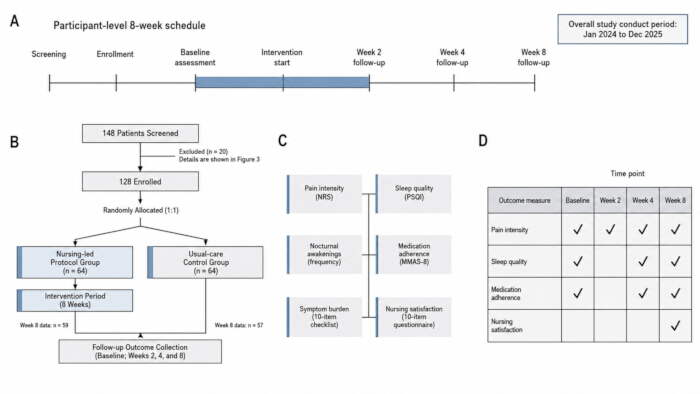
Figure 1: Study design, intervention structure, and outcome-assessment schedule. (A) Participant-level 8-week schedule from screening and baseline assessment through Week 8; the overall study conduct period extended from January 2024 to December 2025. (B) Participant allocation and follow-up. (C) Integrated protocol modules and outcome domains. (D) Scheduled outcome assessments. Please click here to view a larger version of this figure.
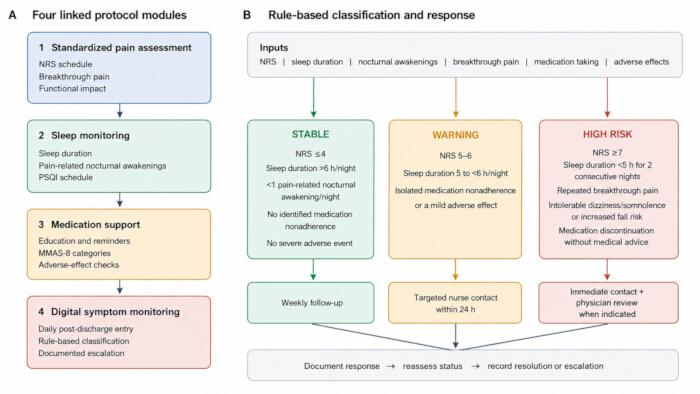
Figure 2: Standardized nursing-led protocol and rule-based escalation pathway. (A) Four linked protocol modules. (B) Rule-based classification and response pathway. Prespecified observations classify records as stable, warning, or high risk and link them to weekly follow-up, targeted nurse contact, or immediate physician escalation. The diagram contains no AI-prediction claim. Please click here to view a larger version of this figure.
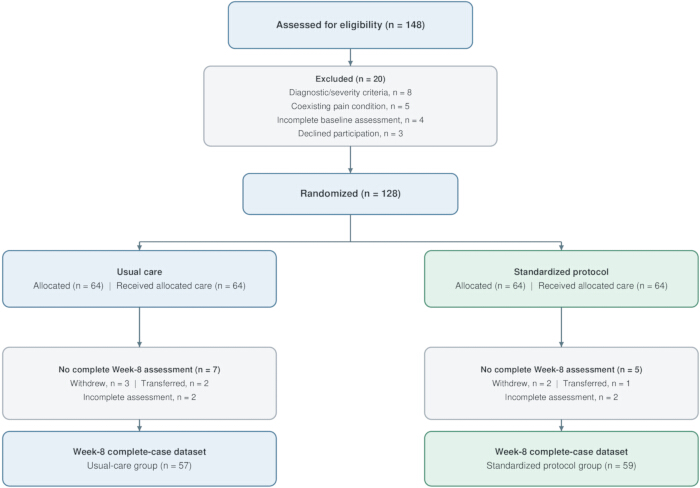
Figure 3: CONSORT-style participant flow. Of 148 individuals assessed for eligibility, 20 were excluded before randomization. A total of 128 participants were randomized (64/group). At Week 8, data were available for 57 usual-care and 59 protocol-group participants. Exclusion and attrition reasons are shown by group. Please click here to view a larger version of this figure.
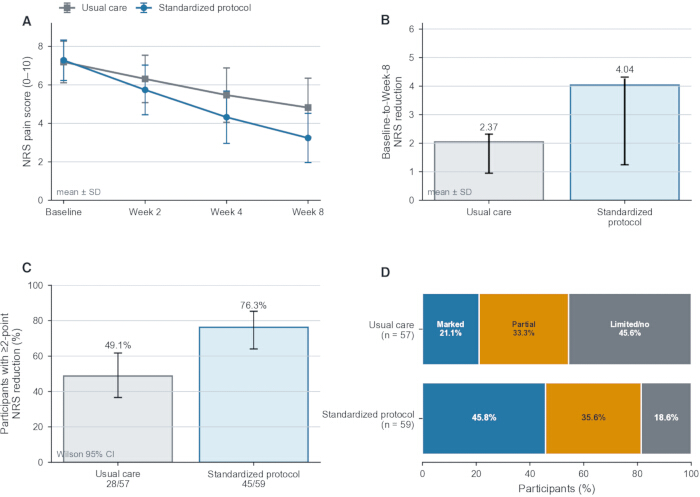
Figure 4: Pain trajectory and Week-8 clinical response. (A) Mean NRS pain score at baseline and Weeks 2, 4, and 8; points show mean and error bars show SD (usual care: n = 57 at Week 8; protocol: n = 59 at Week 8). (B) Mean baseline-to-Week-8 NRS reduction; bars show mean ± SD. (C) Proportion with an absolute NRS reduction ≥2 points; error bars show Wilson 95% CIs. (D) Response categories based on percentage reduction from baseline: marked, ≥50%; partial, 30% to <50%; limited/no response, <30%. P values are reported in Tables 3 and 5. The underlying source data for all panels are available in the accompanying source-data file deposited in the Zenodo repository. Please click here to view a larger version of this figure.
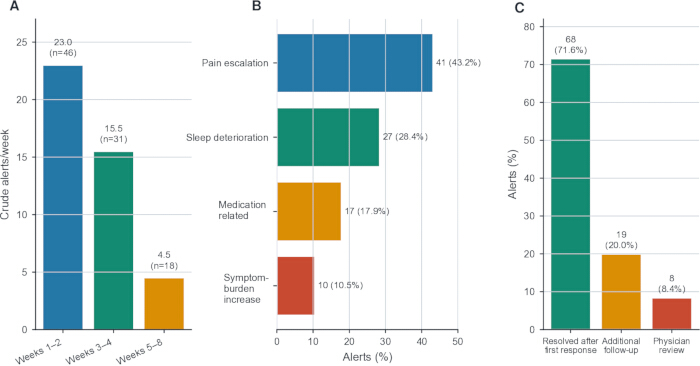
Figure 5: Rule-based symptom alerts and nursing response in the protocol group. (A) Aggregate alert counts and crude alerts/week across three unequal monitoring intervals (Weeks 1–2, 3–4, and 5–8). (B) Composition of the 95 alerts by type. (C) Response disposition: resolved after the first nurse-led response, additional follow-up contact, or physician review. These are single-arm descriptive data; no inferential error bars are applicable, and crude interval rates are not participant-time incidence rates. The underlying source data for all panels are available in the accompanying source-data file deposited in the Zenodo repository. Please click here to view a larger version of this figure.
| Outcome | Instrument or operational definition | Baseline | Week 2 | Week 4 | Week 8 | |||
| Pain intensity | Numeric Rating Scale (0–10), mean of the preceding 3 daily recordings | Yes | Yes | Yes | Yes | |||
| Sleep quality | Pittsburgh Sleep Quality Index (0–21) | Yes | No | Yes | Yes | |||
| Pain-related night awakenings | Number of nights per week with pain-related awakening | Yes | Yes | Yes | Yes | |||
| Medication adherence | 8-item Morisky Medication Adherence Scale (0–8) | Yes | No | Yes | Yes | |||
| Symptom burden | Structured PHN symptom burden score (0–30) | Yes | Yes | Yes | Yes | |||
| Breakthrough pain frequency | Number of breakthrough pain episodes during the preceding 7 days | No | Yes | Yes | Yes | |||
| Rescue analgesic use | Any short-term analgesic use beyond the maintenance regimen | Yes | Yes | Yes | Yes | |||
| Rule-based digital symptom alerts* | Number of alerts triggered within each monitoring interval | No | Yes | Yes | Yes | |||
| Nursing satisfaction | 10-item satisfaction questionnaire (10–50) | No | No | No | Yes | |||
| Adverse events | Dizziness, somnolence, constipation, nausea, peripheral edema, falls | No | Yes | Yes | Yes | |||
Table 1: Schedule and operational definitions of study outcomes. Rule-based digital symptom alerts were recorded only in the standardized protocol group and are a single-arm descriptive implementation outcome.
| Variable | Usual-care group, n = 64 | Standardized protocol group, n = 64 | P value |
| Age, years | 66.7 ± 9.8 | 65.8 ± 10.0 | 0.618 |
| Female, n (%) | 35 (54.7) | 37 (57.8) | 0.724 |
| Body mass index, kg/m² | 23.7 ± 3.3 | 23.9 ± 3.4 | 0.771 |
| Disease duration, months | 5.8 ± 2.7 | 6.1 ± 3.0 | 0.548 |
| Thoracic involvement, n (%) | 28 (43.8) | 26 (40.6) | 0.713 |
| Cervical involvement, n (%) | 8 (12.5) | 10 (15.6) | 0.611 |
| Lumbar involvement, n (%) | 19 (29.7) | 18 (28.1) | 0.842 |
| Craniofacial involvement, n (%) | 9 (14.1) | 10 (15.6) | 0.806 |
| Hypertension, n (%) | 24 (37.5) | 22 (34.4) | 0.713 |
| Diabetes mellitus, n (%) | 16 (25.0) | 15 (23.4) | 0.836 |
| Baseline NRS pain score | 7.19 ± 1.08 | 7.28 ± 1.05 | 0.639 |
| Baseline PSQI score | 13.2 ± 2.6 | 13.5 ± 2.8 | 0.527 |
| Baseline MMAS-8 score | 5.12 ± 1.16 | 5.03 ± 1.18 | 0.667 |
| Baseline symptom burden score | 24.8 ± 4.7 | 25.3 ± 4.9 | 0.556 |
| Baseline pain-related night awakenings, nights/week | 5.6 ± 1.8 | 5.8 ± 1.7 | 0.521 |
| Current gabapentinoid use, n (%) | 47 (73.4) | 49 (76.6) | 0.677 |
| Rescue analgesic use at baseline, n (%) | 29 (45.3) | 31 (48.4) | 0.724 |
Table 2: Baseline demographic and clinical characteristics of randomized participants. Values are mean ± SD or n (%). Abbreviations: NRS = Numeric Rating Scale; PSQI = Pittsburgh Sleep Quality Index; MMAS-8 = 8-item Morisky Medication Adherence Scale.
| Outcome | Group | Baseline | Week 2 | Week 4 | Week 8 | Time effect, P value | Group effect, P value | Group × time interaction, P value | ||
| NRS pain score | Usual-care group | 7.19 ± 1.08 | 6.31 ± 1.23 | 5.47 ± 1.41 | 4.82 ± 1.53 | <0.001 | <0.001 | <0.001 | ||
| NRS pain score | Standardized protocol group | 7.28 ± 1.05 | 5.74 ± 1.29 | 4.32 ± 1.36 | 3.24 ± 1.28 | |||||
| PSQI score | Usual-care group | 13.2 ± 2.6 | — | 11.8 ± 2.7 | 10.9 ± 2.8 | <0.001 | <0.001 | <0.001 | ||
| PSQI score | Standardized protocol group | 13.5 ± 2.8 | — | 9.9 ± 2.6 | 8.1 ± 2.4 | |||||
| MMAS-8 score | Usual-care group | 5.12 ± 1.16 | — | 5.81 ± 1.09 | 6.14 ± 1.12 | <0.001 | <0.001 | <0.001 | ||
| MMAS-8 score | Standardized protocol group | 5.03 ± 1.18 | — | 6.68 ± 0.98 | 7.29 ± 0.89 | |||||
| Symptom burden score | Usual-care group | 24.8 ± 4.7 | 22.1 ± 4.5 | 19.7 ± 4.3 | 17.9 ± 4.1 | <0.001 | <0.001 | <0.001 | ||
| Symptom burden score | Standardized protocol group | 25.3 ± 4.9 | 19.8 ± 4.2 | 15.8 ± 3.9 | 12.7 ± 3.5 | |||||
| Pain-related night awakenings, nights/week | Usual-care group | 5.6 ± 1.8 | 4.9 ± 1.8 | 4.4 ± 1.7 | 3.7 ± 1.6 | <0.001 | <0.001 | <0.001 | ||
| Pain-related night awakenings, nights/week | Standardized protocol group | 5.8 ± 1.7 | 4.1 ± 1.6 | 3.1 ± 1.5 | 2.1 ± 1.3 | |||||
Table 3: Longitudinal pain, sleep, medication-adherence, symptom-burden, and nocturnal-awakening outcomes. Values are mean ± SD. P values correspond to the reported fixed effects of time, group, and group × time interaction from linear mixed-effects models.
| Outcome | Usual-care group, n = 57 | Standardized protocol group, n = 59 | P value |
| Mean reduction in NRS score from baseline | 2.37 ± 1.42 | 4.04 ± 1.51 | <0.001 |
| Clinically meaningful pain improvement (NRS reduction ≥2 points), n (%) | 28 (49.1) | 45 (76.3) | 0.002 |
| Marked response (≥50% reduction from baseline), n (%) | 12 (21.1) | 27 (45.8) | 0.005 |
| Partial response (30% to <50% reduction), n (%) | 19 (33.3) | 21 (35.6) | 0.799 |
| Limited or no response (<30% reduction), n (%) | 26 (45.6) | 11 (18.6) | 0.002 |
| Clinically meaningful PSQI improvement (reduction ≥3 points), n (%) | 24 (42.1) | 40 (67.8) | 0.006 |
| High adherence at Week 8 (MMAS-8 = 8), n (%) | 11 (19.3) | 24 (40.7) | 0.012 |
| Medium adherence at Week 8 (MMAS-8 6 to <8), n (%) | 26 (45.6) | 27 (45.8) | — |
| Low adherence at Week 8 (MMAS-8 <6), n (%) | 20 (35.1) | 8 (13.6) | 0.008 |
| Nursing satisfaction score | 37.8 ± 6.4 | 43.9 ± 4.8 | <0.001 |
| High satisfaction (40–50), n (%) | 19 (33.3) | 40 (67.8) | <0.001 |
| Moderate satisfaction (30–39), n (%) | 28 (49.1) | 17 (28.8) | 0.025 |
| Low satisfaction (<30), n (%) | 10 (17.5) | 2 (3.4) | 0.014 |
Table 4: Week-8 clinical response, medication adherence, and patient satisfaction. Clinically meaningful improvement denotes an absolute NRS reduction ≥2 points; response categories use percentage reduction from baseline. MMAS-8 categories are high (=8), medium (6 to <8), and low (<6).
| Outcome | Usual-care group, n = 57 | Standardized protocol group, n = 59 | P value |
| Breakthrough pain episodes during the preceding 7 days at Week 8 | 2.9 ± 1.8 | 1.5 ± 1.2 | <0.001 |
| Clinically significant breakthrough pain (≥3 episodes/week), n (%) | 19 (33.3) | 8 (13.6) | 0.012 |
| Rescue analgesic use during Weeks 5–8, n (%) | 21 (36.8) | 11 (18.6) | 0.029 |
| Medication discontinuation due to intolerance, n (%) | 7 (12.3) | 3 (5.1) | 0.176 |
| Dizziness, n (%) | 12 (21.1) | 14 (23.7) | 0.738 |
| Somnolence, n (%) | 10 (17.5) | 12 (20.3) | 0.704 |
| Constipation, n (%) | 8 (14.0) | 7 (11.9) | 0.736 |
| Nausea, n (%) | 4 (7.0) | 3 (5.1) | 0.669 |
| Peripheral edema, n (%) | 3 (5.3) | 4 (6.8) | 0.732 |
| Falls, n (%) | 1 (1.8) | 0 (0.0) | 0.307 |
| Alert variable | n (%) | Monitoring duration, weeks | Crude alerts/week |
| Total number of alerts during 8 weeks | 95 | 8 | 11.9 |
| Alerts during Weeks 1–2, n (%) | 46 (48.4) | 2 | 23 |
| Alerts during Weeks 3–4, n (%) | 31 (32.6) | 2 | 15.5 |
| Alerts during Weeks 5–8, n (%) | 18 (18.9) | 4 | 4.5 |
| Pain escalation alerts, n (%) | 41 (43.2) | ||
| Sleep deterioration alerts, n (%) | 27 (28.4) | ||
| Medication-related alerts, n (%) | 17 (17.9) | ||
| Symptom burden increase alerts, n (%) | 10 (10.5) | ||
| Resolved after first nurse-led response, n (%) | 68 (71.6) | ||
| Required additional follow-up contact, n (%) | 19 (20.0) | ||
| Required physician review, n (%) | 8 (8.4) |
Table 5: Breakthrough pain, rescue analgesic use, safety outcomes, and rule-based digital symptom alerts. Week-8/safety values use n = 57 usual-care and n = 59 protocol-group participants. Alert percentages use 95 alerts as the denominator; alert outcomes are single-arm descriptive data.
Supplementary File 1: Source data underlying Figures 1–5.Please click here to download this file.
Discussion
In this prospective randomized trial, the standardized nursing-led protocol was associated with greater eight-week improvement in pain and several secondary outcomes than usual care. The difference in mean NRS reduction and the larger proportion achieving an absolute ≥2-point improvement support the primary clinical signal. The protocol did not replace physician-directed treatment; it standardized how nurses assessed symptoms, reinforced adherence, monitored sleep and adverse effects, and escalated predefined concerns.
The clinical rationale is consistent with contemporary PHN management, in which neuropathic pain commonly requires individualized pharmacotherapy plus longitudinal reassessment of efficacy, tolerability, sleep, and function2,6,7,17,18,19. A standardized pathway may reduce fragmentation by connecting observations to timely education and escalation. However, the present design cannot determine which protocol component produced the observed differences, and medication modifications remain a potential confounder. The improvement in medication adherence is compatible with evidence that nurse-led education, reminders, and follow-up can support adherence in chronic disease20. Nevertheless, the intervention group also received more structured nurse contact than usual care. An attention or contact-time effect therefore cannot be separated from the effects of the specific assessment, sleep, medication, and monitoring components. Future trials should measure contact duration in both groups and consider an attention-matched comparator.
Sleep, adherence, nocturnal awakenings, and symptom burden improved alongside pain, but these outcomes should be interpreted as supportive rather than independent proof of mechanism. The ≥3-point PSQI and ≥3 breakthrough-episode thresholds were study-defined, and the symptom-burden and satisfaction instruments were developed for this study without documented validation evidence. Replication with validated measures and prespecified minimally important differences is needed.
The digital component is best described as rule-based symptom monitoring rather than intelligent or AI-based management because the documented intervention used only predefined thresholds and escalation rules. Digital nursing and eHealth reviews suggest that such systems may support continuity, self-management, and timely response when they are integrated into clinical workflows21,22,23. In this study, however, alerts were collected only in the protocol group and over unequal intervals. Their declining counts are therefore descriptive and cannot establish efficacy without participant-time denominators and a comparator. The parallel improvement in pain and sleep is clinically plausible because PHN can impair sleep and health-related quality of life5,24. The exploratory correlations are hypothesis-generating and should be interpreted cautiously because no adjustment for multiple correlation testing was applied. They do not establish a causal relationship between improvements across domains.
This study has important limitations. It was conducted at a single center with only 8 weeks of follow-up; the sample was dominated by severe baseline pain, limiting generalizability to moderate PHN; participants and nurses were not blinded; usual-care assessment and nurse-contact intensity were not protocolized; physician-directed medication regimens and modifications may have differed between groups; several outcomes were patient reported; the custom symptom-burden and satisfaction measures lack documented validation; alert outcomes were single-arm descriptive measures; and complete model effect estimates and corresponding confidence intervals were not available, limiting the precision with which the longitudinal treatment effects can be interpreted. The 116-participant Week-8 complete-case results should not be presented as an intention-to-treat analysis unless all 128 randomized participants are included appropriately.
In conclusion, an eight-week standardized nursing-led protocol integrating pain assessment, sleep monitoring, medication-adherence support, and rule-based digital symptom monitoring was associated with greater improvement in pain and several secondary outcomes than usual care among participants with PHN who completed Week-8 assessment. These results justify a preregistered, multicenter trial with transparent allocation and blinding procedures, an attention-matched comparator, validated outcome measures, intention-to-treat analysis, effect estimates with 95% CIs, longer follow-up, and public sharing of de-identified data and analysis code.
Disclosures
The authors declare no competing interests.
Acknowledgements
The authors thank the participating patients and the clinical nursing staff of the Department of Pain, Affiliated Hospital of Guizhou Medical University, for their support in protocol implementation and data collection. This work was supported by the Affiliated Hospital of Guizhou Medical University Research Project (gyfyhl-2025-A20). During manuscript revision, OpenAI Codex was used to assist with language editing, organization of point-by-point responses, literature-supported wording, and preparation of revised figures. The authors retain full responsibility for the manuscript, analyses, and figures.
Materials
| Name | Company | Catalog Number | Comments |
|---|---|---|---|
| 10-item nursing satisfaction questionnaire | Study-developed | Study-specific instrument | Week-8 nursing satisfaction assessment using a study-developed 10-item questionnaire |
| Amitriptyline | Hospital pharmacy | Not applicable | Physician-prescribed neuropathic-pain treatment |
| Duloxetine | Hospital pharmacy | Not applicable | Physician-prescribed neuropathic-pain treatment |
| Electronic data-capture system | Affiliated Hospital of Guizhou Medical University | Institutional study system | De-identified case-report data collection and management |
| Gabapentin | Hospital pharmacy | Not applicable | Physician-prescribed neuropathic-pain treatment |
| Mobile follow-up platform | Institutional study system | Study-specific mobile follow-up interface | Daily symptom entry and rule-based alert generation |
| Morisky Medication Adherence Scale (MMAS-8) | Donald E. Morisky / authorized licensor | Not applicable | Medication-adherence assessment using the 8-item Morisky Medication Adherence Scale |
| Numeric Rating Scale (NRS) | Not applicable | Not applicable | 0–10 verbal/numeric scale; Pain-intensity assessment |
| Pregabalin | Hospital pharmacy | Not applicable | Physician-prescribed neuropathic-pain treatment |
| Pittsburgh Sleep Quality Index (PSQI) | University of Pittsburgh / authorized source | Standard PSQI instrument | Sleep-quality assessment at baseline and Weeks 4 and 8 |
| R software | R Foundation for Statistical Computing | Version 4.3.2; https://www.r-project.org/ | Statistical modeling |
| Rescue analgesic(s) | Hospital pharmacy | Not applicable; prescribed as clinically indicated | Short-course rescue treatment prescribed as clinically indicated |
| SPSS Statistics | IBM Corp. | Version 27.0; https://www.ibm.com/products/spss-statistics | Statistical analysis |
| Structured Nursing Symptom Checklist | Study-developed | Study-specific instrument | Ten-item study-developed symptom-burden assessment |
| Paper symptom/pain diary | Study-provided | Study-specific paper form | Used after discharge for evening NRS recording and daily sleep/symptom documentation when the mobile platform was not used |
| Sequentially numbered opaque sealed envelopes | Study team | Not applicable | Used for allocation concealment after eligibility and baseline assessment |
| Standardized case-report forms (CRFs) | Study-developed | Study-specific | Used by trained research staff for baseline and follow-up data collection; paper forms were double-entered into the electronic database |
References
- Gross GE et al. S2k guidelines for the diagnosis and treatment of herpes zoster and postherpetic neuralgia. J Dtsch Dermatol Ges. 2020;18(1):55–78.
- Finnerup NB, Kuner R, Jensen TS. Neuropathic pain: From mechanisms to treatment. Physiol Rev. 2021;101(1):259–301.
- Liu Q, Han J, Zhang X. Peripheral and central pathogenesis of postherpetic neuralgia. Skin Res Technol. 2024;30(8):e13867.
- Li Y, Jin J, Kang X, Feng Z. Identifying and evaluating biological markers of postherpetic neuralgia: A comprehensive review. Pain Ther. 2024;13(5):1095–1117.
- Ho A, Drew VJ, Kim T. What links sleep and neuropathic pain?: A literature review on the neural circuits for sleep and pain control. Nat Sci Sleep. 2025;17:813–838.
- Cao X et al. A meta-analysis of randomized controlled trials comparing the efficacy and safety of pregabalin and gabapentin in the treatment of postherpetic neuralgia. Pain Ther. 2023;12(1):1–18.
- Asadizadeh Sadegh A, Gehr NL, Finnerup NB. A systematic review and meta-analysis of randomized controlled head-to-head trials of recommended drugs for neuropathic pain. Pain Rep. 2024;9(2):e1138.
- Lyu H et al. Clinical predictors of medication compliance in patients with acute herpetic neuralgia. Pain Manag Nurs. 2024;25(6):e479–e486.
- Chen R et al. Comprehensive nursing care improves symptoms and quality of life in elderly patients with postherpetic neuralgia. Sci Rep. 2024;14(1):30650.
- Chen W, Cheng Y, Cai Y, Hong J. Development of an evidence-based pain management protocol and its application in patients with postherpetic neuralgia. Medicine (Baltimore). 2025;104(51):e46629.
- Belizan M et al. Patient experience of herpes zoster disease in Argentina: Validation of a health-related quality of life conceptual model. Value Health Reg Issues. 2024;44:101044.
- Finnerup NB et al. Neuropathic pain: An updated grading system for research and clinical practice. Pain. 2016;157(8):1599–1606.
- Farrar JT et al. Clinical importance of changes in chronic pain intensity measured on an 11-point numerical pain rating scale. Pain. 2001;94(2):149–158.
- Dworkin RH et al. Interpreting the clinical importance of treatment outcomes in chronic pain clinical trials: IMMPACT recommendations. J Pain. 2008;9(2):105–121.
- Buysse DJ et al. Efficacy of brief behavioral treatment for chronic insomnia in older adults. Arch Intern Med. 2011;171(10):887–895.
- Krousel-Wood M et al. New medication adherence scale versus pharmacy fill rates in seniors with hypertension. Am J Manag Care. 2009;15(1):59–66.
- Wu YT et al. From consultation to collaboration: A patient-centered approach to shingles pain and postherpetic neuralgia management. J Pers Med. 2025;15(5):191.
- Adriaansen EJM et al. 8. Herpes zoster and post herpetic neuralgia. Pain Pract. 2025;25(1):e13423.
- Guo Z, Xia Y, Zhang Z. Efficacy and safety of different medications compared for the treatment of postherpetic neuralgia: A network meta-analysis. Front Pharmacol. 2025;16:1614587.
- Berardinelli D et al. Nurse-led interventions for improving medication adherence in chronic diseases: A systematic review. Healthcare (Basel). 2024;12(23):2337.
- Lee J, Mowat R, Blamires J, Foster M. Recent advances in non-invasive digital nursing technologies for chronic pain assessment and management: An integrative review. J Adv Nurs. 2025;81(11):7332–7347.
- Bartels SL, Pelika A, Taygar AS, Wicksell RK. Digital approaches to chronic pain: A brief meta-review of eHealth interventions—current evidence and future directions. Curr Opin Psychol. 2025;62:101976.
- Shi JL-H, Sit RW-S. Impact of 25 years of mobile health tools for pain management in patients with chronic musculoskeletal pain: Systematic review. J Med Internet Res. 2024;26:e59358.
- Shen Y et al. Quality of life in people with herpes zoster: A cross-sectional study in China. Health Qual Life Outcomes. 2025;23(1):99.